Filing an insurance claim for smoke damage isn't just about cleaning up what you can see. It's about proving the existence of hidden, corrosive particles that have invaded your home's structure and soaked into your belongings. This is a battleground where many insurance companies, like State Farm or Allstate, will deliberately downplay the damage to protect their profits.
The Hidden Reality of Smoke Damage Claims
After you report a fire, you expect your insurance company to step up and be your ally. The unfortunate truth? For policyholders dealing with giants like State Farm or Allstate, the opposite is often the case. Their loyalty is to their shareholders, not to making you whole.
Their first move is predictable: a quick, lowball offer designed to make you go away. They want to close your file for as little money as possible, and they’re counting on you not knowing the true scope of the damage.
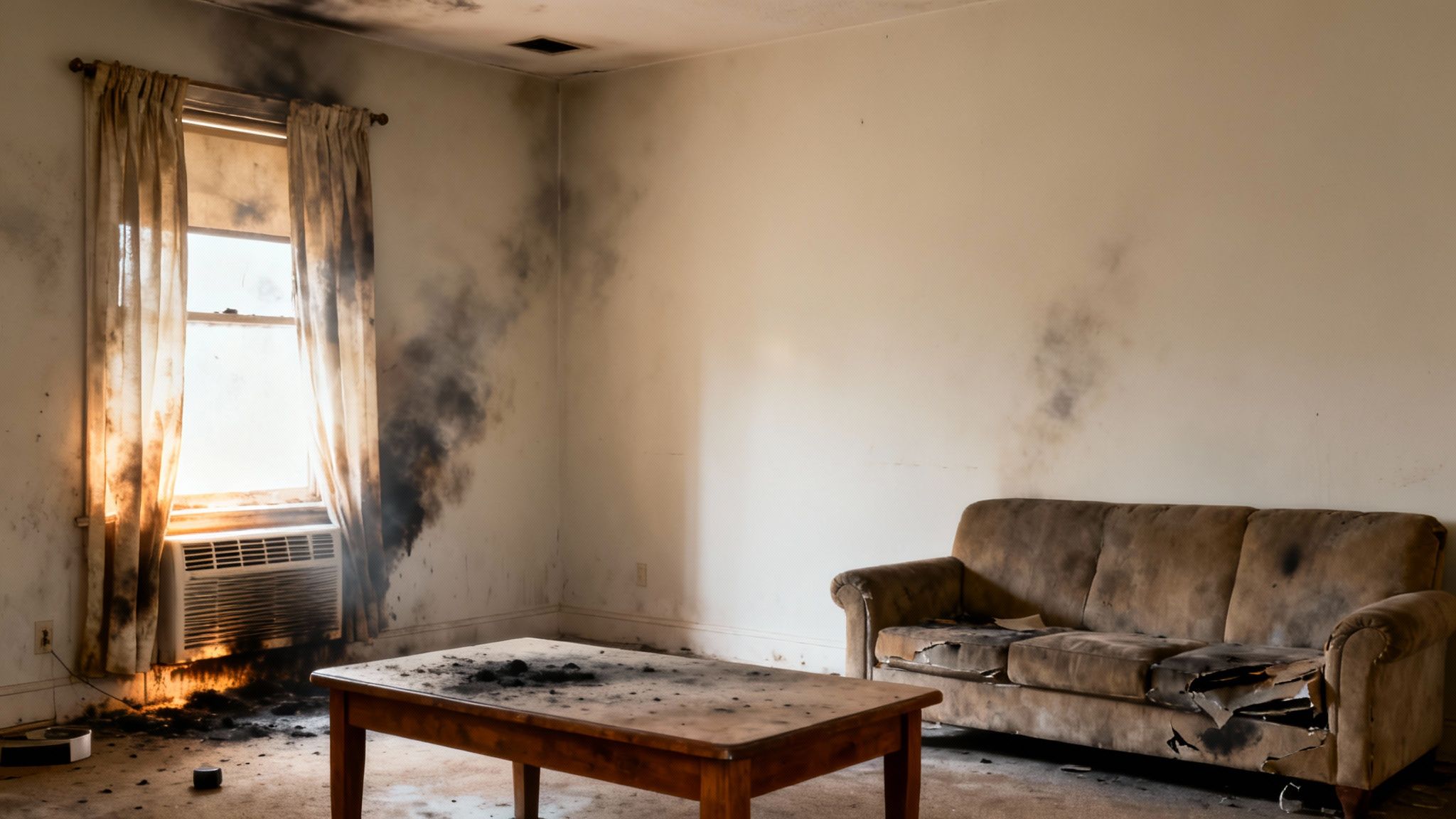
This initial offer almost never accounts for what smoke actually is. It’s not just a bad smell or a film of dust; it’s a toxic soup of fine particulates and corrosive chemicals. These particles don’t just settle on top of surfaces—they penetrate everything.
Where Insurers Deliberately Look Away
The adjuster your carrier sends out will do a quick walk-through, making notes on the obvious soot stains. But what they conveniently ignore is the deeper, far more destructive contamination that creates long-term risks to both your property and your health.
It’s a calculated omission. Here are the key areas they hope you'll overlook:
- Porous Materials: Think of your drywall, insulation, carpeting, and wood framing as sponges. They absorb smoke particles, trapping odors and corrosive compounds deep inside where a simple cleaning can't reach.
- HVAC Systems: Your ventilation system becomes a superhighway for smoke, endlessly circulating toxic soot throughout your entire home long after the fire is out.
- Hidden Cavities: The empty spaces behind your walls, up in the attic, and throughout your crawlspace become reservoirs for soot and ash. This leads to persistent, nasty odors and the slow degradation of your home’s structure.
This isn't just a simple mistake; it's a deliberate strategy. By ignoring these critical areas, the insurance company can generate an estimate that seems plausible on the surface but covers only a tiny fraction of the real remediation work.
They are betting you don’t know any better.
Your insurance company knows exactly how hazardous lingering smoke particles are. They have internal studies detailing the risks, yet their adjusters are trained to minimize these facts when assessing your claim.
This gap between what they know and what they offer is where homeowners get burned, losing thousands of dollars. You accept an inadequate settlement, only to realize months down the road that the smell is permanent and your belongings are still contaminated.
This is precisely why you can't just accept their first offer. Challenging it isn't just an option—it’s an absolute necessity. Understanding the fight ahead is the first step, and bringing in an expert advocate, like a public adjuster, is how you level the playing field against these corporate games.
Why Your Insurer's Smoke Damage Estimate Is Wrong
When the adjuster from your insurance company hands you an estimate for your smoke damage claim, it’s easy to feel a momentary sense of relief. But that feeling often evaporates once you start looking at the actual numbers.
Let's be blunt: their initial assessment is almost never a good-faith effort to make you whole again. It's a strategic opening move designed to close your claim for the lowest possible amount, period.
This isn’t just incompetence; it's a systematic process of undervaluation. Company adjusters are trained to focus only on the most obvious, superficial damage. They'll document the visible soot on the walls but conveniently ignore the invisible army of toxic particles that have been forced into every porous surface of your home—from the insulation in your attic to the fabric of your couch.
This quick, surface-level glance is a deliberate tactic. They know that a real, scientific smoke damage assessment involves much more than what the eye can see. But that level of detail would lead to a much larger payout, and their job is to protect their employer’s bottom line.
The Problem with Visual-Only Inspections
The entire issue starts with how the insurance company's adjuster conducts their inspection. They'll walk through your property, snap a few photos of blackened surfaces, and write up a report based on this extremely limited, visual-only evidence. This method is fundamentally flawed and misses the most critical—and costly—aspects of smoke damage.
Smoke isn't just dirt on a wall; it's a complex mixture of particulates and toxic gases that behave in very specific ways.
- Hot Smoke Rises: During a fire, super-heated smoke is driven upwards with incredible force. This pressure pushes soot and carcinogens deep into your attic, wall cavities, and insulation, areas the adjuster rarely, if ever, looks.
- Pressure Differentials: Smoke naturally moves from high-pressure zones (near the fire) to low-pressure zones (cooler rooms). This process carries contaminants throughout the entire structure, even to rooms the fire never touched.
- Invisible Residue: Many chemical byproducts of combustion are colorless and odorless but remain highly corrosive and toxic. They settle on surfaces and continue to eat away at materials and off-gas into your air long after the fire is out.
The adjuster’s quick walkthrough completely fails to account for this reality. They aren't looking for what they can't immediately see, which means their estimate will never cover the true scope of work required to make your home safe for your family again.
A classic insurance company tactic is to recommend a simple "wipe-down" or a cheap ozone treatment. These are completely inadequate "solutions" that do little more than mask the problem. The underlying corrosive particles and toxic odors remain embedded deep within your property.
Ignoring the Biggest Contamination Source: Your HVAC System
Perhaps the most glaring—and dangerous—omission in a standard insurance adjuster's report is the HVAC system. Think of your home's heating and air conditioning unit as its respiratory system. During a fire, it inhales smoke and then methodically exhales it into every single room connected by ductwork.
Soot, ash, and toxic particles get pulled into the system, where they settle and accumulate in the ducts. From that point on, every time you turn on your heat or AC, you are re-contaminating your entire home with hazardous materials.
A proper smoke damage claim must include a full, professional decontamination of the entire HVAC system. But because this is an expensive process, carriers will fight you on it tooth and nail. They would rather leave your family breathing in contaminated air than pay for what your policy actually covers.
A North Carolina Homeowner Fights Back
Consider a case we handled for a homeowner in Raleigh, North Carolina. After a kitchen fire, their insurance company—one of the big national carriers you see on TV—offered them a paltry $12,000 settlement. The offer was just enough to cover painting a few walls and a superficial cleaning.
The homeowner knew the smell of smoke was still lingering and that something wasn't right. Frustrated by the delay and lowball tactics, they hired a public adjuster.
Our team came in and performed a comprehensive assessment based on IICRC (Institute of Inspection, Cleaning and Restoration Certification) standards. We documented exactly how smoke had penetrated the drywall throughout the house, contaminated all the attic insulation, and thoroughly saturated the HVAC system. We proved with scientific testing that all porous materials—carpets, drapes, and upholstered furniture—were unsalvageable.
Armed with this undeniable evidence, we reopened the claim and went to battle. The final settlement was $98,000—more than eight times the original offer.
This case perfectly illustrates the vast difference between an insurer's self-serving estimate and the actual cost of making a family whole again. Understanding your policy is the first step in this fight; you have to know what you are entitled to before you can demand it. You can learn more about how to read an insurance policy and identify these key coverage areas to strengthen your position.
Building an Undeniable Case for Your Smoke Damage Claim
After a fire, your insurance company wants one thing: to close your claim as quickly and cheaply as possible. To fight back against the inevitable lowball offer, you have to stop thinking like a victim and start acting like a prosecutor. Your mission is to build an undeniable, evidence-packed case for your smoke damage claim that leaves your insurer zero wiggle room.
This isn't just about snapping a few pictures on your phone. It’s a strategic campaign to document every last bit of damage—the stuff you can see and, more importantly, the invisible contamination—to force your carrier to acknowledge the real cost of making your home safe again.
Demanding Proof Beyond a Simple Walkthrough
A weak claim is built on the insurance adjuster's quick visual glance. A strong claim, the kind that gets paid fairly, is built on cold, hard science.
You need to insist on independent air quality and surface testing from a certified industrial hygienist. This is non-negotiable. These tests provide objective data on the soot, char, volatile organic compounds (VOCs), and other toxic garbage left behind by the fire. This is the proof that contamination has settled on every surface and is now circulating through your air.
This scientific evidence becomes your best weapon when an adjuster tries to tell you the smell will just "air out" on its own.
Get Bids From Your Own Experts, Not Theirs
Your insurance company will "strongly recommend" their preferred list of restoration vendors. You should politely, but firmly, decline. These vendors have a cozy relationship with the insurer, and their primary goal is often to keep costs down to stay in the carrier's good graces—not to actually restore your property to its pre-loss condition.
Instead, go out and get multiple, detailed quotes from IICRC-certified restoration companies that answer to you.
- Make sure their estimates spell out every single step of the cleaning and remediation process.
- The scope of work absolutely must include deep cleaning of the HVAC system, treating enclosed spaces like wall cavities, and addressing all porous materials (drywall, carpet, insulation).
- These independent bids establish a realistic baseline for what the repairs will actually cost, directly contradicting the insurer’s artificially low number.
As you document the damage to your home's structure, don't forget about the contents that are a total loss. When items are too damaged to salvage, you may need professional junk removal services, and the cost of that disposal is a legitimate part of your overall claim.
This flowchart shows the proper way to assess the damage, moving from the obvious visual stuff to advanced methods and a crucial look at your HVAC system.
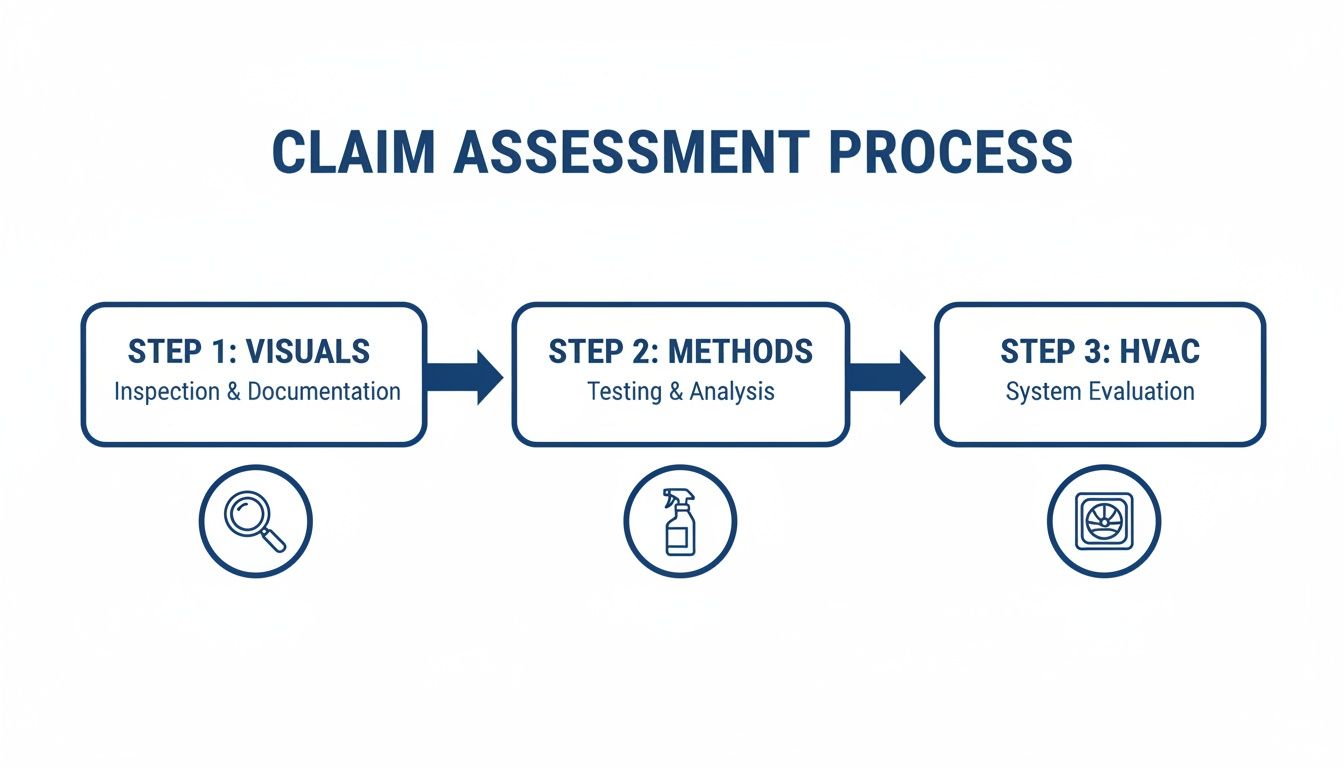
What this shows is that a real smoke damage assessment isn't a 15-minute walkthrough. It’s a multi-layered investigation where each step uncovers deeper, hidden contamination that the insurance company hopes you'll never find.
Master Your Policy and Your Inventory List
You have to become an expert on your own insurance policy. Right now. Find the section defining "direct physical loss." Smoke, ash, and soot physically alter surfaces at a microscopic level, causing corrosion and embedding odors that won't go away. This is a direct physical loss, even if you can't always see the change with the naked eye.
Be prepared for a fight on this. Insurers have been caught inventing their own definitions of this term, demanding "permanent physical changes" to weasel out of paying smoke claims. Know your policy so you can call them on it.
At the same time, you need to create a painfully detailed inventory of every single item that was affected. For each item, you must list:
- A full description (brand, model, serial number if you have it)
- Its age and what you paid for it
- A specific note explaining the smoke or odor damage
This detailed list is the backbone of your contents claim. To see just how critical this document is, you should understand the importance of a Proof of Loss form and how it forces the insurer to address every item you claim.
An insurance company’s adjuster will produce a report that is intentionally vague and dismissive of hidden damage. A public adjuster’s evidence package is a comprehensive dossier of scientific reports, expert opinions, and irrefutable proof designed to win a dispute.
The difference in the level of detail is staggering. To see what I mean, just look at the comparison below. This shows what the insurer's guy typically hands over versus what a public adjuster builds to force a fair settlement.
Insurer's Adjuster vs Public Adjuster Documentation
| Evidence Type | Insurance Adjuster's Report (Typical) | Public Adjuster's Evidence Package (Comprehensive) |
|---|---|---|
| Inspection Method | Brief visual walk-through of obvious damage areas. | In-depth inspection of all rooms, attics, crawlspaces, and wall cavities. |
| Testing | None. Relies on visual cues and a subjective "smell test." | Independent air quality and surface sampling reports from certified labs. |
| HVAC System | Often completely ignored or noted as "needs cleaning." | Detailed scope for full system decontamination, including ductwork and coils. |
| Expert Quotes | Relies on one quote from an insurer-preferred vendor. | Multiple competitive bids from independent, IICRC-certified contractors. |
| Contents Inventory | A general list of "damaged goods" with rapid depreciation. | Itemized list of every affected belonging with documented replacement costs. |
| Policy Application | Vague interpretation that favors the insurer. | Cites specific policy language to prove coverage for all documented damages. |
As you can see, one is a flimsy attempt to close a file. The other is an ironclad case built for a fight.
The Soaring Costs of Smoke Damage and Insurer Underpayments
That lowball offer sitting on your kitchen table isn't just some random number your adjuster came up with. It's the end result of a massive, industry-wide financial squeeze, and your insurance claim for smoke damage is caught right in the middle.
You're not just fighting an adjuster; you're up against a multi-billion-dollar industry under enormous pressure to protect its profits. And to understand why they're so motivated to underpay you, you have to look at the bigger picture.
In the first half of 2025 alone, global insured losses from natural catastrophes—driven hard by the kind of wildfires that cause widespread smoke damage—hit a staggering $80 billion. That number, pushed by events like the Palisades and Eaton fires in California which accounted for over $40 billion in insured losses, is nearly double the 10-year average.
And don't think this is just a California problem. Smoke from these monster blazes travels hundreds, sometimes thousands of miles, blanketing homes and businesses in places as far away as coastal North Carolina.
How Global Disasters Squeeze Your Local Claim
When insurance giants pay out billions for catastrophic events, they immediately start looking for ways to staunch the bleeding. One of the easiest targets? Your individual homeowner's claim.
They tighten their belts, train adjusters to minimize payouts on every single file, and bank on you not having the energy or expertise to fight back. Smoke damage is the perfect place for them to cut corners because so much of the damage is invisible to the untrained eye.
They know that without an expert on your side, claims for hidden soot, pervasive odors, and long-term corrosion to electronics and appliances go completely undocumented. Their adjusters will intentionally lowball the cleanup, often writing an estimate that covers just 10-20% of what a true, IICRC-certified restoration actually costs.
Make no mistake: this is a calculated business strategy. It's not an accident; it's their policy.
The Crushing Impact of Inflation
This problem has been thrown into overdrive by soaring construction costs. Since 2020, the cost of labor and materials for restoration work in the U.S. has jumped by over 35%. That means a lowball offer today is financially devastating in a way it wasn't even a few years ago.
The check your insurer offers isn't based on today's real-world prices for lumber, drywall, and skilled labor. It's based on their outdated pricing software and a deliberate strategy to pay you as little as the contract allows, leaving you with a massive gap to cover out-of-pocket.
Just think about what smoke does to your home's interior. Restoring or replacing hardwood floors, for example, is a major line item. To get a realistic sense of the numbers your carrier is trying to avoid, a comprehensive hardwood floor refinishing cost guide is essential for homeowners in places like Virginia. This is exactly the kind of detailed homework your insurer is hoping you won't do.
This one-two punch of rising global losses and runaway local inflation creates a perfect storm for policyholders. The insurance company is more motivated than ever to underpay, and the real-world cost of that underpayment is higher than ever.
It’s a system designed to protect their bottom line, not to honor the policy you paid for. Recognizing this reality is the first step in fighting for the fair settlement you are owed. It's also why homeowners who get expert help, like a public adjuster, consistently recover 30-50% more than those who try to go it alone.
When Your Insurer Refuses to Negotiate Fairly

You did everything you were supposed to. You documented the damage, got independent reports, and laid out a rock-solid case for the real cost of your insurance claim for smoke damage. And still, your insurer won’t budge. Their adjuster is stonewalling you, offering nothing but vague excuses and refusing to negotiate in good faith.
This isn’t just frustrating—it’s a deliberate strategy. When an insurance company gets caught in a pattern of unreasonable delays, baseless denials, or just flat-out ignores clear proof, they might be crossing a legal line. This is what’s known as operating in bad faith.
Remember, your policy is a legally binding contract, not a friendly suggestion. The insurer has a contractual duty to investigate your claim fairly and pay what they owe promptly. When they intentionally blow off their end of the bargain, you have options.
Understanding Bad Faith Tactics
A bad faith situation is more than just a simple disagreement over a dollar amount. It’s a pattern of behavior designed to grind you down until you finally give up and accept a lowball settlement out of sheer exhaustion.
Spotting these tactics is the first step to fighting back:
- Unreasonable Delays: They keep asking for the same documents over and over, pass your file to a new adjuster every few weeks, or just stop returning your calls and emails altogether.
- Misrepresenting Policy Language: The adjuster might invent their own definition of "direct physical loss" to weasel out of a valid smoke damage claim—a tactic that has been shot down in court.
- Refusing to Acknowledge Evidence: You hand them certified air quality reports and detailed estimates from restoration pros, and they act like the documents don't exist.
- Lowball Offers with No Justification: They throw out an offer that’s a fraction of your contractor's estimates without providing a single logical reason for the massive difference.
These are all calculated moves to make the process so miserable that you'll take any check they write just to make it stop.
Setting a Precedent in Court
Homeowners have taken on insurers for these exact tactics and won, setting powerful legal precedents. In one landmark case, a family’s insurer refused to properly clean up smoke contamination after a nearby fire. The carrier tried to argue that the damage wasn't "physical" enough to trigger full coverage.
The homeowners sued. They brought in experts who proved how invisible soot particles had caused corrosive damage throughout the home, making it unsafe to live in. The jury sided with the family, awarding them the full cost of restoration plus additional damages for the insurer’s bad faith. The ruling hammered home a critical point: smoke damage is a direct physical loss, and insurers don't get to make up their own rules.
An insurance company's refusal to negotiate fairly is a calculated risk. They are betting that the cost and time of a lawsuit will deter you from fighting for what you are owed. This is where a public adjuster becomes your most powerful advocate.
Your Best Defense is a Strong Offense
While taking your insurer to court is a powerful tool, it should always be the last resort. Lawsuits are expensive, incredibly stressful, and can drag on for years. The smartest strategy is to build a claim so strong from day one that the insurance company is forced to settle fairly without a fight.
This is exactly what a public adjuster does. A good public adjuster is your first and best line of defense, meticulously preparing an expert-level claim package that anticipates and shuts down every possible argument the insurer might try to use against you.
With the recent surge in catastrophic weather, insurers are getting more aggressive than ever. In the first half of 2025 alone, severe storms in the U.S. led to $44 billion in insured losses, often from wind-driven smoke infiltrating homes miles from the actual fire. Facing this kind of financial pressure, carriers are quick to deny or lowball these "indirect" smoke claims, leaving property owners in states like North Carolina and Virginia on the hook. You can read the full research about these catastrophic losses to see how these trends are impacting the industry.
A public adjuster levels the playing field. They use their deep policy knowledge and claims experience to counter the insurer's tactics, beating them at their own game. By presenting an airtight case backed by science and professional estimates, they take away the insurer's ability to delay or deny without cause. If you're up against a stubborn carrier, getting help from an experienced fire claim adjuster can completely change the outcome, often forcing a fair settlement and saving you the headache and expense of a lawsuit.
Common Questions When Your Smoke Damage Claim Goes Sideways
When you're fighting with your insurance company over a smoke damage claim, it's not just a simple disagreement. You're up against a corporate machine with a well-worn playbook designed to wear you down until you give up.
Here are some direct, no-nonsense answers to the questions we hear most often from homeowners in North Carolina and Virginia when their carrier refuses to do the right thing.
Can I Say No to the Restoration Company My Insurer "Recommends"?
Yes. And you absolutely should.
Your insurance company will pitch its list of "preferred vendors" as a helpful shortcut, but it's a massive conflict of interest. Think about it: these contractors get a steady stream of business from the insurer. Their loyalty isn't to you or the quality of your home's restoration; it's to the carrier's budget.
You have the right to choose your own contractor. Always get independent, detailed quotes from IICRC-certified restoration companies that you vet. Their bids will show the true scope of work needed to make your home safe again, giving you a powerful, fact-based weapon against the insurer's lowball estimate.
What if My Adjuster Says the Smoke Smell Will Just "Air Out"?
This is one of the oldest, most dishonest delay tactics in the book. If an adjuster tells you this, it's a giant red flag.
Smoke isn't just a bad smell. It's a physical substance made of microscopic, toxic particles that have been blasted into porous materials like your drywall, carpet, wood, and insulation. These particles don't just float away. They have to be professionally removed with specialized equipment and cleaning agents.
When an adjuster says this, they're gambling that you'll just accept it and go away. Your move? Document their exact words in a follow-up email and immediately hire an independent industrial hygienist or air quality testing firm to prove them wrong.
A carrier’s claim that a toxic problem will magically solve itself is a clear sign they are not negotiating in good faith. It’s a cynical strategy to dodge paying for necessary remediation, leaving your family to live with the health risks.
What's a Public Adjuster Going to Cost Me for a Smoke Damage Claim?
This is a critical question because it’s where many homeowners get nervous, afraid of another big bill.
Reputable public adjusters work on a contingency fee basis. That means there are absolutely no upfront costs to you. Zero.
They get paid a small, agreed-upon percentage of the final settlement they secure for you. If they don't get you more money from the insurance company, they don't get paid a dime. This setup perfectly aligns their goal with yours: to maximize your claim payout so you have the funds you need to actually recover. It's a performance-based partnership that costs you nothing out-of-pocket.
What if the Insurer Tries to Argue the Damage Isn't "Physical"?
This is a deceptive, almost laughable argument that some carriers have tried to use to deny legitimate smoke claims. They might invent their own definition of the word "physical," claiming your policy only covers "permanent physical changes" to the property. It's a bad-faith tactic designed to weasel out of paying for soot and ash contamination that can be cleaned but is still hazardous.
Don't fall for it. Smoke is a named peril in most policies. The corrosive and toxic nature of smoke particles causes a direct physical loss by contaminating surfaces and making your home unsafe and uninhabitable. Don't let an adjuster's self-serving interpretation of your policy intimidate you.
Is It Too Late to Hire a Public Adjuster if I Already Cashed Their First Check?
No, in most cases, it is absolutely not too late.
Cashing that initial check from the insurance company almost never signs away your rights. The only exception is if the check itself or a document you signed with it is explicitly marked as a "full and final payment" of the claim.
Most of those first payments are considered undisputed funds to get you started on repairs. A public adjuster can jump in right after you've cashed it to reopen your claim and negotiate a supplemental payment. They will build the comprehensive evidence package needed to prove the insurer's initial settlement was totally inadequate and fight for every dollar you are rightfully owed.
Don't let your insurance company bully you into accepting less than you deserve. If you're facing delays, denials, or lowball offers for your smoke damage claim in North Carolina or Virginia, you need an expert in your corner. The team at For The Public Adjusters, Inc. provides no-cost claim reviews to help you understand your rights and fight back. Visit us at https://forthepublicadjusters.com to get the professional advocacy you need to win.

Thanks for sharing the information
Recovering from property damage can be overwhelming, especially when dealing with smoke-related issues and insurance procedures. A smoke damage claim requires careful assessment, proper documentation, and timely submission to ensure fair compensation. We provide professional support to help property owners evaluate hidden damage, prepare accurate reports, and handle negotiations with insurance companies effectively. With expert guidance, the process becomes smoother and more efficient, reducing the risk of delays or underpaid claims. Addressing smoke damage quickly is essential to protect both property and health. Visit the website today to discover how Claims XP can assist you in managing your claim with confidence and achieving the best possible outcome. Visit the website today!
Fellow PA’s fighting The Good Fight!