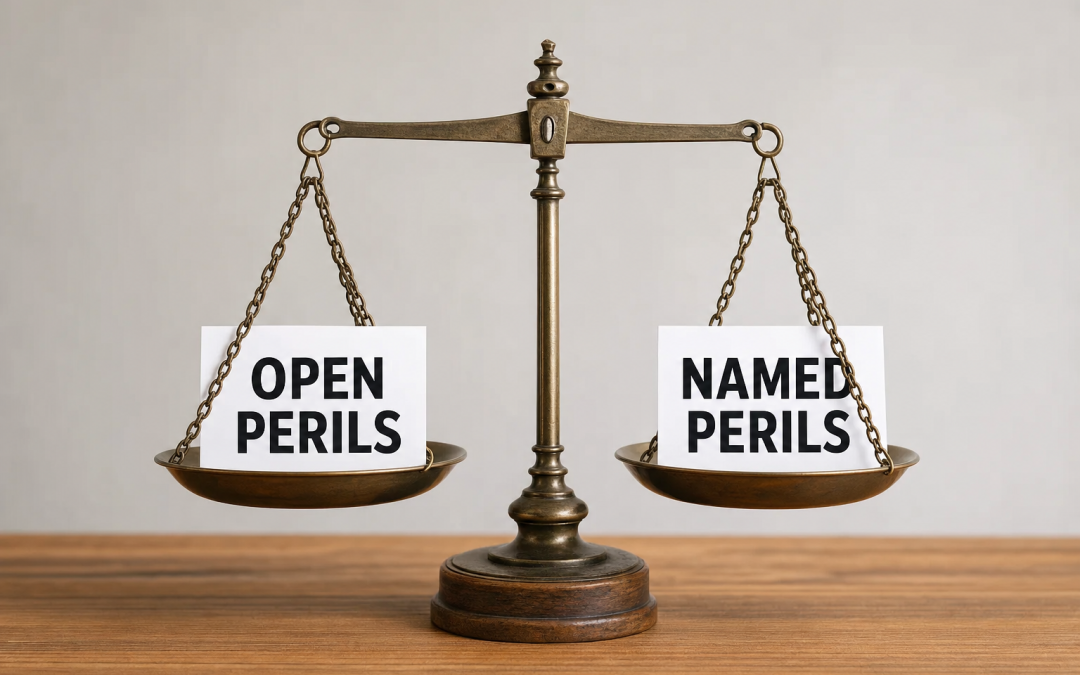
Open Perils vs Named Perils: What’s the Difference?
Open perils vs named perils comes down to who must prove what: open perils (special form) coverage protects against all causes of loss except those the policy specifically excludes, while named perils coverage only protects against causes of loss the policy specifically lists. That difference decides whether you or your insurer carries the burden of proof after a claim.
Key takeaways
- Under an HO-3 open perils policy, the insurer must prove an exclusion applies — you only need to show sudden, accidental damage occurred.
- Named perils coverage flips that burden: you must prove the loss was caused by a specifically listed peril, like windstorm or hail.
- When a carrier blames roof damage on ‘wear and tear’ instead of the storm, on an open perils policy that is the insurer’s exclusion to prove — not yours to disprove.
- Most HO-3 policies cover the dwelling on an open perils basis but personal property on a named perils basis, so the burden of proof can differ within the same claim.
- Documenting your roof’s pre-storm condition with photos and maintenance records makes it much harder for a carrier to sustain a wear-and-tear denial.
These two structures sound like insurance jargon, but they have a very real impact on how a wind or storm damage claim plays out in North Carolina or Virginia. Understanding which type of coverage applies to your dwelling is the first step in knowing your rights when an adjuster starts questioning your claim.
What Is Open Perils (Special Form) Coverage?
Open perils coverage — sometimes called “special form” or “all-risk” coverage — starts from the assumption that everything is covered unless it’s excluded. The policy doesn’t list what it covers; it lists what it doesn’t. Common exclusions include:
- Wear and tear, deterioration, and gradual damage
- Flood and earth movement
- Neglect and intentional loss
- Certain types of water damage, like repeated seepage over time
If your loss isn’t on the exclusion list, it should be covered.
What Is Named Perils Coverage?
Named perils coverage works in reverse: nothing is covered unless it’s listed. Typical named perils include fire, lightning, windstorm, hail, theft, and vandalism. If your damage was caused by something not on the list, there’s no coverage — and it’s up to you, the policyholder, to show your loss fits one of the named causes.
Why the Standard HO-3 Policy Matters
The most common homeowners policy in the United States, the HO-3, is a hybrid:
- Your dwelling and other structures (Coverage A and B) are insured on an open perils basis.
- Your personal property (Coverage C) is typically insured on a named perils basis.
So when wind tears shingles off your roof or a storm drives water through your siding, the structure itself is usually covered under the broader open perils standard.
The Quick Answer: Who Must Prove What?
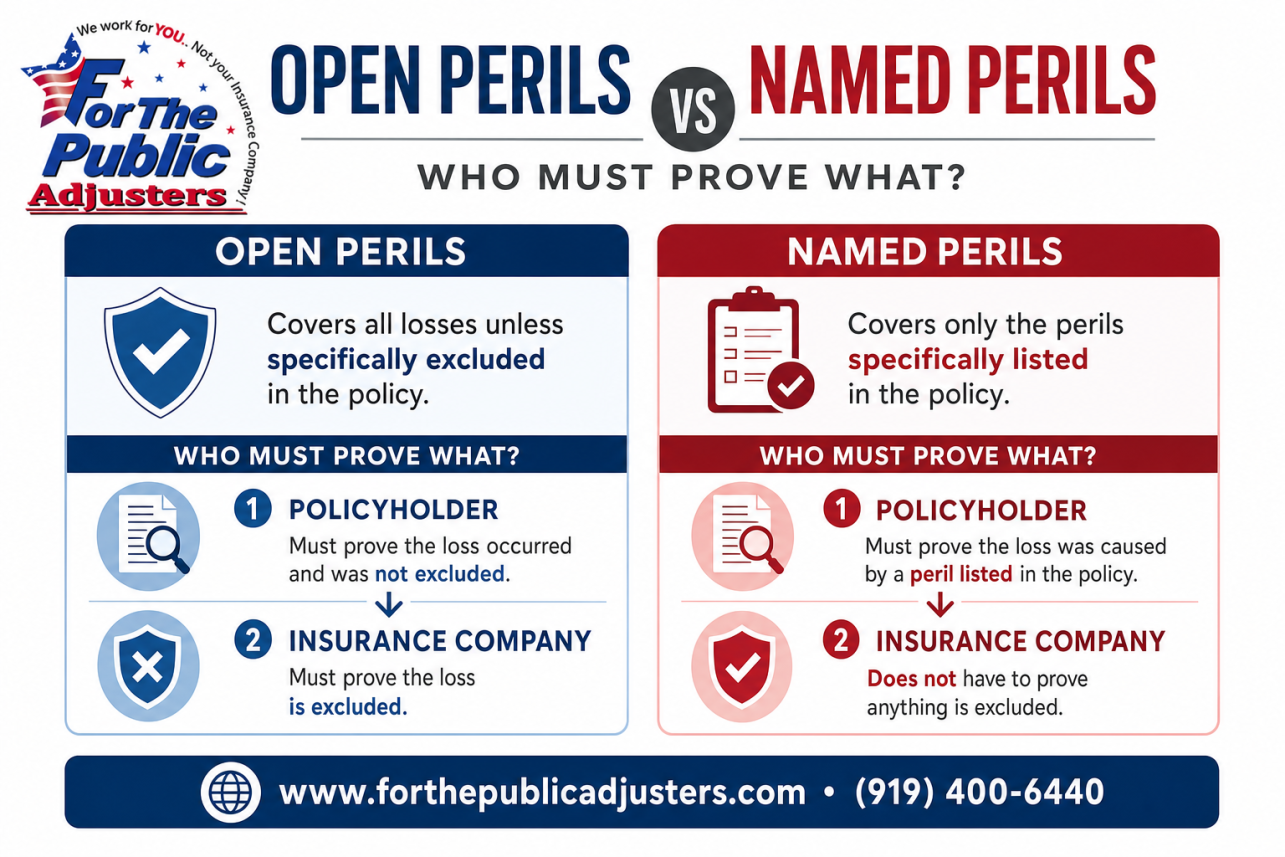
Here’s the direct answer for homeowners in NC and VA: under open perils dwelling coverage, you generally only need to show that physical damage occurred to your home during the policy period. From there, the burden shifts to the insurer to prove that a specific exclusion — like wear and tear — actually applies. Under named perils coverage, that burden stays on you to prove a listed peril caused the loss. This is exactly why insurers often try to recharacterize storm damage as “wear and tear,” and why many policyholders bring in help like a public adjuster who works on the policyholder’s side when a wind claim gets pushed back. The sections below explain how that burden-shifting works in practice — and how homeowners have fought back when insurers get it wrong.
How Does an HO-3 Policy Shift the Burden of Proof to My Insurer?
Under an open perils HO-3 policy, you only have to show that a direct physical loss to your dwelling happened during the policy period. Once you do, the legal burden shifts to your insurance company, which must prove that a specific policy exclusion applies before it can deny your claim.
This burden-shifting framework is the single most important legal feature of an HO-3 policy for the dwelling itself, and most homeowners have never heard of it. It changes who has to do the hard evidentiary work when a claim gets contested.
Your Side of the Equation Is Deliberately Simple
To establish a covered loss on the dwelling under an open perils policy, you generally need to demonstrate three things:
- A direct physical loss occurred — the roof is damaged, the ceiling is stained, the siding is torn away.
- It happened to covered property — the dwelling or other structures insured under Coverage A or B.
- It occurred during the policy period — while your coverage was in force.
Notice what is not on that list: you do not have to identify the exact cause of the damage or prove it matches a peril printed in the policy. That is the fundamental distinction in the open perils vs named perils debate — under named perils coverage (which typically still applies to your personal property under an HO-3), the insured carries the burden of proving the loss was caused by a specifically listed peril like fire, windstorm, or theft.
The Carrier’s Side Is Where the Real Fight Happens
Once you make your basic showing, the insurer cannot simply say “we don’t think this is covered.” To deny the claim, it must affirmatively prove that an enumerated exclusion — such as flood, earth movement, neglect, or gradual deterioration — actually caused the loss. In practice, that means the carrier needs evidence, not just an adjuster’s opinion written on an inspection form.
Why This Matters When Your Claim Is Denied
Many denial letters are written as if the homeowner had to prove the cause of loss. Under an open perils dwelling policy, that framing gets the law backwards. If your carrier invokes an exclusion, it owes you a supportable explanation, and courts in many jurisdictions construe ambiguous exclusions against the insurer that drafted them. A licensed public adjuster can help you push back by documenting the physical loss thoroughly and forcing the carrier to actually carry its burden rather than shifting it back onto you.
Keep in mind that some exclusions contain exceptions (often called ensuing loss provisions), and once the insurer proves an exclusion applies, the burden of proving an exception to that exclusion may shift back to the policyholder. Knowing exactly where the burden sits at each stage is often what separates a paid claim from a denied one.

Can My Insurer Deny a Wind Damage Claim as ‘Wear and Tear’?
An insurer can raise a wear-and-tear exclusion, but under an open perils policy it must prove the exclusion actually applies. Age-related deterioration and wind damage leave physically different evidence on a roof, and a blanket “wear and tear” denial without proof that deterioration — not the storm — caused your loss is often challengeable.
The Exclusions Carriers Commonly Invoke on Roof Claims
Most homeowners policies exclude losses caused by gradual processes rather than sudden events. On roof claims, adjusters frequently cite one or more of the following:
- Wear and tear — ordinary aging from years of sun, heat, and weather exposure
- Deterioration — the gradual breakdown of roofing materials over time
- Inherent vice or latent defect — a flaw in the material or installation itself
- Neglect or lack of maintenance — a claim that the homeowner failed to keep the roof in repair
These exclusions exist for a legitimate reason: insurance covers sudden, accidental losses, not the predictable aging of a roof. The problem arises when carriers stretch them to deny genuine storm damage, especially on older roofs where some normal aging is inevitably present alongside the wind damage.
How Wind Damage Physically Differs from Aging
Storm damage and deterioration are not interchangeable — they leave distinct signatures a qualified inspector can identify:
- Wind damage typically shows: creased or folded shingles where wind lifted and bent the tab, torn or missing shingles, broken sealant strips where tabs were peeled up, and damage concentrated on the slopes facing the storm’s wind direction.
- Age-related deterioration typically shows: uniform granule loss across all slopes, curling or cupping at shingle edges, brittleness and cracking distributed evenly, and blistering from long-term heat exposure.
A crease line across a shingle tab is mechanical damage from a wind event — granule loss in gutters is aging. When a denial letter lumps both together as “wear and tear,” that distinction matters enormously.
The Exclusion Is the Insurer’s to Prove
This is where the open perils vs named perils distinction does real work for you. Under an open perils policy, once you show physical damage to your roof, the carrier cannot simply assert an exclusion — it bears the burden of proving that excluded deterioration, rather than wind, caused the loss. Practically, that means:
- The insurer should support a wear-and-tear denial with a documented inspection identifying specific age-related conditions, not just the roof’s age.
- An old roof is not, by itself, proof of an excluded cause — older roofs suffer wind damage too, and that damage remains covered.
- If the evidence shows both aging and storm damage, the carrier still generally owes for the portion the wind caused, and a vague denial letter that doesn’t separate the two is a red flag worth pushing back on.
If you receive a wear-and-tear denial, request the inspection report and photos the carrier relied on, and consider an independent inspection of your own before accepting the decision.
Have Homeowners Beaten the ‘Wear and Tear’ Defense in Court?
Yes. Courts have repeatedly held that once a homeowner shows a direct physical loss under an open perils policy, the insurer must prove an exclusion like wear and tear actually applies. A leading example is Avis v. Hartford Fire Insurance Co., 283 N.C. 142 (1973), where the North Carolina Supreme Court placed that burden squarely on the insurer.
What the Avis Decision Established
In Avis, the North Carolina Supreme Court addressed a dispute over whether the insurer or the policyholder had to prove the cause of the damage. The court’s reasoning has been cited for decades because it draws a clean line: the policyholder’s job is to show that a loss occurred within the coverage of the policy, and if the insurer wants to escape payment based on an exclusion, the insurer must plead and prove that the exclusion applies. The homeowner does not have to disprove every possible excluded cause the carrier can imagine.
That principle matters enormously in wear-and-tear disputes. When a carrier’s denial letter says your roof damage is “deterioration” rather than wind, the carrier is invoking an exclusion — and under the reasoning in cases like Avis, invoking an exclusion is not the same as proving it. Speculation, a drive-by inspection, or a generic reference to the roof’s age typically falls short of real evidence.
Why This Precedent Helps You in Practice
- It reframes the negotiation. Instead of scrambling to prove your roof was in perfect condition, you can ask the carrier to produce the evidence supporting its exclusion — engineering reports, photos, weather data.
- It exposes thin denials. Denials built on conclusory language (“consistent with age-related deterioration”) are vulnerable when the insurer cannot back them up with documentation.
- It supports appraisal and litigation strategy. Attorneys and licensed public adjusters routinely cite this burden-shifting framework when challenging a wear-and-tear denial.

Important Caveats
No court decision guarantees a particular outcome in your claim. Insurance law varies by state, and the strength of any case depends on the policy language, the evidence, and the facts of the loss. What Avis and similar decisions confirm is the general rule that makes the open perils vs named perils distinction so consequential: under an open perils policy, the exclusion is the insurer’s hill to climb, not yours.
If you believe your claim was wrongly denied as wear and tear, document everything, request the carrier’s inspection reports in writing, and consider filing a complaint with your state insurance regulator — for example, the North Carolina Department of Insurance handles consumer complaints in that state. You can also review consumer guidance from the National Association of Insurance Commissioners (NAIC) to understand your rights during the claims process. Working with a licensed and bonded public adjuster can also help you assemble the evidence needed to push back effectively.
Open Perils vs Named Perils: How the Burden of Proof Compares
| Factor | Open Perils (HO-3 Dwelling) | Named Perils (HO-3 Contents / HO-2) |
|---|---|---|
| What’s covered | All causes of loss unless specifically excluded | Only the perils listed in the policy |
| Policyholder must prove | That sudden, accidental physical damage occurred during the policy period | That a specifically listed peril (e.g., windstorm) caused the damage |
| Insurer must prove | That a policy exclusion (e.g., wear and tear) applies to deny the claim | Generally nothing beyond disputing your evidence of the listed peril |
| Typical wind claim dispute | Carrier bears burden to show damage was pre-existing deterioration, not wind | You bear burden to tie the roof damage directly to the windstorm |
Illustrative Example: The ‘Wear and Tear’ Wind Denial
Illustrative example
Consider a hypothetical homeowner whose asphalt shingle roof loses shingles and develops leaks after a severe windstorm, only to have the carrier deny the claim as ‘wear and tear’ on an aging roof. Because her HO-3 policy covered the dwelling on an open perils basis, her attorney pointed out that the insurer — not the homeowner — bore the burden of proving the deterioration exclusion applied. A recent roof inspection report and dated photos from before the storm undercut the carrier’s position that the damage was pre-existing. Faced with its evidentiary burden and contrary documentation, the insurer reopened the claim and paid for the storm-related repairs. This composite scenario illustrates why the open perils burden of proof, combined with good records, can be decisive in wind damage disputes.
Frequently asked questions
What is the difference between open perils vs named perils coverage?
A named perils policy only covers losses caused by perils specifically listed in the policy, and the burden is on you, the policyholder, to prove a listed peril caused the damage. An open perils (or ‘special form’) policy covers all causes of loss except those specifically excluded. On a standard HO-3 policy, the dwelling is typically insured on an open perils basis while personal property is often covered on a named perils basis.
How does an HO-3 open perils policy shift the burden of proof on a wind damage claim?
Under an open perils policy, you generally only need to show that direct physical damage to your dwelling occurred during the policy period. Once you do that, the burden typically shifts to the insurer to prove the loss falls within a specific exclusion, such as wear and tear. That’s the opposite of a named perils policy, where you would have to affirmatively prove that windstorm caused the damage. Note that the exact rules can vary by state, so local law matters.
What can I do if my insurer blames my roof damage on ‘wear and tear’ instead of the storm?
Because wear and tear is an exclusion, on an open perils policy the insurer generally must support that conclusion with evidence, not just an adjuster’s opinion. You can help your case by documenting the damage promptly with photos, keeping records of your roof’s condition and maintenance before the storm, noting the date of the storm, requesting the insurer’s inspection report in writing, and considering an independent inspection by a qualified roofer or engineer. You can also invoke any appraisal or appeal process in your policy, or consult a public adjuster or attorney if the dispute continues.
Does an open perils policy mean everything is covered?
No. Open perils means all risks of direct physical loss are covered unless excluded, but HO-3 policies contain significant exclusions, commonly including flood, earth movement, wear and tear, neglect, and gradual deterioration. Reading your policy’s exclusions section is essential, because those exclusions define the boundaries of your coverage and are usually what a carrier will cite when denying a claim.
Related local pages
- Public Adjuster Burlington NC: Fire, Water & Storm Damage Claims Handled On The Policyholder’s Side
- Public Adjuster Elon NC — Fire & Water Claim Help For Alamance County Homeowners
- Public Adjuster Haw River NC — Fire, Flood & Storm Claim Help For Older Mill-Town Homes Along The Haw
If your carrier blamed storm damage on ‘wear and tear,’ you don’t have to accept that answer alone. Our licensed and bonded public adjusters serve homeowners across North Carolina and Virginia, reviewing HO-3 policies and building the documentation your claim deserves. Schedule your free policy and claim review today. Get in touch.
Last updated: July 31, 2026