Filing an insurance claim for water damage should be a simple process to get your life back in order. But the hard truth is, that first phone call often marks the start of a brutal fight.
Your insurance company is a business. A very profitable business. And their path to profitability is built on a simple formula: collect as much as they can in premiums and pay out as little as possible in claims. This is the fundamental conflict of interest you’re up against from day one.
Your Insurance Company Is Not On Your Side
When water is pouring into your home or business, you call your insurer expecting a partner. You’ve paid them faithfully, sometimes for decades, and now you need the protection they sold you.
Here’s the reality check: The adjuster they send works for them, not you. Their primary loyalty is to their employer’s shareholders, and their job is to protect the company’s bottom line. That means paying you the absolute minimum they can get away with.
This isn’t just a pessimistic opinion; it’s how the industry operates. Insurance giants like State Farm and Allstate have spent fortunes developing internal playbooks and training adjusters on strategies designed to limit payouts. They’ll use vague policy language, endless delays, and lowball estimates, counting on you to be too exhausted and stressed to fight back.
A Case Study in Fighting Back
Take the story of a restaurant owner in Raleigh, NC. An industrial dishwasher’s supply line burst in the middle of the night, flooding his entire establishment. We’re talking catastrophic damage—ruined custom flooring, thousands in commercial kitchen equipment, and handcrafted cabinetry all destroyed. He was forced to shut down immediately.
He did what anyone would do: he filed an insurance claim for water damage. The insurance company’s adjuster showed up quickly. A few days later, an email arrived with the repair estimate.
The amount offered wouldn’t even cover the replacement cost of his specialized ovens, let alone the structural repairs or the massive loss of business income. The offer was a gut punch.
Defeated, a friend told him to call a public adjuster. This was a game-changer. For The Public Adjusters, Inc. conducted a new inspection and review of the details. They brought in specialists to find hidden moisture in the walls and subfloors, documented every single damaged item at its actual replacement cost, and built an ironclad report that proved the insurer’s estimate was a joke.
If you’re not sure about the roles, you can learn more about the critical differences between an insurance adjuster vs a public adjuster in our detailed guide.
Armed with irrefutable proof, the public adjuster went back to the insurance company. He systematically dismantled their lowball offer, pointing out everything they had “missed”—omitted costs, incorrect material pricing, and overlooked damages. Faced with a professional, detailed claim they couldn’t just dismiss, the insurer had no choice but to negotiate seriously.
The final settlement was more than triple the insurance company’s first offer.
It was enough to restore the restaurant completely—better than it was before—and it fully compensated the owner for all the income he lost while his doors were closed. This isn’t a one-off miracle. It’s what happens when you refuse to be a victim and fight for the settlement you’re truly owed.
Building an Undeniable Evidence Package
When you’re staring at a lowball offer for your insurance claim for water damage, your best weapon isn’t anger. It’s overwhelming, undeniable evidence.
The adjuster your insurance company sends out, has one primary mission: minimize the payout. They are trained professionals, experts at seeing less damage, not more.
Your job is to build a case so airtight it crushes their arguments before they can even make them. This means going way beyond just snapping a few quick pictures on your phone.
Create a Narrated Video Walkthrough
Before a single thing is moved, dried, or touched, pull out your phone and start recording a video walkthrough. The key here is to talk while you film, describing exactly what you see.
- Narrate the Damage: Say things like, “Okay, this is the master bedroom. You can see the ceiling is sagging right here, and the drywall is totally soft. The water has soaked this entire wall, and look at the staining along the baseboards.”
- Show the Scope: Don’t just zoom in on the puddle. Pan slowly across the entire room. Open closets. Film inside cabinets. Show the full path the water took.
- Capture Sounds: Is there a drip you can still hear? Does the carpet squish when you walk on it? Get that audio. It’s surprisingly powerful proof of the conditions you were facing.
This video becomes your timestamped, first-person account of the disaster. It makes it incredibly difficult for an adjuster to show up days later and claim the damage wasn’t that bad.
Document What the Eye Cannot See
Water is a liar. A small stain on a ceiling can be hiding a catastrophe of saturated insulation and wood behind the drywall. Insurance companies absolutely love to pay for a little paint and putty while ignoring the hidden moisture that will turn into a massive mold and rot problem down the road.
You have to fight this by proving the unseen damage. Go to any hardware store and buy a moisture meter. It’s one of the best investments you can make.
First, test a section of wall you know is dry to get a baseline reading. Then, test all the affected areas. Film yourself doing it, showing the meter’s screen as it jumps to a high percentage. This objective data destroys their argument for a cheap, superficial fix.
The infographic below shows the brutal journey most homeowners go on—from the initial shock of the damage to the fight against a lowball offer and, hopefully, the recovery they deserve.
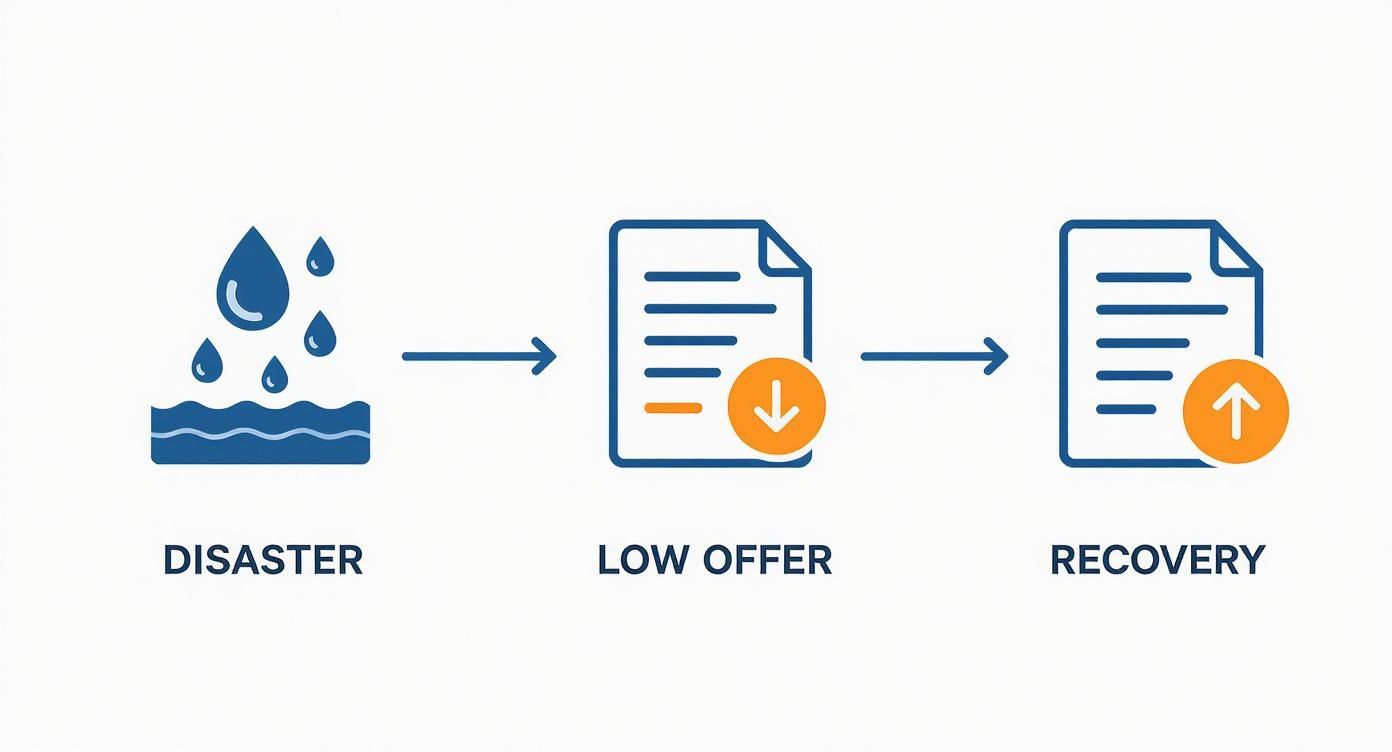
This visual highlights that critical moment where you have to decide: take the insulting offer or fight for what you’re actually owed.
Case Study: A Public Adjuster Uncovers the Truth
A homeowner in Apex, NC, had a leak from their second-floor bathroom. Allstate sent their adjuster, who took a quick look around and wrote an estimate for about $15,000. The check covered only the obvious damage in the bathroom and the stained ceiling directly below it. The homeowner knew something was wrong. That figure felt impossibly low.
So, they hired For The Public Adjusters, Inc. The PA showed up with a thermal imaging camera and moisture meters and immediately found that the water had traveled sideways across ceiling joists and run down the inside of walls in the main living area. It had soaked insulation and created a hidden breeding ground for mold.
He built an entirely new evidence package with detailed photos, moisture readings, and a complete inventory. The final, documented claim he submitted was for over $35,000. Faced with irrefutable proof, Allstate had no choice but to pay.
An adjuster’s initial estimate is not a statement of fact. It’s an opening offer in a negotiation you didn’t even know you were in.
Think about this: the average claim for water damage is around $12,514, and it makes up nearly 24% of all homeowner claims. You can read more about these water damage statistics to see just how common this fight is. This is big money for insurers, and it’s exactly why they don’t train adjusters properly, to minimize every dollar, making your evidence package the only thing standing between you and a massive financial loss.
Decoding Your Policy to Maximize Coverage
Let’s be blunt: your homeowner’s or business owner’s policy is not a helpful guide. It’s a dense legal contract, meticulously crafted by teams of lawyers to protect the insurance company’s bottom line. Giants like State Farm and Allstate are betting on you being too overwhelmed by the jargon to understand your rights, which makes it easy for them to deny or underpay your insurance claim for water damage.
Learning to decode this document is the first step in turning their own weapon against them. Your entire case lives and dies by the words on those pages. Never, ever just take the adjuster’s word for what is and isn’t covered.
Key Sections They Use Against You
When that adjuster tells you there’s a problem with your claim, the reason is almost always buried in one of three sections of your policy. You need to know where they’re looking.
- Declarations Page: This is the one-page summary. It lists your coverage limits for the dwelling, personal property, and other structures. Insurers love pointing to these numbers as absolute maximums, conveniently forgetting to mention other additional coverages you’re often entitled to.
- Duties After a Loss: This section is a checklist of your responsibilities, like preventing further damage and providing endless documentation. Insurers use this as a tripwire, arguing you didn’t act fast enough or missed some procedural deadline to deny an otherwise valid claim.
- Exclusions: This is the insurer’s primary battleground. It’s a long, detailed list of everything your policy does not cover, and it’s where adjusters go hunting for justifications to say “no.”
An insurance policy is what’s known as a contract of adhesion, meaning you had zero power to negotiate its terms. Because of this, courts often interpret any confusing or ambiguous language in favor of you, the policyholder—not the company that wrote it. This is a powerful legal concept to keep in your back pocket.
Fighting Back Against Common Water Damage Loopholes
Insurance companies have a playbook filled with go-to excuses for denying water damage claims, usually by twisting their own policy language. Your job is to spot these tactics and shut them down with facts.
One of the most notorious is the “gradual damage” or “long-term leakage” exclusion. Insurers adore this one. They’ll claim the damage wasn’t from a sudden pipe burst but from a slow leak you should have noticed and fixed ages ago. They’ll try to reclassify a sudden discovery—like a collapsed, water-logged ceiling—as a long-term problem to weasel out of paying, even when the leak was hidden behind a wall. The burden is on them to prove it was gradual, so don’t let them deny your claim without hard evidence.
Another favorite is the mold limitation. Most policies have a specific, and usually very low, cap on mold remediation—sometimes just $5,000. Here’s the trick: if the mold grew because of a covered water loss (like that burst pipe), the cost to tear out the wall, fix the pipe, and rebuild should be covered under your main dwelling coverage, not crammed into that tiny mold cap. Insurers will try to lump everything under the mold limit to save themselves tens of thousands of dollars. You can get more details on how homeowners insurance may cover water damage and the fine print involved.
Finally, watch out for improperly applied flood exclusions. A standard policy doesn’t cover “flooding,” which has a specific definition: rising surface water from outside the home. If a supply line bursts and floods your basement, that is not a flood by the policy’s definition. It’s a plumbing failure, and that’s a completely different (and typically covered) event. They are counting on you not knowing the difference.
A Precedent-Setting Case Against an Insurer
In the legal battle of Tong v. State Farm General Insurance Company, a homeowner’s claim for a burst water line was flatly denied. State Farm pointed to an exclusion for pipes “below the surface of the ground.” The problem? The pipe was inside the home’s concrete slab foundation, which absolutely should have been covered.
State Farm refused to budge, digging in their heels and upholding the denial for seven agonizing months. It was only after the homeowners sued and started deposing the company’s own adjusters that State Farm suddenly reversed course and paid the $274,000 claim. This case reveals a disturbing reality: insurance companies may knowingly stick to an improper denial, banking on the hope that you’ll just give up before they’re forced to admit their “mistake” under legal fire.
How to Dispute the Adjuster’s Lowball Estimate
When the adjuster from a big insurance company like Allstate or State Farm shows up and hands you an estimate, that’s not the end of the road. It’s the opening shot.
Their number is just a starting point, carefully calculated to protect their bottom line, not to make you whole. Fighting back against this lowball offer isn’t about getting emotional; it’s about using a methodical, evidence-based approach to prove what you’re really owed.
First things first: never, ever accept their initial estimate as the final word. It’s a proposal, and it’s heavily biased in their favor. The adjuster’s job is to close your insurance claim for water damage for the least amount of money in the shortest amount of time. That means they will almost certainly overlook critical line items, use bargain-basement pricing for materials, and completely ignore the true labor costs for a quality restoration.
Managing the Adjuster’s Inspection
From the second the company adjuster steps onto your property, you need to be in control. Don’t let them lead the tour and tell you what’s damaged. You lead them.
Pull out the evidence you’ve already gathered. Walk them through your narrated video, pointing out every single thing you documented. This isn’t the time to be passive.
Be ready with a sharp list of questions. Their answers—or their attempts to dodge them—will tell you everything you need to know about how they plan to lowball you.
- “How are you accounting for the hidden moisture my meter detected behind this wall?” This forces them to deal with damage that isn’t immediately visible.
- “What software are you using to price this out?” Most use programs like Xactimate, but they can manipulate the settings to spit out lower costs for your specific area.
- “Does your estimate cover matching the existing floors and paint throughout the whole room?” They love to budget for a small patch job, leaving you with a mismatched mess that tanks your property value.
- “How does this account for the new building code upgrades the city requires for this kind of repair?” This is a huge cost they conveniently “forget” all the time.
The adjuster is not your partner in this. They are a trained negotiator working for the other side. Be polite, but be firm. You have to make it crystal clear that you know your stuff and you won’t be pushed around.

Building Your Counter-Offer with Independent Estimates
Once you get that shamefully low written estimate, the real fight begins. Now, you need to get your own detailed, independent estimates from licensed contractors you trust. Whatever you do, don’t use the “preferred vendors” your insurance company suggests—they have a cozy deal with the insurer that’s all about keeping costs down for them, not doing right by you.
Get at least two, but preferably three, fully itemized estimates. These can’t be scribbled on a napkin. They need to break down every single part of the job:
- Demolition and Debris Removal: The actual cost to tear out every last bit of damaged material.
- Drying and Dehumidification: The bill from a professional water mitigation company.
- Material Costs: Spelled out by grade and quality to match what you lost.
- Labor Costs: Broken down by trade—plumbing, electrical, drywall, painting.
- Permits and Fees: Any city or county costs needed to do the job right.
Armed with these independent estimates, you can now build a counter-offer that has teeth. You’re not just telling them their number is wrong; you’re showing them why, line by painful line.
The sheer volume of these disputes is unreal. Water damage and freezing are a nightmare for homeowners, now making up over 43% of all home insurance claims. That’s way more than wind and hail, making water damage the number one threat you’ll likely face. You can dig into these consistent home insurance trends to see why being ready for a fight is absolutely non-negotiable.
This is where a public adjuster earns their keep. They speak the same insurance jargon, use the same software (but with correct settings), and have a whole network of experts to prove the true scope of your loss. They turn your claim from a desperate plea into a professional, data-backed negotiation.
The table below shows a real-world example of just how vast the difference is between the insurance company’s opening bid and what a public adjuster proves the claim is actually worth.
Insurance Adjuster vs Public Adjuster Estimate Comparison
This table illustrates the common discrepancies between an initial lowball offer from an insurance company’s adjuster and a comprehensive estimate prepared by a public adjuster for the same water damage claim.
| Damage Category | Insurance Adjuster’s Lowball Estimate | Public Adjuster’s Comprehensive Estimate | Reason for Discrepancy |
|---|---|---|---|
| Drywall Repair | $1,200 (Patch & Paint) | $4,500 (Full Wall Replacement) | Insurer ignored hidden moisture requiring full replacement, not just cosmetic patching. |
| Flooring | $3,500 (Partial Match) | $8,200 (Replace Entire Room) | Public adjuster proved a partial match was impossible and devalued the home, forcing full replacement. |
| Kitchen Cabinets | $2,000 (Repair Bottoms Only) | $11,000 (Replace All Lower Cabinets) | Insurer’s estimate failed to account for swelling and delamination requiring full replacement. |
| Mold Remediation | $0 (Claimed Not Covered) | $5,000 (Within Policy Sublimit) | Public adjuster proved the mold was a direct result of the covered water loss, forcing coverage. |
| Total Estimate | $6,700 | $28,700 | The public adjuster’s total is over 4 times higher, reflecting the true cost of restoration. |
This stark contrast isn’t an accident; it’s a strategy used to underpay your insurance claim for water damage. When you fire back with a detailed, evidence-backed counter-offer, you completely change the power dynamic. You force the insurance company to either justify their ridiculous numbers or finally start negotiating in good faith.
Escalating Your Claim When Your Insurer Says No
You’ve done everything right. You documented the loss meticulously and tore apart the company adjuster’s lowball estimate, piece by piece. And still, you hit a brick wall.
It’s an infuriatingly common tactic from carriers like State Farm and Allstate: they just say no. They’ll ignore your proof, drag their feet for months, and refuse to offer a fair settlement for your insurance claim for water damage. They’re betting you’ll get tired, run out of money, and finally accept whatever scraps they throw your way.
This isn’t the end of the road. It’s just the moment you have to start fighting back and using the system against them.

File a Formal Complaint with the Department of Insurance
Every state has a Department of Insurance (DOI), and it’s their job to regulate these companies. Filing an official complaint is a powerful and free way to put the heat on your insurer.
Suddenly, you’re not just some policyholder they can afford to ignore. Once you file that complaint, the insurance company is legally required to respond to the state. They have to explain their actions and justify their ridiculous offer or outright denial. This forces them to create a paper trail, and it often gets a senior claims manager involved—someone who might be more interested in settling fairly than looking bad in front of state regulators.
Invoke Your Policy’s Appraisal Clause
Buried deep in the fine print of your policy is a powerful tool you probably never knew you had: the Appraisal Clause. This is a contractual process designed to resolve one specific thing: disputes over the cost of the loss.
So, if you and the insurer agree the damage is covered but are miles apart on the price tag to fix it, you can invoke appraisal. It’s a game-changer.
Here’s how it works:
- You hire your own impartial appraiser to evaluate the damage and determine the real cost of repairs.
- Your insurer hires their own appraiser to do the same.
- The two appraisers then agree on a neutral third party, called an umpire. If they can’t agree on one, a judge will appoint one for them.
- The three of them review all the evidence. An agreement by any two of the three becomes a legally binding award, and the insurance company must pay it.
Invoking appraisal rips the decision out of the biased company adjuster’s hands and puts it into the hands of independent experts.
When to Bring in a Bad Faith Attorney
Sometimes, an insurer’s behavior crosses the line from a simple disagreement over money to outright deception, malicious delays, or intimidation. When that happens, it’s time to call an attorney who specializes in insurance bad faith.
Bad faith is when an insurance company fails to honor its side of the contract without any reasonable basis for doing so. They know they should pay, but they refuse anyway.
A landmark case, Tong v. State Farm, shows just how far insurers will go. State Farm denied a homeowner’s claim for a burst water line and stuck to that denial for seven miserable months. It wasn’t until the homeowner sued and lawyers started scheduling depositions that the company finally caved and paid $274,000. It proves that sometimes, the only thing that gets an insurer to act honorably is the threat of a lawsuit.
This fight is only getting harder. With global insured losses from natural catastrophes hitting $100 billion in just the first half of a recent year, insurance carriers are under immense pressure to minimize what they pay out. You can read more about how climate change affects the insurance industry to understand the bigger picture.
This is why they fight so hard. If your claim gets denied, learning how to appeal an insurance claim denial is the most critical next step you can take. A good attorney can look at your case and see if you have grounds for punitive damages—extra money you’re owed because of the insurer’s bad behavior—on top of what they already owed you for the claim.
Common Questions About Disputed Water Damage Claims
When your insurance claim for water damage gets denied or they send you a check that’s a slap in the face, the stress is immediate. Suddenly, you’re drowning in questions. Here are the straight answers to the things we hear every single day from homeowners fighting back.
My Insurer Denied My Claim, Calling It a “Long-Term Leak.” What Can I Do?
This is the oldest trick in the adjuster’s playbook. Big carriers like State Farm and Allstate love to use the “gradual damage” or “long-term leakage” exclusion to get out of paying what they owe. They’ll take a sudden pipe burst and try to frame it as some slow, seeping problem you should have noticed and fixed years ago. It’s nonsense.
Your first move is to put the burden of proof back where it belongs: on them. Demand that the insurance company provide dated, hard evidence to back up their theory. They can’t just make an assumption; they have to prove it.
Next, you hit them with your own expert evidence. Hire an independent plumber or a leak detection specialist to write a report that clearly identifies the cause, origin, and timeline of the water loss. A real expert’s opinion will almost always tear an adjuster’s baseless claim to shreds. This is where a public adjuster is crucial—they have a roster of trusted experts ready to go and know exactly how to dismantle this shady tactic.
Can I Start Repairs Before My Claim Is Settled?
Yes and no. You have a duty to perform immediate, emergency mitigation. That means stopping the water, getting a professional extraction company to remove standing water, and setting up fans and dehumidifiers to prevent mold. Document everything—take photos, videos, and keep every receipt. These are costs you can get reimbursed for.
But you absolutely cannot start permanent reconstruction until you have a signed settlement agreement. If you start hanging new drywall or laying new floors, you hand the insurance company the perfect excuse to stand by their lowball number. They’ll argue they couldn’t see the full scope of the damage, leaving you stuck with their terrible estimate and a massive bill.
Don’t ever sign a final release form to get your check until you are 100% positive the money covers all known and potential hidden damage. They’ll pressure you to sign to close the claim fast and cheap. Once that paper is signed, you’ve likely lost your right to file a supplemental claim when you find more damage later.
What Is “Insurance Bad Faith” and How Do I Spot It?
“Bad faith” isn’t just a disagreement over how much your claim is worth. It’s a legal term for when your insurer deliberately fails to uphold their end of the contract without a good reason. It’s dishonest, and it’s illegal.
Here are the classic warning signs:
- Unreasonable Delays: Dragging their feet for months without any real updates or justification.
- Refusing to Investigate: Doing a lazy, five-minute walkthrough and refusing to conduct a real investigation.
- Twisting Policy Language: Intentionally misinterpreting the words in your own policy to justify a denial.
- Lowballing: Making an offer that is so outrageously low it’s clear they never intended to pay you fairly.
If you suspect bad faith, document everything. Create a log of every call, email, and conversation. Note the date, time, who you spoke with, and what was said. This detailed record is the ammo you’ll need for a formal complaint with your state’s Department of Insurance or for a lawsuit.
How can I prove the water damage was sudden and accidental and not a maintenance issue?
You can prove it was sudden by obtaining a detailed report from a licensed plumber or restoration company immediately after the loss. This report must explicitly state the source of the leak, the nature of the failure (e.g., burst connection, sudden crack), and that it was not due to long-term neglect. You should consider speaking with a local Public Adjuster as well.
What steps should I take immediately after the damage to avoid having my claim denied later?
You have a duty to mitigate further damage. Immediately take clear, date-stamped photos and videos of the damage and its source before cleanup begins. Then, safely stop the water source (if possible) and hire a professional water mitigation company to dry the structure, keeping all invoices and receipts. This is all new to most people. It's a good idea to consult with a Public Adjuster before doing anything.
What is the "Proof of Loss" and what role does it play in fighting a disputed claim?
The Proof of Loss (POL) is a formal, sworn statement detailing your damages and the compensation you are claiming. If your claim is disputed, a professionally prepared POL (often done by a Public Adjuster) backed by expert documentation forces the insurer to address the true valuation of your loss, not just their low estimate.
My claim was denied because of a mold exclusion. How do I fight this?
Most standard policies exclude mold damage if it is a consequence of an unrepaired, gradual leak. To fight this, you must first successfully dispute the denial of the original water damage event by proving it was sudden. If the initial water event is covered, resulting mold damage related to the covered event often must be addressed. A Public Adjuster can answer all your questions on this issue.
Can a Public Adjuster help me re-open a water damage claim that was already denied or underpaid?
Yes. Public Adjusters specialize in fighting denials. They review the entire claim file, bring in independent experts (like forensic engineers or hydrologists), and submit a comprehensive appeal package that often overturns denials by proving the insurer misapplied the policy or overlooked evidence.
The insurance adjuster's estimate is too low to cover the repairs. What is my next move?
Do not accept the first offer. Your next move is to hire a Public Adjuster to conduct an independent, detailed estimate using industry-standard software (like Xactimate). This creates a formal counter-demand based on true costs, shifting the negotiation power back to you.
Will the insurance company pay for my temporary living expenses (ALE) if my home is uninhabitable due to water damage?
Yes, if the water damage is from a covered peril, your policy's Additional Living Expense (ALE) coverage should pay for temporary housing, food, and other necessary extra costs. Your Public Adjuster ensures ALE coverage is maximized and paid out efficiently while your home is under repair.
What should I do if the adjuster claims there was pre-existing damage and denies the claim based on that?
If an adjuster claims pre-existing damage, they must provide reasonable evidence. A Public Adjuster counters this by providing dated records, maintenance logs, and expert reports that demonstrate the most recent damage was caused by the current covered event, not a historical issue.
Is it necessary to hire a Public Adjuster versus an Attorney to fight a water damage claim dispute?
In the initial dispute and negotiation phases, hiring a Public Adjuster is usually more efficient and cost-effective. PAs are claims experts who fight the denial using claims procedures and policy language. If the denial is based on bad faith or a complete legal impasse, an attorney is the next step, but a PA often resolves the issue sooner.
When you’re in a tough fight over your water damage claim, you don’t have to face it alone. The team at For The Public Adjusters, Inc. levels the playing field. We work for you, the policyholder—not the insurance company. We make sure your claim is documented right so you get the maximum settlement you’re owed. Get a no-cost claim review today and let us take over the fight. Learn more at https://forthepublicadjusters.com.
Thanks for sharing. I read many of your blog posts, cool, your blog is very good.