Why Gray v. NCIUA Still Matters for Insurance Bad Faith NC Claims
The most important insurance bad faith NC decision for homeowners is Gray v. North Carolina Insurance Underwriting Association, in which the North Carolina Supreme Court confirmed that an insurer who unfairly low-balls a homeowner’s claim can be held liable under the state’s Unfair and Deceptive Trade Practices Act — exposing the carrier to significantly enhanced damages.
Key takeaways
- In Gray v. NCIUA (2000), the NC Supreme Court confirmed that an insurer’s bad faith claim handling can violate North Carolina’s Unfair and Deceptive Trade Practices Act, exposing the insurer to treble damages.
- Conduct listed as an unfair claim settlement practice under N.C. Gen. Stat. § 58-63-15(11) — like failing to promptly and fairly settle a claim where liability is reasonably clear — can support a UDTPA claim without proving the insurer acted frequently or as a general business practice.
- A low-ball offer on a hurricane damage claim is not just a contract dispute in NC — if aggravating conduct accompanies the breach, the policyholder may recover far more than the policy benefits.
- Treble damages under Chapter 75 mean a successful insurance bad faith NC claim can multiply actual damages by three, plus potential attorney’s fees.
- Policyholders should document every communication, estimate, and delay, because that paper trail is what turns an underpaid claim into a provable bad faith case.
That ruling wasn’t just a win for one family. It set the standard that North Carolina insurers are still measured against today, especially during hurricane season, when coastal and inland homeowners alike file wind, water, and tree damage claims — and too often receive settlement offers that don’t come close to covering real repair costs.
The Quick Takeaway From Gray
In Gray, homeowners with hurricane damage argued that their insurer’s handling of the claim — including an unreasonably low settlement offer — amounted to more than a simple contract dispute. The North Carolina Supreme Court agreed that this kind of conduct can violate N.C. Gen. Stat. § 75-1.1, the Unfair and Deceptive Trade Practices Act. That matters because:
- Damages can be trebled. Unlike an ordinary breach-of-contract claim, a successful UDTPA claim allows a court to award three times the actual damages.
- Attorney’s fees may be recoverable. In appropriate cases, the policyholder’s legal fees can be shifted to the insurer.
- Claims-handling conduct itself is on trial. The way an insurer investigates, delays, and offers to settle can create liability — not just whether the loss was technically covered.
Why It Still Protects Homeowners Today
Gray remains a cornerstone of insurance bad faith NC law because it changed the economics of low-balling. Before it, an insurer that underpaid a claim risked little more than eventually paying what it owed. After Gray, unfair claims practices carry real financial consequences, which gives homeowners genuine leverage when negotiating a disputed claim.
That leverage matters most in exactly the situations North Carolina sees every storm season:
- Hurricane or tornado-remnant wind damage that the adjuster attributes to “wear and tear”
- Roof and water intrusion claims paid at a fraction of actual repair costs
- Long, unexplained delays that pressure homeowners into accepting less
If a hurricane remnant has opened your roof and the insurer’s offer won’t rebuild it, understanding your rights is step one — and getting help documenting the full loss is step two. For a practical look at how these disputes play out on the ground, see this guide to wind damage claim help in Burlington NC.
In the sections that follow, we’ll break down what actually happened in Gray, what conduct counts as bad faith under North Carolina law, and what to do if your own storm claim was underpaid.
What Happened in Gray v. North Carolina Insurance Underwriting Association?
In Gray v. NCIUA, an Outer Banks homeowner’s hurricane damage claim was underpaid after a superficial investigation, and the North Carolina Supreme Court ruled the insurer could be held liable for bad faith and unfair claim settlement practices — confirming that NC insurers who low-ball claims without a reasonable investigation face real legal consequences, including extra-contractual damages.
The Storm, the Claim, and the Low Offer
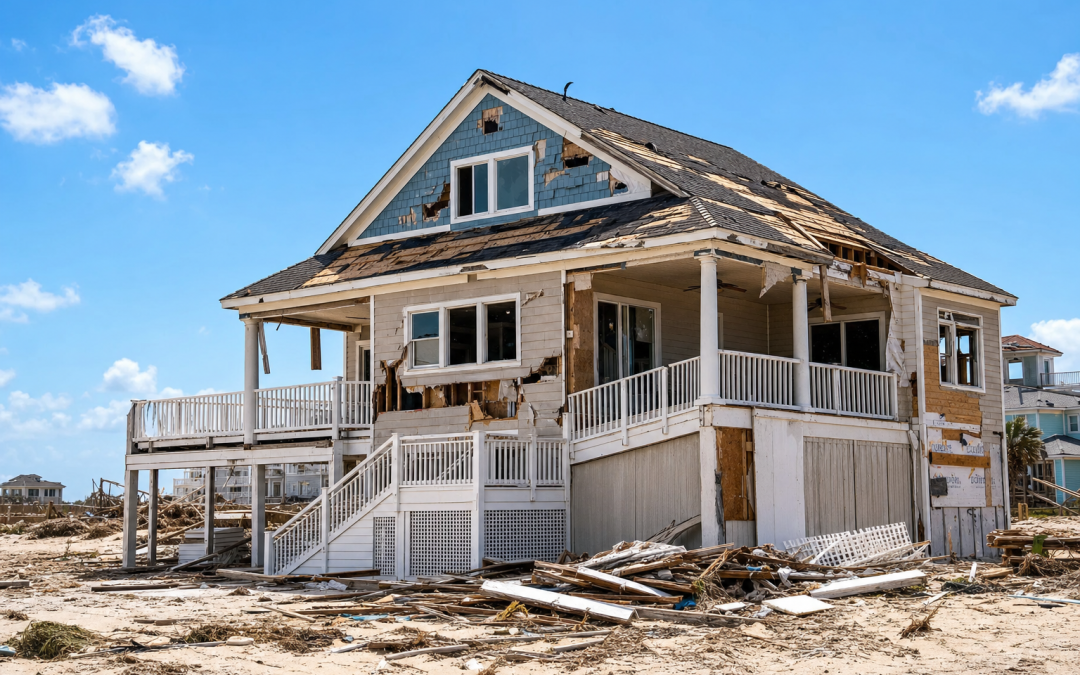
The case grew out of Hurricane Fran’s destructive path through North Carolina. The Grays’ coastal property suffered serious storm damage, and they filed a claim with the North Carolina Insurance Underwriting Association — the state-created “Beach Plan” that insures many coastal properties that private carriers won’t cover.
According to the homeowners, what followed was a textbook example of a claim handled on the cheap:
- The insurer’s investigation of the damage was limited and superficial — far short of what the loss actually required.
- The settlement offer that came back was dramatically lower than what independent estimates showed the repairs would actually cost.
- When the homeowners pushed back with their own evidence of the true scope of damage, the insurer held firm on its inadequate number.
Rather than accept the shortfall, the Grays sued — not just for breach of the insurance contract, but for bad faith and unfair and deceptive trade practices.
How the NC Supreme Court Held the Insurer Accountable
In 2000, the North Carolina Supreme Court sided with the policyholders on the issues that matter most. The key legal takeaways, in plain language:
- The Beach Plan isn’t above the law. Even though NCIUA is a creature of statute, the Court made clear it can be held accountable like other insurers when it mishandles a claim.
- A single mishandled claim can be enough. The Court held that a policyholder pursuing an unfair or deceptive trade practices claim does not have to prove the insurer mistreats customers as a “general business practice.” One inadequately investigated, low-balled claim — yours — can support the claim.
- Bad faith carries teeth. Because the case involved more than a simple contract dispute, the homeowners could pursue remedies beyond the unpaid policy benefits, which is exactly what gives insurers a financial reason to handle claims fairly.
That last point is why the decision still matters. Gray established that insurance bad faith NC claims can rest on how your individual claim was investigated and valued — not on some pattern you’d have no way to prove. For homeowners whose hurricane or wind damage claim was met with a drive-by inspection and a take-it-or-leave-it offer, the case remains a powerful reminder: an insurer’s duty is to investigate reasonably and pay what the loss is actually worth.
What Counts as Insurance Bad Faith NC Homeowners Should Watch For?
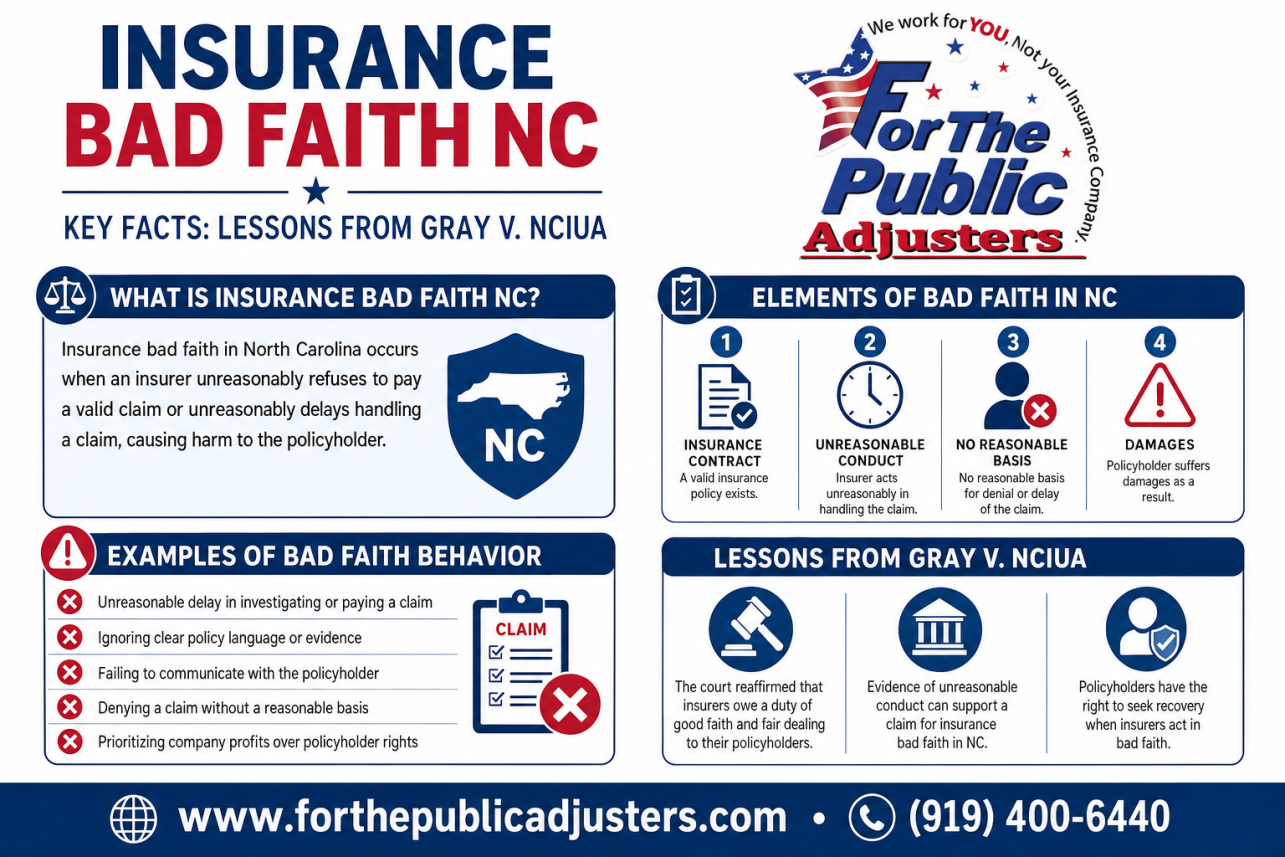
Insurance bad faith NC claims arise when an insurer refuses to pay a valid claim without a reasonable basis for doing so — and knows it. Warning signs include unexplained delays, refusals to investigate properly, settlement offers far below documented damage, and misleading statements about what your policy covers.
The Gray v. NCIUA decision is a useful lens because it shows how courts distinguish an honest coverage dispute from conduct that crosses the line. North Carolina also codifies unfair claim settlement practices in its insurance statutes (found in Chapter 58 of the General Statutes), and violations of those provisions can support claims under the state’s unfair and deceptive trade practices law. Here are the red flags homeowners should watch for.
Unreasonable Delays in Handling Your Claim
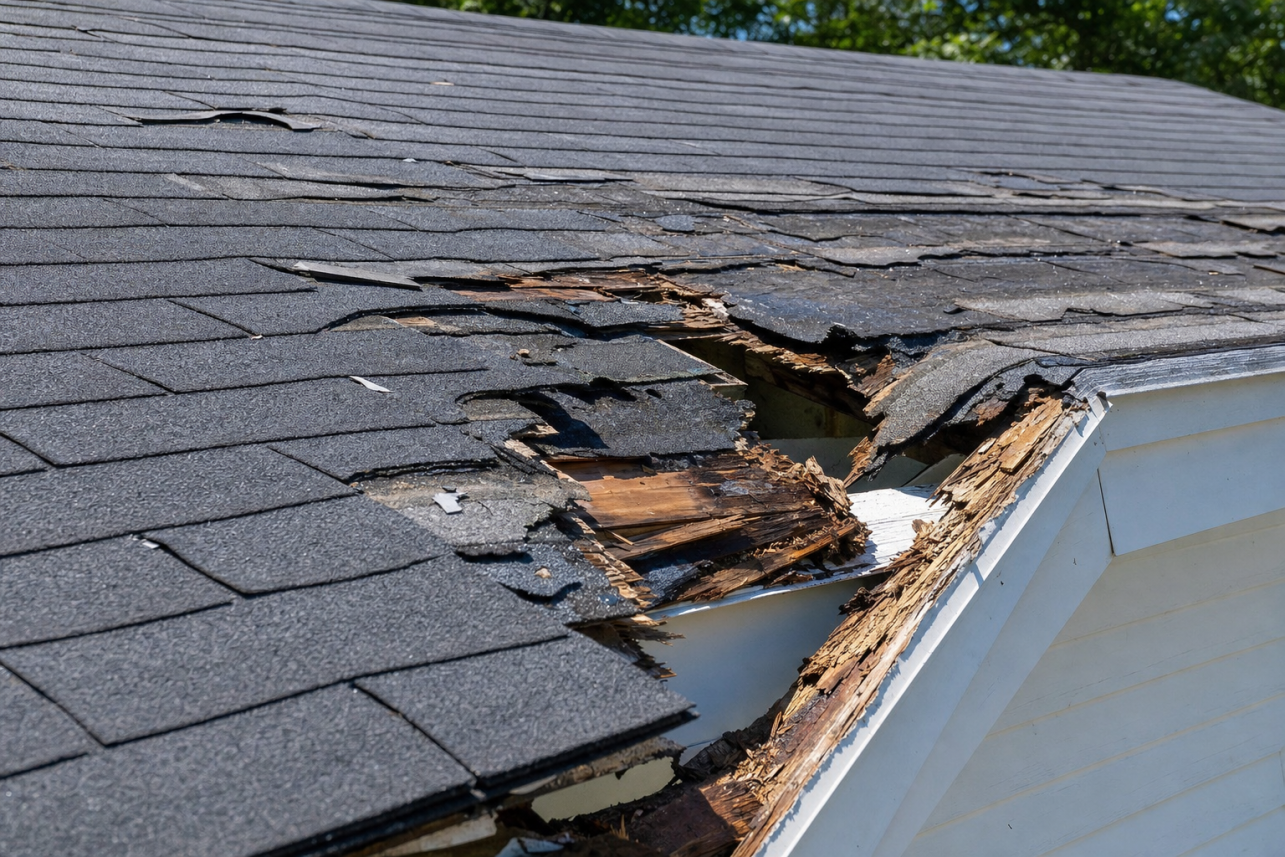
Insurers are expected to acknowledge, investigate, and resolve claims promptly. Repeatedly asking for documents you’ve already sent, going silent for weeks at a time, or stalling until you’re desperate enough to accept less are classic delay tactics. After a hurricane, delays can compound your damage — a tarped roof that goes unrepaired for months leads to rot, mold, and interior losses.
Failure to Properly Investigate
A carrier can’t deny or underpay a claim based on an investigation it never meaningfully conducted. Watch for:
- An adjuster who spends minutes at your property, never gets on the roof, or skips damaged rooms entirely
- Denials that ignore your contractor’s or engineer’s reports without explanation
- Conclusions about the cause of loss (for example, blaming “pre-existing wear” for fresh storm damage) with no supporting inspection or documentation
Low-Ball Offers Far Below Documented Damage
An offer that’s a fraction of your documented repair estimates — especially when the insurer won’t explain the gap line by line — is a serious warning sign. Common examples include paying to patch a section of roof when matching shingles are unavailable and full replacement is warranted, or pricing repairs at rates no local contractor will actually accept.
Misrepresenting Policy Provisions
Some adjusters tell homeowners that coverage doesn’t exist when it does, misstate deadlines, or bury exclusions that don’t actually apply to the loss. If what you’re told over the phone doesn’t match your policy language, get every coverage position in writing and compare it against your actual policy.
An Honest Dispute Is Not Bad Faith
One important caveate courts emphasize: a genuine disagreement over the value of a claim or a reasonable coverage question is not, by itself, bad faith. What matters is whether the insurer had a legitimate, fact-based reason for its position — or whether it denied, delayed, or lowballed while knowing better. Documenting every interaction, keeping repair estimates and photos, and requesting written explanations builds the record that separates the two.
Can I Sue My Insurer Over a Low-Ball Settlement in NC or VA? Insurance Bad Faith NC Remedies Explained
Yes — in both North Carolina and Virginia, policyholders can pursue legal action over an unreasonably low settlement, but the remedies differ significantly. North Carolina law allows claims under its Unfair and Deceptive Trade Practices Act, which can triple your damages, while Virginia offers a narrower path focused mainly on recovering attorney’s fees.
A low offer by itself is not automatically bad faith. Insurers are allowed to disagree with you about value. The legal question is whether the carrier acted unreasonably — ignoring evidence, refusing to investigate, misrepresenting your coverage, or pressuring you to accept far less than the claim is plausibly worth. That distinction shapes what kind of lawsuit, if any, makes sense.
North Carolina: The UDTPA and Treble Damages
North Carolina gives policyholders one of the stronger toolkits in the region. Beyond a standard breach-of-contract claim for the unpaid amount, an insurance bad faith NC case may also invoke the Unfair and Deceptive Trade Practices Act (Chapter 75 of the General Statutes). When an insurer’s conduct violates that statute, courts can award treble damages — three times the actual damages — plus, in some cases, attorney’s fees. Conduct that has supported these claims includes:
- Failing to conduct a reasonable investigation before denying or slashing a claim
- Misrepresenting policy provisions or coverage to the policyholder
- Refusing to attempt a fair, prompt settlement when liability is reasonably clear
- Compelling the insured to sue just to recover what was owed all along
Separate tort claims for bad faith may also open the door to punitive damages where the insurer’s conduct was aggravated — but courts apply that standard strictly.
Virginia: A Narrower Path
Virginia treats first-party property claims differently. There is no broad statutory scheme equivalent to North Carolina’s UDTPA for these disputes, and Virginia generally channels a policyholder’s remedy through the insurance contract itself. The main statutory tool, Virginia Code § 38.2-209, allows a court to award attorney’s fees to an insured who wins a coverage dispute if the judge finds the insurer acted in bad faith. That’s meaningful, but it doesn’t multiply your damages the way North Carolina law can.
Honest Expectations Before You Sue
Legal remedies are real, but no attorney or adjuster can guarantee an outcome. Keep these realities in mind:
- Facts drive everything. Courts look at what the insurer knew, when, and how it responded — not just the size of the gap between offers.
- Documentation is your leverage. Estimates, photos, correspondence, and adjuster reports often decide whether a low offer looks like a negotiating position or bad faith.
- Deadlines matter. Both statutes of limitation and policy-imposed suit deadlines can bar otherwise valid claims, so don’t wait to get advice.
A consultation with a policyholder-side attorney licensed in your state is the only reliable way to know whether your specific claim supports litigation — or whether a stronger documented demand can resolve it first.
What Should I Do If My Hurricane or Storm Damage Claim Was Underpaid?
If your storm damage claim was underpaid, document all damage thoroughly before making repairs, request the insurer’s decision and adjuster’s estimate in writing, review your policy’s coverage and dispute provisions, keep a detailed log of every communication, and act quickly — policy and legal deadlines for challenging a settlement can expire faster than you expect.
Summer thunderstorm and tropical-storm season is exactly when underpayments spike. Adjusters are stretched thin after widespread wind, hail, and flooding events, and rushed inspections often miss hidden damage like saturated insulation, compromised roof decking, or moisture behind walls. Here’s how to protect your claim step by step.
Document Everything Before You Repair
Your evidence is strongest before anything is fixed. Take wide shots and close-ups of every damaged area, inside and out, with timestamps if possible. Keep damaged materials (a section of shingle, a piece of water-stained drywall) when practical. If you must make emergency repairs to prevent further damage — which most policies actually require — photograph the damage first and save every receipt for tarps, plywood, and labor.
Get the Numbers in Writing
- Request the written offer or partial denial. A verbal explanation isn’t enough. You need the insurer’s position on paper, including which coverages were applied and which were excluded.
- Ask for the adjuster’s full estimate. You’re entitled to see how the payment was calculated — line items, unit prices, depreciation, and overhead. Compare it against contractor quotes for the same scope of work.
- Review your policy carefully. Check your dwelling and other-structures limits, whether you have replacement cost or actual cash value coverage, and your deductible — especially any separate named-storm or hurricane deductible, which is common in coastal North Carolina.
Keep a Communication Log
Record the date, time, name, and substance of every call, email, and visit with your insurer. Follow up phone conversations with a short confirming email. If your dispute later escalates into an insurance bad faith NC claim, a clean paper trail showing delays, shifting explanations, or ignored requests can be some of your most powerful evidence.
Know Your Deadlines
Don’t sit on an underpayment. Your policy typically sets time limits for submitting proof of loss, requesting appraisal, and filing suit — and these contractual deadlines can be shorter than the general statutes of limitations under North Carolina law. Read the “Suit Against Us” and appraisal provisions in your policy, mark the dates on a calendar, and if a deadline is approaching, get professional help before it passes. Missing a deadline can forfeit an otherwise valid claim, no matter how badly it was underpaid.
Finally, don’t cash a check labeled “full and final settlement” without understanding what you’re giving up. In many cases, accepting an initial payment doesn’t close your claim — but release language can. When in doubt, get the insurer to confirm in writing that the payment is partial and the claim remains open.
How Can a Public Adjuster Help Me Fight an Unfair Claim Settlement?
A licensed and bonded public adjuster works exclusively for the policyholder — not the insurance company. They independently inspect and document your property damage, prepare a detailed estimate of the loss, interpret your policy, and negotiate directly with the carrier to pursue a fair settlement, helping level the playing field the way Gray intended.
When an insurer’s adjuster writes the estimate, the carrier is effectively grading its own homework. The Gray decision recognized that policyholders and insurers do not stand on equal footing, and a public adjuster exists to help close that gap. In any potential insurance bad faith NC situation, a thorough, independent record of the damage is often what separates a stalled claim from a resolved one.
Independent Documentation and Valuation
A public adjuster builds the evidence your claim needs to stand on, including:
- A room-by-room (or building-by-building) inspection of residential or commercial damage, including areas a carrier’s adjuster may have overlooked, such as hidden water intrusion or roof system damage.
- A detailed, line-item estimate using industry-standard pricing tools, so you’re not relying solely on the insurer’s numbers.
- Photographic and written records that support supplemental claims if additional damage is discovered later.
- A careful reading of your policy to identify coverages — like code upgrades, debris removal, or loss of use — that policyholders frequently miss.
Negotiating on Your Behalf
Once the loss is documented, a public adjuster communicates with the carrier for you: responding to requests, challenging low estimates with evidence, and pushing back on unsupported denials or depreciation. Because public adjusters handle claims every day, they know how carriers evaluate losses and where estimates commonly fall short. No reputable adjuster can promise a specific dollar outcome — and you should be wary of anyone who does — but professional representation ensures your side of the file is complete and credible.
Verify Licensing Before You Hire
Public adjusters in North Carolina must be licensed, and consumers can verify credentials through the North Carolina Department of Insurance. The National Association of Insurance Commissioners (NAIC) also offers consumer resources explaining how the claims process works and what to expect from all parties involved. Confirming that your adjuster is licensed and bonded protects you and signals that they’re accountable to state regulators.
A Note on Flood Damage
If your loss involves flooding, remember that flood claims are typically handled under a separate policy through the National Flood Insurance Program rather than your homeowners coverage. A public adjuster can help you sort out which damage belongs to which policy — a distinction that frequently causes underpayments after hurricanes and coastal storms.
Ultimately, hiring a public adjuster is about balance: making sure the person valuing your loss answers to you, not the insurance company.
Insurance Bad Faith NC: Breach of Contract vs. Bad Faith vs. UDTPA Claims
| Claim Type | What You Must Show | Potential Recovery |
|---|---|---|
| Breach of insurance contract | Insurer failed to pay benefits owed under the policy | Unpaid policy benefits plus interest |
| Common law bad faith | Refusal to pay a valid claim plus aggravating conduct (e.g., bad motive, reckless indifference) | Compensatory damages and possible punitive damages |
| UDTPA (Chapter 75) claim | Unfair or deceptive act affecting commerce — including § 58-63-15(11) settlement practices, per Gray | Actual damages automatically trebled, plus possible attorney’s fees |
| Combined strategy (common today) | Plead all three theories; elect the most favorable remedy after verdict | Maximizes leverage in settlement negotiations |
Illustrative Example: A Coastal Homeowner Pushes Back
Illustrative example
Consider a hypothetical Outer Banks homeowner whose roof and interior are badly damaged in a hurricane. The insurer’s adjuster attributes most of the damage to ‘pre-existing wear’ and offers a fraction of the documented repair costs, then delays responding to the homeowner’s contractor estimates for months. After hiring counsel, the homeowner asserts breach of contract, bad faith, and UDTPA claims, relying on the framework the NC Supreme Court established in Gray v. NCIUA. Faced with the prospect of trebled damages and attorney’s fees, the insurer reassesses the claim and negotiates a settlement reflecting the true cost of repairs. This composite scenario is for illustration only and does not describe any real client or actual settlement.
Frequently asked questions
What is insurance bad faith NC law, and how does Gray v. NCIUA fit in?
In North Carolina, an insurer acts in bad faith when it refuses to pay or unreasonably lowballs a valid claim without a legitimate basis. In Gray v. North Carolina Insurance Underwriting Association, the North Carolina Supreme Court held that an insurer’s unfair claim settlement conduct toward a homeowner could support liability under the state’s Unfair and Deceptive Trade Practices Act (Chapter 75). The decision is significant because it confirmed that policyholders are not limited to a simple breach-of-contract recovery when an insurer mishandles a claim.
Why does it matter whether my claim is a breach of contract or an unfair trade practice?
The difference is mostly about remedies. A breach-of-contract claim generally gets you what the policy owed you. A successful claim under North Carolina’s Unfair and Deceptive Trade Practices Act allows treble (triple) damages and, in some cases, attorney’s fees. Gray helped establish that unfair claim settlement practices by an insurer can trigger these enhanced remedies, giving policyholders real leverage against lowball tactics.
Do I have to prove the insurer treats all its customers this way, or just that it mistreated me?
A key takeaway from Gray is that a policyholder pursuing an unfair trade practices claim based on unfair claim settlement conduct does not have to prove the insurer engaged in that conduct so frequently that it was a general business practice. Conduct directed at your own claim can be enough, which makes these cases far more practical for individual homeowners to bring.
What should I do if I think my hurricane or storm damage claim was lowballed in North Carolina?
Document everything: keep the policy, all letters and emails, adjuster reports, photos of the damage, and your own repair estimates. Get an independent contractor or public adjuster estimate to compare against the insurer’s figure, and put your disagreement in writing. You can file a complaint with the North Carolina Department of Insurance, and if the gap is significant, consult an attorney experienced in insurance bad faith NC cases — many offer free consultations, and the potential for treble damages under Chapter 75 can change the settlement dynamic. Also be mindful of policy deadlines and statutes of limitations, which can bar late claims.
Related local pages
- Public Adjuster Burlington NC: Fire, Water & Storm Damage Claims Handled On The Policyholder’s Side
- Public Adjuster Elon NC — Fire & Water Claim Help For Alamance County Homeowners
- Public Adjuster Haw River NC — Fire, Flood & Storm Claim Help For Older Mill-Town Homes Along The Haw
Think your hurricane or storm damage claim was low-balled? Talk to our licensed and bonded public adjusters serving NC and VA for a free claim review today. Get in touch.
Last updated: August 8, 2026