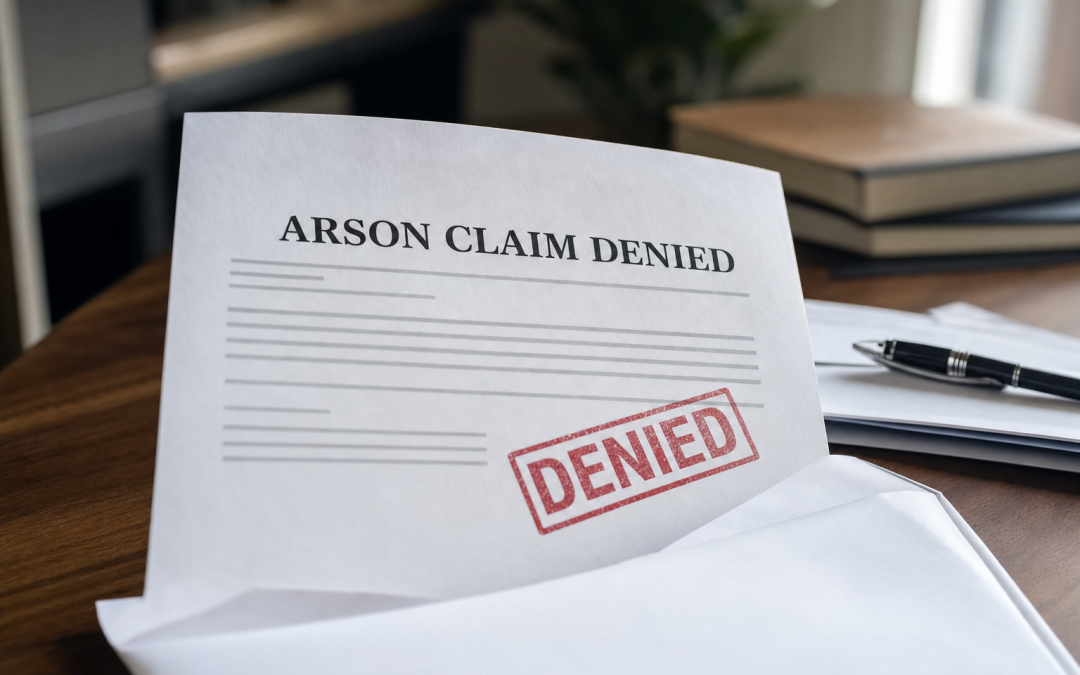
Denied for Arson When You Did Nothing Wrong? Here’s the Quick Answer to an Arson Claim Denial
An arson claim denial cannot legally rest on suspicion alone — your insurance company carries the burden of proving that the fire was intentionally set and that you were connected to it. In North Carolina and Virginia, an initial denial letter is an accusation, not a verdict, and courts require carriers to back it up with real evidence.
Key takeaways
- When an insurer denies a fire claim as arson, the legal burden of proof falls on the insurance company, not the homeowner.
- Courts in North Carolina and Virginia generally require insurers to prove incendiary origin, motive, and opportunity — not just one of the three.
- Suspicion, financial difficulty, or an inconclusive fire investigation alone is not enough to legally justify an arson claim denial.
- An open or closed criminal arson investigation is separate from the civil insurance claim, and no criminal charge or conviction is required for you to fight a denial.
- Homeowners who did nothing wrong can challenge an arson-based denial in court, where the insurer must present actual evidence, not theories.
That distinction matters more than most homeowners realize. When a fire claim is denied on the basis of arson, the insurer is essentially accusing you of fraud — a serious allegation. Because of that, the legal system does not let carriers simply point to an unexplained fire and walk away from the policy. If your claim ends up in dispute, the insurer generally has to establish its arson defense, not the other way around.
Why Insurers Raise Arson in the First Place
Fire losses are among the most expensive claims an insurance company faces. A total or near-total house fire can involve the structure, contents, and additional living expenses all at once. That financial pressure means carriers investigate fires aggressively, and certain red flags — recent financial stress, a fire of undetermined origin, or accelerant-detection findings — can push an adjuster or special investigations unit toward a denial even when the homeowner did nothing wrong.
What an Arson Denial Actually Means (and Doesn’t)
- It means the carrier is asserting a defense to paying the claim — one it must be prepared to prove with evidence if challenged.
- It does not mean you’ve been found guilty of anything. An insurance denial is not a criminal charge, and many homeowners denied for arson are never charged with a crime at all.
- It does not end your claim. Denials can be disputed, appealed, and litigated — and homeowners have prevailed when the insurer’s evidence didn’t hold up.
- It shifts the fight to evidence. Fire cause-and-origin findings, timelines, alibis, and financial records all become central to the dispute.
The Bottom Line for NC and VA Homeowners
If you received an arson claim denial and you know you had nothing to do with the fire, don’t accept the letter as the final word. Preserve the fire scene and your documentation as much as possible, get the insurer’s stated reasons in writing, and bring in help that works for you rather than the carrier. A fire damage public adjuster who represents policyholders can help you challenge the denial, document your actual loss, and hold the insurance company to the burden of proof the law places squarely on its shoulders.
The sections below break down exactly who bears that burden, what an insurer must prove to sustain an arson defense, and the practical steps to take after a denial in North Carolina or Virginia.
Who Has the Burden of Proof in an Arson Claim Denial?
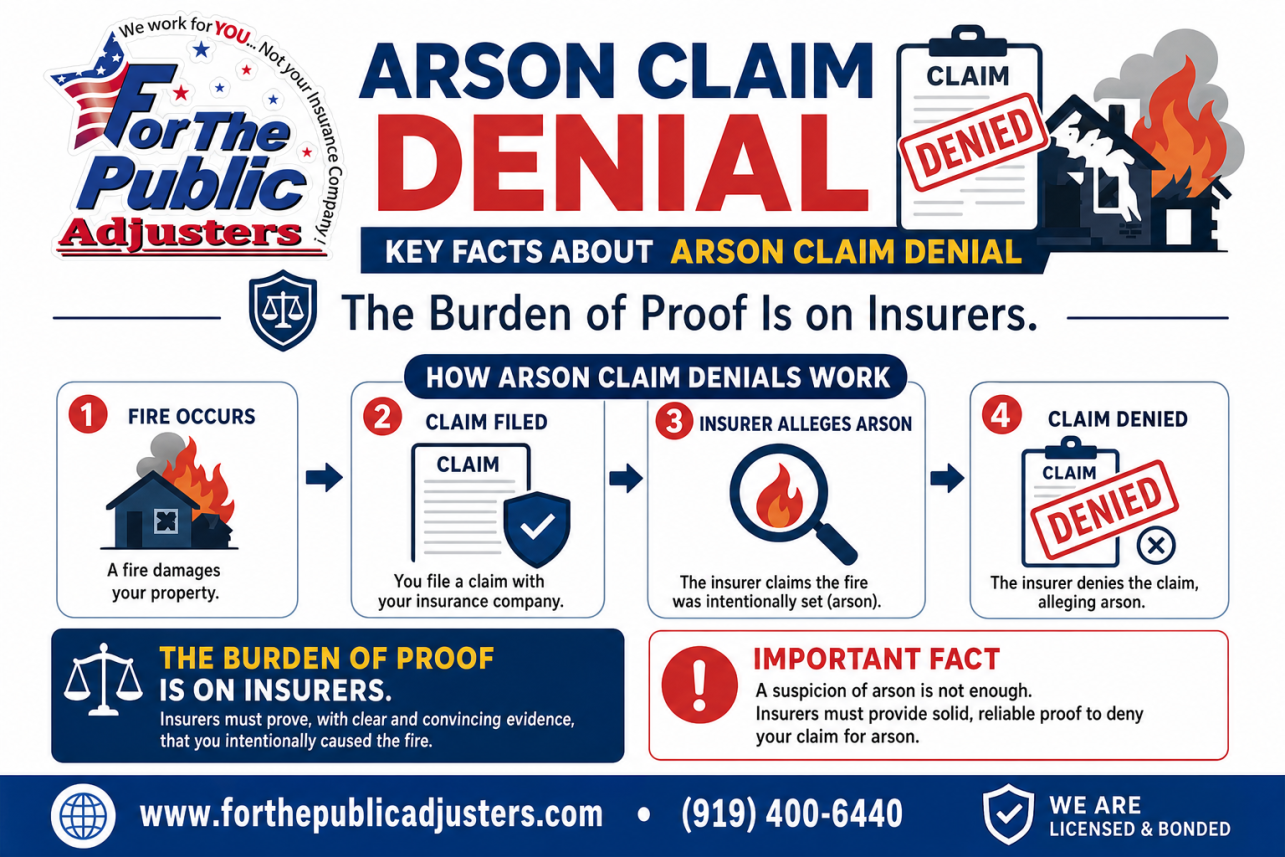
In an arson claim denial, the insurance company carries the burden of proof — not you. Arson is an affirmative defense, which means the insurer must build and prove its case with actual evidence. You do not have to prove your innocence; the law presumes a fire was accidental until the carrier proves otherwise.
This surprises many homeowners, because a denial letter can make it feel like you’re the one on trial. Legally, the roles are reversed. Once you show that a fire occurred and that your policy covers fire damage, you’ve done your part. If the insurer wants to escape paying by claiming arson, the burden shifts squarely onto the company to back that accusation up.
Why the Law Presumes Fires Are Accidental
Courts have long recognized that most fires are accidents — electrical faults, appliance failures, chimney problems, cooking mishaps, lightning. Because arson is essentially an accusation of fraud (and often a crime), the law doesn’t allow an insurer to make that accusation casually. A few practical reasons behind the presumption:
- Accusing a policyholder of arson is serious. It attacks your character and can carry criminal implications, so suspicion alone isn’t enough.
- The insurer wrote the policy and collected the premiums. If it wants out of its contractual promise, it must justify that with proof.
- Fire destroys evidence. Courts know that ambiguous burn patterns and unanswered questions are common after any fire, so uncertainty is not treated as proof of wrongdoing.
What “Preponderance of the Evidence” Means in Plain Language
In a civil dispute over a fire claim, the insurer generally must prove its arson defense by a preponderance of the evidence. In plain terms, that means the company must show its version of events is more likely true than not — think of a scale that has to tip at least slightly past 50% in the insurer’s favor.
That’s a lower bar than “beyond a reasonable doubt” in a criminal case, but it’s still a real hurdle. A few key takeaways for homeowners:
- A tie goes to you. If the evidence is evenly balanced or merely raises questions, the insurer hasn’t met its burden.
- Suspicion isn’t proof. Financial stress, an undetermined fire cause, or an adjuster’s gut feeling doesn’t tip the scale on its own.
- The insurer must connect the fire to you. Even a fire that was intentionally set doesn’t defeat coverage unless the carrier ties it to the policyholder.
Understanding this burden changes how you respond to a denial. Instead of scrambling to “prove” your innocence, the smarter move is demanding the insurer’s evidence and challenging whether it actually meets the legal standard. That’s exactly the kind of pushback a fire damage public adjuster working on the policyholder’s side can help organize.

What Must an Insurer Prove to Deny a Fire Claim as Arson?
To support an arson claim denial, an insurer generally must prove three elements: that the fire was intentionally set (incendiary origin), that you had a motive to set it (often alleged financial distress), and that you had the opportunity to set it. If the carrier fails on any one element, the denial typically cannot stand.
Because arson is an affirmative defense, the insurance company can’t simply point to suspicion or an unexplained fire. It has to build a case on all three legs of this framework — and each leg has real evidentiary requirements that homeowners can challenge.
1. Incendiary Origin: The Fire Was Deliberately Set
First, the insurer must show the fire didn’t start accidentally. This usually involves a cause-and-origin investigation conducted by a fire investigator. Common problems with this element include:
- Undetermined causes: If investigators can’t rule out electrical faults, appliance malfunctions, or other accidental causes, the incendiary-origin element weakens considerably.
- Junk science: Older investigative assumptions — like treating certain burn patterns as automatic proof of accelerants — have been discredited. Investigations that don’t follow accepted standards, such as NFPA 921, are vulnerable to challenge.
- Rushed or incomplete work: Scenes that were altered, evidence that wasn’t preserved, or alternative causes that were never tested can all undermine the insurer’s conclusion.
2. Motive: A Reason You Would Burn Your Own Property
Second, the carrier must show you had a reason to destroy your property. Insurers frequently point to financial distress — missed mortgage payments, debts, a pending foreclosure, or a policy that exceeds the property’s market value. But motive evidence is often weaker than it looks:
- Many homeowners carry debt or face financial pressure without ever committing fraud. Financial difficulty alone is not proof of arson.
- If your finances were stable, if the property had sentimental or irreplaceable value, or if the fire actually left you worse off, the motive argument falls apart.
3. Opportunity: You Could Have Set the Fire
Third, the insurer must connect you to the fire itself — showing you were present, had access, or arranged for someone else to act. Alibi evidence, witness testimony, security footage, cell phone location data, and access records can all defeat this element. If someone else had equal access to the property, or if the timeline doesn’t fit, opportunity becomes difficult for the carrier to establish.
Why One Weak Element Sinks the Whole Denial
These elements work together like a three-legged stool. An insurer that proves incendiary origin but can’t tie you to a motive hasn’t proven you committed arson — only that someone may have. Likewise, financial trouble means nothing without proof the fire was intentionally set. When reviewing a denial letter, look at each element separately: identifying the weakest one is often the fastest path to overturning the decision.
Have Homeowners Actually Beaten Insurers in Arson Cases?
Yes. Homeowners have repeatedly defeated insurers in court after an arson claim denial. In Bryant v. Nationwide Mutual Fire Insurance Co. (N.C. 1986), a North Carolina homeowner whose fire claim was denied on arson grounds prevailed against the carrier, and courts across the country have rejected denials built on suspicion rather than actual proof.
It’s easy to feel hopeless when a large insurance company accuses you of burning your own property. But the track record in the courts should give you real encouragement: because the insurer carries the burden of proving its arson defense, homeowners who push back — rather than accepting the denial letter as the final word — often win.
The Bryant Case: A North Carolina Homeowner Wins
Bryant v. Nationwide Mutual Fire Insurance Co. remains one of the most important fire insurance decisions in North Carolina. After a house fire, Nationwide refused to pay, asserting the fire was intentionally set. The homeowner sued — and won. The case is significant for homeowners today for a few reasons:
- The insured prevailed against a major carrier. A denial letter is an accusation, not a verdict, and Bryant proves the policyholder can come out on top.
- The court held the insurer to its burden. The carrier could not simply point to a suspicious fire; it had to actually prove its defense to the satisfaction of the fact-finder.
- It opened the door to bad-faith exposure. Bryant is also known for recognizing that an insurer’s wrongful conduct in denying a claim can expose it to liability beyond the policy limits — meaning carriers take a real risk when they deny on thin evidence.
Courts Reject Denials Built on Guesswork
Bryant is not an outlier. Courts reviewing arson defenses routinely refuse to let insurers win on innuendo. Judges and juries have rejected denials where the carrier relied on things like:
- Financial difficulty alone. Owing money or being behind on a mortgage does not prove you set a fire — millions of people have financial stress and never commit arson.
- An “undetermined” fire cause. If investigators cannot rule out accidental causes, the arson theory often collapses.
- Mere opportunity. The fact that a homeowner had keys and access proves nothing by itself; almost every homeowner does.
- Stacked inferences. Courts are skeptical when an insurer piles one assumption on top of another instead of presenting concrete evidence tying the insured to an intentionally set fire.
Why This Matters for You
If your arson claim denial rests on circumstantial guesswork — a suspicious adjuster, a debt, a hunch — you are standing on stronger legal ground than the denial letter suggests. Insurers know cases like Bryant exist, and many weak denials are reversed or settled once the homeowner demonstrates a willingness to fight.
What Should I Do If My Fire Claim Is Denied as Arson in NC or VA? Steps to Fight an Arson Claim Denial
If your fire claim is denied as arson in North Carolina or Virginia, request the denial in writing, preserve the fire scene and all evidence, gather your own documentation, review your policy’s deadlines, and get experienced help. Acting quickly protects both the physical evidence and your legal options for challenging the denial.
An arson claim denial can feel like an accusation, but it is not the final word. The steps you take in the days and weeks after the denial letter arrives often determine whether you can successfully push back. Here is a practical roadmap.
Step 1: Get the Denial in Writing
Insist on a formal denial letter that cites the specific policy provisions and the evidence the insurer is relying on. A vague verbal denial is not enough. The written explanation locks the insurer into its stated reasons and gives you a clear target to challenge. Keep every letter, email, and adjuster note you receive.
Step 2: Preserve the Fire Scene
Do not clean up, demolish, or discard fire-damaged materials until the dispute is resolved or your own experts have documented everything. The scene itself is evidence.
- Photograph and video the entire property, inside and out, from multiple angles.
- Keep damaged contents in place or store them securely if you must move them.
- Ask for copies of the fire department and fire marshal reports.
- Consider retaining an independent origin-and-cause investigator before anything is disturbed.
Step 3: Build Your Own File
Collect receipts, mortgage statements, utility bills, and anything showing where you were when the fire started. Financial records matter too, since insurers often lean on alleged “motive.” Documentation showing stable finances can undercut that theory.
Step 4: Know Your Deadlines and Your Rights
Both states impose contractual and legal time limits on suing your insurer, and your policy may require sworn proofs of loss or examinations under oath. Missing a deadline can sink an otherwise strong case. You can also file a complaint with your state regulator: the North Carolina Department of Insurance or the Virginia Bureau of Insurance both assist consumers who believe a claim was handled unfairly.
Step 5: Bring in Professional Help
A licensed public adjuster works for you, not the insurance company, and can document the loss, challenge the insurer’s investigation, and negotiate on your behalf. While no one can promise a specific outcome, having an experienced, licensed and bonded advocate reviewing the evidence often reveals weaknesses in the insurer’s arson theory that a homeowner would never spot alone. In cases involving accusations of fraud, your public adjuster will know exactly who to bring in to defend your position.
The bottom line: stay calm, preserve everything, put everything in writing, and don’t face the insurer’s investigators alone.
Arson Claim Denial: What Insurers Must Prove vs. Common Denial Tactics
| Element Insurer Must Prove | What It Means | Weak Evidence Insurers Often Rely On |
|---|---|---|
| Incendiary origin | The fire was intentionally set, not accidental or of undetermined cause | An ‘undetermined’ cause listing or ruling out some accidental causes without proof of intent |
| Motive | The insured had a real reason to burn the property, such as documented financial distress | Ordinary debts, a mortgage, or a recent policy purchase treated as suspicious |
| Opportunity | The insured had the realistic ability to set (or arrange) the fire | Mere ownership of the home or lack of a verified alibi |
| All three together | Courts typically require origin, motive, AND opportunity — not just suspicion | Denial letters citing ‘ongoing investigation’ or circumstantial hunches |
Illustrative Example: A Denial Built on Suspicion, Not Proof
Illustrative example
Consider a hypothetical composite scenario: a North Carolina homeowner’s house is badly damaged by a nighttime fire while the family is out of town, and the fire marshal lists the cause as undetermined. The insurer denies the claim as suspected arson, pointing to the homeowner’s recent job loss and the fact that no accidental cause was confirmed.
With proper, professional help from a Public Insurance Adjuster, the homeowner challenges the denial, showing the carrier could not prove the fire was intentionally set, let alone connect the homeowner to setting it, since the family was verifiably hundreds of miles away. Faced with its burden to prove incendiary origin, motive, and opportunity, the insurer ultimately resolves the claim rather than defend a denial built on suspicion alone. This composite example illustrates why homeowners should never treat an arson-based denial letter as the final word.
Frequently asked questions
Who has the burden of proof when an insurance company denies a fire claim as arson?
The insurance company does. Arson is an affirmative defense, which means the insurer must prove it — not the other way around. Courts have generally required carriers to show, typically by a preponderance of the evidence, that the fire was intentionally set (incendiary origin) and that the insured was connected to it, often through evidence of motive and opportunity. Mere suspicion or an unexplained fire is not enough to justify a denial.
Can I fight an arson claim denial if I did nothing wrong?
Yes. A denial letter is the insurer’s position, not a final legal ruling. If the carrier cannot back up its arson defense with actual evidence of incendiary origin and your involvement, the denial can be challenged through an appeal, negotiation, or a lawsuit for breach of the insurance contract. Many homeowners in North Carolina and Virginia successfully contest denials that rest on speculation, circumstantial gaps, or a rushed fire investigation.
What evidence does an insurer usually need to support an arson defense?
Courts generally look for proof of three things: (1) the fire was incendiary in origin, meaning it was deliberately set rather than accidental; (2) the insured had a motive, such as serious financial distress; and (3) the insured had the opportunity to set the fire or arrange for it to be set. Weakness in any of these areas can undermine the insurer’s defense, especially if the fire cause was never conclusively determined or accidental causes were not properly ruled out.
Does financial trouble alone mean my fire claim can be denied as arson?
No. Financial difficulty may be offered as evidence of motive, but motive by itself does not prove arson. The insurer still has to establish that the fire was intentionally set and connect you to it. Many homeowners carry debt or face money pressures, and courts have recognized that these facts alone do not show a person burned their own property. If your denial rests mainly on your finances, that is a strong reason to have the decision reviewed by a NC Public Adjuster experienced in fire loss claims.
Related local pages
- Public Adjuster Burlington NC: Fire, Water & Storm Damage Claims Handled On The Policyholder’s Side
- Public Adjuster Elon NC — Fire & Water Claim Help For Alamance County Homeowners
- Public Adjuster Haw River NC — Fire, Flood & Storm Claim Help For Older Mill-Town Homes Along The Haw
If your fire claim was denied on suspicion of arson and you did nothing wrong, you don’t have to accept it. Our licensed and bonded public adjusters serve homeowners across North Carolina and Virginia. Contact us today for a free, no-pressure review of your denial letter and policy. Get in touch.
Last updated: August 7, 2026