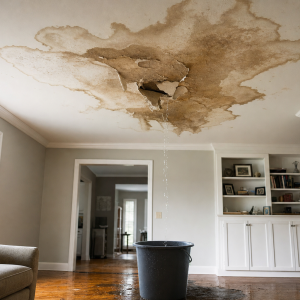
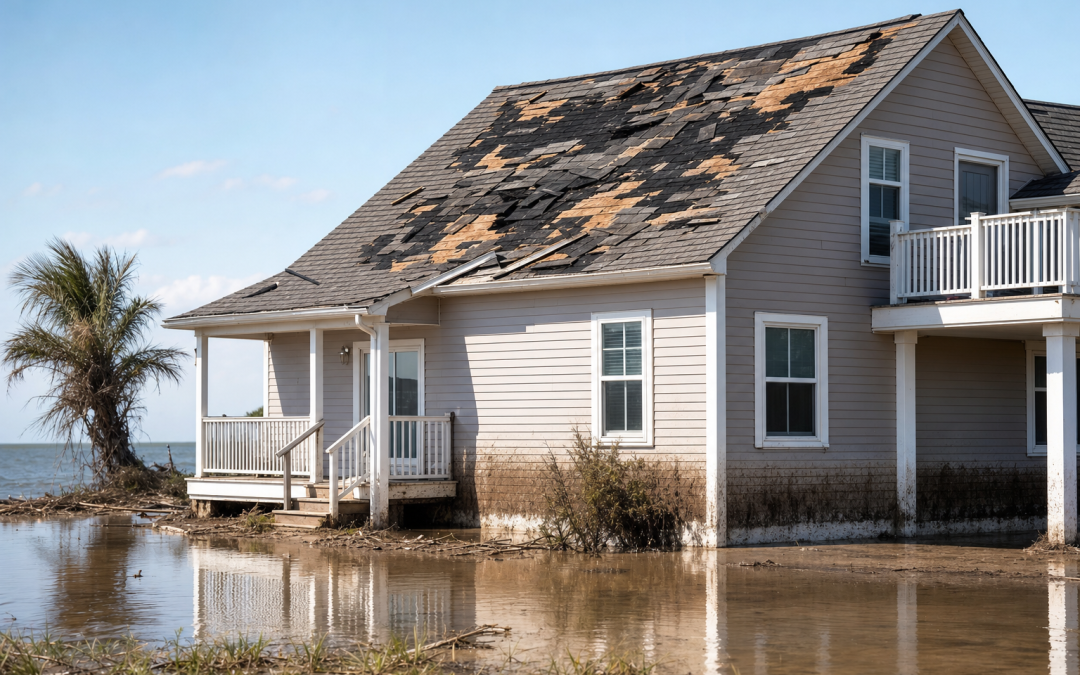
Who Pays When Wind vs Flood Damage Collide in a Hurricane?
In a wind vs flood damage dispute, your homeowners insurance pays for wind damage while a separate flood policy — usually through the National Flood Insurance Program (NFIP) — pays for flood damage. Under the Corban v. USAA ruling, wind damage that happens before floodwater arrives stays covered by your homeowners policy, even if flooding follows.
Key takeaways
- In Corban v. USAA (2009), the Mississippi Supreme Court held that wind damage occurring before floodwaters arrive remains covered, even under an anti-concurrent causation clause.
- Anti-concurrent causation clauses only bar coverage when wind and flood act together to cause an indivisible loss — not when wind causes distinct damage first.
- Once wind damages your home, that loss ‘vests’ as a covered claim, and later flooding cannot retroactively erase the insurer’s obligation to pay for it.
- Coastal homeowners in NC and VA should document damage timelines carefully, because carriers often attribute entire hurricane losses to excluded flood.
- The burden is on the insurer to prove a loss falls within the flood exclusion — not on the homeowner to disprove it.
That short answer hides a fight that plays out after nearly every major hurricane. Tropical systems don’t cause one kind of damage — they cause both, often within hours of each other. Wind peels back shingles and drives rain into the attic in the afternoon; storm surge or a swollen creek pushes water through the first floor that night. When the adjuster shows up, the question becomes: which policy owes for what?
Two Policies, Two Very Different Payers
- Homeowners insurance covers wind, wind-driven rain that enters through storm-created openings, fallen trees, and roof damage.
- Flood insurance (NFIP or private flood) covers rising water — storm surge, overflowing rivers, and surface flooding — but typically with lower limits and stricter payout rules.
- No flood policy? Then any damage the insurer labels “flood” may be paid at zero, which is exactly why the wind vs flood damage classification matters so much.
What Corban v. USAA Says, in Plain Language
Corban v. USAA came out of the Hurricane Katrina litigation in Mississippi. In simple terms, the court held that when wind damages your home first, that loss is covered the moment it happens — and flooding that arrives later doesn’t erase or “take back” that coverage. An insurer can’t point to the flood, invoke its anti-concurrent causation clause, and deny everything. Wind damage that occurred before the water rose remains a covered wind loss.
Why This Matters Right Now in NC and VA
Homeowners across North Carolina and Virginia are squarely in the path of peak tropical-storm season, and the same one-two punch — wind first, water second — plays out from the coast to inland communities where hurricane remnants dump rain and spin off damaging gusts. When both perils hit the same house, some insurers push the entire loss into the “flood” bucket, shrinking or eliminating what they owe under the homeowners policy.
Knowing the Corban principle gives you a starting position: if you can show the wind got there first — a torn-open roof, snapped trees, rain-soaked ceilings above the water line — that damage belongs on your homeowners claim. If a hurricane remnant has already opened up your roof and let rain pour in, see our guide to wind damage claim help in Burlington, NC for what to document before the insurer’s adjuster arrives.
The rest of this article breaks down the Corban case itself, the anti-concurrent causation clauses insurers rely on, and the practical steps to take if your carrier blames everything on flood.
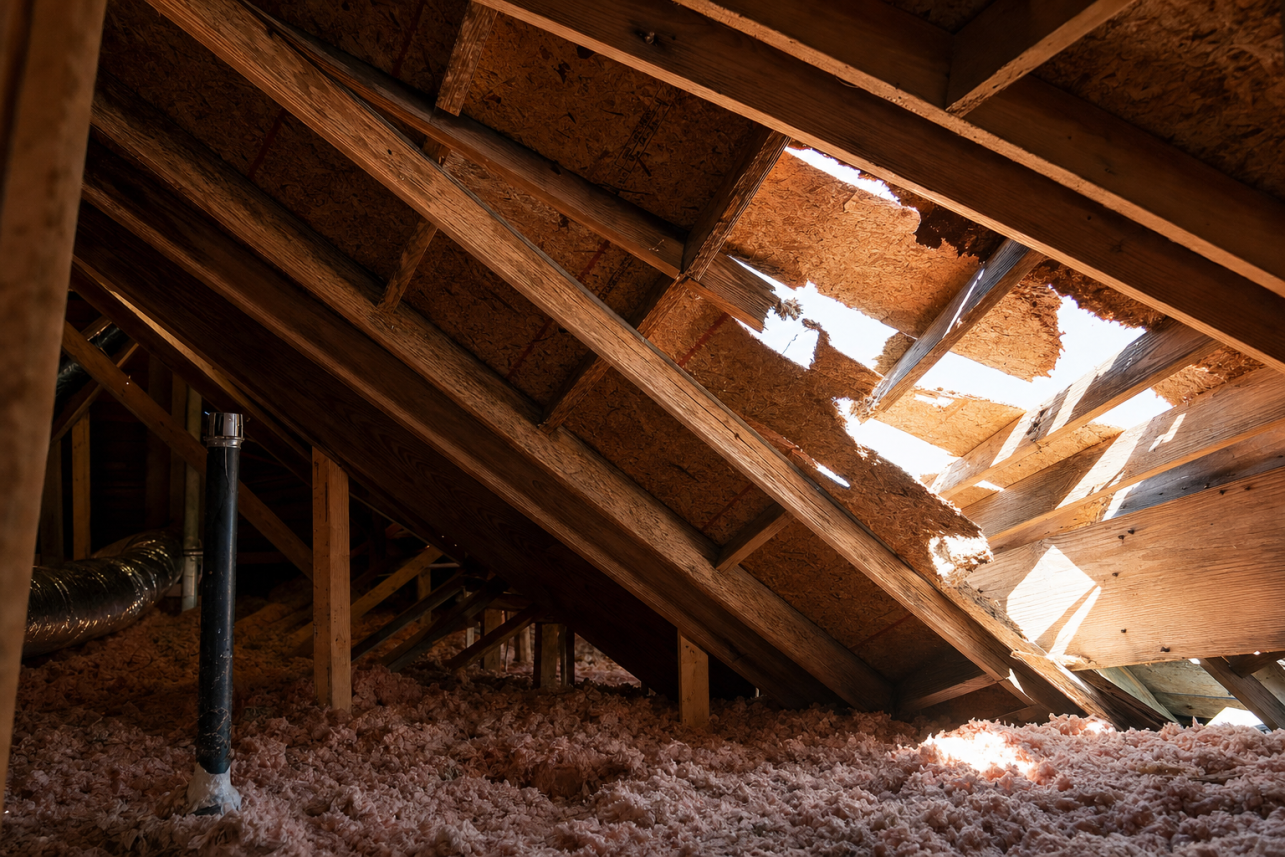
What Happened in Corban v. USAA?
In Corban v. USAA, a Mississippi family whose home was damaged by Hurricane Katrina fought their insurer’s argument that a flood exclusion wiped out all coverage. The Mississippi Supreme Court sided with the homeowners, ruling that wind damage occurring before floodwaters arrived was a separate, covered loss that the insurer still had to pay.
The Corbans owned a home on the Mississippi Gulf Coast when Katrina struck in 2005. Like thousands of coastal properties that day, their house took a one-two punch: hours of hurricane-force winds, followed by a devastating storm surge. When they filed their claim, USAA leaned on the flood exclusion and the policy’s anti-concurrent causation language, arguing that because flooding was involved in the loss, coverage for the damage was excluded — even portions the wind may have caused first.
The Insurer’s Argument
USAA’s position reflected how many carriers read anti-concurrent causation clauses after Katrina:
- The policy excluded flood damage entirely.
- The anti-concurrent language said excluded water damage was not covered even if a covered peril (like wind) contributed to the loss.
- Therefore, once storm surge touched the property, the whole loss allegedly fell under the exclusion.
Why the Mississippi Supreme Court Disagreed
In 2009, the Mississippi Supreme Court rejected that sweeping interpretation. The court’s reasoning came down to a simple but powerful idea: a loss happens the moment the damage occurs. If wind tears off shingles, breaks windows, or lets rain pour into a home before any floodwater arrives, that damage is already a completed, covered loss under the wind portion of the policy. Flooding that shows up later cannot reach back in time and “un-cover” damage the wind already caused.
The court explained that wind and flood acting at different times on different parts of the property are not truly “concurrent” causes at all — they are sequential, separate losses. The anti-concurrent clause, the court held, only applies when the two perils combine at the same time to produce a single, indivisible loss. It cannot be used to erase distinct wind damage simply because water damage happened afterward.
What the Ruling Means in Practice
- Wind damage that occurs first stays covered, even if flooding later destroys the same structure.
- The insurer bears the burden of proving that damage falls within the flood exclusion — homeowners don’t have to disprove flood involvement for every item.
- Wind vs flood damage disputes become questions of sequence and evidence, not automatic denials.
For homeowners, Corban stands as a landmark reminder that a hurricane claim isn’t all-or-nothing. If you’re facing a similar fight over storm-driven roof and rain damage, resources like this wind damage claim help guide can show what documenting the wind’s role actually looks like.
What Is an Anti-Concurrent Causation Clause?
An anti-concurrent causation (ACC) clause is policy language that lets an insurer deny a claim entirely when a covered cause of loss (like wind) and an excluded cause (like flood) combine to damage your property. Insurers often invoke it in hurricane claims, but the Corban ruling limited it to losses where both forces act simultaneously.
What the Clause Actually Says
Most homeowner policies bury ACC language in the exclusions section. While wording varies by carrier, it typically reads something like: “We do not insure for loss caused directly or indirectly by any of the following. Such loss is excluded regardless of any other cause or event contributing concurrently or in any sequence to the loss.” Flood is almost always on that excluded list.
In plain English, the carrier is saying: if an excluded peril plays any role in the damage — even alongside a covered peril — the whole loss can be excluded. Read literally, that phrase “in any sequence” is sweeping, and that’s exactly how many insurers wanted it applied after major hurricanes.
How Insurers Use It in Hurricane Claims
Hurricanes are the classic wind vs flood damage scenario: wind arrives first and tears at the roof, siding, and windows, and storm surge or rising water may follow hours later. Carriers have used ACC clauses to argue that because floodwater eventually touched the property, the entire loss falls under the flood exclusion — including damage the wind caused before any water arrived. The practical result for homeowners:
- Blanket denials of mixed-cause claims, even when clear wind damage exists
- Pressure to rely solely on flood insurance, which many homeowners don’t carry or which has lower limits
- Shifted burden, forcing the homeowner to disprove flood involvement rather than the insurer proving its exclusion applies
How Corban Narrowed the Clause
The Mississippi Supreme Court in Corban v. USAA rejected the broadest reading of ACC language. The court held that the clause only applies when wind and water act together, at the same time, as an indivisible force causing the same damage. It does not apply to sequential losses — damage that wind caused first and that flood later worsened or destroyed.
The reasoning is straightforward: once wind damages your roof, that loss has already occurred and coverage has attached. A flood arriving later cannot retroactively “un-cover” damage that was complete before the water showed up. Two causes striking in sequence are two separate losses, not one concurrent event.
For homeowners, the takeaway is that an ACC clause is not the automatic claim-killer insurers sometimes present it as. If you can establish the timeline — wind first, water second — the covered portion of your loss should remain covered, and the exclusion should only reach damage the flood itself caused.
Does the Corban Ruling Apply to Homeowners in North Carolina and Virginia?
Not directly. Corban v. USAA is a Mississippi Supreme Court decision, so it is binding only in Mississippi. But its reasoning is persuasive authority that attorneys and adjusters cite in hurricane claims across the Southeast — and courts and insurance regulators in North Carolina and Virginia already reject the idea that any flooding automatically wipes out wind coverage.
Binding vs. Persuasive Precedent: What That Means for You
A binding precedent is a ruling that courts in a particular state must follow. A persuasive precedent is a well-reasoned decision from another jurisdiction that a court may adopt when facing a similar question. Because wind vs flood damage disputes look much the same whether the storm hit Biloxi or the Outer Banks, Corban’s core logic — that a homeowner does not lose coverage for wind damage that occurred before flooding arrived — is frequently raised in coastal claims well beyond Mississippi.
How North Carolina and Virginia Courts Approach Causation
Neither state has a rule that the mere presence of flood damage defeats an entire hurricane claim. In practice, causation disputes in both states tend to turn on a few familiar principles:
- Policy language controls. Courts read the actual wording of the policy, including any anti-concurrent causation clause, and typically construe genuine ambiguities against the insurer that drafted the policy.
- Covered losses stay covered. Damage caused by wind — a covered peril — before floodwater ever reached the home is generally a separate, compensable loss, not something erased by later flooding.
- Evidence decides close calls. The sequence and cause of damage is usually treated as a question of fact, which is why documentation and expert analysis matter so much.
What State Insurance Regulators Expect
The North Carolina Department of Insurance and Virginia’s Bureau of Insurance both require insurers to conduct reasonable investigations and to explain the specific basis for any denial. A blanket statement that “flood was involved, so nothing is covered” — without a genuine effort to separate wind damage from flood damage — can raise fair claims handling concerns. Homeowners in both states can file complaints with their regulator if they believe an insurer denied covered wind damage without properly investigating it.
The Bottom Line for NC and VA Homeowners
You cannot walk into a Raleigh or Norfolk courtroom and demand that Corban be applied as controlling law. What you can do is use the same framework Corban made famous: insist that your insurer identify which damage was caused by wind, which was caused by flood, and pay for the covered portion. “Flood was involved” is an argument for allocating the loss — not an automatic reason to deny your entire claim.
What Should I Do If My Insurer Blames All My Hurricane Damage on Flood?
Don’t accept a flood-only conclusion at face value. Request the denial and the adjuster’s causation reasoning in writing, preserve all evidence showing wind struck first — photos, weather data, and witness accounts — and get an independent review of the damage. The burden often shifts back to the insurer once you document wind-caused losses.
Get Everything in Writing
Ask the carrier for a written denial letter that cites the specific policy language and explains how the adjuster determined flood — not wind — caused each element of damage. A vague verbal statement that “it was all storm surge” is not enough. A written explanation locks in the insurer’s position and gives you (and any professional you hire) something concrete to challenge.
Preserve Evidence That Wind Came First
In a wind vs flood damage dispute, the sequence of events is everything. Wind typically arrives hours before storm surge, so documentation of that timeline can be decisive:
- Photograph everything before repairs or cleanup. Take wide shots and close-ups of the roof, siding, windows, and interior, and keep damaged materials like torn shingles when it’s safe to do so.
- Note damage above the waterline. Missing shingles, broken windows, roof deck damage, and water stains on upper floors or ceilings are strong indicators of wind and wind-driven rain, since floodwater rises from below.
- Pull weather data for your address. Recorded wind speeds, gust timing, and surge arrival times from official weather sources help establish that damaging winds hit your property before water did.
- Collect witness accounts. Neighbors who saw your roof peel back or windows blow out before the water rose can provide statements. Doorbell cameras, security footage, and time-stamped phone videos are even better.
- Save all communications. Keep emails, letters, texts, and notes from every phone call with the insurer, including the adjuster’s name and the date.
Don’t Accept the Carrier’s Causation Call Without Independent Review
The insurance company’s adjuster works for the insurance company. Their conclusion about what caused your damage is an opinion — one you’re entitled to test. An independent engineer, contractor, or licensed public adjuster can inspect the property, separate wind damage from flood damage line by line, and prepare a competing damage estimate. In many hurricane claims, an independent inspection reveals substantial wind-caused losses the carrier’s report glossed over or lumped in with flooding.
Act Quickly and Mind Your Deadlines
Policies contain deadlines for disputing a claim decision, submitting proof of loss, and filing suit, and evidence degrades fast once cleanup and rebuilding begin. Document first, dispute promptly, and get qualified eyes on the damage before you sign anything releasing the insurer from further payment.
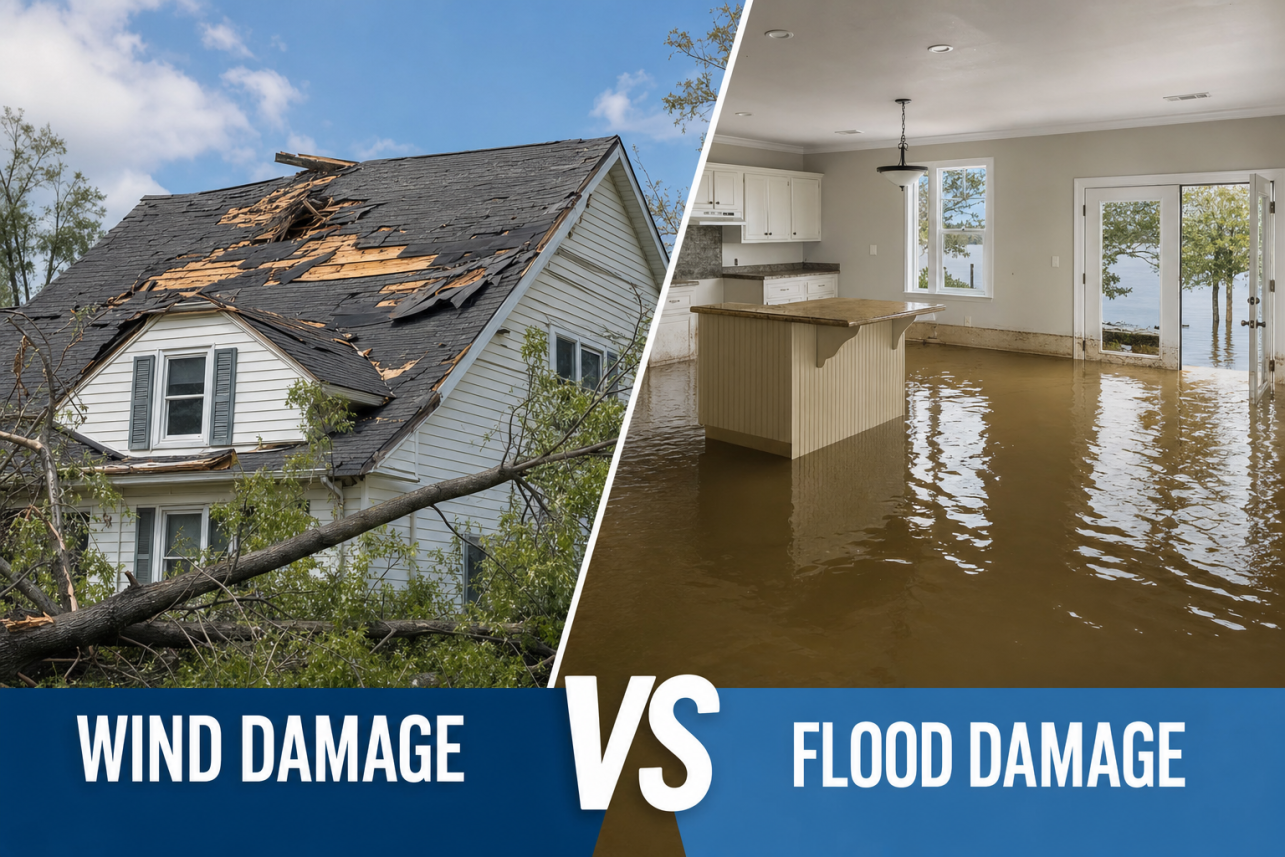
How Can a Public Adjuster Help Prove Wind Damage Came First in a Wind vs Flood Damage Dispute?
A licensed and bonded public adjuster works for you, not the insurance company. They document evidence that wind struck before floodwater arrived — inspecting the roof and elevation lines, building a storm timeline from official weather data, and preparing a detailed inventory — then present that evidence to support your claim under your policy’s terms.
Because the burden of separating wind vs flood damage often falls on the policyholder, the quality of your documentation can make or break the outcome. Here is what a thorough public adjuster typically does.
Physical Evidence: Roof, Openings, and Water Lines
- Roof and exterior inspection: Missing shingles, lifted flashing, torn siding, and broken windows are classic wind signatures. Water intrusion from above tells a very different story than water rising from below.
- Elevation and water-line analysis: Flood damage generally leaves a horizontal high-water mark. Damage found above that line — soaked attic insulation, ceiling stains, wet upper-wall cavities — points to wind-driven rain entering through storm-created openings.
- Interior mapping: Photographing and moisture-mapping each room helps separate what got wet from the top down versus the bottom up.
Meteorological Timelines and Official Data
Establishing sequence is central to these claims. Public adjusters often pair on-site findings with objective weather records — sustained wind speeds, gust reports, and storm-surge timing from sources such as the National Hurricane Center — to show that damaging winds hit your property hours before any flooding began. Neighbor accounts, security footage, and time-stamped photos can reinforce that timeline.
Contents Inventories and Claim Advocacy
A room-by-room contents inventory, with each item’s location and condition noted, helps assign losses to the correct cause and the correct policy. Wind losses typically fall under your homeowners policy, while flood losses belong to a separate flood policy — most commonly through the National Flood Insurance Program (NFIP). A public adjuster organizes the estimate, communicates with the insurer’s adjusters, and pushes back when all damage is lumped under a flood exclusion without supporting evidence.
To be clear, no public adjuster — including us — can promise a specific result. What a licensed and bonded professional can do is make sure your side of the story is documented thoroughly, presented persuasively, and evaluated on the actual evidence rather than assumptions.
A Timely Reminder Before the Next Tropical System
Hurricane season is the wrong time to discover what your policy says. Before the next storm forms, review your homeowners policy for anti-concurrent causation language, confirm whether you carry separate flood coverage, and photograph your home and belongings now. That baseline documentation is one of the strongest tools you can hand a public adjuster if wind and water ever collide at your address.
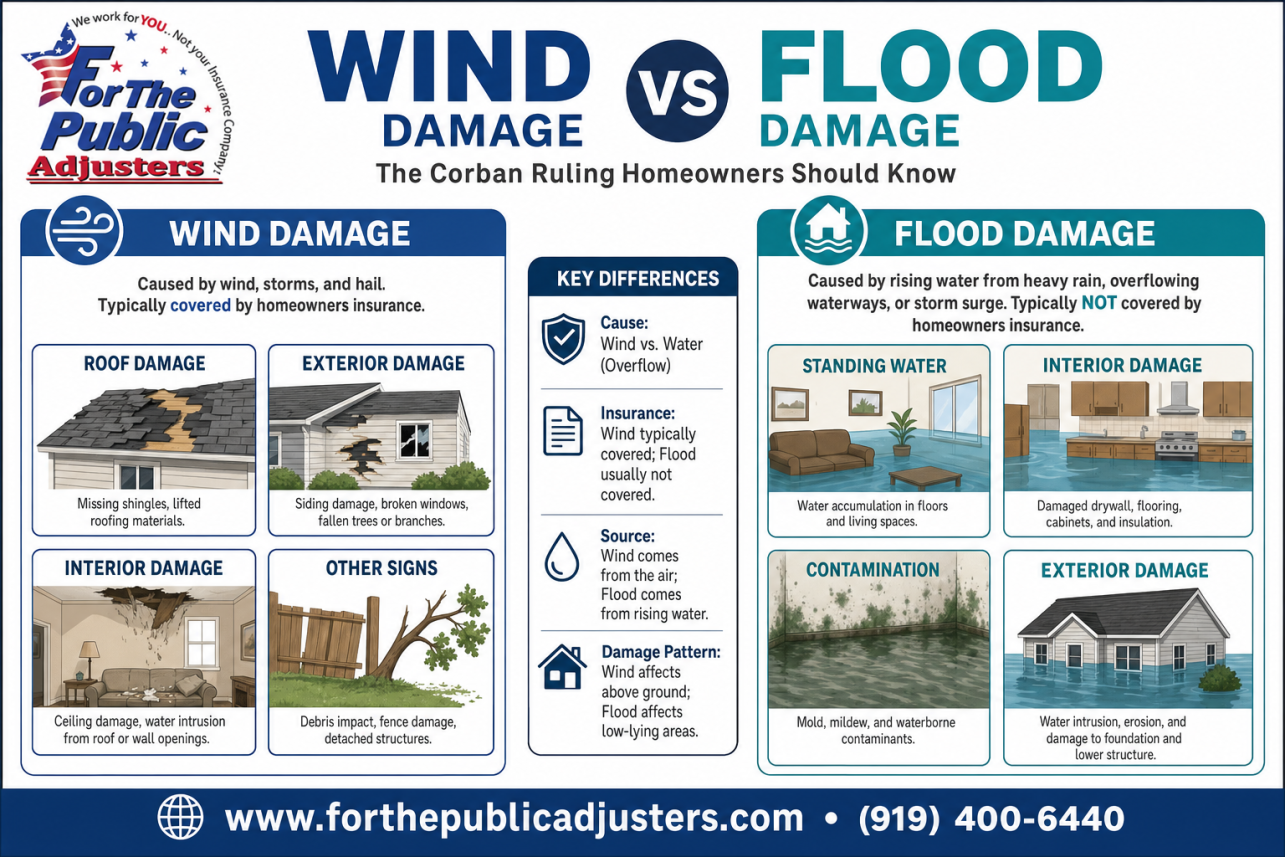
Wind vs Flood Damage: How Coverage Typically Breaks Down After a Hurricane
| Factor | Wind Damage | Flood Damage |
|---|---|---|
| Typical coverage source | Standard homeowners policy | Separate NFIP or private flood policy |
| Common evidence | Roof loss, broken windows, wind-driven rain entry, debris patterns | Water lines, sediment, damage rising from ground level |
| Timing significance under Corban | Covered if it occurred before floodwaters arrived | Excluded under most homeowners policies regardless of timing |
| Who bears the burden of proof | Homeowner shows a covered loss occurred | Insurer must prove the flood exclusion applies |
| Typical carrier dispute tactic | Attributing wind damage to later flooding | Arguing all damage was caused by storm surge |
Illustrative Example: Separating Wind Loss from Storm Surge
Illustrative example
Consider a hypothetical Outer Banks homeowner whose roof was torn open by hurricane-force winds hours before storm surge flooded the first floor. The carrier initially denied the entire claim, pointing to the anti-concurrent causation clause and attributing all damage to flood.
By gathering weather data, neighbor accounts, and time-stamped photos showing roof and interior wind-driven rain damage before the surge arrived, the homeowner established a sequential timeline of distinct losses. Applying the reasoning of Corban, the wind damage that occurred first remained a covered loss under the homeowners policy, and the claim was resolved on that basis. This composite scenario is illustrative only, but it reflects how timeline evidence can defeat a blanket flood-based denial.
Frequently asked questions
Who has to prove whether it was wind vs flood damage after a hurricane?
It depends on the policy language and state law, but generally the insurer must prove an exclusion applies. Under the reasoning in Corban, once you show a covered loss occurred, the carrier bears the burden of proving the damage was caused by excluded flooding rather than covered wind. That’s why documenting your home’s condition before and immediately after the storm is so valuable — it makes it harder for the insurer to attribute everything to flood.
What did the court actually decide in Corban v. USAA?
The Mississippi Supreme Court held that damage caused by wind before floodwaters arrived remains covered under a homeowners policy, even when the policy contains an anti-concurrent causation clause. The court reasoned that once wind causes a loss, that loss has already occurred and coverage attaches — later flooding can’t retroactively erase it. The clause only bars coverage when wind and water act together, indivisibly, to cause the same damage.
What is an anti-concurrent causation clause in a homeowners policy?
It’s policy language saying the insurer won’t pay for damage caused by an excluded peril, like flood, even if a covered peril, like wind, contributes to the loss at the same time or in sequence. Carriers have used these clauses to deny entire hurricane claims. Corban limited that tactic by holding the clause doesn’t apply to damage wind caused on its own before flooding arrived.
Does the Corban ruling apply to homeowners in North Carolina or Virginia?
Not directly — Corban is a Mississippi Supreme Court decision, so it binds only Mississippi courts. However, courts in other states often find its reasoning persuasive, and policyholder attorneys in North Carolina and Virginia cite it when fighting denials based on anti-concurrent causation clauses. Whether a NC or VA court follows Corban depends on that state’s own case law and the specific policy language, so consult a local insurance attorney.
How do adjusters tell the difference between wind and flood damage?
They look at physical evidence: waterlines on walls indicate flooding, while missing shingles, broken windows, and water intrusion from the roof down point to wind. Damage above the flood line is typically wind-driven. Engineers may examine debris patterns, the direction structures fell, and neighboring properties. The sequence matters too — in most hurricanes, damaging winds arrive hours before storm surge, which supports arguments that certain damage occurred first from wind.
What should I do if my insurance company blames my hurricane damage on flooding?
Don’t accept the denial at face value. Request the carrier’s engineering or adjuster reports in writing, gather your own evidence — photos, videos, weather data showing when winds hit versus when surge arrived, and neighbor accounts — and consider hiring an independent engineer or public adjuster. If the carrier won’t budge, an insurance attorney can evaluate whether the denial misapplies the anti-concurrent causation clause. Many wrongful denials get reversed once challenged with evidence.
What evidence helps prove wind caused damage before floodwaters arrived?
Timestamped photos and videos during or right after the storm, security or doorbell camera footage, weather service data showing wind speeds and surge timing at your location, eyewitness statements from neighbors, and physical evidence like roof damage or broken windows above the waterline. An independent structural engineer’s report analyzing the damage pattern is often the strongest single piece of evidence in disputed wind-versus-water claims.
Does homeowners insurance cover any flood damage at all during a hurricane?
Almost never. Standard homeowners policies exclude flooding, including storm surge, rising water, and overflow from bodies of water. Flood coverage requires a separate policy, typically through the National Flood Insurance Program or a private flood insurer. That gap is exactly why carriers try to classify hurricane damage as flood — it shifts the loss off their books. Coastal homeowners should carry both policies so damage is covered regardless of which peril caused it.
What are the biggest mistakes homeowners make with wind vs flood damage claims?
Common mistakes include accepting the first denial without question, failing to photograph damage before cleanup, throwing away damaged materials the insurer might need to inspect, missing proof-of-loss deadlines, giving recorded statements that speculate about causation, and not reading the actual policy language. Another big one: assuming a flood policy payout settles everything, when wind damage may entitle you to a separate recovery under your homeowners policy.
How long do I have to dispute a denied hurricane damage claim?
Deadlines vary by state and by policy. Many policies impose their own suit-limitation periods that can be shorter than the state’s statute of limitations, sometimes requiring legal action within a year or two of the loss. Check your policy’s conditions section and your state’s rules, and act quickly — waiting too long can permanently bar an otherwise valid claim, even if the insurer’s denial was clearly wrong.
Related local pages
- Public Adjuster Burlington NC: Fire, Water & Storm Damage Claims Handled On The Policyholder’s Side
- Public Adjuster Elon NC — Fire & Water Claim Help For Alamance County Homeowners
- Public Adjuster Haw River NC — Fire, Flood & Storm Claim Help For Older Mill-Town Homes Along The Haw
If your carrier is calling your hurricane wind damage a ‘flood loss,’ don’t accept that answer at face value. Our licensed and bonded public adjusters serve homeowners across North Carolina and Virginia, and we know how to document which damage happened first. Contact us today for a free, no-obligation claim review — before you sign anything or accept a lowball settlement. Get in touch.
Last updated: August 10, 2026