
When you file an insurance claim for water damage, the process starts the second you find the leak. It’s about meticulously documenting everything with photos and videos and then, finally, notifying your insurance company. But make no mistake, the real fight for fair compensation truly begins after that initial call. Large insurers are notorious for using your own words and actions against you to lowball or deny your claim.
Your First Moves After Discovering Water Damage
The moments after you find water pouring into your home or business are pure chaos. It’s stressful. Your first instincts are probably to start cleaning up and get your insurer on the phone, but how you handle these first few steps can make or break your entire fight against them.
Big insurance companies like State Farm and Allstate have a well-oiled process designed to protect their profits—not necessarily to get your property back to normal. They count on policyholders making a few common mistakes in the first 24 hours to justify delaying or underpaying claims.
Your primary goal here is to build an undeniable foundation for your dispute before their adjuster even sets foot on your property. That means your first actions must be strategic and deliberate.
Prioritize Safety and Stop the Damage
Before you touch anything, make sure the area is safe. If water is anywhere near electrical outlets or appliances, kill the power at the breaker box immediately. The very next thing you do is stop the source of the water if you can. This might mean shutting off the main water supply to your property.
This is a non-negotiable step. Insurance companies will look for any excuse to deny a claim, and one of their favorites is arguing that you failed to mitigate further damage. By taking swift action to stop the leak, you take that argument right out of their playbook.
The visual guide below breaks down the essential first actions to take after discovering water damage.
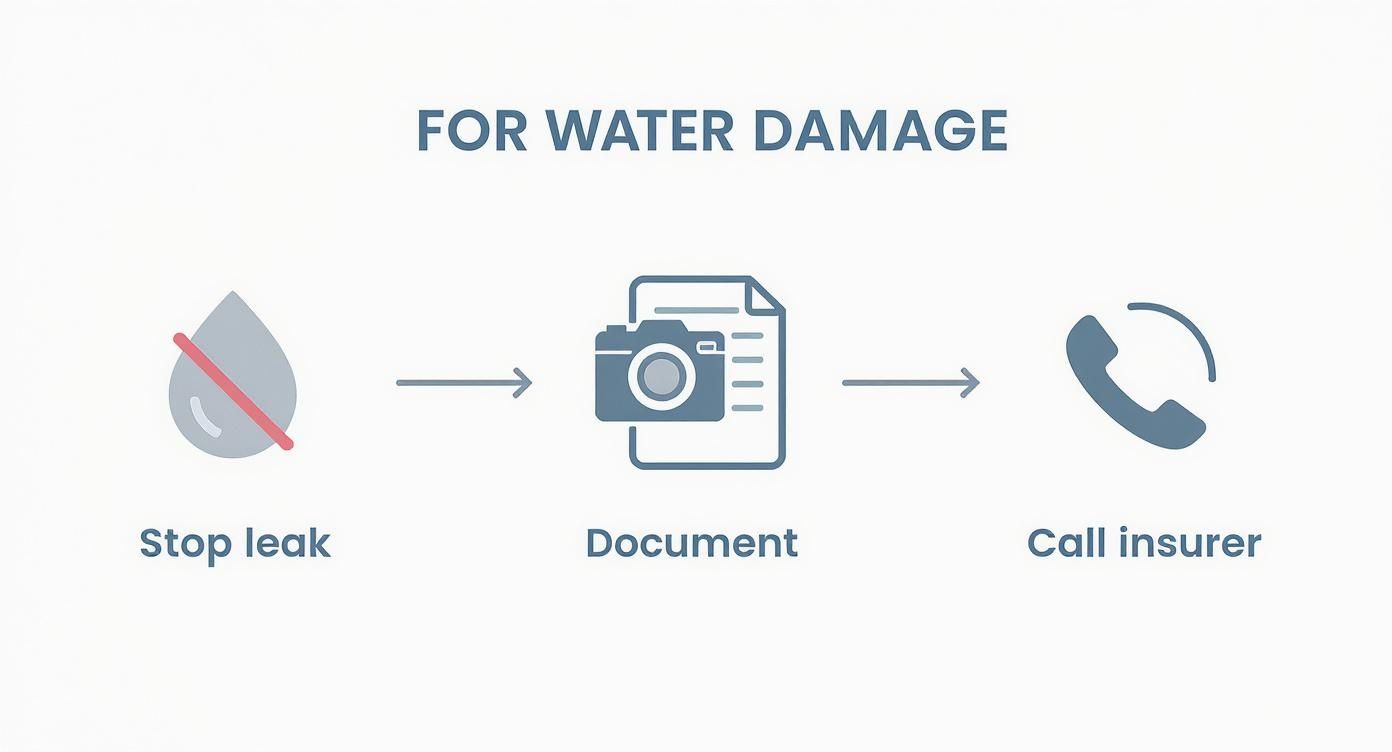
This process highlights the critical sequence: stop the leak to prevent more loss, document everything before you change a thing, and then contact your insurer.
Document Everything Before a Single Thing is Moved
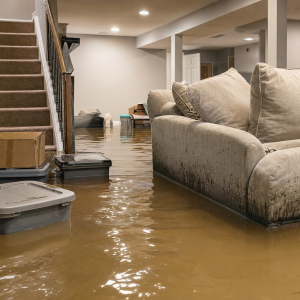
Your smartphone is your most powerful weapon in this fight. Before you move one piece of furniture or even think about mopping up, document everything. Take wide-angle photos and videos of the entire affected area. Then, get in close. Get shots of the saturated drywall, the warped flooring, and every single soaked belonging.
Crucial Tip: Narrate your videos. State the date and time, and describe what you are seeing. Pan slowly across the room, showing how the water traveled. This creates a timestamped record that is much harder for an adjuster to dispute than still photos alone.
Insurers often try to argue that damage was pre-existing or not as bad as you claim. Meticulous, immediate documentation is your best defense against these lowball tactics. This initial evidence becomes the bedrock of your claim, proving the extent of the loss from the very beginning.
Make the Initial Call Without Damaging Your Insurance Claim for Water Damage
When you call your insurance company, keep it short and factual. State your name, your policy number, and that you have experienced a insurance claim for water damage. That’s it. Do not guess about the cause of the damage or offer your opinion on how bad it is. An adjuster can and will use any admissions of fault or downplayed descriptions against you later.
It’s a startling but common scenario. In fact, water damage is the second most frequent reason for homeowners insurance claims, making up about 29.4% of all property claims. With roughly 1 in 60 insured homes filing a water damage claim each year, insurers have perfected their methods for delaying and minimizing these payouts.
Remember, the first call is just a notification. You’ll provide your detailed evidence later. If you’re wondering about specific coverages, you can read our guide that explains if homeowners insurance covers water damage. Your focus right now is on protecting your rights and setting the stage for a fair fight.
Building an Undeniable Record of Your Loss
When you’re standing in the middle of a water-damaged home, the last thing you want is a drawn-out fight with your insurance company. But let’s be honest—big carriers like State Farm or Farmers often build their strategy around ambiguity and delay. They count on you being overwhelmed and disorganized to justify a lowball offer.
This is your battle plan. It’s how you build a powerful, undeniable record of your loss that leaves them no room to argue.
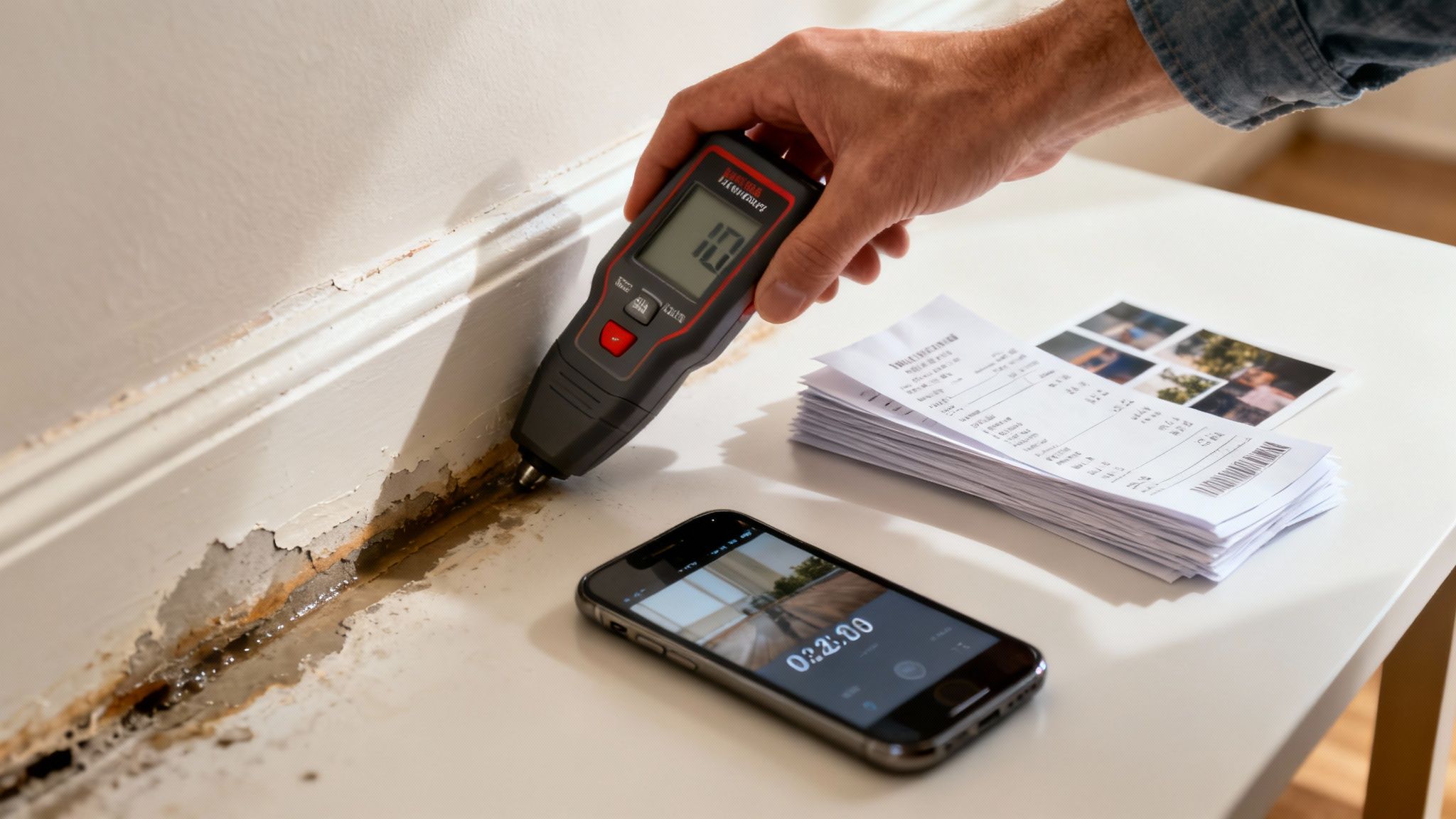
The documentation you gather isn’t just a formality. It’s the core evidence you’ll use to dismantle the adjuster’s arguments and prove the true value of what you’ve lost. Insurers win when policyholders are unprepared. Your job is to be the exact opposite: meticulous, thorough, and ready for a fight.
Create a Detailed Inventory of Damaged Property
The company adjuster’s goal is often to get in and out quickly. They’ll sweep through, cataloging the most obvious damage while conveniently “overlooking” smaller items or the hidden extent of the destruction. Your mission is to leave them zero room for omission.
Start by creating your own comprehensive inventory of everything the water touched. Go room by room, listing every single item—from the big-ticket furniture right down to the smallest personal belongings.
Don’t just write “books”; list the titles if you can. Don’t write “clothes”; specify the type and brand. I know it’s tedious, but this level of detail is absolutely essential when you’re up against an adjuster looking for any reason to pay you less.
For the structure of your home, be just as specific:
- Drywall: Note the square footage of every affected wall and ceiling.
- Flooring: Identify the type—hardwood, laminate, carpet—and measure the total area that needs to be ripped out and replaced.
- Baseboards and Trim: Get a tape measure and document the linear feet that are warped, stained, or swollen.
- Cabinets: Note the materials (MDF, plywood, solid wood) and dimensions, documenting any swelling or delamination you see.
By creating your own detailed loss inventory, you seize control of the narrative. You’re no longer just reacting to the adjuster’s incomplete list; you are presenting them with a factual account they are forced to address, item by item.
To make sure you don’t miss a thing, we’ve put together a checklist of the critical evidence you need. This isn’t just about taking a few pictures; it’s about building a fortress of proof that your insurance company can’t ignore. Each piece of evidence serves a specific purpose in defending the true value of your claim.
Critical Documentation Checklist for Your Water Damage Claim
| Evidence Type | Why It’s Critical | Pro Tip |
|---|---|---|
| Photos & Videos | Visual proof is your strongest weapon. It documents the initial state of the damage before any cleanup begins. | Shoot wide shots of each room, then move in for close-ups of specific damage. Narrate your videos, stating the date, time, and what you’re recording. |
| Damaged Item Inventory | Creates a detailed record of every single item lost, preventing the adjuster from “forgetting” things on their own list. | Use a spreadsheet. Include the item, brand, estimated age, and where you bought it. Don’t throw anything away until the adjuster has seen it. |
| Pre-Loss Photos | Counters the common adjuster tactic of claiming your property was in poor condition before the water damage. | Look for photos from holidays, birthdays, or family gatherings that show your furniture, flooring, and belongings in their original state. |
| Purchase Receipts | Establishes the original cost and age of high-value items, making it harder for the insurer to devalue them. | Check old emails, credit card statements, and online retail accounts (like Amazon or Wayfair) for digital receipts if you can’t find the paper ones. |
| Independent Repair Estimates | Provides a realistic, market-rate cost for repairs, directly challenging the lowball estimate from the insurer’s “preferred” contractor. | Get at least two quotes from reputable, local contractors who work for you, not the insurance company. Make sure their estimates are detailed. |
| Communication Log | Creates a timeline of every interaction with your insurance company, which is invaluable in proving delays or bad faith. | Note the date, time, who you spoke with, and a summary of the conversation for every single phone call and email. |
This checklist is your starting point. The more thorough you are, the stronger your position will be when negotiations begin. Don’t let the insurance company dictate the value of your loss—prove it to them with undeniable evidence.
Capture Evidence That Disarms Adjuster Arguments
Your photos and videos need to do more than just show a wet floor. They need to tell a story that anticipates and shuts down the insurance company’s favorite tactics for minimizing claims.
Focus on capturing specific, technical details that are hard to argue with. If your mitigation company uses a moisture meter, get your phone out and take a video of them taking readings in different areas. That digital readout is scientific proof of saturation levels—something an adjuster can’t just dismiss as “superficial damage.”
Timestamping is also a game-changer. Most phones do this automatically, but it never hurts to state the date and time out loud when you’re recording a video. This simple step can stop an insurer from claiming the damage got worse because you didn’t act fast enough.
The Power of Pre-Loss Proof and Independent Estimates
One of the biggest hurdles you’ll face is proving what your property was like before the water hit. An adjuster from a company like Allstate might look at your five-year-old sofa and claim it was already worn out to justify a rock-bottom replacement value. This is where your pre-loss evidence becomes your trump card.
Dig up any photos or videos of your home before the damage—holidays, birthdays, you name it. These everyday snapshots establish the real condition and quality of your belongings. While you’re at it, hunt down receipts, credit card statements, or original purchase orders for any big-ticket items. For a more detailed walkthrough of this entire process, you can find some powerful insights on how to file a property damage claim and build an airtight case from day one.
Finally, and this is critical: never, ever rely solely on the estimate provided by the insurer’s preferred contractor. Their loyalty is to the insurance company that feeds them work, not to you. Get at least two independent estimates from reputable, local contractors you trust. These competing quotes establish the true market rate for repairs, making it much harder for your insurer to defend an offer based on the cut-rate pricing they’ve negotiated with their network of vendors.
How to Handle the Insurance Adjuster Inspection
When your insurance company’s adjuster schedules their visit, it’s easy to feel a sense of relief—like help is finally on the way. But you need to be crystal clear on their role: the adjuster is not your advocate. They are a trained employee or contractor whose one and only job is to protect the insurance company’s bottom line by minimizing your claim.
This inspection is where your hard work and meticulous evidence go head-to-head with their playbook of delay, denial, and lowball tactics. They aren’t there to find all the damage; they are there to find reasons to pay you as little as your policy allows. How you prepare for this meeting is every bit as critical as the documentation you’ve already gathered.

Setting the Stage for the Inspection
Before that adjuster even sets foot on your property, get all your documentation organized and ready to hand over. This means your detailed inventory list, all photos and videos, and any repair estimates you’ve already gotten from independent contractors. Make copies for them. Never, ever hand over your originals.
This simple act of being organized sends a powerful message: you are serious, you are prepared, and you will not be pushed around. It forces them to work from your comprehensive list of damages, not just what they happen to glance at during a quick walkthrough.
The entire process can feel like a nightmare, especially when you’re already in a crisis. Research shows that while 47% of U.S. homeowners have some kind of property inventory, most are completely unprepared for the adjuster’s scrutiny. This inspection is the moment they decide what is—and isn’t—covered. You can see more on water damage claim statistics at ConsumerAffairs.com.
What to Say and What to Avoid
During the inspection, every word you say matters. The adjuster is actively listening for anything they can twist to limit your claim. Stick to the facts. Let your documentation do the talking.
What you SHOULD do:
- Point out all damage: You are the tour guide. Walk the adjuster through your home and point out every single item on your inventory list. Show them the warped baseboards, the stained ceiling, and the moisture readings you took.
- Answer questions factually and concisely: If they ask when it happened, give them the date and time. If they ask what caused it, state the facts— “The supply line to the dishwasher burst.” Nothing more.
- Provide your evidence: Hand them the copies of your photos, videos, inventory, and independent estimates.
What you should NOT do:
- Do not speculate: Never guess about the cause or admit any fault. Don’t say things like, “I guess that old pipe finally gave out.”
- Do not downplay the damage: Avoid saying, “It’s not that bad,” or “We caught it pretty quickly.” Let the evidence show the true extent of the loss.
- Do not sign anything: The adjuster might offer you an on-the-spot settlement and pressure you to sign a release. Don’t do it. It is almost certainly a lowball offer designed to close your claim fast and cheap.
Key Takeaway: Treat this inspection like a business transaction, not a friendly chat. Your goal is to present irrefutable proof of your loss. The adjuster’s goal is to find reasons to pay you less.
Countering Common Adjuster Tactics
Insurance giants like Allstate and State Farm have a well-worn playbook their adjusters use to control the cost of every claim. Knowing their tactics is your best defense.
A classic move is for the adjuster to bring their “preferred” contractor to the inspection. This contractor isn’t there to give you a fair estimate; they’re there to write up a lowball number that just so happens to align with what the insurance company wants to pay. Politely decline their “help” and state that you will be getting your own estimates from independent professionals who work for you.
Another common tactic is to misrepresent your policy language. An adjuster might casually tell you that something like mold, which resulted directly from the water damage, isn’t covered. Your response should always be, “Show me exactly where it says that in my policy, in writing.” Never take their word for it.
Challenging their interpretations and understanding these games is crucial. In fact, our guide on how to negotiate with an insurance adjuster dives deep into strategies for these exact scenarios.
By controlling the inspection, presenting overwhelming evidence, and calling out their tactics, you completely shift the power dynamic. You’re no longer just a victim of water damage; you’re a prepared policyholder demanding the fair settlement you are rightfully owed.
Fighting a Lowball Offer or Unfair Denial
That settlement offer from your insurance company should bring a wave of relief. Instead, for far too many homeowners, it’s a gut punch. It’s the moment you realize the real fight is just getting started.
A shockingly low offer or an outright denial isn’t the final word—it’s a calculated opening move from insurers like State Farm and Allstate. They’re betting you’ll get frustrated and just give up.
Don’t fall for it. This is a common tactic designed to protect their bottom line, and it’s your cue to shift gears from just documenting your loss to actively disputing their decision. You have rights, and there are specific, powerful steps you can take to make them pay what you’re actually owed.
Countering Their Go-To Denial Excuses
Insurance companies keep a playbook of excuses to deny water damage claims. Knowing what they are is the first step to tearing their arguments apart. They are counting on you not knowing the fine print in your policy or the real-world specifics of property damage.
Two of the most common excuses you’ll hear are:
- “Gradual Damage”: They’ll claim the leak was slow and happened over a long time, trying to frame it as a maintenance issue you should have caught.
- “Maintenance Issues”: This is their catch-all excuse. They’ll try to blame you for the loss by saying your property was in bad shape before the incident ever happened.
Your job is to prove the damage was sudden and accidental. Go back to your time-stamped photos and videos from the second you discovered the problem. If you had a plumber or contractor come out, get a report from them stating a specific part failed abruptly—like a burst washing machine hose or a cracked supply line. That expert evidence completely shatters their narrative that you neglected your home.
The Power of a Competing Estimate
Never, ever accept the insurance company’s repair estimate at face value. This is especially true if it comes from their “preferred” contractor. These vendors often have backroom agreements with the insurer to keep repair costs as low as possible, which only benefits the insurance company, not you. It’s a huge conflict of interest.
Your strongest weapon against a lowball offer is a detailed, line-item estimate from a trusted, independent contractor or a public adjuster who works for you. This competing estimate must be based on real-world local material and labor costs, and it has to reflect the full scope of work needed to put your property back to how it was before the disaster.
When you hand that professional estimate to your adjuster, it gets a lot harder for them to defend their ridiculously low number.
A low settlement offer isn’t a negotiation; it’s a test of your resolve. By providing your own professional evidence of the true repair costs, you force the insurance company to defend their numbers against an industry expert who works for you.
Writing a Formal Demand Letter
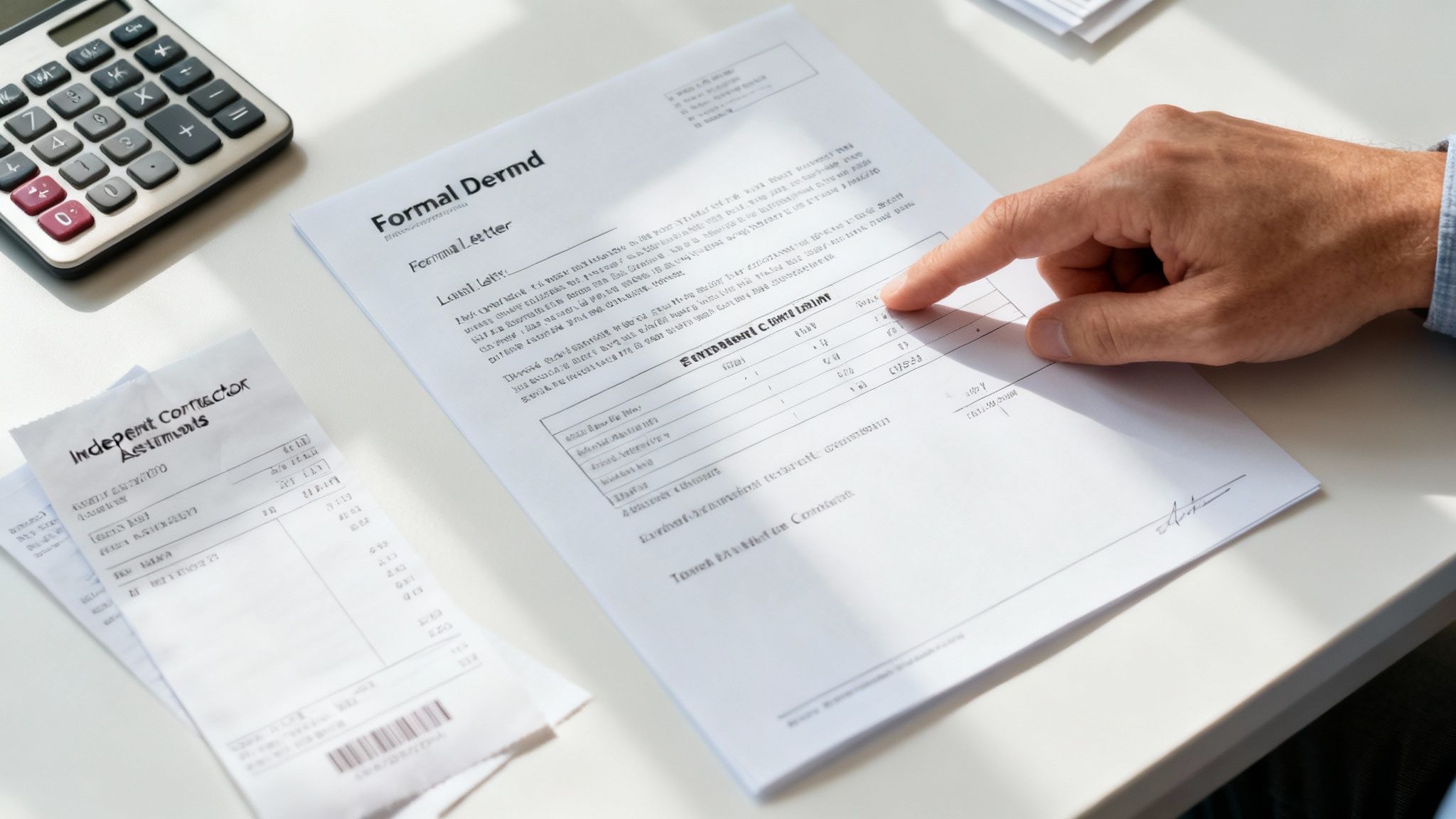
If the adjuster still won’t budge after seeing your independent estimate, it’s time to escalate. A formal demand letter is a professional but firm communication that lays out the facts, proves their offer is inadequate, and demands a fair settlement.
Your letter needs to include:
- Your name, address, and claim number.
- A brief, factual summary of the water damage event.
- A clear statement that you reject their settlement offer.
- A copy of your independent contractor’s or public adjuster’s detailed estimate.
- The specific settlement amount you are demanding and a reasonable deadline for them to respond.
This letter creates a crucial paper trail. It shows the insurance company you’re serious and won’t be pushed around. It officially puts them on notice that you’re prepared to fight for what’s right.
Understanding Gaps in Your Coverage
It’s also critical to know that some things just aren’t covered by standard policies. For example, damage from flooding is almost always excluded from a standard homeowners policy—that requires separate flood insurance.
This is a critical distinction, and insurers will absolutely use it against you. This coverage gap means that a huge amount of water-related damage goes uninsured. In fact, only about 40% of global economic losses from disasters are actually covered by insurance, highlighting a major ‘protection gap.’ You can get more insights on this and other key water damage trends for homeowners.
If your denial is based on a policy exclusion, you need to read your policy word for word to make sure their interpretation is even correct before deciding on your next move.
When Your Insurer Still Refuses to Pay
You did everything by the book. You documented the loss perfectly, you handed them a professional estimate, and you even sent a formal demand letter. And still, your insurance company refuses to pay what your water damage claim is actually worth.
This isn’t just frustrating; it’s a calculated business strategy. The carrier is playing a game of attrition, hoping to wear you down until you either accept their garbage offer or just give up entirely.
This is where the real fight begins. You stop negotiating and start bringing in outside authorities to hold their feet to the fire. The big insurance companies are betting you won’t know where to turn next. It’s time to prove them dead wrong.
Filing a Formal Complaint with the Department of Insurance
Every state has a Department of Insurance (DOI), a government agency that exists for one reason: to regulate insurance companies and protect people like you. Filing a formal complaint is a powerful—and free—way to escalate the fight.
The moment the DOI gets involved, your claim is no longer just another file on a busy adjuster’s desk. It becomes an official inquiry that the insurance company is legally required to respond to.
This isn’t just about tattling. A DOI complaint can trigger a full-blown investigation into your insurer’s conduct. If they’re caught violating state laws on fair claim practices, they can be hit with serious fines and penalties. Suddenly, they have a powerful financial incentive to stop messing around and take you seriously.
To file an effective complaint, you need to give the DOI a clear, concise summary of the dispute. Make sure you include:
- Your full contact information and policy number.
- The insurance company’s name and the adjuster you’ve been dealing with.
- A chronological timeline of what happened, including the date of loss, when you filed, and all key communication dates.
- A clear explanation of the problem, whether it’s an unreasonable delay, a lowball offer, or an outright denial.
- Copies of all your documentation—photos, your independent estimate, emails, letters, everything.
A well-documented complaint to the Department of Insurance forces your insurer to justify their actions to a state regulator. It’s one of the most effective tools you have to break through their wall of delays and denials.
Knowing When It’s Time to Bring in an Expert
A DOI complaint is a fantastic step, but sometimes, it’s not enough to make a stubborn carrier do the right thing. If you’re dealing with massive damages, a denial based on tricky policy language, or clear signs of bad faith, it might be time to call a Public Adjuster who specializes in fighting insurance companies.
Look for these red flags—they’re signals you may need legal help:
- The insurer is twisting the facts or misrepresenting the language in your own policy.
- They refuse to give you a reason for their denial in writing.
- The damages are huge, and the gap between their offer and your estimate is massive.
- You suspect they’re acting in bad faith by intentionally stalling or denying a valid claim for no good reason.
Water damage and flooding are a massive global problem. In one recent year alone, natural disasters caused over $214 billion in economic losses, with $105 billion of that being insured. What’s shocking is that more than 90% of those global insured losses happened right here in the United States, driven by storms and flooding. You can learn more about the staggering impact of these disasters from Insurance Journal.
With that much money at stake, it’s no wonder they fight tooth and nail to minimize every single payout. Don’t let your legitimate claim become just another number that boosts their bottom line. When your insurer digs in their heels, it’s not the end of the road. It’s the signal that it’s time to bring in the heavy hitters and get the fair settlement you deserve.
If your Public Adjuster is not getting through to the carrier they will let you know the right time to bring in an attorney or not. having an expert sends the one message they can’t ignore: you will not be bullied. If and when an attorney makes sense it moves the battle to a legal arena where their dirty tricks can be exposed and punished.
Common Questions When Fighting a Water Damage Claim
When you’re going toe-to-toe with your insurance company over a water damage claim, it’s designed to make you feel isolated and overwhelmed. They wrote the policy, they have the adjusters, and they rely on confusing language to wear you down.
But you’re not powerless. Here are the real answers to some of the most common questions we hear from property owners who are in the middle of this exact fight.
What Exactly Is Insurance Bad Faith?
“Bad faith” isn’t just a term for lousy customer service. It’s when your insurance company actively works against the promises made in your policy, using unreasonable tactics to deny or underpay what you’re owed. This goes way beyond a simple disagreement over the cost of new drywall.
We’re talking about actions like dragging their feet for months without a legitimate reason, refusing to even look at the evidence you’ve provided, or twisting the words in your policy to get out of paying.
Keep an eye out for these red flags:
- They won’t give you a reason for their denial in writing.
- They dangle a quick, lowball settlement offer, pressuring you to sign before you even know how bad the damage really is.
- Your paperwork conveniently gets “lost,” or your calls and emails go into a black hole for weeks at a time.
If any of this sounds familiar, start documenting everything. Every call, every email, every missed deadline. This paper trail becomes your most powerful weapon to prove they aren’t dealing with you fairly.
Can I Hire My Own Contractor?
Yes, absolutely. In fact, you should. It is your fundamental right to hire a trusted, independent contractor to repair your property. Don’t be surprised when insurers like State Farm or Allstate try to steer you toward their “preferred vendors.” You should be immediately skeptical.
Think about it: these vendors get a constant pipeline of work from the insurance company. In return, there’s an unspoken agreement to keep repair costs down. This entire arrangement is built to protect the insurer’s profits, not to ensure your home is properly restored. Their estimate is just a reflection of what the insurance company wants to pay—not what the job actually costs to do right.
Always get at least two estimates from reputable, local contractors who work for you, not the insurance company. This is the only way you’ll get a clear picture of the real-world cost for quality repairs and gain the leverage you need to dismantle a lowball offer.
Don’t let your insurer dictate who rebuilds your home. Choosing your own contractor puts you back in control of the quality and scope of the work, making sure your property is put back together correctly.
How Long Can My Insurer Legally Take to Pay?
They can’t leave you hanging forever. While the specific timelines can differ between states, most have laws on the books that force insurance companies to acknowledge, investigate, and settle claims in a reasonable amount of time.
If you’re stuck in a cycle of endless delays and radio silence, it’s often a deliberate strategy. They’re betting that you’ll eventually get so exhausted and desperate that you’ll just take whatever scraps they throw your way.
Don’t let them win this waiting game. Send a formal letter via certified mail demanding a written update on your claim’s status and a clear timeline for payment. If they ignore that or give you another runaround, your next step is to file a formal complaint with your state’s Department of Insurance. That usually gets their attention and forces them to act.
How can I prove the water damage was sudden and accidental and not a maintenance issue?
You can prove it was sudden by obtaining a detailed report from a licensed plumber or restoration company immediately after the loss. This report must explicitly state the source of the leak, the nature of the failure (e.g., burst connection, sudden crack), and that it was not due to long-term neglect. You should consider speaking with a local Public Adjuster as well.
What steps should I take immediately after the damage to avoid having my claim denied later?
You have a duty to mitigate further damage. Immediately take clear, date-stamped photos and videos of the damage and its source before cleanup begins. Then, safely stop the water source (if possible) and hire a professional water mitigation company to dry the structure, keeping all invoices and receipts. This is all new to most people. It's a good idea to consult with a Public Adjuster before doing anything.
What is the "Proof of Loss" and what role does it play in fighting a disputed claim?
The Proof of Loss (POL) is a formal, sworn statement detailing your damages and the compensation you are claiming. If your claim is disputed, a professionally prepared POL (often done by a Public Adjuster) backed by expert documentation forces the insurer to address the true valuation of your loss, not just their low estimate.
My claim was denied because of a mold exclusion. How do I fight this?
Most standard policies exclude mold damage if it is a consequence of an unrepaired, gradual leak. To fight this, you must first successfully dispute the denial of the original water damage event by proving it was sudden. If the initial water event is covered, resulting mold damage related to the covered event often must be addressed. A Public Adjuster can answer all your questions on this issue.
Can a Public Adjuster help me re-open a water damage claim that was already denied or underpaid?
Yes. Public Adjusters specialize in fighting denials. They review the entire claim file, bring in independent experts (like forensic engineers or hydrologists), and submit a comprehensive appeal package that often overturns denials by proving the insurer misapplied the policy or overlooked evidence.
The insurance adjuster's estimate is too low to cover the repairs. What is my next move?
Do not accept the first offer. Your next move is to hire a Public Adjuster to conduct an independent, detailed estimate using industry-standard software (like Xactimate). This creates a formal counter-demand based on true costs, shifting the negotiation power back to you.
Will the insurance company pay for my temporary living expenses (ALE) if my home is uninhabitable due to water damage?
Yes, if the water damage is from a covered peril, your policy's Additional Living Expense (ALE) coverage should pay for temporary housing, food, and other necessary extra costs. Your Public Adjuster ensures ALE coverage is maximized and paid out efficiently while your home is under repair.
What should I do if the adjuster claims there was pre-existing damage and denies the claim based on that?
If an adjuster claims pre-existing damage, they must provide reasonable evidence. A Public Adjuster counters this by providing dated records, maintenance logs, and expert reports that demonstrate the most recent damage was caused by the current covered event, not a historical issue.
Is it necessary to hire a Public Adjuster versus an Attorney to fight a water damage claim dispute?
In the initial dispute and negotiation phases, hiring a Public Adjuster is usually more efficient and cost-effective. PAs are claims experts who fight the denial using claims procedures and policy language. If the denial is based on bad faith or a complete legal impasse, an attorney is the next step, but a PA often resolves the issue sooner.
Fighting a disputed water damage claim is exhausting, but you don’t have to face it alone. The team at For The Public Adjusters, Inc. works exclusively for policyholders—never for insurance companies. If you’re dealing with a lowball offer, an outright denial, or endless delays, contact us for a no-cost claim review. We’ll show you how we can fight to get you the full and fair settlement you are rightfully owed. Visit us online at https://forthepublicadjusters.com to get the expert help you deserve.