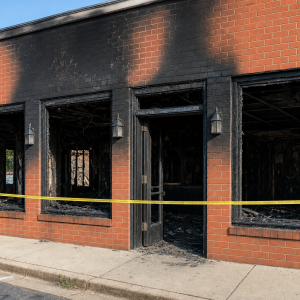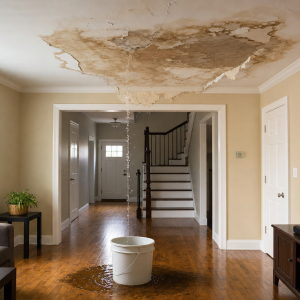

Disputing an insurance claim means you're officially telling your insurer you reject their decision. You're not just complaining; you're building a case with evidence to force them to pay what they actually owe. It requires you to methodically document your losses, clearly state your objections in writing, and understand the rights your policy gives you to successfully fight a lowball offer or flat-out denial.
Your Claim Was Denied. What Happens Now?
That letter from your insurance company—the one with the insultingly low offer or an outright denial—feels like a punch to the gut. It's designed to feel final.
It’s not.
For many homeowners and business owners, this is just the opening shot in a negotiation you never asked for. Big-name insurers like State Farm and Allstate have spent decades perfecting the art of using confusing policy language and vague excuses to underpay policyholders. This is your playbook for fighting back.
Decoding Their Excuses
Insurers pull from a standard list of reasons to deny a home or business property claim. The first step to dismantling their argument is to understand exactly what they're trying to do.
You'll hear the same excuses over and over again:
- "It's just wear and tear." They'll argue the damage to your home or business was already there or happened because you didn't maintain your property, not because of the storm, fire, or whatever event you filed for.
- "You didn't provide enough documentation." This is a classic delay tactic. They're betting you didn't keep perfect records of your property before the damage and won't have the energy to gather them now.
- "That's excluded in your policy." They'll point to a complicated, hard-to-read clause buried deep in your policy, hoping you won't challenge their interpretation.
The second you get that bad-news letter, your next move is critical. Do not cash any check they send you, not even a partial one. Cashing that check can be legally interpreted as you accepting their offer as a final settlement.
Instead, your job is to immediately pivot into building your counter-argument.
An insurer's first offer is almost never their best offer. Think of it as a test. They want to see if you know your rights and are willing to fight for what you're owed. If you stay silent or take the money, their lowball strategy wins.
This is the basic roadmap to follow as soon as you get a denial or a lowball offer.
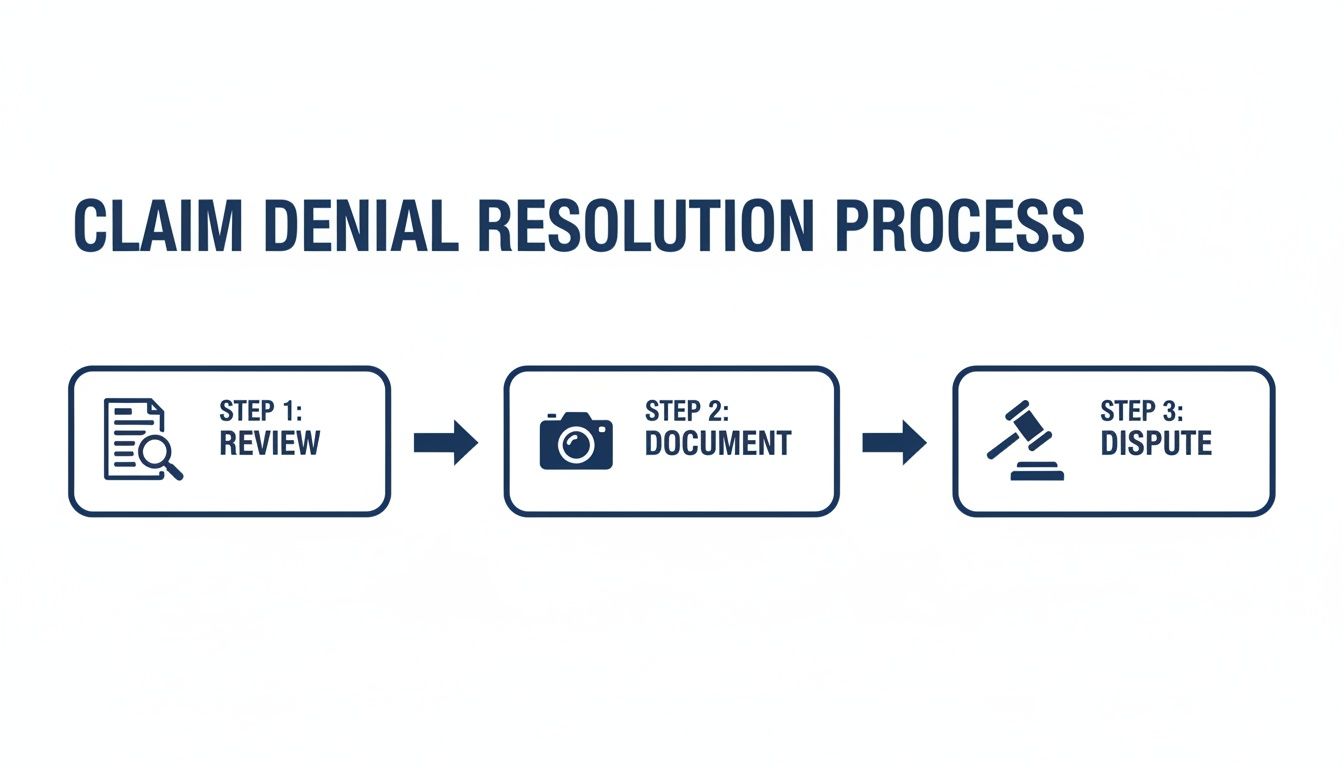
This isn't about getting into a screaming match with an adjuster. It's a structured process that starts with a careful review and solid documentation long before you send a single email.
Your First Steps in the Fight
Your immediate actions will set the tone for this entire dispute. Forget emotional phone calls with the adjuster. From this point on, every important conversation needs to be in writing to create a bulletproof paper trail.
Once your claim is denied, learning how to appeal an insurance claim effectively is your top priority.
Start thinking like you're building a legal case. Pull together your entire insurance policy, every email and letter from the company, and every photo or video you have of the damage. For a deeper dive into the next steps, check out our guide on what to do when your homeowners claim is denied.
This isn't just a simple disagreement. You are now defending the value of your property against a massive corporation whose business model depends on minimizing payouts. By staying organized, communicating formally, and acting decisively, you send a clear signal: you will not be pushed around.
Build an Undeniable Case with Documentation
Let’s be blunt: an insurance dispute isn't won by arguing on the phone. It’s won with a mountain of cold, hard evidence. Your insurer has an entire team dedicated to one goal: paying you as little as legally possible. To even the odds, you have to build a case so thorough and well-documented they simply can't ignore it.
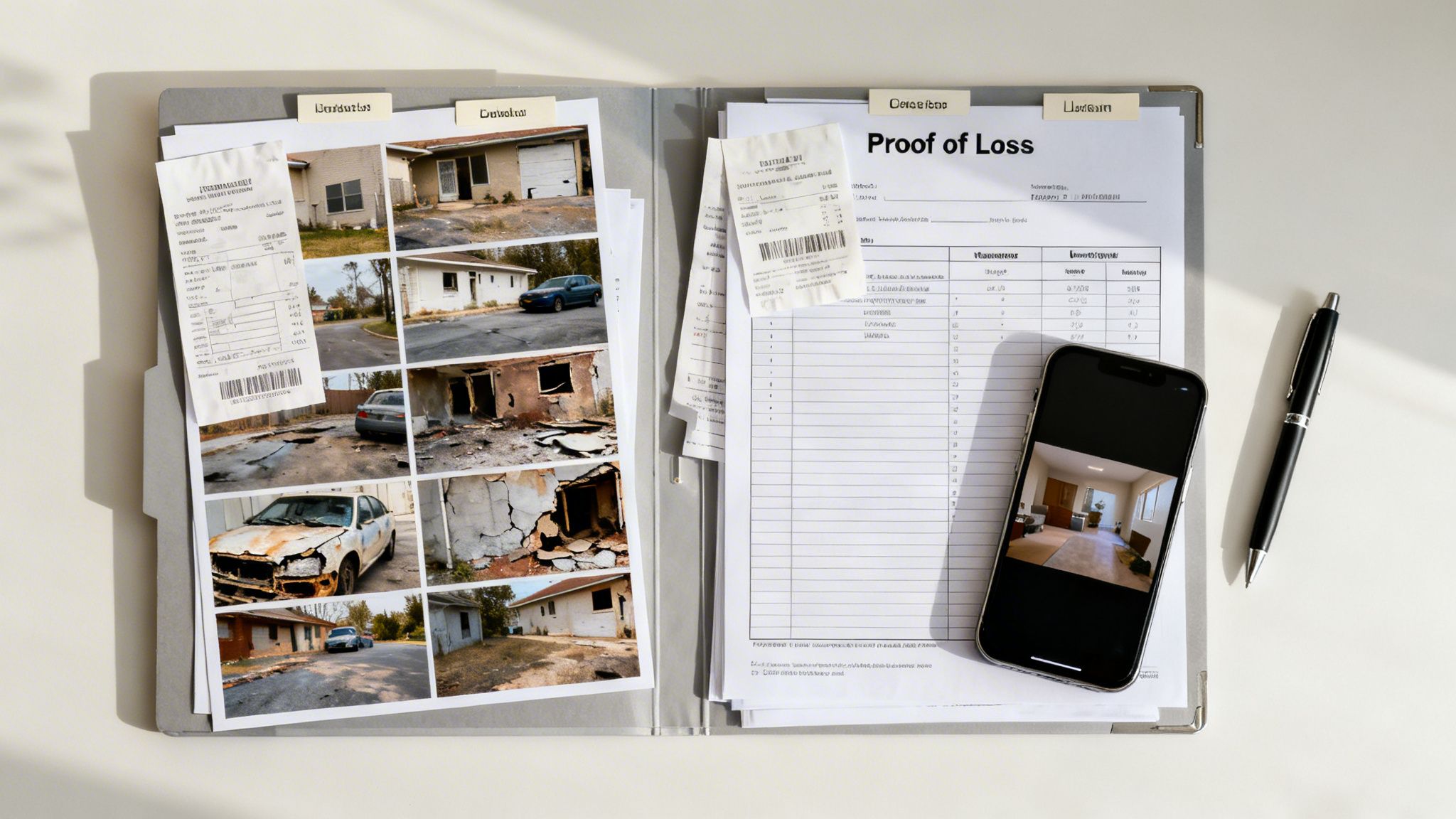
This is about much more than just snapping a few pictures of the damage. It means creating what's known in the industry as a "proof of loss" file. Think of it as your master file of irrefutable proof, detailing every single crack, stain, and broken item and what it will actually cost to fix. For a deeper dive, check out our guide on how to prepare a complete proof of loss.
Your Evidence Arsenal
Your job is to bury their lowball offer in facts. Start gathering every scrap of paper, every digital file, and every image related to your property and your claim.
Here’s what absolutely must be in that file:
- Your Complete Insurance Policy: I don't mean just the declarations page. You need the entire contract, including every single endorsement and rider. This is the document they are legally bound by.
- All Communication Records: Print out every email. Keep a detailed log of every phone call—date, time, the name of the person you spoke with, and a summary of what was said. Never, ever rely on their notes or your memory.
- A Detailed Inventory of Damaged Items: Go room by room. For every single thing that was damaged, list what it is, how old it was, what you paid for it, and what a new one costs today. This goes for everything from your sofa to the canned goods in your pantry.
- A Flood of Visual Proof: Take way more photos and videos than you think you need. Do a slow video walkthrough of the entire property, narrating what you’re seeing and describing the damage as you go. It captures the full scope of the disaster in a way static photos never can.
This level of meticulous organization sends a powerful message to your insurer: you’re serious, you’re prepared, and you won’t be pushed around.
Counter Their Numbers with Real-World Costs
This next step is the most important part of the entire process. Never accept the insurance adjuster's estimate as the final word. Their job is to find the cheapest possible way to close your claim, and they often rely on generic, outdated pricing software that doesn't reflect what things actually cost in your area.
You have to get your own independent estimates. Call at least two or three reputable, local, licensed contractors and have them write up a detailed scope of work and pricing. These pros know the current cost of lumber, labor, and everything else in your specific market—something the insurer’s software almost always gets wrong.
When the insurance company's adjuster says a new roof will cost $30,000, but three local roofers all give you written quotes between $45,000 and $50,000, you’ve just gained massive leverage. Their number is an assumption; your numbers are reality.
This isn’t just a good idea; it's an absolute game-changer. These independent estimates become the bedrock of your dispute. You’re no longer saying, "I think it costs more." You're now saying, "Here is documented proof from multiple local experts showing what it will actually cost to make me whole again."
The Power of a Public Adjuster's Assessment
While contractors are essential for repair estimates, a public adjuster brings a whole different level of expertise to the table. They are trained to see the hidden damages that contractors—and especially the insurance company’s adjuster—almost always miss.
Think about a small kitchen fire. A contractor will give you an estimate to replace the burned cabinets and appliances. A good public adjuster, however, will also document the cost of smoke and soot damage inside the walls, the damage to your HVAC system from circulating particles, and the need for specialized cleaning of every item in the adjoining rooms.
These are the details that can turn a $50,000 claim into a $150,000 claim—which is the correct amount you're owed. They build a comprehensive scope of loss that forces the insurance company to pay for the total damage, not just the parts that are easy to see. Having a PA on your side shows the insurance company you mean business and instantly levels the playing field.
How to Write a Powerful Insurance Dispute Letter
Once you have all your evidence lined up, it's time to go on the offensive. A well-crafted dispute letter is your opening salvo, moving the conversation from frustrating phone calls to a formal, documented process. It puts the insurance company on notice that you mean business.

This isn't the time for emotional appeals or angry rants. Forget all that. The most effective approach is firm, professional, and built on a foundation of cold, hard facts. Your goal is to state in writing that their offer is unacceptable and that you have the proof to back it up.
Structuring Your Argument for Maximum Impact
Your letter has to be sharp, concise, and incredibly easy to follow. You cannot make the adjuster work to understand your point. You need to guide them through your argument so clearly that they have no choice but to acknowledge the facts.
A simple, effective structure looks like this:
- The Opener: Get straight to the point. State your name, policy number, claim number, and date of loss. Then, deliver the purpose of the letter: "I am writing to formally dispute the settlement offer dated [Date] for claim number [Your Claim #]."
- Your Position: Immediately follow up by explaining why you're disputing their decision. For instance, "The settlement offer of $25,000 is insufficient to cover the actual costs of repair for the water damage to my property."
- The Rebuttal: This is the heart of your letter. Go through their denial or low-ball offer point by point. Address each of their reasons directly and counter them with your evidence. This is where you dismantle their case.
- Your Demand: State exactly what you expect. Be specific. "Based on the enclosed estimates from certified contractors, the total cost of repairs is $48,500. I expect a revised settlement reflecting this amount."
- The Deadline: End by setting a reasonable timeframe for a response, usually 15 or 30 days. Make it clear that you're prepared to take further action to get a fair settlement.
This methodical approach signals to the insurer that you're organized, serious, and not going away.
Key Phrases and Factual Counterpoints
The words you choose matter. You need to sound confident and informed, not desperate or aggressive. Use precise language to counter their reasoning.
- If they cite a policy exclusion: "You have misinterpreted section 4(b) of my policy. The language clearly states that this exclusion does not apply in cases of sudden and accidental discharge, which is precisely what occurred."
- If they lowball the repair costs: "Your adjuster's estimate relies on generalized pricing software. Enclosed you will find three detailed estimates from licensed local contractors that reflect the true market cost of materials and labor in our area."
- If they claim insufficient documentation: "I am enclosing the previously submitted photographs, video walkthrough, and a comprehensive inventory list that fully documents the extent of the loss."
Critical Tip: Never, ever admit fault or speculate on what might have caused the damage. Stick to the facts you can prove. Every word you write can be twisted and used against you to weaken your claim.
Crucial Mistakes to Avoid
Your dispute letter becomes part of the official record. One wrong move can give the insurance company the opening they need to undermine your case.
Steer clear of these common blunders:
- Making Threats: Don't threaten to sue, call the news, or post all over social media. It just makes you look unprofessional. State your intentions calmly: "If we cannot resolve this matter, I will be forced to pursue other remedies."
- Using Emotional Language: Words like "devastated," "unfair," or "disgusted" have no place here. The facts of your case should make the argument for you, not your emotions.
- Being Vague: Never just say their offer is "too low." Prove it. Provide the exact figures from your contractor estimates and other documentation.
The power dynamic in insurance disputes is changing. Policyholders are no longer passively accepting denials. They're fighting back, and new platforms are giving them a voice. It's now common for claimants to use social media to publicly name and shame insurers who treat them unfairly, a trend you can learn more about from this analysis of claim management challenges on RGAre.com. Your formal dispute letter is the first, most critical step in this modern fight for what you're owed.
The Real Reasons Your Insurance Company Denied Your Claim
Let's get straight to it. When your insurance company denies your claim or sends you a laughably low offer, it’s not personal. It’s business. These are multi-billion dollar corporations whose primary duty is to their shareholders, and that means protecting their bottom line.
The entire claims process is built around a simple, brutal formula: the less they pay you, the more profit they make. That mindset dictates every single move they make.
It All Starts with Their Adjuster
The company adjuster who shows up at your property might seem like a nice person, but make no mistake—their loyalty is to their employer, not to you. They aren't there to find every bit of damage; they're there to close your claim as quickly and cheaply as possible.
Many of these adjusters operate under strict performance metrics that reward them for closing a high volume of claims for low amounts. They’re armed with proprietary software that consistently undervalues local labor rates and materials, and they are trained to sniff out any possible policy exclusion they can use against you. This isn't a mistake. It's a core feature of their business model.
You’ve paid your premiums for years, trusting you’d be protected when you needed it most. The insurance company sees it differently. To them, your policy is a financial liability they need to resolve for the lowest possible cost.
Understanding this fundamental conflict of interest is the first step in fighting back. It shifts your perspective from being a victim of the process to a strategic player who can see their moves coming.
The "Delay, Deny, Defend" Playbook
After a disaster, you’re stressed, exhausted, and just want your life back. Insurance companies know this, and they have a well-oiled playbook designed to exploit your vulnerability.
- Delay Tactics: They’ll ask for the same document three times. Your adjuster will go silent for weeks. They’ll transfer you endlessly between departments. This is all designed to create "claims fatigue." They’re hoping you’ll get so worn out and frustrated that you’ll either give up or accept a terrible offer just to be done with it.
- Twisting Your Policy Language: Insurance policies are dense, confusing legal documents by design. Insurers will weaponize that complexity, pointing to vague clauses and obscure exclusions to justify their denial. They’re betting you don’t have the time, energy, or expertise to challenge their interpretation.
- The Threat of a Lawsuit: They know that the average person is terrified by the thought of suing a massive corporation. The cost, the time, the stress—it's overwhelming. They use this fear as leverage to bully you into accepting a fraction of what you’re owed.
Here's a revealing fact: while insurers love to talk about fighting fraud, it's rarely why they actually deny claims. A Global Claims Fraud Survey found that a staggering 72% of insurers prefer to deny claims for reasons other than fraud, even when they suspect it. Why? Because proving fraud in court is expensive and risky for their reputation. It’s far easier and cheaper to just point to a policy exclusion. You can see more of these eye-opening claims industry statistics on Talli.ai.
Knowing these tactics isn't about being cynical—it’s about being prepared. When you understand their playbook, you can build your counter-strategy. You document every call, you challenge their weak arguments with hard facts, and you refuse to be intimidated. This is how you start to level the playing field.
When to Hire a Public Adjuster for Your Fight
Let's be blunt: going head-to-head with a massive insurance corporation is an unfair fight by design. They have teams of adjusters, lawyers, and experts all working with one goal: protecting their bottom line. This is exactly where a public adjuster comes in. It’s time to stop trying to do it all yourself and bring in a professional advocate who is legally on your side.
The distinction is critical. The insurance company's adjuster works for them. A public adjuster works exclusively for you, the policyholder.

Signs You Need to Call for Backup
Sure, you can probably handle a tiny, straightforward claim on your own. But certain situations are giant red flags that almost always demand professional help. Recognizing these early can save you from a costly, soul-crushing mistake.
Consider calling a public adjuster when:
- The Claim is Large or Complex: For catastrophic events like a house fire, major hurricane damage, or a significant commercial loss, the sheer number of details is overwhelming. A public adjuster knows how to find and document every single loss, including hidden damages the company adjuster will conveniently “miss.”
- The Insurer is Dragging Their Feet: If your claim has been stuck in limbo for months with no clear path forward, it’s a classic delay tactic. A public adjuster knows the legal deadlines and how to apply the right kind of pressure to get your claim moving again.
- You've Received a Lowball Offer: Does their settlement offer feel like a slap in the face? If it doesn't even come close to your contractor's estimates, you're being lowballed. A public adjuster will build a detailed, evidence-backed counter-offer that forces the insurer to negotiate in good faith.
- You Lack the Time or Expertise: Let's be honest, managing a complex insurance claim is a full-time job. Between work, family, and the stress of the disaster, most people simply don't have the bandwidth to learn complex policy language and aggressive negotiation tactics.
An experienced public adjuster completely levels the playing field. They take over the entire dispute process, from documentation to negotiation, to secure the maximum settlement you're rightfully owed.
What a Public Adjuster Really Does in a Claim Dispute
When you hire a public adjuster, you're not just getting a second opinion. You're getting a dedicated advocate who manages the entire painful process for you. To see the full scope of their work, you can dig into the details of what a public adjuster does for you.
A public adjuster speaks the same language as the insurance company. They understand the software, the policy loopholes, and the negotiation tactics used to underpay claims—and they use that insider knowledge for your benefit.
Their involvement sends a clear signal to the insurance company that the days of delays and lowball offers are over. This alone is often enough to bring a stubborn insurer back to the negotiating table. For very complex situations, it's also smart to understand when you might need to hire a lawyer for your insurance claim, especially if things are heading toward legal action.
The proof is in the results. Policyholders who get an expert on their side often find that what the insurance company called a "final offer" was just their first move in a long game. Just ask our clients who've been through it:
Common Questions About Fighting a Claim Denial
Going up against an insurance company like Allstate or State Farm can feel overwhelming. When they deny or lowball your property claim, you're suddenly flooded with questions and uncertainty. Let's cut through the noise and get you the direct, practical answers you need to fight back.
What’s My First Move If My Claim Is Denied?
First thing's first: refuse to accept the denial as the final word. Think of it as their opening offer in a negotiation, not a verdict. The absolute worst thing you can do right now is get into a shouting match over the phone. From this moment on, everything important happens in writing. You need a paper trail.
Your immediate next step is to send a formal, written request for a detailed explanation of the denial. Make them show you exactly where in your policy it says they can do this. While you wait for that response, get your ducks in a row. Gather your full policy, every photo and video you took of the damage, and any estimates you’ve gotten from independent contractors.
How Long Do I Have to Fight My Claim?
This is critical. The clock is ticking, and missing a deadline can kill your claim completely. In North Carolina, the statute of limitations for a breach of contract claim (which is what your insurance dispute is) is generally three years from the date they broke their promise—like the day they sent you that wrongful denial letter.
But don't get too comfortable with that three-year window.
Your insurance policy is a contract, and it can—and often does—contain its own deadlines that are much shorter. Many policies will force you to file a lawsuit within just one or two years from the date the damage actually happened. If you miss that policy deadline, it doesn't matter what the state law says. You're done.
You need to pull out your policy today and find that deadline. Don't put it off.
Can I Reopen a Claim If I Find More Damage Later On?
Yes, you can often reopen a closed claim if you discover more damage directly tied to the original event. A classic example is when your roofer starts tearing off shingles from a hailstorm and finds hidden structural damage to the trusses underneath. That new damage should absolutely be covered.
The key is to notify your insurance company the second you find it. And be ready for a fight. They will almost certainly argue the new damage is from something else entirely, or just blame it on "wear and tear."
This is where your initial documentation becomes your best weapon. The more detailed your original photos, videos, and reports were, the easier it is to connect the dots and prove the new damage was part of the original loss.
What Is a Supplemental Claim?
A supplemental claim isn't a new claim; it's an addition to your original one. You file one when the insurance company's initial payment isn't enough to actually cover the repairs, or when new, related damage is found. This happens all the time when a contractor opens up a wall and finds problems that were impossible to see during the first inspection.
Filing a supplemental claim basically re-starts the process for that specific part of the damage. The insurer might want another inspection, demand new estimates, or even require you to sit for a formal recorded statement called an Examination Under Oath (EUO).
Don't take this lightly. A recent case, Treasure Cay Condominium Association v. Frontline Ins. Unlimited Co., is a chilling reminder of what's at stake. The court ruled that because the policyholder refused to cooperate with the insurer's requests on their supplemental claim, they breached the policy and forfeited their entire $3 million claim. The lesson is crystal clear: treat a supplemental claim with the same seriousness as your original one.
What’s the Difference Between Appraisal and Mediation?
People often confuse these two, but they are completely different tools for resolving a dispute.
-
Appraisal: This process is used for one thing and one thing only: to determine the price of the damage. It answers the question, "How much will this cost to fix?" Each side hires an appraiser, and if they can't agree, a neutral "umpire" makes a final, binding decision on the dollar amount. Appraisal never decides if something is covered, just what it costs.
-
Mediation: This is a negotiation aimed at settling the entire dispute. A neutral third-party mediator helps you and the insurance company talk through the issues and try to find a middle ground. A mediator has zero power to force a decision; they just help facilitate a settlement.
So, appraisal sets the price tag. Mediation tries to get everyone to shake hands and walk away.
Why Was My Claim Really Denied?
Let's be blunt: your claim was probably denied for a business reason, not because it wasn't valid. Denials are rampant. In fact, a recent survey found that nearly 1 in 5 insured American adults had a claim denied in the last year. It’s no surprise that the same survey shows that people who’ve had a claim denied are far more likely to find insurance confusing. You can dig into these consumer survey findings from KFF.org yourself.
Insurers protect their profits by paying out as little as possible. They use confusing policy exclusions, argue you didn't provide enough proof, or blame the damage on pre-existing "wear and tear." These are calculated tactics. Understanding that you're in a business negotiation, not a partnership, is the first step to winning.
The insurance claim process is built to be confusing and is stacked against you from day one. You don't have to go through this alone. The team at For The Public Adjusters, Inc. is here to level the playing field, take over the fight, and force the insurance company to pay you the full and fair settlement you're owed. Contact us today for a free, no-obligation review of your claim.