
If My Tree Falls on My Neighbor’s House, Who Is Responsible?
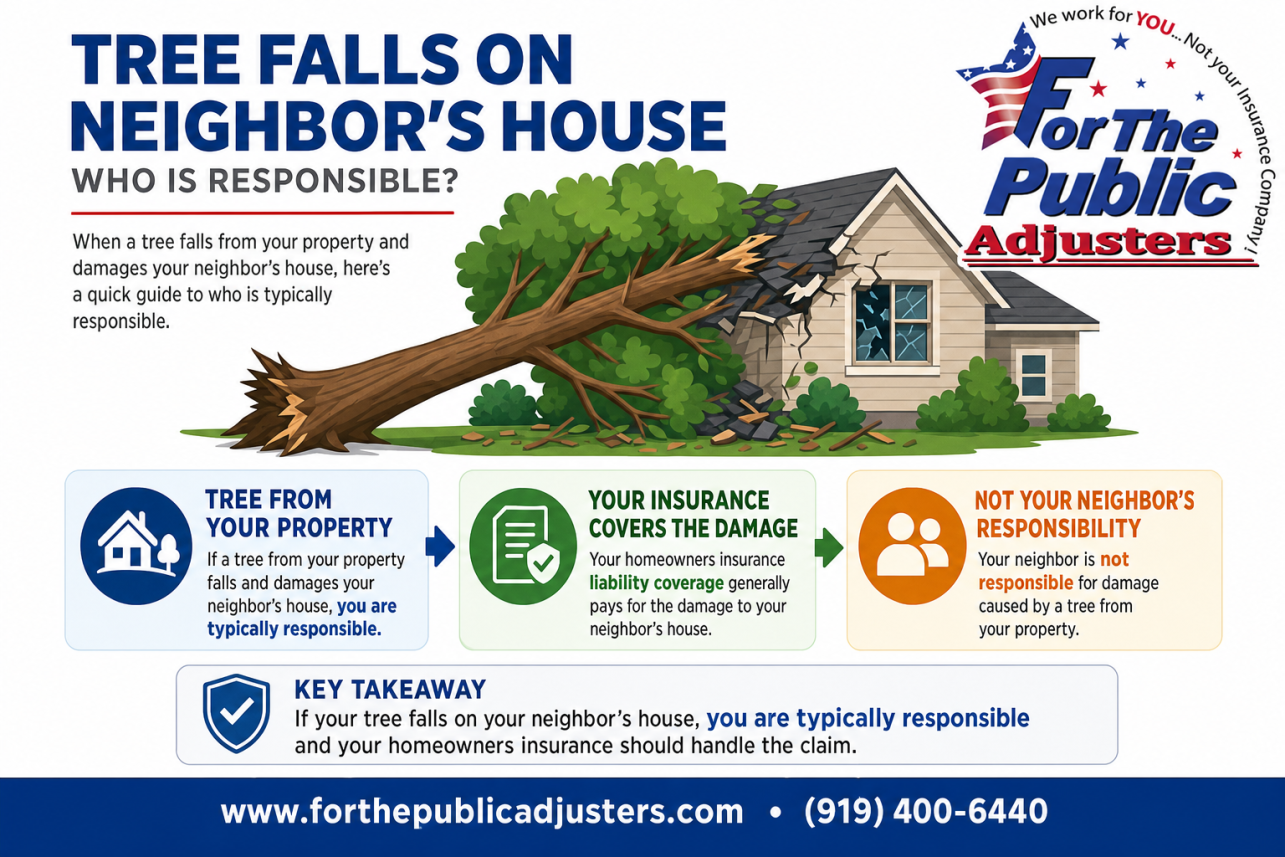
When a tree falls on neighbor’s house, the neighbor’s own homeowners insurance usually pays for the damage — not you. In North Carolina, the tree’s owner is generally only responsible if they were negligent, such as ignoring a tree they knew (or should have known) was dead, diseased, or dangerously unstable.
Key takeaways
- In most states, the neighbor whose house was damaged files a claim with their own homeowners insurance, regardless of whose tree fell.
- The tree owner is typically only liable if the tree was visibly dead, diseased, or they ignored prior written warnings about the hazard.
- Acts of nature like storms and high winds usually shift responsibility to the property owner where the damage occurred, not the tree owner.
- Documenting a hazardous tree in writing to your neighbor before it falls is often the key evidence needed to prove negligence later.
- Insurers can use subrogation to recover costs from a negligent tree owner, which may raise that owner’s premiums or trigger a liability claim.
This surprises a lot of homeowners. It feels intuitive that “my tree, my problem,” but insurance and North Carolina law don’t work that way. A healthy tree that comes down in a thunderstorm, straight-line winds, or a tropical system is treated as an act of nature. Nobody caused it, so nobody is at fault — and each property owner’s insurance covers the damage on their own side of the property line.
The General Rule in North Carolina
Here’s the short version of how responsibility typically breaks down:
- Healthy tree falls in a storm: The neighbor whose house was hit files a claim with their homeowners insurance. You are not liable, even though the tree grew on your land.
- Dead, dying, or visibly hazardous tree falls: If you knew about the danger — or a reasonable person would have noticed it — you may be liable for negligence, and your liability coverage could come into play.
- Neighbor warned you in writing beforehand: Documented warnings (letters, emails, texts, or an arborist’s report) make it much easier for the neighbor to argue you were on notice and failed to act.
Why This Question Spikes Every Summer
In North Carolina, tree-fall claims cluster in the warmer months, and it’s not hard to see why:
- Summer thunderstorms bring sudden downbursts and straight-line winds that can topple even healthy trees.
- Tropical storms and hurricanes saturate the soil, loosening root systems so trees fail days after the rain stops.
- Full summer canopies act like sails, catching wind that bare winter branches would let pass through.
When a storm rolls through a neighborhood, it’s common for multiple trees to come down at once — which means neighbors on both sides of the fence are suddenly asking the same question at the same time.
The Bottom Line
Unless there’s evidence you neglected a known hazard, your neighbor’s policy handles their house, and your policy handles yours. That doesn’t mean the claim will be simple, though. Roof damage, structural issues, tree removal costs, and interior water intrusion all get valued differently by insurers, and disputes are common. If you’re dealing with a damaged roof or a lowball estimate, getting tree damage insurance claim help in Burlington early can make a real difference in how the claim is documented and paid. The sections below walk through liability, insurance, and what to do step by step.

When Am I Actually Liable for a Tree Falling on My Neighbor’s Property?
In North Carolina, you are generally liable only if you were negligent — meaning the tree was dead, diseased, leaning dangerously, or you had been warned about it and did nothing. If a healthy tree falls on a neighbor’s house during a severe storm, that is usually treated as an act of God, and you are not responsible.
The key legal question isn’t whose tree it was — it’s whether a reasonable property owner would have known the tree posed a danger. North Carolina follows standard negligence principles here, so liability turns on knowledge and inaction, not ownership alone.
When You Likely ARE Liable
Courts and insurers look for evidence that you knew, or reasonably should have known, the tree was hazardous. Red flags include:
- Visible death or disease — bare branches in summer, fungus growth, peeling bark, hollow trunk sections, or large dead limbs.
- Obvious structural problems — a pronounced lean toward the neighbor’s home, cracked or split trunks, or exposed and lifting roots.
- Prior warnings — a neighbor, arborist, landscaper, or even your own insurance company pointed out the hazard and you took no action.
- Previous damage from the same tree — limbs from that tree have already fallen and caused problems before.
When You’re Usually NOT Liable
- The tree was healthy and showed no outward signs of decay or instability.
- It came down in a severe thunderstorm, hurricane remnant, ice storm, or straight-line wind event — a classic “act of God.”
- You had no notice, written or verbal, that anyone considered the tree a hazard.
In these situations, when a tree falls on a neighbor’s house through no fault of yours, the neighbor’s own homeowners policy typically responds — a frustrating reality for them, but the standard outcome under NC negligence rules.
Why Written Notice Changes Everything
A letter, email, or text from your neighbor documenting concern about your tree is one of the most important pieces of evidence in these disputes. Once you’ve received written notice:
- You can no longer credibly claim you didn’t know about the hazard.
- Failing to inspect or remove the tree afterward looks like negligence, shifting liability toward you if it later falls.
- Conversely, if you’re the worried neighbor, sending written notice — ideally with photos — protects you and may put the responsibility where it belongs.
If you’ve received notice about a questionable tree, getting a certified arborist’s written assessment is a smart, inexpensive step. It either documents that the tree is sound or gives you clear grounds to act before disaster strikes. And if a tree has already come down and you’re navigating fault questions with an insurer, professional tree damage insurance claim help in Burlington can make a real difference in how the claim is documented and resolved.
Whose Insurance Pays When a Tree Falls on a Neighbor’s House?
In most cases, when a tree falls on a neighbor’s house, the neighbor’s own homeowners insurance pays first — regardless of whose tree it was. The tree owner’s liability coverage only comes into play if the owner was negligent, such as ignoring a visibly dead or dying tree. Then the neighbor’s insurer may seek reimbursement through subrogation.
This surprises a lot of homeowners. It feels intuitive that “your tree, your problem,” but property insurance doesn’t work that way. Coverage follows the damaged property, not the tree. Here’s how the pieces fit together.
The Neighbor’s Homeowners Policy Responds First
The homeowner whose house was hit files a claim under their own policy. Several coverages can apply:
- Dwelling coverage (Coverage A): Pays to repair the house itself — roof, walls, windows, and attached structures like an attached garage or deck.
- Other structures coverage (Coverage B): Handles detached structures such as a fence, shed, or detached garage. This is often capped at a percentage of the dwelling limit, commonly around 10%.
- Debris removal: Most policies help pay to remove the fallen tree, but usually only when the tree damaged a covered structure or blocks a driveway or accessible ramp. Tree removal coverage is frequently subject to a modest per-tree or per-occurrence limit, so large trees can exceed it.
- Personal property coverage: Covers belongings inside the home damaged by the impact or resulting water intrusion.
The homeowner will owe their own deductible, and payment for the structure may be based on replacement cost or actual cash value depending on the policy.
When Subrogation Shifts Costs Back to the Tree Owner
If the tree’s owner was negligent — for example, they had been warned the tree was dead, hollow, or leaning dangerously and did nothing — the neighbor’s insurance company can pay the claim and then pursue subrogation. That means the insurer seeks reimbursement from the tree owner’s liability coverage (Coverage E on a standard homeowners policy). If subrogation succeeds, the neighbor may even recover their deductible.
For the tree owner, this is where liability limits matter. Liability coverage on a typical homeowners policy often starts around $100,000, with higher limits available. Serious structural damage to a neighboring home can approach or exceed a low limit, which is one reason many agents recommend higher liability limits or an umbrella policy.
A Quick Way to Think About It
- Healthy tree, storm knocks it over: Neighbor’s policy pays; it’s treated as an act of nature.
- Visibly hazardous tree, owner ignored it: Neighbor’s policy still pays first, but the tree owner’s liability coverage may ultimately absorb the cost through subrogation.
- Tree falls in your own yard, damages nothing: Removal is often not covered at all under either policy.
Because the first insurer to pay isn’t always the one that ultimately bears the cost, documenting the tree’s condition matters for both sides of the fence.
What Should I Do Right After a Tree Falls in a Summer Storm?
Immediately after a tree falls in a summer storm, get everyone away from the damaged area, check for downed power lines, and call 911 if anyone is hurt. Then photograph all damage before touching anything, cover openings with tarps to prevent further damage, notify the insurance company promptly, and save every receipt.
Step 1: Put Safety First
Before you assess anything, make sure people are safe. A tree that has fallen on a house can bring down power lines, rupture gas lines, or destabilize parts of the structure. Keep everyone — including curious neighbors — out of the damaged rooms and away from the tree itself. If you smell gas or see downed wires, leave the area and call your utility company or emergency services. Do not assume a partially fallen tree is stable; summer storms often leave hung-up limbs that can drop without warning.
Step 2: Document Everything Before Cleanup
Once the scene is safe, photograph and video the damage from multiple angles before anyone moves a single branch. This matters whether your tree falls on a neighbor’s house or theirs falls on yours — the insurer will want to see the condition of the tree, where it stood, and exactly what it hit. Capture:
- The full tree, including the trunk, root ball, and where it broke or uprooted
- All damage to the roof, siding, gutters, fences, vehicles, and landscaping
- Interior damage, including ceilings, walls, and any water intrusion
- Any visible signs of the tree’s prior condition, healthy or otherwise
Step 3: Prevent Further Damage — Fast
Most insurance policies require you to take reasonable steps to protect the property from additional harm. Tarp roof openings, board up broken windows, and move undamaged belongings away from exposed areas. In summer, this step is urgent: heat and humidity accelerate water damage, and mold can begin developing in wet drywall, insulation, and carpet within days. A hole in the roof during July thunderstorm season can turn a moderate claim into a major one if it sits uncovered through the next downpour.
Step 4: Notify the Insurance Company Promptly
Report the loss to the appropriate insurer as soon as reasonably possible. If a tree falls on a neighbor’s house, both homeowners should notify their own carriers and exchange contact and policy information, even before fault or coverage is sorted out. Prompt notice protects your rights under the policy.
Step 5: Keep Every Receipt
Save documentation for anything you spend because of the loss, including:
- Tarps, plywood, and other emergency supplies
- Tree removal and debris hauling
- Temporary repairs and board-up services
- Hotel stays or meals if the home is unlivable
These out-of-pocket costs are often reimbursable, but only if you can prove them. A simple folder or phone photo album of receipts can make a real difference when the claim is reviewed.
What If the Insurance Company Underpays or Denies the Tree Damage Claim?
If your insurer underpays or denies a fallen tree claim, you can dispute the decision. Request the denial in writing, gather your own repair estimates and an arborist’s report, invoke the appraisal clause in your policy, or hire a public adjuster or attorney. North Carolina homeowners have successfully challenged insurers in court over storm damage disputes.
Unfortunately, tree damage claims are a common source of friction between homeowners and insurance companies. The damage often looks straightforward — a tree is lying on a roof — but the payout rarely feels that simple. Here are the disputes that come up most often, and what you can do about them.
Common Reasons Insurers Underpay or Deny Tree Claims
- Lowball repair estimates. The insurer’s adjuster may price the roof repair using outdated labor rates, skip hidden structural damage under the impact point, or ignore matching issues with shingles and siding.
- Claims of rot or “pre-existing” decay. Insurers sometimes argue the tree was already dead or diseased, framing the loss as neglect rather than a covered windstorm event. This matters whether the tree falls on a neighbor’s house or your own — the insurer may use alleged decay to shift blame or shrink the payout.
- Disputes over debris removal limits. Many policies cap tree removal costs, and insurers may apply that cap narrowly even when the tree caused structural damage.
- Depreciation disputes. Aggressive depreciation on roofing, fencing, and other materials can cut an actual cash value payment well below what repairs really cost.
How to Push Back
- Get everything in writing. Ask the insurer to explain the denial or the estimate line by line, citing the specific policy language it relied on.
- Build your own evidence. Independent contractor estimates, photos of the tree’s trunk and root ball, and a certified arborist’s opinion on the tree’s health can directly rebut a “pre-existing decay” argument.
- Invoke the appraisal clause. Most homeowners policies include an appraisal provision for disputes over the amount of loss. Each side hires an appraiser, the appraisers select an umpire, and the resulting award resolves the valuation dispute — often faster and cheaper than a lawsuit.
North Carolina Homeowners Have Won These Fights
Insurers do not always get the last word. In Guyther v. Nationwide Mutual Fire Insurance Co., North Carolina homeowners disputed their insurer’s handling of storm damage to their home and ultimately prevailed. The case is a useful reminder for NC property owners: an insurer’s initial position on a storm claim is not final, and policyholders who document their damage and press their rights can recover what the policy actually owes them.
If the dispute involves questions of coverage — not just price — appraisal alone may not resolve it, and it may be time to bring in professional help, which is exactly where the next section picks up.

How Can a Public Adjuster Help With a Fallen Tree Claim in NC?
A licensed public adjuster works only for the policyholder — not the insurance company. After a tree falls on a house, they document the structural and contents damage, prepare a detailed independent estimate, and negotiate the claim with the carrier so the settlement reflects the full scope of covered damage under the policy.
Tree claims often look simple on the surface, but the damage rarely stops at the roofline. Impact from a heavy trunk can crack framing, shift trusses, break rafters, and open the home to water intrusion that spreads into insulation, ceilings, and personal property. A carrier’s initial inspection may focus on the visible hole; a public adjuster’s job is to make sure the hidden damage is documented before it gets missed or repaired incorrectly.
What a Public Adjuster Actually Does on a Tree Claim
- Reviews your policy. Identifies applicable coverages — dwelling, other structures, contents, debris removal, tree removal limits, and additional living expenses if the home isn’t livable.
- Documents the full scope of damage. Photographs and inventories structural damage, interior water intrusion, and damaged contents room by room, often working alongside contractors or engineers when structural questions arise.
- Prepares an independent estimate. Builds a line-item repair estimate rather than relying solely on the carrier’s numbers.
- Handles communication and negotiation. Manages correspondence, inspections, and supplement requests so the policyholder isn’t negotiating alone.
- Keeps the claim on track. Tracks deadlines, documentation requests, and payment status through settlement.
Why Licensing and Bonding Matter in North Carolina
In North Carolina, public adjusters must be licensed and bonded, which provides accountability and consumer protection that unlicensed “claim consultants” can’t offer. You can verify any adjuster’s license through the North Carolina Department of Insurance. Working with someone licensed and bonded means they operate under state rules governing conduct, fees, and contracts — protections that exist specifically for policyholders.
An Honest Note About Outcomes
No reputable public adjuster can guarantee a specific settlement or promise the carrier will pay more. What a public adjuster can do is make sure the claim is thoroughly documented, professionally presented, and negotiated by someone who understands policy language and the claims process. That preparation often makes the difference between a claim that stalls and one that moves toward a fair resolution.
If a tree falls on a neighbor’s house or your own, and the claim involves significant structural damage, disputed scope, or a settlement that doesn’t seem to match the repairs needed, a consultation with a public adjuster is a reasonable next step. The National Association of Insurance Commissioners also offers consumer resources on the claims process and your rights as a policyholder.
Who Pays When a Tree Falls on a Neighbor’s House: Common Scenarios
| Scenario | Who Typically Pays | Why |
|---|---|---|
| Healthy tree falls in a storm | Neighbor’s homeowners insurance | Considered an act of nature; no negligence by the tree owner |
| Dead or diseased tree the owner knew about | Tree owner (or their liability coverage) | Owner had a duty to address a known hazard |
| Neighbor sent prior written warnings about the tree | Tree owner, often via subrogation claim | Documentation helps prove negligence |
| Tree falls but causes no structural damage | Whoever’s property the debris lands on | Cleanup of fallen limbs is usually the landowner’s responsibility |
| Tree on a shared property line falls | Often split or negotiated between owners | Boundary trees are typically co-owned by both parties |
Illustrative Example: The Warned-About Oak
Illustrative example
Consider a hypothetical scenario: a homeowner notices their neighbor’s large oak is visibly dying, with dead limbs and fungal growth on the trunk. They send the neighbor a certified letter with photos asking that the tree be inspected, but the neighbor takes no action. Months later, the oak falls onto the homeowner’s roof during a moderate windstorm. Because the homeowner documented the hazard in advance, their insurer pays the claim and then pursues the neighbor through subrogation, shifting the ultimate cost to the negligent tree owner. This composite example shows why written notice can completely change who ends up responsible.
Frequently asked questions
If my tree falls on neighbor’s house, whose insurance pays?
In most cases, your neighbor’s homeowners insurance pays for damage to their house, even though the tree was yours. Insurance follows the property that was damaged, not the tree’s owner. The main exception is negligence: if you knew the tree was dead, diseased, or hazardous and did nothing, your neighbor’s insurer may pursue your policy to recover costs. Absent negligence, a healthy tree falling in a storm is treated as an ‘act of God.’
Can my neighbor sue me if my tree falls on their house?
They can sue, but they’re unlikely to win unless they can prove negligence. That typically means showing you knew or should have known the tree was hazardous — visible rot, dead limbs, a leaning trunk, or prior written warnings — and failed to act. If the tree was healthy and fell due to a storm, courts generally won’t hold you liable. Documentation of the tree’s condition before it fell matters enormously in these disputes.
What should I do first if a tree falls on my neighbor’s house?
Make sure everyone is safe and call emergency services if there’s structural damage or downed power lines. Then both parties should photograph everything from multiple angles before anything is moved. Contact your insurance companies promptly — the neighbor files with theirs, and you should notify yours in case a negligence claim arises. Don’t admit fault or promise to pay; let the insurers sort out responsibility. Get an emergency tarp on any roof openings quickly.
Who pays to remove the tree after it falls on a house?
Typically the neighbor’s insurance covers removal of the portion on their property, since that’s part of their property damage claim. However, policies often cap tree removal coverage, and removal from the yard (versus off a structure) may be limited or excluded. Any part of the tree still on your property is generally your expense. If negligence is established, removal costs can be shifted to the tree owner or their insurer.
How can I prove my tree was healthy before it fell?
Keep records before problems arise: dated photos of your trees, receipts from arborist inspections or pruning, and any written communications with neighbors. After a fall, an arborist can often examine the trunk and root system to determine whether the tree was healthy or had hidden decay. If a neighbor ever sends you written concerns about a tree, respond by having it professionally assessed and keep proof — that paper trail protects you either way.
What if I warned my neighbor their tree was dangerous and it still fell on my house?
That warning strengthens your position significantly. Send concerns in writing (email or certified letter) and keep copies, along with photos showing the tree’s condition. If the tree later falls, that documentation helps prove the owner knew of the hazard and was negligent, which can shift liability to them and their insurance. Your own insurer will still likely pay your claim first, then pursue reimbursement from the negligent owner through subrogation.
Will my insurance rates go up if my tree damages a neighbor’s home?
If your neighbor’s insurance pays and no negligence claim is made against you, your rates typically aren’t affected because no claim hit your policy. If your liability coverage ends up paying due to negligence, that claim could influence your premiums at renewal. This is one reason insurers handle it this way — and one more reason to address hazardous trees before they fall rather than after.
What happens if the fallen tree was on the property line?
Trees with trunks straddling the boundary are generally considered jointly owned by both neighbors. If a boundary tree falls, the damaged party’s insurance still usually handles their house damage, but removal costs and any negligence questions can get more complicated since both owners shared responsibility for maintaining it. A survey may be needed to confirm where the trunk actually sat. Co-owned trees are a common source of disputes, so clarify ownership early.
Does it matter if the tree fell during a storm or hurricane?
Yes. A healthy tree toppled by high winds, lightning, or heavy snow is generally an ‘act of God,’ meaning no one is legally at fault and each property owner’s insurance covers their own damage. But a storm doesn’t automatically excuse everything — if a visibly dead or rotting tree fell in weather that wouldn’t have toppled a healthy one, the owner can still be found negligent for failing to remove a known hazard.
Can I make my neighbor remove a dangerous tree before it falls?
You can’t force removal yourself, but you have options. Start with a friendly conversation, then follow up in writing so there’s a record. Many municipalities have ordinances allowing code enforcement to inspect and order removal of hazardous trees. You’re also generally allowed to trim branches overhanging your property line at your own expense, as long as you don’t harm the tree’s health. If all else fails, some jurisdictions allow a private nuisance claim.
Tree Damage Claim help near you
Related local pages
Dealing with tree damage after a summer storm? Our licensed and bonded public adjusters help NC homeowners document, file, and negotiate property claims. Call today for a free claim review. Get in touch.
Last updated: August 14, 2026