
House Hit by Car Claim – The sound of screeching tires, followed by a sickening crunch that shakes your entire house. It’s a nightmare scenario. When that nightmare becomes your reality, the next few moments are pure shock and adrenaline.
But what you do in these first few minutes can make or break your entire insurance claim. This isn’t just about cleaning up a mess; it’s about methodically building your case against an insurance company whose primary goal is to pay you as little as possible.
You’re not alone in this. It’s a shocking, but surprisingly common, event. According to the Storefront Safety Council, cars crash into buildings like houses and apartments about 100 times every single day in the U.S. That adds up to roughly 36,500 incidents a year—a number that’s a staggering 40% higher than what older government estimates showed.
This visual guide breaks down the core priorities right after a car hits your house.

Moving from securing the scene to documenting the damage isn’t just a checklist; it’s the strategy that protects your family and your financial recovery.
First, Nail Down the Immediate Safety Risks
Your only job in the first minute is to check on everyone. Your family, the people in the car—if anyone is hurt, even if it seems minor, call 911 immediately. Don’t hesitate.
Beyond injuries, your house itself is now a hazard. That impact could have easily compromised a load-bearing wall, damaged electrical wiring, or even ruptured a gas line. You have to assume the worst until you know otherwise.
- Get Out If You Have To: If you smell gas, see sparks from wiring, or notice the structure groaning, sagging, or showing deep cracks, get everyone out. Now.
- Kill the Utilities: If you can safely get to them, shut off the main breakers for electricity, water, and gas. This is your best defense against a potential fire or major water damage compounding the problem.
- Stay Out of the Impact Zone: Rope off the damaged area. A hole in the wall might look simple, but the structure around it could be on the verge of collapse.
Become an Evidence Collector—Before Anything Moves
Once you know everyone is safe and first responders are on their way, your role changes completely. You are now the primary investigator for your own claim. Before that car gets towed or a single piece of brick is moved, you need to create a complete visual record. Your smartphone is the most important tool you have right now.
The photos and videos you take in this first hour are your ammo. They are irrefutable proof that an adjuster, sitting in an office miles away, can’t easily dismiss when they try to downplay the damage later.
Take way more pictures than you think you need. Get wide shots of the entire scene—the car, the house, the angle of approach. Then get in close. Document every crack, every broken stud, every bit of debris. This initial evidence is the bedrock when you file your homeowners insurance claim, and you can read our guide for more on that process. Your mission is to tell a story with your photos that leaves no room for the insurance company’s spin.
To help you stay focused during this chaotic time, here is a quick-reference checklist.
Immediate Action Checklist After a Vehicle Impact
This table isn’t just a to-do list; it’s a strategic guide to protecting your claim from the very first minute. Follow these steps to ensure you’re not just safe, but also prepared for the fight ahead with the insurance companies.
| Priority | Action Required | Why It’s Critical for Your Claim |
|---|---|---|
| #1 – Safety | Check for injuries and call 911 immediately. Evacuate if there’s any sign of structural instability, gas leaks, or electrical hazards. | Establishes an official record of the event and any injuries. It also shows you took responsible steps to prevent further damage, which insurers look for. |
| #2 – Police | Report the incident to the police. Ensure they create an official accident report, and get the report number. | The police report is a key third-party document. It identifies the at-fault driver and provides an unbiased account of the incident that is difficult for insurers to contest. |
| #3 – Documentation | Take extensive photos and videos of everything before the scene is altered. This includes the vehicle, license plate, all property damage (inside and out), and debris field. | This is your primary evidence. Unaltered, time-stamped visuals are your strongest weapon against an adjuster trying to minimize the scope and cost of repairs. |
| #4 – Information Exchange | Get the driver’s name, contact information, insurance company, and policy number. Also, gather contact info from any witnesses. | This information is essential for filing a claim against the driver’s auto liability policy, which is the primary source of coverage. Witness statements can back up your version of events. |
| #5 – Secure Property | Once safe, perform emergency board-up or tarping to prevent further weather damage. Keep all receipts for these temporary repairs. | Your policy requires you to mitigate further damage. Failing to do so can give your insurer a reason to deny parts of your claim. Receipts are crucial for reimbursement. |
Following these steps methodically will put you in a much stronger position when you start dealing with adjusters and contractors. Every action you take now is a step toward getting the full and fair settlement you are owed.
Untangling Auto vs. Homeowners Insurance Tactics
When a car smashes into your house, you’re instantly caught in an insurance tug-of-war. This isn’t just one straightforward claim; it’s a complicated battle between the driver’s auto insurance and your own homeowners policy.
And you can bet on one thing: both companies have the exact same goal. They want to pay out as little money as they possibly can, even if it means pointing fingers at each other while you’re left standing in the wreckage.

On paper, the at-fault driver’s auto liability insurance is supposed to cover everything. That’s the first place we look for recovery. But the world of insurance claims is rarely that neat, and you’re likely to hit some serious roadblocks right out of the gate.
The Limits of Auto Liability Coverage
The first major hurdle is the driver’s policy limit. It’s shockingly low. In North Carolina, the state minimum for property damage liability is only $25,000. Virginia is a bit better at $30,000.
Think about that. If a car plows through your front wall, cracks the foundation, and obliterates your landscaping, that money is gone in a flash.
So what happens when the repair bill is bigger than the policy limit? The auto insurer simply writes a check for their maximum amount and walks away. They’re done, leaving you holding the bag for the rest.
Another brick wall you might hit is an uninsured or underinsured driver. If they have no insurance, you get nothing from them. If they’re underinsured, you burn through their low policy limit and are right back where you started, trying to figure out how to pay for the rest yourself.
This is exactly when your homeowners policy is supposed to kick in and be your safety net.
Insurers know that a house hit by a car creates confusion. They will use this chaos to their advantage, pointing fingers at each other while you wait for answers, hoping you’ll get frustrated and accept a lowball offer from anyone willing to pay.
This finger-pointing is a classic delay tactic. The driver’s auto adjuster might try to argue that the cracks in your interior drywall were already there. Your own homeowners insurer might stall, claiming they won’t pay a dime until the auto policy is completely exhausted. You’re trapped in a bureaucratic nightmare.
Your Homeowners Policy as a Battleground
When you’re forced to file a claim with your own carrier—whether it’s State Farm, Allstate, or another big name—don’t expect a warm welcome. You’ve paid your premiums for years, but their goal is still to minimize their payout. This is where the real fight often begins.
Your homeowners policy is designed to cover these gaps, but the insurer is going to pick apart every line item. They’ll send their own adjuster whose job is to find reasons to deny parts of your claim or shrink the scope of repairs. You can learn more in our guide on what homeowners insurance typically covers.
Here’s a real-world example we handled in Apex, NC:
A speeding driver lost control and hit our client’s home. The driver’s insurance company was quick to offer a check—but it only covered the obvious brick damage. What they “missed” was the spiderweb of cracks spreading across the foundation, a far more serious and costly repair.
When the homeowner turned to their own insurance company, they met a wall of resistance. The adjuster was hesitant to cover the huge gap, implying the first offer should have been enough.
It wasn’t until a public adjuster got involved, documented the full extent of the structural damage, and forced the issue that both insurance companies came back to the table. Only then did they agree to pay the proper amount for a complete repair. This case proves a critical truth: you cannot trust either insurance company to look out for your best interests. They are protecting their profits, not your property.
Why The Insurance Adjuster Is Not on Your Side
Once the dust settles after a car smashes into your house, you’ll get a call from the insurance company. They’ll tell you an adjuster is on the way to assess the damage. This probably sounds like a relief—the first sign that help has arrived.
It’s not.
You have to get one thing straight from the very beginning: the insurance company’s adjuster works for the insurance company. Their job, their professional duty, is to protect their employer’s bottom line. That means paying you as little as legally possible.
They are trained professionals, and they are good at their jobs. They’ll likely be friendly, maybe even seem empathetic. Don’t be fooled. This is a deliberate strategy to build trust and get you to lower your guard.
The Recorded Statement Trap
One of the first things the adjuster will ask for is a recorded statement. They’ll frame it as a routine step, just a way to “get your side of the story on record.”
Do not agree to this. At least, not without talking to an advocate who is on your side first.
This isn’t just a friendly chat. It’s a fishing expedition. They’ll ask seemingly innocent, open-ended questions designed to trip you up or get you to downplay the damage.
- “So, the damage doesn’t look too bad from the inside, does it?”
- “Were there any cracks in that wall before the accident?”
- “How are you feeling? A little shaken up?”
Answering these can wreck your claim. If you agree the damage doesn’t look “too bad,” you’ve just minimized your own loss. If you guess about a pre-existing crack, you’ve given them an excuse to deny part of the claim. Admitting you’re “shaken up” can be twisted to suggest you’re an unreliable witness. Every word is being documented to be used against you.
The Lowball Scope of Loss
The adjuster’s favorite weapon is the scope of loss—the detailed report of what needs to be fixed. Their scope will almost always be laughably incomplete. It will focus on the obvious, cosmetic stuff while conveniently ignoring the deep, expensive structural problems.
For instance, after a car hits your house, their estimate might cover:
- Patching a hole in the drywall.
- Replacing a few cracked bricks on the outside.
- A little bit of paint.
What’s missing is the real work. They won’t include the cost of hiring a structural engineer to check for a cracked foundation or a compromised load-bearing frame. They won’t budget for replacing an entire wall to ensure its integrity; they’ll just push for a cheap patch. This is exactly how a $90,000 proper repair turns into a $15,000 settlement offer.
A Virginia family lived this nightmare. Their insurer’s adjuster approved a quick patch for the hole in their living room. But a public adjuster they hired insisted on bringing in an engineer, who uncovered massive, hidden frame damage. Faced with the hard evidence, the insurer had no choice but to triple its initial offer.
This isn’t a mistake; it’s the playbook. They know most homeowners aren’t construction experts and will take their “professional” assessment at face value. Their goal is to close your file as fast and as cheaply as they can. If you want to see more of their methods, our guide on dealing with an insurance adjuster breaks it down further.
This fundamental conflict of interest is why the system feels stacked against you—because it is. The table below shows the night-and-day difference between their adjuster and an expert fighting for you.
Company Adjuster Tactics vs Public Adjuster Solutions
The adjuster your insurance company sends and a public adjuster you hire are playing on completely different teams. Here’s a look at their opposing game plans.
| Tactic/Goal | How the Company Adjuster Uses It | How a Public Adjuster Counters It |
|---|---|---|
| Protecting Interests | The adjuster’s loyalty is to the insurance company’s bottom line. Their goal is to limit the payout to protect company profits. | A public adjuster’s loyalty is 100% to you, the policyholder. Their legal and fiduciary duty is to maximize your settlement. |
| Scope of Damage | Creates a narrow scope focusing only on visible, cosmetic damage. They often omit hidden issues like structural, electrical, or plumbing damage. | Conducts a forensic, comprehensive inspection. They hire independent experts (like engineers) to uncover all hidden damages and create a detailed scope of loss. |
| Estimating Costs | Uses outdated pricing or company-preferred software that undervalues labor and materials to produce a lowball repair estimate. | Builds a detailed, line-item estimate based on current, local market rates for labor and materials to reflect the true cost of restoration. |
| Communication | Controls the flow of information, may use confusing language, and can pressure you into signing documents or accepting a quick, low offer. | Manages all communication with the insurer. They translate complex policy language and handle all negotiations, protecting you from pressure tactics. |
When it’s all said and done, you have to see the company adjuster for what they are: your opponent in a financial negotiation. They aren’t there to make you whole; they are there to manage their company’s exposure. Getting this right from day one is the most critical step you can take in the fight to get back what you’re truly owed.
Uncovering The Hidden Damage Your Insurer Ignores
When a car slams into your house, the first thing anyone sees is the gaping hole. It’s dramatic, it’s messy, and it’s exactly what the insurance company’s adjuster wants to focus on. But the hole in the wall isn’t your biggest problem—not by a long shot.
The real financial threat comes from the invisible web of damage that radiates from that single point of impact.
Your insurer is betting you’ll be so relieved to get a check for new bricks and drywall that you won’t dig any deeper. This isn’t an accident; it’s a deliberate strategy. They aim to close your claim fast and cheap, leaving you to deal with the consequences. A simple cosmetic patch-up can tank your home’s value and hide a ticking time bomb of structural problems that might not surface for months or even years.
Looking Beyond The Obvious Destruction
The kinetic energy from a vehicle impact doesn’t just stop at the surface. It travels through your home’s entire frame like a shockwave, creating serious issues far from the crash site. The insurance adjuster is trained to ignore these things, but you absolutely cannot.
Here’s what you and your experts need to be hunting for:
- Foundation Cracks: Look for new, spiderweb-thin cracks spreading out from the impact zone, both on the interior concrete slab and the exterior foundation walls.
- Compromised Framing: Studs, joists, and headers that look fine to the naked eye can be split, twisted, or weakened, jeopardizing the integrity of the entire structure.
- Drywall and Plaster Issues: Are doors suddenly sticking? Do you see new cracks appearing around window frames or nail heads popping out of the ceiling? These are tell-tale signs that your house’s frame has shifted.
- Utility System Damage: The violent jolt can wreak havoc on systems inside your walls. We’re talking about cracked plumbing pipes causing slow leaks, frayed electrical wires creating a serious fire hazard, and crushed HVAC ducts.
These items almost never make it into the insurance company’s first estimate. Their goal is to patch the hole and walk away, leaving you to find the rest long after your claim is supposedly “settled.”
Why a Structural Engineer Is Non-Negotiable
Do not rely on a contractor’s quick look, and you certainly can’t trust the insurance adjuster’s opinion on your home’s safety. After a car hits your house, hiring an independent structural engineer isn’t just a good idea; it’s an absolute necessity.
A structural engineer delivers an unbiased, scientific verdict on your home’s structural health. Their certified report is powerful, factual evidence that an insurance company can’t just brush aside.
A serious impact often damages critical structural elements. You need a professional structural engineering assessment to understand the true scope of the damage and create a plan for repairs that are safe, up to code, and fully covered by your policy. This report shifts the argument from their opinion to hard facts.
This is where a public adjuster becomes critical. We don’t just tell you to hire an engineer; we bring them in and manage the process. We take their findings and build an ironclad case, complete with detailed repair plans and line-item costs, that forces the insurer to pay for a complete restoration, not just a cosmetic band-aid.
Success Story: A Six-Figure Foundation Fight
We recently took on a case for a homeowner in Raleigh, North Carolina, after a commercial truck hit his home. The insurer, a huge national company, sent out their preferred adjuster who promptly wrote up an estimate for just over $40,000. It covered the brick, a new window, and some drywall patching.
But the homeowner knew something felt off. Doors on the far side of the house were suddenly hard to close, and he spotted a new, thin crack running across his garage floor. He called us.
Our team immediately brought in a structural engineer. The inspection revealed the impact had shifted the entire foundation on that side of the house by almost a full inch. That “minor” crack was a symptom of a massive, systemic failure.
Armed with the engineer’s undeniable report, we went back to the insurance company. Their first move was to deny the connection, claiming it was a “pre-existing” condition. We fought them, laying out the clear, expert-backed evidence.
Faced with a professional report they couldn’t refute and the looming threat of a bad faith lawsuit, the insurer folded. The final settlement wasn’t for $40,000. It was for over $185,000, which covered the massive cost of lifting, stabilizing, and repairing the foundation before a single new brick was laid. The adjuster didn’t “miss” the foundation damage; he was counting on the homeowner not finding it.
Building a Bulletproof Claim to Force a Fair Payout
Let’s get one thing straight: you don’t win a major insurance fight by asking nicely. You win with overwhelming, undeniable proof. When your insurance company’s first offer comes in—and trust me, it’s going to be a lowball—you need a file so thick with evidence that it leaves them no room to argue.
This is where you stop reacting to the disaster and start controlling the outcome. Passive hope doesn’t get your home rebuilt correctly. Building a powerful claim file is an aggressive, methodical process. It’s about creating a fortress of documentation that proves the true, full cost of your loss and forces the insurance company to pay what they actually owe you.

Assembling Your Evidence Arsenal
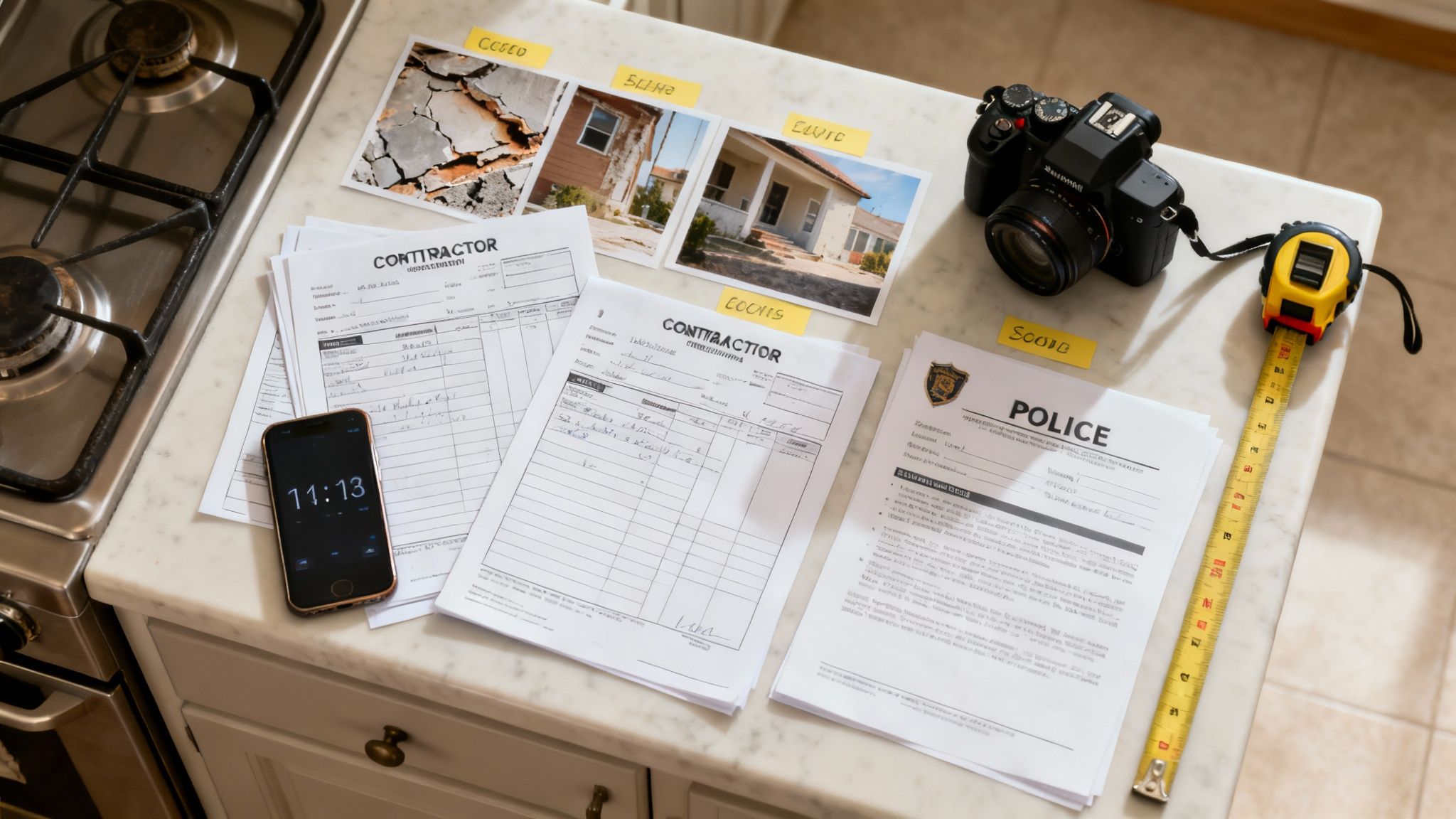
Your job is to build a claim so detailed and so thorough that it shuts down the adjuster’s arguments before they can even make them. You need your own independent proof for every single dollar you are owed.
Start with the basics and build out from there:
- The Official Police Report: This is your foundation. It’s a neutral, third-party account of what happened, making it incredibly difficult for the insurer to argue the basic facts.
- Your Independent Contractor Estimates: Never, ever just accept the estimate from the insurer’s “preferred” contractor. Get at least two highly detailed, line-item bids from your own trusted, local builders. These estimates need to specify the quality of materials and real-world labor costs, not just what some outdated software says it should cost.
- The Structural Engineer’s Report: As I said before, this is completely non-negotiable. An engineer’s certified report that details hidden damage to your foundation, frame, and load-bearing walls is exactly the kind of expert evidence that wins disputes.
When you’re fighting for a fair payout, make sure the final settlement covers quality repairs that are backed by a solid workmanship warranty. The goal isn’t just to patch a hole in the wall; it’s to restore your home to its pre-loss condition with work that’s built to last.
Tracking Your Additional Living Expenses (ALE)
If the damage is bad enough that you have to move out, your policy should cover Additional Living Expenses (ALE). This is often one of the most disputed parts of a claim, and big insurers are notorious for fighting homeowners on these costs.
You must track every single expense with the discipline of an accountant. Keep every receipt. Organize them by date and category. The insurance company will call anything they can “unreasonable,” and your meticulous documentation is your only defense.
Your ALE claim isn’t a blank check. It’s for costs above and beyond your normal living expenses. This includes things like:
- Hotel bills or rent for a comparable temporary house.
- Increased food costs (if you’re eating out because your rental has no kitchen).
- Extra mileage if your commute is now longer.
- Costs for laundry services, boarding your pets, or renting a storage unit.
Don’t assume anything is automatically covered. You have to prove it was a necessary expense directly caused by you being forced from your home.
Fighting Back When They Say No
The lowball offer will come. It’s not a question of if, but when. And when it does, that’s when the real fight begins. Your first move is to formally reject their offer in writing, clearly stating that it’s inadequate to cover the scope of repairs documented by your independent experts.
If they won’t negotiate in good faith, your policy has a powerful tool you can use: the appraisal clause. This process lets you and the insurer each hire an independent appraiser. Those two appraisers then agree on a neutral third party, called an umpire. A final value agreed upon by any two of those three people becomes binding. It’s a way to settle a dispute over the cost of damages without having to go straight to court.
But sometimes, a lawsuit is the only way forward. If your insurer is deliberately misinterpreting your policy, creating unreasonable delays, or flat-out refusing to pay for clearly covered damage, you may have a bad faith case. In a landmark case, State Farm Mut. Auto. Ins. Co. v. Campbell, the U.S. Supreme Court upheld a massive verdict against State Farm for a pattern of bad faith conduct, showing that insurance companies can be held accountable for their actions. A well-documented fight against an insurance company acting in bad faith is a fight you can absolutely win.
Frequently Asked Questions About Vehicle Impact Claims
When a car plows into your house, your mind is a chaotic mess of questions and panic. The answers you need aren’t always clear, especially when you’re up against an insurance company looking for any loophole to deny or underpay what you’re owed. Here are some straight answers to the most common concerns for homeowners in NC and VA to help you prepare for the fight.

How Long Do I Have to File a Claim in NC or VA?
This is a classic insurance trap. While state laws in North Carolina and Virginia might give you a couple of years to sue someone for property damage, your insurance policy plays by a much stricter, faster set of rules.
Most policies demand you give them “prompt” or “immediate” notice. In their world, that means days or weeks—not months or years.
Waiting is the worst thing you can do. It’s like handing your insurer a pre-written denial letter. They’ll argue you violated the policy terms, and just like that, they have a reason to kill your claim on a technicality. You have to report it immediately.
But remember, reporting the claim isn’t the same as settling it. Get the incident on record right away to protect your rights. Then, you can take the time to get the damage properly assessed by your own experts before you even think about accepting their first lowball offer.
Can I Start Repairs Before the Insurance Claim Is Settled?
Hold on. You can—and should—only make emergency, temporary repairs meant to stop the damage from getting worse. Think boarding up a gaping hole to keep rain and critters out or throwing a tarp over a smashed section of the roof.
Do not, under any circumstances, start permanent reconstruction. Your insurance company has a contractual right to see the original, untouched damage. If you start rebuilding the wall before their adjuster shows up, you’ve just given them all the leverage.
They will absolutely argue that they can’t verify the true extent of the damage because you’ve already fixed it. This is a deliberate tactic that allows them to write their own version of the story—one where the damage was minor and their payout is, too.
A public adjuster is invaluable here. We can tell you exactly what counts as a necessary temporary fix versus a permanent repair that could sink your entire settlement.
What if the Driver Fled or Has No Insurance?
It’s a nightmare scenario. The driver who smashed into your home is uninsured or took off in a hit-and-run. Now what? You have to file the claim under your own homeowners policy.
This is where your own insurance company, whether it’s State Farm, Allstate, or another big name, often puts up the biggest fight.
Why? Because now there’s no other insurance company to point the finger at or split the costs with. The entire financial burden lands right on their shoulders. You can bet they will tear through every line of your policy looking for an exclusion or a loophole to limit what they have to pay.
You’ll have to cover your deductible, but your policy should pay for the rest of the covered damage. In a situation like this, having a public adjuster becomes critical. We force your own insurance company to honor the policy you’ve been paying for, making sure they don’t treat you like an adversary.
When your house is hit by a car, the insurance battle can be more damaging than the crash itself. If you’re facing delays, denials, or lowball offers, you don’t have to fight alone. For The Public Adjusters, Inc. represents you, not the insurance company. Contact us for a no-cost claim review to ensure you get the full settlement you are owed. Learn more at https://forthepublicadjusters.com.