You're staring at an insurance check that has your name on it, but your mortgage company's name is printed right beside yours. The insurer says the claim is paid. The servicer says the money must go into escrow. Your contractor wants a deposit, repairs can't wait, and nobody has explained when you'll receive enough to rebuild.
That frustration is justified. A joint-payee check is a normal part of a mortgaged property claim, but it creates a dangerous opportunity for confusion. The lender's approval to release a draw doesn't prove the insurer's estimate is complete or fair. You must manage the escrow process and challenge the claim scope as separate problems.
Table of Contents
- Why Your Mortgage Company Is on the Insurance Check
- Endorsing the Check and Navigating Escrow Draws
- The Danger of Confusing Lender Approval with Claim Adequacy
- Fighting Back Against Low-Ball Estimates and Delays
- Managing NFIP Flood Claims and FEMA Coordination
- Securing Your Full Settlement with Expert Claim Help
Why Your Mortgage Company Is on the Insurance Check
When a mortgaged home suffers covered damage, the insurance claim check is commonly made payable to both the homeowner and the mortgage lender or servicer because the lender has a financial interest in preserving the property that secures the loan. California's Department of Insurance explains the lender's role in structural insurance payments, including the lender's right to receive and control proceeds connected to repairs.
The lender isn't named because it owns your insurance claim. It's named because the damaged home secures the loan. If the property isn't repaired, its value can fall, leaving the lender with weaker collateral. That's why the mortgage agreement and the policy's mortgagee or loss-payable provisions commonly require joint payment and lender oversight.
The lender protects the collateral. The insurer evaluates coverage. You still have to prove the full cost of restoring the property.
Structural proceeds usually receive the most scrutiny. The servicer may endorse or deposit the check into a restricted escrow or controlled account, then release money as repairs advance. The Consumer Financial Protection Bureau describes a process in which the servicer may issue an initial amount, distribute additional funds as construction progresses, and release the balance after completion and inspection. That procedure controls access to money, but it doesn't decide whether the insurer included every covered item.
Structural funds are different from other claim payments
Personal-property proceeds and additional-living-expense payments may be handled differently from money earmarked for rebuilding. Depending on the policy, the lender's requirements, and the type of damage, those payments may not be subject to the same repair-draw process.
That distinction matters after a serious loss. You may need temporary housing, clothing, food, transportation, or replacement belongings while the structural check remains in escrow. Keep those expenses separate from construction costs, preserve receipts, and ask the insurer and servicer in writing how each payment category will be handled.
Your mortgage payment doesn't stop because the house is damaged or because the lender is holding claim money. Continue scheduled payments unless the servicer gives you a specific written alternative. A lender-controlled account can slow your access to repair funds, but it doesn't erase the underlying loan obligation.
For a useful explanation of lender insurance requirements before you communicate with the loss-draft department, review this LendingXpress insurance requirements guide. Treat the lender's process as an administrative track, not as a ruling on the value of your loss.
Endorsing the Check and Navigating Escrow Draws
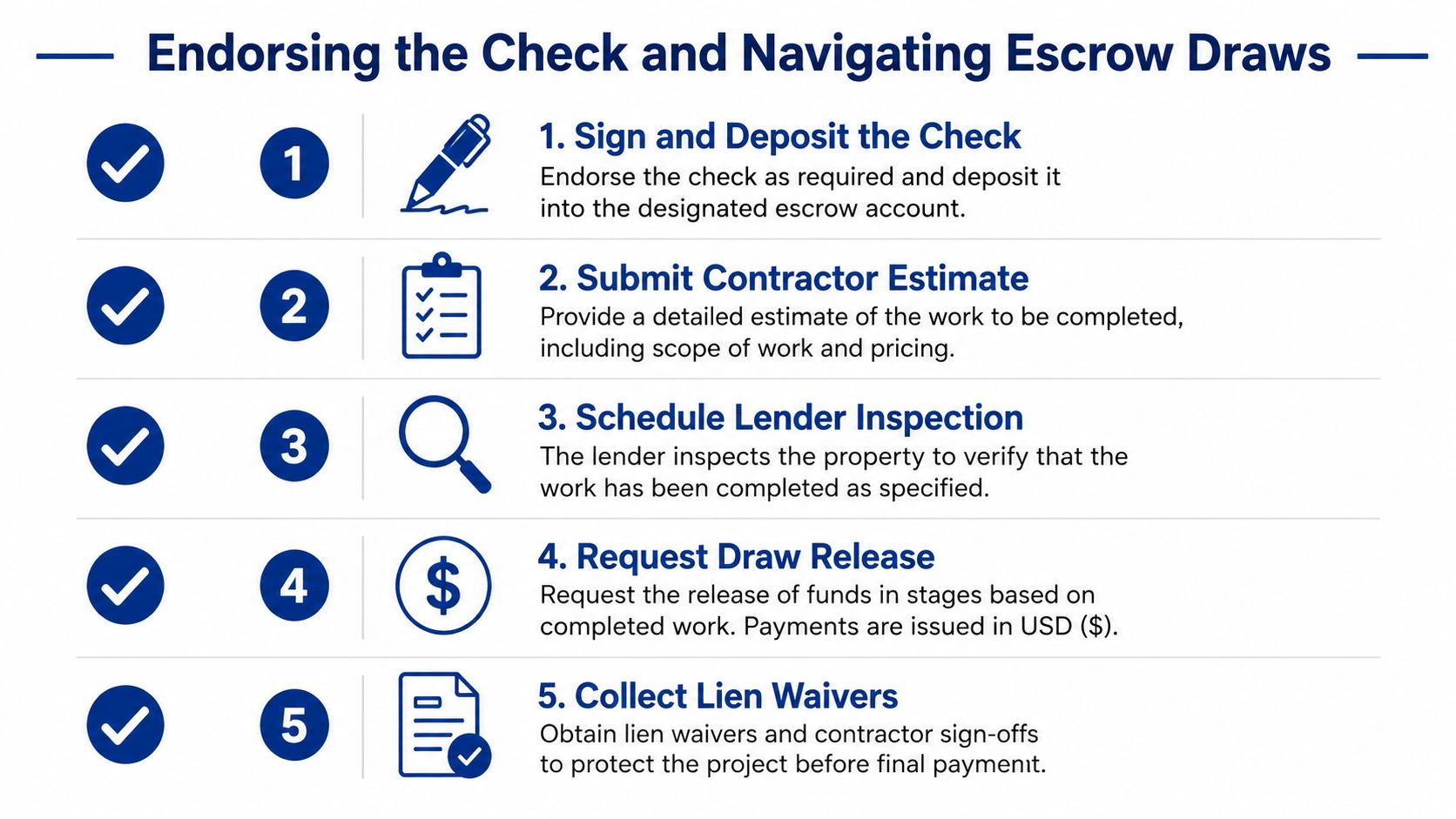
The first mistake homeowners make is treating endorsement as the finish line. It's only the beginning of the controlled-release process. Before you sign anything, photograph the front and back of the check, confirm every payee name, and ask the servicer for written delivery and deposit instructions.
Use a written lender workflow
Follow this sequence:
Confirm the payee information. Ask whether the mortgage company's legal name, servicing address, and loan number are correct. A transfer of servicing can create confusion if the check names an outdated entity.
Ask for the loss-draft packet. Request the exact endorsement form, contractor requirements, inspection procedure, draw request form, and submission address. Don't rely on a verbal promise from a call-center representative.
Submit a complete repair package. Include the insurer's estimate, your independent contractor's detailed scope, material specifications, permits when available, contractor contact information, and a realistic construction schedule.
Demand the draw schedule in writing. Get the amount or percentage expected at each stage, the inspection trigger, the documents required for each release, and the conditions for the final draw before signing a reconstruction contract.
Track every submission. Send documents through a traceable method and maintain a dated log of names, phone calls, emails, promised actions, and missing items.
The servicer's requirements may become stricter when the loan is delinquent. Fannie Mae's hurricane-relief guidance states that, for a loan current or less than 31 days delinquent, the servicer may authorize an initial repair advance up to the greater of $40,000, 33% of the insurance proceeds, or the amount exceeding the unpaid principal balance, accrued interest, and advances, with remaining funds released after periodic inspections. The Fannie Mae guidance explains this repair-advance and inspection framework.
For a loan at least 31 days delinquent when the disaster occurs, a final inspection may be required. That makes documentation even more important.
Build the file before construction starts
Keep invoices, paid receipts, permits, inspection reports, photographs, engineer documents, and contractor correspondence in one claim folder. Photograph open walls, removed flooring, framing, wiring, plumbing, and other concealed work before it disappears behind drywall or finishes.
Require written approval for every change order. A contractor's price increase, hidden damage discovery, or code-related change can create a funding gap if the servicer sees work that wasn't included in its approved repair plan. Collect lien waivers and proof of payment as the project advances so the final draw doesn't stall over questions about contractor balances.
Use this guide to endorsing an insurance check for additional procedural considerations. Above all, don't deposit the check while telling yourself the insurer's figure must be final. Endorsement gives the lender control over disbursement. It doesn't waive your right to pursue covered supplemental damage.
The Danger of Confusing Lender Approval with Claim Adequacy
A lender can approve a draw from an estimate that is far too low. That's the central problem many homeowners miss.
The servicer's question is usually whether the proposed work protects the property and whether the requested release matches documented progress. The insurer's question should be whether the policy covers the damage and what it costs to repair or replace the covered property. Those questions overlap, but they aren't the same.
The Consumer Financial Protection Bureau makes this distinction clear in its explanation of how home insurance companies pay claims. A jointly payable check doesn't establish that the settlement is adequate. The homeowner still needs a process for disputed scopes, supplements, code upgrades, depreciation, hidden damage, and contractor price changes.
Separate three decisions
| Decision | Who controls it | What it means |
|---|---|---|
| Coverage and covered damage | Insurer, subject to the policy and applicable rules | Determines what loss the policy responds to |
| Repair-fund disbursement | Mortgage servicer | Determines when escrowed proceeds are released |
| Construction performance | Homeowner and contractor | Determines how the approved work is actually completed |
A lender inspection may confirm that framing is installed. It won't necessarily identify omitted code upgrades, overlooked water damage, inadequate demolition allowances, missing debris removal, or a depreciated payment that doesn't fund replacement.
That's why you should compare the insurer's estimate against an independent, room-by-room scope before committing to a fixed-price contract. Mark every omission. Separate confirmed damage from newly discovered damage. Ask the insurer to address each item in writing and preserve the policy language supporting your position.
A lender draw approval validates a release request. It does not validate the insurer's estimate.
If the first check reflects actual cash value or withheld depreciation, identify the policy's replacement-cost procedure and the documentation required to recover the balance. Don't let a contractor assume the initial check is the total claim value, and don't let the lender's escrow schedule pressure you into accepting an incomplete scope.
Fighting Back Against Low-Ball Estimates and Delays
A low estimate becomes harder to fix once demolition is complete and the contractor has committed to a price. Challenge the insurer's scope early, in writing, while you can still document what was damaged and why the proposed repair is necessary.

Start with a clean dispute package. Include the policy, declarations page, insurer estimate, photographs, contractor estimate, engineer or specialist findings, receipts, correspondence, and a written list of disputed items. For every disagreement, identify the location, damage condition, proposed repair, cost difference, and policy provision that supports payment.
If the carrier denies part of the loss, demand the denial in writing. A phone explanation isn't enough. Preserve the claim number, adjuster messages, inspection notes, recorded statements, estimates, payment breakdowns, and every supplement submission.
Use appraisal for amount disputes
The National Association of Insurance Commissioners explains that, when the disagreement concerns repair or replacement cost, an appraisal clause may allow each side to select an appraiser. The two appraisers compare estimates, and an umpire resolves issues on which they can't agree. The NAIC post-disaster claims guide explains the distinction between amount disputes and coverage disputes.
Appraisal generally addresses the amount of loss, not whether the policy covers the damage. It isn't a substitute for proving coverage, challenging an exclusion, or explaining why the insurer wrongly denied an item. Read the policy's appraisal language and obtain professional advice before invoking it.
A public adjuster can organize the scope, document the loss, communicate with the carrier, and coordinate information needed for lender draws. That independent role matters when the insurer's adjuster is minimizing damage while the servicer is waiting for a package that nobody has assembled properly.
For roof-related disputes, homeowners should also understand the difference between storm damage, maintenance issues, exclusions, and replacement-cost provisions. This resource on claiming a roof on insurance can help frame the repair discussion with a roofing contractor.
The following video provides another practical perspective on insurance claim handling:
If the servicer mishandles the escrow process, contact the agency that regulates mortgage lenders, the state attorney general, or the state insurance department. A complaint won't replace a properly documented supplement, but it can create a formal record when communication breaks down.
Managing NFIP Flood Claims and FEMA Coordination
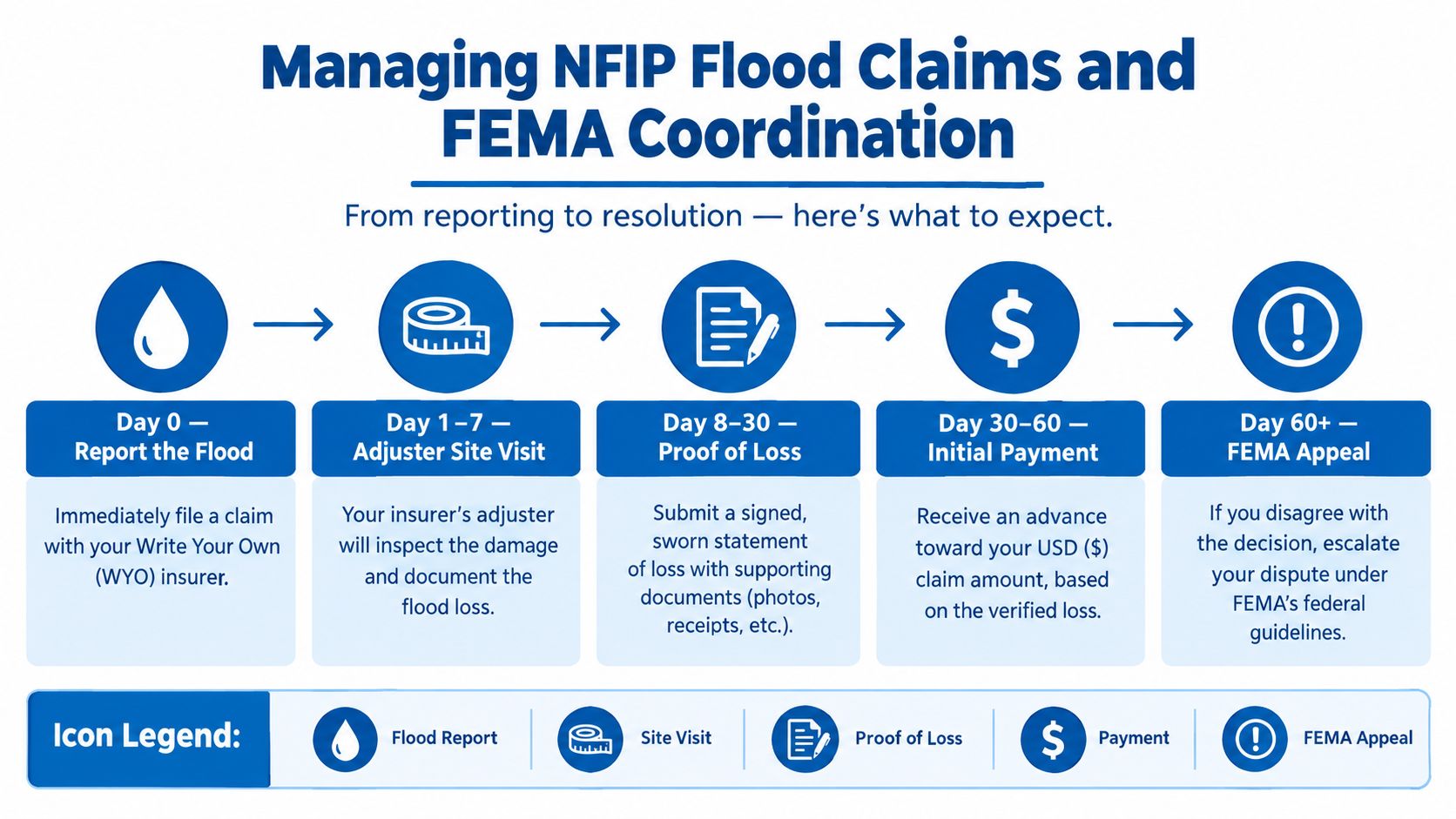
Flood claims require a separate strategy. Standard homeowners coverage generally doesn't handle flood damage, and NFIP claims operate under the federal flood-insurance program through participating insurers, including Write Your Own companies. Don't apply ordinary wind, fire, or water-loss assumptions to an NFIP dispute.
FEMA states that a standard NFIP claim can take approximately four to eight weeks to be finalized and paid. The payment check may name both the policyholder and the mortgage company, creating another endorsement step before the funds can be deposited or released. FEMA's flood-recovery guidance explains the NFIP payment process and mortgagee information requirements.
Keep flood, lender, and FEMA records distinct
Verify the mortgagee's exact name, mailing address, and telephone number with the lender and the WYO insurer. If you're displaced, update contact information immediately. A check sent to an outdated address can add an avoidable delay.
Maintain separate folders for:
- NFIP claim documents: Adjuster scope, photographs, engineering reports, inventory, proof of loss, correspondence, and payment calculations.
- Mortgage documents: Check instructions, escrow terms, draw requests, inspections, contractor scopes, and release confirmations.
- FEMA records: Application details, insurer settlement or denial, temporary-housing expenses, receipts, correspondence, and assistance decisions.
FEMA says insured applicants should still apply for disaster assistance and submit the insurer's settlement or denial. If the insurance decision is delayed more than 30 days, an insurance advance may be available for temporary housing in qualifying situations. FEMA also prohibits duplicate recovery for expenses already covered by insurance. FEMA's questions and answers on disaster assistance explain this coordination requirement.
That means you must track temporary housing, food, transportation, repairs, and personal-property expenses separately. Don't use one receipt category for everything. If insurance later pays an expense, report it so you don't create a repayment problem with FEMA.
For North Carolina homeowners, keep the signed proof of loss and supporting evidence organized from the start. This NFIP proof-of-loss deadline guide can help you identify the documents that matter in a flood claim dispute. If the WYO carrier's scope is incomplete, challenge it independently from the mortgage company's release process.
Securing Your Full Settlement with Expert Claim Help
You're dealing with three separate systems: the insurer's coverage decision, the mortgage servicer's escrow controls, and the contractor's repair demands. Handle them as separate negotiations, and keep one master file showing how they connect.
Your immediate action plan is straightforward:
- Preserve leverage: Don't sign a contract that assumes the first insurance check is the final settlement.
- Control the paper trail: Request every denial, draw requirement, inspection result, and supplemental decision in writing.
- Document concealed damage: Photograph demolition and hidden conditions before they're covered.
- Protect other benefits: Track personal property, additional living expenses, temporary housing, and FEMA costs separately.
- Escalate intelligently: Use appraisal for amount disputes, regulatory complaints for mishandling, and qualified legal advice for coverage or bad-faith issues.
A licensed public adjuster works for the policyholder, not the insurer. For The Public Adjusters, Inc. is a North Carolina firm serving residential and commercial policyholders across North Carolina and Virginia, with claim documentation, scope preparation, carrier communication, and lender-draw coordination for property losses. The firm's team includes IICRC-certified expertise for fire and water damage and offers no-cost claim reviews. Learn more about what a public adjuster does before deciding whether independent representation fits your claim.
Client reviews can help you evaluate communication, documentation quality, and results, but ask any firm direct questions about licensing, fees, the people handling your claim, and how it will protect supplemental benefits. Your objective isn't merely to get the lender to release the first draw. It's to secure enough covered funds to complete a proper repair.
For The Public Adjusters, Inc. helps homeowners separate lender escrow delays from insurer underpayments, document disputed damage, prepare supplements, and coordinate the information required for staged claim releases. Visit For The Public Adjusters, Inc. for a no-cost claim review and direct guidance from a licensed public insurance adjuster. Have your water damage claim questions answered at NO COST. Call 919-400-6440 to speak with a licensed Public Insurance Adjuster or Contact Us here with questions. WE Work For YOU… NOT Your Insurance Company!