A Car Hit My House — Is a New Garage Door Really All I Need?
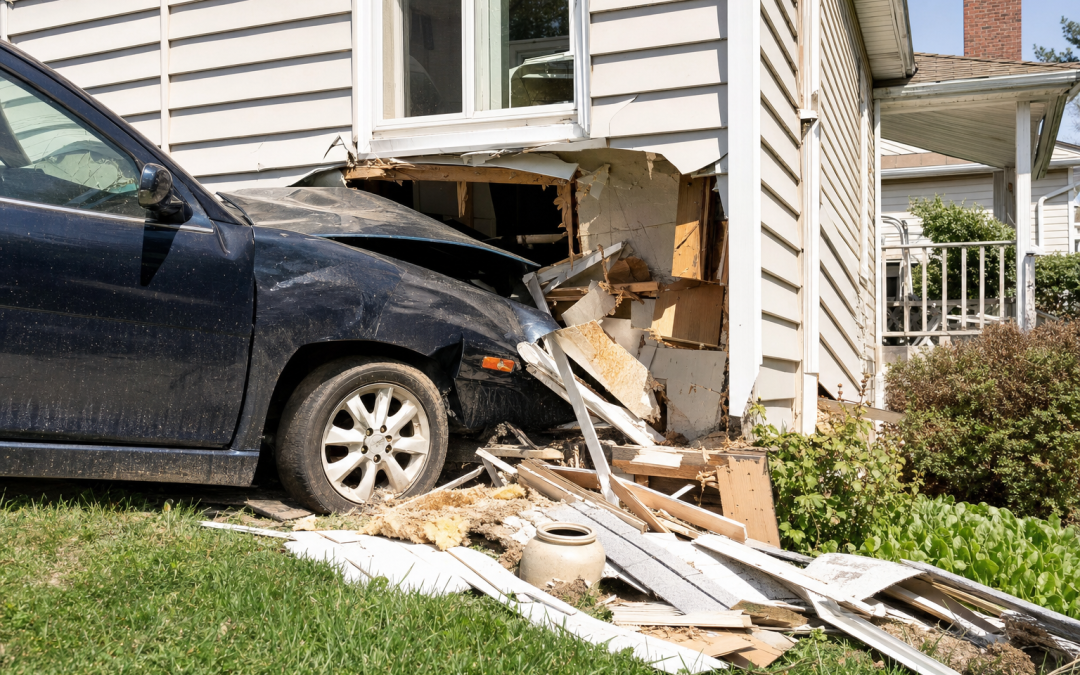
If a car hit my house, a new garage door alone is rarely the full repair — vehicle impacts transfer thousands of pounds of force into the framing, headers, and even the foundation behind that door. The visible dent is often just the surface of deeper structural damage that a quick first estimate can easily miss.
Key takeaways
- If a car hit my house is the reason for your claim, the visible damage is often only part of the story — vehicle impacts transfer force into headers, framing, and slabs that a quick estimate can miss.
- A first estimate scoped as a simple garage door replacement should be treated as a starting point, not a final answer, until the structure behind the door has been inspected.
- Hidden structural damage like a bent steel header, racked wall framing, or a shifted load-bearing connection can turn a cosmetic repair into a proper structural rebuild.
- Courts have sided with policyholders on full, proper repairs — in Windridge of Naperville Condominium Ass’n v. Philadelphia Indemnity Ins. Co. (7th Cir. 2019), the insurer was required to replace all of a building’s siding so the repair matched, not just the directly damaged panels.
- A licensed public adjuster works for the policyholder, documenting the full scope of damage so the claim reflects what it actually takes to restore the home.
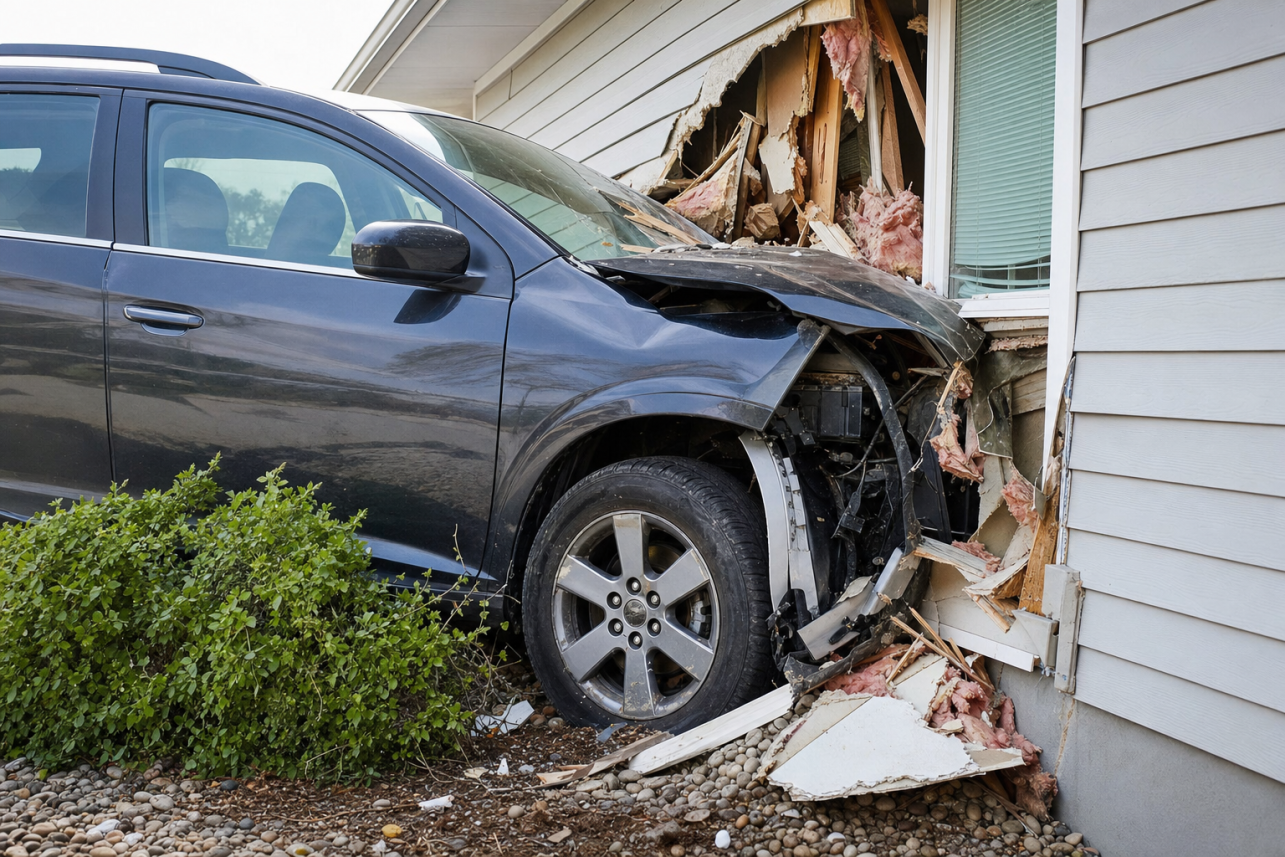
It happens more often than most people realize: a driver loses control, misjudges a driveway, or confuses the gas pedal for the brake, and suddenly a vehicle is resting against — or inside — someone’s home. The insurance adjuster arrives, photographs the crumpled garage door, and writes an estimate to replace it. The homeowner, relieved that someone responded quickly, assumes that’s the end of it.
One NC Homeowner’s Wake-Up Call
Consider a scenario we see regularly across North Carolina: a homeowner accepts a garage-door-only estimate, the new door is installed, and within weeks the door won’t close properly, drywall cracks appear inside the garage, and a door into the house starts sticking. Why? Because the impact pushed the wall framing out of plumb and stressed the header above the opening — damage that was never inspected, never scoped, and never paid for. Situations like a car hits home claim in Raleigh NC often start exactly this way, with a first estimate that addresses only what the camera can see.
Why the Garage Door Is Just the Tip of the Damage
Think about the physics. Even a slow-moving vehicle weighs several thousand pounds, and all of that energy has to go somewhere when it stops against your home. Common damage hiding behind a “simple” garage door replacement includes:
- Bent or shifted wall framing that throws the door opening out of square
- Cracked or compromised headers and posts supporting the structure above
- Damage to the concrete slab, stem wall, or foundation at the point of impact
- Hidden damage to electrical wiring, plumbing, or HVAC lines running through impacted walls
- Roof and ceiling stress when load-bearing elements absorb the blow
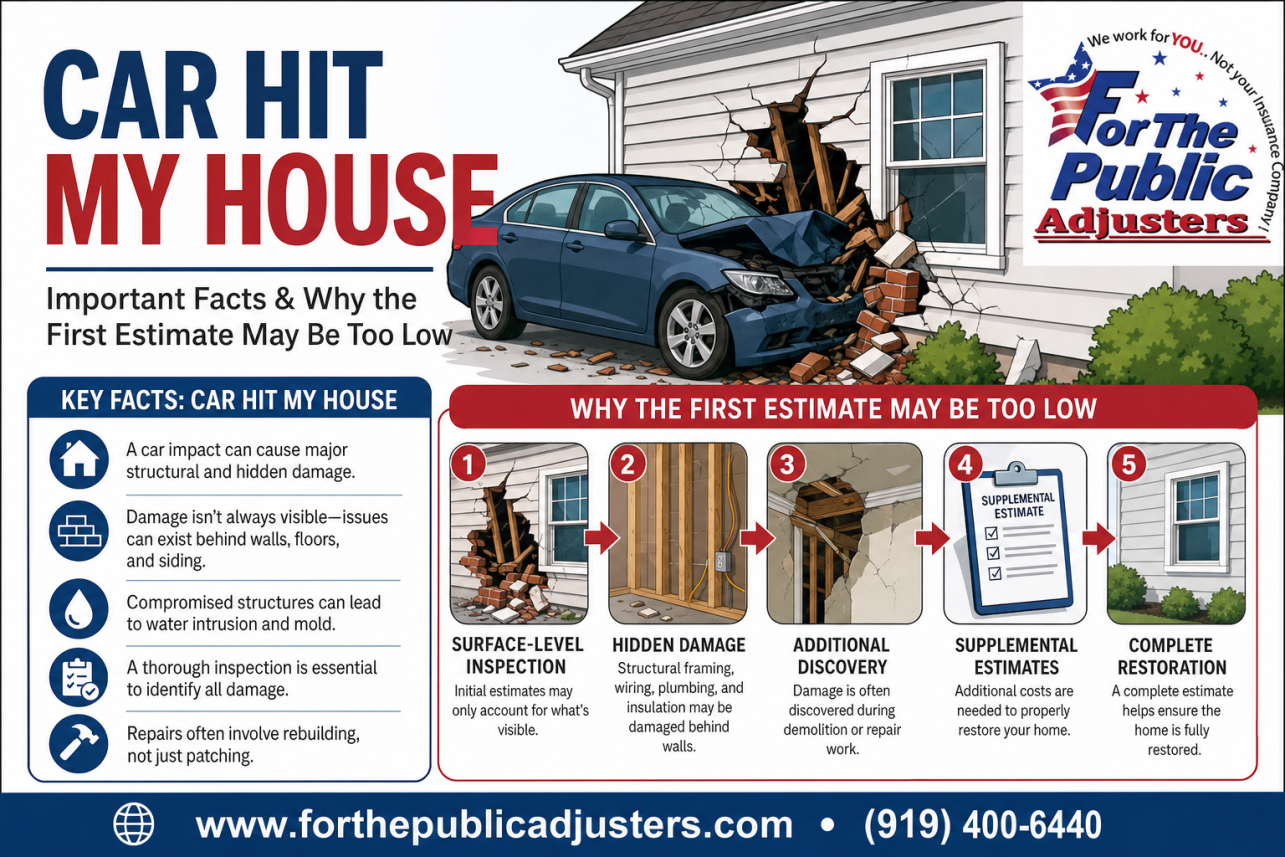
A first estimate written in fifteen minutes simply cannot account for all of this, because much of it only shows up when walls are opened or the structure is professionally evaluated. That’s why many homeowners choose to have their claim independently reviewed — for example, by a licensed public adjuster in Durham NC — before accepting that the garage door was the only casualty.
The reassuring news: you are not obligated to accept the first estimate, and you have the right to a complete, properly documented scope of damage. The rest of this article walks through why initial estimates come in low, what hidden damage to look for, whose insurance pays in North Carolina, and the practical steps to take right now.
Why Did the Insurance Company Scope Only a Garage Door Replacement After a Car Hit My House?
Insurance carriers often scope vehicle-impact claims based on a quick exterior inspection, listing only the most visible damage — in this case, a crumpled overhead garage door. The adjuster’s estimate came to roughly $3,800 for a new door and tracks, because nothing behind the drywall or under the slab was ever opened up and examined.
Here is how the first half of this story typically unfolds. The field adjuster arrives, photographs the bent door panels, measures the opening, and writes an estimate for a replacement overhead door, new tracks, and perhaps a fresh coat of paint on the trim. The visit may last twenty or thirty minutes. The homeowner, relieved that someone showed up quickly, assumes the professional saw everything that mattered.
The problem is that a garage door is designed to flex and absorb energy. The vehicle’s force does not stop at the door — it transfers into the framing, the foundation, and the structure around the opening. A visual inspection from the driveway simply cannot see where that energy went.
Why “Drive-By” Scoping Misses Impact Damage
- No invasive inspection: Adjusters rarely remove drywall, insulation, or trim during a first visit, so cracked studs, shifted headers, and racked framing stay hidden.
- Volume pressure: Field adjusters often handle heavy caseloads and are trained to document what is plainly visible, not to investigate what a collision does to a load path.
- Surface-level photos drive the estimate: The written scope is built from photographs of the damaged door, so the estimate reflects only what the camera captured.
- Slab and footing damage is invisible: A vehicle can crack a garage slab or disturb the footing beneath the impact point, and neither shows up without closer examination.
The Estimate Reflects the Inspection, Not the Loss
A $3,800 door estimate is not necessarily dishonest — it is simply incomplete. The carrier paid for what its adjuster documented, and the adjuster documented what could be seen in half an hour. That gap between the visible damage and the actual damage is exactly where homeowners get shortchanged on impact claims. We see this pattern regularly in a car hit my house insurance claim in Burlington and in similar losses across the Triangle and Triad.
If your settlement letter arrived before anyone looked behind the drywall, inspected the header above the opening, or checked the slab for new cracks, your claim was scoped on appearance alone. Homeowners dealing with a car hits home insurance claim in Durham face the same risk: a fast first estimate that quietly becomes the carrier’s final answer unless the homeowner pushes for a deeper look.
The good news is that a first estimate is not a final verdict. Claims can be reopened and supplemented when properly documented damage comes to light — and with vehicle impacts, there is very often more to find.
What Hidden Structural Damage Can a Vehicle Impact Cause When a Car Hit My House?
A vehicle impact can bend the steel header above the garage opening, crack the concrete slab, rack the wall framing out of square, and shift the connection where a load-bearing wall ties into the structure. None of these are visible from the street, yet each one affects the safety and long-term stability of the home.
When our public adjuster inspected this home, the damage list grew well beyond the garage door the first estimate covered. Here is what the inspection actually documented — and why each item matters in plain terms.
A Bent Steel Header
The header is the beam that spans the garage opening and carries the weight of everything above it — framing, roof load, sometimes a bonus room. The impact bent this steel member out of its original shape. A bent header no longer carries load the way it was engineered to, and it can also prevent a new garage door from sealing or operating correctly. Hanging a new door under a compromised header is like putting a fresh bandage over a broken bone.
A Cracked Garage Slab
The force of the vehicle traveled down through the structure and cracked the concrete slab. Cracks like these allow moisture intrusion, can worsen with freeze-thaw cycles, and may signal that the footing below took part of the blow. A slab inspection is a standard part of how we document a car hits home claim in Elon and similar vehicle-impact losses across North Carolina.
Racked Wall Framing
“Racked” means the wall studs were pushed out of plumb — the wall is no longer square. Signs include:
- Doors and windows near the impact that stick or won’t latch
- Drywall cracks radiating from corners
- Visible gaps where the wall meets the ceiling or floor
- Nail pops along the affected wall
Racked framing has lost some of its ability to resist lateral forces. It typically needs to be opened up, straightened or replaced, and re-sheathed — not simply patched and painted.
A Shifted Load-Bearing Wall Connection
Most concerning, the inspection found that the connection where a load-bearing wall ties into the rest of the structure had shifted. Load-bearing walls transfer the weight of the roof and upper floors down to the foundation. When that load path is disrupted, the home may look fine today while stress slowly concentrates in places never designed to carry it. This is the kind of finding that often requires an engineer’s evaluation before repairs are scoped.
The lesson for homeowners is simple: cosmetic repairs on top of structural damage don’t make a home safe, and they rarely satisfy building codes. If you’re dealing with a car hit my house insurance claim in Burlington or anywhere in our service area, a thorough, documented inspection is what separates a surface-level estimate from one that reflects the true scope of the loss.
Whose Insurance Pays When a Car Hits Your House in NC?
In North Carolina, the at-fault driver’s auto liability insurance is typically the primary source of payment when a vehicle strikes a home. Your own homeowners policy can also respond — often faster — and your insurer may then pursue the driver’s carrier for reimbursement. A public adjuster handles the claim for your home and contents, never the vehicle itself.
Understanding how these two policies interact can make a real difference in how quickly and how fully you are paid. Here is how it usually works for homeowners saying “a car hit my house” for the first time.
The Driver’s Liability Coverage
North Carolina requires drivers to carry property damage liability coverage. When a driver crashes into your home, their insurer is responsible for the damage they caused. In practice, though, there are common complications:
- The driver’s liability limits may be too low to cover serious structural damage.
- The driver may be uninsured, or the vehicle may have been stolen.
- Liability carriers often investigate fault slowly, leaving you waiting while your home sits damaged and exposed.
Your Own Homeowners Policy
You do not have to wait on the driver’s insurer. Vehicle impact is a covered peril under standard homeowners policies, so you can file with your own carrier, pay your deductible, and let your insurer seek recovery from the at-fault driver’s company through subrogation. If subrogation succeeds, you may get your deductible back. Filing under your own policy is often the faster path to repairs — but it only works well if the damage is scoped completely, which is where many first estimates fall short. That is exactly the kind of claim we document in a car hit my house insurance claim in Cary and across North Carolina.
What a Public Adjuster Does — and Does Not — Handle
To be clear about our role: a licensed public adjuster represents you on the property claim — the structure, attached garage, foundation, interior finishes, and damaged contents. We never handle the motor vehicle claim, injury claims, or any dispute over the car itself. Our job is making sure every bit of damage to your home is identified, documented, and presented properly, whether the paying carrier is yours or the driver’s.
North Carolina courts have long held insurers accountable when they underpay or mishandle legitimate property claims. In Gray v. North Carolina Insurance Underwriting Association, the North Carolina Supreme Court allowed homeowners to pursue claims against their insurer over the handling of storm damage to their coastal properties — a reminder that policyholders have real rights and real remedies. Working with an experienced Public Adjuster in Burlington or anywhere in our service area means you have a licensed, bonded professional protecting those rights from day one, without the matter ever needing to reach a courtroom.
How Can a Public Adjuster Change the Outcome of a Car Hit My House Claim?
A public adjuster works solely for you, not the insurance company. By bringing in engineering documentation, measuring hidden structural movement, and rebuilding the repair scope line by line, a public adjuster can turn a “garage door only” estimate into a settlement that reflects the true structural repair your home needs.
Evidence Changes the Conversation
Insurance carriers respond to documentation, not frustration. When a vehicle strikes a home, a public adjuster typically assembles proof the first estimate never considered, such as:
- An independent structural engineer’s inspection of framing, footings, and load paths
- Photographs and measurements of shifted studs, cracked masonry, and racked openings
- A detailed repair scope written by contractors who actually perform structural work
- A line-item comparison showing exactly what the carrier’s estimate left out
In claims like these, that package of evidence often reframes the loss entirely. Instead of debating the price of a garage door, the conversation becomes about restoring the structural integrity of the home — which is what your policy is meant to do. A licensed and bonded Public Adjuster in Garner handles this documentation and negotiation on the policyholder’s behalf from the first inspection forward.
You Have the Right to Dispute the Scope of Loss
North Carolina policyholders are not required to accept the carrier’s first number. Most homeowner policies contain an appraisal clause, and North Carolina courts have backed the insured’s right to use it. In Harleysville Mutual Insurance Co. v. Narron, the North Carolina Court of Appeals sided with the insured, confirming that the full “amount of loss” — not just the pieces the insurer agrees are damaged — can be resolved through the appraisal process. That ruling matters enormously when a car hit my house claim gets scoped as cosmetic: it means the dispute over what the loss actually includes does not end simply because the adjuster’s first estimate was narrow.
A public adjuster understands how to document the loss so that, if appraisal or further negotiation becomes necessary, your position is supported by evidence rather than opinion. Homeowners in smaller communities face the same underscoped estimates as anyone else, and a Public Adjuster in Kenly NC can review the carrier’s estimate and identify what was missed before you sign off on repairs.
An Honest Word About Outcomes
No public adjuster can guarantee a specific result, and you should be wary of anyone who promises one. What a public adjuster can do is make sure every element of the damage is professionally documented, every policy right is exercised, and the carrier is answering to evidence instead of assumptions. In vehicle-impact claims, that difference in preparation is frequently what separates a surface-level payout from a settlement that actually rebuilds the structure.

What Should NC Homeowners Do Right Now If a Car Hit My House?
If a car hit my house is the emergency you’re facing, act fast: make sure everyone is safe, call 911, keep people away from the damaged area, photograph everything before anything is moved, board up and tarp the breach against fall weather, and notify your homeowner’s insurance carrier promptly — in writing, with your photos attached.
Fall in North Carolina brings early cold snaps, gusty days, and wind-driven leaves and rain. A breached garage wall or a door knocked off its tracks is an open invitation for moisture, pests, and heat loss — and unaddressed water intrusion can turn one claim into two. If rain gets through a damaged opening and into drywall or framing, you may end up needing water damage insurance claim help in Bennett or wherever you live, on top of the impact claim itself.
Your Fall-Season Action Plan
- Keep everyone out of the damaged area. A vehicle strike can compromise load-bearing framing even when the structure looks stable. Wait for a professional opinion before working inside the garage.
- Get the police report. It identifies the driver, their insurer, and the facts of the incident — all critical to your claim.
- Photograph and video everything before cleanup. Capture the vehicle’s resting position if possible, the door, framing, slab cracks, shifted walls, interior ceilings, and anything stored in the garage that was damaged.
- Secure the opening properly. Use plywood sheathing and tarps rated for outdoor use, fastened so autumn winds can’t peel them back. Keep receipts — reasonable costs to protect the property from further damage are typically covered under most policies.
- Protect against moisture now. Clear leaves and debris away from the breach so wind-driven rain doesn’t pool against exposed framing, and check the area after every storm.
- Report the loss in writing. Your policy requires prompt notice. Confirm the claim number and the adjuster’s contact information by email so there’s a record.
- Don’t sign off on the first scope. As covered earlier, initial estimates often miss structural and hidden damage. You’re entitled to question the scope before accepting payment.
Know Your Rights and Get Qualified Help
North Carolina homeowners can review their rights and file complaints through the North Carolina Department of Insurance, and the National Association of Insurance Commissioners offers consumer guidance on the claims process. If you’re unsure whether the scope you received reflects the full damage, a licensed and bonded public adjuster can review it at no obligation — for example, through a car hits home claim in Raleigh NC review. While no one can guarantee a specific outcome, having a professional document the full extent of the loss helps ensure nothing is left out of your claim.
Car Hit My House: First Estimate Scope vs. Full Structural Inspection
| Damage Area | Typical First Estimate | What a Thorough Inspection May Find |
|---|---|---|
| Garage door | Replace overhead door and tracks | Door opening out of square from racked framing — new door won’t seal or operate correctly without framing repair |
| Steel header above opening | Not inspected or assumed fine | Bent or deflected header that can no longer safely carry the load above |
| Garage slab and foundation | Not in scope | Impact cracking in the slab or footing that requires evaluation and repair |
| Load-bearing walls | Cosmetic drywall patch, if anything | Shifted wall-to-structure connections that affect how the home carries weight |
| Documentation | Brief walkthrough and photos of the door | Engineer-supported scope covering framing, header, slab, and connections |
Illustrative Example: From Door Swap to Structural Repair
Illustrative example
Consider a composite scenario based on claims like those we commonly see: a driver loses control and strikes the front of a North Carolina home at the garage. The carrier’s first estimate covers only a new overhead door, and the homeowner nearly accepts it. A public adjuster’s inspection, supported by a structural evaluation, documents a bent steel header, a cracked garage slab, racked wall framing, and a shifted load-bearing wall connection. With that evidence in the file, the claim is re-scoped from a door swap to a proper structural repair that restores the home the way the policy intends. This example is hypothetical and illustrative — every claim is different, and no specific outcome can be guaranteed.
Frequently asked questions
A car hit my house — whose insurance pays for the repairs?
Usually the driver’s auto liability policy is responsible, but you don’t have to wait on it. You can file under your own homeowner’s policy, get repairs moving, and let your insurer pursue the driver’s carrier through subrogation. If the driver was uninsured or fled the scene, your homeowner’s policy is typically your path to recovery. Either way, the damage to your home is a property claim — document everything before any cleanup.
How do I know if a car hitting my garage caused structural damage?
Warning signs include a garage door that won’t track or close evenly, new cracks in the slab or drywall, doors and windows nearby that suddenly stick, visible gaps where walls meet the ceiling, and framing that looks out of plumb. A vehicle impact transfers force well beyond the point of contact, so a bent header or racked wall can hide behind a door that merely looks dented. A thorough inspection — not just a glance at the door — is essential.
Should I accept the insurance company’s first estimate after a vehicle hit my home?
Not before the full scope of damage is known. First estimates are often written quickly from what’s visible — a damaged door or siding — before anyone opens walls or checks framing, footings, and load paths. You’re entitled to supplement the claim when additional covered damage is found. Reviewing the estimate with a licensed public adjuster or contractor before signing off helps ensure structural repairs aren’t reduced to cosmetic ones.
Is it safe to keep using my garage after a car crashed into it?
Treat it cautiously until it’s inspected. A bent steel header or shifted load-bearing connection can compromise the structure even if everything looks stable. Don’t operate a damaged overhead door — the springs and tracks are under high tension and can fail dangerously. Keep people and vehicles out of the affected area, take photos, and have the structure evaluated before resuming normal use.
What does it cost to hire a public adjuster for a car-hits-house claim?
Public adjusters typically work on a contingency fee — a percentage of the claim settlement — so there’s usually no upfront cost, and the fee is agreed to in writing before work begins. Percentages vary by state and claim size. For impact claims where hidden structural damage is common, the added documentation often changes the scope of what the insurer pays for, though no specific outcome can ever be guaranteed.
Do I need a structural engineer after a car hits my house?
Often, yes. When an impact involves a load-bearing wall, header, foundation slab, or framing, an engineer’s report establishes what must be repaired to restore the home’s integrity — not just its appearance. That report also carries weight with the insurance company, because it’s an objective professional opinion rather than a negotiation position. Your public adjuster or contractor can tell you whether the damage pattern warrants one.
Can the insurance company refuse to pay for matching new materials to the rest of my house?
Matching is a frequent dispute, and policyholders have prevailed in court. In Windridge of Naperville Condominium Association v. Philadelphia Indemnity Insurance Co. (7th Cir. 2019), the court required the insurer to pay to replace undamaged siding so the building matched after storm damage to one side. Your rights depend on your policy language and state rules, but a mismatched patch is not automatically all you’re owed.
What happens if more damage is found after repairs start?
You file a supplement. Contractors routinely discover hidden damage — cracked framing, slab damage, shifted connections — once demolition begins. Stop at that point, photograph everything in place, and notify the insurer in writing before covering it up. The claim scope and payment are then adjusted. This is normal and expected; the original estimate is a starting point, not a cap on what the insurer owes for covered damage.
How long does it take to settle a claim after a vehicle hits a home?
It varies widely. A simple, well-documented claim may resolve in weeks, while one involving structural engineering reports, supplements, or a dispute between your insurer and the driver’s carrier can take several months. The biggest delays usually come from an incomplete initial scope — which is why documenting all damage early, before repairs begin, tends to shorten the process rather than lengthen it.
What are the biggest mistakes homeowners make after a car hits their house?
The most costly ones: accepting a surface-level estimate without checking for structural damage, cleaning up or starting repairs before everything is photographed, signing off on a quick settlement, assuming the driver’s insurer will volunteer a fair amount, and not getting the police report. Also, don’t give recorded statements or sign releases until you understand the full scope of damage. Take your time — you generally only get one settlement for the loss.
Car Hits Home Claim help near you
Related local pages
If a vehicle has damaged your North Carolina home and the insurance estimate feels too small for what you’re seeing, let our licensed and bonded public adjusters take a closer look before you sign off. Schedule your free claim review today. Get in touch.
Last updated: October 3, 2026