
You’ve already lived through the fire. Then the estimate arrives, and it feels like a second hit. The carrier agrees there’s damage, but the numbers don’t come close to what it will take to clean, rebuild, replace, and move forward. That’s where a homeowners fire claim dispute usually starts. Not with a dramatic denial letter. With a low offer dressed up as “reasonable.”
If that’s where you are right now, don’t treat the first number as the final number. Treat it as the opening move in a negotiation you need to control.
Table of Contents
- Your House Fire Was Devastating The Lowball Offer Is Insulting
- Why Insurers Deny and Low-Ball Fire Claims
- Build Your Counter-Offensive An Evidence Master List
- Strategic Communication to Win Your Dispute
- Escalate Your Fight The Appraisal Clause and Legal Options
- You Don’t Have to Fight Alone When to Hire a Public Adjuster
Your House Fire Was Devastating The Lowball Offer Is Insulting
A lot of homeowners get stuck in the same miserable spot. The fire department is gone. The house still smells like smoke. Soot is in the vents, insulation is ruined, cabinets are swollen from firefighting water, and half your belongings are either visibly damaged or contaminated. Then the insurer sends an estimate that seems to account for only the obvious burn area.
That’s not a paperwork issue. That’s a money issue.
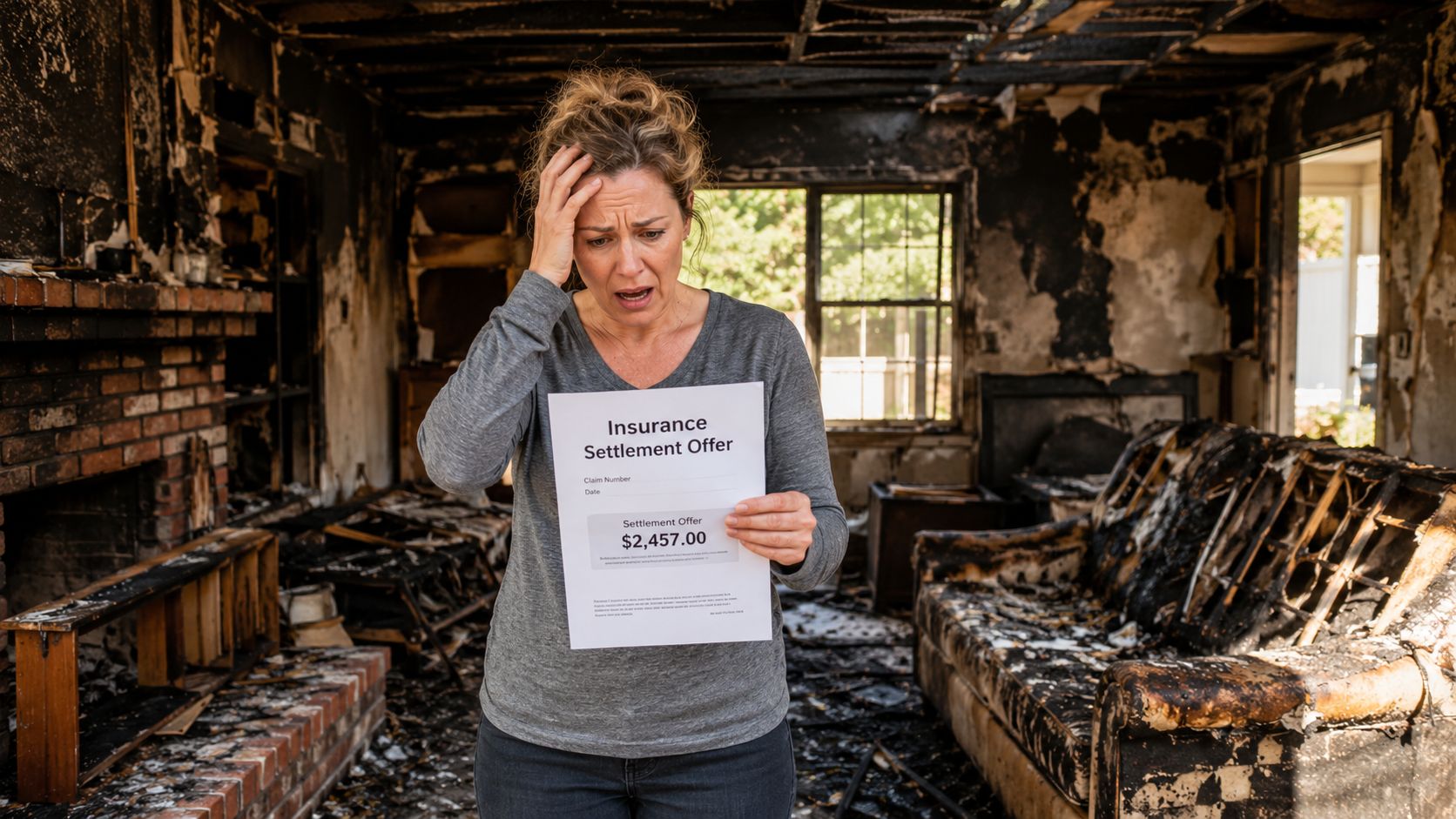
Between 2018 and 2022, the average insurance payout for house fire and lightning claims reached $83,991, making it the most expensive category of homeowners losses, according to reported house fire payout data. That’s why even a “small” disagreement over scope, cleaning, replacement, code upgrades, or contents can explode into a major financial dispute.
Why the first offer feels so far off
The carrier’s estimate often looks neat because it’s narrow. It may focus on visible structural damage while minimizing smoke migration, odor remediation, electrical concerns, insulation replacement, debris handling, and the full value of personal property. Homeowners see the whole loss. The insurer often prices only the part it can’t ignore.
Here’s the practical problem:
- Your contractor sees rebuild reality: demolition, hidden damage, material matching issues, and contamination.
- The adjuster may see line items: what can be measured quickly, priced cheaply, and challenged later.
- You see your life interrupted: temporary living issues, missing contents, and a home that still isn’t safe or complete.
Practical rule: If the offer doesn’t reflect what it actually takes to return the property to pre-loss condition under the policy, it’s not a fair number. It’s a number designed to test whether you’ll accept it.
Don’t let cleanup erase your leverage
A lot of homeowners rush into cleanup because they’re desperate to regain some control. That instinct makes sense. But if you remove debris, dispose of contents, or start repairs without preserving evidence, you can weaken your position. Before you move too fast, review some essential property restoration advice for homeowners so the work you do next helps your recovery instead of helping the carrier argue later.
A homeowners fire claim dispute is rarely about one bad estimate alone. It’s about whether you can prove what the estimate left out. If you can, the fight changes.
Why Insurers Deny and Low-Ball Fire Claims
Insurance companies don’t pay fire claims out of generosity. They pay what they believe they can justify under the policy and defend in a dispute. If they think you’re overwhelmed, undocumented, or likely to accept less, the offer usually reflects that.
That’s why you need to understand the playbook.
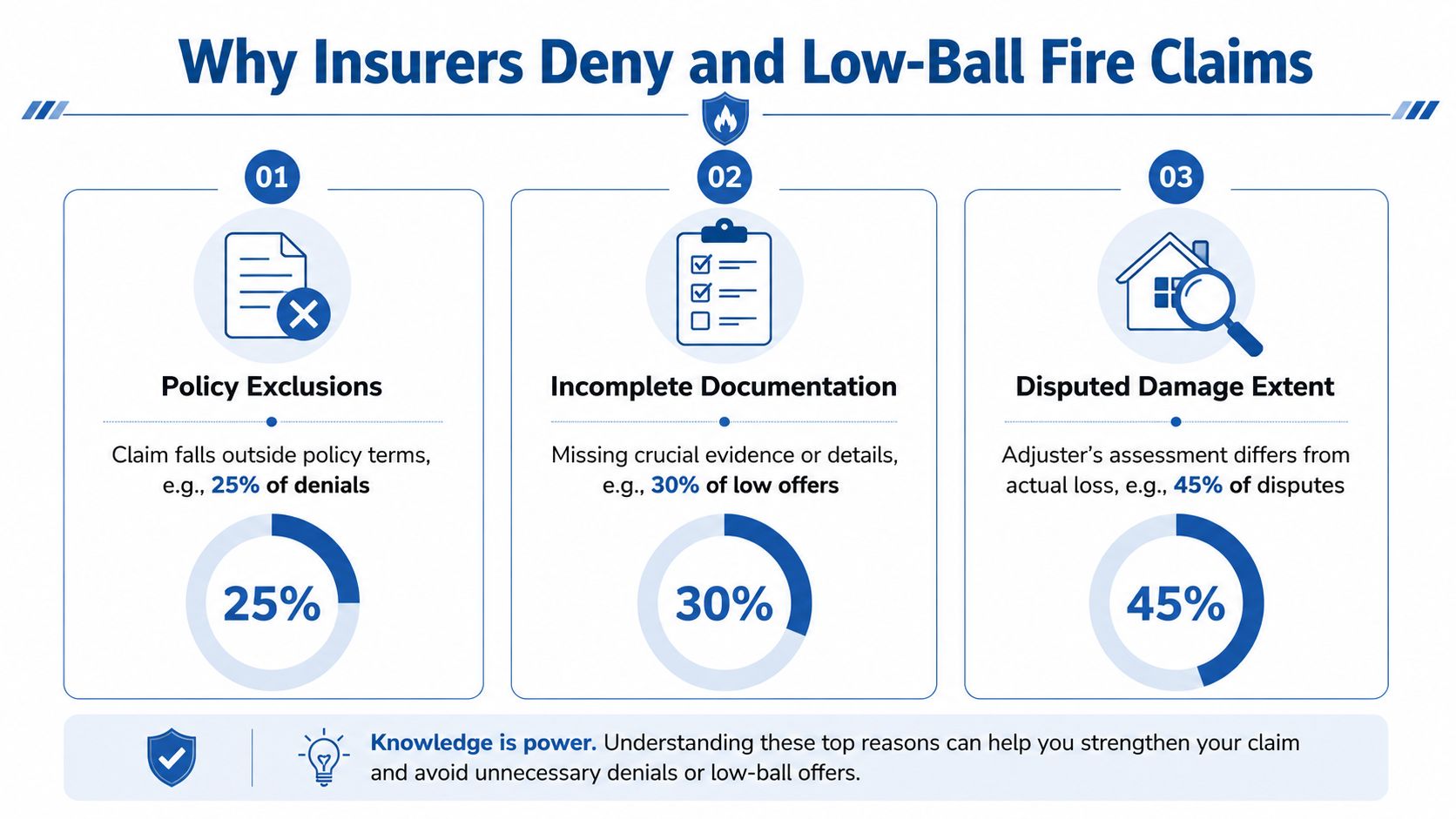
In 2023, three major California insurers denied nearly half of all fire claims submitted, and in Florida, 27.5% of fire claims ended up in litigation, based on fire claim denial and litigation reporting. That tells you something important. If you’re dealing with a denial, delay, or low offer, you’re not looking at some freak mistake. You’re looking at a recurring claims pattern.
The three denial themes you’ll keep seeing
Insurers usually package their objections in familiar ways.
| Dispute angle | What the insurer argues | Why it matters |
|---|---|---|
| Coverage issue | The loss or part of it falls under an exclusion | They try to avoid paying entirely or limit major parts of the claim |
| Proof issue | You didn’t document enough | They shift the burden to you and use missing details to justify less |
| Scope issue | The damage isn’t as extensive as you say | They reduce repair, cleaning, and replacement costs |
Those categories show up in different forms.
Common tactics behind the low-ball
- Pre-existing condition arguments: The carrier says some of the damage existed before the fire, or resulted from neglect instead of a sudden loss.
- Documentation attacks: Missing receipts, incomplete lists, vague descriptions, and cleanup that started too early become ammunition.
- Damage segmentation: They separate burn damage from smoke, water, odor, and electrical impact to pay only for the narrowest slice.
- Repair-cost disputes: Their adjuster’s estimate is treated like the benchmark even when real contractors say it’s incomplete.
Some carriers also rely on technical causation arguments. They may say the fire wasn’t the full cause of the damage, or that another excluded condition is responsible for part of the loss. That’s how they create room to cut the number.
The insurer’s report is not neutral just because it’s typed on company letterhead.
Don’t miss the pattern while arguing the details
Homeowners often spend all their energy fighting one line item at a time. That matters, but the bigger issue is strategy. If the insurer is building a record that says you didn’t prove the full loss, every casual phone call, guessed answer, and missing document helps them.
When you read the denial or estimate explanation, compare it against the usual tactics in this guide to common reasons fire claims get denied. You’re trying to identify the carrier’s theory early, before it hardens into a formal position.
Once you know whether they’re challenging coverage, value, or both, you can answer the right problem instead of wasting weeks arguing the wrong one.
Build Your Counter-Offensive An Evidence Master List
A fire claim is won or lost on proof. Not frustration. Not common sense. Proof.
If the insurer has one estimate and one inspection driving the claim, your job is to build a stronger file. That means better photos, better scopes, better inventories, better timelines, and better outside opinions. You’re not “adding paperwork.” You’re taking control of the narrative.
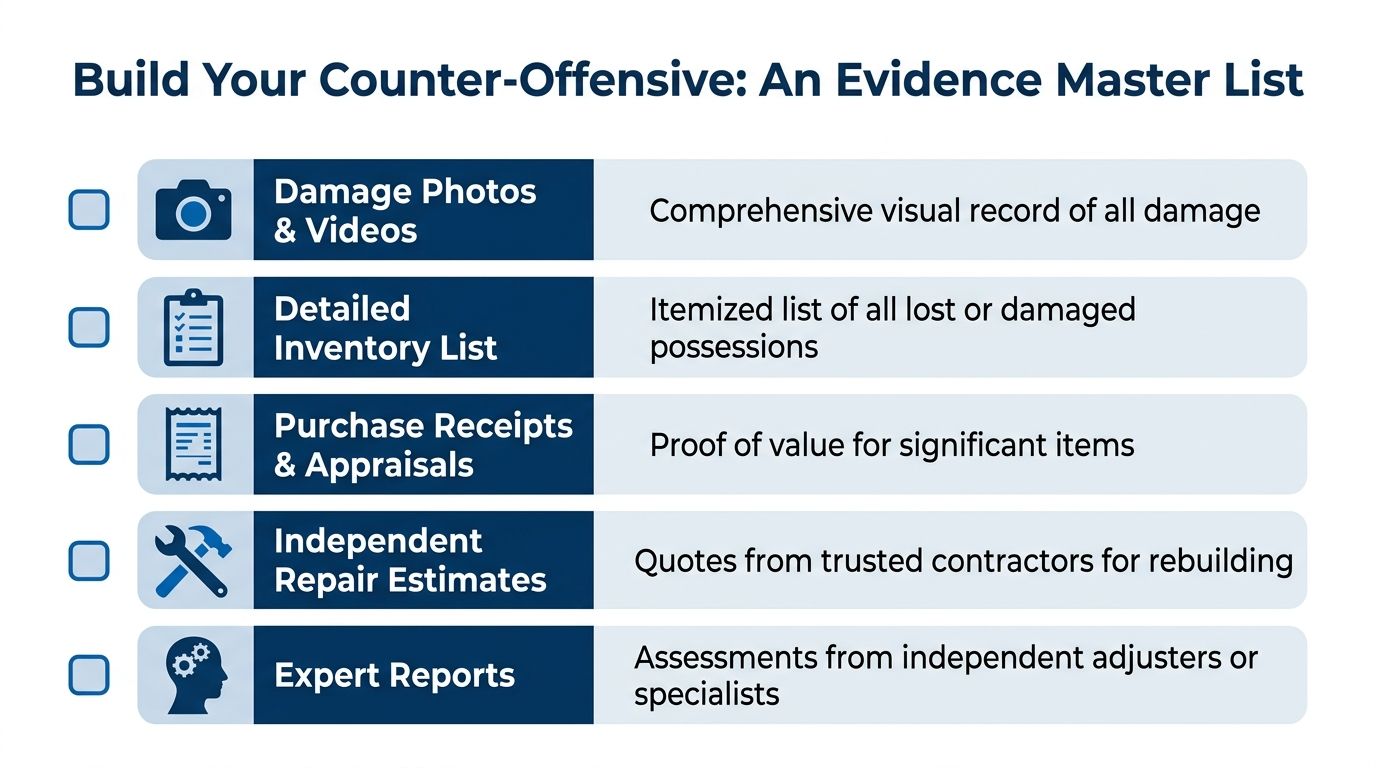
To protect the claim, homeowners should document all damage with photos and videos before any cleanup, avoid giving recorded statements without understanding their rights, and have a representative present during the adjuster’s inspection, based on fire claim tips for California residents. That advice applies well beyond California.
What to gather before the next dispute call
Start with the house itself. Then move to contents. Then move to the paper trail.
-
Scene photos and video
Capture every room, every wall, every ceiling, every floor transition, every cabinet interior, every appliance, every attic or crawlspace access point, and every exterior elevation affected by fire, smoke, soot, or water. Do close-ups and wide shots. -
A room-by-room content inventory
List what was in each room before the loss and what happened to it after the loss. Don’t write “miscellaneous kitchen items.” Write the actual item names. -
Independent repair estimates
Get estimates from licensed contractors who understand fire, smoke, and water-related rebuilding. If the insurer’s estimate misses insulation, wiring concerns, HVAC cleaning, sealing, or specialty finishes, your contractor needs to say that plainly. -
Specialist reports when needed
Electricians, engineers, restoration contractors, and contents specialists can identify damage a basic field estimate may skip.
The evidence most homeowners forget
The obvious damage gets attention. The hidden damage wins disputes.
- Smoke and soot spread: document closets, drawers, vents, returns, attic spaces, and rooms away from the origin point.
- Water from suppression efforts: photograph buckled floors, stained ceilings, wet cavities, and swollen trim.
- Odor contamination: note where odor persists, even if surfaces look intact.
- Temporary protections: keep records of emergency board-up, tarping, and mitigation efforts.
- Communication logs: save every email, text, voicemail summary, inspection date, and name of every company representative.
Bring a notebook to every inspection. Write down who attended, what they looked at, what they skipped, and what they said they’d “get back to you on.”
How to handle the adjuster inspection
Don’t treat the inspection like a casual walkthrough. It’s evidence collection for the insurer.
| During inspection | What you should do |
|---|---|
| Adjuster asks about cause | Stick to known facts. Don’t guess. |
| Adjuster moves quickly room to room | Slow it down and point out every affected area |
| Adjuster dismisses an item | Photograph it again and note the comment |
| Adjuster inspects alone | Have yourself or a representative present |
The biggest mistake I see is homeowners trying to be helpful by speculating. They’ll say things like, “Maybe that part was old,” or “I’m not sure if the smoke got into this room.” Stop doing that. If you don’t know, say you don’t know. Your uncertainty shouldn’t become the carrier’s defense.
Build the file like it’s headed for appraisal
Even if you hope the insurer resolves this fast, prepare as if you’ll need formal escalation. A strong homeowners fire claim dispute file should include:
- Chronology: date of loss, inspections, estimate receipt, denial letters, and follow-ups
- Policy documents: declarations, endorsements, exclusions, and any replacement cost provisions
- Cost support: contractor estimates, invoices, and receipts for emergency measures
- Contents proof: photos, receipts, warranty records, appraisals, or bank records where available
When your file is stronger than theirs, negotiations change tone. Fast.
Strategic Communication to Win Your Dispute
If you’ve been handling this by phone, stop. Phone calls are where adjusters fish for admissions, soften your objections, and keep key statements out of a clean written record. In a homeowners fire claim dispute, your position strengthens the minute you move the conversation into writing.
That doesn’t mean you have to sound like a lawyer. It means you need to sound organized, firm, and specific.
Put every disagreement in writing
Homeowners often lose thousands because insurers dispute replacement cost claims and argue the homeowner failed to properly document replacement needs. The average fire claim is over $88,000, yet many people receive far less because of these underpayment tactics, according to homeowner rights guidance on fire insurance claims.
Replacement cost fights are where carriers shave claims. They may agree something was damaged, then question whether full replacement is necessary, whether your documentation proves the quality level, or whether a cheaper repair should do the job.
What your letter needs to say
Use short, direct language. Your letter or email should include:
- The disputed issue: low valuation, omitted damage, denied coverage item, contents underpricing, or replacement cost disagreement
- Your factual support: attached photos, contractor estimate, inventory, specialist opinion, policy language
- Your demand for clarity: ask the insurer to identify the exact policy language and factual basis for every reduction or denial
- Your deadline for response: a reasonable request for a written answer
Here’s a useful framework:
I dispute the current valuation of the fire loss because it does not include the full scope of fire, smoke, soot, and related damage observed at the property. Please provide a written explanation identifying the factual basis and specific policy language relied on for each item omitted, reduced, or denied.
That’s better than sending an angry message saying the estimate is ridiculous. Even if it is.
Don’t say these things
A lot of claim damage happens in casual conversations.
- “I guess that part might not be from the fire.” You just handed them a causation argument.
- “We already threw a lot of stuff away.” You may have weakened contents proof.
- “We can probably repair it cheap.” That phrase can come back in valuation disputes.
- “I just want to get this over with.” Adjusters hear that as pressure to settle low.
If you need a sharper sense of where homeowners get trapped verbally, read this breakdown on what not to say to a fire claim adjuster.
Keep the burden where it belongs
Your job is to prove your loss. Their job is to explain their reductions. Don’t let those roles blur.
When the adjuster says the estimate is “based on industry standard pricing,” ask for the omitted line items to be addressed one by one. When the insurer says replacement wasn’t documented, provide product descriptions, photos, prior purchase records, and contractor support. When they deny part of the claim, demand the policy basis in writing.
A polite paper trail beats an emotional phone call every time.
The strongest communication strategy is boring on purpose. Clear. Written. Repetitive when necessary. Focused on evidence. That’s how you pin the insurer to an explanation they may later have to defend.
Escalate Your Fight The Appraisal Clause and Legal Options
Some disputes won’t resolve through back-and-forth letters. If the insurer is dug in, you need to escalate in a way the policy recognizes. For valuation fights, the most important tool is often the appraisal clause.
That option matters because many fire disputes aren’t really about whether a fire occurred. They’re about how much the loss is worth.
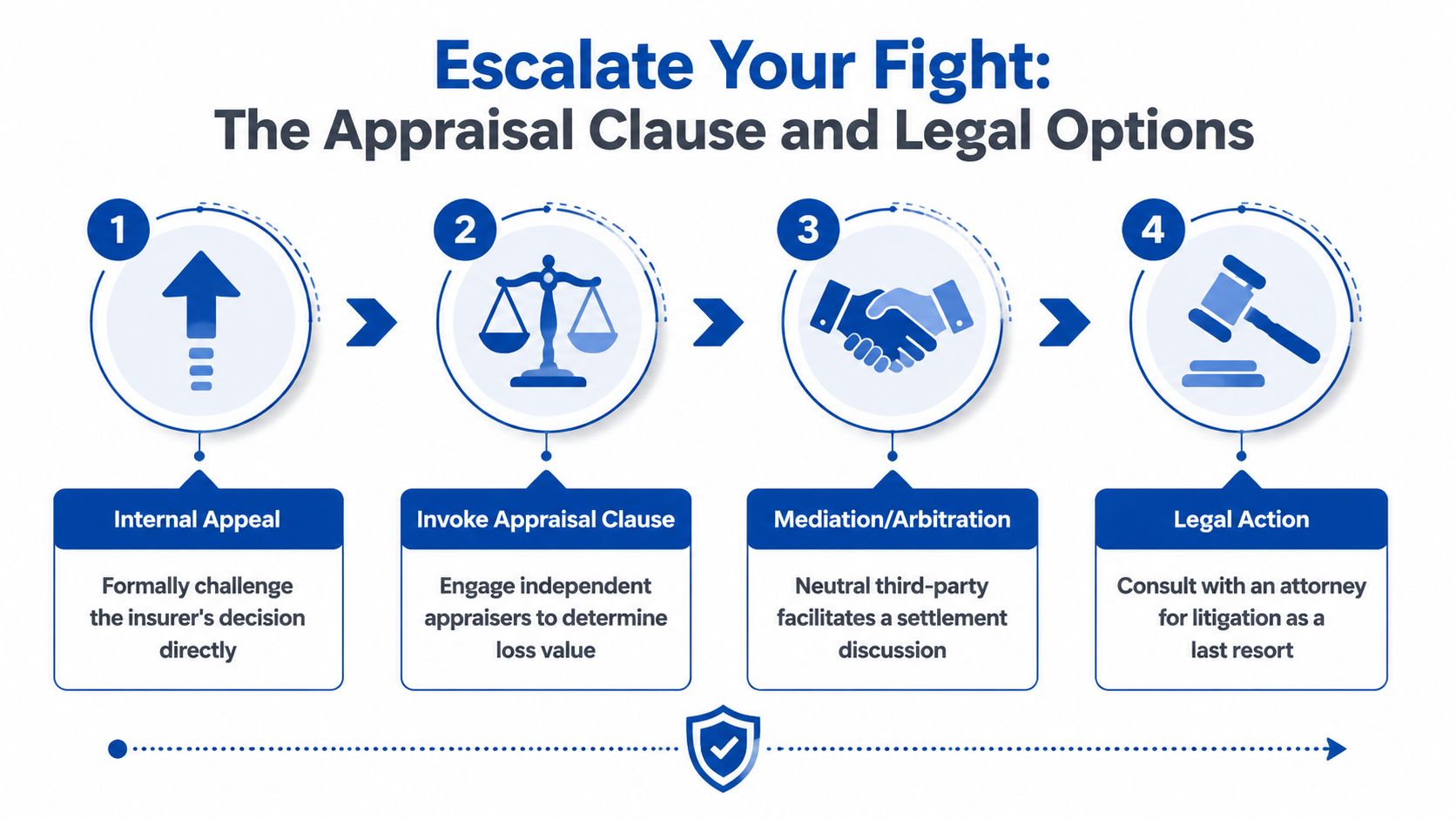
The appraisal process is a critical dispute resolution tool. Each party selects an appraiser, they choose an umpire, and a decision agreed to by two of the three becomes binding on both parties, as explained in this overview of the insurance appraisal process.
When appraisal makes sense
Appraisal is usually the right move when the carrier admits at least some coverage but low-balls the amount of loss. If the primary fight is value, not pure coverage, appraisal can force movement.
Use this rough guide:
| Situation | Best next move |
|---|---|
| Carrier agrees damage is covered but values it too low | Consider appraisal |
| Carrier denies the entire claim on exclusion grounds | Legal review may be needed first |
| Claim includes both coverage and valuation disputes | Separate the issues carefully before invoking appraisal |
How to approach it in North Carolina and Virginia
In North Carolina and Virginia, policyholders need to pay close attention to the exact policy language, deadlines, and written notice requirements in the policy itself. Don’t assume the insurer will volunteer your best option. Read the appraisal provision, loss conditions, and suit-limitation language carefully. If you’re not sure whether the dispute is ripe for appraisal, get a professional review before you invoke it.
A practical escalation path usually looks like this:
-
Send a formal written dispute
Attach your estimate, photos, inventory, and specific objections. -
Request a written breakdown
Force the insurer to explain omitted items and disputed values. -
Review the policy for appraisal language
Confirm whether your dispute is about amount of loss. -
Invoke appraisal in writing if appropriate
Name your appraiser according to the policy requirements.
Appraiser, mediator, or attorney
These roles aren’t interchangeable.
- Appraiser: focuses on value and scope.
- Mediator: helps the parties negotiate, but doesn’t usually decide the number.
- Attorney: handles legal claims, coverage disputes, bad faith issues, and litigation strategy.
If you want a clearer picture of what an appraiser does, this page on an insurance appraiser’s role in property claim disputes is worth reviewing.
If the insurer is stalling, under-scoping, or hiding behind vague denials, escalation isn’t aggressive. It’s appropriate.
Don’t wait so long that you lose leverage
The biggest procedural mistake is delay. Homeowners get exhausted, repairs drag, letters pile up, and then critical policy deadlines become a problem. In North Carolina and Virginia, that risk is real enough that you should track every date from day one, including inspections, denials, supplements, and every written request you’ve sent.
When the insurer won’t deal fairly at the desk level, use the next tool available under the policy. That’s how you turn a complaint into a formal dispute the carrier has to answer.
You Don’t Have to Fight Alone When to Hire a Public Adjuster
At some point, this stops being a homeowner’s side project. If your fire loss is large, the scope is disputed, the contents claim is messy, or the carrier keeps slicing away at replacement cost, you need help.
That’s where a licensed public adjuster can make sense. A public adjuster works for the policyholder, not the insurance company. The job is straightforward. Inspect the property, review the policy, document the loss, prepare estimates, assemble support, and negotiate the claim.
In fire and lightning claims, the average settlement is $77,340, and dispute outcomes improve when professional help such as a public adjuster or mediator is involved, according to homeowners insurance statistics on fire and lightning claims.
When a public adjuster is the right call
Hire a public adjuster when the claim has become technical, document-heavy, or adversarial.
- The insurer’s estimate is missing major categories of damage: especially smoke, soot, hidden contamination, or full contents valuation.
- You’re getting buried in paperwork: inventories, supplements, estimate comparisons, and policy interpretation take time.
- You keep hitting the same wall with the adjuster: repeated delays and recycled explanations usually mean the claim needs stronger presentation.
- You want to prepare for appraisal: a well-documented scope and valuation file matters.
For homeowners in North Carolina and Virginia, one factual option is For The Public Adjusters, Inc., a licensed public adjusting firm that represents policyholders in documenting, presenting, and negotiating residential and commercial property losses.
Public adjuster versus attorney
You don’t always need a lawyer first.
| If your problem is mainly… | Start with… |
|---|---|
| Underpayment, scope dispute, estimate gap | Public adjuster |
| Full denial on coverage grounds | Public adjuster or attorney, depending on the denial basis |
| Suspected bad faith or lawsuit posture | Attorney |
| Valuation dispute headed to appraisal | Public adjuster or appraiser |
A good public adjuster can often organize the claim well enough to resolve the dispute before litigation becomes necessary. An attorney becomes more important when the insurer’s conduct raises legal claims beyond the loss amount itself.
A word on “reviews” and dramatic promises
You should be skeptical of miracle stories. Fire claims are complex, and no honest professional should promise a guaranteed outcome. What matters is whether the person you hire can document the full loss, explain the policy issues, and stand between you and a carrier that’s trying to narrow the claim.
The right help doesn’t make the fire easier. It makes the dispute harder for the insurer to control.
What specific policy language does an insurer use to deny a claim based on "Poor Maintenance," and how do we fight it?
Insurers cite clauses excluding damage from wear and tear or neglect. Your Public Adjuster fights this by demonstrating that the proximate cause of the loss (e.g., short-circuit, appliance failure) was a sudden, accidental event that an average homeowner could not reasonably prevent, thus triggering coverage.
If the insurer denies coverage because the claim was filed "too late," can the claim still be pursued?
Yes. Most policies require prompt notice, but a Public Adjuster argues that the notice was given as soon as practicable (i.e., after the policyholder was safe and able to reasonably contact the insurer). We emphasize that the delay did not cause prejudice (harm) to the insurer's ability to investigate the loss.
My claim was denied due to "Misrepresentation" on the application. What is the immediate legal recourse?
This is a serious denial. The immediate recourse is to provide objective proof that any initial misstatement was a good-faith error and not an intentional attempt to defraud. A Public Adjuster manages all communication to prevent the insurer from leveraging innocent mistakes into a basis for voiding the entire policy.
How does a Public Adjuster fight a lowball settlement offer for the structural damage component of a fire claim?
We systematically dismantle the insurer's low estimate by providing a detailed Xactimate estimate (the industry-standard software) that includes all necessary costs: Code Upgrades (Ordinance or Law), professional engineering fees, and fair-market labor rates, forcing the insurer to justify their low figures line-by-line for your fire damage claim.
What are the common strategies for disputing the valuation of fire-damaged or destroyed Personal Property (Contents)?
The strategy is to establish Replacement Cost Value (RCV) using a Contents Inventory Specialist. They use software and databases to prove the RCV of thousands of items, rejecting the insurer's reliance on excessive depreciation (ACV) or low-quality replacement options.
The insurer won't pay for cleaning items, claiming they are "not restorable." How do we dispute this and get paid for replacement?
We dispute this by obtaining a Restorability Assessment from a certified, third-party fire remediation company. If the report states the item's residual smoke/soot damage makes it unsafe, the insurer is obligated to pay the RCV for replacement rather than force a flawed, incomplete cleaning.
What is the critical documentation needed to ensure the full cost of smoke and soot damage remediation is covered?
Critical documentation includes Air Quality Tests (proving particulate contamination), Soot Testing (proving acidity and corrosion risk), and Specialized Remediation Protocols (e.g., HVAC system cleaning, odor removal) provided by certified professionals, proving the need for deep cleaning beyond basic wiping.
When is the Appraisal Clause the most effective tool for resolving a fire damage claim dispute?
The Appraisal Clause is most effective when the dispute is strictly over the cost or amount of the loss, not the coverage itself. This binding mechanism allows the Public Adjuster to present your valuation to a neutral umpire, often leading to a resolution faster and cheaper than litigation. More about the Insurance Appraisal Clause Process.
Can a Public Adjuster help recover losses related to lost rental income or Business Interruption (BI) after a commercial fire?
Yes. For commercial or rental properties, a Public Adjuster works with a forensic accountant to calculate the precise monetary loss from Business Interruption (BI) and Loss of Rents, submitting a quantified claim to ensure the insurer pays for the entire duration of the necessary restoration period.
How does the Public Adjuster stop the insurer from delaying the fire claim process unnecessarily?
A Public Adjuster maintains a tight timeline, formally demanding prompt action and full responses while documenting every delay. This aggressive stance is necessary because state laws impose penalties (and open the door to Bad Faith lawsuits) when an insurer exhibits unreasonable delay without justification.
What specific credentials should I look for when hiring a Public Adjuster to handle a complex fire claim dispute?
Look for a PA with a valid state license, proven experience specifically with high-value fire losses (not just wind/hail), and the ability to demonstrate a network of independent experts: Forensic Engineers, CFI Investigators, and Contents Inventory Specialists.
If you’re dealing with a denied, delayed, or low-balled fire claim in North Carolina or Virginia, For The Public Adjusters, Inc. can review the damage, evaluate the policy, and help document and negotiate the dispute. Have your water damage claim questions answered at NO COST. Call 919-400-6440 to speak with a licensed Public Insurance Adjuster or Contact Us here with questions. WE Work For YOU… NOT Your Insurance Company!