The floodwater is gone, but your real fight started when the adjuster's number showed up. Maybe the estimate barely covers tear-out. Maybe they denied part of the loss and blamed “wear and tear,” “seepage,” or “mold.” Maybe they acted helpful on the phone, then sent a letter that reads like they never walked through your house.
That shock is common in flood damage claims. Flood insurance disputes are different from ordinary homeowners claims, and that difference matters. You're not dealing with the same rules, the same adjusters, or the same coverage traps. If you're a homeowner in North Carolina or Virginia staring at a denied or low-balled flood claim, you need to stop thinking like a customer service issue is happening. It isn't. This is a documentation fight governed by FEMA and the National Flood Insurance Program.
Table of Contents
- Your Flood Damage Claim Was Denied or Low-Balled Now What
- The Coverage Trap Why Your Homeowners Policy Is Useless for Flood Damage
- Meet Your Opponent The NFIP Adjuster and WYO Companies
- Building Your Case How to Document Flood Damage to Fight a Denial
- Common NFIP Low-Ball Tactics and How to Defeat Them
- Case Study How a Public Adjuster Overturned a Flood Damage Denial in NC
- NC and VA Flood Claim FAQs
- What is the Proof of Loss deadline and why is it so dangerous
- Can that deadline be extended
- What does a public adjuster charge on a flood claim
- Can you sue FEMA or a WYO company
- What evidence matters most in NC and VA flood disputes
- Are low-risk properties safe from this problem
- Where should NC and VA homeowners turn first
- Take Control of Your Flood Claim Recovery
Your Flood Damage Claim Was Denied or Low-Balled Now What
The letter lands in your inbox or mailbox. You open it expecting help, and instead you get a number that won't rebuild the first floor, won't replace what was destroyed, and won't come close to making your family whole. That's usually the moment homeowners go from exhausted to furious.
You should be angry. But don't waste that anger on a panicked phone call.
Flood damage claims often start with a low offer or a denial that feels final. It isn't final. It's the insurance side taking the first position. They know many policyholders are overwhelmed, displaced, and short on cash. They also know plenty of people accept a bad number because they think they have no choice.
Practical rule: The first flood claim decision is not the finish line. It's the opening move.
If you're in that spot right now, do three things immediately:
- Preserve every document. Save the estimate, denial letter, photos, emails, and adjuster notes in one folder.
- Stop relying on phone-only conversations. If a key point is discussed by phone, confirm it in writing the same day.
- Read the reason for underpayment carefully. Don't skim it. Low-ball letters usually hide the actual fight inside a few phrases like “pre-existing,” “below deductible,” “not direct physical loss,” or “excluded moisture.”
What the low-ball usually means
A flood adjuster may have missed damaged components, undervalued materials, ignored code-related repair realities, or narrowed the loss to the easiest visible items. That happens all the time with flooring, wall systems, insulation, electrical components, trim, built-ins, and utility-related damage below the flood line.
The mistake homeowners make is treating the estimate as if it's objective. It isn't. It's one side's version of the loss.
Your job now
Shift from reacting to proving. Flood disputes are won with evidence, causation, material classification, and a clean paper trail. Emotion won't beat a denial. A stronger file will.
The Coverage Trap Why Your Homeowners Policy Is Useless for Flood Damage
Homeowners get trapped here before the claim fight even starts. They assume “water damage” means all water damage. It doesn't.
A standard homeowners policy and a flood policy are different products. Each is designed to address specific perils and operates under its own distinct framework. Your homeowners policy may cover certain kinds of sudden water intrusion inside the home, but flood damage falls into a separate system.
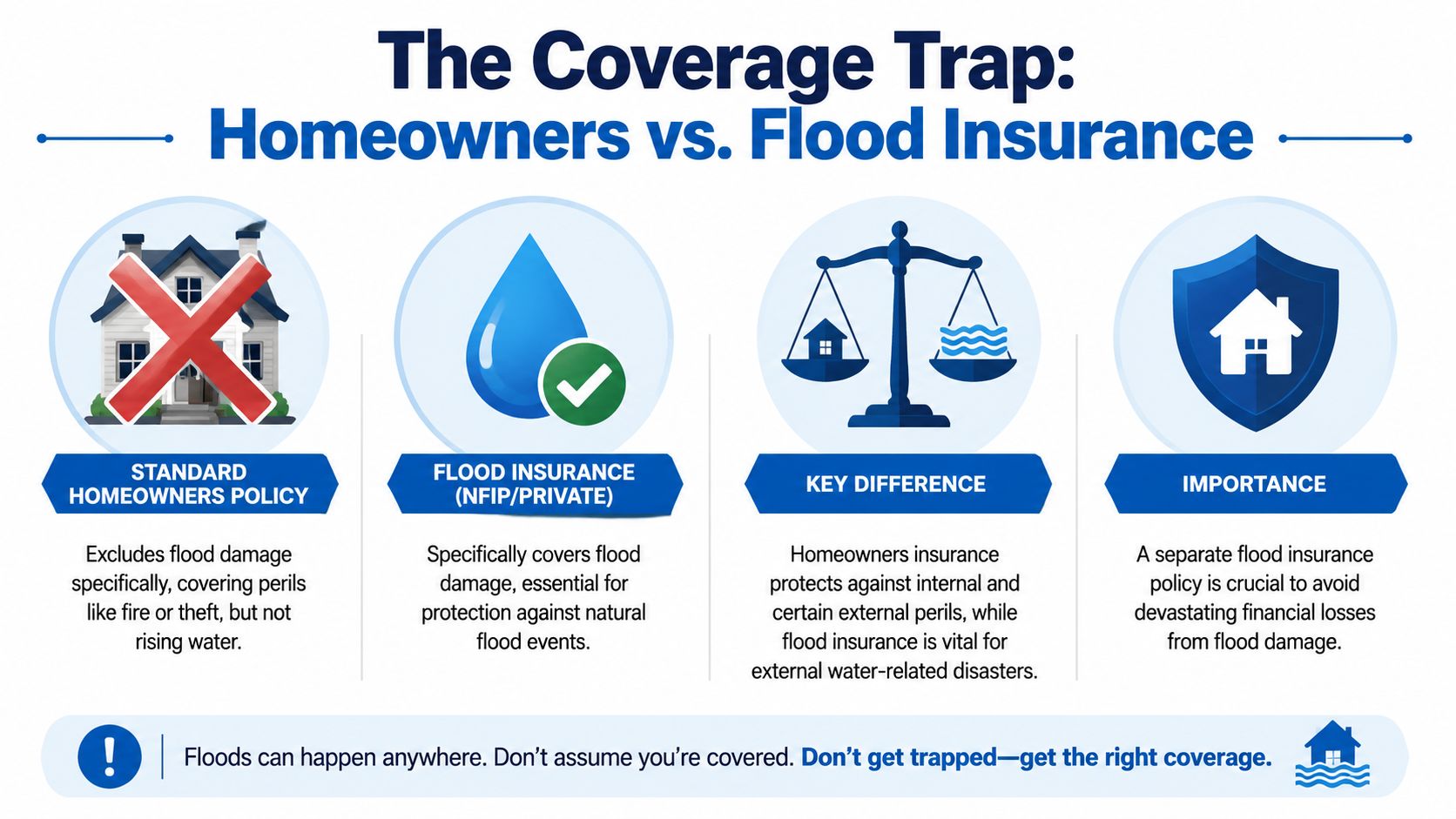
The critical distinction is this. Flood damage involves water from a natural source affecting multiple properties, while storm-related water damage can involve internal or single-property entry. That difference controls coverage, and 25% of all flood claims come from low-to-moderate risk areas, which is one reason so many homeowners wrongly assume their standard policy covers the loss and get denied immediately, as explained in Marsh McLennan Agency's discussion of water damage versus flood coverage.
Flood claim confusion starts with bad assumptions
If rain enters because wind tears open part of the roof, you may be dealing with a homeowners claim issue. If rising water from outside enters the structure as part of a flood event, you're in the flood insurance world. Those are not handled the same way, and they are not judged under the same policy language.
That's why homeowners in North Carolina and Virginia often feel blindsided. They thought they were reporting a water loss. The carrier reclassified it as flood and pushed it into a completely different process.
| Policy Type | Typical Focus | Why It Matters |
|---|---|---|
| Homeowners policy | Internal accidental water events and other named or broad perils | Doesn't function as flood coverage |
| Flood policy | Rising external floodwater losses | Uses separate rules, documentation, and adjuster handling |
Don't let the carrier blur the cause
Insurers love muddy causation when it helps them. If they can push a loss out of homeowners coverage and into flood, or out of flood and into an exclusion, they will. Your job is to pin down exactly how the water entered and what happened next.
If you own property in a coastal or flood-prone area and want a state-specific overview of mandatory coverage questions, this guide to Florida's flood insurance rules is useful because it shows how separate flood coverage gets treated in a real-world insurance market.
If the water came from outside and rose into the home as part of a flood event, your homeowners policy won't save you. You need to analyze the flood policy, not argue with the wrong contract.
Meet Your Opponent The NFIP Adjuster and WYO Companies
This isn't your ordinary property claim. The people handling your file are working inside a federal flood claims system, and that changes everything.
Flood insurance claims under the NFIP are handled by adjusters who must be registered with FEMA and hold an active Flood Claim Number (FCN). They work under the June 2023 NFIP Claims Manual, which makes the process highly technical and often adversarial, as outlined in the FEMA NFIP Claims Manual.

Who's actually handling your flood claim
You may have bought the policy through a familiar insurance brand, but many flood claims are administered either directly under the NFIP framework or by a Write Your Own company, often called a WYO. That means the company may issue and service the flood policy, but the claim still runs through federal flood rules.
That setup confuses homeowners because the logo on the letter feels familiar. The process is not familiar.
A WYO adjuster is not your advocate. The NFIP adjuster is not your advocate either. They are there to inspect, classify, apply the manual, and close the file under their rules.
Why this feels so hostile
Ordinary homeowners claims already involve tension. Flood claims take that tension and add federal documentation requirements, strict wording, causation fights, and coverage distinctions that punish sloppy submissions.
Here's what usually goes wrong:
- They inspect narrowly. The adjuster focuses on obvious visible flood damage and leaves out systems or components that need fuller evaluation.
- They document for closure, not recovery. Their report may be technically complete enough for them, but not complete enough to pay what the property needs.
- They speak in federal claim language. Homeowners hear plain English. Flood files get judged on proof, classification, and strict compliance.
For a broader look at how these disputes develop, this flood damage claim overview gives a helpful background on the pressure points policyholders run into after a major loss.
The adjuster may be polite, but don't confuse polite with aligned. Your financial interest and their claim-handling role are not the same thing.
The practical takeaway
Treat every inspection like testimony. Walk the adjuster through the property. Take your own photos during the inspection. Ask what they included, what they excluded, and why. If they won't answer clearly, that tells you plenty.
Building Your Case How to Document Flood Damage to Fight a Denial
If you want to overturn a denial or beat a low-ball offer, build a file that's stronger than the adjuster's. Flood claim disputes are won on documentation. Not general photos. Not a rough guess. Real evidence.

FEMA defines flood damage-resistant materials as materials that can withstand 72 hours of contact with floodwater without significant damage. Under NFIP rules, only Class 4 and Class 5 materials are acceptable below the Base Flood Elevation, while common materials like drywall and carpet are not, according to FEMA's technical bulletin on flood damage-resistant materials. That matters because your claim file should identify not just what got wet, but what those materials were and whether they were expected to survive.
What to capture immediately
Start with the structure. Then move to contents.
- Water lines on every wall: Photograph the line at multiple angles and include a wider room shot so the location is obvious.
- Material type: Note whether the lower wall is drywall, cement board, tile, paneling, wood trim, or another material.
- Flooring details: Don't just photograph “damaged floors.” Identify whether it's hardwood, laminate, tile, vinyl plank, carpet, or subfloor exposure.
- Cabinets and built-ins: Open doors and drawers. Show swelling, separation, staining, and fastener corrosion if visible.
- Mechanical and electrical components: Document outlets, baseboard heaters, lower wiring areas, ducts, water heaters, HVAC components, and plumbing exposure.
Don't ignore contents and pre-loss condition
Flood adjusters often undervalue contents because homeowners document them too loosely. “Couch damaged” won't cut it. Brand, age, room location, photos, purchase record if available, and visible flood impact all help.
If you had pre-loss photos from listings, renovations, family events, or holiday pictures, use them. They can kill the lazy “pre-existing damage” argument before it gets traction.
For homeowners dealing with wood flooring specifically, this practical guide to Buff & Coat hardwood floor repair tips can help you understand what visible and hidden floor damage may look like after water intrusion.
Build a dispute file, not just a photo album
Your documentation should include:
- A room-by-room photo index
- A contents inventory
- Repair estimates from qualified contractors
- A communication log
- Copies of every adjuster estimate and revision
If you need more background on how flood claim evidence should be organized, this insurance claim for flood damage resource is a useful reference point.
Evidence beats outrage. When you can show the water line, the failed material, the affected system, and the repair scope, you stop arguing feelings and start proving loss.
One detail homeowners miss
If something below the flood line was built with a material that FEMA does not treat as flood damage-resistant, document that clearly. In many disputes, that single detail explains why cleaning isn't enough and replacement is necessary.
Common NFIP Low-Ball Tactics and How to Defeat Them
Low-ball tactics in flood claims are predictable. Once you see the pattern, you stop taking the denial letter personally and start attacking the weak spots.

NFIP coverage excludes damage from moisture, mildew, or mold that could have been avoided by the owner, and it also excludes business interruption losses. Adjusters for WYO carriers often use those exclusions to push damage into “post-flood neglect” or “pre-loss conditions” instead of paying it as direct flood damage, as discussed in Merlin Law Group's analysis of flood damage claims.
Tactic one, pre-existing damage
This is one of their favorites. They'll point to cracked trim, old staining, worn finishes, or prior settling and act like the flood didn't worsen anything meaningful.
Fight it with timeline evidence. Use pre-loss photos, inspection reports, renovation records, and post-loss images taken immediately after the event. The closer your evidence is to the flood date, the harder this argument is to sustain.
Tactic two, gradual seepage instead of sudden flood impact
If they can relabel sudden water intrusion as a long-term condition, they gain an advantage. They know many homeowners don't have expert causation evidence ready.
Use weather records, emergency declarations, inspection notes, and sequential photos showing the water line and immediate aftermath. If the origin and timing matter, that proof has to be tight.
Tactic three, clean it instead of replace it
This happens constantly with drywall, insulation, lower cabinets, trim, and floor assemblies. The estimate reads as if surface cleaning solves structural contamination or material failure.
Push back with material-specific proof. If the material is not flood damage-resistant under FEMA's standards, cleaning may not restore it to acceptable condition.
If the carrier's estimate treats failed materials like cosmetic issues, the estimate is probably built to reduce payment, not fix the property.
A helpful explainer on the broader flood dispute environment is below:
Tactic four, mold blame
Mold is where policyholders get bullied. The carrier suggests you didn't dry fast enough, didn't clean correctly, or let conditions worsen.
Your response should include a clean timeline:
- First notice date: When the loss was reported
- Mitigation steps: Dry-out efforts, tear-out, contractor visits, fans, dehumidifiers
- Access barriers: Power outages, road closures, municipal restrictions, or unsafe conditions
- Follow-up proof: Invoices, moisture logs, remediation notes, and dated photos
Tactic five, under-scoping utilities and hidden systems
Flood damage doesn't stop at flooring and baseboard. Utility systems below the flood protection level can be a major issue. If the estimate barely addresses electrical, plumbing, mechanical components, or ductwork, challenge the scope aggressively.
Ask a simple question. Did they inspect the systems, or did they assume them away?
Case Study How a Public Adjuster Overturned a Flood Damage Denial in NC
A North Carolina family came back to a first floor soaked by rising water. The flood receded, cleanup started, and the insurer's flood estimate arrived fast. The problem was obvious. The number didn't come close to the damage in the walls, flooring, cabinets, and lower electrical components.
The carrier's position was narrow. It treated much of the structural loss like a limited tear-out and cosmetic reset. Several key items were either priced too low or not meaningfully addressed at all. The family was exhausted, displaced, and close to accepting it because they thought fighting a flood decision meant fighting the federal government.
They brought in a public adjuster instead.
What changed when the file was rebuilt
The second inspection wasn't rushed. The adjuster documented room-by-room water lines, material types below the flood line, cabinet failure, base trim impact, flooring separation, and utility-related concerns the original scope barely touched.
A contractor team and supporting experts helped tie the damage back to actual repair requirements. The dispute package didn't rely on broad complaints. It relied on specifics. Missing line items. Misclassified materials. Incomplete structural scope. Weak assumptions about what could be cleaned instead of replaced.
That's what changed the conversation.
Why the denial didn't hold
The original claim decision looked strong only because the homeowner didn't yet have a stronger file. Once the documentation was organized and the scope matched the actual condition of the property, the carrier had to reevaluate.
This is the part frustrated homeowners need to understand. A bad flood claim outcome often isn't the end of the case. It's the result of an incomplete record.
A flood carrier will usually defend the first number until someone forces the file to compete with better evidence.
What homeowners say after getting help
The most common feedback from people who've gone through this process is simple. They wish they had challenged the first estimate sooner. They also say the same thing about representation: having someone who understands policy language, scope writing, and adjuster tactics changes the tone of the entire claim.
Homeowners often describe the best public adjuster relationships the same way. Clear communication. Fast answers. Thorough inspections. No sugarcoating. That's what people remember when their house is torn apart and the insurer is talking in circles.
A flood denial gets overturned when the claim stops being a vague complaint and becomes a documented demand.
NC and VA Flood Claim FAQs
What is the Proof of Loss deadline and why is it so dangerous
The NFIP claim process includes a strict 60-day Proof of Loss deadline, and that deadline is a major trap for homeowners because you may be forced to submit your own complete estimate even when the full damage is still being sorted out, as discussed in this analysis of common flood insurance claim mistakes.
The danger is simple. If you wait around for the insurer to “figure it out,” your own rights can get damaged. Don't assume the adjuster's paperwork protects you.
Can that deadline be extended
Sometimes extensions happen after major disasters, but never assume one exists unless it has been formally announced for your loss situation. Act like the deadline is real from day one. Because it is.
What does a public adjuster charge on a flood claim
Fees vary by firm and claim structure, so you need to ask directly and get the answer in writing. Any honest public adjuster should explain the fee agreement, what services are included, and whether the arrangement depends on improving the claim outcome.
Don't hire anyone who gets vague when money comes up.
Can you sue FEMA or a WYO company
That depends on the policy, the claim posture, and the legal issues involved. Flood litigation is not the same as an ordinary bad faith homeowners suit. Federal rules and deadlines can control the path forward.
That means one thing for homeowners. Get legal advice early if the denial is severe or the deadline picture is unclear.
What evidence matters most in NC and VA flood disputes
Use a layered approach:
- Cause evidence: Weather records, flood event timing, emergency notices, and early photos
- Damage evidence: Water lines, damaged materials, utility impact, contents inventory
- Condition evidence: Pre-loss photos, maintenance records, inspection records
- Response evidence: Dry-out invoices, mitigation logs, contractor estimates, communications
Are low-risk properties safe from this problem
No. As noted earlier, flood claims also come from low-to-moderate risk areas. A lot of homeowners learn that only after the denial letter arrives.
Don't wait for certainty before acting. In flood disputes, delay usually helps the carrier more than it helps the homeowner.
Where should NC and VA homeowners turn first
Start with your policy, denial letter, estimate, photos, and correspondence. Then get a qualified review of the file. The right review should tell you what's missing, what was under-scoped, what was excluded, and what must be challenged in writing.
Take Control of Your Flood Claim Recovery
Floods are natural disasters. Low-ball claim handling is not. That part is a business decision made by people who know most homeowners are tired, displaced, and desperate to move on.
You don't have to accept a bad flood claim result just because it arrived on official letterhead. If the adjuster under-scoped the loss, blurred the cause, leaned on exclusions, or priced repairs as if your house only needed a light cleanup, challenge it. That is exactly what flood damage disputes require.
What winning usually looks like
It usually doesn't start with one dramatic call. It starts with a better claim file.
That means a sharper estimate, stronger photos, better material identification, tighter causation proof, organized communications, and someone who knows how flood adjusters think. If you're weighing professional help, this explanation of the benefits of hiring an independent claims adjuster is worth reading because it lays out why independent representation changes the balance of a disputed property claim.
The right next move
Don't chase the adjuster in circles. Don't assume delay means progress. Don't sign off on a weak scope because you're worn down.
Get the file reviewed. Get the damage documented correctly. Get the policy interpreted by someone who works for policyholders, not the carrier. Flood claims under FEMA and the NFIP are difficult by design, but they can be challenged.
Have your water damage claim questions answered at NO COST. Call 919-400-6440 to speak with a licensed Public Insurance Adjuster or Contact Us here with questions. WE Work For YOU… NOT Your Insurance Company!
If your flood damage claim was denied, delayed, or low-balled, talk to For The Public Adjusters, Inc.. They help North Carolina and Virginia homeowners and business owners document losses, challenge underpayments, and push back when the insurance company's number doesn't match the actual damage.