
When your property is ravaged by fire, the person you need fighting in your corner is a fire damage claim adjuster. This is a state-licensed professional who works for one person and one person only: you, the policyholder. They are your advocate in the brutal dispute that often follows a disaster.
They are the complete opposite of the adjuster your insurance company sends out. A public adjuster’s entire mission is to fight back against lowball offers and delay tactics to get you the absolute maximum and fairest settlement your policy allows for.
Why You Need a Fire Damage Claim Adjuster on Your Side
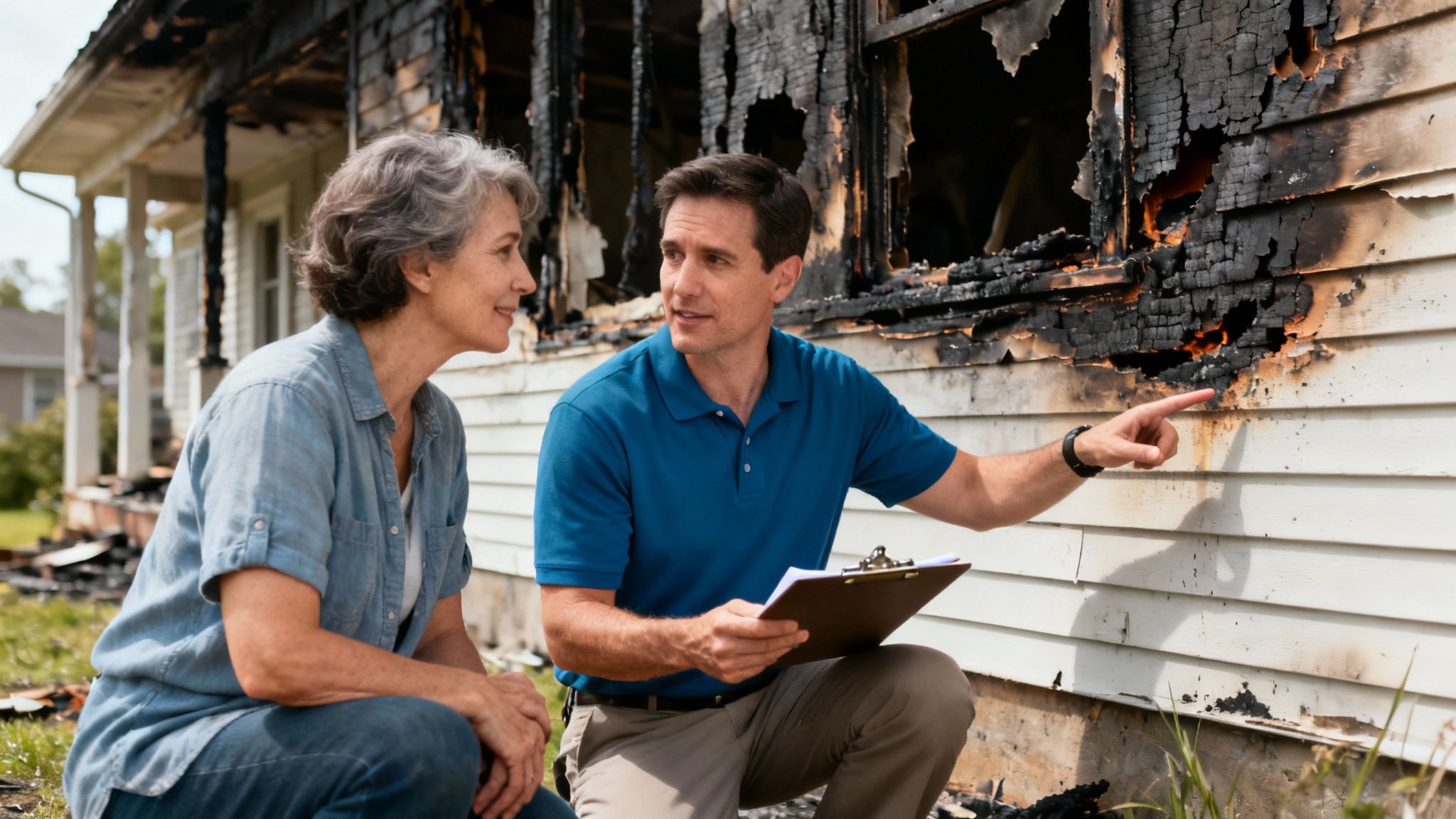
After the trauma of a fire, the last thing you expect is to get into a brutal fight with your own insurance company. You’ve paid your premiums on time, year after year, trusting they’d have your back.
But here’s the cold, hard truth many homeowners discover: the adjuster the insurance company sends—often friendly and wearing a red polo shirt like a State Farm rep—is not on your side. Their one and only job is to protect their employer’s bottom line by minimizing what they pay you. These big insurers are notorious for lowballing, delaying, and denying valid claims to boost their profits.
This creates a massive, unavoidable conflict of interest. The company adjuster is trained to find ways to reduce your claim, which is the exact opposite of what you need to recover. This conflict is the number one reason you need a fire damage claim adjuster, also known as a public adjuster, in your corner to fight back from day one.
Leveling an Unfair Playing Field
Hiring a public adjuster instantly balances the scales of a game that is heavily rigged against you. They bring a deep, technical expertise in evaluating fire, smoke, and soot damage—knowledge the average homeowner simply doesn’t have.
While you’re trying to cope with the emotional fallout and logistical nightmare, your public adjuster is methodically building an ironclad claim to dismantle the insurer’s weak arguments.
Think of it this way: The insurance company has its expert representative protecting its interests. A public adjuster is your expert representative, hired to protect yours. Without one, you’re negotiating against a professional whose entire job is to pay out as little as legally possible.
They know all the sneaky tactics big insurers like Allstate and State Farm use, from dragging their feet to wear you down to throwing out lowball offers that conveniently ignore hidden, costly damages.
Your Advocate in a Complex Process
The complexity of fire claims has exploded, especially with the rise of catastrophic wildfires. Global insured losses from wildfires skyrocketed from around $9 billion in the 2000s to over $56 billion in the 2010s. A single event like the Camp Fire caused $12.5 billion in insured losses. This massive scale makes having a professional advocate more critical than ever.
A public adjuster shoulders the entire burden of the claim for you. This includes:
- Digging for Every Detail: They document everything. Not just the obvious holes in the roof, but the hidden damage like soot contamination inside your HVAC system or compromised electrical wiring behind the walls.
- Decoding Your Policy: They pour over the fine print of your policy to find and claim every bit of coverage you’re entitled to, including crucial things like additional living expenses (ALE).
- Fighting on Your Behalf: They build a powerful, evidence-based claim and go head-to-head with the insurance company, negotiating from a position of strength to get a settlement that truly covers the cost of rebuilding your life.
Bringing in your own expert completely changes the power dynamic. It’s no longer you against a multi-billion dollar corporation. It becomes a negotiation between two professionals, ensuring your rights are defended and your claim is valued fairly. Understanding what is a public adjuster is the first critical step toward a successful recovery.
Your Adjuster vs Their Adjuster A Critical Comparison
The distinction between the adjuster your insurer sends and the public adjuster you hire couldn’t be more stark. One is paid to protect the company’s profits; the other is paid to protect your financial recovery. This table breaks down the fundamental differences.
| Attribute | The Insurer’s Adjuster (Company Adjuster) | Your Public Fire Damage Claim Adjuster |
|---|---|---|
| Loyalty | Works for the insurance company. | Works exclusively for you, the policyholder. |
| Objective | Minimize the claim payout to protect the company’s bottom line. | Maximize your claim payout to ensure a full recovery. |
| Expertise | Trained in company policies and cost-containment strategies. | Expert in policy interpretation, damage valuation, and negotiation. |
| Assessment | Often conducts a quick, surface-level inspection. | Performs a deep, forensic investigation to find all hidden damages. |
| Control | Controls the flow of information and dictates the process. | Puts you back in control by managing the entire process for you. |
| Outcome | Tends to result in lower, often insufficient, settlement offers. | Fights for a fair and complete settlement that covers the true loss. |
Ultimately, having a public adjuster on your team ensures the entire process is managed with your best interests as the only priority.
Recognizing Bad Faith Insurance Tactics
After a fire guts your home, you’re counting on your insurance company to be your lifeline. But here’s the hard truth: big carriers like Allstate and State Farm often work from a playbook designed to do one thing—pay you as little as possible. This isn’t just bad service; it’s a deliberate strategy called bad faith.
Knowing their game is the first step to beating them at it. Insurance companies bank on the fact that you’re devastated, exhausted, and financially wrecked. They use that vulnerability against you, creating endless friction and frustration, hoping you’ll just give up and take whatever crumbs they offer.
Common Delay and Deny Strategies
One of their go-to moves is the strategic delay. It’s infuriatingly effective. The company adjuster—the one who shows up in a red polo shirt and khakis—suddenly takes days to return a call. Documents you sent mysteriously get “lost.” They ask for the same information over and over, burying you in a bureaucratic nightmare designed to wear you down.
Then comes the demand for impossible paperwork. They’ll ask for receipts for a couch you bought ten years ago or for records that were incinerated in the very fire they’re supposed to be covering. This isn’t about getting the facts straight. It’s about creating so many roadblocks that you become too exhausted to continue the fight.
The Lowball Offer: A Deliberate Undervaluation
The most ruthless tactic, though, is the lowball offer. Their adjuster will do a quick walk-through, spend 30 minutes on-site, and then hand you an estimate that conveniently ignores the real costs of rebuilding. They’ll use cheap, outdated materials pricing, undervalue your belongings, and completely miss hidden damage like toxic soot inside your walls or your fried HVAC system.
That first offer isn’t a good-faith attempt to make you whole. It’s a strategic anchor. They throw out a shockingly low number so that when they come back with a slightly less insulting one, you feel like you’ve won something—even if it’s still tens of thousands short of what you actually need.
They are betting you don’t know what it really costs to rebuild your life. They’re betting you’re desperate enough to take the first check they wave in your face. This is precisely the moment a fire damage claim adjuster becomes your only line of defense.
Case Study: A Total Loss Met with a Partial Offer
Take the Johnson family. After an electrical fire destroyed their North Carolina home, it was declared a total loss. Their big-name insurance carrier sent out their adjuster who quickly presented an offer for less than 50% of their policy limit. He told them it was a fair price for a “standard rebuild.”
Overwhelmed and exhausted, the Johnsons nearly signed. But something felt wrong. They called a public adjuster for a second opinion, and it changed everything. The public adjuster immediately saw what the company man had “missed.”
- Smoke and Soot Contamination: The company’s estimate had zero dollars allocated for remediating the toxic soot that had been baked into the wall cavities and insulation—a massive health hazard and a huge expense.
- Code Upgrades: Their home was 30 years old. The insurer’s offer completely ignored the mandatory—and costly—upgrades needed to bring the new construction up to current building codes for plumbing, electrical, and structure, all of which their policy covered.
- Foundation Damage: The fire’s intense heat had spiderwebbed the concrete foundation with hairline cracks. The company adjuster never even looked, but the damage required thousands in repairs.
The public adjuster didn’t just argue. He brought in an independent structural engineer and an industrial hygienist to prove the damage. Armed with irrefutable evidence, he tore apart the insurance company’s pathetic offer and submitted a new, detailed claim. After a tough fight, the insurer paid the full policy limit—more than double their initial insulting offer. The Johnsons’ story is a stark reminder: the first offer is never the final offer.
How a Public Adjuster Dismantles a Lowball Offer
That first settlement offer from your insurance company after a fire isn’t the final word. It’s just the opening shot in a negotiation you simply can’t afford to lose. When their adjuster hands you an estimate that feels like a punch to the gut, that’s not by accident. It’s a calculated strategy. They are banking on your stress and exhaustion to force you into accepting pennies on the dollar for what you’re actually owed.
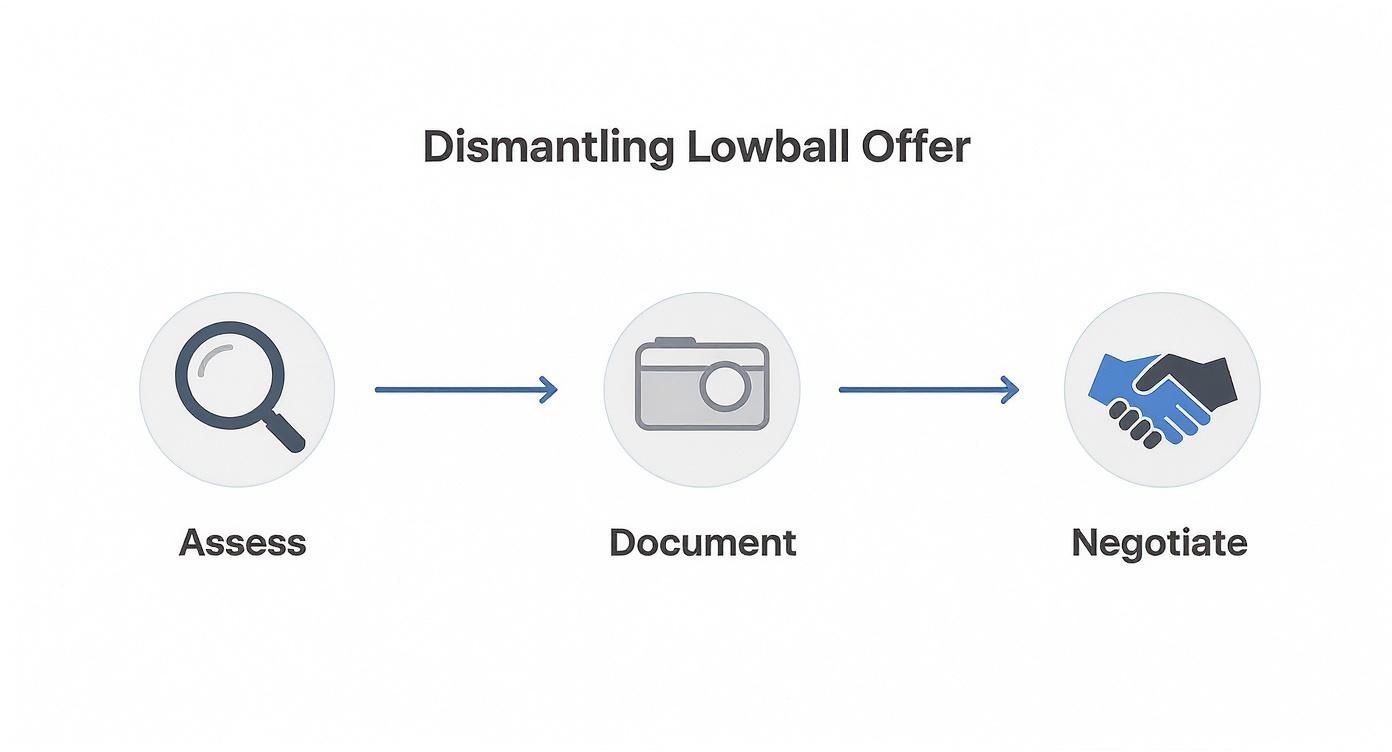
This is the exact moment an expert fire damage claim adjuster steps into the ring and turns the tables. They don’t just argue; they systematically demolish the insurance company’s shoddy estimate, piece by painful piece, using hard evidence, deep expertise, and a relentless focus on getting you paid. It’s a methodical process built on undeniable facts, and it leaves the insurer with nowhere to hide.
Independent and Exhaustive Damage Assessment
The very first thing your public adjuster does is launch their own, independent, top-to-bottom investigation of the fire damage. This isn’t a quick walk-through. While the company adjuster might spend less than an hour on-site, your advocate treats your property like a forensic crime scene. They’re bringing out the heavy equipment, using thermal imaging cameras to find hidden moisture trapped behind walls and borescopes to inspect deep inside your HVAC system for soot—the kind of damage the insurer’s rep “forgets” to look for.
This is far more than a visual inspection. They assemble a team of specialists to build an airtight case for your recovery. That team often includes:
- Structural Engineers: To prove the integrity of your home’s foundation and frame was compromised by the intense heat.
- Industrial Hygienists: To test for the toxic soot, ash, and chemical residues that are a serious health hazard and demand specialized, expensive remediation.
- Certified Electricians and Plumbers: To document the full extent of damage to complex systems that the company adjuster is absolutely not qualified to assess.
Each one of these experts produces a certified report. Every report becomes another piece of indisputable evidence that shreds the insurance company’s lowball number.
As you can see, it’s a rigorous cycle of assessment, documentation, and hard-nosed negotiation that turns a low offer into a fair settlement.
Case Study: A Business Rebuilt from the Ashes
Think about the business owner in Raleigh whose warehouse was gutted by an electrical fire. His insurance company—one of the giant national carriers—offered him a settlement that wouldn’t even cover the cost of hauling away the debris. They claimed most of the structural damage was already there before the fire. It was a classic delay-and-deny game.
Feeling completely beaten down, he finally hired a public adjuster. The first thing the adjuster did was bring in a structural engineer. That engineer’s report proved the fire’s extreme heat had warped the steel support beams, making a total rebuild the only safe option.
The public adjuster’s meticulous re-evaluation of the claim found that the insurance company’s estimate had missed over 60% of the actual restoration costs. He documented every single thing they ignored, from melted wiring to the smoke-damaged inventory.
Armed with this mountain of evidence, he went back to the insurer. It was a tough fight, but the facts were undeniable. The final settlement was more than triple the insurance company’s initial offer, giving the owner the money he needed to rebuild his business from the ground up. This is the brutal difference between taking what they give you and fighting for what you’re owed. If you’re facing this battle, understanding how to negotiate with insurance adjusters is your single most powerful weapon.
Holding the Insurer Accountable to Your Policy
At the end of the day, a public adjuster uses this overwhelming body of evidence to hold your insurance company’s feet to the fire, forcing them to honor the specific language in your policy. This isn’t just about arguing over numbers. It’s about pointing to the exact clauses that cover things like mandatory code upgrades, smoke remediation, and additional living expenses while your home is uninhabitable.
They create a brand new, line-by-line estimate based on what it actually costs to hire contractors and buy materials in your town, right now—not based on the outdated, cheap software the insurers love to use. This professional estimate becomes the new baseline for the negotiation, forcing them to scrap their lowball offer and start talking about the real-world cost of making you whole again.
The Power of Precedent in Insurance Disputes
When your insurance company lowballs, delays, or outright denies your fire damage claim, it feels like an impossible fight. They have armies of lawyers and a system built to protect their profits. But there’s a brutal truth they hope you never discover: they are not above the law.
Over the years, courts across the country have hammered major insurance carriers for acting in bad faith. These court cases create a powerful history—legal precedents—that you can use to fight back against their unfair tactics. They are proof that challenging your insurer isn’t just possible; it’s often the only way to get justice.
These lawsuits drag the insurance industry’s dirty tricks into the light. They expose everything from deliberately twisting the words in their own policies to creating endless, soul-crushing delays for no good reason. And when these tactics get put in front of a jury, the results can be catastrophic for the insurer.
Landmark Cases That Hold Insurers Accountable
Time and time again, courts have sided with policyholders who were wronged by their insurance companies. These legal victories are more than just wins; they’re a clear warning to insurers that their bad faith tactics will cost them dearly.
A classic example is the Campbell v. State Farm case. While it wasn’t a fire claim, it set a massive precedent for punishing insurance companies that act in bad faith. The jury hit State Farm with $145 million in punitive damages for refusing to settle a claim within the policy limits. While the Supreme Court later addressed the size of the award, the core principle was cemented: bad faith behavior will be punished.
These verdicts send one clear message: acting in bad faith can cost an insurer far more than just paying the claim fairly in the first place.
In another major case, Pistorius v. Prudential, a jury awarded huge punitive damages against the insurer for their bad faith handling of a disability claim. This case reinforced the legal duty of “good faith and fair dealing” that every single insurance company owes its policyholders. This duty is the legal weapon you and your fire damage claim adjuster use to hold the carrier’s feet to the fire.
These court battles aren’t just about money; they are about accountability. They establish that an insurance policy is a promise, and when an insurer breaks that promise through deceptive or unfair tactics, the courts can and will intervene to protect the policyholder.
The increasing number of large-scale disasters has only made these fights more intense. The role of a fire damage claim adjuster has become absolutely vital, especially with record-breaking wildfire seasons. For instance, in just the first half of a recent year, wildfires torched about $40 billion in insured losses worldwide. This explosion in claims puts enormous pressure on insurance companies, leading to more delays, more disputes, and more legal challenges from exhausted homeowners. You can find more details on this trend by reviewing the full report on insured catastrophe losses.
Using Legal Precedent as Leverage
Here’s the best part: you don’t always have to file a lawsuit to use these legal precedents to your advantage. A skilled public fire damage claim adjuster knows the power of these court decisions and uses them as a hammer during negotiations.
When your adjuster submits your claim—backed by meticulous documentation—they can also casually reference specific cases where the insurer’s current behavior was judged to be bad faith. That one simple move completely changes the power dynamic.
It tells the insurance company that you know your rights, you know their playbook, and you’re ready to escalate the fight if they don’t back down. The implied threat of a long, expensive lawsuit—with the potential for a massive punitive damage award from a jury—is often all it takes to force them to drop the delay-and-deny games and finally offer a fair settlement. This is how you win the fight: not just with receipts and repair estimates, but with the full weight of the law on your side.
How to Hire the Right Public Adjuster for Your Claim
After a devastating fire, picking the right advocate is the single most important decision you’ll make for your recovery. It’s no exaggeration to say that hiring the wrong person can be just as destructive as the fire itself. The right fire damage claim adjuster, however, becomes the champion who fights tooth and nail for every dollar you need to rebuild your life.
The stakes are astronomically high. Insurance carriers are feeling immense financial pressure, and that pressure gets passed down to you in the form of lowball offers. In high-risk states like Florida, homeowner premiums are skyrocketing to an average of $6,000 a year, dwarfing the national average of $1,700.
Why? Because insured losses from natural catastrophes recently blasted past $100 billion, and a staggering 90% of that was in the U.S., driven heavily by wildfires. This environment gives insurers every incentive to minimize what they pay out, making your choice of adjuster absolutely critical. For a deeper look at these market forces, you can explore the government’s research on the property insurance market.
Essential Vetting Checklist for Your Public Adjuster
Use this checklist to ensure you hire a qualified and trustworthy public adjuster to handle your fire damage claim.
| Qualification Criteria | What to Look For | Red Flags to Avoid |
|---|---|---|
| State Licensing | A valid, current public adjuster license number you can verify with your state’s Department of Insurance. This is non-negotiable. | Hesitation to provide a license number. Claims of being “certified” without a state license. An expired license. |
| Specialized Experience | A proven track record and portfolio of successfully settled fire claims. They should be a fire specialist, not a generalist. | Vague answers about their experience. A portfolio filled with minor water or wind claims but few complex fire cases. |
| Fee Structure | A clear contingency fee model. They only get paid a percentage of the settlement they win for you. Their success is tied to yours. | Any demand for large upfront fees or retainers. Hidden fees or ambiguous language in the contract about costs. |
| Reputation & Reviews | A long list of satisfied former clients, especially from past fire claims. Positive, detailed online reviews that speak to their process. | Unwillingness to provide references. Vague or generic online reviews. A history of complaints with the Better Business Bureau. |
| Contract Clarity | A straightforward, easy-to-understand contract outlining the scope of work, the exact fee percentage, and cancellation policies. | High-pressure sales tactics to sign immediately. A confusing contract filled with legal jargon you don’t understand. |
Vetting your potential adjuster with this checklist isn’t about being difficult—it’s about protecting your financial future.
Verify Credentials and Experience
Your very first move is to confirm they are a state-licensed public adjuster. Period. Ask for their license number and check it yourself with your state’s Department of Insurance. This one simple step weeds out the unqualified frauds immediately.
But a license is just the starting line. You need to demand specific, relevant experience. Fire claims are a different beast entirely—they’re notoriously complex. You need someone with a deep history of handling claims involving destructive smoke, insidious soot, and hidden structural damage, not just an adjuster who dabbles in minor roof leaks.
A great public adjuster is a specialist, not a generalist. They should be able to show you a portfolio of fire damage claims they’ve successfully settled, proving they have the expertise to handle the unique challenges your situation presents.
Don’t be shy during that first meeting. Ask pointed questions like, “How many fire claims just like mine have you taken to a final settlement?” or “Walk me through your exact process for documenting hidden smoke and soot damage.” Their answers will tell you everything you need to know about their real-world expertise.
Understand the Fee Structure and Contract
Here’s the deal: legitimate public adjusters work on a contingency fee basis. This means they get paid a small, agreed-upon percentage of the settlement money they recover for you. Simple. If they don’t get you paid, they don’t get paid.
This model is the gold standard because it perfectly aligns their financial interests with yours—the more they get for you, the more they earn. Be extremely suspicious of anyone demanding a big upfront fee or a “retainer” to get started. That’s a massive red flag.
The fee percentage must be spelled out clearly in the contract, leaving zero room for interpretation or surprise charges down the road. If you’re weighing this decision, our article on if you should hire a public adjuster can offer more perspective.
Ask for References and Read Reviews
Finally, a great adjuster will have a trail of happy clients. Ask for references from their past fire claim clients and—this is important—actually call them. Ask about their communication, their professionalism, and the final outcome of their claim.
A few minutes searching online will also paint a clear picture of their reputation. Look for detailed reviews that describe their process and the results they delivered. Choosing a public adjuster is like hiring a general to lead your army in the biggest fight of your life. Vet them thoroughly to make sure you’re putting your future in the hands of a proven winner.
Common Questions About Disputing Fire Damage Claims
When a fire turns your life upside down, the last thing you need is a brutal fight with the insurance company you paid to protect you. Below are answers to the most common questions we hear from homeowners and business owners who find themselves in a dispute over their fire damage claim. The goal here is simple: give you clear, actionable advice to fight back and win.
My Insurance Company’s Offer Seems Too Low. What Should I Do First?
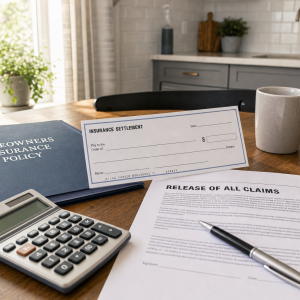
That first offer is almost always a lowball. Your gut is right. But don’t argue—get strategic. The absolute first thing to do is this: do not accept the offer. Don’t sign any release forms, and don’t cash any checks they send you that could be considered a “final” payment. This is a classic trap that can kill your chances of ever recovering what you’re actually owed.
Instead, your first move should be to formally request a detailed, line-by-line breakdown of their estimate in writing. This forces the company adjuster—the guy they sent to your property—to put his numbers on paper and try to justify every single decision he made. That document is the foundation of your fight.
Next, and this is the most critical step, contact a licensed public fire damage claim adjuster immediately for a no-cost consultation. A true expert can look at that lowball offer and spot undervalued items, missed damages, and dirty tricks in minutes. Don’t get stuck in a long, losing argument with the company adjuster alone. He’s a trained professional whose entire job is to defend that low number. Your power comes from bringing in your own expert to build a powerful counter-claim based on a real, independent, and evidence-backed inspection.
How Much Does a Public Fire Damage Claim Adjuster Cost?
This is where you can breathe a sigh of relief. A professional public adjuster costs you nothing upfront. Reputable public adjusters work on a contingency fee basis. This means they only get paid if they successfully recover money for you. There are no out-of-pocket fees, no retainers, and no hidden charges.
They get paid a small, pre-agreed-upon percentage of the final settlement they win for you. This payment model is the industry standard for one huge reason: it lines up their interests perfectly with yours.
The more money they recover for you, the more they get paid. It’s a powerful incentive that ensures they will fight for the absolute maximum settlement your policy allows, turning over every stone and documenting every last nail.
Be extremely careful if anyone asks you for a big payment before they even start working. That’s a massive red flag and often a sign of an unlicensed or unethical operator. A real professional is confident they can win for you and will cover all the initial costs of building your case themselves.
The Insurance Company Is Delaying My Claim. What Can I Do?
Unreasonable delays aren’t just bad service; they’re a classic bad-faith insurance tactic. Big carriers like State Farm and Allstate know that the longer they drag their feet, the more desperate you become. They use your financial and emotional exhaustion as a weapon to pressure you into accepting a terrible offer just to make the nightmare stop.
Your first line of defense is to document everything. Starting right now, log every single interaction.
- Record all calls: Note the date, time, who you spoke with, and what was said.
- Save all correspondence: Keep every single email and letter.
- Communicate in writing: From now on, use email or certified letters for any important requests. This creates an undeniable paper trail.
But the single most powerful tool you have against delays is hiring your own public adjuster. They are experts in the contractual deadlines and state laws that insurance companies are legally required to follow. The second you hire one, they take over all communication and start applying formal, professional pressure, citing your policy and state insurance codes. Their involvement sends a clear signal: you’re serious, you know your rights, and you’re ready to escalate. This professional intervention is what it takes to break the stalemate and force them to act.
Can I Reopen a Fire Claim if I Already Accepted a Settlement?
The answer is often yes, but it hinges on your state’s laws and the specific wording in your policy. If you find more fire-related damages that weren’t in your original settlement—like hidden soot damage that shows up later or long-term problems with your HVAC system—you may have the right to file a supplemental claim.
Time is of the essence here, as there are strict deadlines for reopening a claim. This is not something you should ever try to do on your own. A public fire damage claim adjuster is absolutely essential in this situation. They can expertly review your original claim file, assess the new damages, and figure out if reopening your case is possible.
They will then build a new, evidence-based strategy to get the additional money you’re owed. Never assume that the first check is the final word, especially if you settled before you knew the full extent of the damage. An expert advocate can help you go back and get the complete settlement you deserved all along.
When should I hire a Public Adjuster for a fire damage insurance claim?
Ideally, you should hire a Public Adjuster immediately after the fire is extinguished and you have secured the site. Early involvement ensures proper documentation of the scene, contents, and temporary repairs before the insurer can set a low initial scope. However, most people do not know that Public Adjuster's exist. If you have already filed your claim and have been having difficulty with your carrier, speak with a Public Adjuster right away so you can make an informed, educated decision on what to do next.
What is the most common mistake policyholders make in a fire claim that a Public Adjuster prevents?
The most common mistake is failing to meticulously document the personal property (contents) loss. A Public Adjuster ensures a complete, detailed inventory list with accurate replacement costs, preventing the insurer from issuing a lowball contents payment.
Does my policy cover smoke, soot, and water damage caused by fighting the fire?
The Public Adjuster ensures the insurer provides adequate Additional Living Expenses (ALE) for temporary housing and other necessary costs while your home is uninhabitable. They negotiate the appropriate type and duration of housing based on your previous standard of living.
How is the value of my lost personal property (contents) calculated in a fire claim?
The value is calculated based on either Actual Cash Value (ACV) or Replacement Cost Value (RCV), depending on your policy. Your Public Adjuster documents the RCV, ensuring you receive the full potential amount required to purchase new replacements.
Can the insurance company deny my fire claim if they suspect the fire was intentionally set?
The insurer can deny the claim based on suspicion of arson, but they must meet a high burden of proof. A Public Adjuster will immediately counter with independent forensic fire investigators to challenge the insurer's findings and defend the policyholder.
Can the insurance company deny my fire claim if they suspect the fire was intentionally set?
The insurer can deny the claim based on suspicion of arson, but they must meet a high burden of proof. A Public Adjuster will immediately counter with independent forensic fire investigators to challenge the insurer's findings and defend the policyholder.
How does a Public Adjuster fight a lowball structural damage estimate after a fire?
The Public Adjuster hires an independent structural engineer and creates a detailed scope of damage (including code upgrades and hidden structural compromise) that is often 20% to 50% higher than the insurer's initial estimate, forcing a higher payout.
What is the role of the "Proof of Loss" document in a disputed fire damage claim?
The Proof of Loss is the policyholder's sworn statement detailing the exact dollar amount claimed. In a dispute, a Public Adjuster prepares this document precisely and accurately, establishing the legal benchmark for the settlement negotiation.
Can a Public Adjuster help me if the insurance company is pressuring me to quickly sign a release or settlement?
Yes. You should never sign a full release without expert review. Your Public Adjuster steps in immediately to block insurer pressure and ensure you fully understand the settlement amount and whether it truly covers all repair and replacement costs.
If you’re facing a battle with your insurance company over a fire damage claim, you don’t have to fight alone. The team at For The Public Adjusters, Inc. is ready to put their expertise to work for you, ensuring you get the full and fair settlement you deserve. Contact us today for a free, no-obligation claim review by visiting https://forthepublicadjusters.com.