That letter from the insurance company changes the tone of your claim fast. One minute you’re trying to repair a home, reopen a business, or make sense of fire, water, storm, or theft damage. The next, you’re being told to appear for an examination under oath and answer questions from the insurer’s lawyer under oath.
If you’re in North Carolina or Virginia, don’t treat that letter like routine paperwork. Treat it like escalation.
An examination under oath isn’t customer service. It’s not a friendly fact-finding call. It’s the insurance company tightening control of the claim, building a sworn record, and looking for anything it can use to delay, low-ball, or deny payment. Carriers love to dress this up as standard procedure. Sometimes it is contractually allowed. That doesn’t make it harmless.
Policyholders get hurt here because they underestimate the setup. They’re stressed, tired, and trying to be cooperative. The insurer’s attorney is trained, prepared, and listening for inconsistencies, gaps, and statements that can be twisted into a coverage defense. This is the primary peril.
You don’t need panic. You need a plan. If your homeowner claim, dwelling claim, or business property claim has reached the EUO stage, you need to understand what this process really is, what the insurance company is trying to accomplish, what you’re required to do, and how to protect your claim from being dismantled word by word.
Table of Contents
- Introduction You Received an Examination Under Oath Demand Now What
- What Is an Examination Under Oath Really
- Why Insurers Use EUOs to Dispute and Deny Claims
- Your Legal Rights and Obligations in an EUO for NC and VA
- Common Insurer Questions and Traps to Avoid
- Your Battle Plan A Preparation Checklist for Your EUO
- Claim Dispute Success A Real Client Story
- Get Claim Help For The Public Adjusters Fights for You
Introduction You Received an Examination Under Oath Demand Now What
The envelope usually looks ordinary. The language inside doesn’t. Buried in legal wording is the phrase that gets every policyholder’s attention: examination under oath.
If you just received that demand, your claim has entered a more adversarial stage. The insurer may still say it’s “investigating.” What it’s really doing is gaining an advantage. The company wants sworn answers, recorded testimony, and documents it can compare against everything you’ve already submitted.
That matters because homeowners and business owners rarely arrive at this point rested and organized. You’re already dealing with damaged property, contractors, temporary living issues, lost income, missing inventory, or pressure to get repairs moving. The insurance company knows that. Confusion helps them.
Practical rule: Don’t respond to an EUO demand casually. Slow down, gather your records, and get help before you start talking.
I’ve seen carriers turn harmless memory gaps into “inconsistencies.” I’ve seen them ask broad questions that have little to do with the actual loss, then use the answers to challenge credibility. And I’ve seen policyholders walk in thinking honesty alone is enough. Honesty is required. Preparation is what protects you.
The right response is simple. Take the demand seriously, assume the insurer is looking for weaknesses, and prepare like the outcome of your claim depends on it. Because it often does.
What Is an Examination Under Oath Really
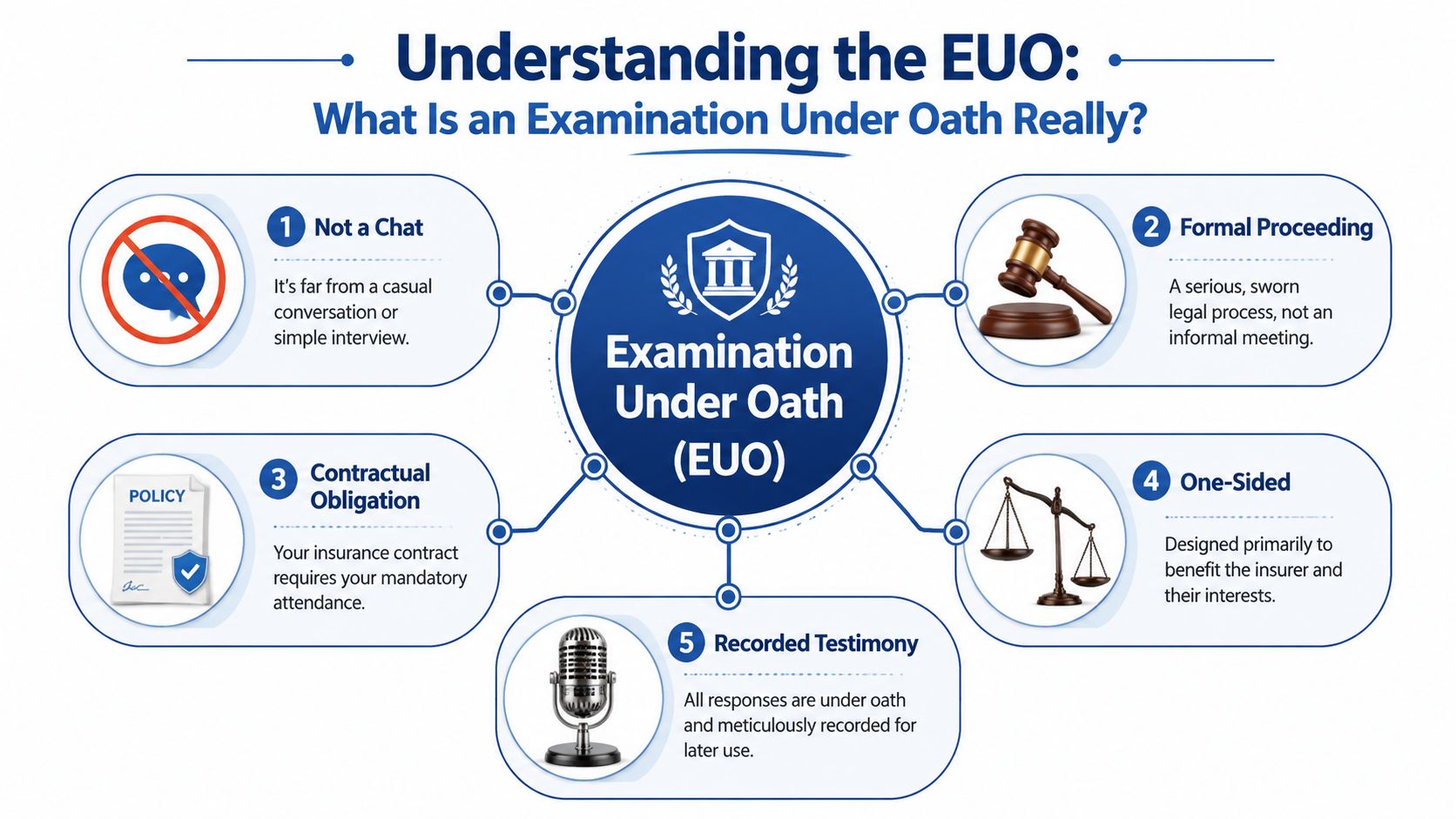
An examination under oath is a formal claims investigation procedure. It is not a casual interview, and it is not the same thing as a routine conversation with the field adjuster or desk adjuster.
This is sworn testimony not a conversation
In a property claim, the insurer’s attorney typically asks the questions, and a court reporter records every question and answer. A transcript is then created, turning your statements into part of the claim record. That’s described in this guide to the sworn evidentiary record created by an EUO. The same source notes that discrepancies between your testimony and your submitted documents can trigger denial.
That format changes everything.
A normal claim call leaves room for follow-up and clarification. An EUO creates a hard record. If your answer later differs from your proof of loss, contractor estimate, invoice, inventory, photos, receipts, mitigation records, or prior statements, the insurer may argue you were inaccurate, misleading, or worse.
Why the format matters
The insurance company benefits from this structure in several ways:
- It locks in your testimony. Once it’s transcribed, the insurer has a clean record to compare against every document in the file.
- It expands the field of attack. Questions can move beyond the immediate damage and into ownership, occupancy, timeline, compliance with policy duties, and credibility.
- It raises the pressure. Most policyholders aren’t used to answering formal questions under oath while a lawyer probes for gaps.
- It builds a denial file. If the carrier wants support for a coverage defense, a sworn transcript is much more useful than a casual phone note.
Think of it as a one-sided deposition before any lawsuit exists. The insurer’s side is prepared. Their lawyer knows the file, knows where the pressure points are, and knows which answers can become arguments later.
The biggest mistake policyholders make is assuming the insurer is still just trying to understand the loss. At the EUO stage, the insurer is also testing whether it can weaken the claim.
That doesn’t mean every EUO ends in denial. It does mean you should stop pretending this is routine. The process is formal, strategic, and designed around the insurer’s interests, not yours.
Why Insurers Use EUOs to Dispute and Deny Claims
The insurance industry didn’t invent the examination under oath yesterday. The EUO has been part of insurance law for over 175 years, with legal foundation tied to Phillips v. Protection Insurance Company in 1851 after the St. Louis fire of 1849, as discussed in this review of the historical foundation of EUOs. That history gives insurers confidence when they demand one. They know courts recognize the tool.
The official reason and the real-world reason
The official line is familiar. The carrier says it needs more information to investigate your claim.
Sometimes that’s partly true. But let’s be honest about how this works in homeowner and business property claims. When a carrier like State Farm or Allstate invokes an EUO, it usually means the claim has been escalated for tougher scrutiny. The company isn’t leaning toward trust. It’s leaning toward defense.
Insurers use EUOs because they help carriers do all of the following at once:
-
Probe for coverage defenses
They ask about when the damage started, who knew what, whether repairs were delayed, who occupied the property, and whether policy conditions were met. -
Attack valuation
If your contents list, repair scope, or business personal property documentation isn’t perfectly aligned, the insurer may argue inflation, unsupported amounts, or unreliable proof. -
Challenge credibility
A minor inconsistency that means nothing in real life can become a major talking point in a denial letter. -
Expand the investigation
Once the EUO is on the table, insurers often demand more records, more explanations, and more time.
Claims that often draw aggressive scrutiny
Certain losses tend to attract harder questioning in NC and VA property claims:
- Fire losses
Carriers often drill into occupancy, ownership, finances, prior condition, and what happened before the loss. - Theft claims
Expect questions about purchase history, receipts, proof of ownership, and who had access. - Water damage claims
The insurer may push hard on whether the damage was sudden, long-term, repeated, or tied to maintenance issues. - Wind and storm losses
They may compare your timeline, weather event reporting, temporary repairs, and prior roof or building condition. - Commercial property claims
Business owners can face questions on inventory, accounting records, operations, vendor documents, and business interruption support.
A short explanation of how insurers approach these examinations can help frame what you’re up against:
The pattern is simple. The bigger, messier, or more expensive the claim looks, the more likely the insurer is to turn procedure into pressure. And once they decide to pressure the claim, every answer you give becomes a potential tool for dispute.
Your Legal Rights and Obligations in an EUO for NC and VA
You cannot ignore an examination under oath demand and expect your property claim to survive. That is the hard truth.
According to the U.S. Supreme Court in Claflin v. Commonwealth Insurance Co. (1884), refusal to appear for an EUO can cause a complete forfeiture of policy rights, and statements made there are under penalty of perjury and can be as binding as trial testimony, as explained in this discussion of Claflin and the legal consequences of noncompliance.
What you must do
Your first obligation is straightforward. You must appear and answer truthfully.
This is a contractual duty in first-party property insurance. If your policy requires cooperation and an EUO, skipping it or stonewalling it can hand the carrier a ready-made argument that you breached the policy. That is exactly the kind of opening insurers want.
Your second obligation is accuracy. Not speed. Not guessing. Not trying to please the questioner. Accuracy.
If you don’t know, say you don’t know. If you don’t remember, say you don’t remember. If a document would answer the question more accurately than your memory, say that too.
You are not required to perform certainty. You are required to tell the truth.
If you also received a reservation of rights letter from the insurer, the pressure is even higher. That usually means the carrier is already signaling possible coverage defenses while it continues investigating.
What the insurer cannot treat as unlimited power
Complying with the EUO does not mean surrendering every protection.
Sources discussing EUO procedure note that the insured is generally entitled to counsel, the questioning may occur in person or by video, and one jurisdiction-specific example explains that the examination should occur on reasonable notice, at a reasonably convenient place, and for a reasonable length of time, with the insured able to record the proceeding. That practical framework is discussed in this operational overview of EUO procedure and limits.
For NC and VA policyholders, the practical takeaway is this:
- You can have representation present.
- You can insist on orderly procedure.
- You can seek the transcript.
- You can push back through counsel when questions become abusive, confusing, or untethered from the claim.
What you should not do is mistake “broad” for “limitless.” Insurers often act as if an EUO gives them free rein. It doesn’t. But you need someone at your side who knows when the company is investigating and when it’s overreaching.
Common Insurer Questions and Traps to Avoid
Most policyholders expect questions about the actual damage. They don’t expect the insurer’s lawyer to spend time digging into finances, prior claims, background issues, document history, or side details that seem miles away from the burst pipe, fire, or theft.
That’s exactly why these examinations are effective for carriers. The scope can extend far beyond the immediate loss event.
How the questioning usually unfolds
The lawyer often starts gently. Name, address, background, ownership of the property, who lives there, who works there, when you bought it, what condition it was in, and who had keys or access.
Then the net widens.
Legal and practitioner sources note that insurers often request financial records, prior claims history, criminal history, and other documents meant to test fraud or coverage defenses, and that a court reporter usually records the full session, as discussed in this analysis of what insurers ask for in an EUO and where policyholders can face overbroad demands.
In homeowner and business claims, that can mean questions like these:
- About finances
Are your mortgage payments current? Were you behind on bills? Did the business have cash flow problems? Did you have any recent loans? - About prior claims
Have you ever filed another property claim? What happened? What was paid? Was anything denied? - About occupancy and use
Was the property owner-occupied, tenant-occupied, vacant, under renovation, partially used, or used differently than listed? - About ownership and proof
When did you buy the damaged items? Where are the receipts? Who prepared the inventory? How did you arrive at the values? - About the timeline
When did you first notice the damage? Whom did you call? What did you move, throw away, clean, or repair before the inspection?
The traps that sink good claims
The traps aren’t always dramatic. Most are simple and effective.
One common trap is forced precision. The lawyer asks for an exact time, exact sequence, exact amount, or exact conversation from a chaotic day. If you guess, they may later compare that guess to a text, invoice, or report and call it inconsistency.
Another trap is document ambush. They use your own estimate, proof of loss, email, mitigation invoice, photo timestamp, or recorded statement to pin you down. If you haven’t reviewed the file carefully, you’ll be answering blind.
A third trap is overexplaining. Nervous policyholders keep talking because silence feels uncomfortable. The extra words create extra angles for attack.
Use these rules instead:
- Answer the question asked. Don’t volunteer side stories.
- Don’t guess. Memory under stress is not perfect, and pretending it is will hurt you.
- Correct mistakes carefully. If a question contains a bad assumption, fix the assumption before answering.
- Stick to what you know firsthand. Don’t speculate about what a contractor, tenant, employee, or family member may have thought or done.
- Pause before answering. Fast answers feel confident. Accurate answers protect claims.
Short, truthful, precise answers usually travel better than long, defensive ones.
Your Battle Plan A Preparation Checklist for Your EUO
If the insurer has demanded an examination under oath, you should prepare as if the company is trying to build a case against your claim. Because it may be.
What to do before the date is locked in
Don’t rush to call the insurer’s lawyer and “work it out” yourself. That impulse gets policyholders in trouble.
Start by getting your file in order. Pull every document tied to the claim. That includes the policy, the insurer’s letters and emails, your proof of loss, contractor and restoration estimates, photos, videos, receipts, inventories, mitigation invoices, lease records if relevant, and business records if it’s a commercial loss.
Then compare those materials for consistency. If one document says the leak began on one date and another implies something different, fix the misunderstanding before you’re under oath. If your contents inventory doesn’t line up with receipts or photos, identify the issue now, not in the middle of questioning.
Your sworn testimony should also align with the proof of loss documentation you submitted to the insurer. If you haven’t reviewed that document recently, do it before the EUO, not after.
Examination Under Oath Preparation Checklist
| Action Item | Purpose |
|---|---|
| Review the full policy | Identify duties after loss, coverage issues, and policy language the insurer may rely on |
| Read every letter from the carrier | Catch deadlines, document requests, and investigation themes |
| Build a loss timeline | Keep the sequence of discovery, reporting, mitigation, inspection, and repair clear |
| Reconcile all estimates and invoices | Reduce contradictions between contractors, mitigation vendors, and your claim position |
| Review photos and videos | Refresh memory and confirm condition, damage pattern, and contents support |
| Organize ownership records | Support building items, personal property, equipment, inventory, and business contents |
| Separate fact from assumption | Know what you personally saw versus what someone else told you |
| Identify weak spots early | Address missing records, disposal issues, prior damage questions, or occupancy concerns before testimony |
| Prepare for broad questions | Anticipate inquiries on finances, prior claims, access, occupancy, and recordkeeping |
| Attend with representation | Keep the process controlled and reduce the chance of avoidable mistakes |
A few preparation habits matter more than people think:
- Chronology first
Write out the timeline in plain language. Date of loss discovery. Emergency response. First notice to insurer. Inspections. Temporary repairs. Contractor involvement. Follow-up requests. - Document custody
Be ready to explain where damaged items went, who removed them, what was discarded, and why. - Vocabulary discipline
Don’t switch terms casually. If you called it “water intrusion” in one place and “flooding” in another, the insurer may try to make that difference sound bigger than it is. - Role clarity
Know who did what. Which contractor inspected. Which mitigation company dried the property. Which employee handled inventory. Which family member spoke to the adjuster.
Preparation doesn’t mean rehearsing fake answers. It means stripping confusion out of the record before the insurer turns that confusion into a defense.
Claim Dispute Success A Real Client Story
When insurers push a claim into dispute territory, policyholders often feel trapped. The company acts like its position is final. It isn’t. One of the clearest reminders of that comes from a real client review involving a denied business water damage claim.
What this review actually shows
The review describes a business owner, Kevin H., whose insurance company denied a water damage claim. After bringing in public adjuster representation, the claim was reopened, the loss was shown to be covered, and the insurer paid.
That’s the lesson. Not that every case resolves the same way. It won’t. The lesson is that a denial is often just the insurer’s opening position after it has framed the facts to its advantage.
When a carrier controls the investigation, controls the requests, controls the pace, and controls the narrative, policyholders get boxed in fast. Add an examination under oath to that mix and the pressure gets worse. A weak presentation of the claim gives the insurer room to say the documents don’t match, the timeline doesn’t make sense, or the support is incomplete.
A disciplined claim response changes the equation. The file gets rebuilt. The damage is documented correctly. The chronology gets cleaned up. Unsupported assumptions get removed. The insurer’s spin has less room to breathe.
A disputed claim isn’t won by outrage. It’s won by facts, documentation, and control of the record.
That’s why people who are facing an EUO, a delay, a low-ball estimate, or a denial shouldn’t assume they’re stuck with the carrier’s version of events. Many aren’t. They just need help proving it.
Get Claim Help For The Public Adjusters Fights for You
Facing an examination under oath alone is a bad idea. The insurer has its lawyer. That lawyer’s job is to protect the carrier, not you.
What good representation changes
Good representation changes the process in practical ways.
It helps you organize the claim file before sworn testimony. It helps you spot conflicts between your estimate, mitigation records, inventory, and prior statements. It helps you prepare for broad questioning on occupancy, finances, prior claims, ownership, and timeline issues. And it gives you someone in the room who understands when the insurer is investigating the loss versus trying to widen the attack.
For property owners dealing with post-loss repairs, vendor disputes can also muddy the claim file. If you’re sorting through cleanup or remediation options after water or mold issues, this guide on comparing restoration service providers near you can help you evaluate contractors more carefully before their invoices and opinions become part of the insurance record.
One available resource for NC and VA policyholders is what a public adjuster does during a property claim dispute. Firms in this space, including For The Public Adjusters, Inc., work on the policyholder side by reviewing damage, organizing support, communicating with the carrier, and helping prepare for sworn claim procedures.
What to do next if your insurer demanded an EUO
Do these things now:
- Stop informal conversations with the insurer’s attorney
Casual calls create unnecessary risk. - Gather your full claim file
Don’t rely on memory when the insurer will rely on paper. - Review your position carefully
Make sure your facts, documents, and claimed damages line up. - Get representation before the examination
Waiting until after bad testimony is far more expensive than preparing properly beforehand. - Treat the EUO as a claim dispute event
Because that’s what it is.
If your insurer is delaying, low-balling, or setting up a denial through an examination under oath, don’t walk into that process blind. Put the claim in order, protect the record, and make the carrier prove its position.
2. Do I legally have to attend the EUO? What happens if I refuse?
3. What kind of questions will they ask? Can they ask about my personal finances?
4. Who will be in the room during the EUO?
5. What is the single biggest mistake policyholders make in an EUO?
6. How can a public adjuster help me before my EUO?
7. What is the difference between a public adjuster and an attorney for an EUO? Do I need both?
8. Can I correct a mistake I made during the EUO?
9. What happens after the EUO is over?
11. Does the insurer have to provide a copy of my previous recorded statements before the EUO?
Answer: In North Carolina and Virginia, this can be a point of contention. Generally, you have a right to your own statements. Your attorney should formally request a copy of any prior recorded statements you have given to the insurance adjuster. It is crucial to review what you said in the hours or days after the loss, as the insurer's attorney will use any inconsistencies—no matter how small—between that initial statement and your EUO testimony to attack your credibility. Do not go into an EUO without re-reading or re-listening to your prior statements.
12. If my spouse is also on the policy, will we be questioned together or separately?
Answer: Almost always, you will be questioned separately. This is a standard tactic. The insurer's attorney will question you, and then your spouse, while the other is outside the room. They will then compare the two testimonies for any inconsistencies. It is perfectly normal for two people to remember small details differently, but they will be looking for significant contradictions in key facts about the claim or the events of the loss. It is critical that you and your spouse both review the facts of the claim but only testify to your own personal knowledge and recollection.
If you’re dealing with an examination under oath, a denied property claim, or a low-ball settlement offer, For The Public Adjusters, Inc. offers a no-cost, confidential review for North Carolina and Virginia homeowners and business owners.