
Fallen Tree On House Claim – When you hear the sickening crash of a tree coming down on your house, the first few moments are a blur of shock and fear. The only thing that matters is getting your family to safety. Period. Make sure everyone is accounted for and out of the danger zone.
But once the immediate danger has passed, what you do in the next few hours is absolutely critical. Your actions will set the stage for the entire insurance claim fight that’s about to begin.
Your First Steps After a Tree Hits Your Home
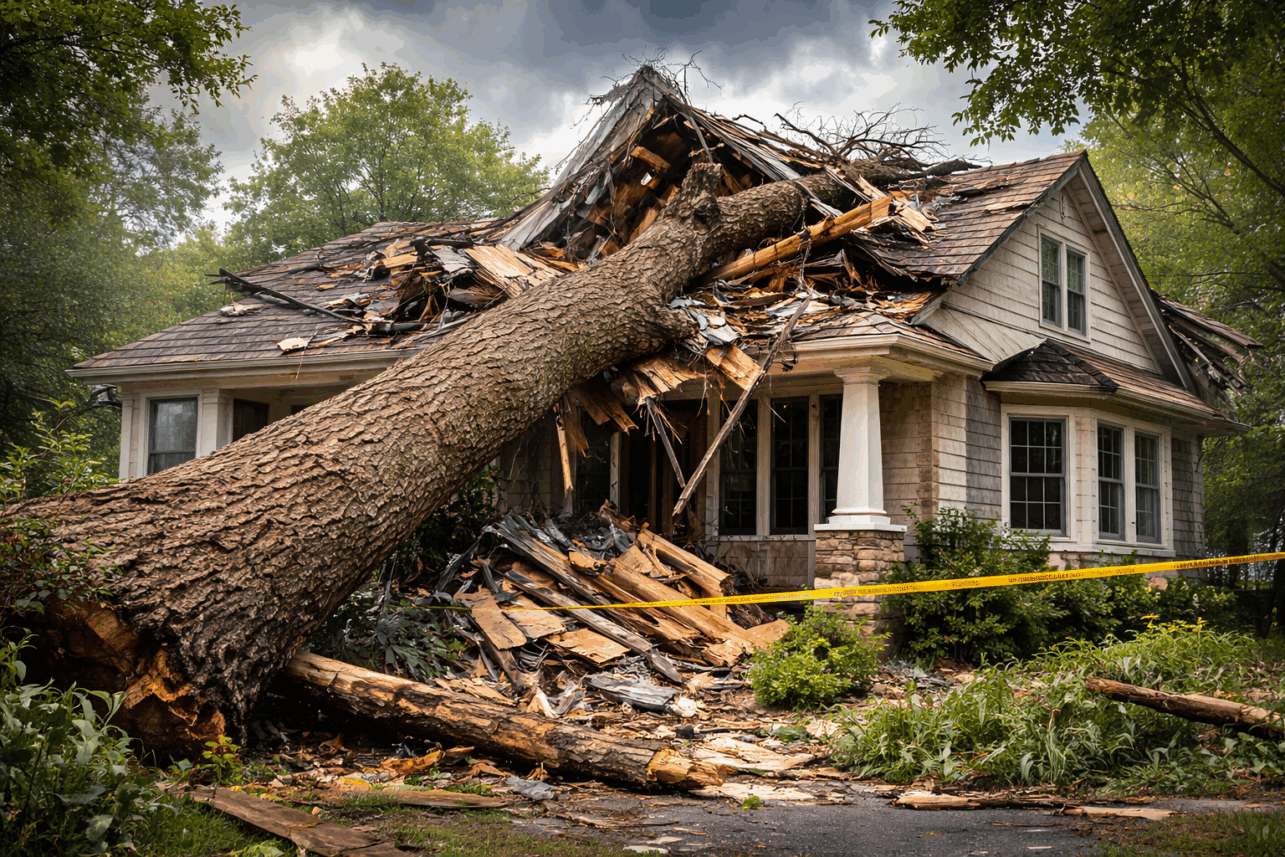
There’s no way to prepare for that sound. In the aftermath, your adrenaline is pumping, but you have to force yourself to be methodical. You need to act in a way that protects your family and your financial recovery, because your insurance company isn’t going to guide you through this crisis—their goal is to minimize their payout.
After confirming everyone is safe, your next priority is to stop the damage from getting worse. This is what the insurance world calls “mitigating damages,” and it’s a non-negotiable part of your policy. Insurers like Allstate and State Farm love to use this clause against homeowners. If you don’t take reasonable steps to protect your property from further harm, they can—and will—blame you for any subsequent damage and refuse to cover it.
Document Everything Before a Single Thing Is Moved
Before you or anyone else touches a single branch, you need to become your own evidence collector. This is not optional. It’s the single most powerful tool you have to fight back when an adjuster tries to downplay the damage.
Get your smartphone out and start recording.
What to Capture Immediately:
- The Big Picture: Get wide shots from the street, your yard, and even a neighbor’s yard if you can. Show the full scale of the tree on your house.
- Impact Points: Now, get close. Take detailed photos of every single spot the tree is touching your roof, walls, windows, or foundation.
- The Inside Story: Go inside and document everything. Cracked drywall on the ceiling, busted window frames, debris that’s come through into your rooms—capture it all.
- The Sneaky Stuff: Look for any signs of water stains already forming. They might seem small, but they’re proof that your roof has been breached and water is getting in.
This first round of photos and videos is your baseline—the undeniable “before” picture that proves the true extent of the initial hit. Don’t let a well-meaning neighbor or a rushed tree service start working until this is done.
Making Emergency Temporary Repairs
Once you’ve got your evidence locked down, you can shift your focus to damage control. This usually means getting a tarp over any gaping holes in your roof to keep the rain out.
But let’s be clear: this is a dangerous job. Never, ever climb onto a roof that has been structurally compromised, especially right after a storm. If you can’t do it safely, call a professional roofer or an emergency services company.
Keep every single receipt for tarps, plywood, plastic sheeting—anything you buy to secure the property. Your policy should reimburse you for these temporary repair costs, but you may have to fight for it.
This initial phase is a minefield. For a deeper dive into the process, check out our comprehensive overview on how to file homeowners insurance claim to make sure you start off on the right foot.
The actions you take in the first 24 hours can make or break your claim. Your insurer’s adjuster is trained to look for reasons to reduce their payout. Your job is to build an irrefutable case from the moment the tree falls.
Why Your Insurance Company’s First Offer Is a Trap
That first phone call after a tree crashes through your roof can give you a false sense of security. The person on the other end uses all the right words—”we’re so sorry this happened,” “we’ll get someone out there right away”—and for a moment, you feel like you’re in good hands.
Don’t be fooled. This is the start of a well-rehearsed strategy designed to do one thing: pay you the absolute minimum your policy allows.
The company adjuster who shows up at your door isn’t there to help you. They work for the insurance company. Their job performance is measured by how quickly and cheaply they can close your claim. What you see as a disaster, they see as a line item on a spreadsheet. Their inspection is often just a quick walk-around, focused on finding the cheapest patch, not the right repair.
The Lowball Offer Playbook
Big-name carriers like State Farm and Allstate have this down to a science. When you have a fallen tree on your house, their adjusters are following a script that puts their profits ahead of your property’s safety.
They’re trained to find the path of least resistance—the quickest, most affordable fix. They might approve a simple patch for your roof, completely ignoring the fact that the impact likely fractured the trusses and compromised the entire structure underneath. A proper, safe repair would mean a full replacement, but that’s not what they’re looking for.
This is how they build that first, insultingly low offer:
- They Ignore What They Can’t See: The adjuster’s report will focus only on the obvious cosmetic damage. They’ll conveniently leave out potential structural problems with your rafters, joists, or even your foundation.
- They Price for Cheap Materials: The estimate they write is almost always based on the lowest-grade materials available, not the quality of what you had before the storm.
- They “Forget” Critical Costs: You’ll often find that their offer mysteriously omits essential expenses like crane services, debris removal, local permit fees, or the costs to bring your home up to current building codes.
That first offer isn’t a good-faith estimate. It’s a test. They’re betting you’re stressed out, overwhelmed, and don’t know any better. They want you to take the first check they dangle in front of you so they can close the file and save themselves a fortune.
A lowball offer is not a starting point for a negotiation. It’s a strategic move to see if you’ll give up your right to a fair settlement without putting up a fight. They are counting on your exhaustion.
 A Real-World Example from Raleigh, NC
A homeowner with a Fallen tree claim in Raleigh, North Carolina, whose house was split in two when a massive oak tree came down in a thunderstorm. Their insurance company was on the scene quickly, and the adjuster seemed incredibly helpful during his quick 20-minute inspection. A few days later, the offer came in.
The insurance company agreed to pay for the labor to cut the tree off the roof. That’s it.
They completely left out the massive cost of hiring a crane to lift the multi-ton sections of the trunk off the structure. They also “forgot” to include the expense of hauling away the mountain of wood and debris. The homeowner was suddenly facing thousands of dollars in out-of-pocket costs that should have been covered under the policy’s “debris removal” clause. This wasn’t a mistake; it was a tactic.
This kind of thing isn’t rare. It’s how they do business.
Why You Must Reject the First Offer
If you accept that first check, you’re falling right into their trap. Cashing it often means you sign away your right to ask for another dime for this claim.
So when mold starts growing from hidden water damage a few months later, or when a contractor finally discovers the cracked support beams the adjuster “missed,” it’s too late. The insurance company will just point to the release you signed.
The financial pressure is real, but you have to understand that their first offer is just an opening bid. You’re in a negotiation you probably didn’t even know you were a part of. You have every right to dispute their numbers, bring in your own experts, and demand the money you need to actually make your home whole again. Fighting back isn’t just an option—it’s the only way to protect your most valuable asset.
Building an Unshakeable Case Against the Insurer
When your home gets smashed by a fallen tree, your insurance company’s adjuster is trained to look for reasons to pay you less. They scrutinize every detail, hoping you missed something. Your best and only defense is to build a case so thorough, so detailed, and so undeniable that it leaves them no room to argue.
Forget a few quick snapshots from your phone. That’s exactly what carriers like Allstate and State Farm hope you’ll do—provide weak evidence that’s easy to dismiss. Building an unshakeable case requires a strategic and methodical approach. It transforms you from a victim into a prepared advocate for your own claim.
Documenting Damage Like an Expert
Your mission is to create a complete visual record of every bit of damage, big and small. This evidence becomes the foundation of your entire fight.
Think like a professional investigator. Your documentation needs to tell the full story of the destruction.
- Go Wide: Start with wide-angle shots from multiple angles. Capture the entire tree on your house from the front, back, and both sides. This establishes the sheer scale of the event right off the bat.
- Zoom In on Impact Zones: Now, move in closer. Take detailed, high-resolution photos of every single point where the tree makes contact with your home. We’re talking crushed gutters, splintered roof decking, cracked siding, and shattered windows.
- Capture the Interior Carnage: The damage inside is just as critical. Photograph any cracked plaster on the ceiling, broken light fixtures, damaged furniture, and debris that crashed into your living space. Look for new water stains forming on ceilings and walls—this is crucial proof that the roof has been breached.
Your photo and video log isn’t just a collection of pictures; it’s a fortress of proof. Every crack, stain, and splinter is a piece of evidence that directly counters an adjuster’s attempt to downplay the severity of the damage.
To really nail this down, you need to go beyond the basics. The adjuster will be happy if you just take a few quick pictures, but winning your claim requires much more detail.
Evidence Checklist Your Insurance Adjuster Hopes You Forget
| Evidence Type | What the Insurer Expects (Basic) | What You Need (Comprehensive) |
|---|---|---|
| Overall Scene | A few exterior photos of the tree on the house. | Dozens of photos & videos from every angle, at different times of day, showing the scale of the disaster. |
| Exterior Damage | Pictures of the most obvious broken parts. | Close-ups of every shingle, siding piece, gutter, and window frame touched by the tree. Show splintering, cracking, and punctures. |
| Interior Damage | Photos of debris that fell inside. | Detailed shots of ceiling cracks, water stains, damaged light fixtures, and scuffed floors. Include measurements for context. |
| Personal Property | A simple list of ruined items. | Photos/videos of each damaged item, with original receipts, model numbers, and links to replacement costs if possible. |
| Communication | Vague memories of phone calls. | A detailed log with dates, times, names, and a summary of every conversation, email, and text. |
This level of detail is what separates a weak claim from an undeniable one. Don’t give them an inch.
The Non-Negotiable Step: Get Independent Estimates
Your insurance company will send out their adjuster, who will write up a repair estimate. As we’ve covered, this initial offer is often a trap. The single most powerful way to fight it is with competing evidence from an unbiased source.
You must get your own estimates from independent, licensed contractors—ones who have absolutely no affiliation with your insurance company. These professionals work for you, not the insurer.
Their estimate will be based on what it actually costs to restore your home to its pre-loss condition using quality materials and proper building practices, not the cheapest shortcuts. When you have multiple detailed estimates from reputable builders, your insurer’s lowball offer starts to look indefensible.
The flowchart below illustrates the simple but deceptive process insurers use to trap unprepared homeowners.

This visual shows the insurer’s playbook: they receive your claim, make a deliberately low offer, and hope you’re too overwhelmed to fight back. This is how they trap you in an unfair settlement.
Create a Detailed Communication Log
From your very first call to the insurance company, start a log. This isn’t optional; it’s a critical piece of your evidence file.
Document every single interaction:
- Who: The name and title of the person you spoke with.
- When: The date and time of the call or email.
- What: A detailed summary of what was discussed, including any promises made or instructions given.
This log shuts down the classic “he said, she said” arguments. When an adjuster conveniently forgets they promised to send an engineer or approve a specific cost, your detailed notes become undeniable proof. This is how you hold them accountable.
The risks associated with a fallen tree are severe. In the United States, falling trees and limbs pose a significant threat, with OSHA reporting over 100 landscape and tree fall fatalities every year on average. When trees crash onto houses, the damage isn’t just structural; it often triggers complex insurance battles where carriers undervalue claims. Homeowners in storm-prone North Carolina and Virginia, who constantly face hurricanes and high winds, frequently end up with denied or underpaid policies. You can discover more insights about the dangers of fallen trees and branches on the Reiff Law Firm’s website.
Hiring a Public Adjuster to Fight for You
Trying to negotiate with a billion-dollar insurance corporation on your own isn’t a fair fight. It’s a David-and-Goliath scenario. You’re exhausted, stressed about your damaged home, and now you’re expected to go head-to-head with a company whose entire business model is built on protecting its profits.
This is where a public adjuster becomes your most powerful ally.
There’s a critical difference you have to understand right away: the insurance company’s adjuster works for them. Their loyalty is to their employer, and their job is to limit the company’s financial payout. A public adjuster, on the other hand, is a state-licensed professional who works exclusively for you, the policyholder. Their only goal is to secure the maximum and fairest settlement you’re entitled to under your policy.
The Advocate in Your Corner
When you bring a public adjuster onto your team, you’re leveling a dangerously uneven playing field. They take over the entire grueling and complicated claims process, from the initial inspection to the final, bare-knuckle negotiation.
They speak the insurance company’s language fluently and know every tactic and excuse in the book used to undervalue claims after a tree crashes through your roof.
A good public adjuster will conduct their own meticulous inspection, often finding significant, hidden damages the company’s adjuster “conveniently” overlooked. They document everything with forensic detail, prepare a professional estimate based on real-world repair costs in your area, and handle all the frustrating communication with the insurer. This frees you from the endless phone calls and stonewalling so you can focus on getting your life back together.
A Virginia Family’s Fight Against Allstate
Let me tell you about a real case. A Virginia family’s home was crushed by a massive oak tree during a storm. Their insurer, Allstate, sent out an adjuster who did a quick, superficial walkthrough. A few days later, they got an offer for $15,000—a slap in the face that wouldn’t even cover the roof, let alone the serious structural damage.
Feeling defeated, they called us. Our team at For The Public Adjusters, Inc. immediately did a deep dive. We brought in structural experts to assess the home’s framework and discovered multiple fractured roof trusses and significant damage to the load-bearing walls. The Allstate adjuster had completely ignored it all.
Armed with undeniable proof, we reopened the claim and went to war with Allstate. We proved their initial assessment was grossly negligent. After an intense back-and-forth, we forced them to increase their settlement from that insulting $15,000 to a final payout of $75,000.
That 400% increase was the difference between a cheap patch job and a safe, properly restored home for their family.
This case study is a stark reminder: insurers like Allstate are not on your side. Their initial offer is often just a test to see what you’ll accept. A public adjuster has the expertise to expose these lowball tactics and fight for the full value of your claim.
Why You Can’t Afford to Go It Alone
These tree-related disasters are only getting more common, creating more opportunities for insurance disputes. Global data shows a sharp increase in these events, and the U.S. is unfortunately the deadliest country for such incidents.
This trend directly impacts property owners in storm-prone states like North Carolina and Virginia. We’ve seen it firsthand after hurricanes like Florence and Isaias uprooted countless trees, leaving residents with staggering repair bills—only to have their claims lowballed by their own insurance companies.
When you’re facing a catastrophic loss from a fallen tree, you need a professional who understands the system from the inside out. A public adjuster knows the policy language, the local building codes, and the true cost of materials and labor. They are your dedicated advocate in a system designed to work against you. To get a better understanding of what they can do, you can learn more about the role of a public claims adjuster in our guide.
They manage every single detail, ensuring your claim is presented so thoroughly that the insurance company has no room to argue, delay, or deny what you are rightfully owed.
Managing Repairs Without Getting Ripped Off

Securing a fair settlement for your fallen tree claim feels like a huge victory, but it’s really just halftime. Now you have to rebuild, and this is where a whole new set of traps are waiting. Your insurance company is ready to close the file and move on, but your diligence during the repair phase is what actually determines if you get your life back to normal.
The first thing your insurer might do is “helpfully” offer a list of their “preferred vendors.” This sounds great, but it’s a massive red flag. These contractors work for the insurance company, not for you. Their main goal is to get the job done inside the insurer’s lowball budget, which often means cutting corners and using cheap materials.
Finding a Contractor Who Works for You
You have to take control of the hiring process. Finding your own reputable, licensed contractor isn’t just a good idea—it’s absolutely essential to making sure your home is restored correctly.
Don’t just hire the first person who gives you a quote. Look for contractors who have:
- A solid local reputation: Dig into online reviews, but more importantly, ask for references from past clients who had similar tree damage. Call them.
- The right credentials: Verify their state license and, critically, make sure they carry both liability and workers’ compensation insurance. You don’t want to be on the hook for accidents.
- Real experience with insurance claims: A contractor who knows how to properly document their work for an insurer is an absolute asset in this fight.
And a crucial piece of advice: never, ever sign a contract with an “assignment of benefits” clause. This is a legal maneuver that gives the contractor the right to bill your insurer directly, effectively cutting you out of the process and giving them control over your settlement funds.
The Payment Puzzle With Your Mortgage Company
When that settlement check finally shows up, you’ll probably see another name on it: your mortgage company. This is standard procedure. Your lender has a financial stake in the property, and they want to ensure it’s actually repaired.
The problem is, mortgage companies are often slow, bureaucratic nightmares. They will hold onto your funds and release them in stages, creating massive delays. Call your lender the moment you know a check is coming. Find out their exact process for endorsing the check and disbursing the money. Stay on them, be persistent, and keep organized records of every conversation.
A fallen tree doesn’t just damage what you can see. The real danger is often hidden. Water seeps into your walls and attic, creating the perfect breeding ground for mold that adjusters love to ignore.
When you’re dealing with major structural damage, you have to think about these secondary issues. Water intrusion can lead to serious, long-term health problems and structural rot if it’s not handled right away, making professional mold testing a very smart move.
The stakes are higher than most people realize. In the U.S., an average of 31 people are killed by fallen trees every year. For homeowners in North Carolina and Virginia, hurricane season turns this risk into an annual threat, sending massive trees crashing through roofs and causing incredibly complex damage. This isn’t just a simple patch job; it demands a comprehensive repair plan. If your roof took a major hit, you might want to read our guide on whether insurance will cover a full roof replacement.
How to Dispute Common Insurance Company Denials & Tricks
When a tree comes crashing down on your house, your mind is racing with a thousand urgent questions. You’re in a crisis, and the last thing you need is the confusing jargon and corporate runaround from your insurance company. Let’s cut through the noise and tackle the real-world tricks insurance companies use and how to fight back.
The “Tree Removal” Trick: Who Pays to Haul It Away?
This is a classic insurance company trap. Your policy almost certainly covers the cost of removing the tree from your house and other insured structures, like a detached garage. But many of the big carriers will exploit that exact wording to the letter.
They’ll argue their responsibility ends the second the tree is cut up and lying in your yard. What they don’t tell you is that you’re now on the hook for a massive, multi-thousand-dollar bill to have tons of heavy debris hauled away. It’s a nasty surprise.
How to Fight Back: A public adjuster knows this game. We argue that “removal” isn’t complete until your property is restored to its pre-loss condition. That means getting every last branch and log off your property, and it absolutely should be part of the covered claim. Don’t let them nickel-and-dime you on this.
The Blame Game: Who Pays If My Neighbor’s Tree Fell On My House?
This is hands down one of the most misunderstood parts of a fallen tree claim. In North Carolina and Virginia, the rule is almost always the same: your own homeowners insurance policy is responsible for the damage. It doesn’t matter whose yard the tree came from. The claim follows the damaged property, not the tree’s origin.
Insurance companies know this trips people up. They often use the confusion to point fingers and delay paying what they owe, hoping you’ll get frustrated and give up.
How to Fight Back: The only real exception is if you can prove your neighbor was negligent. For example, you have proof they knew the tree was dead or diseased and refused to do anything about it. But proving negligence is an uphill, expensive, and incredibly slow legal battle. Your fastest and most direct path to getting your home fixed is always through your own policy. A public adjuster cuts through the nonsense, making sure the claim is filed correctly from day one so the insurer can’t wrongfully deflect responsibility.
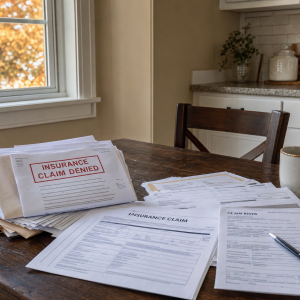
The Stonewall: What If My Insurer Denied My Claim?
First, understand this: a claim denial is not the end of the road. It’s often just the insurance company’s opening chess move, designed to see if you’ll walk away from the table. Don’t do it.
How to Fight Back: Your first step is to demand the denial in writing. This is critical. It forces them to go on record and cite the specific policy language they’re hiding behind. Once you have that letter, don’t bother arguing with the staff adjuster on the phone. Their job is to make the denial stick. Your next call should be to a public adjuster.
We will review your policy, the insurer’s reports, and their denial letter—often at no cost—to find the weak spots in their argument. So many denials are based on sloppy inspections, misinterpretations of the policy, or flimsy excuses. A skilled public adjuster knows how to dismantle these arguments, force the insurer to reopen the claim, and fight to get you the settlement you were owed all along.
2. Why does my insurance only offer $500 for tree removal when the bill is $5,000?
This is the most common "lowball" error made by staff adjusters. Standard policies (HO3) have a Debris Removal sub-limit (usually $500–$1,000) for "hauling away" the wood.
The Solution: You must distinguish between Extraction and Debris Removal. The cost to crane the tree off your roof to prevent further damage is a "Reasonable Repair" under Coverage A (Dwelling) and is not subject to the $500 limit. Only the cost of cutting up and hauling away the logs once they are on the ground falls under the $500 cap.
3. What is the "Virginia Rule" regarding hazardous trees?
Virginia follows a specific legal precedent regarding encroaching and hazardous trees. Under Fancher v. Fagella, a property owner can be held liable for damage caused by their tree's roots or branches if they are a "nuisance"—meaning they cause actual or imminent harm. This gives VA policyholders more leverage to demand a neighbor remove a dead tree before it falls, or to hold them liable if it does.
4. How does the North Carolina "Matching" rule affect my roof repair?
If a tree damages 25% of your shingles, will the insurance pay for a whole new roof? In North Carolina, the NCDOI and the NC Rate Bureau allow for a "reasonable uniform appearance." If your shingles are discontinued and a patch would be an eyesore, a public adjuster can leverage NCGS § 58-63-15 to argue that the insurer must replace the entire slope or roof to maintain the home's value.
5. Does insurance cover tree removal if the tree hit my yard but NOT my house?
Generally, no. If a tree falls in your yard and doesn't hit a covered structure (house, shed, fence), most NC and VA policies provide zero coverage for removal.
The Exception: Most policies include a provision that pays for removal if the tree blocks a driveway (preventing vehicle access) or a handicapped ramp. A public adjuster will look for these "access" clauses to get your yard cleared at the insurer's expense.
6. What if a tree falls on my car while it’s in the driveway?
This is not a homeowners insurance claim. This falls under the Comprehensive Coverage of your Auto Insurance policy. If the tree hit both your house and your car, you will have to file two separate claims and likely pay two separate deductibles.
7. Does my policy cover "Emergency Mitigation" (Tarping)?
Yes. In fact, your policy requires you to prevent further damage. In NC and VA, the "Duties After Loss" section of your policy mandates that you cover holes in the roof immediately.
The Warning: Do not let a tree company charge you $10,000 for a "rush" tarping job without an itemized invoice. Insurers in VA and NC are increasingly denying "unreasonable" mitigation invoices. Always get a "scope of work" before they start.
8. How do I prove my neighbor was negligent after the tree is already on the ground?
The Stump is the Evidence. If you believe the neighbor's tree was dead, do not let the tree service grind the stump immediately. A public adjuster will recommend an arborist to examine the rings and internal decay of the stump. In North Carolina, photos of "fungal conks" or hollow centers are vital evidence to prove the neighbor breached their Duty of Care, potentially getting your deductible reimbursed.
9. What is my deductible for a fallen tree claim in NC/VA?
Check your "Declarations Page."
Coastal Regions: If you are in Virginia Beach or the Outer Banks, you may have a Named Storm or Hurricane Deductible (usually 1%–5% of your home's value).
Inland Regions: In Richmond or Charlotte, you likely have a flat "All-Peril" deductible (e.g., $1,000). If the tree fell during a thunderstorm, the lower deductible applies.
10. Can I use my own contractor, or do I have to use the insurance company’s "Preferred Vendor"?
You have the absolute right to choose your own contractor in both NC and VA. "Preferred Vendors" work for the insurance company and are often incentivized to keep costs low. A public adjuster ensures that your chosen contractor’s estimate—which includes local NC/VA labor rates and Xactimate line items—is the one used for the settlement.
When a fallen tree on house disaster turns your world upside down, you don’t have to battle your insurance company alone. The team at For The Public Adjusters, Inc. is your advocate, fighting to get you the full and fair settlement you deserve.
Contact us today for a no-cost claim review and take the first step toward a real recovery. Visit us at https://forthepublicadjusters.com to get the expert help you need.