You're standing in a damaged home, or maybe outside one, trying to process what just happened. The fire is out, but the stress isn't. Now the insurance company is calling, assigning adjusters, asking for statements, and acting like the process is routine. For you, it's not routine. It's your house, your belongings, your life.
A fair insurance settlement for fire damage doesn't happen because you were honest, cooperative, and patient. It happens because you document the loss better than they document the underpayment. If your gut is telling you the first inspection felt rushed, the estimate feels thin, or the adjuster is already pushing you to move on, trust that instinct.
Table of Contents
- The Fight After the Fire Begins
- Your First 48 Hours Securing the Scene and Your Claim
- Building Your Evidence Arsenal Documenting Every Loss
- Challenging the Insurers Lowball Estimate
- Escalating the Dispute When to Get Professional Help
- Your Next Steps to Secure Your Settlement
The Fight After the Fire Begins
The hardest part for many homeowners isn't the fire itself. It's the moment they realize the insurance company isn't there to readily write a fair check and make things right. Their adjuster may sound polite. They may sound sympathetic. They still work for them, not for you.
That conflict shows up fast. Calls get delayed. The inspection feels incomplete. Damage gets brushed off as minor, cleanable, or pre-existing. Then the estimate lands, and it doesn't come close to what it will take to repair the house, replace what was lost, and deal with smoke contamination that didn't magically disappear because flames were limited to one room.
A 2026 recovery report on wildfire insurance claim problems found that nearly 8 in 10 insured wildfire survivors reported serious problems with their claims, with 50% reporting a lowball settlement offer, 51% reporting communication delays, and 48% saying their claim was passed between three or more adjusters. That's not an outlier. That's the environment you're walking into.
Practical rule: If the process already feels adversarial, treat it that way. Stay polite, but stop being passive.
A fair settlement is not the number they volunteer first. It's the number supported by the full scope of damage, the actual cost of repair, and the policy benefits they'd rather not emphasize unless you force the issue.
Here's the mindset that protects you:
- Assume the first offer is negotiable. It usually is.
- Assume their scope is incomplete. Fire claims often miss hidden smoke, soot, cleaning, and code issues.
- Assume every conversation matters. If it isn't documented, they can deny it later.
- Assume delay helps them more than it helps you. Keep the pressure on.
You paid for coverage. Now you have to make them honor it.
Your First 48 Hours Securing the Scene and Your Claim
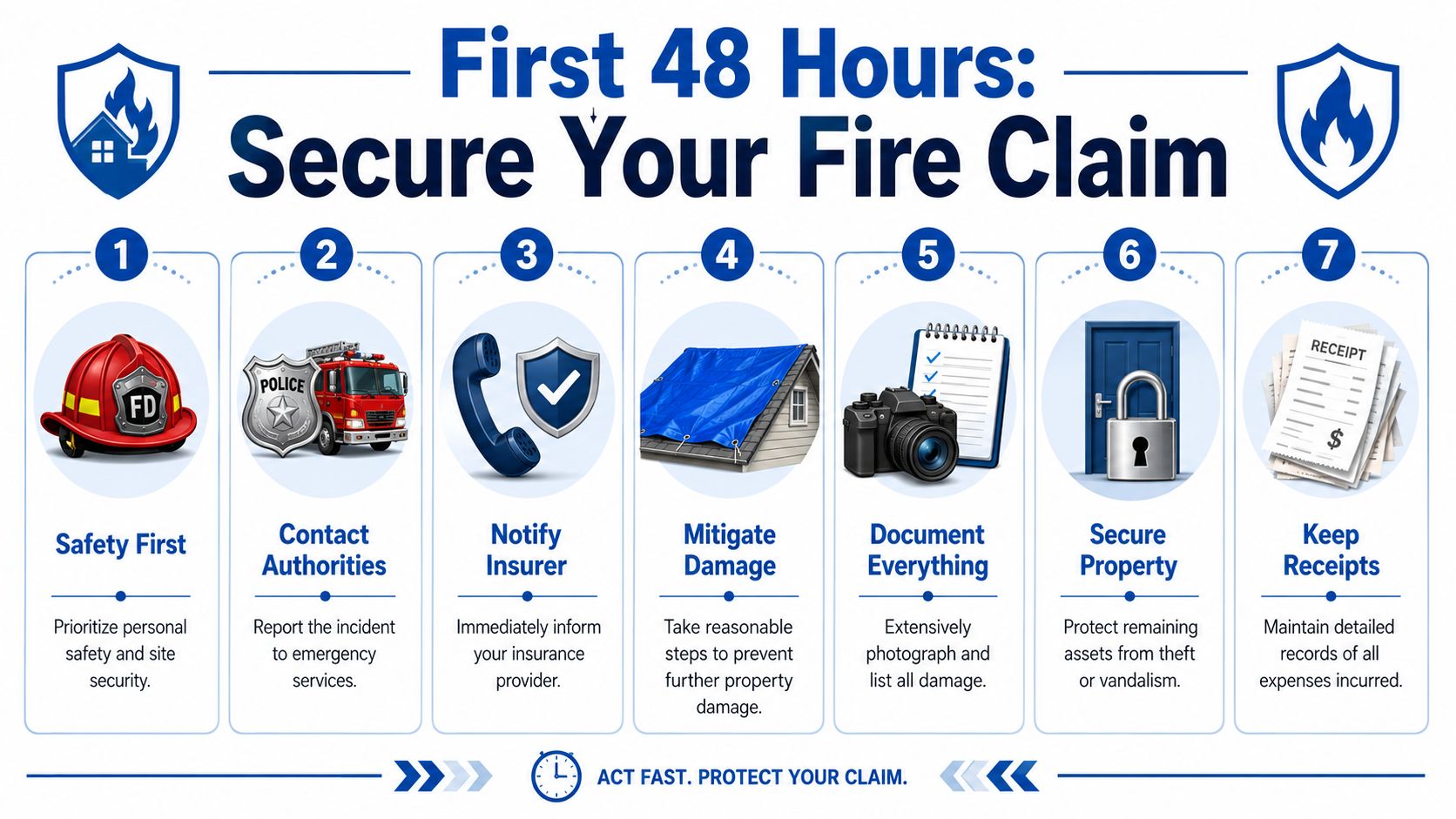
The first two days after a fire are chaotic. That's exactly when mistakes get made, and insurance companies know it. If you wait too long to secure the property, preserve evidence, or track emergency spending, they can use those gaps against you.
Lock down the property and stop further damage
Your policy likely requires you to protect the property from additional loss. That means reasonable emergency steps like board-up work, roof tarping, water extraction, or temporary power shutoff if conditions require it. If rain comes through an exposed roof or someone steals from an unsecured home, the carrier may argue that later damage wasn't the fire's fault.
Take these steps immediately:
- Get official clearance before entering. Don't walk into a structure just because the flames are gone.
- Arrange emergency mitigation. Board openings, tarp exposed areas, and stabilize unsafe conditions.
- Preserve damaged contents when possible. Don't throw items away unless they create a health or safety hazard.
- Separate emergency work from permanent repairs. Stop the damage first. Don't let anyone start rebuilding before documentation is complete.
If they later say you failed to mitigate, your receipts, invoices, photos, and same-day notes are your defense.
Notify the insurer, but don't overshare
Yes, you should report the loss promptly. No, you do not need to give a loose, emotional, off-the-cuff narrative that can be picked apart later. Keep your notice simple. Date of loss, address, broad description, current condition, and immediate needs.
Be careful with recorded statements. Homeowners say too much when they're exhausted, traumatized, and guessing. If you need guidance on dangerous mistakes people make in those early conversations, read this breakdown of what not to say to a fire claim adjuster.
Use this short communication checklist:
- Ask for a full certified copy of your policy. Not just the declarations page.
- Ask for the claim number in writing.
- Ask who the assigned adjuster is and how to contact them.
- Ask what temporary living expense documentation they require if the home is uninhabitable.
Start the paper trail now
Don't trust memory. Start a running claim log on day one.
A good claim log should include:
| Item | What to record |
|---|---|
| Calls | Date, time, who called, what was said |
| Emails | Save every message in one folder |
| Site visits | Who came, what they inspected, what they skipped |
| Expenses | Hotel, food, clothing, boarding, emergency repairs |
| Damage changes | New staining, odor spread, corrosion, contamination concerns |
Keep every receipt. Keep every invoice. Keep every photo in original form.
A fire claim gets harder, not easier, with time. The first 48 hours are when you either build a record or hand them room to dispute one.
Building Your Evidence Arsenal Documenting Every Loss
The company adjuster's file is built to control the narrative. Yours needs to beat it. That means more than a few cell phone pictures and a rough list of damaged items. You need a claim file that shows what burned, what was contaminated, what was soaked during suppression, and what cannot be safely cleaned or reused.

A kitchen fire is a good example. The carrier may focus on obvious charring around the stove, cabinets, and drywall. But the actual damage usually spreads much farther. Smoke moves into upper cabinets, vents, insulation, adjacent rooms, soft goods, and the HVAC system. Firefighting water can push into flooring, wall cavities, and the ceiling below.
A California insurance department action on smoke-damage claims matters here because regulators said consumer complaints revealed a pattern of denials and delays tied to overly narrow standards, and the same action highlights that scientifically proven smoke damage must be covered even when it isn't visible. That's a direct warning to homeowners. If you only document what your eyes can see, you leave hidden contamination open for denial.
Start a proof binder, not a photo folder
A strong file has structure. Don't dump everything into one album and hope it makes sense later. Build a binder, digital or physical, with categories.
Include these sections:
- Scene photos by area. Exterior, each room, attic, crawlspace, garage, HVAC, contents.
- Contents inventory. Room-by-room lists with item descriptions, condition, and whether the item was burned, smoked, sooted, or water-damaged.
- Emergency response records. Fire report, board-up invoices, mitigation records.
- Repair and cleaning proposals. Separate structural work from contents cleaning and specialty remediation.
- Communication log. Every adjuster email, voicemail summary, and inspection note.
If you need a formal framework for organizing the loss, this guide to a proof of loss for insurance claims helps homeowners understand how to present damages in a way insurers can't easily dismiss.
Document hidden damage like you expect a denial
You should. Hidden damage is where many fire claims get cut down.
Document these categories aggressively:
- Smoke inside cabinets and drawers. Open everything. Photograph residue, staining, odor complaints, and warped finishes.
- HVAC contamination. Registers, returns, filters, air handler components, and duct interiors matter.
- Insulation and porous materials. Smoke and soot can penetrate materials that don't look destroyed.
- Water migration. Fire suppression often creates a second loss that carriers try to separate or minimize.
- Electronics and appliances. Soot and corrosive residue can affect equipment even when it still powers on.
The more “invisible” the damage, the more you need third-party support, written findings, and targeted testing.
Don't clean first and document later. That reverses the order and weakens your case. Take photos before debris removal, before wipe-downs, before contents are moved, and before contractors start cutting.
After you've gathered the basics, use visuals to tell the story clearly. This short video is worth watching if you're trying to understand how evidence quality affects the strength of your claim.
A homeowner with a detailed file can challenge omissions. A homeowner with scattered photos and vague memories usually ends up arguing from a position of weakness.
That's the core purpose of documentation. You're not preserving memories. You're building pressure.
Challenging the Insurers Lowball Estimate
When the insurer's estimate arrives, don't ask whether it feels fair. Ask whether the scope of loss is complete. That's the fight. The total number at the bottom is just the result of every line item above it.
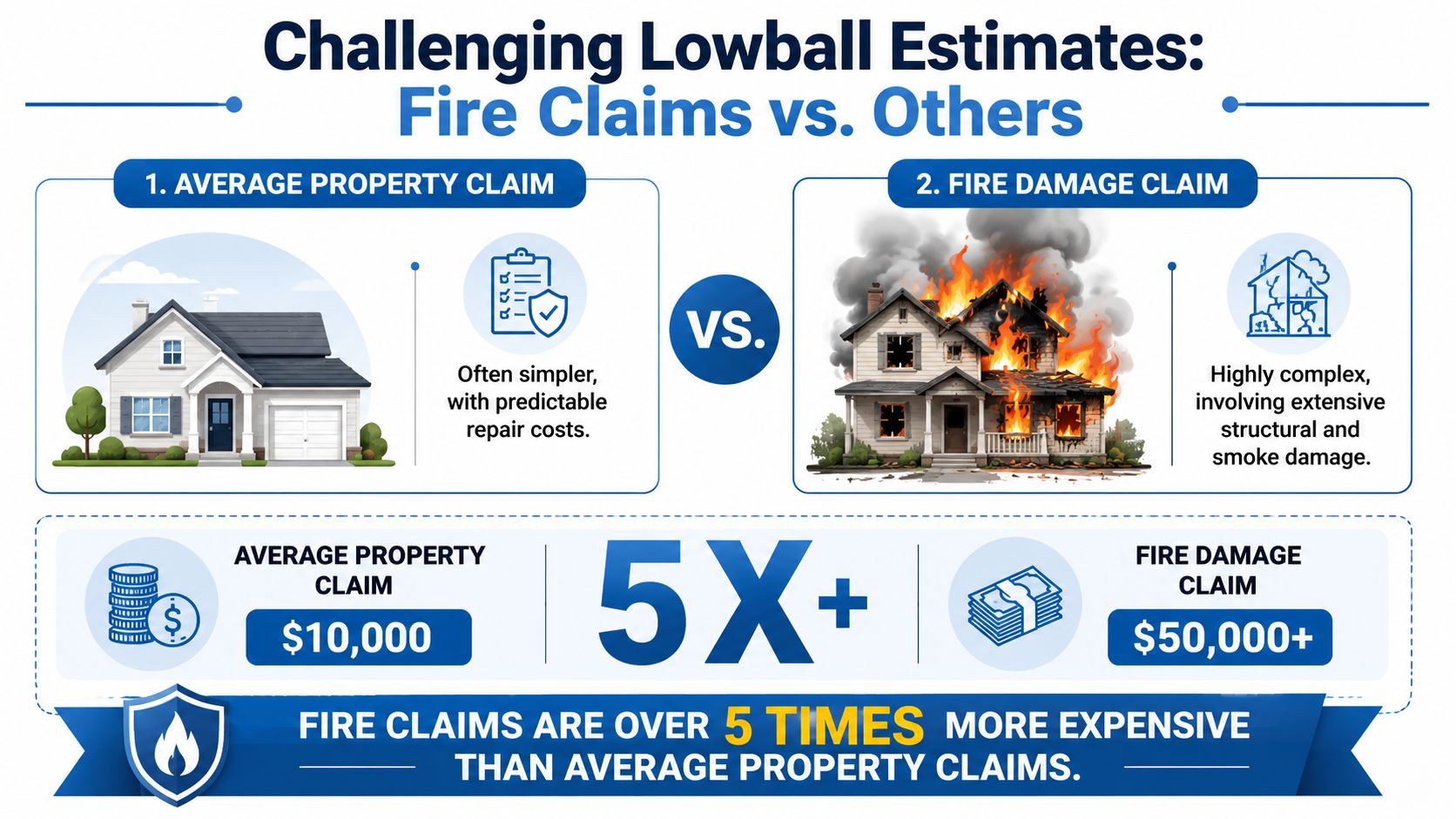
Fire claims are expensive, and that matters because large claims create more pressure on the carrier to shave costs. Policygenius reported homeowners insurance claim statistics showing that from 2016 to 2020 the average fire and lightning claim was $77,340, compared with $13,804 for property damage claims overall. The same guidance supports a practical response: build a written scope of loss, get your own repair estimates, and negotiate disputed line items instead of arguing only about the total.
Fight the scope, not the headline number
If their estimate says “clean” where your contractor says “replace,” that's a dispute. If they priced builder-grade materials where your home had custom finishes, that's a dispute. If they omitted smoke sealing, duct cleaning, insulation replacement, code-related items, detached structures, or specialty flooring transitions, those are disputes.
Use a line-by-line comparison process:
| Estimate issue | What you should ask for |
|---|---|
| Missing work item | Written explanation for omission |
| Low quantity | Re-measurement and revised calculations |
| Wrong material grade | Pricing based on like kind and quality |
| Repair instead of replace | Basis for repairability decision |
| Depreciation | Itemized depreciation schedule |
| Code issue omitted | Written review with code support |
Get an independent contractor estimate. Not a preferred vendor sent by the carrier. Your contractor should identify the full repair scope, not just what the insurer already agreed to.
A low total usually starts with a bad scope. Fix the scope first, and the settlement number changes with it.
Common lowball moves to look for
Insurance estimates often underpay in predictable ways. Watch for these moves:
- They minimize smoke damage. They treat contamination as a light cleaning issue when the house needs specialized remediation.
- They use generic pricing. Standardized software can miss local labor rates, specialty trades, and real rebuild conditions.
- They skip prep work. Protection, demolition, debris handling, content manipulation, and cleaning setup often disappear from the estimate.
- They leave out code-related costs. If current building requirements affect repair, that has to be evaluated.
- They push a fast settlement. That usually means they want closure before your own estimates are in.
Ask for their estimate in full detail. Ask for the depreciation breakdown. Ask for the measurements. Ask for notes supporting any decision to clean, patch, or reuse a damaged component.
Then answer in writing. Not with emotion. With comparison points, contractor support, photos, and specific corrections.
A common pitfall for many homeowners is losing ground. They say, “The number seems too low.” Such expressions are easy for the insurer to disregard.
A stronger response sounds like this: item 27 omits insulation replacement in the affected ceiling cavity. Item 43 prices cabinet cleaning where smoke intrusion and finish damage require replacement. Item 58 excludes HVAC decontamination despite documented smoke migration. That's how you move the file.
Escalating the Dispute When to Get Professional Help
Sometimes you do everything right and the adjuster still won't move. That doesn't mean they're right. It means you've hit the point where pressure needs to change form.
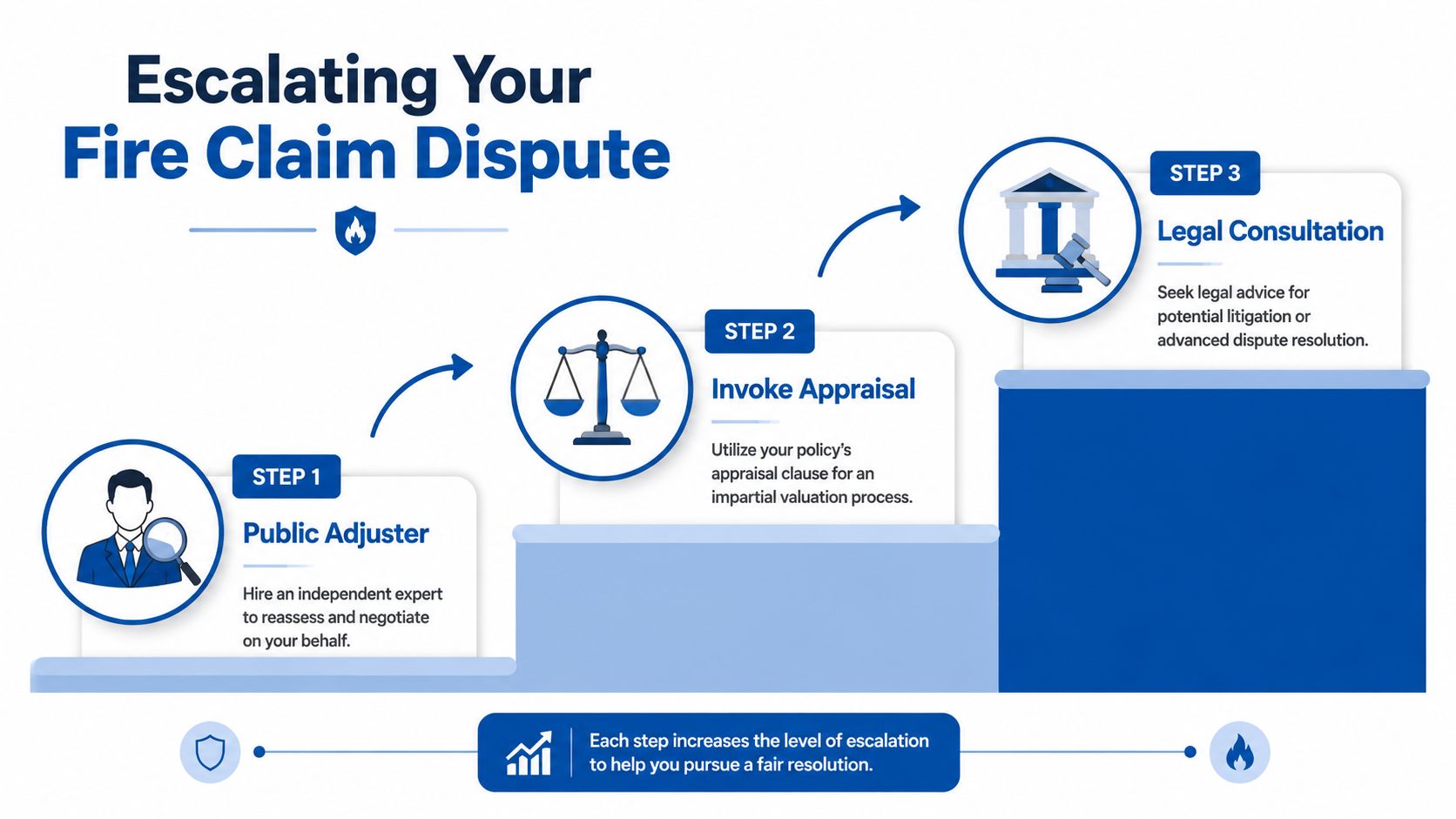
A fair settlement dispute usually escalates in one of three directions. Each path has a different job.
Three ways to break a deadlock
Public adjuster.
A public adjuster represents the policyholder, documents the loss, prepares the estimate, and negotiates with the carrier. This option makes sense when the dispute is about scope, valuation, hidden damage, depreciation, or overall underpayment. If you want a plain-English explanation of the role, start with this page on what a public adjuster does.
Appraisal.
This is a policy-based process usually used for valuation fights, not broad coverage fights. Each side selects an appraiser, and the process moves toward a number. Appraisal can be useful when coverage is accepted but the amount is still far apart. It is less useful when the insurer is denying categories of damage outright.
Attorney.
Bring in counsel when the case moves beyond disagreement and into serious claim handling misconduct, coverage denial, or a legal interpretation dispute. Lawyers are also critical when deadlines, bad-faith issues, or formal litigation become realistic.
Here's a simple comparison:
| Option | Best for | Main strength | Main limitation |
|---|---|---|---|
| Public adjuster | Underpayment and scope disputes | Builds and negotiates the claim | Not a law firm |
| Appraisal | Amount-of-loss disputes | Forces valuation process forward | Usually narrow in scope |
| Attorney | Coverage and bad-faith disputes | Legal leverage | Higher escalation, often slower |
When expert help changes the outcome
A key issue in fire claims is how the insurer values a partial loss. Some carriers act like market value can justify a smaller payment. That position can badly underpay a homeowner whose house is repairable but expensive to restore correctly.
A California appellate ruling discussed by United Policyholders is important because it affirmed that for partial fire losses, insurers must pay the actual cost of repair, rejecting a lower fair-market-value approach in the cited case. That matters because many homeowners don't realize the insurer's valuation method can be wrong even before the numbers are argued.
If you're staring at a low estimate, a denial of hidden damage, or an adjuster who keeps changing, expert help can stop the drift. A licensed public adjuster can re-scope the loss, assemble the support, and deal directly with the carrier. For homeowners in North Carolina and Virginia, For The Public Adjusters, Inc. is one such option for fire claim documentation, estimate preparation, and negotiation on behalf of policyholders.
When they control the estimate, they control the conversation. Expert representation takes that control back.
Don't wait until you're exhausted and boxed in. Escalation works better when the record is still fresh and the claim hasn't hardened around a bad number.
Your Next Steps to Secure Your Settlement
You don't need to become an insurance expert overnight. You do need to stop treating the claim like a customer service issue. It's a financial dispute, and you need to approach it that way.
Start with the basics that drive outcomes. Secure the property. Preserve the evidence. Build a complete damage file. Get independent repair input. Challenge the estimate line by line. Refuse to let them collapse a complex fire loss into a quick, cheap payout.
If the house has smoke, soot, ash, odor, HVAC contamination, or water damage from firefighting efforts, don't let them narrow the claim to the burned area only. If the estimate leaves out real repair work, don't argue about fairness in general terms. Point to the exact missing items and make them answer for each one.
A fair insurance settlement for fire damage is not about being difficult. It's about being accurate. They owe for what the policy covers and what the damage requires. Not what fits neatly into a rushed inspection or a low first estimate.
You survived the fire. Now protect the claim with the same seriousness.
"After the fire, the insurance company's offer wouldn't have even covered half the rebuild. We were lost. Hiring For The Public Adjusters was the best decision we made. They found so much the company adjuster 'missed' and fought for every penny. We got a settlement that allowed us to rebuild our lives." – Review from a satisfied client.
Have your water damage claim questions answered at NO COST. Call 919-400-6440 to speak with a licensed Public Insurance Adjuster or Contact Us here with questions. WE Work For YOU… NOT Your Insurance Company!
If your fire claim has been delayed, low-balled, or pushed in circles, For The Public Adjusters, Inc. can help you document the loss, challenge the carrier's estimate, and pursue the full settlement owed under your policy.