
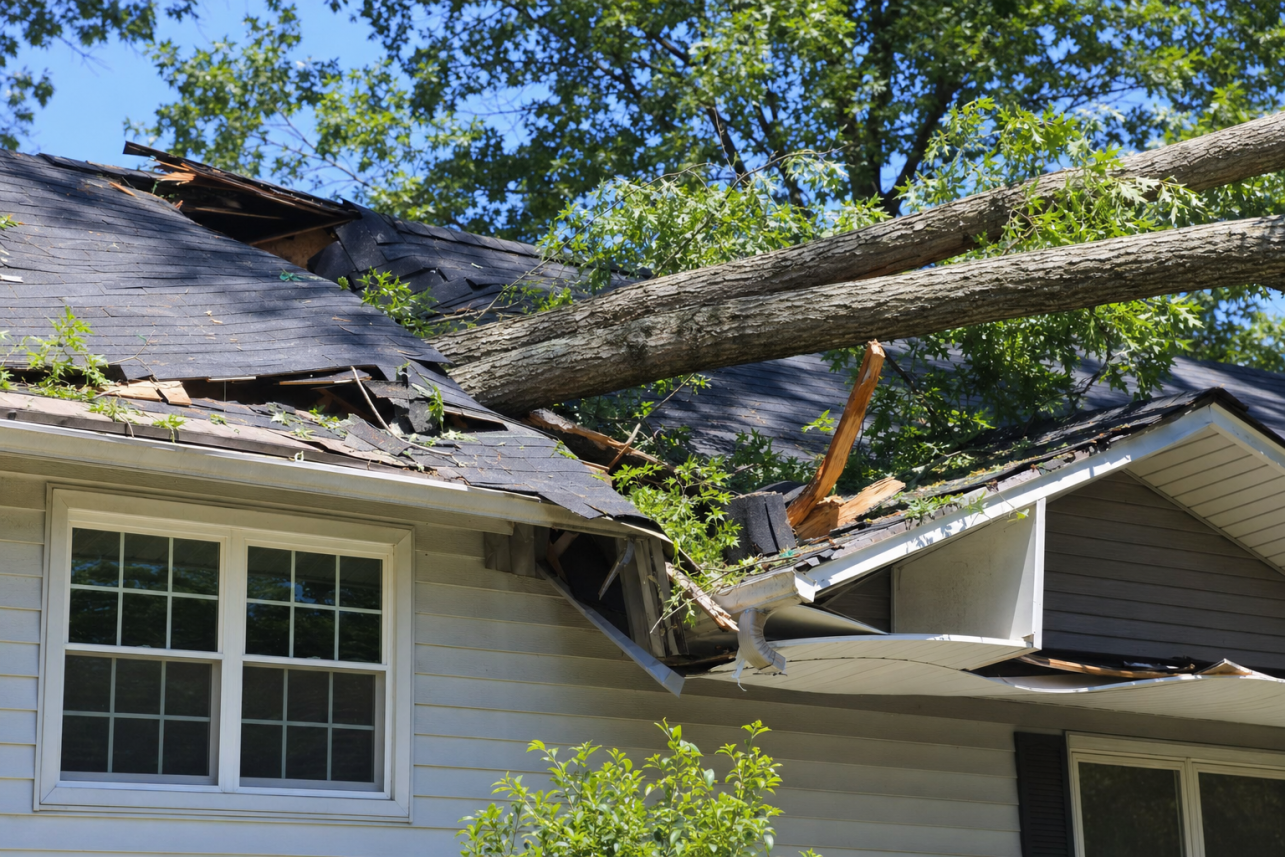
If a hurricane's remnants or a tornado damaged your home, a Wind Damage Claim Chapel Hill NC is a formal demand on your homeowners policy to pay for the roof, siding, interior, and contents that storm destroyed — and you have the right to hire your own licensed public adjuster to prepare and negotiate it. For The Public Adjusters, Inc. works only for the policyholder, never the insurance company. We document the damage, build the repair estimate, and negotiate with the carrier's adjuster so the settlement reflects what the storm actually did to your home.
What This Service Is
When tropical systems push inland across central North Carolina, or a spring tornado cuts through Orange County, homeowners are left dealing with torn shingles, lifted ridge caps, wind-driven rain inside walls and ceilings, and sometimes trees through the roof. Your insurance company sends its own adjuster to assess that damage — but that adjuster is paid by the carrier, not by you.
A public adjuster flips that arrangement. We are licensed by the state and bonded, and we represent you exclusively. We read your full policy, including your windstorm deductible and any coverage limits, inspect the property from the roof down, document every item of storm damage, prepare a detailed repair cost estimate, and negotiate directly with the insurance company on your behalf.
The North Carolina Department of Insurance explains in its NCDOI Public Adjusters Guide that public adjusters may only represent the insured, and that is exactly the point: someone on your side of the table who speaks the carrier's language. It is the same work our team performs on every Wind Damage Claim in Cary NC and across the Triangle — hurricane and tornado claims are what we do, alongside fire, water, and tree damage claims.
Common Problems
Why Is My Wind Damage Claim Chapel Hill NC Payout So Much Lower Than My Roofer's Estimate?
This is the most common call we get after a hurricane. The carrier's adjuster approves a partial repair — a few squares of shingles — while your roofer says the whole slope, or the whole roof, has to go. The gap usually comes from depreciation deductions, actual cash value versus replacement cost accounting, and estimates that quietly leave out items like underlayment, flashing, and interior water staining.
Matching is another quiet money-loser. If your shingles or siding are discontinued, a patch will never match, and courts have sided with homeowners on this. In Windridge of Naperville Condominium Association v. Philadelphia Indemnity Insurance Co., the federal appeals court ruled the insurer had to replace undamaged siding so the storm-damaged building would match — a win for the policyholder that reflects how matching disputes should be resolved.
We review every line of the carrier's estimate against the real scope of work. We cannot guarantee any particular outcome, but we make sure nothing the storm damaged gets left off the page.
The Insurance Company Says It's 'Wear And Tear' — Can They Deny My Storm Claim?
Carriers routinely argue that missing shingles were old, brittle, or poorly installed rather than torn off by a named storm or tornado. On homes built in the late '90s and early 2000s with builder-grade roofing — common in Chapel Hill's newer subdivisions — this argument comes up on almost every claim.
The answer is evidence. We tie your damage to a documented storm event, photograph the directional pattern wind leaves behind, and show how wind-driven rain entered through storm-created openings. The National Hurricane Center's records of tropical systems moving through the Carolinas help establish exactly when and how the weather hit.
Delays and silence are tactics too. A denied or stalled claim is not the end — many of the files we take over were first denied, including a Wind Damage Claim in Haw River NC matter that turned on proving the storm date. If you disagree with your carrier's position, you have options, and deadlines, so act quickly.
Should I Just Handle The Insurance Claim Myself, Or Hire A Wind Damage Public Adjuster?
You can file yourself, and for small, clean losses that may be fine. But a hurricane or tornado claim involves a structural inspection, a line-item repair estimate, policy interpretation, deductible math, and negotiation with a professional adjuster who handles claims every day. Most homeowners do this once or twice in a lifetime.
A good public adjuster earns their fee by finding covered damage the first inspection missed — wind-lifted shingles that look intact from the ground, saturated insulation, racked framing, damaged gutters and screens. We also handle supplemental claims when hidden damage surfaces during repairs.
Before hiring anyone, verify their license with the North Carolina Department of Insurance. We are licensed and bonded, we work on claims for homes, businesses, and contents only, and our interests are aligned with yours: we are paid from the recovery, not by the carrier.
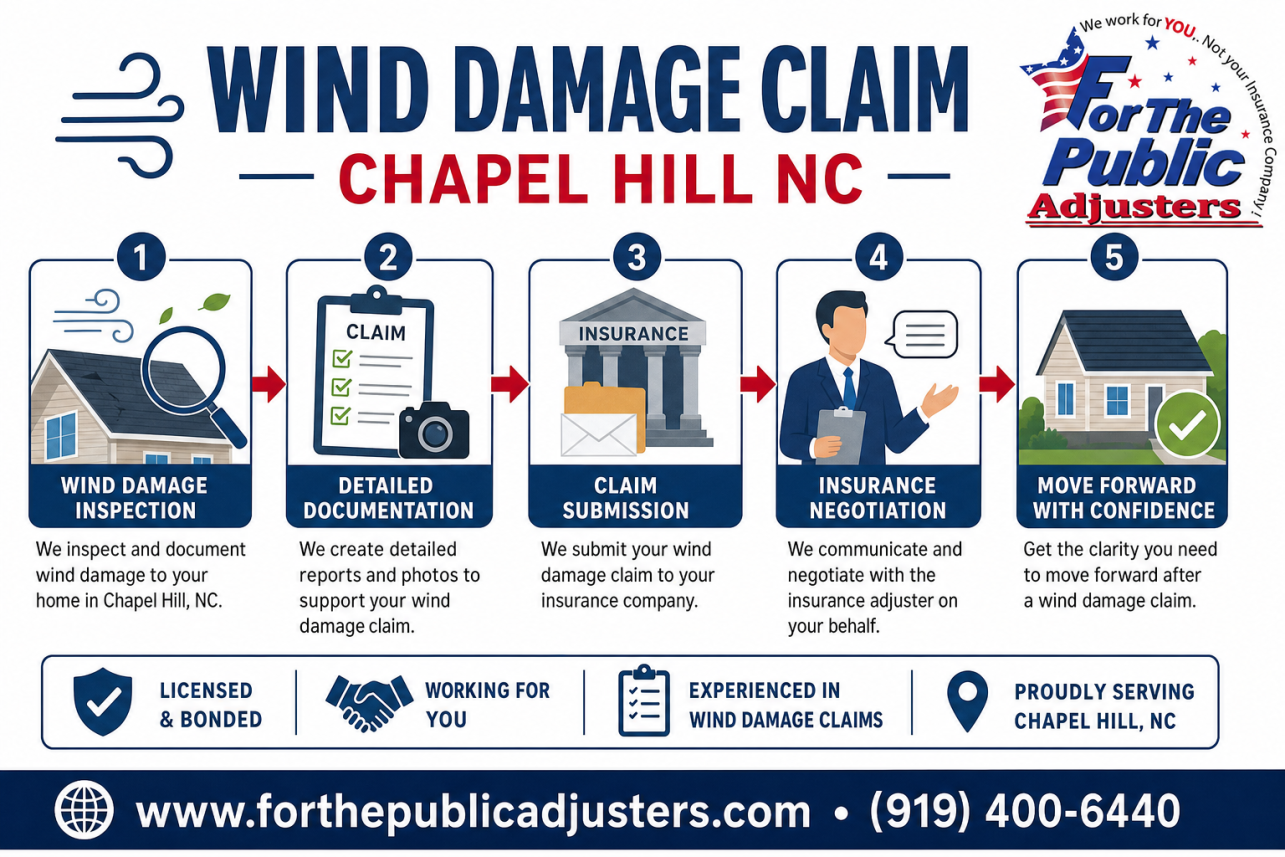
Our Process
Policy Review And Full Property Inspection
We start by reading your actual homeowners policy — coverage limits, your windstorm deductible if you have one, exclusions, and deadlines for filing. Then we inspect the whole property, not just the obvious damage: roof, attic, siding, gutters, interior ceilings and walls, fencing, outbuildings, and contents. Wind-driven rain damage inside wall cavities is one of the most commonly missed items, and we look for it specifically.
Documentation And The Repair Estimate
We photograph and measure everything, note storm dates and weather data, and build a line-item repair cost estimate using the same estimating standards insurance companies use. If emergency tarping or temporary repairs are needed to stop further damage, we document those costs too — your policy typically covers reasonable emergency protection. This file becomes the foundation of the claim, prepared the way our Public Adjuster Burlington NC office prepares every storm file.
Negotiation, Settlement, And Supplements
We present the claim to your carrier, meet their adjuster on site, and negotiate point by point — scope, pricing, depreciation, and matching. If the first offer is low, we push back with documentation rather than frustration. And if contractors open walls later and find more storm damage, we file the supplemental claim so hidden losses are not paid out of your own pocket. We never promise a specific dollar figure, because no honest adjuster can — we promise the claim will be fully built and firmly argued.
| What's Involved | Filing Alone | With For The Public Adjusters |
|---|---|---|
| Roof and property inspection | Carrier's adjuster scopes the damage — often from the ground or one slope | Independent slope-by-slope inspection with photos, moisture mapping, and storm data for your address |
| Estimate and scope of repairs | You accept the carrier's line items, which often omit flashing, matching, and code upgrades | Full line-item estimate including matching issues, ordinance-or-law items, and hidden interior damage |
| Negotiation | You negotiate against trained insurance adjusters yourself | A licensed, bonded Orange County adjuster negotiates on your behalf |
| Disputed or denied claims | Denial often ends the claim unless you hire a lawyer | Rebuttal reports, re-inspections, and the policy's appraisal clause put the claim back in play |
| Who the adjuster works for | The insurance company | You — the policyholder, exclusively |
Commonly Overlooked In The Public Adjusting Industry
- Creased but still-attached shingles — Wind can fold a shingle back and break its seal without tearing it off, so a quick visual inspection from the ground counts it as undamaged.
- Discontinued shingle lines and matching rights — Carriers scope a small repair without checking whether the shingle is still manufactured, leaving the owner with a patchwork roof that matching provisions may actually cover.
- Saturated attic insulation beyond the visible stain — Water spreads laterally through insulation, so the wet area is usually several times larger than the ceiling spot anyone can see.
- Displaced step and chimney flashing — Flashing shifted by hurricane gusts looks intact from the ground but leaks slowly for months, and it rarely appears on a carrier's first estimate.
- Ordinance-or-law code upgrade coverage — Orange County building code can require upgrades like updated decking or drip edge during repairs, and this coverage goes unclaimed when nobody asks for it.
- The policy's appraisal clause — Most policyholders don't know their contract includes a built-in dispute mechanism that can resolve a lowball offer without filing a lawsuit.
- Separating wind damage from flood damage — When surge or rising water accompanies a hurricane, mixing the two on one claim lets the carrier push wind losses onto the flood policy — or deny them outright — so each must be documented and filed separately through the correct carrier and, for flood, through the NFIP.
- Deadlines buried in the policy conditions — Proof-of-loss and suit-limitation deadlines keep running while an owner waits on contractors, and missing one can forfeit an otherwise valid claim.
Case Studies
Case Study #1
Situation: A homeowner in the Westwood neighborhood of Chapel Hill called us after the remnants of a hurricane tracked through Orange County with sustained tropical-storm-force gusts. Shingles were scattered across the yard and water was staining a bedroom ceiling.
Problem: The insurance carrier's adjuster spent twenty minutes on site, approved a repair for one slope of the roof, and offered roughly $4,800. The homeowner's roofer said a partial repair was impossible because the discontinued shingle could not be matched, and the interior water damage was barely addressed.
Investigation: We performed a full roof inspection with photo documentation of creased and uplifted shingles on all four slopes, pulled NOAA wind data for the storm date, and used a moisture meter to map hidden saturation in the attic insulation and bedroom drywall. We also reviewed the policy's matching and ordinance-or-law provisions.
Findings: Wind uplift had broken the sealant strips on shingles across every slope, not just the one the carrier scoped. The shingle line had been discontinued, triggering North Carolina's line-of-sight matching considerations. Attic insulation was wet well beyond the visible ceiling stain, and the chimney flashing had been displaced by the same gusts.
Solution: We prepared a line-item estimate covering full roof replacement, flashing, saturated insulation removal, interior drywall, paint, and code-required upgrades, then presented the documentation package and negotiated directly with the carrier's adjuster and their re-inspector.
Outcome: The claim settled for a full roof replacement plus interior repairs — a figure several times the original offer. The homeowner paid our fee out of the recovery and still came out far ahead of where the first check would have left her.
Lesson: A quick single-slope inspection after a hurricane rarely tells the whole story. Policyholders have real leverage when damage is documented slope by slope — North Carolina courts have long sided with insureds on property coverage disputes, as in Gaston County Dyeing Machine Co. v. Northfield Insurance Co., 351 N.C. 293 (2000), where the North Carolina Supreme Court ruled in favor of the insured on a disputed property damage claim.
Case Study #2
Situation: A small commercial building owner near Franklin Street contacted us after a tornado-warned storm cell moved across Orange County. A rooftop HVAC unit had shifted, the membrane roof was torn in several places, and tenants reported water intrusion in two suites.
Problem: The carrier's engineer attributed the membrane tears to 'wear and age' and the HVAC displacement to 'improper installation,' then denied the roof portion of the claim entirely. The owner was facing a six-figure repair bill and tenants threatening to break their leases.
Investigation: We commissioned an independent engineering review, obtained National Weather Service storm reports confirming rotation and measured gusts over the area that evening, and photographed directional debris patterns, lifted edge metal, and fresh tear patterns inconsistent with gradual deterioration.
Findings: The tear edges were clean and recent, the edge metal showed uplift consistent with tornadic wind vortices, and the HVAC curb bolts were sheared — not corroded. The carrier's engineer had never gotten on the roof; his report was based on ground-level photos.
Solution: We filed a detailed rebuttal with the independent engineering report, invoked the policy's appraisal clause when the carrier refused to move, and presented a complete estimate including the membrane system, insulation board, edge metal, HVAC reset, and interior tenant-space repairs.
Outcome: The appraisal panel awarded payment for full membrane replacement, the HVAC work, and the interior buildout repairs. The denial was effectively reversed, and the building stayed fully leased.
Lesson: A denial letter is an opinion, not a verdict. When a carrier's expert never leaves the ground, independent documentation and the appraisal process can change the outcome — and insureds who push back in court have won, as the policyholder did in Gaston County Dyeing Machine, where the North Carolina Supreme Court enforced coverage for the property damage over the carrier's objections.
| Situation | What It Usually Means | Smart Next Step |
|---|---|---|
| Shingles in the yard or driveway after tropical-storm gusts | Sealant strips have broken; adjacent shingles are likely creased even if still attached | Get a full roof inspection before accepting a per-shingle repair |
| Ceiling stain appeared days after the storm | Water entered through lifted shingles or flashing and soaked insulation before showing | Moisture-map the attic and ceiling; document before anything dries or is painted |
| Carrier offers a repair but your shingle is discontinued | Matching may be impossible; a partial repair can leave a mismatched roof | Raise North Carolina matching considerations before signing off on the estimate |
| Claim denied as 'wear and tear' after a confirmed tornado or hurricane | The carrier's conclusion may rest on a limited inspection | Obtain an independent engineering review and NWS storm reports for your address |
| Tree or large limb came through the roof deck | Structural members and decking may be cracked beyond the visible hole | Insist the scope include rafters, decking, and interior repairs, not just shingles |
| Settlement check feels low but you already deposited it | In most cases a claim can still be supplemented with new documentation | Have the scope reviewed; supplements are common on storm claims |
| Storm surge or rising water also entered the building | Flood damage falls under separate flood coverage, not the wind claim | Contact FEMA and your NFIP flood carrier for the water portion; keep wind damage documented separately |


Reviews
When Hurricane Fran's anniversary rolled around, I never thought I'd be dealing with storm damage of my own. Tropical storm gusts tore shingles off two slopes and my insurer offered a patch job. For The Public Adjusters documented every slope, proved the shingles couldn't be matched, and got my whole roof covered plus the ceiling repairs inside. Worth every penny of their fee.
Margaret T., Chapel Hill
A tornado-warned storm knocked a tree limb through my roof deck off Weaver Dairy Road. The carrier's first estimate missed the cracked rafters and soaked insulation entirely. These adjusters found all of it with a moisture meter and photos, rewrote the scope line by line, and the final settlement was more than triple the first offer. They handled every call with the insurance company so I didn't have to.
D. Okafor, Orange County
After hurricane remnants came through, my claim for roof and siding damage was denied as 'pre-existing wear.' I almost gave up. For The Public Adjusters pulled the weather data for my exact address, brought in an engineer, and pushed the claim into appraisal. The denial got reversed. They never promised a specific number, but they absolutely delivered a fair one.
James R., Chapel Hill
Frequently Asked Questions
How Does A Wind Damage Claim Chapel Hill NC Homeowner Files After A Hurricane Or Tornado Actually Work?
After a hurricane or tornado moves through Orange County, the process starts with documenting everything before cleanup begins. Photograph torn shingles, lifted ridge caps, broken windows, fallen trees on the structure, and any water intrusion that followed the wind opening. Keep damaged contents until they have been inventoried.
Next, your policy is reviewed in detail. Many Chapel Hill homeowners carry policies with separate wind or named-storm deductibles, often calculated as a percentage of the dwelling coverage rather than a flat dollar amount. Understanding which deductible applies to your storm can change the outcome of the settlement significantly.
For The Public Adjusters, Inc. then prepares an independent estimate of the hurricane or tornado damage, including items carriers frequently miss: matching requirements for roofing and siding, hidden moisture in attic decking, and code-upgrade costs under your ordinance-or-law coverage. We present that documentation to the insurance company and negotiate on your behalf as licensed and bonded public adjusters.
Policyholders should know the courts have backed insureds in these disputes. In Corban v. United Services Automobile Association, 20 So. 3d 601 (Miss. 2009), the Mississippi Supreme Court ruled for homeowners whose house was damaged by hurricane winds, holding that the insurer bears the burden of proving how much damage falls under an exclusion. That principle — that wind damage to a home is covered and the carrier must prove otherwise — is exactly why thorough documentation from the start matters so much.
My Chapel Hill Home Was Hit By Both Hurricane Wind And Flooding. Which Damage Does My Homeowners Policy Cover?
This is one of the most important distinctions in any Wind Damage Claim Chapel Hill NC property owners pursue after a tropical system. Standard homeowners policies cover damage caused by wind — torn roofing, structural damage from fallen trees, and rain that enters through a wind-created opening. They generally exclude rising water, which means flooding from creeks like Bolin Creek or Booker Creek overflowing is handled separately.
Flood damage is covered through the National Flood Insurance Program. If floodwater affected your home, you can learn about coverage and claims at FloodSmart.gov (the official NFIP site) and FEMA.gov. If you carry a flood policy, that claim runs on its own track with its own adjuster and deadlines.
The gray area is concurrent causation — when both wind and water contributed. Insurers sometimes attribute everything to flooding to minimize the covered portion. The courts have pushed back on this. In Corban v. USAA, the Mississippi Supreme Court held after Hurricane Katrina that the insured's wind damage remained covered and that the insurance company had to prove which losses were caused by excluded flooding, not the other way around.
Our role is to separate and document the wind-caused damage with evidence: roof inspections, water-line analysis, weather data, and engineering reports where needed. We handle the homeowners claim; we do not handle motor vehicle, health, or life insurance claims. While no one can promise a specific result, proper causation documentation gives your claim its strongest footing.
A Tornado Damaged My Roof And Part Of My House In Orange County. What Should I Do Before The Insurance Adjuster Arrives?
First, make temporary repairs to prevent further damage — tarp the roof, board broken windows — and keep every receipt. Your policy requires you to mitigate, and those emergency costs are typically reimbursable. Do not make permanent repairs or throw anything away before the damage is documented.
Second, photograph and video everything from multiple angles: the roof, interior ceilings, walls, insulation, and damaged contents. Tornado damage in the Chapel Hill area often extends beyond what is visible from the ground. Uplift forces can break the seal on shingles across the entire roof, loosen flashing, and rack framing even where nothing looks torn off.
Third, start a contents inventory. List damaged belongings room by room with approximate purchase dates and replacement costs. Contents are one of the most under-claimed categories after a tornado because homeowners focus on the structure.
Fourth, get your own representation before accepting the carrier's first estimate. The insurance company's adjuster works for the insurance company. A Chapel Hill public adjuster works only for you, and our fee structure means we are aligned with maximizing your documented, legitimate loss.
Finally, watch your deadlines. North Carolina policies contain proof-of-loss requirements and suit limitation periods, and tornado claims that drag on can bump into them. For The Public Adjusters, Inc. manages those deadlines, prepares the estimate, and negotiates with the carrier so you can focus on getting your home back in order.
What Does It Cost To Hire A Public Adjuster For Hurricane Or Tornado Damage In Chapel Hill, And Is It Worth It?
Public adjusters in North Carolina typically work on a contingency basis — a percentage of the claim settlement, agreed to in writing before any work begins. There is no hourly billing and no upfront retainer for a standard hurricane or tornado damage claim. If the claim recovers nothing, you owe nothing under a contingency agreement.
Whether it is worth it depends on the complexity of your loss. For a storm claim involving roof replacement questions, interior water intrusion, matching disputes over discontinued shingles or siding, code upgrades required by Orange County, and a significant contents inventory, professional representation frequently uncovers damage and coverage the carrier's estimate missed. We cannot and do not guarantee any particular recovery amount — no ethical adjuster can — but we do commit to a thorough, documented claim presented under the full terms of your policy.
For The Public Adjusters, Inc. is licensed and bonded, which North Carolina requires of anyone adjusting claims on behalf of policyholders. That licensing matters: it means we answer to the Department of Insurance, not just to you.
It also helps to remember that policyholders who stand their ground often prevail. In Corban v. USAA, homeowners took their hurricane damage dispute to the state's highest court and won a ruling that shifted the burden of proving exclusions onto the insurer. Most claims never need litigation — strong documentation and knowledgeable negotiation resolve them — but the case law shows what careful preparation of a wind claim can accomplish for an insured family.
How Long Do I Have To File A Wind Damage Claim Chapel Hill NC Policyholders Can Still Collect On After A Hurricane Or Tornado?
Most homeowners policies require "prompt" notice of loss, and in North Carolina the general statute of limitations for breach of an insurance contract is three years. However, waiting is risky. The longer wind-torn shingles, lifted flashing, or a tarp-covered roof sit exposed to Orange County weather, the easier it becomes for the insurer to argue that part of the damage came from neglect rather than the storm itself.
Our recommendation is to report hurricane or tornado damage within days of the event, then take your time building the claim properly. Reporting the loss and settling the loss are two different things. You can open the file quickly while still documenting roofing, siding, gutters, interior water intrusion, and contents damage thoroughly before accepting any payment.
If a storm hit months ago and you are only now noticing interior staining or shingle loss, you may still have a valid claim. Hidden wind damage is common because hurricane-force gusts can break shingle seals without tearing shingles off. A licensed and bonded public adjusting team can inspect, document the date of loss evidence, and present the claim in a way that ties the damage back to the specific storm event.
The Insurer Only Wants To Patch A Few Shingles After A Tornado Hit My Chapel Hill Roof. Can They Do That?
This is one of the most common disputes we handle for Chapel Hill homeowners after tornado and hurricane losses. The carrier offers to replace a slope or a handful of shingles, even though the remaining materials are discontinued or visibly mismatched, leaving your home looking patched together.
Courts have sided with policyholders on this exact issue. In Accardi v. Hartford Insurance Co. of the Midwest (N.J. Super. Ct. App. Div. 2017), the court ruled in favor of the insured, finding that where storm-damaged siding could not be matched, the policy required replacement sufficient to provide a reasonably uniform appearance — not a visibly mismatched patch job. While that case arose in another state, it reflects the matching argument adjusters raise nationwide, and it is a powerful reference point in negotiations.
In practice, we document the discontinued shingle line, obtain manufacturer or ITEL verification, and show that a partial repair cannot restore the roof to its pre-loss condition. Many tornado claims in Orange County that start as a two-square repair estimate end up properly scoped as full slope or full roof replacements once this evidence is on the table. We never promise a specific outcome, but we make sure the carrier sees the full, documented loss.
My Hurricane Claim Was Denied Or Underpaid. What Are My Options In Chapel Hill?
A denial or low payment is the carrier's opening position, not the final word on your Wind Damage Claim Chapel Hill NC homeowners still have real leverage after that letter arrives. North Carolina policies give you the right to submit supplemental documentation, demand a re-inspection, and in most cases invoke the appraisal clause, which brings in independent appraisers to resolve the dispute over the amount of loss.
The first step is understanding why the claim was shorted. Common reasons after hurricanes include the adjuster attributing shingle damage to "wear and tear," missing interior water damage behind walls, or applying the wrong deductible. If your loss involved both wind and rising water, remember that flood is a separate peril handled through the National Flood Insurance Program — resources at FEMA.gov and FloodSmart.gov explain NFIP coverage, while your homeowners policy responds to the wind-driven portion.
As licensed and bonded public adjusters, we re-inspect the property, build a line-item estimate of the full scope, and negotiate directly with the carrier on your behalf. Many denials collapse once the evidence is properly presented. We cannot guarantee a specific recovery — no honest adjuster can — but we can make sure your loss is documented and argued the way the policy actually requires.
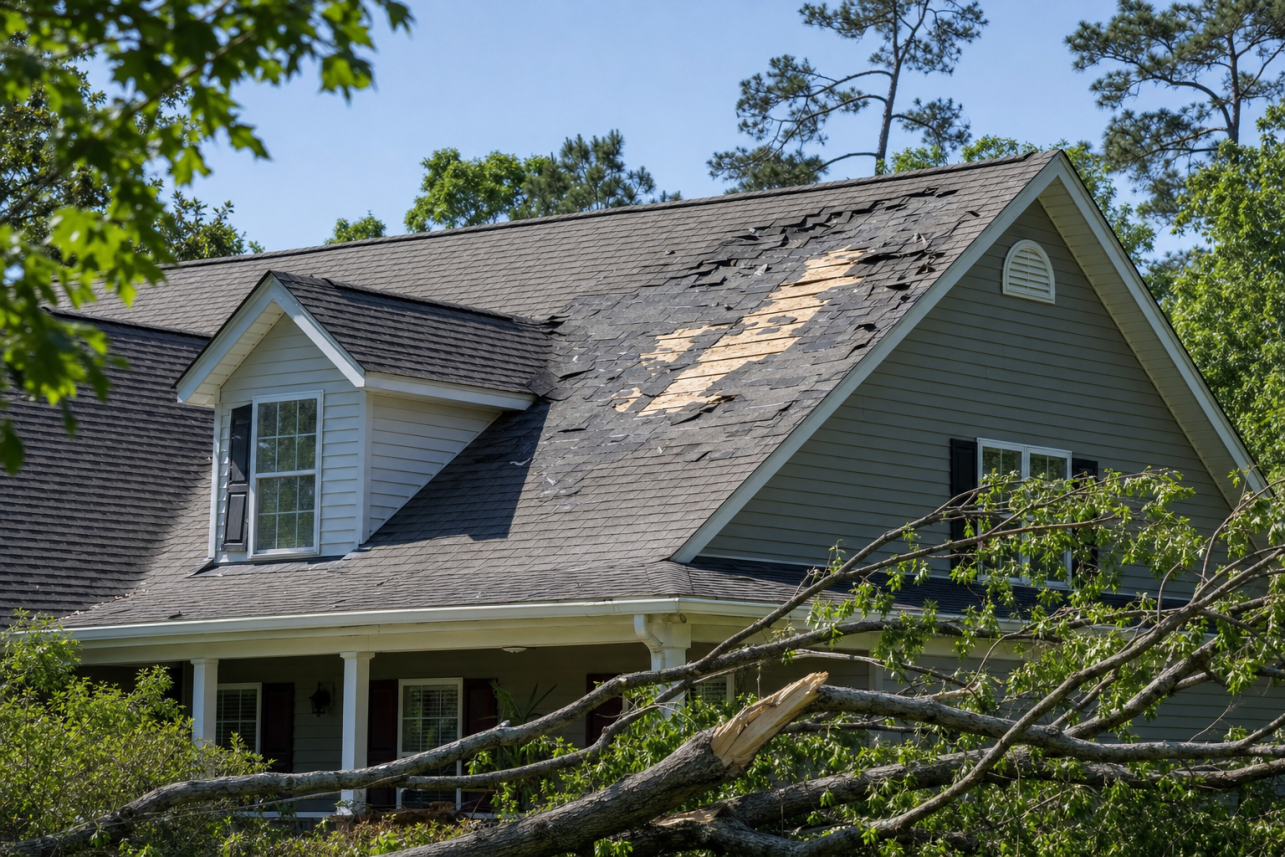
A Hurricane Dropped Trees On My Orange County Home. What Does My Policy Typically Cover, And What Gets Missed?
When hurricane winds drop a tree on your house, detached garage, or fence in the Chapel Hill area, your homeowners policy generally covers the structural damage, the cost to remove the tree from the covered structure, and resulting interior damage from rain entering through the opening. Contents crushed or soaked inside the home are typically covered too, subject to your policy limits.
What gets missed is usually below the surface. Tree impacts transfer force through rafters, trusses, and wall framing, and insurers often scope only the visible hole. We regularly find cracked rafters, shifted ridge lines, separated drywall seams, and racked framing several feet from the point of impact. Water that entered during the storm can also travel inside wall cavities, creating damage that does not show for weeks.
Debris removal limits are another trap. Policies often cap tree removal at a set dollar amount per tree or per occurrence, so how the removal is documented and categorized matters. If part of the tree landed on a covered structure, the removal framework changes.
Before signing off on a quick settlement, have the full structure evaluated. Our team photographs, measures, and estimates the complete loss — framing, roofing, interior, and contents — so nothing uncovered during repairs comes out of your pocket later.
What Exactly Does A Public Adjuster Do On A Wind Damage Claim Chapel Hill NC Homeowners File After A Hurricane Or Tornado?
A public adjuster works for you, not the insurance company. After a hurricane or tornado tears through Chapel Hill, we read your full policy, document every bit of damage, prepare a detailed line-item estimate, and negotiate directly with the insurer's adjuster on your behalf.
The insurance company's adjuster is paid by the carrier. Our team at For The Public Adjusters, Inc. is licensed and bonded in North Carolina and represents only the policyholder. We measure roof slopes, photograph interior water intrusion, inventory damaged contents, and track code-upgrade costs that Orange County building requirements may trigger during repairs.
That level of documentation matters because policy language is often disputed. North Carolina courts have long held that ambiguous policy terms are construed in favor of the insured. In Gaston County Dyeing Machine Co. v. Northfield Insurance Co., 351 N.C. 293 (2000), the North Carolina Supreme Court ruled for the insured in a property damage dispute, holding that where policy language is reasonably susceptible to more than one interpretation, the reading favoring coverage controls. We lean on principles like that when carriers try to narrow what a hurricane or tornado actually damaged.
We handle the paperwork, the deadlines, the proof-of-loss forms, and the back-and-forth meetings at your property. You stay informed at every step, but you are no longer negotiating alone against a trained company adjuster. While no one can promise a specific dollar outcome, professional representation ensures your claim is presented completely and accurately.
How Do You Find Hurricane Or Tornado Damage That The Insurance Company's Adjuster Missed On My Chapel Hill Home?
Wind damage from hurricanes and tornadoes is frequently hidden, and a quick walk-around inspection misses much of it. Our inspections in Chapel Hill and the surrounding Orange County area go well beyond counting lifted shingles.
On the roof, we check for creased or unsealed shingles that look intact from the ground but have lost their wind seal — a failure point that leads to leaks months later. We examine flashing, ridge vents, gutters, and soffits, where tornado-force uplift often does quiet structural harm.
Inside, we look for water staining in attics, wet insulation, and moisture trapped behind walls after wind-driven rain enters through compromised roofing or siding. We also inspect fencing, outbuildings, screened porches, and HVAC units, which carriers' adjusters commonly overlook or undervalue after a storm.
Chapel Hill's mature tree canopy adds another layer. Limbs striking a roof can fracture decking beneath shingles that appear fine, so we probe for soft spots and document them with photos the carrier cannot ignore.
Finally, we compare everything against your policy. Many homeowners don't realize their coverage may include debris removal, additional living expenses if the home is unlivable, and ordinance-or-law coverage for required code upgrades. If flooding accompanied the storm, that falls under separate flood coverage — resources at FEMA.gov and the National Flood Insurance Program (floodsmart.gov) explain those claims, which follow different rules than your homeowners policy.
A thorough inspection is often the difference between a patch job and a properly repaired home.
I Already Received A Settlement Check For My Tornado Damage. Is It Too Late To Get Help, And Can The Claim Be Reopened?
In most cases, no — receiving a check does not automatically close the door. Many Chapel Hill homeowners cash a first payment, start repairs, and only then discover the contractor's real estimate far exceeds what the insurer paid. That is one of the most common situations we handle.
Under most North Carolina homeowners policies, a claim can be supplemented when additional covered damage is found or when the original estimate used inadequate pricing. After a hurricane or tornado, carriers often rely on regional pricing software that doesn't reflect actual Orange County labor and material costs, especially when storms create a surge in demand for roofers and framers.
We review what the insurance company paid line by line, inspect the property for damage the first adjuster missed, and submit a documented supplement. A Wind Damage Claim Chapel Hill NC residents assumed was finished can frequently be reopened within the policy's time limits, so acting promptly matters — don't wait years, and keep all receipts and photos of discovered damage.
North Carolina law supports policyholders who push back. In Gaston County Dyeing Machine Co. v. Northfield Insurance Co., the state Supreme Court sided with the insured in a property damage coverage dispute, confirming that ambiguities in the policy must be read in the policyholder's favor.
One caution: if you signed a full release or accepted a settlement marked as final, options narrow, so bring us the paperwork before signing anything further. We'll review it at no obligation and tell you honestly where the claim stands.
Which Deductible Applies To Hurricane Or Tornado Wind Damage In Chapel Hill — My Regular Deductible Or Something Higher?
It depends on how your policy is written, and this catches many Orange County homeowners off guard. North Carolina policies often include a separate wind-and-hail or named-storm deductible, usually expressed as a percentage of your dwelling coverage rather than a flat dollar amount.
Here's the practical difference. If your home is insured for $450,000 and your policy carries a 2% named-storm deductible, you absorb the first $9,000 of hurricane damage — far more than a standard $1,000 deductible. Tornado damage, however, may fall under the regular wind-and-hail deductible or even the standard all-perils deductible, depending on whether the storm was part of a named hurricane event.
When the deductible applies is also contested. Carriers sometimes apply the higher named-storm deductible to damage that actually occurred outside the declared storm window, or that stemmed from a tornado the National Weather Service never tied to a named system. We pull storm data, NWS reports, and declaration dates to make sure the correct, lower deductible is applied when the facts support it.
Policy ambiguity works in your favor here. North Carolina courts construe unclear deductible and coverage language against the insurer that drafted it, as the state Supreme Court did for the insured in Gaston County Dyeing Machine Co. v. Northfield Insurance Co.
Before accepting the carrier's deductible calculation on a wind claim in Chapel Hill, have the declarations page and endorsements reviewed. We do that as part of every hurricane and tornado claim we handle, because the wrong deductible can quietly take thousands off your settlement.
How Long Does A Wind Damage Claim Chapel Hill NC Homeowners File After A Hurricane Or Tornado Usually Take To Settle?
Timelines vary with the severity of the storm and how the insurer responds. A straightforward tornado roof claim in Chapel Hill might resolve in 30 to 60 days, while a hurricane claim with structural damage, interior water intrusion, and contents losses can run three to six months or longer.
North Carolina regulations require insurers to acknowledge claims promptly and act in good faith, but after a major hurricane, carriers are often stretched thin across the Triangle and the coast. That is when files sit, inspections get rushed, and estimates come back incomplete.
Several things slow claims down: disputes over the scope of damage, missing documentation, back-and-forth over whether damaged materials can be matched, and supplemental damage discovered during repairs. Each of these can add weeks if the paperwork is not handled correctly the first time.
When For The Public Adjusters, Inc. manages the process, we front-load the claim with a detailed inspection, photographs, measurements, and a line-item estimate before the carrier's adjuster ever arrives. That reduces the number of disputes and keeps the file moving. We are licensed and bonded in North Carolina and handle all communication with the insurer so deadlines do not slip.
No one can promise a specific settlement date or amount — anyone who does should raise a red flag. What a well-prepared file does is remove the delays that come from an insurer saying the documentation is insufficient. In our experience, thorough preparation up front is the single biggest factor in how quickly an Orange County claim closes.
What Hidden Damage Should Chapel Hill Homeowners Look For After A Hurricane Or Tornado, Beyond The Obvious Roof Damage?
Hurricane and tornado winds cause far more than missing shingles, and the hidden damage is where Chapel Hill claims most often get underpaid. Wind uplift can break the seal on shingles that still look attached from the ground, leaving the roof vulnerable to leaks months later. That damage rarely shows up in a quick ladder inspection.
Inside the attic, look for daylight through decking, lifted nails, and water staining on insulation. Wind-driven rain frequently enters around flashing, ridge vents, and gable vents during a hurricane, soaking insulation and framing before any ceiling stain appears.
On the exterior, check siding for creases and cracks, window seals for wind-pressure failure, gutters pulled from fascia, and fencing racked out of plumb. Tornado-strength gusts moving through the wooded neighborhoods off Weaver Dairy Road or Mt. Carmel Church Road also twist chimneys and shift porch posts — damage that affects the structure but is easy to miss.
Document everything with dated photos, even items that seem minor. Small overlooked items add up, and supplemental claims are harder to win than items included from the start.
One note on water: if rising water or surface flooding entered your home along Bolin Creek or Morgan Creek, that falls under flood insurance rather than your homeowners policy. FEMA and the National Flood Insurance Program (NFIP) at floodsmart.gov are the right resources for flood-specific losses. Our team focuses on the wind and wind-driven rain portion of the loss, and we distinguish the two carefully so your claim is positioned correctly.
Does North Carolina Law Actually Side With Homeowners When Insurers Dispute Hurricane Or Tornado Damage Coverage?
North Carolina courts have repeatedly held that when policy language is ambiguous, it must be interpreted in favor of the policyholder — a principle that matters enormously in storm claims where insurers argue over what is and is not covered.
A leading example is Gaston County Dyeing Machine Co. v. Northfield Insurance Co., decided by the North Carolina Supreme Court in 2000. The insurer tried to deny coverage for property damage by leaning on its own reading of the policy. The Court ruled for the insured, holding that ambiguous policy provisions are construed against the insurance company that drafted them. That precedent protects Chapel Hill homeowners when a carrier stretches an exclusion to avoid paying for hurricane or tornado damage.
North Carolina also has an Unfair Claim Settlement Practices statute, N.C.G.S. § 58-63-15, which prohibits insurers from misrepresenting policy provisions, failing to promptly investigate, or offering substantially less than a claim is reasonably worth. Violations can expose a carrier to significant liability.
What does this mean practically? When an insurer tells you wind-driven rain is not covered, or that your tornado-damaged roof only merits a patch, those positions are often negotiable — and sometimes legally wrong. A public adjuster in Chapel Hill who knows this case law can push back with documentation and policy analysis rather than just accepting the first answer.
For The Public Adjusters, Inc. prepares claims with these legal standards in mind. We cannot guarantee any outcome, but we make sure the carrier knows the file is built to withstand scrutiny, which changes the tone of negotiations considerably.
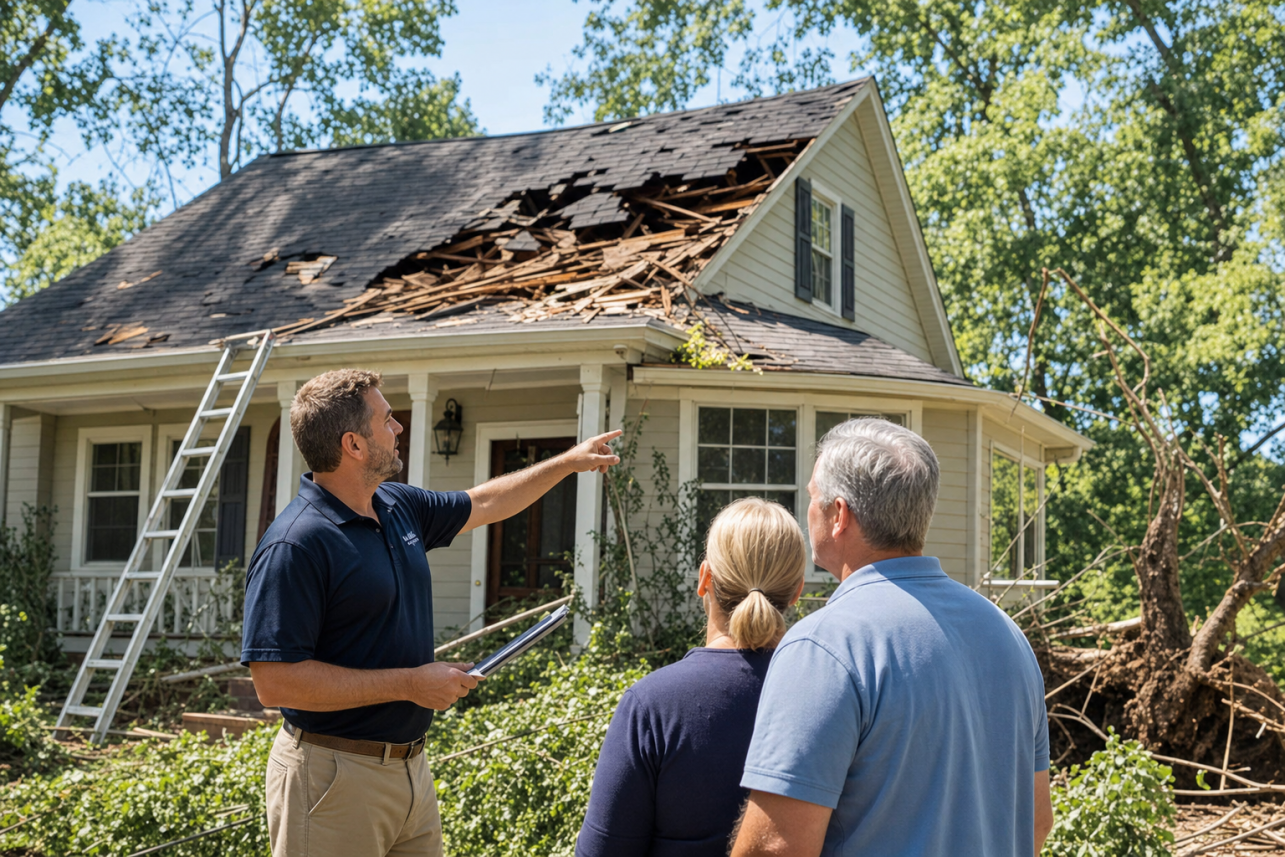
Should I Handle A Wind Damage Claim Chapel Hill NC Policyholders Face Alone, Or Bring In A Public Adjuster From Day One?
You are legally entitled to handle your own claim, and for very small, undisputed losses that may be fine. But involving a public adjuster from the beginning of a Wind Damage Claim Chapel Hill NC homeowners file after a hurricane or tornado almost always produces a better-documented file — and the early days are when the most important decisions get made.
Here is why timing matters. The initial scope of damage set by the carrier's adjuster becomes the baseline for everything that follows. If that first inspection misses broken shingle seals, saturated insulation, or racked framing, you spend the rest of the claim fighting uphill with supplements. Starting with a complete, independent damage assessment avoids that trap.
Early involvement also protects you from common mistakes: discarding damaged contents before they are documented, giving recorded statements that get used against you, signing contractor agreements with assignment-of-benefits clauses, or accepting a quick check that closes the file before hidden damage surfaces.
Our team inspects the entire property — roof, attic, exterior, interior, and contents — and prepares a line-item estimate using the same software insurers use. We then attend the carrier's inspection, so their adjuster walks the property with someone who already knows where the damage is.
If you have already started the claim yourself, it is not too late. We regularly step into Orange County claims mid-stream, after a low offer or a stalled investigation. There is no fee to review your situation, and because we work on a percentage of the recovery, our interests stay aligned with yours throughout.
Local Relevance
Chapel Hill sits far enough inland that homeowners sometimes assume hurricanes are a coast problem. They are not. Weakening tropical systems regularly track across the Piedmont, dropping heavy rain and gusts strong enough to peel shingles, snap mature oaks and pines onto roofs, and drive rain into attics. Spring brings its own tornado and severe thunderstorm risk across Orange County.
The housing stock here cuts both ways. Older homes near town carry original roofing details and mature tree canopy — beautiful, but vulnerable to limb strikes and wind uplift. Newer subdivisions on the edges of town are reaching the age where carriers argue wear and tear instead of storm damage. Both situations reward careful documentation.
We work these claims throughout the Triangle, from a tornado-path roof loss here in Orange County to a Wind Damage Claim in Apex NC, and the pattern is the same: the homeowners who document early and push back with evidence recover more than the ones who accept the first estimate. If a fallen tree caused your loss, our tree damage claim service handles that scope as part of the same file.
Tornado and straight-line wind paths through Orange County tend to be remarkably narrow — one street can lose whole roof slopes while the next block shows nothing — so 'nobody else in my neighborhood filed a claim' means very little here. If your roof took damage, document it and have it assessed on its own merits, not your neighbors'.
Storm Damage To Your Chapel Hill Home? Talk To Your Own Adjuster First
Before you accept the insurance company's number, let a licensed, bonded public adjuster inspect the damage and read your policy. The consultation costs nothing, and you'll know exactly where your claim stands before you sign anything.
Call us: (919) 400-6440
Helpful Resources
- NCDOI Public Adjusters Guide
- Hurricane Center
- National Hurricane Center — Official tropical storm and hurricane tracking records
- North Carolina Department of Insurance — State regulator where public adjuster licenses can be verified
Serving Chapel Hill · Orange
Last updated: November 9, 2026