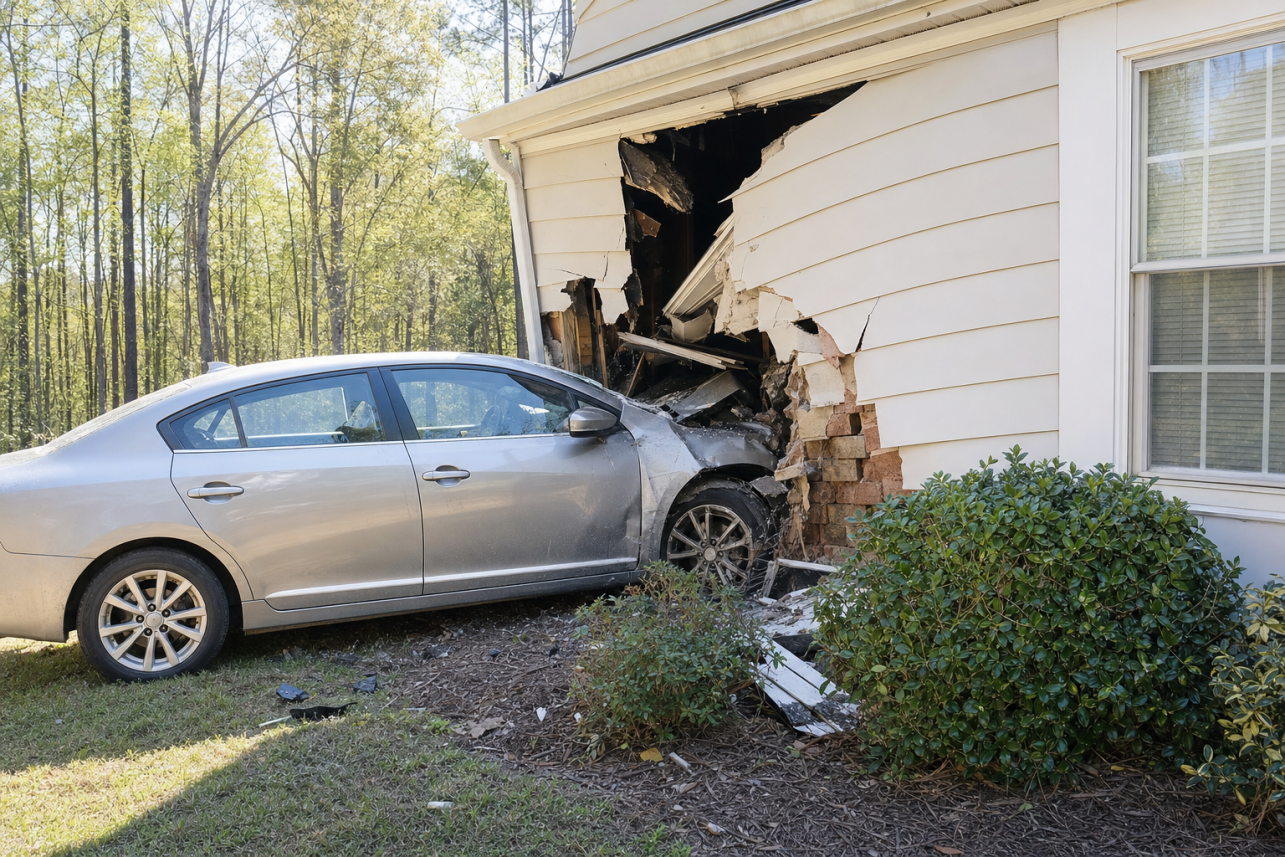
A Car Hits Home Claim Chapel Hill NC usually involves two insurance companies at once — the at-fault driver's liability carrier and your own homeowners policy — and that is exactly where payouts get shorted. For The Public Adjusters, Inc. is a licensed and bonded public adjusting firm that works only for the homeowner, documenting the full structural damage and negotiating directly with both insurers. You are not required to accept the first estimate either company hands you, and in our experience the first number rarely reflects the real cost of rebuilding a wall a vehicle just went through.
What This Service Is
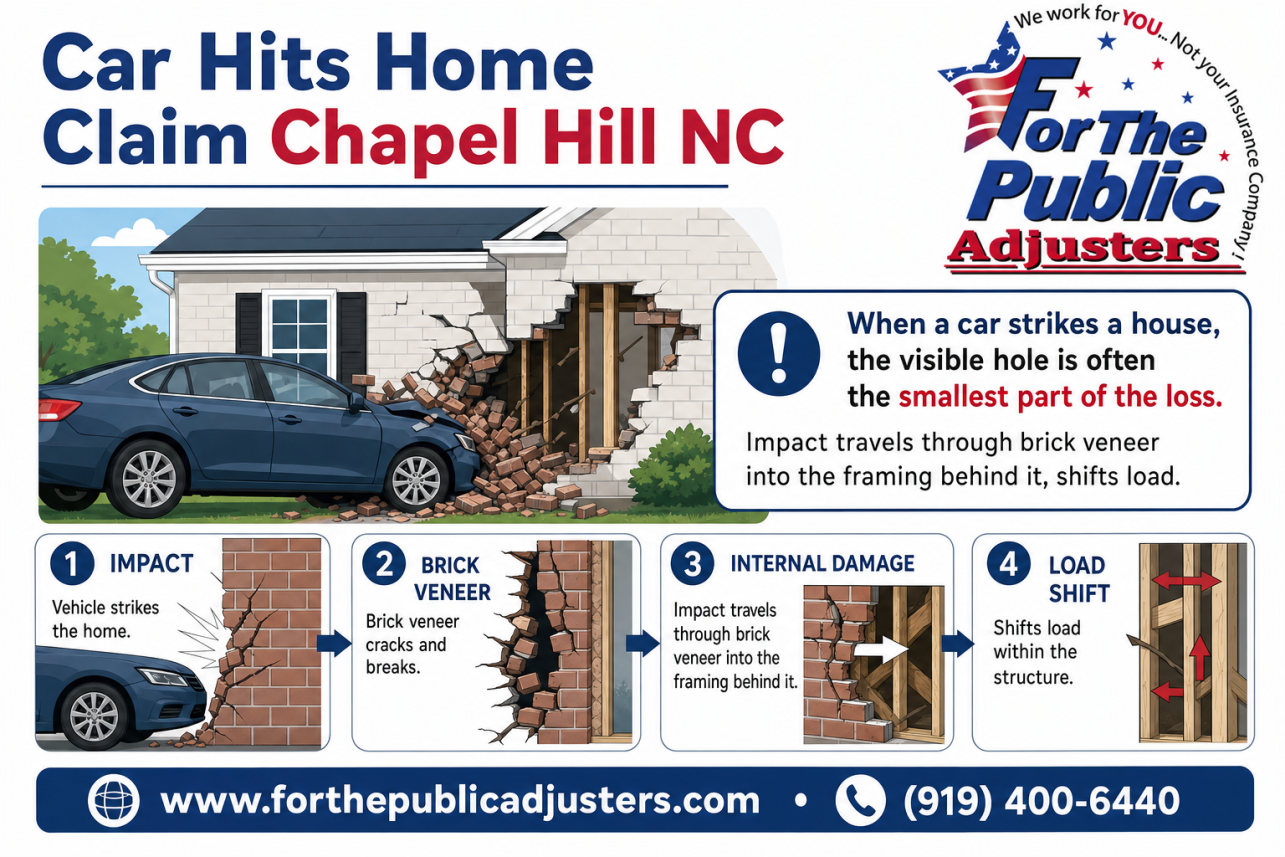
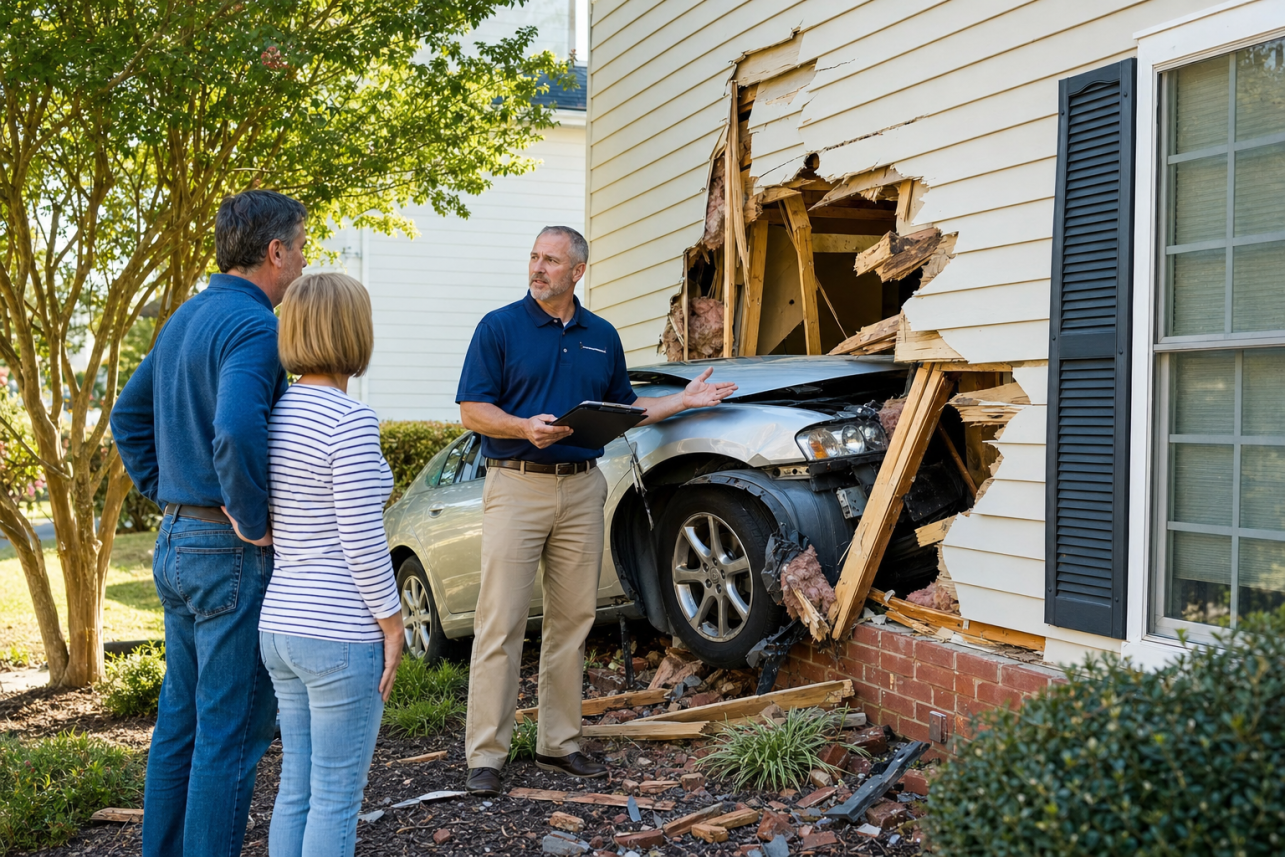
When a car strikes a house, the visible hole is often the smallest part of the loss. Impact travels through brick veneer into the framing behind it, shifts load-bearing walls, cracks foundations, and knocks plumbing and electrical out of alignment. A quick visual estimate from a carrier's adjuster frequently misses all of that.
Our job is to represent you, not the insurance company. We inspect and document the full scope of damage, bring in structural engineers when the framing or foundation is in question, prepare a detailed repair cost estimate, and then negotiate with the driver's liability insurer, your homeowners carrier, or both. We handle the same situation across the Triangle — including every Car Hits Home Insurance Claim in Durham we take on — so we know how these files actually get settled in this region.
We also account for the items homeowners forget to claim: emergency board-up and tarping, temporary housing if the home is unsafe to occupy, building code upgrades required during repairs, and damaged contents. The Insurance Information Institute notes that a standard homeowners policy covers vehicle impact to your dwelling — meaning your own carrier owes you a proper settlement even while fault is still being sorted out with the driver's insurer.
Common Problems
Will The Driver's Insurance Pay For Everything, Or Am I Stuck With The Bill?
This is the first question nearly every homeowner asks, and the honest answer is: not automatically. The at-fault driver's liability coverage has limits, and serious structural damage can exceed them quickly. If the driver was uninsured or fled the scene, your homeowners policy becomes the primary source of recovery.
Even then, carriers often pay actual cash value first — the depreciated worth of your old wall, roofline, or porch — and hold back the rest until repairs are done. Many homeowners never collect that held-back depreciation because nobody explained the process.
There is also the matching problem. If your brick or siding has been discontinued, a patch repair leaves your home looking mismatched. In Windridge of Naperville Condominium Association v. Philadelphia Indemnity Insurance Co., a federal appeals court sided with the policyholder and required the insurer to pay for replacing undamaged siding so the building matched as a whole. We use that same reasoning to push for repairs that restore your home properly, not just cheaply.
Car Hits Home Claim Chapel Hill NC: What If The Adjuster Stops Responding Or Low-Balls The Offer?
A home insurance adjuster not responding is one of the most common complaints we hear after a vehicle strike, because the file bounces between your carrier and the driver's carrier while each waits for the other to act. Meanwhile your wall is tarped and your family is displaced. Behind the scenes, your insurer may pursue the driver's company to recover what it pays you — a process called subrogation — but that is their fight, and it should never delay your settlement.
A home insurance adjuster low ball offer is the other pattern. The first estimate often prices a cosmetic patch: new drywall and paint over framing that an engineer would condemn. If you accept it, the shortfall comes out of your pocket.
When a claim stalls or comes back underpaid, we reopen the file with documented evidence — engineer reports, itemized line estimates, photographs — and negotiate from there. We recently applied this same approach on a Car Hits Home Claim in Raleigh NC, where the difference between the carrier's patch estimate and the real structural scope was substantial. Homeowners who feel stonewalled can also file a complaint with the state; the North Carolina Department of Insurance oversees how carriers handle claims and publishes the NCDOI Public Adjusters Guide explaining your right to hire your own representative.
Should I Handle This Myself, Or Hire A Public Adjuster?
You can file on your own, and for a minor scrape to a fence, you probably should. But a vehicle into a dwelling is a structural loss, and people searching for which home insurance company denies the most claims are usually asking the wrong question — almost any carrier will underpay a complicated claim that is poorly documented.
A good public adjuster does three things the insurance company's adjuster will not: works only for you, builds an independent repair estimate rather than accepting the carrier's numbers, and manages both insurers so nothing falls into the gap between them. Ask any adjuster you consider whether they are licensed and bonded in North Carolina — we are — and whether they have handled vehicle-impact losses specifically, because these claims mix liability determination with property damage in a way ordinary storm claims do not.
We never promise a specific dollar outcome; no honest adjuster can. What we can promise is a fully documented claim, pursued by professionals who do this every day, with fees that come from the settlement rather than out of your pocket up front.
Our Process
Emergency Documentation And Stabilization Review
We photograph and document everything before repairs disturb the scene: the point of impact, cracked foundation walls, shifted framing, and interior damage rooms away from the strike. We make sure emergency board-up and tarping costs are captured in the claim, and if the home is unsafe, we document the conditions that support an uninhabitable finding so your temporary housing costs are covered under loss of use.
Full Structural Assessment And Independent Estimate
Vehicle strikes hide damage behind finished surfaces, so we bring in structural engineers when load-bearing walls or foundations are in question. We then build a line-by-line repair estimate that includes code upgrade requirements, matching of discontinued materials, and contents damage. This is the same disciplined scope we build on every Car Hits Home Claim in Morrisville NC, because the estimate is the foundation of the entire negotiation.
Negotiation With Every Insurer Involved
We present the documented claim to your homeowners carrier and the at-fault driver's liability insurer, coordinate between them so neither delays the other, and respond to disputed line items with evidence rather than argument. If the carrier's contractor estimate conflicts with ours, we reconcile the scopes item by item. You review and approve the settlement before anything is final.
| Claim Task | Handling It Yourself | With For The Public Adjusters |
|---|---|---|
| Damage scope | Carrier's adjuster scopes visible damage — brick, siding, drywall | Full structural evaluation of footings, framing, load paths, and hidden systems behind the impact point |
| Who pays first | Often told to wait on the at-fault driver's auto insurer | Your homeowners policy is pressed to pay promptly; subrogation is the carriers' problem, not yours |
| Contents losses | Easy to forget furniture, electronics, and belongings crushed or damaged inside | Room-by-room contents inventory documented and valued before settlement |
| Code upgrades | Ordinance-and-law coverage frequently never mentioned | Code-required anchoring, bracing, and rebuild standards included in the estimate |
| Negotiation | You accept or argue the carrier's number alone | Line-item estimate, engineering support, and direct negotiation with the carrier's claims desk |
| Legal leverage | Most homeowners don't know coverage ambiguities favor the insured | We apply NC precedent — insureds have prevailed on disputed property coverage, as in Gaston County Dyeing Machine Co. v. Northfield Ins. Co., 351 N.C. 293 (2000) |
Commonly Overlooked In The Public Adjusting Industry
- Cracked footings and shifted sill plates below the impact wall — Field adjusters scope what they can see at eye level, and nobody crawls under the house to check where the impact energy actually landed.
- Ordinance-and-law coverage for code-required rebuild upgrades — Older Chapel Hill homes must be rebuilt to current anchoring and bracing codes, but carriers rarely volunteer that this coverage exists in the policy.
- Crushed ductwork, plumbing, and electrical runs inside the struck wall — These systems are hidden behind drywall and under slabs, so they get discovered mid-repair after the claim has already been settled too low.
- Racked framing two or three rooms away from the point of impact — Impact force travels through connected framing, and hairline drywall cracks in distant rooms are dismissed as pre-existing settling.
- Delay-related water intrusion through the breached wall — While carriers argue over liability, rain damages insulation, flooring, and finishes — losses that go unclaimed because they happened after the crash date.
- Contents damaged inside the impact room — Homeowners focus on the hole in the house and forget the furniture, electronics, and personal property that were crushed or showered with debris.
- The right to be paid first by your own homeowners policy — Most policyholders don't know their first-party contract owes prompt payment regardless of the at-fault driver, and carriers rarely correct that assumption.
- Matching requirements for brick, siding, and roofing at the repair zone — Patching one wall with non-matching brick or siding creates an obvious scar, and carriers often omit the cost of achieving a reasonably uniform appearance.
Case Studies
Case Study #1
Situation: A homeowner off Weaver Dairy Road in Chapel Hill called us after a pickup truck left the roadway at night and struck the corner of their brick ranch, punching through the garage wall and shifting the front porch columns.
Problem: The homeowner's insurance carrier sent a field adjuster who scoped only the visible brick damage and the garage door, offering a settlement that covered cosmetic masonry repair. The estimate ignored the foundation, the load path above the impact point, and the porch structure that had visibly racked.
Investigation: Our team brought in a structural engineer to evaluate the impact zone. We documented cracked footings below the struck wall, a displaced sill plate, sheared anchor bolts, and drywall cracking that telegraphed two rooms deep into the home. We also measured the porch columns, which were out of plumb by over an inch.
Findings: The engineer's report confirmed that the vehicle's impact energy transferred through the brick veneer into the structural wall and footing. Repairing the brick alone would have left the home structurally compromised. Code-required upgrades to anchoring and bracing added further legitimate costs the carrier's estimate never addressed.
Solution: We prepared a line-item estimate covering foundation repair, wall reconstruction, porch re-leveling, interior finishes, and ordinance-and-law coverage for code upgrades. We presented the engineering report alongside the policy language and negotiated directly with the carrier's large-loss desk.
Outcome: The claim was resettled at more than four times the carrier's original offer, and the homeowner was able to hire a licensed contractor to restore the structure correctly rather than patching brick over hidden damage.
Lesson: When a vehicle strikes a house, the visible hole is rarely the whole loss. Impact energy travels through framing and footings, and North Carolina courts have long held that ambiguous policy language is read in the insured's favor — the state Supreme Court reinforced that principle in Gaston County Dyeing Machine Co. v. Northfield Insurance Co., 351 N.C. 293 (2000), a property damage dispute the insured side ultimately won on coverage interpretation.
Case Study #2
Situation: A family near Southern Village came home to find a sedan had jumped the curb, crossed their front yard, and crashed into the living room wall. The driver's auto liability carrier and the family's own homeowners carrier were both involved, and each pointed at the other.
Problem: Weeks passed with no payment. The auto carrier delayed while it investigated its driver, and the homeowners carrier issued a low estimate and told the family to chase the at-fault driver's insurer for the rest. Meanwhile the wall was tarped, rain was intruding, and interior contents sat damaged.
Investigation: We reviewed both policies and established that the family's homeowners policy owed the loss promptly, regardless of the liability fight — the carriers could sort out subrogation between themselves. We then documented every element of the loss: structural framing, window units, HVAC line sets crushed at the exterior wall, hardwood flooring, and a damaged piano and furniture inside the impact room.
Findings: Our scope identified water intrusion damage that developed during the delay, crushed ductwork in the crawl space beneath the impact point, and contents losses the family hadn't thought to list. The homeowners carrier's original estimate had captured less than half of the actual repair cost.
Solution: We filed a complete, documented claim under the homeowners policy with a demand for prompt handling, itemized the contents inventory room by room, and insisted the carrier pursue the driver's insurer through subrogation rather than making the family wait.
Outcome: The homeowners carrier paid the full documented scope, including the delay-related water damage and additional living expenses while the living room was rebuilt. The family never had to litigate against the at-fault driver's insurer themselves.
Lesson: Your own homeowners policy is a first-party contract — you don't have to wait for the at-fault driver's carrier. Courts protect that right: in Gaston County Dyeing Machine Co. v. Northfield Insurance Co., 351 N.C. 293 (2000), North Carolina's highest court sided with the insured's reading of disputed coverage language in a physical damage claim, confirming that carriers can't lean on ambiguity to delay or deny what the contract promises.
| Your Situation | Best First Step | What It Depends On | Watch Out For |
|---|---|---|---|
| Driver is identified and insured | File with YOUR homeowners carrier and give it the driver's auto insurance info | Your policy pays first-party losses promptly; it can recover from the auto insurer later | Carriers telling you to wait for the auto insurer — you don't have to |
| Hit-and-run, driver unknown | File under your homeowners policy immediately and get a police report | Your dwelling coverage applies regardless of who drove | Missing the police report, which carriers often request for vehicle-impact losses |
| Your own car or a household member's car hit the house | Review your policy carefully before filing — some policies limit this scenario | Specific policy language on vehicles owned or operated by residents | Assuming coverage is identical to a stranger-driver impact; the wording matters |
| Wall or foundation visibly cracked | Get a structural engineer involved before accepting any estimate | Impact energy travels into footings, sills, and framing beyond the hole | Cosmetic-only estimates that patch brick over structural damage |
| Home is unsafe to occupy | Document everything, then invoke additional living expense coverage | Your policy's ALE/loss-of-use limits and the rebuild timeline | Paying hotel and meal costs out of pocket without tracking receipts |
| Gas, water, or electrical lines struck | Call utilities first, then document damage before emergency repairs | Safety comes first, but photos and invoices preserve the claim | Emergency contractors discarding damaged components before they're documented |
| Carrier's offer seems low | Request the full estimate in writing and have the scope independently reviewed | Whether hidden structural, mechanical, and code-upgrade items were included | Signing a release or cashing a final check before the true scope is known |
Reviews
A delivery van backed through our carport and into the kitchen wall. Our insurance company's adjuster wrote it up as siding and drywall repair. For The Public Adjusters brought out an engineer who found the wall studs and a section of the foundation were damaged. The final settlement covered a proper structural rebuild, not a cosmetic patch. I would never handle a vehicle-into-house claim alone again.
Marcus T., Chapel Hill
A car ran off Estes Drive and hit the corner of our house. Two insurance companies spent a month pointing fingers while we lived with plywood over the hole. This team got our homeowners carrier to step up and pay first, then let the insurers fight it out between themselves. They also caught crushed ductwork under the house that nobody else even looked for.
Deborah L., Carrboro
After a truck hit our garage, the first offer didn't even cover re-leveling the slab. For The Public Adjusters documented cracked footings, a shifted header, and code-required anchoring upgrades. The negotiation took a few weeks longer than I hoped, but the result paid for the repairs our contractor actually quoted. Honest, thorough, and they explained every step.
James R., Chapel Hill
Frequently Asked Questions
A Driver Just Crashed Into My House In Chapel Hill — What Should I Do First?
Your first priority is safety. Keep everyone away from the impact area, because a vehicle strike can compromise load-bearing walls, foundations, and gas or electrical lines even when the damage looks cosmetic. Call 911 so Chapel Hill Police document the incident and the fire department can check structural stability.
Get the police report number, the driver's name, and their auto liability insurance information before they leave the scene. Photograph everything: the vehicle position, skid marks, the breach in the wall, cracked brick veneer, shifted framing, and any damaged belongings inside.
Next, arrange emergency board-up and shoring. Your homeowners policy requires you to protect the property from further damage, and Orange County weather can turn a hole in your wall into a water-damage problem overnight. Keep every receipt — temporary repairs are typically reimbursable.
Then report the loss to your own homeowners carrier, even though the driver was at fault. Your policy usually responds first and faster, and your carrier can pursue the at-fault driver's insurer afterward through subrogation.
Finally, before you accept any carrier estimate, consider having the damage independently documented. Vehicle impacts frequently cause hidden structural movement that a quick visual inspection misses. As a licensed and bonded firm serving Chapel Hill and the rest of Orange County, For The Public Adjusters, Inc. evaluates the full scope of structural and contents damage to your home and prepares the claim on your behalf. We handle the property side only — the damage to the car itself is a separate matter between the driver and their auto insurer.
How Does A Car Hits Home Claim Chapel Hill NC Get Paid — My Homeowners Policy Or The Driver's Insurance?
In most cases, both policies come into play, and the order matters. Your homeowners policy typically responds first because it covers vehicle impact as a named peril, and it pays regardless of who was driving. The driver's auto liability coverage is the ultimate source of recovery, but liability claims move slowly and the at-fault carrier owes you nothing until fault and damages are established.
Filing under your homeowners policy first means repairs can start sooner. Your carrier then subrogates — it pursues the driver's insurer to recover what it paid, and in a successful subrogation your deductible is often recovered too.
The complication in Chapel Hill is valuation. Many homes here involve older masonry, custom millwork, or construction details that a standard carrier estimate undervalues. If your homeowners carrier writes a low scope, that low number can also anchor what the auto carrier eventually pays.
North Carolina courts have shown they will hold insurers to their coverage obligations when building damage is at stake. In Gaston County Dyeing Machine Co. v. Northfield Insurance Co., 351 N.C. 293 (2000), the North Carolina Supreme Court sided with the insured on how property damage must be treated under the policy language, rejecting the insurer's narrower reading. That principle — policy language is construed in the policyholder's favor when ambiguous — is a real tool in these disputes.
We prepare and negotiate the building and contents claim so the documented scope reflects the true cost of repair. We cannot guarantee any specific outcome, but a complete, defensible claim file puts you in the strongest position with both carriers.
What Damage Can Be Included When A Vehicle Strikes A Chapel Hill Home?
Far more than the visible hole in the wall, and this is where many claims fall short. A vehicle impact transfers force through the entire structure, so a thorough claim should account for every category of loss your policy covers.
Structural damage comes first: breached brick veneer or siding, cracked or shifted foundations, racked wall framing, damaged sill plates, and compromised headers or load paths. In Chapel Hill's older neighborhoods, matching original brick, stone, or trim profiles can significantly increase legitimate repair costs, and your claim should reflect that.
Secondary damage is often missed. Impact can rupture plumbing supply lines inside walls, sever electrical circuits, crack gas lines, and knock HVAC equipment or ductwork out of alignment. Cracked drywall and nail pops two rooms away from the impact point are common and compensable.
Contents coverage applies to furniture, electronics, and personal property destroyed or damaged in the strike. Document each item with photos, purchase information where available, and replacement pricing.
If the home is unsafe to occupy while structural repairs are made, your policy's additional living expense coverage can pay for comparable temporary housing, which matters in a tight rental market like Orange County's. Landscaping, fencing, retaining walls, and detached structures the vehicle damaged on the way in may be covered under other structures provisions.
Our role is to inspect, measure, and document all of it, then present a complete scope to the carrier. While no result can ever be promised, claims built on thorough documentation are consistently harder for an insurer to cut down.
Do I Really Need A Public Adjuster For A Vehicle-Into-House Claim, Or Can I Handle It Myself?
You can handle it yourself, and for a minor glancing blow with purely cosmetic damage, some homeowners do. The problem is that vehicle impacts are deceptive. The carrier's adjuster may scope visible damage — patch the brick, replace some drywall — while missing foundation displacement, racked framing, or plumbing damage that surfaces months later, after the claim is closed.
These claims also involve two insurance companies with competing interests. Your homeowners carrier wants to pay the minimum it can justify, and the at-fault driver's auto carrier benefits from that low number during subrogation. Nobody in that negotiation is advocating for the full cost of restoring your home except you.
A public adjuster works exclusively for the policyholder — never for the insurance company. For The Public Adjusters, Inc. is licensed and bonded in North Carolina, and on a Car Hits Home Claim Chapel Hill NC homeowners rely on us to inspect the structure, document hidden damage, inventory contents losses, interpret the policy, and negotiate directly with the carrier so you are not accepting a first offer written in a twenty-minute walkthrough.
One honest limitation: we handle the damage to your home, other structures, and belongings only. We do not handle motor vehicle, health, or life insurance claims, so the driver's wrecked car is between them and their auto insurer.
If you are unsure whether the carrier's estimate is adequate, a consultation costs nothing but time. Reviewing the scope before you cash a settlement check is far easier than reopening an underpaid claim afterward.
How Long Does A Car Hits Home Claim Chapel Hill NC Usually Take To Resolve?
Most vehicle-impact claims on Chapel Hill homes resolve in six to sixteen weeks, though structural losses with foundation or load-bearing damage can run longer. The timeline depends heavily on how quickly the scope of damage is documented and whether an engineer needs to evaluate the framing.
North Carolina requires insurers to handle claims promptly and in good faith, and the NC Department of Insurance can intervene when a carrier drags its feet without a valid reason. In practice, delays usually happen because the first estimate missed hidden damage behind brick veneer, under flooring, or inside wall cavities — which triggers rounds of supplements and reinspections.
Our team front-loads the work to avoid that cycle. We photograph and measure the impact zone, bring in structural engineers when the collision affects bearing walls or the foundation, and submit a complete, line-item scope before the carrier writes its first check. A thorough initial package tends to shorten the back-and-forth considerably.
One local factor worth knowing: many Chapel Hill and Carrboro-area homes, especially in older neighborhoods off Franklin Street and in established subdivisions around Orange County, have brick or masonry construction that can crack well beyond the visible point of impact. Rebuilding those sections to match existing materials takes time, and the claim should be scoped — and paid — to reflect that. We are licensed and bonded, and while no one can promise a specific outcome, a properly documented claim almost always moves faster than one built on the insurer's first walkthrough.
What If The Driver Who Hit My Chapel Hill House Fled The Scene Or Had No Insurance?
You are not stuck. A hit-and-run or an uninsured driver does not leave you without recovery, because your own homeowners policy covers vehicle impact as a standard peril. You file under your own coverage, pay your deductible, and your insurer may later pursue the driver through subrogation if that person is ever identified.
Start by calling Chapel Hill Police or the Orange County Sheriff and getting a report number — your carrier will want it, and it preserves your ability to recover the deductible if the driver is found. Photograph everything before any emergency board-up or shoring, including tire marks, debris, and paint transfer on the masonry.
From there, the claim works like any other structural loss on your home: the dwelling damage, attached structures like porches or garages, damaged contents inside the impact zone, landscaping and fencing up to policy limits, and additional living expenses if the house is unsafe to occupy. One important note — our firm handles damage to your home, building, and contents only. We do not handle motor vehicle claims, so if your own parked car was also struck, that portion goes through an auto carrier separately.
Where homeowners get shortchanged in these situations is scope. The insurer's adjuster sees a hole in the wall; a trained eye sees racked framing, shifted sill plates, cracked footings, and plumbing or electrical runs disturbed inside the wall. As your Chapel Hill public adjuster, we document all of it so the uninsured-driver angle never becomes an excuse for a thin payout.
Can Hidden Damage Show Up Weeks After A Vehicle Strikes A House, And Can The Claim Be Reopened?
Yes, and it happens often. The force of a vehicle hitting a home transfers through the structure well beyond the point of impact. Weeks later, homeowners notice doors that no longer latch, new drywall cracks radiating from corners, sloping floors, or separation where brick veneer meets window frames. These are classic signs the impact shifted framing or disturbed the foundation.
A Car Hits Home Claim Chapel Hill NC can and should be supplemented when this kind of delayed damage appears. In North Carolina, you generally have the right to submit additional documented damage after the initial payment, provided it relates to the original loss and you act within your policy's time limits — typically within the contractual period for filing suit, which is often shorter than the statute of limitations, so don't sit on it.
The key is causation. The carrier will ask whether the crack or settlement came from the collision or from ordinary aging. That is where engineering documentation made early in the process pays off: if the impact zone, load paths, and pre-existing conditions were recorded at the start, connecting new symptoms to the collision is far easier.
Our approach for homes in Chapel Hill and across Orange County is to anticipate this. We flag impact-adjacent framing, foundations, and masonry for monitoring in the original claim file, so a later supplement reads as a continuation of a documented injury to the structure — not a brand-new dispute. If you have already settled and new damage is surfacing, bring us the file; reopening is frequently possible when the evidence is handled correctly.

Have Homeowners Actually Won In Court When An Insurer Underpaid Structural Damage?
Yes — courts have repeatedly sided with policyholders when insurers tried to narrow coverage for damage to homes and buildings. A useful example is Sebo v. American Home Assurance Co., 208 So. 3d 694 (Fla. 2016), where a homeowner's residence suffered major damage from a combination of causes and the insurer argued it owed little because an excluded cause contributed to the loss. The Florida Supreme Court ruled for the insured, holding that when multiple perils combine to destroy property and at least one is covered, the loss can be covered under the concurrent causation doctrine.
Why does that matter when a car crashes into a house? Because these losses are rarely one-dimensional. The impact itself is covered, but it often triggers secondary damage — a ruptured supply line flooding the crawlspace, a breached wall letting rain into the interior, or framing failure that worsens over days. Carriers sometimes try to carve out the secondary damage or attribute cracking to pre-existing settlement. Case law like Sebo shows courts expect insurers to honor the covered cause rather than hunt for an excluded one.
Our job as public adjusters in Chapel Hill is to build the file so it never needs to reach a courtroom: engineering reports tying each element of damage to the collision, detailed repair scopes, and clear policy analysis. If flooding from a broken line or storm intrusion is involved, we also point homeowners to resources like FEMA and the NFIP for flood-specific questions. We are licensed and bonded, and while results depend on the facts and the policy, thorough documentation gives a homeowner the strongest possible position.
Will My Insurer Pay To Match New Brick Or Siding To The Rest Of My Chapel Hill Home After A Vehicle Strike?
Matching is one of the most disputed issues when a car crashes into a house. Insurers often want to patch only the hole in the wall, leaving you with a visible mismatch where new brick, siding, or stucco meets weathered material that has faded over decades. Many Chapel Hill homes, especially older brick ranches near Carrboro and the historic districts, use brick blends that simply are not manufactured anymore.
Policyholders have fought this battle and won. In Windridge of Naperville Condominium Association v. Philadelphia Indemnity Insurance Co. (7th Cir. 2019), the court sided with the insured property owner, ruling that when replacement panels could not reasonably match the undamaged siding, the insurer had to pay to replace siding on entire elevations — not just the damaged section. Courts recognized that a patchwork repair does not restore a building to its pre-loss condition.
As your Chapel Hill public adjuster, we document the existing materials, obtain discontinued-product confirmations from suppliers, and build the argument that a true repair must be uniform in appearance. We cannot promise a specific outcome on any claim, but we can make sure the matching issue is raised properly, supported with evidence, and not quietly written out of the insurer's estimate.
What Does It Cost To Hire For The Public Adjusters For A Car Hits Home Claim Chapel Hill NC?
A Car Hits Home Claim Chapel Hill NC handled by our firm works on a contingency basis — our fee is a percentage of the insurance settlement, and you pay nothing out of pocket up front. If the claim recovers nothing, you owe us nothing for our adjusting work. We are licensed and bonded in North Carolina, and our fee agreement is put in writing before we touch your file.
For most Chapel Hill homeowners, the math is straightforward. Vehicle-into-structure losses involve foundation walls, load-bearing framing, gas and plumbing lines, and code-upgrade costs that carrier estimates frequently miss. Our job is to scope every item of covered damage to the structure and your contents so the settlement reflects the real cost of repair in Orange County, where contractor pricing runs higher than state averages.
One important note: we represent you only on the property side of the loss. We do not handle claims involving motor vehicles themselves, so damage to the driver's car — or to your own car if it was struck in the garage — is outside our scope, and we can point you toward the right channel for that piece.
We never guarantee a specific dollar result, because no honest adjuster can. What we commit to is a thorough, professionally documented claim presented under the full terms of your policy, with you kept informed at every stage.
If My House Is Unsafe To Live In After The Crash, Will Insurance Cover A Hotel Or Rental In Chapel Hill?
In most cases, yes. Standard homeowners policies include Additional Living Expenses (ALE), sometimes called Loss of Use coverage. If a vehicle strike leaves your home uninhabitable — a breached exterior wall, compromised foundation, severed gas line, or a structure the Town of Chapel Hill posts as unsafe — ALE pays the reasonable increase in your living costs while repairs are made.
That can include a hotel near Franklin Street or I-40, a short-term rental in Orange County, restaurant meals above your normal grocery spending, pet boarding, laundry, and extra mileage if your temporary housing lengthens your commute. The key word is "increase": the carrier pays the difference between your normal costs and your displaced costs, so keep every receipt from day one.
Disputes usually arise over two things. First, insurers sometimes argue the home is habitable when a licensed engineer or the town's building inspector says otherwise — we obtain that documentation to support displacement. Second, carriers may try to cut off ALE before repairs are actually complete. Structural repairs after a vehicle impact often require engineering plans, permits, and inspections, and Chapel Hill's permitting timeline is part of the reasonable repair period.
As part of a car-into-home claim, we track your ALE as its own documented ledger, submit it alongside the structural claim, and push back when the carrier tries to end temporary housing prematurely. Check your declarations page for your ALE limit; it is typically a percentage of your dwelling coverage.
Will A Car Hits Home Claim Chapel Hill NC Raise My Homeowners Insurance Rates?
It is a fair worry, and the honest answer is: often less than homeowners fear, because this is a not-at-fault loss. When a driver crashes into your house, you did nothing to cause it, and your insurer typically has subrogation rights — meaning after paying your claim, the carrier pursues the at-fault driver's auto liability insurance to recover what it paid, including your deductible in many cases.
Successful subrogation matters. When your insurer recovers its payout from the driver's carrier, the loss has far less impact on your claims history than a fire or water loss you are deemed responsible for. North Carolina insurers also weigh claim frequency heavily; a single, well-documented, not-at-fault structural loss generally carries less rate pressure than multiple small claims.
That said, no public adjuster can promise your premium will not move, and we never make guarantees about rates or settlement amounts. What we can do is strengthen the subrogation picture. A claim backed by the Chapel Hill police report, the driver's insurance information, scene photographs, and a precise engineering-supported damage scope gives your carrier everything it needs to recover from the responsible party — which is the best protection your claims history can get.
One more point for Orange County homeowners: never skip a legitimate claim out of rate fear when structural damage is involved. Unrepaired foundation or framing damage can void future coverage for related losses and create far bigger costs than any premium adjustment.
What Evidence Should I Document Before Cleanup Or Emergency Repairs Begin At My Chapel Hill Home?
Before anyone boards up the wall or sweeps away debris, photograph and video everything from multiple angles. Capture the vehicle's resting position if it is still on site, the point of impact, cracked brick or siding, shifted framing, broken windows, and any interior damage like cracked drywall, doors that no longer close, or sloping floors.
Get the Chapel Hill Police or Orange County Sheriff's report number before the officers leave. That report documents the driver's identity and insurance information, which matters enormously for recovering your deductible later. Also collect names and phone numbers of any neighbors who witnessed the crash.
Keep every receipt. Emergency board-up, temporary fencing, tarping, debris removal, and even a locksmith if a door frame was destroyed are typically reimbursable expenses. Do not throw away damaged contents — furniture, electronics, or belongings crushed in the impact should be photographed, listed, and set aside until an adjuster has seen them.
One warning from experience: avoid letting a contractor start permanent repairs before the damage is fully scoped. Once new brick or framing goes up, proving the true extent of structural movement becomes much harder. Our team, which is licensed and bonded, documents vehicle-impact losses for Chapel Hill homeowners precisely so nothing gets buried behind a fast patch job. One note on scope — we handle the damage to your home, building, and contents only; any claim for the vehicle itself is between the driver and their auto carrier.
Who Determines Whether The Crash Caused Structural Or Foundation Damage, And Will Insurance Pay For An Engineer?
A vehicle strike delivers a sudden lateral force that houses were never designed to absorb. The visible hole is often the smallest part of the loss. Load-bearing walls can shift, roof trusses can rack out of alignment, and in Chapel Hill's older neighborhoods near Franklin Street and Carrboro's edge, brick veneer homes can suffer cracking far from the impact point.
The insurance company will usually send a field adjuster first, but field adjusters are not structural engineers. When there is any sign of racking, cracking, or foundation movement, a licensed structural engineer should evaluate the home — and in many cases the reasonable cost of that evaluation is a covered part of a Car Hits Home Claim Chapel Hill NC, because it is necessary to establish the scope of the loss.
Be cautious if the carrier relies only on its own engineer. Insurer-retained engineers sometimes attribute cracking to "settlement" or "pre-existing conditions" rather than the impact. Having an independent engineer and a public adjuster working for you creates a documented counterweight to that narrative.
When For The Public Adjusters, Inc. handles a vehicle-impact loss in Orange County, we coordinate the engineering inspection, make sure the report addresses the full structure rather than just the hole, and fold those findings into the claim package. We cannot promise any particular outcome, but a properly engineered scope is the single best defense against a surface-level repair estimate.
What If The Insurer's Offer On My Car Hits Home Claim Chapel Hill NC Won't Cover The Actual Repairs?
A low first offer is common with vehicle-impact losses. Carriers often scope only the visible opening — a few squares of siding, some framing, a sheet of drywall — while ignoring racked walls, cracked footings, and code-required upgrades that Orange County inspectors will demand before signing off on the rebuild.
You are not required to accept the first number. You can submit a detailed rebuttal estimate, invoke the appraisal clause in most homeowners policies, or pursue legal remedies when a carrier underpays or delays in bad faith. Courts have sided with policyholders in exactly these situations. In Bi-Economy Market, Inc. v. Harleysville Insurance Co., 10 N.Y.3d 187 (2008), a building and its contents were destroyed and the insurer dragged out and underpaid the claim; New York's highest court ruled the policyholder could recover consequential damages beyond the policy limits because the carrier's delay destroyed the very business the insurance was supposed to protect.
That case is a reminder that an insurer's obligation is to pay what the loss is actually worth, promptly. As your Chapel Hill public adjuster, we build a line-item estimate covering structure, contents, code upgrades, and matching issues, then negotiate from documented facts rather than the carrier's template.
We never guarantee a specific result — no honest adjuster can — but a professionally documented claim gives the carrier far less room to dismiss legitimate damage, and it preserves your appraisal and legal options if negotiation stalls.

Can I Get My Deductible Back After A Car Crashes Into My House?
Often, yes — through subrogation. When your homeowners carrier pays for the repairs, it typically pursues the at-fault driver's auto liability insurance to recoup what it paid. Your deductible rides along with that recovery, and when the carrier collects, it is generally required to reimburse your deductible proportionally.
The catch is timing and follow-through. Subrogation can take months, and homeowners who never ask about it sometimes never see that money. Part of managing a Car Hits Home Claim Chapel Hill NC properly is confirming the driver's liability carrier was identified from the police report, verifying your insurer opened a subrogation file, and following up until the deductible comes back to you.
In some situations you can also present damages directly to the driver's auto liability carrier instead of using your homeowners policy at all — no deductible applies to a liability claim. That route can make sense for smaller losses, though liability carriers investigate fault before paying, which takes time, and you lose the leverage of your own policy's deadlines. For significant structural damage, most Chapel Hill homeowners are better served filing with their own carrier and letting subrogation recover the deductible afterward.
To be clear about our scope: For The Public Adjusters, Inc. represents you on the damage to your home, other structures, and contents. We do not handle motor vehicle, health, or life insurance claims, so any claim for the car itself stays between the driver and their insurer. We walk Orange County homeowners through both payment routes and track the deductible recovery so it does not fall through the cracks.
Local Relevance
Chapel Hill's winding, tree-lined two-lane roads, hilly terrain, and steep wooded lots put many homes closer to traffic than homeowners realize — especially older houses near downtown and along the busy corridors feeding the university. Add heavy student and commuter traffic, wet leaves in fall, and the occasional winter ice glaze, and vehicle-into-home strikes happen here more often than people expect.
The housing stock matters too. Orange County has everything from mid-century brick ranches to 1990s and 2000s subdivisions, and many of those exterior materials — specific brick blends, discontinued siding profiles — simply cannot be matched with a small patch. That turns a 'simple' repair into a matching dispute, which is exactly where carriers try to save money.
We work these claims throughout the Triangle, and homeowners just across the county line can reach the same team through our Public Adjuster Durham NC office. Whether the loss is a vehicle strike, a fire, or a fallen tree, the principle is identical: the homeowner deserves an advocate who answers only to them.
In Chapel Hill's older neighborhoods and HOA-governed subdivisions alike, a vehicle strike often damages brick or siding that was discontinued years ago — and when a patch repair won't match, HOA appearance rules and established matching case law can strengthen the argument for replacing the full elevation rather than leaving a visible scar on the home.
A Car Just Hit Your House. Don't Face Two Insurance Companies Alone.
For The Public Adjusters, Inc. is licensed and bonded in North Carolina and represents only the homeowner — never the insurance company. The consultation is free, and we review your damage, your policy, and any offer already on the table before you commit to anything. The sooner the damage is documented, the stronger your claim.
Call us: (919) 400-6440
Helpful Resources
- NCDOI Public Adjusters Guide
- Insurance Information Institute (III)
- North Carolina Department of Insurance consumer resources — State regulator overseeing insurance claims and public adjuster licensing in NC
- Insurance Information Institute — Nonprofit consumer education on homeowners coverage and the claims process
Serving Chapel Hill · Orange
Last updated: November 11, 2026