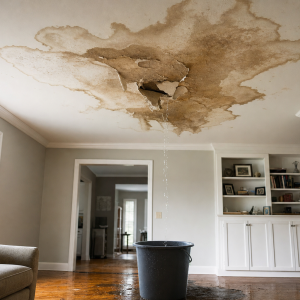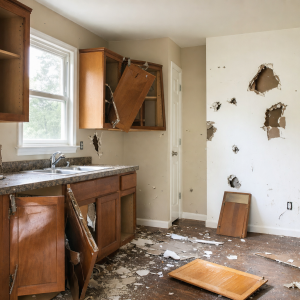

Your kitchen ceiling is bubbling after a Carolina storm. The insurance adjuster allowed a roof patch and some paint, but the wall still feels damp, the cabinet trim is swelling, and the letter says the remaining damage isn't covered. You're left trying to reconcile a small payment with a repair problem nobody has fully investigated.
Don't argue about the stain. Challenge the cause determination, the inspection, and the repair scope. A wind driven rain damage dispute needs evidence showing where water entered, what it damaged, and why the policy should pay.
Table of Contents
- When Wind Driven Rain Damage Becomes a Claim Fight
- How Wind Forces Water Into a Building
- Interior and Exterior Signs to Document Right Away
- What Your Policy Actually Says About Wind Driven Rain
- The Pushbacks Insurers Use and Why They Fail
- Step by Step Actions to Dispute a Low-Ball or Denied Claim
- Mitigation, Repair Priorities, and How a Public Adjuster Helps
When Wind Driven Rain Damage Becomes a Claim Fight
A roof-patch estimate doesn't settle whether the insurer evaluated the entire loss. It tells you what the adjuster included. Your job is to identify what's missing and demand a written explanation.
Start by separating coverage from scope. A coverage dispute concerns whether the policy pays for a particular cause of damage. A scope dispute concerns which materials need drying, removal, or replacement and what that work costs. You may have both.
Identify what the insurer actually decided
Read the payment letter alongside the estimate. Highlight every interior room mentioned, then compare that list with the areas where you observed water, staining, or swelling.
- Missing investigation: Did anyone inspect the attic, window perimeter, wall cavity, or affected insulation?
- Missing work: Does the estimate address wet materials, access, drying, and necessary reconstruction, or only surface finishes?
- Missing explanation: Did the insurer identify the policy provision supporting each rejected item?
- Missing causation: Does the report trace a water-entry pathway, or label the problem maintenance?
Use a contractor's repair assessment to clarify construction details, not to substitute for a coverage analysis. Resources such as SuperiorPRO storm damage repair can help you prepare questions about exterior repairs before comparing those recommendations with the insurer's scope.
Practical rule: A payment isn't proof that the inspection was complete. Ask what the adjuster inspected, what was excluded, and why.
For homeowners and business owners in North Carolina and Virginia, the strongest next move is a specific written dispute, not an angry demand for a larger check. Identify the disputed room, material, cause determination, or estimate line item. Attach the evidence supporting your position.
Don't accept maintenance as an explanation without asking which component failed and how the inspector reached that conclusion. Equally, don't assume every condition discovered after a storm was caused by it. A credible claim separates new damage from old conditions instead of treating the entire building as one undifferentiated loss.
How Wind Forces Water Into a Building
Wind-driven rain isn't ordinary rainfall arriving at an inconvenient angle. Wind adds momentum to droplets and creates pressure differences across the building envelope, the roof, walls, windows, doors, and connecting components that separate outside conditions from interior space.
Think of the difference between water running down a closed window and water being pushed against its joints. During a storm, exposure and pressure can change repeatedly. The windward face takes direct pressure, while pressure conditions elsewhere around the building differ.
This diagram shows the mechanisms an inspection should investigate.

An intact window doesn't settle the question
Pressure-chamber testing found that contemporary windows and doors resisted leakage under steady conditions but leaked substantially under fluctuating storm pressures. Water could move through drainage-plane discontinuities in the reverse direction from ordinary drainage, according to the North Queensland cyclone water-damage study.
That finding matters when an adjuster points to unbroken glass as the end of the investigation. Glass condition and assembly watertightness are different questions. Inspectors need to consider gaskets, weep holes, frame interfaces, flashing, and adjacent wall connections.
If replacement glazing becomes part of the repair discussion, information about impact glass from Breaking Glass Co. can help you distinguish glazing choices from the separate investigation into how water crossed the existing assembly. Don't let a product discussion replace a component-level diagnosis.
Follow the path beyond the visible stain
A useful inspection connects exterior entry points with concealed materials and interior symptoms.
- Roof and wall transitions: Examine flashing, roof edges, and intersections rather than concentrating only on missing shingles.
- Openings and penetrations: Check window and door interfaces, siding joints, and penetrations through the enclosure.
- Concealed spaces: Investigate insulation, sheathing, ceilings, and electrical spaces where water may have traveled.
A U.S. Forest Service investigation of wind-driven-rain intrusion examined water entry in wall assemblies while accounting for changing wind directions. That's the right investigative mindset: exposure, assembly details, and water movement belong together.
Your claim needs a connected explanation. Where did water cross the enclosure? Which materials did it reach? What inspection findings support that pathway? A photograph of a ceiling stain answers only part of the problem.
Interior and Exterior Signs to Document Right Away
Document conditions before anyone removes the evidence, but don't postpone emergency protection to stage a perfect inspection. Ask the mitigation contractor to photograph exposed materials during work and record why removal was necessary.
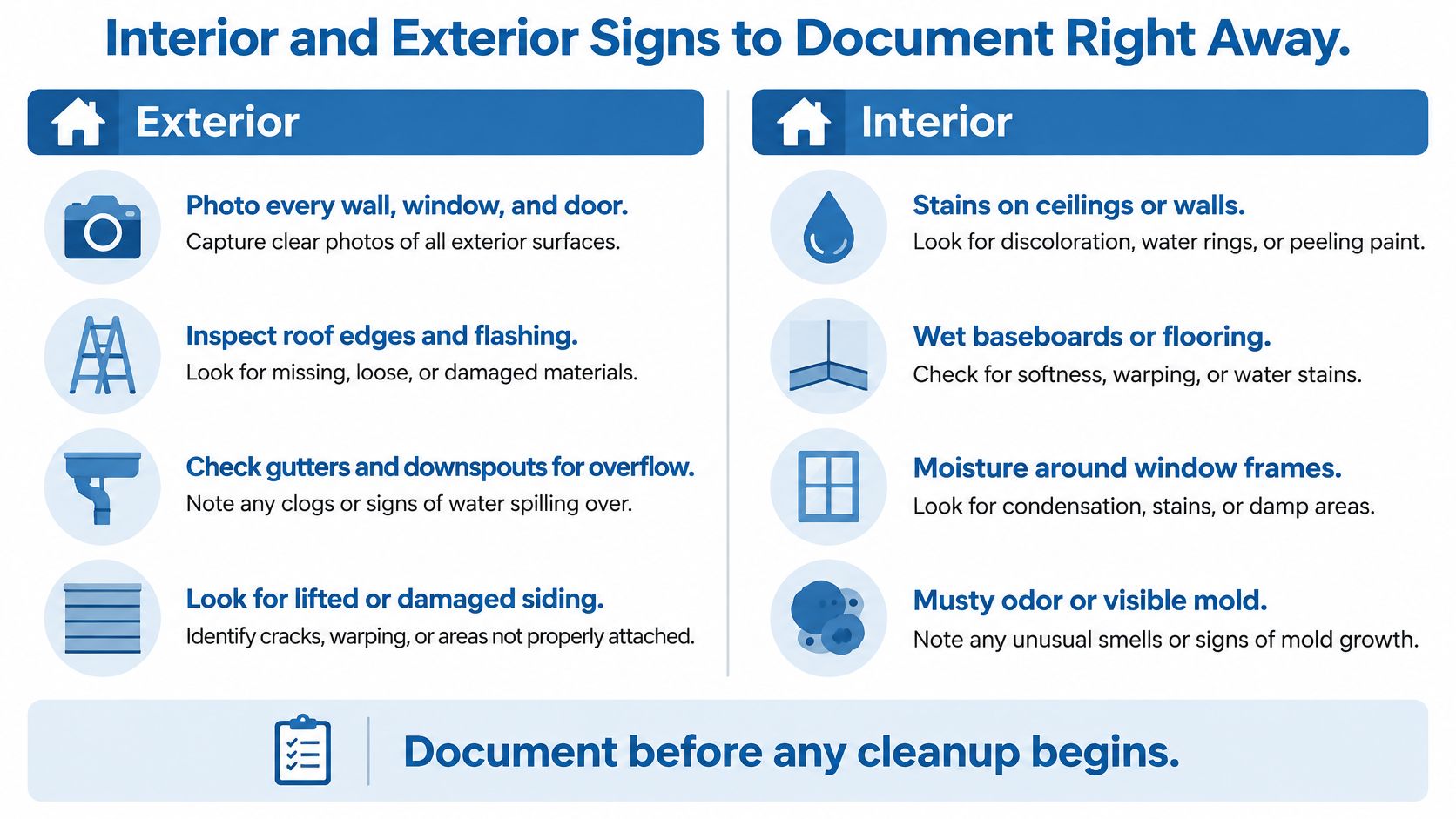
Use this checklist to organize the inspection record.
Record exterior conditions safely
Take broad photographs showing each elevation, followed by closer views of suspect components. Identify which side faced the storm exposure, and keep original image files with their timestamps.
- Roof-edge details: Photograph displaced flashing, visibly lifted shingles, stained soffits, and disturbed interfaces from a safe location.
- Wall components: Record siding displacement, peeling sealant, window perimeters, and door thresholds.
- Water markings: Capture debris lines or staining without deciding, from appearance alone, what caused them.
Don't climb onto a wet or damaged roof. Ask an appropriate professional to document inaccessible conditions and identify the location of each photograph.
Build a room-by-room moisture record
Inside, photograph ceiling stains, bubbling paint, swollen baseboards, window returns, flooring changes, and any exposed wet materials. Record musty odors and efflorescence as observations, not automatic proof of storm causation.
Ask the inspector to prepare moisture mapping with labeled measurement locations. A pinless moisture meter can help screen areas, while infrared images can guide further investigation. Request confirmation of suspect findings rather than accepting a colorful thermal image as a complete diagnosis.
Record room names, wall orientation, ceiling height, affected materials, readings, and inspection dates. The water damage documentation guide provides an additional framework for assembling photographs and supporting records.
Keep the original evidence and a separate annotated copy. Labels are useful, but they shouldn't replace the underlying files.
Don't assume a surface that looks dry proves the assembly has dried. In testing of 75 mm masonry veneer, total leakage increased by more than 85% after four wind-driven-rain cycles, and more than 24 hours of drying could be needed to materially reduce leakage in that configuration, according to the cyclic masonry wetting-drying research.
Those results aren't a drying schedule for your building. They support a narrower point: appearance alone is a poor basis for declaring concealed materials unaffected. Demand measurements and an explanation of what was tested.
What Your Policy Actually Says About Wind Driven Rain
Find the actual policy language before accepting either a denial or an assurance of coverage. Your declarations page identifies purchased coverage, but it doesn't replace the policy forms and endorsements.
Request the complete policy that applied on the loss date. Read the interior-rain limitation, wind provisions, water exclusions, endorsements, deductibles, and any wind-driven-rain sublimit together.
The opening requirement can decide the dispute
Some policies require wind or hail to create an opening before interior rain damage qualifies. Other wording may expressly address wind-driven rain without that same requirement. Don't let anyone substitute a general explanation of home insurance for your contract.
An introductory resource such as AMPM Restoration Services' does home insurance cover water damage can help frame your questions. The controlling answer still comes from your policy and the documented cause of loss.
Review the water damage exclusion discussion when comparing the insurer's explanation with the exclusion it cites. Ask the adjuster to explain how that language applies to the specific entry pathway, not to the presence of water.
Which Policy Typically Responds to Each Water Entry
FEMA explains that NFIP flood insurance covers ground-up water entry, including qualifying storm surge, heavy rainfall, or overflowing water, but excludes wind-driven rain and rain entering through a wind-damaged roof. Homeowners or commercial coverage may respond to wind-driven rain subject to its terms, as detailed in FEMA's wind-versus-floodwater fact sheet.
| Water Entry Scenario | NFIP Flood Policy | Homeowners or Commercial Policy |
|---|---|---|
| Rain enters through a wind-damaged roof | Excluded | May respond, subject to applicable wording |
| Wind forces rain around a window assembly | Excluded | Depends on rain limitations and endorsements |
| Storm surge enters from ground level | Evaluate under flood coverage | Generally requires separate flood coverage |
| Wind intrusion occurs before later ground-up flooding | Evaluate the flood-related portion | Evaluate the wind-related portion separately |
If your NFIP policy is administered through a Write Your Own company, keep the flood adjustment distinct from the homeowners or commercial adjustment. Ask each assigned adjuster to identify the damage being evaluated under that policy.
Check anti-concurrent causation wording too. If the insurer relies on it, request the exact clause and its explanation of the causal sequence. Don't assume identifying wind somewhere in the storm resolves every exclusion.
For coastal NC and VA properties, coordinated claims may be necessary. Neither adjuster's conclusion should substitute for a complete analysis of the other policy's potential coverage.
The Pushbacks Insurers Use and Why They Fail
An insurer's explanation fails when it doesn't match the evidence or policy. It doesn't fail merely because you disagree with it. Some exclusions are enforceable, and some opening requirements are decisive.
Use this chart to organize your questions, not as a promise of coverage.

Important qualification: Wind-driven rain isn't automatically covered wind damage, and identifying wind as a dominant cause doesn't automatically defeat a concurrent-cause exclusion. The contract and applicable law control.
Pre-existing wear and tear
Ask which condition the insurer considers pre-existing, what evidence dates it, and how it caused the disputed damage. Prior repair invoices, maintenance records, inspection photographs, and a component-level causation report can help test that conclusion.
But don't dismiss a defect exclusion as boilerplate. In Corliss Condominium Owners Association v. National Surety Corp., a federal court applying Washington law upheld denial because excluded construction or maintenance conditions initiated the damage sequence. The ensuing-loss provision didn't preserve coverage on those facts.
Your response must address the alleged defect, not merely establish that a storm occurred.
No opening was created
If the policy requires a wind-created opening, prove the opening and sequence. Identify the damaged component, when it changed, and how rain entered through it.
In Iler v. RVOS Farm Mutual Insurance, coverage depended on wind or hail first creating an opening in the roof or wall. Texas Windstorm Insurance Association v. Commerce Office Park-One likewise involved a limitation requiring a wind-created opening and resulting interior rain damage.
These Texas decisions don't decide an NC or VA claim. They demonstrate why building science alone can't override an express coverage condition.
Flood versus wind and concurrent causes
Describe the observed sequence accurately. Don't relabel ground-up water as wind-driven rain to pursue a preferred policy, and don't accept a flood label for every wet room without a documented pathway.
- Separate locations: Identify which rooms or elevations show each entry mechanism.
- Separate timing: Record when leakage began and when exterior water rose, if observed.
- Separate costs: Ask estimators to distinguish repair work attributable to different causes.
A stronger dispute narrows uncertainty. It doesn't replace one unsupported conclusion with another.
Covered doesn't necessarily mean the full building limit
In Ironshore Specialty Insurance Co. v. RPG Hospitality, the Georgia Court of Appeals reversed a ruling applying the $26,239,400 building limit because factual issues remained over a $250,000 wind-driven-rain sublimit. That wasn't a final award of the larger amount.
Read definitions and sublimits together before valuing the dispute. These out-of-state decisions are useful illustrations, not promises about North Carolina or Virginia outcomes.
Whether your insurer is State Farm, Allstate, Liberty Mutual, or Universal North America, demand the same evidence-based explanation. Don't rely on unsupported stories that a public adjuster automatically forces a reopening or settlement.
Step by Step Actions to Dispute a Low-Ball or Denied Claim
Start with a no-cost claim review, then submit a written request identifying the decision you want reconsidered. A vague complaint makes it easy to respond with another vague letter.
This sequence keeps the dispute organized.

Build the reconsideration package
- Collect the claim record. Assemble the complete policy, denial or payment letters, estimates, photographs, and mitigation records.
- Request reconsideration in writing. Identify disputed findings and ask for the supporting policy provisions and inspection conclusions.
- Obtain targeted independent findings. Use a qualified moisture investigator, contractor, or engineer according to the unresolved question.
- Compare estimates line by line. Connect each requested repair to a documented material condition, quantity, and explanation.
- Request a substantive response. Ask the carrier to address each disputed item rather than repeat its original position.
Allocation matters. In Brindley v. Firemen's Insurance Co. of Newark, the court recognized that a storm could produce covered and excluded damage, but required evidence allowing allocation without conjecture.
Escalate the unresolved issue
Ask a supervisor or claims manager to review unanswered findings. Keep a correspondence log showing document submissions, responses, commitments, and unresolved questions.
Before demanding appraisal, have a qualified professional review whether the policy's process fits the dispute. Don't assume an appraisal or umpire can decide every coverage disagreement. For unresolved complaints, consider the North Carolina Department of Insurance's consumer assistance process or the Virginia State Corporation Commission Bureau of Insurance, and consult counsel about legal remedies and applicable deadlines.
Unsupported denials or unanswered evidence deserve documentation, but disagreement alone doesn't establish bad faith. Ask counsel to assess that issue rather than making accusations you can't support.
Use the video alongside your policy and claim documents when preparing questions for professional review.
Mitigation, Repair Priorities, and How a Public Adjuster Helps
Protect the building now. Preserve the evidence while doing it. Authorize necessary emergency protection and drying, and require photographs, readings, work descriptions, and invoices.
Don't leave wet materials in place solely to wait for another inspection. Conversely, avoid undocumented demolition that removes the very assembly needed to explain water entry.

Match the professional to the problem
- Mitigation contractor: Controls ongoing wetting and documents drying.
- Building specialist or engineer: Investigates disputed entry pathways or component failures.
- Public adjuster: Develops the loss scope, reviews estimates and policy provisions, and communicates the claim position.
- Coverage attorney: Evaluates legal disputes and litigation when needed.
The explanation of what a public adjuster does can help you decide which assistance fits your situation. Ask about licensing, relevant certifications, fees, and who will personally inspect the property.
An Australian Cyclone Testing Station review found water ingress in approximately 70% of reviewed strata claims, with housing water-ingress repairs averaging about $25,000 and detailed strata ingress costs ranging from $70,000 to $1.7 million, according to its post-cyclone claims research. Those aren't NC or VA pricing benchmarks; they show why water entry deserves a complete investigation.
A denied claim supported only by surface photographs needs better evidence, not a promised success story. Ask for an appropriately qualified inspection, full moisture mapping where warranted, and a written explanation connecting findings to disputed repairs. When evaluating company reviews, look for specific descriptions of inspection quality and communication, not assurances that every denial can be overturned.
For wind-driven rain disputes, For The Public Adjusters, Inc. offers no-cost claim reviews, property inspections, estimate preparation, and carrier communication, with offices in Apex, NC and regional service across NC and VA. Have your water damage claim questions answered at NO COST. Call 919-400-6440 to speak with a licensed Public Insurance Adjuster or Contact Us here with questions. WE Work For YOU… NOT Your Insurance Company!