When you find water damage to your kitchen cabinets, it feels like a nightmare. It’s a messy, expensive problem, and you assume your insurance policy is there to make you whole again.
But here’s the hard truth: your insurance company is banking on you not understanding the game. They often throw out a quick, low-ball settlement that only covers the cosmetic stuff, leaving you to foot the bill for the real, hidden damage.
Your Kitchen Claim: What Your Insurance Company Hopes You Don’t Know
That gut-punch feeling when you see a burst pipe or leaking dishwasher has wrecked your kitchen is overwhelming. Your first instinct is to grab the phone and call your insurance company.
Stop. Before you make that call, you need to understand exactly who you’re dealing with.
Major carriers like State Farm or Allstate are not your partners in recovery. They are massive, for-profit businesses. The adjuster they send to your home has one primary job: protect the company’s money by paying you as little as legally possible. That creates an immediate, unavoidable conflict of interest.
The Low-Ball Offer Tactic
The company adjuster will probably show up fast, act concerned, and do a quick walk-through. Then comes the offer. It might seem reasonable on the surface—enough to replace a warped cabinet door or maybe sand and repaint a stained area.
Don’t fall for it. This initial offer isn’t a good-faith effort to help; it’s a strategic move designed to close your claim fast and cheap. It’s a number based on ignoring the full scope of destruction that water damage to kitchen cabinets almost always creates.
Key Takeaway: An insurer’s first offer is never their best offer. It’s the starting bid in a negotiation where they have all the power, and it’s calculated based on a five-minute visual inspection meant to limit their payout.
What the Adjuster Is Paid to Ignore
Water is sneaky. It doesn’t just stain the surface you can see. It wicks and travels into every hidden nook and cranny, causing catastrophic damage their quick look will conveniently miss. The adjuster’s low offer is deliberately ignoring:
- Saturated Cabinet Boxes: Your cabinet boxes, especially if they’re made of MDF or particleboard, are like sponges. Once they get wet, they swell, delaminate, and lose all structural strength. They can’t be “repaired”—they are garbage and must be fully replaced.
- Hidden Mold Growth: The moisture trapped behind your cabinets, under the toe-kicks, and inside the drywall is a perfect incubator for toxic mold. It can start growing in as little as 24-48 hours.
- Compromised Subflooring: A simple dishwasher leak can send water flowing under your cabinets, saturating the subfloor. This leads to rot and instability that puts the entire kitchen’s structure at risk.
- The Matching Nightmare: It’s practically impossible to get a new cabinet door or a single new cabinet to match a set that’s been in your kitchen for years. A “patchwork” repair job tanks your home’s value, leaving you with a mismatched, ugly kitchen.
This isn’t a rare problem. In fact, kitchens are a hotspot for these kinds of disasters. A 2022 report from Sweden’s Vattenskadecentrum found that kitchens were the origin of 33% of all water damage incidents. The main culprits? Appliances like dishwashers. You can read more about these water damage trends and their sources here.
Your insurer knows a proper fix is incredibly expensive. Replacing a full set of cabinets, dealing with mold, and repairing the subfloor can easily run into the tens of thousands. If they can convince you to take a few hundred bucks for a cosmetic touch-up, they save a fortune.
This is why you have to be ready to fight. You must become your own advocate to force them to pay what you’re actually owed.
Documenting The Hidden Damage Your Insurer’s Adjuster “Missed”
When you discover water damage in your kitchen cabinets, the relief you feel when the insurance adjuster shows up is usually short-lived.
Here’s the hard truth: their inspection is almost always a quick, surface-level glance. They aren’t there to find all the damage; they’re there to find the cheapest possible “fix” so they can close your claim and protect their employer’s bottom line.
Your most powerful weapon against their inevitable low-ball offer is building an undeniable case file that proves the full extent of the destruction.
The adjuster sent by a big carrier like State Farm or Allstate is paid to minimize your claim. They’ll make a note of a warped cabinet door or a visible water stain, but they are trained to ignore what’s lurking underneath. You have to become the lead investigator on your own claim and document the hidden damage they will conveniently overlook.
This is the frustrating game homeowners are forced to play. It starts with damage and almost always leads to a low-ball offer that leaves you fighting for what you’re rightfully owed.
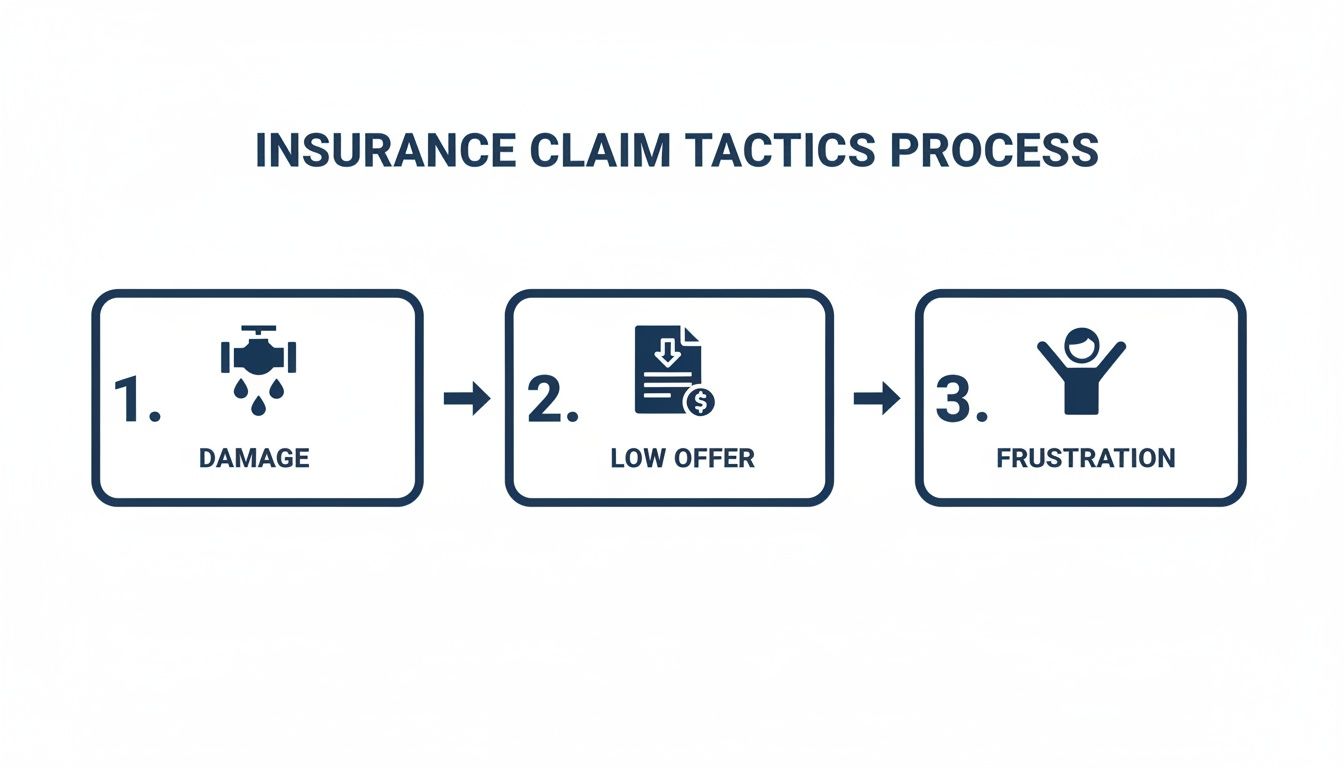
As you can see, the path from filing a claim to getting paid fairly is rarely a straight line. This is exactly why your own proactive, detailed documentation is the only real defense you have against the insurance company’s cost-cutting playbook.
A public adjuster’s approach is fundamentally different. Their job is to find and document the full scope of the loss to maximize your payout, not minimize it for the insurance carrier.
Here’s a look at how their assessments typically differ:
Company Adjuster vs Public Adjuster Cabinet Assessment
| Assessment Area | Insurance Adjuster’s Likely Approach | Public Adjuster’s Comprehensive Approach |
|---|---|---|
| Visible Damage | Notes only the most obvious issues, like a delaminating door or a stained shelf. | Documents all visible damage but sees it as a starting point, not the full story. |
| Hidden Damage | Rarely removes toe-kicks, pulls out drawers, or uses tools to check for moisture behind or under cabinets. | Systematically checks inside, behind, and under every cabinet. Uses moisture meters and thermal cameras to find trapped water. |
| Cabinet Material | Often assumes particleboard or MDF can be “dried out,” ignoring that it loses structural integrity once wet. | Understands that swollen composite materials are permanently compromised and must be replaced, not repaired. |
| Matching & Scope | Will push for replacing only the single damaged cabinet, creating an obvious mismatch. | Argues for “line of sight” or matching replacement for the entire run of cabinets to restore the kitchen to its pre-loss condition. |
| Associated Damage | May ignore water damage to the drywall behind cabinets or the subfloor underneath to keep the repair cost low. | Inspects and documents all affected surrounding materials, including drywall, insulation, flooring, and electrical. |
The difference is stark. The company adjuster is looking for a patch. A public adjuster is building a case for a proper restoration.
Beyond The Obvious: What To Look For
You have to think like a professional. Water is relentless—it travels far from the initial source, wicking into materials you can’t see. Before you can document the damage, you have to find it all. Getting familiar with how to detect water leaks gives you a massive head start.
Once you’ve found the source, start your own forensic inspection. Look for these subtle but critical signs that prove the damage is widespread:
- Peeling Laminate or Veneer: Don’t just look at the front. Check the bottom edges, back seams, and inside corners of cabinet doors and boxes. Any bubbling or lifting means the core material has soaked up water and is failing.
- Swollen Particleboard or MDF: Most modern cabinet boxes are made of composite materials that act like a sponge. Get on your hands and knees and feel the bottom edges and toe-kicks, especially under the sink. If the material feels puffy, soft, or crumbles in your fingers, it’s structurally ruined and has to be replaced.
- Stained Seams and Joints: Look closely where the cabinet boxes meet each other and where they meet the wall. Faint, dark lines are a dead giveaway that water has wicked into the joints, compromising the integrity of the entire cabinet run.
- Rusted Hinges and Hardware: Open every door and pull out every drawer. Check the hinges, mounting screws, and drawer slides for any sign of rust or corrosion. This is concrete proof that moisture has been sitting there long enough to cause metal to degrade.
Building Your Undeniable Proof Package
Your job is to create a story of damage so detailed and compelling that the adjuster cannot argue with it. A few blurry phone pictures won’t do it. You are building an organized, professional-grade file that proves the true cost of your loss.
Start by taking hundreds of photos and videos. Get wide shots of the entire kitchen, then zoom in for close-ups of every single problem you find—every peel, every swollen edge, every rust spot. Turn on the timestamp feature on your phone. Even better, narrate your videos, explaining what you’re showing. “This is the back of the sink base cabinet. The particleboard is completely soft and crumbling when I press on it.”
Crucial Tip: Go buy a moisture meter. For about $30-$50, this tool gives you the scientific data needed to destroy an adjuster’s subjective opinion that things are “just a little damp.” Systematically test everywhere: the drywall behind the cabinets, the subfloor under the toe-kicks, and the cabinet boxes themselves. Take a picture of the meter’s reading at each spot.
Finally, create a detailed inventory. List every single cabinet box, door, drawer front, and piece of trim that is damaged. For each item, describe the specific damage (e.g., “Upper cabinet, 36-inch, right of sink: MDF back panel swollen, 45% moisture reading; right side panel delaminating at bottom edge.”).
This detailed, line-by-line list becomes the foundation of your demand for a full and proper replacement, not the cheap, patchwork repair they want to give you. It’s this level of detail that gives you the power to fight back when they try to shortchange your insurance water damage claim.
Winning the Repair Versus Replace Battle for Your Cabinets
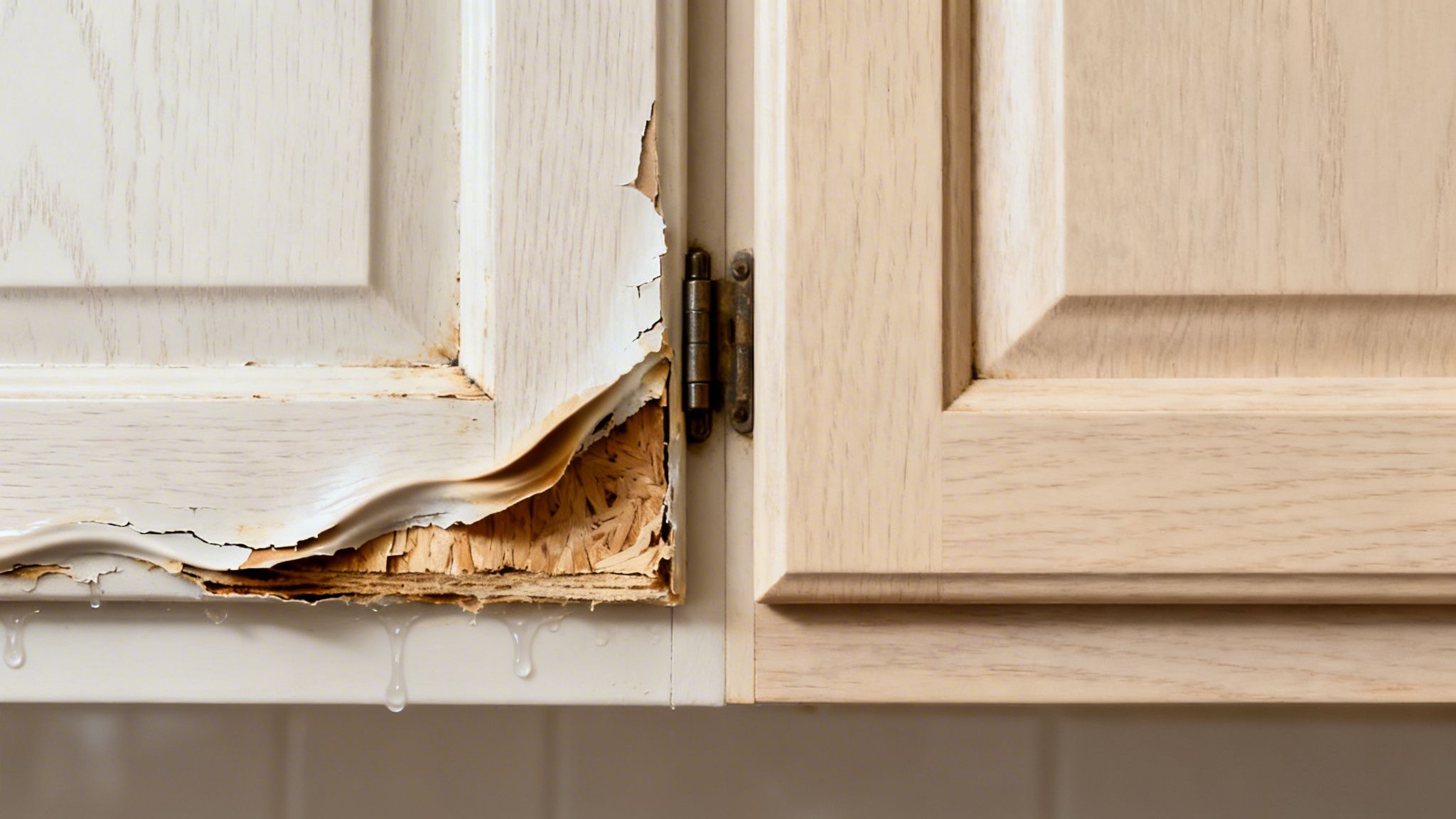
When it comes to a claim for water damage to kitchen cabinets, the biggest fight you’ll have is almost always over repair versus replacement. Get ready for it. Your insurance company will come in strong, pushing for the cheapest, most minimal “fix” they can get away with.
They’ll try to convince you that replacing one warped door or slapping some paint on a stained surface is good enough. Don’t fall for it. This is a classic low-ball tactic. You need to know exactly how to dismantle their bogus arguments and demand the full replacement your policy actually entitles you to.
Why “Repairing” Water-Saturated Cabinets Is a Lie
The adjuster from a carrier like Allstate or State Farm will send their preferred contractor who will confidently claim they can “repair” your soaked cabinets. Let’s be clear: this is fundamentally dishonest, especially with the materials used in most modern kitchens.
The vast majority of cabinets today are made from Medium-Density Fiberboard (MDF) or particleboard. These are just wood scraps, dust, and fibers compressed with glue. Once water gets in, their game is over.
- It Swells Permanently: Water melts the resins holding the wood fibers together, causing the material to expand like a sponge. This swelling is irreversible. You can’t un-swell a waterlogged cabinet box.
- Structural Integrity is Gone: Once swollen, the material loses all its strength. It becomes soft, crumbly, and can no longer support the weight of your countertops or even hold a screw.
- The Finish Delaminates: The veneer or laminate finish bonded to the surface will bubble and peel away as the core material underneath turns to mush.
The adjuster will tell you to just “dry it out.” That’s a pointless exercise. The material is compromised forever and can never be returned to its pre-loss condition—which is the standard your policy requires.
The Unwinnable Matching Game
Even if only one or two of your cabinets are obviously ruined, the insurer’s next move is to offer to replace just those units. This is another play from their cost-cutting playbook, and it will leave your kitchen looking like a mismatched mess.
It is practically impossible to perfectly match new cabinets to an existing set that’s been in your home for years. Here’s why their “spot repair” is an unacceptable insult:
- Color Fading: Sunlight, cooking grease, and simple age change the color and finish of cabinets. A brand-new door or box will stick out like a sore thumb against the originals.
- Dye Lot and Finish Changes: Manufacturers are constantly tweaking their stains and paints. The “Espresso” finish from 2024 is almost never a dead-on match for the one they produced in 2019.
- Discontinued Styles: It’s extremely common for cabinet lines to be discontinued altogether, making an exact match physically impossible.
Your policy obligates the insurance company to indemnify you—to put you back in the same financial position you were in before the disaster. A mismatched, devalued kitchen doesn’t come close to meeting that standard. This failure to match is your most powerful argument for replacing the entire continuous run of cabinets.
Case Study: In a notable Florida case, Silverstein v. State Farm Fire & Cas. Co., the court ruled in favor of the homeowner. The kitchen cabinets suffered water damage, and State Farm offered to replace only the damaged sections. The court found that because an exact match could not be found, State Farm was required to pay for the replacement of all cabinets to ensure a uniform and matching appearance, reinforcing the principle of returning the policyholder to their “pre-loss condition.”
In some very minor cases, understanding the difference between cabinet refacing vs refinishing can be helpful. But when you’re dealing with saturated MDF or particleboard, neither of those is a real solution.
The bottom line is simple: a patchwork repair fails to restore your kitchen’s function, appearance, and value. The only solution that truly makes you whole is a full replacement, and you have to be ready to fight tooth and nail for it.
How to Use Your Own Policy to Fight a Denied Claim
Let’s be blunt: insurance policies are written to be confusing. Companies like State Farm and Allstate bank on the fact that you, the homeowner, won’t understand the tricky language and fine print. They use this complexity as a weapon when you file a claim for water damage to kitchen cabinets.
They’ll hunt for any excuse to deny coverage, often pointing to obscure clauses about “slow leaks” or “wear and tear.” They expect you to get frustrated and just give up. You can’t let them. You have to be ready to fight their manipulative wording head-on.
The “Sudden and Accidental” vs. “Gradual Damage” Trap
The entire denial often boils down to a single argument: was the damage “sudden and accidental” or was it “gradual”? Your policy is designed to cover a “sudden and accidental” event, like a dishwasher supply line bursting open.
But that’s not how the insurance company will frame it.
They’ll send out their adjuster to find evidence of a tiny, slow drip that may have existed for weeks. They’ll then claim that drip is the real cause of the loss. And since it was “gradual,” they’ll try to deny the entire claim for your ruined kitchen.
It’s a dishonest argument, and your job is to tear it apart by focusing on the result, not their twisted version of the cause.
- The Damage Was Hidden. You can’t fix a problem you don’t know exists. A slow leak festering behind a toe-kick or under a dishwasher is concealed from view. You only discovered the problem when the cabinet materials catastrophically failed—a sudden event.
- The Failure Was Sudden. The drip may have been slow, but the moment your particleboard cabinet box turned to oatmeal and collapsed was a distinct, sudden failure. That is the covered event.
Don’t let them control the narrative. The real “loss” isn’t some microscopic drip they found; it’s the sudden and complete destruction of your cabinets.
Is Your Insurance Company Acting in Bad Faith?
Beyond simply denying your claim, your insurance company has a legal requirement called the duty of good faith and fair dealing. This means they have to treat you honestly and fairly. When they deliberately fail to do so, it can cross the line into “insurance bad faith,” which gives you serious leverage.
Big insurance carriers are masters at walking this line, using tactics that are infuriating but just shy of illegal. The first step to holding them accountable is knowing what these dirty tricks look like.
An insurance company’s job is to investigate your claim, evaluate the damage, and pay you what you’re owed—fairly and promptly. When they invent unreasonable delays or use deceptive tactics to underpay, they could be acting in bad faith.
Keep an eye out for these classic bad faith red flags:
- Unreasonable Delays: Dragging their feet for months to make a decision or conveniently “losing” your documents.
- Refusing to Justify a Denial: If they deny the claim, they are required to give you a reason in writing, pointing to the exact policy language they’re using.
- Endless Paperwork Requests: Asking for the same photos or estimates over and over is a classic stall tactic.
- Threats and Intimidation: Hinting that your premiums will skyrocket if you dare to pursue the claim.
- A Pathetic Low-Ball Offer: Knowingly offering you a settlement that doesn’t even come close to covering the actual repair costs.
If this sounds familiar, start documenting everything. Create a log of every call, save every email, and send critical documents via certified mail. This paper trail becomes undeniable proof when you escalate the fight. Beating a massive corporation at their own game requires a professional who knows their playbook inside and out. A public adjuster’s entire career is built on exposing these tactics and forcing the insurer to pay what they rightfully owe you.
How a Public Adjuster Forces a Fair Cabinet Claim Settlement

When you discover water damage to your kitchen cabinets, understand this: you’ve just walked into a fight you’re not equipped to win alone. The insurance company isn’t your partner; it’s a billion-dollar corporation with an army of adjusters and lawyers whose job is to protect their profits by paying you as little as possible.
Going against them by yourself is a recipe for a low-ball settlement and a half-repaired kitchen.
A public adjuster is your equalizer. We are state-licensed claim professionals who work for one person and one person only: you, the policyholder. We never work for the insurance company. Our entire purpose is to turn the tables and force your insurer to pay what they actually owe you under the terms of your policy.
Dismantling the Low-Ball Offer with Forensic-Level Evidence
The company adjuster will show up, take a few quick photos, and write up an estimate designed to minimize the scope of the damage. It’s a game of smoke and mirrors. We don’t play that game. We launch a full-scale forensic investigation to prove the true extent of your loss.
Our fight strategy is built on undeniable proof:
- Advanced Moisture Mapping: We use professional-grade thermal cameras and moisture meters to find every drop of hidden water. This isn’t just for show—it uncovers saturation deep inside your walls, under your floors, and within the cabinet materials that their adjuster conveniently “misses.”
- Material Failure Analysis: We know that materials like MDF and particleboard don’t just “dry out.” They swell, delaminate, and lose all structural integrity. We document this irreversible damage, proving why a cheap “repair” is not an option.
- Building a Contractor-Grade Estimate: We don’t argue with their flawed number. We build our own comprehensive, line-item-by-line estimate from scratch. It’s a detailed scope of work that accounts for what it actually costs to do the job right—including replacing a continuous run of cabinets to ensure a perfect match and dealing with the hidden mold they ignored.
A public adjuster makes the insurance company’s low-ball offer irrelevant. We build a new claim from the ground up on a mountain of evidence, forcing them to negotiate on our terms, not theirs.
Fighting Delay Tactics and Winning the Negotiation
Once our evidence is compiled, we take over all communication with the insurance company. Immediately, their stall tactics and manipulative phone calls stop. We speak their language fluently, and we know their playbook inside and out.
When they try to pay for a mismatched “patchwork” job, we hit back by citing the specific language in your policy that obligates them to restore your kitchen to its “pre-loss condition.” We counter their opinions with our objective facts.
This is exactly the battle our clients face before they call us. Here’s a real review from a homeowner who felt the immediate shift in power after hiring our team.
This client’s experience is a textbook example of how we turn a nightmare claim around. By bringing in an expert who knows the system, you go from being a victim of the process to being in control of it. You can learn more about what a public adjuster is and how we fight for homeowners on our website.
Our involvement is a clear signal to the insurance company: the games are over. It compels them to stop the delays, negotiate in good faith, and pay the settlement you deserve to rebuild your kitchen correctly.
FAQ: Fighting for Your Water Damaged Kitchen Cabinet Claim
Trying to get your insurance company to pay for water-damaged kitchen cabinets feels like hitting a brick wall. The process is a nightmare of confusing policy language, stall tactics, and low-ball offers from carriers like State Farm and Allstate. They’re counting on you to get frustrated and give up.
Don’t. Here are the real answers to the most common fights homeowners have over cabinet claims—and how you can win.
The Insurer Denied My Claim, Calling It “Gradual Damage.” How Do I Fight That?
This is the oldest trick in the adjuster’s playbook. They’ll point to a slow, hidden drip from a pipe or drain and label the whole disaster a “long-term” or “gradual” issue, which they’ll tell you isn’t covered. Refuse to accept that answer.
It’s a garbage argument, and you can beat it. The secret is to reframe what the actual loss was. Yes, a drip may have been slow, but it was also completely hidden behind a cabinet or under your sink. You couldn’t have known. The real “loss” happened the moment that water-soaked particleboard or MDF failed catastrophically.
That sudden swelling, delamination, or collapse of the cabinet box is the covered event.
A public adjuster will hammer this point home: the damage was undiscoverable until it became sudden and severe. The material failure is the “sudden and accidental” event, not the microscopic drip that started it. Their initial denial is just a negotiation tactic, not the final word.
My Adjuster’s Estimate Only Covers Two Cabinet Doors. Now What?
Whatever you do, do not cash that check. This is an insulting low-ball offer designed to get you to go away cheap, leaving you with a mismatched and devalued kitchen. Water is sneaky; it wicks and spreads far beyond the most obvious damage. If a couple of doors are shot, it’s a near certainty the cabinet boxes they’re hanging on are compromised, too.
Even more important is the standard your policy owes you: a return to “pre-loss condition.” This applies to function and appearance. It is physically impossible to match new cabinet doors to an older set that’s been exposed to sunlight, grease, and daily use for years.
The counter-argument is simple and powerful: a patchwork kitchen is not a restored kitchen. A mismatch fails to meet the insurer’s contractual obligation, and that justifies replacing the entire continuous run of cabinets to ensure aesthetic uniformity.
Should I Hire a Contractor Before a Public Adjuster?
The most powerful strategy is to hire them at the same time. It might seem logical to get a repair estimate first, but your contractor and your public adjuster have two distinct, equally vital roles. They’re your one-two punch.
- Your Contractor: This is your rebuilding expert. They document exactly what it will take to properly tear out the damage and rebuild your kitchen, creating a detailed scope of work and estimate.
- Your Public Adjuster: This is your insurance policy and negotiation expert. They take the contractor’s professional scope of work and use it as undeniable evidence to force the insurance company to pay for the entire job.
When they work in tandem, you build an airtight case. The contractor provides the proof, and the public adjuster uses that proof to demolish the insurance company’s cheap estimate. It’s the best way to ensure you’re not left paying for half the rebuild out of your own pocket.
How Much Does a Public Adjuster Cost for a Cabinet Claim?
We get it. After your kitchen is wrecked, the last thing you want is another bill. That’s why we, like most reputable public adjusting firms, work strictly on a contingency fee. That means zero upfront cost to you.
We always start with a completely free, no-strings-attached review of your claim and an inspection of the damage. If you hire us, our fee is a small, pre-agreed percentage of the final insurance settlement we recover for you.
Let me be clear: if we don’t get you paid, you owe us nothing. Our interests are 100% aligned with yours. Our fee is directly tied to your success, which motivates us to fight for every single dollar you’re owed to rebuild your kitchen right.
What specific water damage endorsements should I have that a Public Adjuster can leverage when a claim is denied?
Many claims are denied because the homeowner lacks key endorsements. We immediately look for Water Backup and Sump Overflow (critical for basement claims) and Hidden Water Leak or Concealed Plumbing Leak coverage. These endorsements can override the standard exclusion for gradual damage if the leak was hidden within a wall or under a floor, turning a likely denial into a covered loss.
My claim was denied because the adjuster claimed "Lack of Maintenance." How does a PA successfully challenge this negligence argument?
We first require the insurer to prove the lack of maintenance caused the covered damage, not just the failed item (which is usually excluded anyway). We then provide proof of reasonable maintenance (e.g., utility records, contractor invoices, dated photos of the area). If a pipe burst due to a flaw, the failure is covered, even if the pipe was old, unless the policyholder had specific prior knowledge of the imminent failure and ignored it.
Does my policy cover the cost to actually find and repair the source of the hidden water leak?
No, standard policies often cover the resulting damage (e.g., ruined drywall and flooring), but typically exclude the cost to repair the faulty appliance or pipe itself (the source). However, if you purchased an "Explosion of Pipes" endorsement or a "Service Line Coverage" endorsement, the cost to excavate or repair the broken line itself may be covered. We identify the relevant coverage parts to ensure you get paid for both the repair and the resulting damage.
What is the correct way to document the "Category" of water loss, and why is this critical to the final settlement?
Water damage is classified into three categories: Category 1 (Clean Water): From a supply line. Category 2 (Grey Water): From an appliance, carrying contaminants. Category 3 (Black Water): Highly contaminated (sewage, floodwater). A Public Adjuster ensures the restoration scope is based on the proper category. For instance, Category 3 water necessitates full demolition of all porous materials (drywall, insulation, carpet) to prevent biohazards, resulting in a significantly higher, more accurate claim value.
The mitigation company chosen by the insurer started work immediately. How does a Public Adjuster audit their bill to prevent it from consuming my coverage limit?
We immediately review the mitigation company’s drying logs, equipment rental invoices, and moisture mapping reports. We check for over-utilization (leaving excessive drying equipment in place too long) and padded labor hours. Since mitigation costs (which are separate from repair costs) can be $10,000-$30,000, we ensure the charges are Reasonable and Necessary to prevent the mitigation bill from eating into the funds needed for the actual reconstruction.
If my water-damaged subfloor is contaminated with mold, how does a Public Adjuster ensure full remediation is covered?
Mold coverage is often limited (e.g., $5,000 or $10,000) or excluded entirely. We argue the mold remediation is necessary because the mold resulted directly from the covered water peril. We coordinate air quality testing and mold protocols with certified industrial hygienists. Crucially, we ensure the insurer pays for the Access and Repair costs (the cost to tear out the wall to get to the mold) under the dwelling coverage, separate from the small mold sublimit.
How does a Public Adjuster use thermal imaging and moisture meters to overcome the insurer’s lowball estimate?
Insurance adjusters rely on visual inspection. We use thermal imaging and non-penetrating moisture meters to find hidden moisture pockets inside walls, ceilings, and under cabinets that visual inspection misses. This objective, forensic evidence proves the full scope of affected materials is much larger than the insurer estimated, forcing the carrier to approve a larger demolition and drying plan.
The insurance adjuster is offering to pay for a partial repair (e.g., half a wall). How do you force them to pay for a full wall or entire room?
Some states can invoke the Matching Clause or Uniformity Doctrine. You can argue that the repair must be of "like kind and quality." If the damaged wall cannot be perfectly matched in texture, paint, or material (which is common with older homes), demand replacement of the entire, non-damaged section (the whole wall, or even the whole room if necessary) to restore the aesthetic and structural uniformity of the home, thus maximizing the claim.
What North Carolina’s Official Position Is (As of 12/2025)
According to the NCDOI’s FAQ for homeowners insurance, there example is for a roof claim: “If my roof is damaged, does the company have to replace my whole roof?” — the answer given is: No. The insurer generally must replace only the damaged area, even if the shingles (or other materials) will not match because they’re discontinued. NC DOI
In other words: North Carolina does not automatically mandate a full-roof (or full-surface) replacement just because a match cannot be found. NC DOI+1
As one roofing-claim guide puts it (in the context of NC): “matching requirements depend on the terms outlined in your specific insurance contract."
So unlike some states that statutorily require “matching” materials or a “reasonably uniform appearance,” NC policyholders should expect matching/ uniformity to be subject to the insurance contract’s language — not a broad state-level mandate.
My claim was approved for ACV (Actual Cash Value). How does a Public Adjuster ensure I receive the full RCV (Replacement Cost Value) amount?
ACV is the depreciated amount. We ensure the policyholder signs a contract and completes the necessary repairs, incurring costs equal to or greater than the full RCV estimate. We then submit the invoices and receipts to the carrier. We meticulously track the claim to ensure the carrier releases the final Recoverable Depreciation holdback, as the policyholder has fulfilled their duty to repair.
My home is uninhabitable due to the water damage. How do I ensure my Additional Living Expenses (ALE) are maximized and not cut short?
We immediately secure an "Uninhabitability Report" from the mitigation company and a long-term estimate from the contractor (often longer than the insurer’s estimate). We manage the ALE documentation (receipts for temporary housing, food costs, etc.) and negotiate a cash advance or direct billing arrangement with the carrier to prevent the financial burden from forcing the policyholder to prematurely return to an unsafe home.
What is the main reason my water damage claim may be settled for a low amount, and what is the Public Adjuster’s countermeasure?
The main reason is that the insurance company's estimate (usually done via Xactimate) is based on minimal scope and generic pricing. Our countermeasure is to submit a comprehensive, expert-driven Xactimate estimate that includes all hidden damage, local market labor rates, mandatory code compliance costs, and professional overhead and profit (GCOP), typically raising the initial offer by 50% to 300% to reflect the true cost of restoration.
If your insurance company is giving you the runaround on your kitchen cabinet claim, you don’t have to accept their decision. The team at For The Public Adjusters, Inc. is here to fight for you. Contact us today for a free, no-obligation claim review and learn how we can help you get the settlement you deserve. https://forthepublicadjusters.com


Enjoyed reading your article on insurance claims involving kitchen cabinets and I assume it includes kitchen floors, I’m just starting the claim when I seen your article, I’m holding on to your information just in case.
Hi Darrell, what city and state is your claim?