
Filing a smoke damage insurance claim should be simple. You paid your premiums, you suffered a loss, and now you need the protection you were promised. But the hard truth is, that first phone call to your insurer often marks the start of a brutal fight.
Insurance companies like Allstate and State Farm are massive corporations, and their primary goal is profit, not paying claims. They have a playbook full of tactics designed to delay, underpay, or flat-out deny legitimate claims. They’re counting on you to get tired and give up.
This guide gives you the strategies to fight back and get the full settlement you’re owed.
The Battle After the Fire: Unfair Claim Denials
You expect your insurance company to honor its policy. Unfortunately, that’s not what usually happens. The entire claims process, from the adjuster’s first visit to a final denial letter, can feel like a setup designed to leave you with the bill.
The conflict of interest is baked into the system. Companies like Allstate or State Farm are motivated to protect their bottom line, which often puts them directly at odds with your need to fully recover. This is why so many claims turn into frustrating, drawn-out battles.
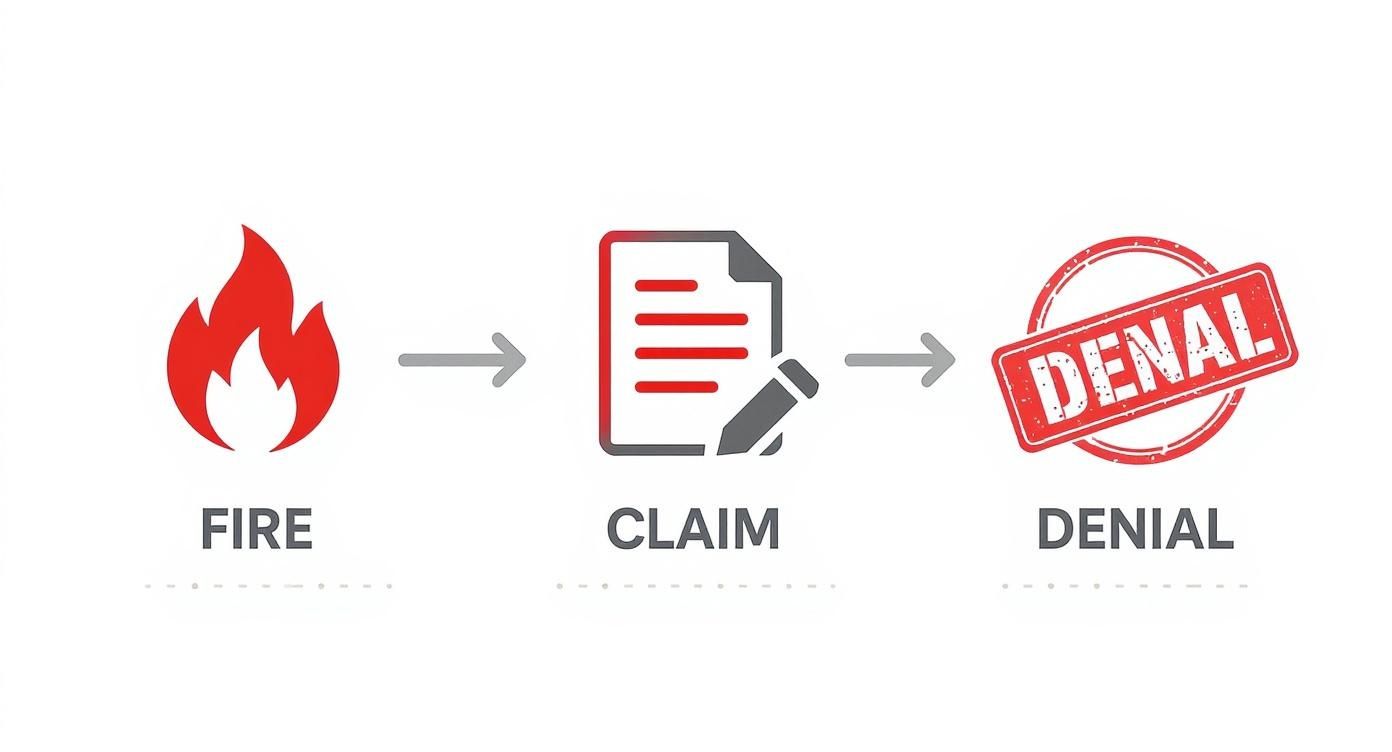
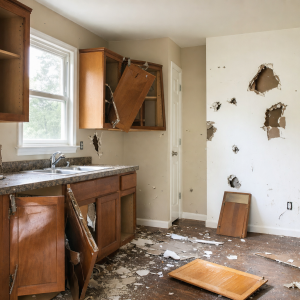
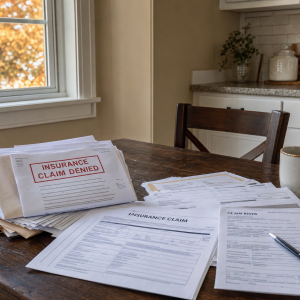
This infographic shows a familiar story: a real fire causes real damage, but the claim journey ends in a denial stamp, leaving a policyholder completely stranded by an insurer who cashed their premium checks.
Common Tactics Insurers Use to Lowball and Deny
Insurance adjusters have a whole toolbox of strategies to minimize what they have to pay you. They might send out their “preferred” contractor who writes a lowball estimate that doesn’t even come close to covering the real cost of repairs.
Other times, the adjuster they send will rush through the inspection, conveniently “missing” the hidden smoke damage that has seeped into your attic, crawlspace, or HVAC system. It’s a calculated move.
Remember this: The insurance company’s first offer is never their final offer. A denial isn’t the end of the road—it’s a signal that you need to escalate the fight.
In a landmark case, State Farm Fire & Cas. Co. v. Simmons, a jury found State Farm had acted in bad faith by unreasonably denying a homeowner’s fire claim. The court upheld a massive verdict against the insurer, sending a clear message that these delay and deny tactics can have severe consequences for the company.
Preparing for the Dispute
Knowing their playbook is the first step to beating them at their own game. Don’t let your insurer control the narrative. The insurance company has teams of experts working for them—you need to be just as prepared to fight for yourself.
Here are some of the most common tactics we see and how you can counter them immediately.
Common Insurer Tactics vs Your Counter Strategy
| Common Insurer Tactic | Their Goal | Your Proactive Counter Strategy |
|---|---|---|
| Unreasonable Delays | Wear you down so you accept a low offer out of desperation. | Document every single interaction—dates, times, names, what was discussed. Send follow-up emails confirming conversations. |
| Lowball Estimates | Use their “preferred” vendors to create an estimate that grossly undervalues your loss. | Get your own independent estimates from reputable, local contractors before you accept their number. |
| Misinterpreting Policy Language | Find an obscure clause or exclusion to wrongfully deny parts of your claim. | Request a certified copy of your full policy. Highlight the sections that support your claim. Don’t take their interpretation as fact. |
| Rushed or Incomplete Inspection | Miss or ignore less obvious damage (soot in HVAC, insulation, etc.) to reduce the claim’s value. | Point out every area of concern during their inspection. Take your own photos and videos of the damage they “overlook.” |
The key is to meticulously document everything, challenge the adjuster’s findings at every turn, and aggressively advocate for what you’re owed. This isn’t just about getting a check. It’s about holding your insurance company accountable to the contract they signed.
Uncovering The Hidden Damage Insurers Ignore
After a fire, the most dangerous damage isn’t always what you can see. It’s the smoke particles, the corrosive soot, and the toxic residue that seep deep into your home’s bones. This stuff gets everywhere—drywall, insulation, and even your HVAC system.
This is the kind of damage insurance company adjusters love to ignore.
An adjuster from Allstate or State Farm will walk through, take a quick look at the obvious soot stains, and tell you a little paint and some surface cleaning will fix it right up. Let me be clear: this isn’t an accident. It’s a strategy. Their job is to close out your smoke damage insurance claim for the absolute minimum, leaving you to discover the real problems months or years down the road.
And those problems are serious. We’re talking about permanent odors, soot that literally eats away at metal and glass, and toxic particles that your HVAC system blows into every room of your house. This is a fight you have to be ready for, and the only way to win is with overwhelming proof.
Your Inspection Blueprint: Go Beyond the Obvious
To build a rock-solid case, you need to stop thinking like a homeowner and start acting like a forensic investigator. The company adjuster’s 15-minute walkthrough is designed to miss things. Your job is to document everything they “conveniently” overlook.
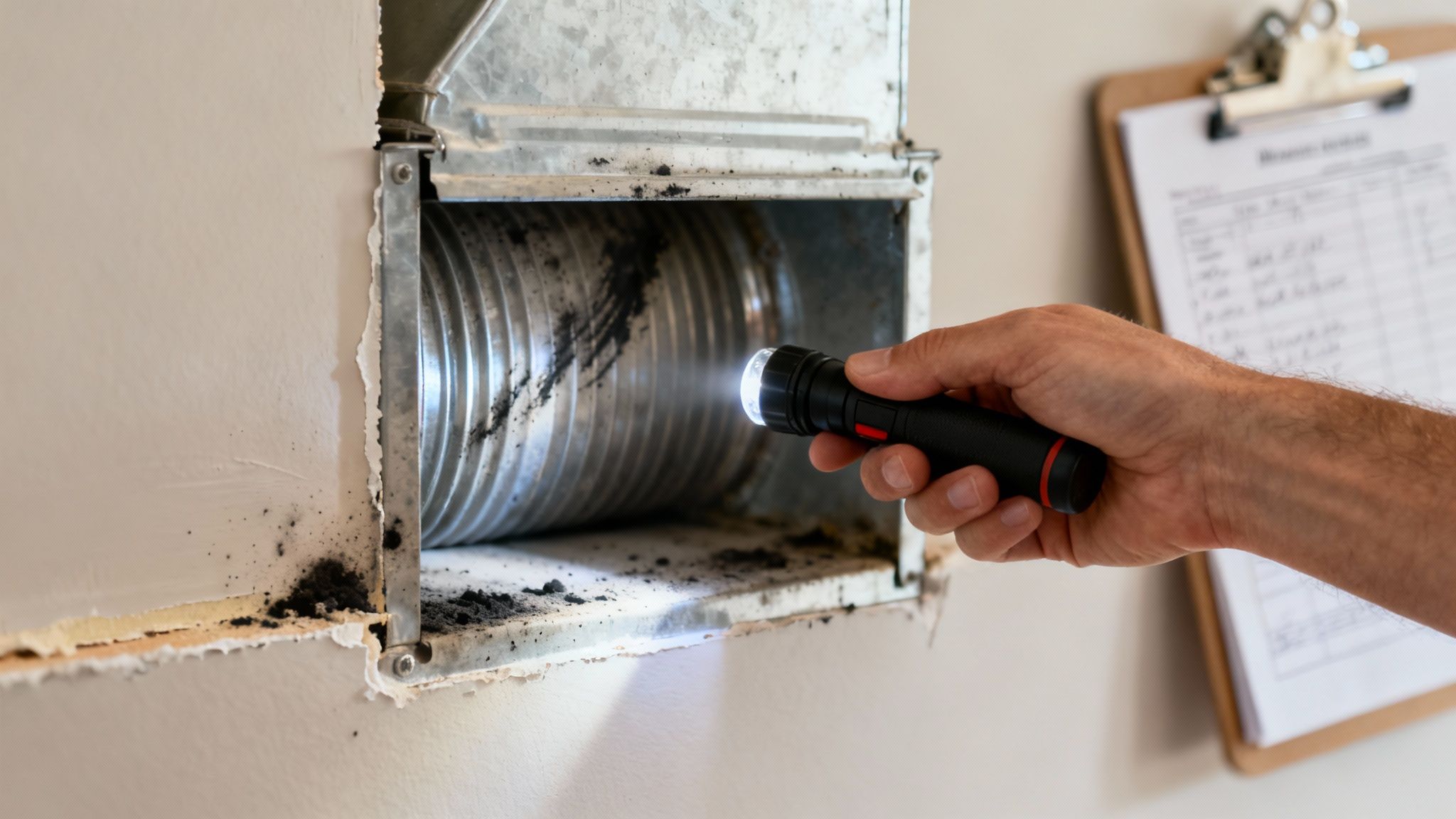
Get a good flashlight and a high-quality camera (your phone is fine) and start a systematic inspection. You’re creating a detailed video and photo log that proves just how far the smoke damage has spread.
- HVAC System: Pop off a few vent covers and stick your flashlight inside. You’ll likely see a greasy, black film coating the ductwork. Snap a picture. That’s undeniable proof that contaminants are being pumped throughout your home every time the system kicks on.
- Attics and Crawlspaces: Adjusters hate going into these spaces, but they act like giant sponges for soot and odor. Get up there and document any discoloration you see on the insulation, rafters, or any boxes you have stored.
- Behind Appliances and Fixtures: This is a classic move. Carefully pull out your fridge and washer/dryer. Take off a few light switch and outlet covers. The wall behind these items is often untouched, creating a perfect before-and-after picture that shows a stark contrast with the smoke-damaged surfaces around it.
You aren’t just taking pictures of a dirty wall. You’re building a narrative—a story of widespread contamination that proves a simple wipe-down won’t cut it.
Documenting Corrosive Soot and Lingering Odor
Soot isn’t just dirt; it’s highly acidic. It corrodes surfaces over time, causing permanent damage. You have to look for the subtle signs of this chemical warfare on your property.
Check your windows, mirrors, faucets, and even doorknobs for “soot etching.” It looks like a faint, cloudy film that you can’t clean off, no matter how hard you scrub. This is proof of permanent damage that requires full replacement, not just a cleaning fee.
Odor is just as real as a physical stain, even if it’s harder to prove with a photo. Walk through every single room and open every closet and cabinet. Make detailed notes about where you smell smoke. This documentation is crucial for justifying the need for professional, industrial-grade deodorization—a process far more involved than the can of air freshener the insurer will offer to pay for.
The insurance company’s adjuster is paid to minimize your loss. They will argue that the damage is just cosmetic or that it was there before the fire. Your detailed, specific evidence is the only weapon you have to dismantle their arguments and force them to pay what you’re actually owed.
The Power of An Independent Expert
Sometimes, even with a mountain of photos, the insurance company won’t budge. Their adjuster will look you in the eye and deny what’s right in front of them. When that happens, it’s time to call in a professional.
Hiring a certified industrial hygienist can be a game-changer. These experts perform scientific air and surface sample testing to prove, with data, that your home is contaminated and unsafe.
Their formal report gives you objective, third-party validation that the insurance company can’t easily dismiss. It turns the argument from your word against theirs into their opinion against scientific fact. While hiring an expert costs money upfront, it can pay for itself ten times over by forcing the insurer to cover the full cost of remediation—which often means replacing contaminated materials instead of just cleaning them. This directly impacts how much you get paid, which you can learn more about by understanding the critical differences between ACV vs. RCV in our detailed article.
How to Dispute a Lowball Settlement Offer
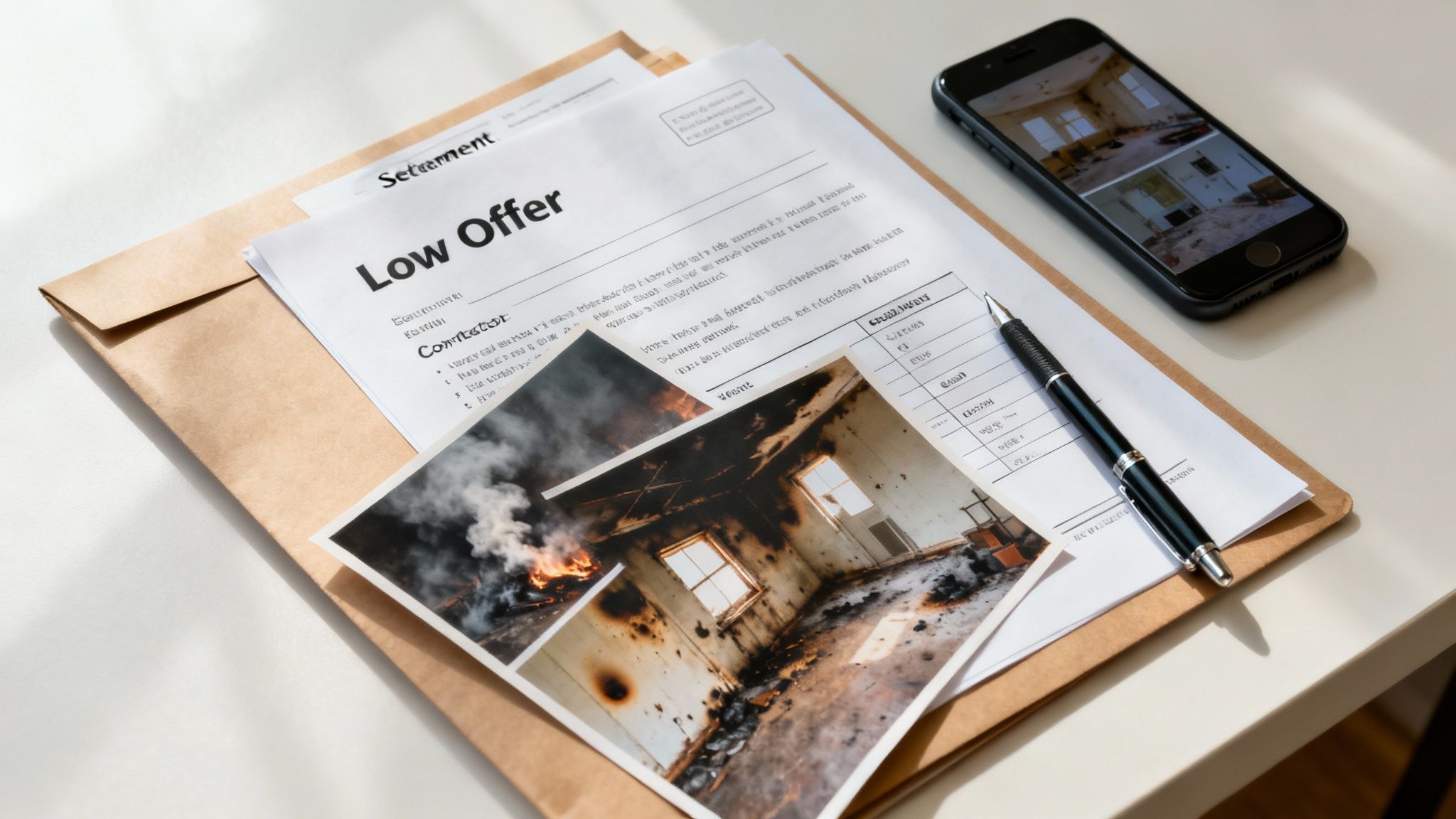
That first settlement offer from your insurance company can feel like a punch to the gut. After the trauma of a fire, getting an insultingly low number for your smoke damage insurance claim isn’t a mistake—it’s a calculated move by insurers like Allstate or State Farm.
They are banking on you being too exhausted, overwhelmed, and emotionally drained to fight back.
Accepting their first offer is exactly what they want you to do. But this isn’t the end of your claim; it’s the start of the real negotiation. Proving them wrong means building a strategic, evidence-based response that leaves them no room to wiggle out of their obligations.
Deconstructing Their Lowball Estimate
Your first move is to treat their estimate not as a fact, but as a proposal you need to tear apart. Demand a copy of their adjuster’s detailed breakdown—what they call a “scope of loss.” I guarantee you’ll find they’ve conveniently “missed” entire categories of damage.
Their estimate might have a line item for “surface cleaning” of walls but completely ignore the cost to seal those walls with a shellac-based primer to block permanent odors. It might offer a tiny allowance to clean your HVAC ducts but leave out the cost of replacing the contaminated insulation around them.
These are not innocent mistakes. They are deliberate omissions designed to save the company thousands of dollars at your expense. Your job is to create a side-by-side comparison with their lowball numbers on one side and the detailed, real-world quotes from your own trusted contractors on the other. This contrast is the entire foundation of your dispute.
Writing a Powerful Rebuttal Letter
Once you have your counter-evidence lined up, you must formally reject their offer in writing. A phone call won’t cut it—it creates zero paper trail. Your rebuttal letter needs to be professional, firm, and packed with proof.
Structure your letter methodically:
- State Your Position Clearly: Start by saying you are formally rejecting Settlement Offer #[Offer Number] dated [Date] because it fails to cover the full scope of damages.
- Present Your Evidence: Systematically contrast their findings with yours. Reference your detailed photo logs, your independent contractor estimates, and your comprehensive inventory of damaged property.
- Demand a Re-evaluation: End by demanding they re-evaluate the claim based on the substantial evidence you’ve provided and issue a revised settlement that actually reflects your documented losses.
Send this letter via certified mail with a return receipt. This gives you undeniable proof they received it and forces them to respond, creating a documented timeline that is absolutely critical if things escalate. Understanding how to negotiate with an insurance adjuster is a skill, and this letter is your powerful opening move.
Case Study: The Power of a Public Adjuster
A Virginia business owner suffered major smoke damage from a fire in the unit next door. The insurer’s initial offer was a pathetic $50,000, arguing the damage was mostly cosmetic. The owner hired For The Public Adjusters who immediately brought in an industrial hygienist. Air quality tests proved toxic soot had penetrated deep into the drywall, contaminated the entire inventory, and settled inside sensitive electronics. Armed with this scientific proof, the public adjuster reopened negotiations. The final settlement was $250,000—five times the original offer—covering full remediation, inventory replacement, and the business interruption losses their adjuster had completely ignored.
What if They Still Say No?
Even after you send a powerful rebuttal, some insurance companies will just dig in their heels. They might send back a letter that barely acknowledges your proof, offering only a token increase to their original insulting offer. This is a classic delay tactic meant to wear you down.
If they refuse to negotiate in good faith, it’s a clear signal you’re dealing with a company that has no intention of treating you fairly. At this point, you have two primary options: invoking the appraisal clause in your policy or escalating by bringing in a public adjuster or an attorney who specializes in fighting bad faith insurance practices.
Don’t let them wear you down. This is a marathon, not a sprint, and every documented step you take strengthens your position for the next phase of the fight.
Why You Need a Public Adjuster on Your Side
When a fire hits your property, your insurance company sends out an adjuster. You have to understand, right from the start, who this person actually works for. The adjuster sent by your insurer—whether it’s a big name like State Farm or a smaller carrier—has one job, and it isn’t to help you. Their primary loyalty is to the insurance company’s bottom line.
Their goal is to close your smoke damage insurance claim for the absolute minimum amount possible. They are not your advocate. A public adjuster, on the other hand, is a state-licensed professional you hire to represent you. This distinction is the single most critical factor in leveling a very uneven playing field.
Uncovering What the Company Adjuster “Misses”
It’s a classic tactic. The insurance company’s adjuster performs a rushed, surface-level inspection. They’ll document the obvious scorch marks and fire damage but conveniently ignore the insidious, invisible damage that smoke and soot leave behind. This isn’t an accident; it’s a deliberate strategy to undervalue your loss from the very beginning.
A public adjuster operates with a completely different mission. Their job is to hunt down and document every single trace of damage to force the insurance company to pay what you’re actually owed. They know exactly where to find the hidden damage that the company adjuster will “overlook”:
- Inside HVAC Systems: This is where toxic soot loves to hide, getting endlessly recirculated throughout your property long after the fire is out.
- In Attics and Crawlspaces: Insulation acts like a giant sponge for smoke, trapping odor-causing particles that are impossible to just “clean.”
- Behind Walls and Appliances: They prove the contamination isn’t just on the surface but has penetrated the structure itself.
- On Surfaces Prone to Etching: They identify corrosive soot damage on glass, metal, and sensitive electronics that require total replacement, not a simple wipe-down.
They don’t just look; they bring in experts like industrial hygienists to provide hard, scientific proof of contamination. This is the kind of evidence an insurance company can’t just ignore or dismiss.
Success Story From a North Carolina Homeowner
Let me give you a real-world example. A family in North Carolina had a kitchen fire that filled their entire home with thick, acrid smoke. The insurance company’s adjuster showed up, spent less than an hour on-site, and came back with a pathetic offer of $15,000 for what he called “cosmetic cleaning.” He insisted that a simple wipe-down and a fresh coat of paint would fix everything.
Feeling completely steamrolled, the family hired a public adjuster. The first thing that public adjuster did was bring in an industrial hygienist to take air and surface samples. The results were damning. Toxic soot had permeated deep into the home’s insulation and had thoroughly contaminated the entire HVAC system.
Armed with this irrefutable scientific report, the public adjuster reopened the fight. He proved that the insurer’s cheap “fix” was grossly inadequate and would have left the family living in a toxic home. The final settlement wasn’t $15,000. It was $120,000—enough money to properly remove the toxic materials, replace the entire HVAC system, and restore their home to a safe, pre-loss condition. That’s the difference an advocate makes.
Decoding Your Policy and Managing the Claim
Let’s be honest, insurance policies are dense legal contracts written by lawyers to protect the insurer, not you. The company adjuster is trained to interpret any ambiguous language in a way that limits coverage. A public adjuster knows these policies inside and out—and they know how to interpret every clause in your favor.
They take the entire brutal, stressful process off your shoulders. This includes:
- Documenting every single phone call and email to build an undeniable paper trail.
- Filing all the complex paperwork correctly and on time, so there are no technicalities to deny your claim.
- Meeting with the insurance company’s army of representatives on your behalf.
- Negotiating aggressively and relentlessly for a fair and full settlement.
A public adjuster is your professional advocate in a complex process dominated by the insurance company’s interests. They handle the fight so you can focus on recovery.
The Fee Structure: How Public Adjusters Get Paid
Reputable public adjusters work on a contingency fee basis. That means you pay them nothing upfront. Zero. They are paid a small, agreed-upon percentage of the final settlement after you get paid by the insurance company.
This is huge because it perfectly aligns their interests with yours. The more money they recover for you, the more they earn. This gives them every incentive to fight for every last dollar you are entitled to under your policy. If they don’t win you a settlement, you owe them nothing. It’s a completely risk-free way to get an expert on your side for your smoke damage insurance claim.
Fighting Back Against Bad Faith Delays and Denials
After a fire, you’re counting on your insurance company to be your safety net. But what happens when that net has a giant hole in it? What do you do when your calls go unanswered or your perfectly valid smoke damage insurance claim gets denied for a reason that makes absolutely no sense?
This isn’t just bad luck. It’s often a deliberate strategy, and it has a name: bad faith.
Big insurers like Allstate and State Farm didn’t become corporate giants by accident. Many have perfected a brutal playbook: “delay, deny, defend.” They drag their feet, issue baseless denials, and bury you in paperwork, all in the hopes of wearing you down. Their goal is to make you so financially and emotionally exhausted that you’ll accept a fraction of what you’re owed just to make it all stop.

This isn’t poor customer service. It’s a calculated business move designed to protect their profits at your expense. Learning to spot their tactics is the first step in fighting for the money you’re rightfully owed.
Recognizing the Red Flags of Bad Faith
Bad faith isn’t always a formal denial letter stamped with bold red letters. Most of the time, it’s a soul-crushing pattern of behavior meant to obstruct your claim at every turn.
If you’re seeing any of this, you’re probably dealing with an insurer who isn’t playing fair:
- The Ghosting Game: Your adjuster, who was so responsive at first, has suddenly stopped returning your calls and emails. Silence becomes their weapon.
- The Paperwork Merry-Go-Round: They keep asking for documents you’ve already sent. This isn’t disorganization; it’s a classic stalling tactic.
- “Creative” Policy Interpretations: They tell you something isn’t covered, even when a plain reading of your policy says it is. They’re banking on you not knowing the details.
- Vague Denials: They reject your claim without providing a specific, legitimate reason that directly references a section of your policy.
These aren’t honest mistakes. They are chess moves in a game you didn’t even know you were playing.
Your Most Powerful Weapon: The Paper Trail
When you suspect you’re getting the runaround, documentation becomes your superpower. You have to build an undeniable record that proves their pattern of unreasonable behavior. This means you must stop relying on phone calls. Conversations can be “misremembered,” denied, or conveniently left out of the claim file.
From this point forward, every single communication needs to be in writing.
After every phone call, immediately send a follow-up email that memorializes the conversation. It’s simple: “Hi [Adjuster’s Name], just to confirm our call today at 2:15 PM, you stated you would have an update on the contractor’s estimate by this Friday, [Date]. Please confirm if my understanding is correct.”
This one small step changes everything. It turns a casual chat into a documented commitment. It builds a timeline, holds the adjuster accountable, and creates the rock-solid proof you’ll need if you have to file a formal complaint or bring in professional help.
A landmark court case against a major insurer set a powerful precedent after they systematically delayed thousands of wildfire claims. The company was hit with millions in punitive damages, with the court ruling that their internal policies created an unreasonable and harmful delay for policyholders. This shows that courts will punish insurers for these exact tactics.
The financial pressure on these companies is real, especially as disasters get more frequent and costly. According to one report, recent natural catastrophes have triggered massive insured losses, forcing many insurers to double down on aggressive, anti-policyholder tactics to protect their bottom line. You can find more details on these catastrophe losses on insuranceindustryblog.iii.org.
Use Language That Forces a Response
In your written communications, your tone needs to shift. Be firm, be professional, but be absolutely clear. You need to use language that puts the pressure back on them and establishes non-negotiable deadlines. Stop asking. Start instructing.
Don’t say: “Could you please provide an update?”
Instead, write this:
“It has been 15 days since I submitted the contractor’s estimate, and I have not received a response. Per the terms of my policy and state regulations, I require a formal response regarding this estimate within the next 72 hours.”
This language shows them you know your rights and will not be passively ignored. By referencing their contractual obligations (your policy) and the law, you immediately escalate the seriousness of their delay. You’re sending a clear signal: I am building a case, and your continued inaction will have consequences.
If they still refuse to act responsibly, this documented trail of failure becomes the cornerstone of your argument when you bring in a public adjuster or an attorney to force their hand.
Common Questions in a Smoke Damage Claim Fight
When you’re reeling from a fire, the last thing you need is a claims process designed to confuse and frustrate you. But that’s often exactly what you get. Insurers know you’re vulnerable, and they use that to their advantage, throwing up delays and roadblocks. Here are the real answers to the questions homeowners and business owners are forced to ask when their smoke damage insurance claim goes sideways.
What Should I Do if My Insurance Adjuster Is Ignoring Me?
This isn’t an accident; it’s a strategy. Ghosting you is a classic bad faith tactic designed to make you give up. The second you realize your calls and voicemails are going into a black hole, you have to change your approach.
Stop calling. Start documenting.
Create a formal communication log, noting every single unanswered call. Then, you escalate. Send a certified letter—return receipt requested—to both the adjuster and their direct supervisor. State clearly that you’ve tried to make contact multiple times with no response and demand a real answer within a non-negotiable timeframe, like 48 or 72 business hours.
This move creates a paper trail that is undeniable proof of their behavior. If they still ignore you, you’re looking at a massive red flag. This kind of willful unresponsiveness is powerful evidence of bad faith and a clear sign it’s time to bring in a public adjuster to make them listen.
Should I Trust My Insurer’s Preferred Contractor?
Be incredibly skeptical. When companies like Allstate recommend a “preferred” contractor, it’s not because they do the best work. It’s because they have a cozy business relationship with the insurer and know how to write estimates that serve the insurance company’s bottom line—not yours.
This is a massive conflict of interest. Their real loyalty is to the company that keeps their schedule full, not to the property owner who needs their life put back together. Their mission is often to do the cheapest fix possible, not the right one.
You have the absolute right to hire your own contractor. Always get at least two detailed, independent estimates from trusted, local professionals. It’s the only way you’ll know if the insurer’s scope of work is complete and their offer is even in the ballpark of fair.
Can My Insurer Deny My Claim if Smoke Came From a Neighbor’s Fire?
This is a bogus denial tactic, and you need to fight it hard. The vast majority of standard homeowner (HO-3) and business policies cover damage from “smoke.” Period. The policy language almost never says the fire has to start on your property for the smoke damage to be covered.
When an insurer denies a claim on these grounds, they are deliberately misinterpreting their own contract to save money. Your first move must be a formal, written appeal that directly challenges their reading of the policy.
This is exactly the kind of fight a public adjuster is built for. They live and breathe complex policy language and can build a rock-solid case, citing the specific clauses in your contract that prove you’re covered. They use the insurer’s own fine print against them to get the wrongful denial overturned and your claim paid.
2. My denial cites "long-term, chronic" smoke damage instead of a "sudden and accidental" fire. How is this technicality challenged?
This distinction is a common bad-faith tactic. Insurers use "long-term, chronic" to suggest the damage (often from a furnace puff-back or slow electrical malfunction) is a non-covered maintenance issue or wear and tear.
How a PA Solves It: A PA retains an independent Forensic Engineer to produce a certified report. This report strategically argues:
Sudden Failure: The report determines if the mechanical malfunction was a sudden and unanticipated mechanical failure (which is covered), rather than gradual deterioration.
Date of Loss: The PA focuses on the date the widespread contamination was discovered, arguing that the resulting smoke infiltration and structural contamination was still a sudden event—the moment the property was rendered unsafe and functionally damaged.
3. If my claim is denied because my contractor's estimate is too high, how does a PA professionally rebut the insurer's low-ball estimate?
The insurer's low estimate is usually generated using proprietary software (like Xactimate) that omits key, high-cost line items.
A PA ensures a fair settlement through a three-step approach:
Forensic Scope: The PA uses a certified adjuster to generate an estimate using the same industry software (Xactimate), but with every necessary, high-value line item included that the insurer omitted (e.g., contents manipulation, specialty cleaning, demolition to access hidden framing damage).
Market Price Data: The PA integrates local, non-negotiable pricing data for specialized labor and materials, proving the insurer's line-item rates are too low for the specific North Carolina or Virginia market.
Initiate Appraisal: If negotiation fails, the PA invokes the Appraisal Clause in the policy—a contractual dispute resolution process where both parties hire independent appraisers who legally determine the final, binding cost of the loss.
4. Can I still hire a Public Adjuster in NC or VA if I have already received a final denial letter from the insurance company?
es, absolutely. A denial letter is not final. It simply means the insurer's internal adjuster has closed the file. A Public Adjuster is hired specifically to re-open, document, and negotiate claims that have been denied or underpaid.
In both North Carolina and Virginia, there are statutory time limits for litigation after a denial:
North Carolina (NC): The statute of limitations for breach of contract (suing the insurer) is generally three years from the date of loss.
Virginia (VA): The statute of limitations for contract is generally five years from the date of loss.
Hiring a PA after denial allows them to dedicate the available time to strategically gathering the specific forensic reports (air quality tests, engineering reports) needed to legally refute the insurer's exact denial argument.
5. What specific health-related evidence does a PA use to convert a "cosmetic" smoke claim into a high-value "life, health, and safety" claim?
Medical bills and the "Life, Health, and Safety" argument is non-negotiable under a homeowners policy. A PA will focus on evidence of respiratory hazards to have coverage extended for you to live somewhere else until the repairs are completed:
Medical Documentation: Securing a physician's or allergist's recommendation stating that the property is unsafe for occupancy until fully remediated, especially for household members with asthma, allergies, or compromised immune systems.
Soot/VOC Testing: Independent lab testing that confirms elevated levels of VOCs (Volatile Organic Compounds) and other combustion byproducts in the home, which are linked to chronic respiratory issues.
ALE (Additional Living Expenses): The PA will use the health risk to demand payment for ALE, arguing the home is uninhabitable until professional remediation (not just cleaning) is completed, thereby escalating the immediate cost of the claim.
6. The insurer only offered to clean my smoke-damaged contents. How does a PA demand replacement instead of restoration?
The claim for replacement hinges on "diminished value" and "unrestorability." The PA proves that for porous items, mere cleaning fails to restore the property to pre-loss condition:
Porous Materials (Furniture, Clothing, Books): The PA argues that acidic smoke odor is irreparably embedded in porous fibers and will be reactivated by humidity, heat, or cleaning chemicals, resulting in a permanent loss of functional value.
Electronics: The PA hires an independent Contents Expert to prove that acidic soot has penetrated the sensitive internal components of electronics and appliances, causing corrosion that significantly diminishes the expected lifespan or voids the original warranty. The only adequate remedy is Replacement Cost Value (RCV).
7. What are the key factors I should look for when choosing a Public Adjuster for a denied smoke claim?
When the stakes are high with a denial, you need a specialist, not a generalist. Look for these four pillars:
Expertise: PA staff with IICRC FSRT (Fire and Smoke Restoration Technician) certifications and a demonstrated history of utilizing Forensic Engineers and Industrial Hygienists as part of their standard procedure.
Experience: A PA with a track record of successfully reversing denial letters on large-loss claims, not just filing new ones.
Authoritativeness (Local): Verify their Public Adjuster license in NC or VA and look for demonstrated success dealing with the specific local insurance carriers that issued your denial.
Trustworthiness (Contract): An agreement based on a contingency fee and a "No Recovery, No Fee" clause, ensuring their compensation is tied directly to your success.
8. My insurer is delaying my claim response past the deadline. What regulatory action can a PA take in North Carolina or Virginia?
Both states have regulations against unfair claims practices, often called "bad faith" tactics. A PA weaponizes these deadlines to force a decision:
Virginia (VA): Insurers must advise the claimant of acceptance or denial within 15 calendar days of receiving a properly executed Proof of Loss. If more time is needed, they must send a written notice with reasons within that same 15-day window, and then update the claimant every 45 calendar days thereafter.
North Carolina (NC): Insurers must generally pay or deny a claim within 30 days of receiving a claim. If an investigation is needed, they must update the policyholder every 45 days thereafter.
The PA will formally document the insurer’s delay and use that evidence to pressure the carrier to expedite the claim, threatening a complaint to the State Department of Insurance (DOI) for an unfair claims practice violation.
9. Can a PA help me recover the full cost of temporary housing (ALE) if my home is deemed uninhabitable due to smoke odor and cleaning?
Yes. Additional Living Expenses (ALE) are a critical and often overlooked part of the claim. Insurers frequently try to cap or minimize ALE payments.
A PA ensures full recovery by:
Establishing Uninhabitability: Using the Health, Safety, and IICRC standards (as detailed in FAQ #5 and #6) to get a professional opinion that the home requires extensive, invasive remediation and is unsafe/unlivable.
Documenting Full Costs: Ensuring you are reimbursed for all reasonable, necessary expenses, including hotel costs, restaurant meals, laundry, temporary furniture storage, and even increased utility costs for the time it takes to complete the full restoration scope.
10. My policy has specific language excluding "loss caused by smudging from industrial operations." How does this relate to my kitchen fire smoke claim?
This is an example of an "exclusionary clause" that insurers may cite incorrectly.
A PA handles this by performing a forensic policy interpretation based on the specific facts of your loss:
Factual Causation: If your smoke damage originated from a fire within your home (kitchen fire, fireplace malfunction, electrical issue), the PA argues that the loss was caused by the covered peril of "fire" and the resulting smoke damage is a covered consequential loss.
The Intent of the Exclusion: The PA shows that the exclusion for "smudging from industrial operations" is intended to deny claims from external, non-covered sources like a nearby factory smokestack or controlled agricultural burning—not the covered fire peril that occurred within your insured property's walls. The PA forces the insurer to prove the exclusion applies, which they often cannot do.
When your insurance company’s tactics leave you feeling powerless, it’s time to get a professional advocate on your side. The team at For The Public Adjusters, Inc. fights exclusively for policyholders in North Carolina and Virginia, ensuring you get the full and fair settlement you deserve for your smoke damage insurance claim. Don’t let the insurer dictate the outcome—contact us for a no-cost claim review today.