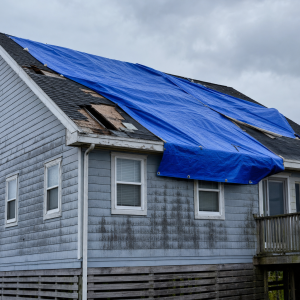
You wake up after the windstorm and the roof just looks wrong. A few shingles are lifted, a strip of flashing is bent, and now there's daylight showing in the attic where there wasn't any before. The carrier will still send someone who wants to treat that like a quick cosmetic repair, but wind damage on a roof is rarely just cosmetic, and that's exactly where homeowners get underpaid.
If you're dealing with roof damage from wind, the fight is not just about proving the storm happened. It's about proving causation, showing the loss pattern, and stopping the insurer from shrinking the claim into a patch job when the roof was compromised in a way that keeps leaking, spreads hidden damage, and can turn into a much bigger loss if it's handled badly.
Table of Contents
- What Wind Damage to a Roof Really Looks Like After the Storm
- Why Wind Fails a Roof Before It Blows One Off
- Wind Speeds and Damage Categories That Hold Up in a Claim
- How to Document Wind Damage Without Getting Denied on Causation
- How Insurers Low-Ball Wind Roof Claims and How to Fight Back
- Staff Adjuster vs Independent Adjuster vs Public Adjuster
- When to Bring in a Public Adjuster or Attorney in NC and VA
- Your Wind Damage Claim Action Plan and Free Claim Review
What Wind Damage to a Roof Really Looks Like After the Storm
The first mistake homeowners make is looking for a giant hole. Wind usually doesn't attack a roof like a hammer. It pries, lifts, peels, and loosens, and that means the worst damage is often spread across edges, seams, and fastener points rather than sitting in one dramatic spot.
That's why a roof can look “mostly fine” from the driveway and still be a valid claim. The problem is that the insurer's first look often happens fast, sometimes before the homeowner has even documented the attic, the flashing, the ridges, or the moisture path that starts the day the seal fails. A rushed inspection tends to under-scope the loss, and once that estimate is written, carriers act like it's the whole story.
A solid external reference for homeowners is the guide to roof insurance claims from Artisan Quality Roofing, because it reinforces the same core point, roofs don't need to be ripped off to be damaged by wind. The visible symptoms are often subtle, lifted tabs, bent metal, granule loss, loose sealant, and debris that tells you how the wind moved across the home.
Practical rule: if the roof looks “a little off” after a wind event, assume there's more damage than you can see from the ground until someone proves otherwise.
The telltale pattern is key. Wind damage typically manifests along a ridge, at a hip, at a rake, or around an edge zone where the roof assembly begins to lose its grip. Once that edge is compromised, water finds a path, and then the insurer starts calling it deterioration instead of storm damage unless the homeowner has already built the proof.
Why Wind Fails a Roof Before It Blows One Off
Wind doesn't need to rip the whole roof away to break coverage open. It only needs to defeat the roof system at its weak points. The three forces that matter are uplift pressure, lateral shear, and differential pressure, and those forces work on different parts of the roof assembly at the same time.
The edge zones take the punishment first
Eaves, rakes, hips, and ridges are where failure usually starts because the roof is most vulnerable there. That's where the suction is strongest, and that's where the sealant and fasteners lose engagement first. If you want a simple mental picture, think about prying open a paint can from one corner instead of lifting straight from the middle. The edge gives first.
A structural wind study summarized in the verified data shows why this matters. A Frontiers in Built Environment study of tornado-impacted residential damage found that up to 56% of houses in the EF1 to EF3 damage range suffered partial roof-framing failures, which shows wind can damage the load-bearing structure itself, not just shingles. Another structural wind study presented at the 13th International Conference on Applications of Statistics and Probability in Civil Engineering found that, if no wall-dominant opening exists, the mean proportions of roof sheeting loss and roof truss failures are negligible under a 500-year return-period wind speed, which underscores how design-level wind resistance is evaluated at the structural level. Frontiers study

Why the pattern matters more than the photo
Carriers get slippery when they spot a close-up of one missing shingle, as it makes the loss look tiny. They avoid discussing the chain reaction: broken sealant, lifted tabs, exposed underlayment, and water intrusion paths that don't show up until the next rain.
The best claim file doesn't just show damage, it shows how the damage spread. If the evidence is limited to one isolated spot, the carrier argues repair. If the evidence shows repeated loss across edge zones and components, the argument shifts toward systemic damage. That's the difference between a low repair number and a real scope.
Wind Speeds and Damage Categories That Hold Up in a Claim
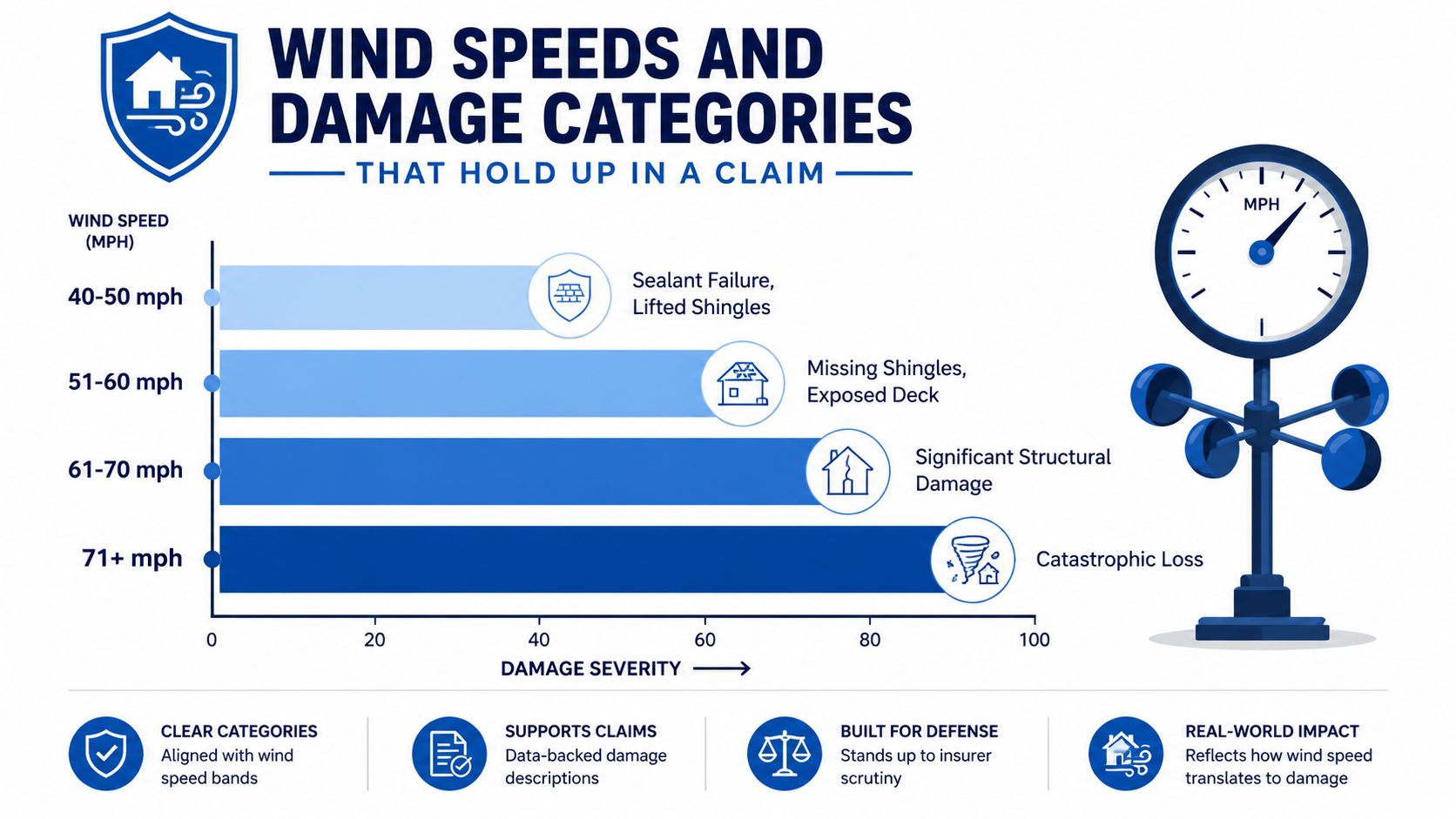
Homeowners need wind numbers, but they need them the right way. Speed alone doesn't win a claim. It supports causation. The damage pattern decides whether the insurer can credibly call it a localized repair or whether the loss has crossed into replacement territory.
What the wind bands mean in plain English
A technically relevant benchmark is that many roofing references treat 60 mph and higher as wind speeds where wind-induced damage becomes credible. In that same technical framing, 60 to 85 mph is associated with substantial shingle loss and possible structural damage, while above 85 mph is associated with catastrophic roof failure. Wind-related sealant failure and lifted shingles can start around 45 to 50 mph, which is exactly why a roof can be damaged without a dramatic blow-off event. RoofAdvance wind damage reference A-Rite wind damage guide
How to translate speed into claim value
Think in two layers. First, was the wind strong enough to cause the type of failure you're showing? Second, did the damage stay isolated, or did it spread across the roof system? That second question matters because isolated repair is more defensible when damage is limited to fewer than 3 contiguous squares and flashing or ridge cap components remain intact, while broader damage patterns or structural displacement point toward replacement-level loss. National Roofing Authority wind damage guidance
Insurers also try to hide behind age and depreciation. Don't let them. The key questions are whether the roof still has meaningful service life, whether matching can be achieved, and whether local code forces more than a simple patch. If those issues are ignored, the carrier is not evaluating the loss. It's trimming it.
Bottom line: wind speed supports your cause of loss, but the scope of damage determines what you get paid.
A homeowner with a wind-damaged roof should not ask, “Was the storm strong enough?” The better question is, “Does the damage pattern prove the storm broke the roof system?” That's the question the carrier will fight hardest to avoid answering.
How to Document Wind Damage Without Getting Denied on Causation
The carrier's favorite defense is causation denial. They'll say the roof was old, brittle, poorly maintained, or already failing, then use that story to avoid the central question. Document like an investigator, not like a panicked homeowner, and you give them less room to play that game.
Build the claim file before anyone starts arguing
Start from the ground. Take wide photos of the full roof slope, then move in to the edges, rakes, ridges, valleys, flashing, and anything that looks bent, lifted, or detached. Then go into the attic in daylight and look for daylight through decking, moisture staining, damp insulation, and any sagging or streaking that suggests water entered after the storm. A clear attic view can carry as much weight as what you capture outside.
Use a weather record and a timeline. Save the storm date and time, write down what you heard, and keep screenshots or reports that show the wind event. Add contractor markup notes if a roofer spots lifted shingles, missing tabs, exposed nails, or other damage the insurer may try to wave off later. If you need a separate inspection before the carrier shows up, use property inspection services to get a documented look at the roof before evidence disappears.
- Ground-level photos: capture the whole slope first, then move in close to the edges, ridges, and valleys.
- Video walkthrough: narrate what you see, including debris direction, bent metal, and any lifted tabs.
- Interior proof: photograph attic daylight, ceiling staining, wet insulation, and any fresh moisture path.
- Storm context: save weather records and local news coverage that match the time and direction of the wind.
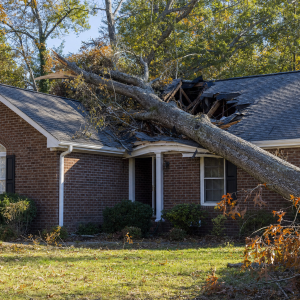
- Collateral damage: photograph downed trees, broken fencing, and debris patterns that support wind direction, because inspectors are supposed to compare the wind's magnitude and direction with the location and extent of the distress, not just glance at the shingles. ASCE/AMS paper
The GAF roof-storm-damage guide is useful because it names the concrete indicators carriers can't easily wave away, missing shingles, cracked or curled shingles, dark patches from granule loss, bent or detached flashing, and debris on the roof. It also warns that bare patches can dry out asphalt over time and lead to leaks. GAF roof storm damage guide
Never get on a wet or suspect roof just to satisfy an insurer. Use binoculars or a drone if you have to, and let a pro climb if there's any doubt about structural integrity.
How Insurers Low-Ball Wind Roof Claims and How to Fight Back
A wind claim usually does not get denied in plain English. It gets underpaid in a neat little estimate that leaves out the actual work, then the carrier waits to see whether you know enough to challenge it. The insurer trims the scope, calls obvious damage cosmetic, buries code-related items, loads depreciation, and pushes matching problems back on you.
The common low-ball moves
The first move is the cosmetic-only scope. The adjuster writes for a few shingles and acts like the roof is fine, even when the damage pattern points to broader loss or hidden exposure. The second move is the code dodge. If local building rules require upgraded materials or installation methods, the carrier tries to treat those line items like optional extras.
Depreciation is another favorite. If the policy pays actual cash value, the insurer cuts the number hard and leaves you to cover the gap. Then comes the matching fight, where they try to repair one slope or one side of the roof even though the roof cannot be matched in a clean, defensible way.
Strong rule: never accept the first scope as final. The first estimate is usually the insurer's opening move, not the true repair cost.
What to use to push back
You do not beat these tactics with frustration. You beat them with proof.
- Local building code citation: use it when they ignore required upgrades or refuse to scope code-driven work.
- Manufacturer matching bulletin: use it when the carrier wants to patch one section and pretend the appearance does not matter.
- Contractor photo log: use it when you need a clean visual record of lifted tabs, edge failure, exposed decking, or widespread patterning.
- Independent engineer opinion: use it when the carrier's engineer never really inspected the roof or wrote the loss off as wear before measuring it properly.
A public adjuster matters here because the fight is usually won or lost in the rescope. The carrier's first number often misses line items, misses the repair path, or pretends the damage is smaller than it is. A strong re-presentation of the evidence can change the money without changing the facts.
For homeowners who want a clearer breakdown of who is really working for whom, the internal guide on insurance adjuster vs public adjuster lays out the conflict plainly.
Where policyholders lose the most money
They lose it by treating the first offer like a verdict. That is how a wind claim turns into an out-of-pocket problem, not because the roof was not damaged, but because the homeowner did not force the carrier to defend its scope.
Staff Adjuster vs Independent Adjuster vs Public Adjuster
A wind claim is not a fair fight if the carrier controls the inspection. The person standing on your roof, writing the scope, and deciding what gets counted is usually deciding how much money you get.
Who they work for
A staff adjuster works for the insurance company. That adjuster protects the carrier's file first, because that file is the basis for the payout decision. An independent adjuster may sound separate, but the carrier still hires and pays that person for the claim, so the pressure points still favor the insurer. A public adjuster is the only one in that group hired by the policyholder to document, scope, and negotiate the loss on the homeowner's side.
That difference changes everything that happens next. It affects what gets photographed, whether the attic gets checked, whether the ridge and edges are measured correctly, whether lift, creasing, or collateral damage are included, and whether the estimate reflects the work needed to make the roof whole. The carrier's adjuster builds the carrier's version of the file. Your representative builds the record that should have existed from the start.
The clearest breakdown for homeowners is the internal guide on insurance adjuster vs public adjuster, because it lays out who answers to whom. Once that is clear, the adjuster's estimate stops looking neutral.
Why the moment matters
The first number is where carriers try to win the claim. That number tells you what they think the wind did and what they think it is worth. If you accept it without a counter-scope, you are usually fighting from a weak baseline.
Staff adjusters and carrier-hired independents also know the usual shortcuts. They can focus on the few obvious shingles, ignore the broader pattern, call wind damage “wear,” and leave out the items that drive the actual repair cost. That is how a claim gets boxed into a low scope before the homeowner realizes the game has started.
A public adjuster changes that dynamic by forcing a proper reinspection, a better estimate, and a cleaner record of causation. For The Public Adjusters, Inc. is one option for homeowners who want direct representation. It is a licensed public insurance adjusting firm that represents policyholders in documenting and negotiating property damage claims, including wind and hail losses, and it provides no-cost claim reviews.
When to Bring in a Public Adjuster or Attorney in NC and VA
Bring in help before the file hardens. If the carrier denies the loss as pre-existing wear, underpays code-required repairs, sends someone who never properly inspects the roof, or drags the claim past its own stated timeline, the fight has already started. Waiting only gives the insurer more room to frame the story its way.
The trigger points that matter
North Carolina and Virginia both have claim-handling rules and prompt-pay expectations that carriers are supposed to follow, and those rules matter most when the insurer starts delaying supplements or stalling on a proper reinspection. In storm seasons, especially after tornadoes and hurricanes across the Carolinas and the Piedmont, carriers often lean hard on staff engineers and quick denials because volume gives them cover. That's exactly when homeowners need assertiveness, not patience.
A public adjuster is usually the right first escalation when the loss is clearly more than a simple repair, but the carrier is acting like it isn't. An attorney becomes more relevant when there's a hard denial, a coverage fight over policy language, or a bad-faith style delay that won't move without legal pressure. The point is not to wait until the relationship is broken. The point is to stop the carrier from controlling the record.
The internal article on homeowners insurance claim lawyers in NC is a useful companion if the claim has already gone sideways.
Practical rule: if the adjuster never climbed the roof, or the estimate ignores the real repair scope, escalation isn't dramatic. It's necessary.
The homeowners who do best usually don't argue every point themselves. They bring in someone who knows how to read the scope, challenge the denial, and force a proper inspection before the gap gets too wide to close.
Your Wind Damage Claim Action Plan and Free Claim Review
Stabilize the roof without destroying evidence. Document the roof the way the carrier's engineer will document it, pull the policy and read the wind and replacement-cost language, and don't give a recorded statement until the facts are organized. If the first estimate is thin, treat it like an opening offer and get a second set of eyes on the scope before you sign anything.
A carrier's adjuster is working the file the day after the storm. You need to be working it too, because time helps the insurer build a clean denial story if you let the record go stale. Get the photos, the weather proof, the attic evidence, and the repair opinions lined up now, not after the gap gets bigger.
Have your water damage claim questions answered at NO COST. Call 919-400-6440 to speak with a licensed Public Insurance Adjuster or Contact Us here with questions. WE Work For YOU… NOT Your Insurance Company!
For The Public Adjusters, Inc. handles wind roof claims by documenting the damage, challenging weak scopes, and pushing back when the carrier tries to low-ball the loss. If your roof was hit by wind and the first offer doesn't match the damage, visit For The Public Adjusters, Inc. and get the claim reviewed before you accept a number that leaves repairs unfinished.