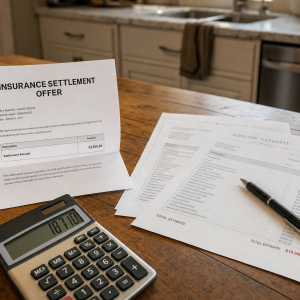
Your home suffers a fire or large water damage claim. Other times a severe storm blows through the Triangle, the roof starts leaking. Next, the insurer’s first check shows up looking neat on paper and useless in real life. It won’t cover the contractor’s deposit, the code items, or the hidden damage that sits behind the drywall, so the gap falls back on the homeowner or business owner. That’s the moment many begin looking for a public adjuster North Carolina policyholders can truly rely on, because the carrier has its own adjuster and you need someone on your side to push back on the numbers.
In North Carolina, this isn’t some fringe move. Public adjusting is a regulated, licensed profession, and the state’s fee limits are designed so the insured keeps most of the recovery while still getting representation. For policyholders from Winston Salem, through Raleigh, Apex, Wilmington, to Jacksonville, the coast, and everywhere in between, the question isn’t whether the carrier has a team. It’s whether you want to meet a low-ball offer with a quote and hope, or with a licensed advocate who knows how these claims get squeezed.
Table of Contents
- When the Insurance Company’s Offer Is Not Enough
- What a Public Adjuster Actually Does in North Carolina
- Claim Types We Handle Across North Carolina
- Why Hiring a Public Adjuster Usually Pays for Itself
- The Claims Process From First Call to Final Check
- Insurer Tactics That Shrink NC Claims and How to Respond
- A North Carolina Case Study and What the Courts Have Said
- How to Choose the Right Public Adjuster in NC and Take the Next Step
When the Insurance Company’s Offer Is Not Enough
A homeowner in Apex gets a wind and hail estimate after a storm, and the check looks clean until the roofer explains the missing pieces. There’s no money for upgraded materials, no realistic line for hidden damage, and the depreciation hit makes the number even thinner. The same thing happens to a small business owner in Raleigh after a fire or a landlord on the coast after a storm, the carrier sends an offer that sounds final, but doesn’t get the building back to pre-loss condition.
That gap is where a public adjuster earns the fee. The insurance company sends its own adjuster, and that person is there to evaluate the claim under the carrier’s guidelines, not to protect the policyholder’s bottom line. A policyholder-side adjuster does the opposite, documenting the loss, testing the policy language, and forcing the conversation back to what’s owed.
Practical rule: If the first offer doesn’t let you hire the right contractor and cover the real scope, the claim isn’t done, it’s underdeveloped.
Homeowners often ask whether bringing in representation turns the claim into a fight. It doesn’t. In North Carolina, public adjusting is a normal, regulated response to a disputed claim, the same way hiring a CPA is normal when the tax numbers don’t make sense. If you need a broader homeowner example of how storm damage can affect coverage questions, the guide for Atlanta homeowners on tree insurance is useful context because tree, roof, and structural loss issues often overlap with the same kind of coverage disputes.
The smart move is to stop treating the insurer’s first number like a verdict. It’s a starting position, and sometimes a very aggressive one. The rest of this article lays out what a public adjuster does in North Carolina, what claim types are most common, what the fee looks like, and how to tell the difference between a real advocate and someone just chasing storm damage.
What a Public Adjuster Actually Does in North Carolina
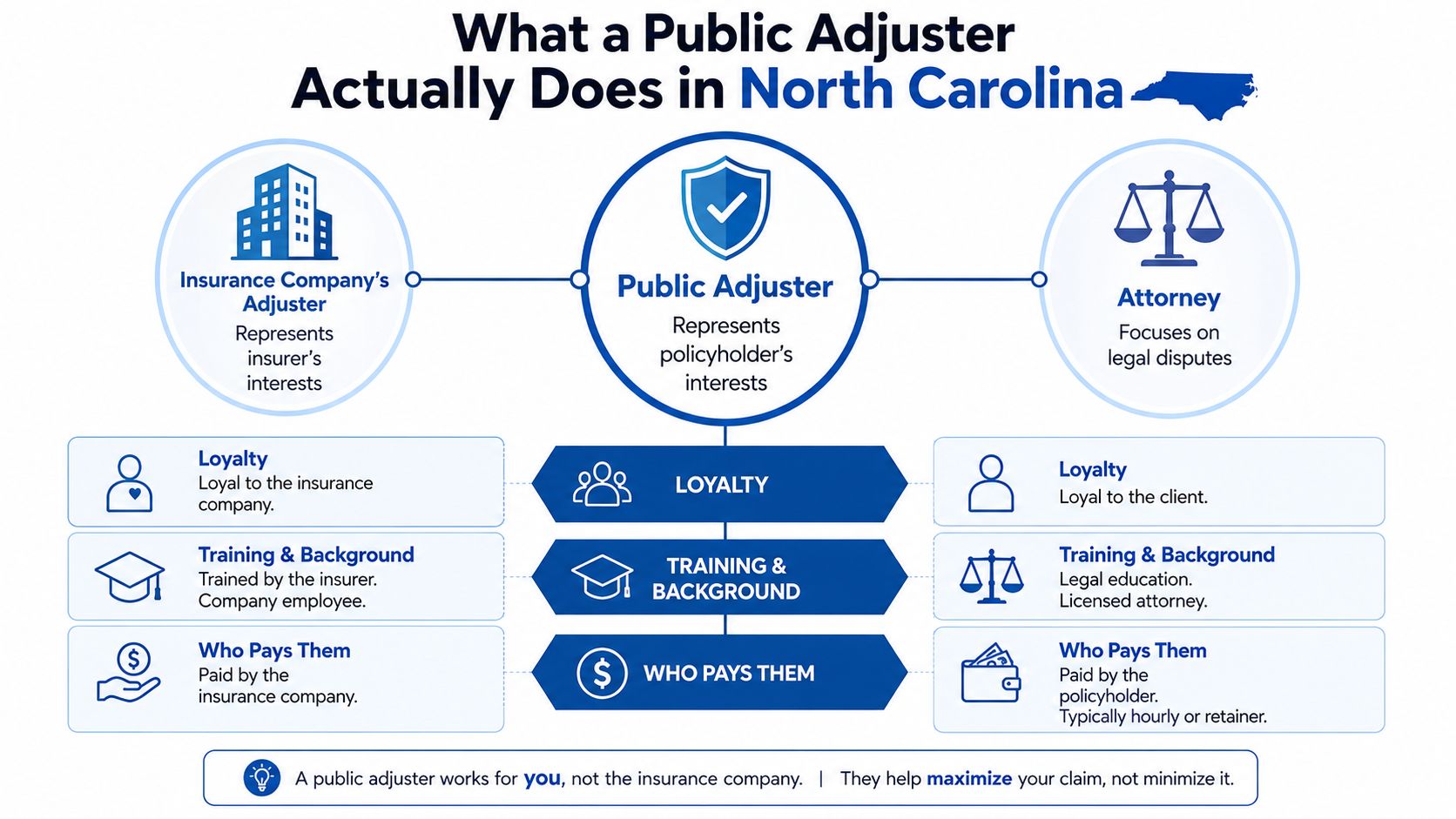
A public adjuster is the policyholder’s claims professional. That means they inspect the damage, read the policy, build the estimate, and negotiate with the insurance company for the insured, not for the carrier. The insurer’s adjuster works for the insurer, and that difference matters every time a line item gets cut or a denial letter leans on vague policy language.
The legal difference in North Carolina
North Carolina law is strict about who can call themselves a public adjuster. A person or business entity can’t act or hold itself out as a public adjuster without a license, and a business entity must designate a licensed public adjuster responsible for compliance with North Carolina insurance laws and regulations. The statute also bars public adjusters from misrepresenting themselves as insurer representatives, which is exactly why license and authority checks matter before anyone signs a contract.
Resident applicants must pass the state exam, and the Department of Insurance says resident individuals applying on or after 7/1/2010 must also submit fingerprints for state and federal background checks. Nonresident public adjusters must provide a $20,000 surety bond or irrevocable letter of credit, and annual renewal is required by March 31. The license search is public, so policyholders can verify authority before letting anyone onto a claim.
A real public adjuster should be easy to verify, easy to talk to, and clear about who they represent.
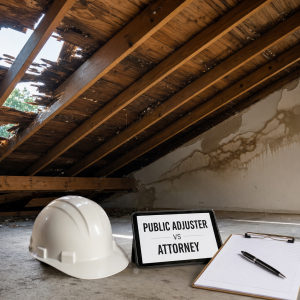
Public adjuster versus attorney
A public adjuster negotiates the claim. An attorney steps in when the dispute moves into legal conflict, litigation, or a statutory fight that needs court action. In practice, many property disputes never need a lawsuit, they need a well-built loss file, a tougher estimate, and a negotiator who knows how carriers try to narrow coverage.
For a plain-English comparison, the internal guide on whether to should I hire a public adjuster is a useful companion read. The short version is simple, if the problem is the size, scope, or handling of the claim, a public adjuster is often the first call. If the problem has become a legal dispute, the path can shift to counsel.
Claim Types We Handle Across North Carolina
Storm season in North Carolina doesn’t show up in one clean category. A single loss can involve wind-driven roof damage, water intrusion, torn gutters, wet insulation, and smoke or soot if the structure also had a fire event. That’s why policyholder-side adjustment has to stay practical, not theoretical.
The common losses that get undercounted
Wind damage from hurricanes, tropical storms, and straight-line winds often gets minimized when the visible shingles look better than the decking underneath. Carriers tend to focus on what they can see quickly, while a proper scope looks for lifted materials, hidden leaks, and the downstream damage that follows.
Hail damage usually gets treated like a surface issue until a close inspection shows bruised roofing, fractured components, or collateral exterior damage. Fire and smoke damage is a different kind of problem, because the loss is often bigger than the flame path. Smoke moves through insulation, cavities, HVAC, contents, and finishes, and those items are easy for an insurer to underwrite too narrowly.
Water and burst-pipe damage are where documentation usually makes or breaks the recovery. Adjusters on the policyholder side document moisture migration, affected materials, and the difference between a quick dry-out and a true repair scope. Tornado damage often combines several of these issues at once, especially when wind, debris, and structural impacts hit the same property.
Flood claims need separate attention
NFIP and Write-Your-Own flood claims deserve their own lane. Those claims follow a different framework than ordinary homeowners losses, and the policyholder can run straight into narrow readings of cause, scope, and timing if the file isn’t built carefully. That’s one reason flood disputes feel so frustrating, the rules are different, the adjusters are different, and the denial logic can sound confident even when it’s incomplete.
Theft and vandalism are easier to underestimate than people think, especially when contents, repairs, and replacement documentation are scattered across rooms or inventory lists. A public adjuster builds the record around what was lost, not just what was stolen on paper.

Why Hiring a Public Adjuster Usually Pays for Itself
North Carolina caps public adjuster fees at 15% of the claim recovery, with a 10% cap on catastrophic-event fees, and there’s no pre-settlement retainer in the way many people assume. That structure matters because the policyholder doesn’t have to write a check upfront just to get claim help. The fee comes from the recovery, not from your pocket before the dispute is resolved.
The question isn’t whether a fee exists. The question is whether the fee buys back money that the carrier would otherwise leave off the table. In real claims, that gap usually shows up in code-upgrade items, debris removal, contents valuation, depreciation strategy, and overlooked repair components that a rushed estimate leaves behind.
The economics are simple
A carrier’s first offer is often built to move the file, not to fully rebuild the loss. A public adjuster slows the process down enough to document what was missed, then pushes the numbers to match the scope. If the recovery increases because the claim is fully developed, a contingency fee can still leave the insured better off than accepting a quick, thin payment.
North Carolina’s market is also relatively small. The Department of Insurance reported about 55 licensed public adjusters active in 2024 and noted three disciplinary actions in 2023, which tells you two things at once, the field is credentialed, and you still need to vet who you hire. That’s why price shopping alone is a mistake. Experience, claim type, and the ability to hold ground with carrier adjusters matter more than the cheapest pitch.
For a closer look at how fees are usually structured, the internal breakdown on public adjuster cost NC is worth reading before anyone signs.
Bottom line: In a serious property claim, the fee is a percentage of the recovered amount, not an extra bill layered onto a fair settlement.
The Claims Process From First Call to Final Check
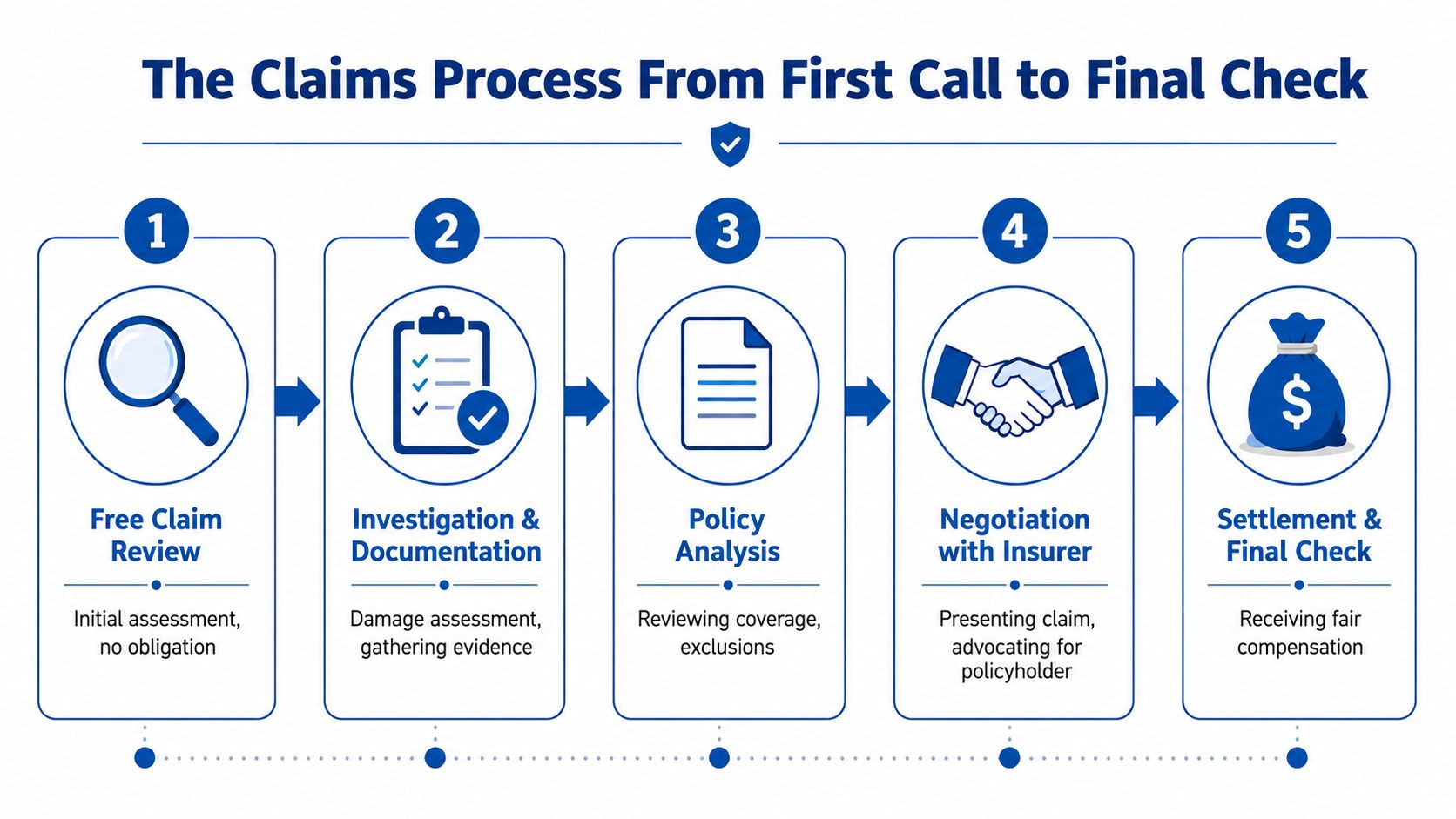
The cleanest claims files don’t start with paperwork, they start with a hard look at the damage and the policy. That first call should be a no-cost conversation about the loss, the denial, the underpayment, or the missing pieces in the carrier’s estimate. From there, the process should get more detailed, not more confusing.
What happens after the call
- Free claim review. The policy and the first estimate get reviewed for obvious misses, exclusions, and weak spots. A policyholder finds out whether the claim is slow, or whether it’s being underpaid on purpose.
- Inspection and documentation. The property gets photographed, measured, and scoped. For fire and water losses, that often means documenting hidden damage, moisture paths, soot movement, and affected contents in a way the carrier can’t wave away.
- Estimate and policy analysis. The adjuster builds a detailed claim package, usually using the same kind of estimating logic the insurance side understands. That keeps the fight on the facts instead of on vague opinions.
- Negotiation with the insurer. The file gets presented, supplements get submitted, and any partial denial gets challenged line by line. The point isn’t to argue loudly, it’s to make the carrier defend each cut.
- Settlement and final check. Once the recovery is resolved, the contingency fee comes out of the final settlement, and the insured gets the balance.
The internal timeline guide at NC insurance claim timeline helps policyholders understand why delays happen and what a normal back-and-forth looks like.
Insurer Tactics That Shrink NC Claims and How to Respond
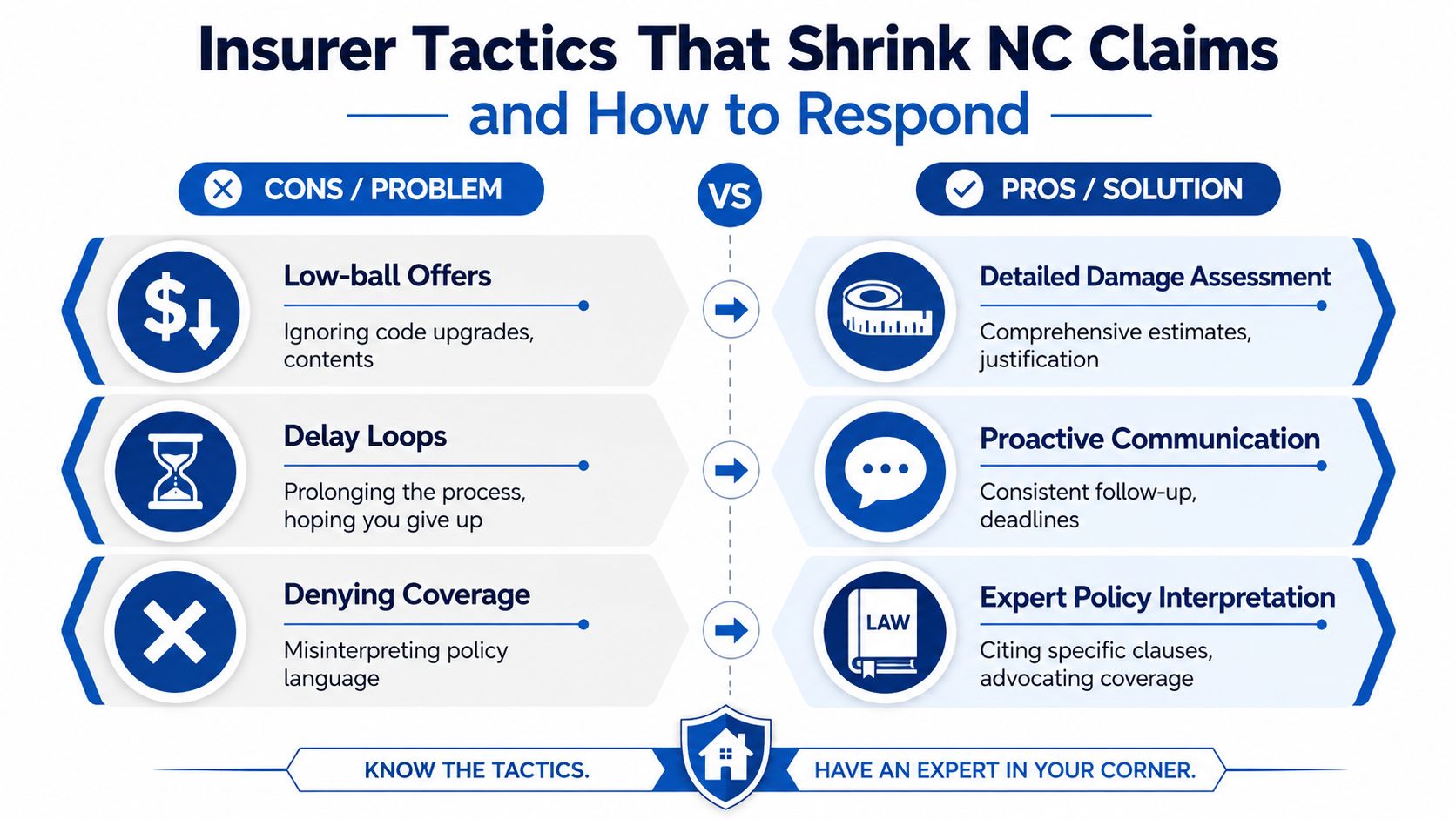
Low offers usually don’t arrive with an apology attached. They arrive with clean formatting, a partial scope, and just enough detail to make the insured feel like the number must be right. The move works because many individuals don’t know where the estimate was shaved, especially when the carrier leaves out code items, contents, or the hidden side of the damage.
The tactics to watch for
Low-ball offers are the most obvious move, and they’re often paired with pricing that ignores real contractor costs or structural repairs. The response is to rebuild the claim from the damage outward, not from the insurer’s spreadsheet inward.
Delay loops are more common than most policyholders expect. A new adjuster gets assigned, another document is requested, or the carrier asks for yet another inspection while the clock keeps running. The response is steady follow-up, written deadlines, and a clean paper trail that shows the insured kept cooperating.
Partial denials usually lean on wear and tear, maintenance, or “pre-existing” language. That’s where the policy language has to be read tightly, because the insurer’s first explanation is often broader than the actual exclusion.
Recorded statements can become a trap when they’re pushed too early or framed as routine. A policyholder should know what the carrier is really asking before giving up facts that can be taken out of context later.
What a policyholder-side response looks like
- Document every cut: Match the carrier estimate to the actual damage and mark what’s missing.
- Don’t rush a signature: Releases, AOBs, and contractor agreements should be reviewed before anyone signs.
- Push back in writing: Keep the dispute factual and organized, not emotional.
- Get policy language checked: Coverage fights are won on the wording, not on the carrier’s summary.
A good way to think about insurer behavior is to look at how claims management affects financial pressure across the industry. The guide to insurance underwriting health is useful context because the insurer’s business incentives help explain why many files get managed tightly, especially when losses are large.
You’ll hear the same complaints around big-name carriers like State Farm, Allstate, Liberty Mutual, and Universal Property. The lesson isn’t that every claim is bad, it’s that the policyholder needs someone who knows how these companies trim scope, stretch timelines, and defend denials when the file is weak.
A North Carolina Case Study and What the Courts Have Said
A homeowner brought in a fire and smoke claim after the insurer’s first offer came in short on the interior, contents, and cleanup scope. The early estimate treated the loss like a surface repair, but the actual damage reached farther into materials, odor remediation, and finish replacement, so the file had to be rebuilt from the ground up. For The Public Adjusters, Inc. re-inspected the property, documented the missing scope, and negotiated from a more complete record, which is how an underpaid claim gets turned into a defensible settlement rather than a guess.
That kind of result isn’t magic. It comes from matching the damage to the policy, then refusing to let the insurer define the loss too narrowly. On fire and smoke claims especially, the turning point is often the documentation the carrier skipped the first time around.
North Carolina law gives policyholders another important tool, the courts. In Gray v. North Carolina Insurance Underwriting Association, the North Carolina Supreme Court confirmed that an insurer who unfairly low-balls a homeowner’s claim can face liability under the state’s Unfair and Deceptive Acts and Practices Act. That matters because it puts legal weight behind the idea that a low offer is not just frustrating, it can cross into actionable conduct when the facts support it.
When a carrier trims the scope without a real basis, the dispute can move from a billing argument to a legal exposure problem.
Public reviews matter here too. A claim file can sound impressive in a sales pitch, but policyholders should look at what real customers say after the settlement, not before it. That’s where patterns show up, whether the firm communicates clearly, stands up to adjusters, and follows the loss through to the end.
How to Choose the Right Public Adjuster in NC and Take the Next Step
Start with the license. North Carolina’s Department of Insurance public search should tell you quickly whether the person or business is authorized to act as a public adjuster. If someone can’t pass that basic check, don’t let them near your claim file.
The vetting checklist that matters
- Verify the license: Confirm the adjuster is licensed in North Carolina, not just “working with” someone who is.
- Get the fee in writing: The agreement should show the contingency fee clearly and stay within the state limits.
- Check for a retainer: There should be no pre-settlement retainer for a normal public-adjuster engagement.
- Ask who will inspect the loss: You want to know whether the licensed adjuster is the one handling the claim, and whether they understand fire, water, or other specialized losses.
- Read reviews carefully: Look for consistent comments about communication, follow-through, and claim handling, not just star ratings.
A few red flags should stop the conversation fast. Door-knocking right after a storm, pressure for an upfront fee, and anyone who says they work for the insurance company are all bad signs. A real public adjuster is transparent about role, license, and fee.
For policyholders who want a local team, For The Public Adjusters, Inc. serves residential and commercial claims from Apex and across North Carolina and Virginia, with support on fire, smoke, water, wind, hail, hurricane, tornado, theft, vandalism, and flood disputes. They also offer no-cost claim reviews and hands-on help when the carrier is delaying, underpaying, or denying a property claim.
2. Why shouldn’t I just use the "Adjuster" provided by my insurance company?
The insurance company’s adjuster has a fiduciary duty to the carrier, not to you. There are three types of adjusters: Staff Adjusters (employees of the insurer), Independent Adjusters (contractors hired by the insurer), and Public Adjusters (hired exclusively by the policyholder). A Public Adjuster is the only professional licensed to advocate for your interests. In NC and VA, the "best" adjusters act as your claims quarterback—managing everything from forensic damage assessments to negotiating "Law & Ordinance" upgrades that staff adjusters frequently overlook.
3. Is it legal for my roofing contractor in VA or NC to negotiate my insurance claim?
No. In both North Carolina and Virginia, it is a crime for a contractor to negotiate an insurance claim; this is known as the Unauthorized Practice of Public Adjusting (UPAL). In Virginia, under Va. Code § 38.2-1845.1, only licensed public adjusters or attorneys can legally represent a policyholder in a claim. If your contractor is "handling the insurance," your claim could be voided for fraud, and you lose all legal leverage. The best practice is to have your contractor identify the damage and your Public Adjuster negotiate the settlement.
4. How much do the best public adjusters charge in NC and VA?
Public adjusters typically charge a contingency fee ranging from 10% to 20% of the total settlement, but specific state caps apply during disasters.
In North Carolina: Following a declared State of Emergency (like a hurricane), fees are often capped at 10% of the claim proceeds. The best public adjusters near me in NC cannot charge upfront "file fees" or "inspection fees," which are against NC State Statutes.
In Virginia: Fees must be "reasonable" and are clearly outlined in the written contract required by state law. The "best" adjusters provide a transparent fee schedule and do not charge upfront "file fees" or "inspection fees," which are red flags of predatory firms.
5. Can a public adjuster help me if my claim was already denied or "lowballed"?
Yes. A public adjuster’s primary value is in "reopening" claims where the insurer issued a partial payment or a full denial based on "wear and tear." In the Piedmont and Coastal regions of NC and VA, insurers often blame storm damage on age. A top-tier public adjuster will hire an independent engineer to provide a "Causation Report" that proves the storm was the primary "proximate cause," forcing the insurer to acknowledge coverage under the NC/VA Standard Fire Policy guidelines.
6. What is the "Appraisal Clause," and why does my local public adjuster use it?
The Appraisal Clause is a powerful alternative dispute resolution tool found in most NC and VA policies used to settle "amount of loss" disputes without a lawyer. If you and the insurance company disagree on the cost of repairs, your Public Adjuster can invoke Appraisal. This involves two independent Appraisers and a neutral Umpire. In North Carolina and Virginia, the decision of the Appraisal panel is generally binding, making it a faster and cheaper alternative to litigation.
7. How does a local public adjuster determine the "best" price for my repairs?
The best local adjusters use Xactimate or Symbility, but they manually adjust the "Price List" to reflect actual Raleigh, Charlotte, or Richmond labor rates. Insurance companies use "standardized" regional pricing that often lags behind real-world inflation. A local NC/VA adjuster understands the specific costs for IBHS Fortified Roof standards in coastal NC or historic preservation codes in Richmond, ensuring your settlement covers the actual cost of local contractors, not a national average.
8. When is it "too late" to hire a public adjuster for a claim in Virginia or North Carolina?
While it’s best to hire an adjuster immediately, you can generally hire one up until the Statute of Limitations expires, which is often 2 or 3 years depending on your state and policy. * Virginia: Most policies have a 2-year window to file suit or finalize a claim.
North Carolina: The window is often 3 years, but many "standard" policies shorten this. If you’ve already signed a "Proof of Loss" or a "Final Release," it may be too late. The "best" adjusters will offer a free claim review to determine if there is still "money left on the table."
9. Will hiring a public adjuster cause my insurance company to drop me?
No. In North Carolina and Virginia, it is a violation of unfair trade practices for an insurer to retaliate against a policyholder for hiring a licensed professional. Your policy is a contract that explicitly allows for professional representation. Hiring a public adjuster often makes the insurer’s job easier because they are dealing with a professional who provides evidence-backed estimates in a format the carrier can actually process.
10. How do I solve a dispute with my public adjuster if I’m not satisfied?
If you are in NC or VA, you have a statutory right to a "cooling-off" period to cancel your contract. * North Carolina: You have 3 business days to cancel a public adjuster contract.
Virginia: You have 3 business days (or 5 if the loss occurred during a disaster). If a dispute arises later, you can file a complaint with the NCDOI Consumer Services or the VA SCC. The "best" public adjuster firms will always have a "Satisfaction Guarantee" or a clear termination clause in their contract.
Have your water damage claim questions answered at NO COST. Call 919-400-6440 to speak with a licensed Public Insurance Adjuster or Contact Us here with questions. WE Work For YOU… NOT Your Insurance Company!