
How Long Does an Insurance Claim Take in North Carolina?
The typical NC insurance claim timeline runs from about 30 days for a simple, well-documented property claim to several months for larger or disputed losses. Insurers generally acknowledge a claim within days, investigate over the following weeks, and must pay promptly — usually within about 30 days — once a settlement is agreed upon.
Key takeaways
- North Carolina does not set one universal deadline for paying claims, but insurers must acknowledge, investigate, and respond to claims with reasonable promptness under the state’s unfair claim settlement practices law (N.C. Gen. Stat. § 58-63-15).
- Most straightforward NC insurance claims resolve within about 30 to 90 days, while disputed or complex claims can take several months or longer.
- North Carolina generally gives claimants three years to file a lawsuit over personal injury or property damage, so the claim process must fit inside that statute of limitations.
- If an insurer unreasonably delays or lowballs a claim, policyholders can file a complaint with the NC Department of Insurance or pursue a bad faith claim.
- Documenting every call, letter, and deadline is the single best way to hold an insurer accountable to the NC insurance claim timeline.
That quick answer covers the average case, but every claim moves at its own pace. North Carolina does not impose a single hard deadline for resolving every property claim. Instead, insurers are required to act promptly and in good faith at each stage, and the state’s unfair claim settlement practices rules prohibit unreasonable delays. In practice, most straightforward homeowner claims follow a predictable rhythm:
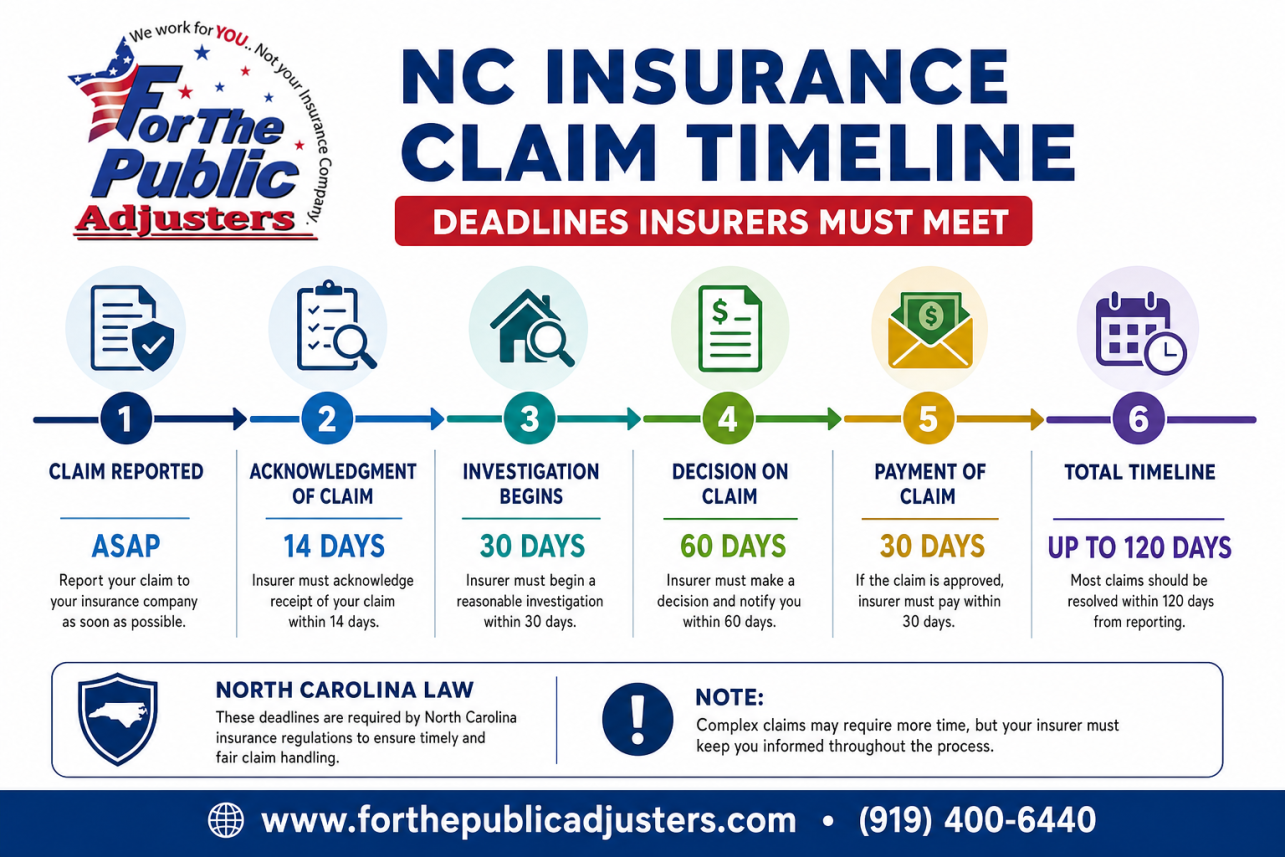
The Typical Stages of an NC Property Claim
- Acknowledgment: The insurer confirms it received your claim, usually within a few business days, and assigns an adjuster.
- Investigation: The company inspects the damage, reviews your policy, and requests documentation. For a routine claim, this often takes two to six weeks.
- Decision: The insurer accepts, partially accepts, or denies the claim and explains its position in writing.
- Payment: Once you and the insurer agree on a settlement amount, payment typically follows within about 30 days.
Why Some Claims Take a Month and Others Take a Year
The difference between a one-month claim and a twelve-month claim usually comes down to complexity and disagreement. Common factors that stretch the timeline include:
- Severity of the loss: A total fire loss or major structural damage requires engineering opinions, detailed estimates, and contents inventories that take time to build.
- Disputes over cause or scope: If the insurer questions whether the damage is covered — common with water damage claims, where wear-and-tear exclusions get raised — expect back-and-forth that adds weeks or months.
- Catastrophe backlogs: After hurricanes or widespread storms, adjusters are stretched thin across thousands of claims, and inspections alone can take weeks to schedule.
- Documentation gaps: Missing receipts, incomplete proof of loss forms, or slow responses to insurer requests pause the clock on your end.
- Lowball offers and negotiations: If the first offer doesn’t cover your actual repair costs, the negotiation, re-inspection, or appraisal process extends the timeline significantly.
The key takeaway for North Carolina homeowners and business owners: the calendar starts moving the moment you report the loss, and both sides have obligations. Understanding the specific deadlines insurers must meet — covered in the next section — helps you recognize when a slow claim has crossed the line into an unreasonable delay.

What Deadlines Are Part of the NC Insurance Claim Timeline?
The NC insurance claim timeline is governed by the Unfair Claim Settlement Practices Act (N.C.G.S. § 58-63-15(11)), which requires insurers to promptly acknowledge claims, communicate with reasonable promptness, investigate claims fairly, and respond to proof-of-loss submissions without unreasonable delay. Policyholders generally have three years to file a lawsuit if a dispute cannot be resolved.
The Unfair Claim Settlement Practices Act
Unlike some states, North Carolina does not attach a rigid number of days to every step of a claim. Instead, N.C.G.S. § 58-63-15(11) sets conduct standards insurers must follow. When a carrier violates these standards as a general business practice, it can face regulatory consequences from the NC Department of Insurance — and the same conduct can support a policyholder’s bad faith or unfair trade practices claim.
Prompt Acknowledgment and Communication
Under the statute, insurers are prohibited from failing to acknowledge and act reasonably promptly upon communications about a claim. In practical terms, that means:
- Your claim should be acknowledged shortly after you report the loss.
- Letters, emails, and calls from you (or your representative) deserve a timely response — not weeks of silence.
- The insurer should keep you informed as the claim progresses rather than leaving you to chase updates.
Reasonable Investigation Standards
The Act also bars insurers from refusing to pay claims without conducting a reasonable investigation based upon all available information. For homeowners, this means the adjuster should actually inspect the damage, review your documentation, and consider evidence you provide — not deny or underpay a claim based on a drive-by inspection or an incomplete file.
Proof-of-Loss Response Expectations
Once you submit a completed proof of loss, the insurer must affirm or deny coverage within a reasonable time. Stringing a policyholder along after proof of loss has been submitted — with no decision and no explanation — is exactly the kind of conduct the statute targets. Keep in mind that some policies, particularly NFIP flood policies, carry their own strict proof-of-loss deadlines that fall on the policyholder, so read your policy’s requirements carefully and get your documentation in on time.
The Policyholder’s Deadline: The Three-Year Statute of Limitations
Deadlines cut both ways. In North Carolina, a policyholder generally has three years to file a breach-of-contract lawsuit against an insurer over an unpaid or underpaid claim. A few points to remember:
- Ongoing negotiations with the insurer do not automatically pause this clock.
- Your specific policy language may affect how the limitation period applies, so review it early.
- Waiting until the deadline is close limits your leverage — insurers know it, and delay can work in their favor.
Knowing these obligations gives you a benchmark: if your insurer’s conduct falls short of these standards, you have grounds to push back.
Why Do Insurers Delay or Lowball Home and Business Claims?
Insurers delay or lowball claims because every dollar not paid out protects their bottom line. Common tactics include repeated requests for documents already submitted, rotating adjusters who restart the process, small partial payments framed as final settlements, and initial estimates that ignore hidden damage. These strategies wear policyholders down until they accept less than their policy owes.
It’s important to understand that most of these tactics aren’t necessarily illegal on their face — they exploit gray areas in the NC insurance claim timeline. An insurer that keeps a claim technically “open” while asking for one more form can argue it never formally denied or delayed anything. Recognizing the pattern is the first step to pushing back.
The Most Common Delay and Undervaluation Tactics
- Repeated document requests. You send the proof of loss, receipts, and photos — then weeks later a new request arrives for the same materials, or for records that are difficult to produce after a fire or flood destroyed your files.
- Rotating adjusters. Each new adjuster “needs time to get up to speed,” effectively resetting the review. Policyholders often repeat the same walkthrough two or three times with different representatives.
- Partial payments presented as resolution. A quick check for a fraction of the loss can create the impression the claim is closed. Some owners cash it without realizing they can still pursue the remaining amount.
- Low initial estimates. First-visit estimates frequently capture only visible surface damage, using discounted labor rates or pricing that doesn’t reflect local contractor costs.
How Undervaluation Plays Out in Real Losses
The pattern shows up across every major type of property damage in North Carolina:
- Fire claims: An initial estimate may cover charred drywall and contents in one room while overlooking smoke and soot contamination throughout the HVAC system, insulation, and adjacent rooms — costs that often exceed the visible burn damage.
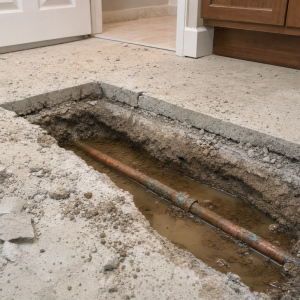
- Water claims: A burst pipe estimate might pay to replace wet flooring but skip moisture trapped in wall cavities and subfloors, which later produces mold the insurer then calls a “new” or excluded loss.
- Hurricane claims: Coastal homeowners and business owners frequently receive estimates for missing shingles while wind-driven rain intrusion, structural racking, and business interruption losses go unaddressed until someone documents them properly.
In many of these situations, the gap between the first offer and the true cost of repairs only becomes clear when a public adjuster or independent contractor scopes the entire loss — opening walls, testing moisture levels, and pricing repairs at real market rates. When the full documentation lands on the insurer’s desk, the negotiation changes because the carrier can no longer rely on an incomplete picture.
The takeaway for property owners: a delay or a low first number is rarely the final word. It’s often the opening position — and one you’re entitled to challenge.
What Can Policyholders Do When an Insurer Misses Deadlines?
When an insurer misses deadlines, policyholders can send a written demand letter, file a complaint with the North Carolina Department of Insurance, invoke the policy’s appraisal clause to resolve valuation disputes, or pursue litigation — including bad-faith and unfair trade practices claims, which North Carolina courts have allowed against insurers that mishandle property claims.
You have more leverage than you might think. North Carolina law gives homeowners and business owners several escalating remedies, and using them in the right order often gets a stalled claim moving without ever setting foot in a courtroom.
Start With a Written Demand Letter
A demand letter creates a paper trail and signals that you’re tracking the NC insurance claim timeline. Send it by certified mail and include:
- Your claim number, date of loss, and dates of every unanswered call or letter
- The specific deadlines the insurer has missed
- A clear request — a coverage decision, payment, or written explanation — with a firm response date
- Notice that you’ll escalate to the Department of Insurance if the deadline passes
File a Complaint With the NC Department of Insurance
The Department of Insurance regulates carriers doing business in the state and accepts consumer complaints online, by mail, or by phone. Once a complaint is filed, the insurer must respond to the Department — which alone often prompts a stalled adjuster to act. The Department can’t force a carrier to pay a disputed claim, but it can investigate patterns of unfair claim handling and take regulatory action.
Invoke the Appraisal Clause
If the insurer accepts coverage but you disagree on the amount of the loss, most property policies contain an appraisal clause. Each side hires its own appraiser, the two select an umpire, and agreement between any two of the three sets the loss amount. Appraisal is typically faster and cheaper than a lawsuit, though it resolves only valuation disputes — not coverage denials.
Litigation and Bad-Faith Claims
When an insurer’s conduct goes beyond a simple disagreement, North Carolina policyholders can sue for breach of contract and, in appropriate cases, for bad faith and unfair or deceptive trade practices. The leading example is Gray v. North Carolina Insurance Underwriting Association, in which the North Carolina Supreme Court allowed a policyholder’s bad-faith and unfair practices claims to proceed after the insurer mishandled a hurricane damage claim on the policyholder’s home. The case matters because it confirms that policyholders aren’t limited to recovering the policy amount — insurers who handle claims in bad faith can face additional liability, including potential punitive damages and treble damages under the state’s unfair trade practices statute.
Practical Tips Before You Escalate
- Keep every letter, email, estimate, and adjuster note organized by date
- Photograph and preserve evidence of the damage before making repairs
- Note deadlines in writing when adjusters make verbal promises
- Consult a public adjuster or attorney before signing any release
Escalating methodically — letter, complaint, appraisal, then litigation — protects your rights while keeping the door open to a faster, negotiated resolution.
How Can a Public Adjuster Speed Up Your Property Claim?
A licensed, bonded public adjuster speeds up a property claim by submitting complete, well-documented proof of loss from the start, preparing itemized building and contents estimates, tracking every insurer deadline, and negotiating directly with the carrier. This removes the back-and-forth requests for information that cause most claim delays.
Insurers rarely slow-walk a claim out of pure malice — more often, the file simply stalls because the adjuster assigned to it is waiting on something: a signed proof of loss, a contents list, a contractor estimate, or clarification on scope. A public adjuster’s job is to make sure the insurer never has a legitimate reason to wait, which keeps your claim moving through the NC insurance claim timeline instead of sitting in a queue.
Complete Documentation Up Front
Most delays start with an incomplete claim file. A public adjuster front-loads the work the insurer would otherwise request piecemeal over weeks or months:
- Detailed damage inspections — including hidden damage (water intrusion behind walls, roof decking, HVAC systems) that a quick carrier inspection often misses.
- Line-item repair estimates — written in the same estimating format insurers use, so the carrier’s adjuster can review and respond quickly rather than rebuilding the estimate from scratch.
- Itemized contents inventories — room-by-room lists with descriptions, quantities, ages, and replacement values. Contents claims are a common bottleneck for homeowners, and a thorough inventory prevents repeated supplemental requests.
- Supporting records — photos, receipts, mitigation invoices, and business income documentation for commercial claims.
Deadline Tracking and Follow-Up
Public adjusters know when the insurer is required to acknowledge, investigate, and respond — and they calendar those dates. If a response deadline passes, they follow up in writing immediately rather than waiting for the policyholder to notice weeks later. That consistent, documented pressure keeps the file active and creates a paper trail if the delay ever needs to be escalated.
Negotiation Backed by Evidence
When the carrier’s estimate comes in low, a public adjuster responds with a documented, line-by-line rebuttal instead of a general complaint. Disputes over scope and pricing get resolved faster when both sides are working from detailed estimates. Because public adjusters typically work on a contingency fee tied to the recovery, their interests are aligned with getting the claim both paid promptly and paid fully.
What About Results?
Policyholders who bring in professional representation often see meaningfully higher settlements on building and contents damage, largely because hidden damage gets documented and undervalued line items get corrected. That said, every claim depends on the policy language, the damage, and the evidence — no adjuster can guarantee a specific outcome or dollar amount. What a good public adjuster can promise is a complete, professionally presented claim and persistent follow-up, which are the two biggest factors in keeping any property claim on schedule.

How Do Virginia’s Claim Deadlines Compare to North Carolina’s?
Virginia regulates insurers through its Unfair Claim Settlement Practices rules (14 VAC 5-400), which require insurers to acknowledge claims within 15 days and act on them promptly after receiving proof of loss. The biggest difference from North Carolina is the statute of limitations: Virginia generally allows five years to sue on a written contract, while North Carolina allows three.
If you own property near the state line—or hold policies in both states—understanding how the two systems differ can save you from missing a critical deadline. While the NC insurance claim timeline is governed by North Carolina’s own unfair claims settlement statutes, Virginia spells out its expectations in a dedicated administrative regulation, 14 VAC 5-400, enforced by the Virginia Bureau of Insurance.
Virginia’s Key Claim-Handling Requirements
- Acknowledgment: Insurers must acknowledge a claim within 15 days of receiving notice and provide necessary claim forms and instructions.
- Prompt investigation: Carriers must begin a reasonable investigation promptly and may not drag out the process without cause.
- Decision after proof of loss: Once a properly completed proof of loss is submitted, the insurer must advise the policyholder of acceptance or denial within a reasonable, defined window—or explain in writing why more time is needed and follow up at regular intervals.
- Prompt payment: After a claim is accepted and the amount is agreed upon, payment is expected without unreasonable delay.
In practice, both states expect similar conduct: timely acknowledgment, active investigation, written explanations for delays, and reasonably prompt payment. The main distinction is where those rules live—Virginia’s are consolidated in one regulation, while North Carolina’s are spread across statute and departmental guidance.
Statute of Limitations: The Critical Difference
- North Carolina: Breach-of-contract claims, including most property insurance disputes, are generally subject to a three-year statute of limitations.
- Virginia: Written contracts generally carry a five-year statute of limitations, giving Virginia policyholders more breathing room.
- Policy suit-limitation clauses: In both states, your policy itself may contain a shorter contractual deadline to file suit—often tied to standard fire policy language. Always read your policy, because the contractual deadline can arrive well before the statutory one.
Where to Turn in Each State
Virginia policyholders can file complaints with the Bureau of Insurance through the Virginia State Corporation Commission, which oversees claim-handling conduct much like the North Carolina Department of Insurance does south of the border. If your property or your policy touches both states, confirm which state’s law governs your contract before assuming a deadline applies. When in doubt, act on the shorter timeline—waiting out the longer one is a risk no policyholder should take.
NC Insurance Claim Timeline: Typical Stages and What Insurers Must Do
| Claim Stage | Typical Timeframe | Insurer’s Obligation in NC |
|---|---|---|
| Acknowledgment of claim | Promptly, often within days to a few weeks | Acknowledge and act reasonably promptly on claim communications |
| Investigation | Weeks to a few months, depending on complexity | Conduct a reasonable and timely investigation before denying or paying |
| Decision (approve or deny) | Within a reasonable time after proof of loss | Affirm or deny coverage within a reasonable time; explain any denial |
| Payment after settlement | Typically within days to weeks of agreement | Pay agreed amounts promptly once liability and value are settled |
| Lawsuit deadline if disputed | Generally 3 years from the loss or injury | N/A — this is the claimant’s statute of limitations in NC |
Illustrative Example: A Delayed Storm Damage Claim
Illustrative example
Consider a hypothetical Raleigh homeowner whose roof is damaged in a spring storm and who files a claim the next day. Weeks pass with no adjuster inspection and only vague responses, so she begins keeping a written log of every call and email. After sending a certified letter citing North Carolina’s unfair claim settlement practices law and filing a complaint with the NC Department of Insurance, the insurer promptly schedules an inspection and issues a decision. This composite scenario shows how documentation and regulatory pressure can get a stalled NC claim moving again.
Frequently asked questions
What is the typical NC insurance claim timeline after I file a claim?
North Carolina law requires insurers to handle claims promptly and in good faith, which generally means acknowledging your claim, investigating it, and communicating a decision within a reasonable time. Simple claims are often resolved within a few weeks, while complex claims involving disputed liability, extensive damage, or injuries can take several months. If an insurer needs more time, it should keep you informed about the status of your claim and the reason for any delay.
Are there specific deadlines insurers must meet in North Carolina?
North Carolina’s Unfair Claim Settlement Practices law prohibits insurers from failing to acknowledge and act promptly on claims, failing to conduct a reasonable investigation, or delaying payment without a legitimate basis. Rather than one universal deadline for every step, the law focuses on ‘prompt’ and ‘reasonable’ handling. Your own policy may also spell out timeframes for acknowledgment, inspection, and payment, so it’s worth reading the claims section of your policy carefully.
What can I do if my insurance company is dragging out my claim?
Start by putting your requests in writing and asking the adjuster for a specific explanation of the delay and a timeline for a decision. Keep records of every call, email, and letter. If the delay continues, you can file a complaint with the North Carolina Department of Insurance, which can look into the insurer’s claim handling. If the delay appears to be in bad faith, consulting an attorney about your options may be worthwhile.
Is there a deadline for me to take legal action if my claim is denied or underpaid?
Yes. In North Carolina, a lawsuit for breach of an insurance contract is generally subject to a three-year statute of limitations, though the exact deadline can depend on the type of claim and your policy’s terms — some policies contain their own suit-limitation provisions. Because missing a deadline can permanently bar your claim, check your policy language and consider speaking with an attorney well before any potential deadline passes.
Related local pages
- Public Adjuster Burlington NC: Fire, Water & Storm Damage Claims Handled On The Policyholder’s Side
- Public Adjuster Elon NC — Fire & Water Claim Help For Alamance County Homeowners
- Public Adjuster Cary NC — Licensed Help For Fire, Storm, Water & Tree Damage Claims In Wake County
Tired of waiting on your insurance company? Contact our licensed and bonded public adjusters for a free claim review in North Carolina and Virginia. Get in touch.
Last updated: July 21, 2026