Public Adjuster vs Attorney: What’s the Difference?
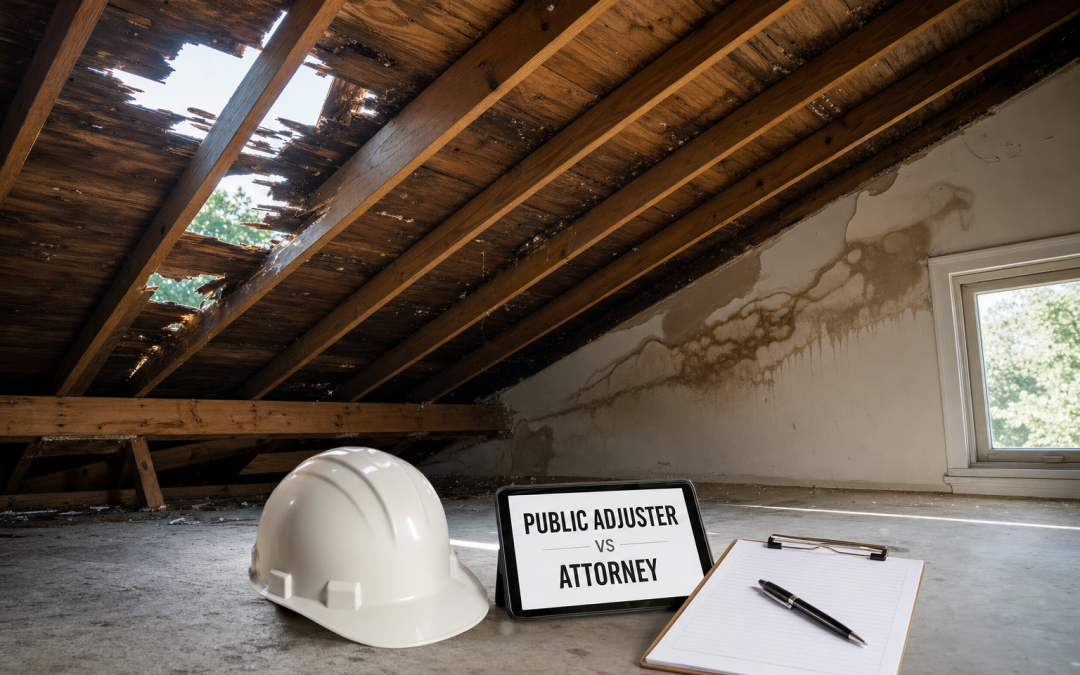
The public adjuster vs attorney decision comes down to what your claim actually needs: a public adjuster is a licensed, bonded professional who documents your property damage and negotiates the claim’s value with your insurer, while an attorney handles legal disputes — like bad faith conduct, breach of contract, or a claim headed to court.
Key takeaways
- Hire a public adjuster when your claim is accepted but underpaid or complex to document; hire an attorney when the insurer denies the claim, acts in bad faith, or litigation is likely.
- Public adjusters typically charge a percentage of the claim payout, while attorneys may work on contingency, hourly rates, or flat fees depending on the case.
- Only attorneys can file lawsuits, allege bad faith, and represent you in court — public adjusters are limited to negotiating and documenting the claim itself.
- You can start with a public adjuster and escalate to an attorney later if negotiations stall, and in some cases both professionals work together on the same claim.
- Check state licensing before hiring either professional, since public adjuster fee caps and rules vary significantly by state.
Both work on your side of the claim, not the insurance company’s. But they solve very different problems. Most underpaid or complicated property claims are valuation problems — the insurer’s estimate misses damage, uses low pricing, or ignores parts of your policy. That’s public adjuster territory. A smaller share of claims involve genuine legal wrongdoing, and that’s when an attorney earns their fee.
What a Public Adjuster Does
A public adjuster is licensed by your state’s Department of Insurance and represents policyholders — never insurance companies. On a fire, water, or storm claim, a public adjuster typically:
- Reads your full policy and identifies every coverage that applies to your loss
- Inspects and documents all damage, including hidden damage the insurer’s adjuster may have missed
- Prepares a detailed, line-item estimate of repair and replacement costs
- Handles communication, meetings, and negotiations with the insurance company
- Pushes the claim toward a settlement that reflects what the policy actually owes
If you’re dealing with fire, water, or storm damage in central North Carolina, a local firm like a public adjuster in Burlington NC handles exactly this kind of policyholder-side claim work.
What an Attorney Does
An attorney steps in when the dispute is legal rather than about dollars-and-documentation. Common examples include:
- Wrongful claim denials that need to be challenged formally
- Bad faith conduct — an insurer unreasonably delaying, lowballing, or refusing to investigate
- Breach of contract disputes over policy language
- Litigation, depositions, and lawsuits, which only a licensed attorney can handle
Quick Decision Snapshot for NC and VA Policyholders
Both North Carolina and Virginia license public adjusters, so homeowners in either state have both options available. As a fast rule of thumb:
- Claim is open but underpaid, undervalued, or moving slowly? A public adjuster is usually the right first call — they can often resolve the gap without litigation.
- Claim was denied for legal reasons, or the insurer is acting in bad faith? Talk to an attorney.
- Not sure yet? Many policyholders start with a public adjuster’s free claim review; if genuine legal issues surface, a good adjuster will tell you it’s time for a lawyer.
The sections below break down each scenario — including costs and whether you can hire both — so you can match the right professional to your specific claim.

When Should You Hire a Public Adjuster for a Property Claim?
Hire a public adjuster when your insurance company has lowballed, underpaid, or delayed a home, building, or contents claim — and there’s no legal dispute yet, just a disagreement over the scope and value of the damage. Public adjusters document, estimate, and negotiate claims on the policyholder’s behalf, often as the smartest first call.
Most property claim problems aren’t legal problems — they’re documentation and valuation problems. The insurer’s adjuster missed damage, used pricing that doesn’t reflect real repair costs, or classified the loss in a way that shrinks the payout. Those are exactly the fights a public adjuster is licensed and trained to win, without ever setting foot in a courtroom.
Situations Where a Public Adjuster Is the Right First Call
- The estimate looks too low. If a contractor’s bid to actually repair your home is far above what the insurer offered, that gap is a scope-and-pricing dispute — a public adjuster’s specialty.
- The claim is dragging on. Repeated requests for the same documents, unreturned calls, and vague timelines often resolve once a professional takes over communication and forces the file to move.
- Hidden or secondary damage was ignored. Smoke odor in wall cavities, moisture behind drywall, HVAC contamination, and structural issues are commonly left out of initial estimates.
- Your contents claim was undervalued. Inventorying and pricing personal property is tedious, and insurers rarely capture the full loss unless someone does it thoroughly.
- You’re overwhelmed and don’t trust the process. Even a fairly handled claim involves policy language, deadlines, and proof requirements most homeowners have never dealt with.
A Real-World Example: The Underpaid Fire Claim
Consider a typical scenario: a kitchen fire damages part of a home, and the insurer’s estimate covers repainting the kitchen and replacing a few cabinets. But smoke traveled through the ductwork, soot settled on contents throughout the house, and the family can’t safely live there during repairs. A public adjuster re-inspects the property, documents the full extent of smoke and soot damage, builds a complete contents inventory, and adds additional living expenses the insurer never mentioned. The renegotiated settlement often ends up several times the original offer — not because anyone sued, but because the loss was finally documented properly. Homeowners dealing with underpaid fire claims in Burlington, NC see this pattern constantly.
Why This Matters in the Public Adjuster vs Attorney Decision
In the public adjuster vs attorney question, think of it this way: if the insurer is still negotiating and the disagreement is about how much the damage is worth, a public adjuster can usually resolve it faster and keep the claim out of litigation entirely. Attorneys become necessary when the dispute shifts from valuation to legal wrongdoing — a distinction the next section covers in detail.
When Do You Actually Need an Attorney for an Insurance Claim?
You need an attorney when your claim crosses from a valuation dispute into a legal dispute — your insurer denies the claim outright, acts in bad faith, misses statutory deadlines, or argues your policy doesn’t cover the loss at all. At that point, only a licensed attorney can file suit, take depositions, and pursue extra-contractual damages on your behalf.
A public adjuster can document damage and negotiate value, but they cannot practice law. If the fight is about whether the insurer owes you anything — not just how much — legal counsel becomes essential.
The Four Legal Triggers That Call for an Attorney
- Outright claim denial. If the insurer denies your claim in writing and won’t reconsider after you’ve provided supporting documentation, appealing the decision often requires legal pressure or litigation.
- Bad faith conduct. Repeated unexplained delays, lowball offers that ignore documented damage, misrepresenting policy language, or failing to investigate your loss can all support a bad faith or unfair trade practices claim.
- Missed statutory deadlines. Insurers in North Carolina and Virginia are required to acknowledge, investigate, and respond to claims within reasonable timeframes. When those obligations are ignored, an attorney can invoke them as leverage — and preserve your own deadlines, since suit limitation clauses in many policies give you a limited window to file.
- Coverage disputes. If the argument is over policy interpretation — whether the damage falls under an exclusion, whether the cause of loss is covered, or how an ambiguous clause should be read — that’s a legal question a court, not an adjuster, ultimately decides.
Policyholders Do Win These Cases in NC and VA
Courts in both states have ruled in favor of homeowners and commercial property owners who sued their insurers. In North Carolina, unfair or deceptive claim-handling practices can violate N.C.G.S. § 75-1.1, the state’s Unfair and Deceptive Trade Practices Act. That statute matters enormously because a successful claim can allow treble damages — three times the actual damages — plus, in some cases, attorney’s fees. North Carolina appellate courts have repeatedly held that unfair claim settlement practices by an insurer can support a § 75-1.1 claim, giving policyholders leverage well beyond the policy limits.
In Virginia, insurance disputes are generally pursued as breach-of-contract actions, and Virginia courts have issued rulings favoring insureds where the insurer wrongly denied coverage or misapplied an exclusion. Virginia law also construes ambiguous policy language against the insurer that drafted it — a principle that has decided many coverage disputes in the policyholder’s favor.
A Practical Rule of Thumb
In the public adjuster vs attorney decision, the dividing line is simple: if the insurer accepts coverage but disputes the amount, an adjuster may suffice; if the insurer disputes coverage itself or is behaving unlawfully, hire an attorney — ideally one experienced in first-party property claims — before your filing deadlines run out.

How Much Does a Public Adjuster Cost Compared to an Attorney?
Public adjusters typically charge a percentage of the insurance settlement — often somewhere between 5% and 20%, depending on the claim size and state rules. Attorneys usually work on a contingency fee of roughly one-third of the recovery, or bill hourly. In most straightforward property claims, a public adjuster costs less; in disputed or litigated claims, an attorney’s higher fee may be worth it.
How Public Adjuster Fees Work
Public adjusters almost always work on contingency: they take an agreed-upon percentage of what the insurance company pays. You generally don’t owe anything upfront, and if there’s no recovery, there’s typically no fee. A few things influence the percentage:
- Claim size: Larger commercial or total-loss claims often command a lower percentage than small residential claims.
- Timing: Some adjusters charge less if hired early in the claim versus being brought in to reopen or dispute a claim that’s already been underpaid or denied.
- State regulations: Some states cap what public adjusters can charge, particularly after declared disasters, so it’s worth confirming the rules in your state before signing a contract.
How Attorney Fees Work
Insurance attorneys generally use one of two fee structures:
- Contingency fees: Common in denied-claim and bad-faith cases, usually a percentage of the total recovery — often in the range of one-third, sometimes more if the case goes to trial. Litigation costs (filing fees, expert witnesses, depositions) may be deducted on top of the fee.
- Hourly billing: Some attorneys bill by the hour, which can make sense for limited work like reviewing a policy or sending a demand letter, but costs can climb quickly if a dispute drags on.
What Each Fee Structure Means for Your Net Recovery
The real question in the public adjuster vs attorney cost comparison isn’t the fee percentage — it’s what you keep after the professional is paid. A public adjuster’s lower percentage leaves more of the settlement in your pocket, which is why they’re often the better value when the insurer is cooperating but undervaluing the damage. An attorney’s larger cut only makes financial sense when their involvement can unlock money you couldn’t otherwise reach — for example, a wrongfully denied claim or a bad-faith dispute where litigation leverage changes the outcome entirely.
One honest caveat: no public adjuster or attorney can guarantee a specific result. A reputable professional will explain their fee clearly in writing, walk you through realistic scenarios for your claim, and never promise a particular dollar figure. If someone guarantees an outcome before they’ve even reviewed your policy and damage, treat that as a red flag rather than a selling point.
Can You Hire Both a Public Adjuster and an Attorney?
Yes, you can hire both a public adjuster and an attorney, and on larger or disputed claims it’s often the strongest approach. The public adjuster documents and values the damage, while the attorney handles legal disputes. The adjuster’s independent estimate typically becomes the core evidence the attorney relies on in appraisal or litigation.
The debate over public adjuster vs attorney is often framed as an either/or choice, but the two roles complement each other rather than compete. Think of it this way: an attorney can argue that your insurer acted in bad faith or breached the policy, but that argument goes nowhere without a credible, well-documented answer to the question, “What is this claim actually worth?” That’s the public adjuster’s job.
How the Two Professionals Work Together
In a typical disputed claim, the workflow looks something like this:
- The public adjuster builds the damage file. They inspect the property, photograph and scope every category of damage, prepare a line-item estimate using industry pricing software, and organize the documentation the policy requires.
- The attorney builds the legal case on top of it. If the insurer denies, underpays, or delays, the attorney uses the adjuster’s estimate and file as the factual backbone for demand letters, appraisal, or a lawsuit.
- The adjuster often serves as a witness or appraiser. In many disputes, the public adjuster’s detailed valuation is what a court, appraisal panel, or opposing counsel has to respond to line by line.
Why the Documented Estimate Matters in Appraisal and Litigation
Insurance disputes are frequently won or lost on documentation. When an insured goes into appraisal or litigation armed only with a contractor’s rough bid or their own photos, the insurer’s estimate tends to dominate. When there’s a thorough, independent, line-item valuation in the file, the dynamic shifts:
- In appraisal, the panel compares two competing estimates. A detailed public adjuster scope — covering items the insurer’s adjuster missed, like code upgrades, matching requirements, or hidden water damage — frequently moves the award well above the carrier’s original offer.
- In litigation, the adjuster’s estimate gives the attorney concrete damages to plead and prove, rather than a vague claim that the payment was “too low.” Insurers often settle once they see the insured can actually prove the gap.
Practical Tips for Coordinating Both
- Hire the public adjuster first when the dispute is about the amount of damage; bring in the attorney if the carrier still won’t pay fairly.
- Make sure both professionals know about each other and share the claim file so estimates and legal arguments stay consistent.
- Ask each how their fees interact, so you understand your combined cost before signing both agreements.
Used together, the two create a claim the insurer can’t easily dismiss: documented facts backed by legal leverage.

How Do You Decide Which One Your NC or VA Claim Needs Right Now?
Match the professional to your claim’s status. For a new, underpaid, or delayed property claim, start with a licensed public adjuster who can document and negotiate the loss. Reserve an attorney for denied claims, suspected bad faith, or approaching legal deadlines. Many North Carolina and Virginia policyholders resolve claims without ever filing a lawsuit.
The public adjuster vs attorney question gets much easier when you stop thinking about titles and start thinking about where your claim actually stands today. Use the checklist below.
A Quick Decision Checklist by Claim Status
- New claim: Call a public adjuster before you accept the insurance company’s first inspection as the final word. Early documentation and a complete scope of damage prevent most underpayment problems.
- Underpaid claim: A public adjuster can prepare a detailed estimate, challenge the carrier’s scope, and invoke your policy’s appraisal clause if the dispute is about the amount of the loss rather than coverage.
- Delayed claim: Start with a public adjuster to organize the file and push for a response, and consider filing a complaint with your state’s insurance regulator if the delay continues without explanation.
- Denied claim: If the carrier says the loss isn’t covered at all, or you suspect bad faith handling, that’s a legal question — talk to an attorney.
NC and VA Specifics You Shouldn’t Ignore
- Deadlines matter. Both states limit how long you have to sue over a claim, and many policies contain their own suit-limitation clauses that can be shorter than the statute of limitations. Read your policy and confirm your deadline early — waiting too long can end your options entirely.
- Appraisal clauses. Most property policies in both states include an appraisal provision for resolving disputes over the amount of loss. It’s often faster and cheaper than litigation, and a public adjuster can guide you through it.
- Regulator complaints. You can file a free consumer complaint with the North Carolina Department of Insurance or the Virginia Bureau of Insurance. A complaint won’t decide your claim, but it creates a record and can prompt a stalled carrier to respond.
When to Call a Licensed Public Adjuster First
If your claim is open — new, underpaid, or dragging on — a licensed and bonded public adjuster is usually the right first call. You keep the door open to hiring an attorney later, but you may resolve the dispute through documentation, negotiation, or appraisal without legal fees. No professional can promise a specific outcome, but getting the claim properly measured and presented is the foundation everything else is built on. If your claim has been denied outright or a deadline is closing in, skip ahead and speak with an attorney right away.
Public Adjuster vs Attorney: Key Differences at a Glance
| Factor | Public Adjuster | Attorney |
|---|---|---|
| Best for | Underpaid, complicated, or poorly documented claims | Denied claims, bad faith conduct, coverage disputes |
| Typical fees | Percentage of the claim settlement (often capped by state law) | Contingency, hourly, or flat fee depending on the matter |
| Can file a lawsuit? | No — negotiation and claim documentation only | Yes — can litigate and pursue bad-faith damages |
| Core skill set | Damage estimating, policy interpretation, claim preparation | Legal strategy, court advocacy, contract and insurance law |
| When to involve them | Early, ideally before or soon after filing the claim | After denial, lowball final offers, or signs of bad faith |
Illustrative Example: From Underpayment to Full Resolution
Illustrative example
Consider a hypothetical homeowner whose roof and interior were damaged in a storm, and whose insurer accepted the claim but offered far less than repair estimates suggested. The homeowner hired a public adjuster, who re-documented the damage, prepared a detailed estimate, and negotiated a substantially improved settlement on most of the loss. When the insurer refused to cover one disputed portion of the damage and stopped responding, the homeowner brought in an attorney to address the potential bad-faith handling. This composite scenario shows how the two roles can complement each other: the adjuster maximized the documented claim, while the attorney provided legal leverage once negotiations broke down.
Frequently asked questions
What’s the main difference in a public adjuster vs attorney for a property claim?
A public adjuster is a licensed professional who documents your loss, prepares the estimate, and negotiates the claim amount directly with your insurance company. An attorney handles legal disputes, such as bad faith conduct, denied claims, or lawsuits. In short: a public adjuster maximizes the claim through the normal claims process, while an attorney steps in when the dispute becomes a legal matter.
When should I hire a public adjuster instead of an attorney?
Hire a public adjuster when your claim is open and the disagreement is mainly about the scope of damage or the payout amount, but the insurer is still engaging with you in good faith. Public adjusters are typically most valuable early in the process, when thorough documentation and a well-supported estimate can prevent underpayment in the first place.
When does it make sense to hire an attorney for my insurance claim?
Consider an attorney if your claim has been denied, the insurer is acting in bad faith (unreasonable delays, ignoring evidence, misrepresenting your policy), there’s a coverage dispute over policy language, or litigation seems likely. Attorneys can file suit and pursue legal remedies that a public adjuster cannot.
Can I hire both a public adjuster and an attorney?
Yes, and it’s fairly common in complex or high-value claims. A public adjuster can handle damage documentation and valuation while an attorney addresses legal or coverage disputes. Just review each professional’s fee agreement carefully so you understand how their compensation works and confirm both are properly licensed in your state.
Related local pages
- Public Adjuster Burlington NC: Fire, Water & Storm Damage Claims Handled On The Policyholder’s Side
- Public Adjuster Elon NC — Fire & Water Claim Help For Alamance County Homeowners
- Public Adjuster Cary NC — Licensed Help For Fire, Storm, Water & Tree Damage Claims In Wake County
Not sure which path your claim needs? Get a free, no-obligation claim review from our licensed and bonded public adjusters serving North Carolina and Virginia. Get in touch.
Last updated: August 11, 2026