
If you’ve received a letter denying or low-balling your homeowner's claim, you may need a lawyer for your home insurance claim to fight back. An attorney can challenge the insurer's decision, especially if they are acting in bad faith, while a public adjuster focuses on documenting and negotiating the value of your property damage. A denial isn't the end; it's the start of a dispute.
Table of Contents
- Your Home Insurance Claim Was Denied. Now What?
- Why Fighting Your Insurer Feels Like a Losing Battle
- Public Adjuster vs. Insurance Lawyer: Who Should You Call?
- Recognizing Bad Faith Tactics from Your Insurer
- How Rising Repair Costs Magnify Lowball Offers
- Your Next Steps to Fight a Claim Denial
- Answering Your Questions About Hiring Claim Help
Your Home Insurance Claim Was Denied. Now What?
That sinking feeling hits the moment you open the letter from your insurance company. The words "denied" or a settlement number that doesn't even come close to covering your repairs—it's a gut punch. You've paid your premiums faithfully, trusting you'd be protected. Now, when you need them most, it feels like they’ve slammed the door in your face.
It’s easy to feel powerless, but a denial isn’t the final word. Think of it as the opening shot in a dispute you are now forced to have. Insurers often deny claims by citing an obscure policy exclusion, claiming you have insufficient proof of loss, or arguing the damage doesn't meet your deductible. You didn't come this far to give up now.

The most important thing to remember is this: You do not have to accept the insurance company's decision. You have the right to fight back, and you have professional allies ready to get in the ring with you.
Your Claim Help Options at a Glance
When your insurer won't budge, two main professionals can step in to advocate for you: public adjusters and insurance lawyers. While both work for you—not the insurance company—they serve very different roles. Knowing who to call, and when, can make all the difference.
Here’s a quick breakdown of your two main options.
| Professional | Primary Role | Typical Cost Structure | Best For |
|---|---|---|---|
| Public Adjuster | Assesses, documents, and negotiates the full value of property damage. | A percentage of the final claim settlement. | Disputes over the scope of damage and repair costs. |
| Insurance Lawyer | Handles legal disputes, including bad faith, breach of contract, and lawsuits. | A percentage of the settlement or hourly fees. | When the insurer acts illegally or refuses to negotiate fairly. |
Think of it like this: a public adjuster is your frontline expert for proving the value of your loss. They meticulously build the case for what you’re owed based on the physical damage. But if the insurer is breaking the law, refusing to negotiate in good faith, or forcing you into a lawsuit, a lawyer for your home insurance claim becomes your most powerful weapon.
Why Fighting Your Insurer Feels Like a Losing Battle
That feeling you have—the one where the deck is stacked against you in your own insurance claim? You’re not wrong. It isn't just a hunch; it's the reality of the insurance industry's business model. Your fight is one shared by countless homeowners in North Carolina and Virginia after a fire, hurricane, or major water disaster.
It all comes down to a built-in conflict of interest. The adjuster your insurance company sends to your home works for them. Their paycheck is signed by the same company that profits by minimizing what they pay you. This person isn’t your advocate; they represent a corporation with a direct financial incentive to undervalue your loss. In a notorious 2014 case, Vardanyan v. Amco Insurance Company, a California court found that Amco (a subsidiary of Nationwide) acted in bad faith by low-balling a claim and using an unqualified adjuster, reinforcing that some insurers prioritize profits over policyholder duties.
A System Designed for Denial
The numbers expose just how tough this fight is. Insurers are increasingly moving toward outright denials and zero-payout closures as standard practice. They may use their own preferred vendors and biased reports to justify a lowball offer, knowing most homeowners won't have the expertise to challenge them effectively.
These "denials" aren't always because of fraud. They’re often the result of administrative games and policy language designed to protect the insurer, not you. You can dig into the statistics behind these insurance claim realities yourself.
This reality means that without a professional advocate on your side, you're at risk of accepting the insurance company's narrow, self-serving interpretation of your policy. The result is often a lowball offer that won't come close to covering the true cost of rebuilding your home.
The most common excuses for these zero-payouts include:
- Administrative Closures: The insurer just closes your claim for a procedural reason, not because your damage isn't real.
- Deductible Arguments: They claim the damage costs less than your deductible, even when your own contractor estimates say otherwise.
- Coverage Games: The adjuster points to some obscure policy exclusion to avoid paying for a part of the damage.
- Claim Withdrawals: Discouraged homeowners simply give up after being worn down by endless delays and roadblocks.
For homeowners in NC and VA trying to recover from a storm or fire, these tactics are devastating. The system is designed to wear you down until you either accept a fraction of what you're owed or walk away with nothing. This is exactly why getting an experienced public adjuster or attorney involved is so important—they know the playbook and have the tools to fight back.
Public Adjuster vs. Insurance Lawyer: Who Should You Call?
You know you need help fighting the insurance company, but you're not sure who to call. That's a common spot for homeowners to be in.
Making the right choice between a public adjuster and an insurance lawyer can completely change the outcome of your claim. Understanding what each professional actually does is the first step to getting the money you're owed.
Think of it this way: a public adjuster is the ‘general contractor’ of your insurance claim. They are masters of the physical loss—the damage you can see and touch. Their entire job is to assess, document, and negotiate the real-world value of your property damage, fighting over the scope of work and repair costs. They make sure every nail, wire, and piece of drywall is accounted for at today's prices.
An insurance lawyer, on the other hand, is your ‘courtroom advocate.’ They step in for legal battles when your insurer crosses the line from being difficult to acting illegally. A lawyer for your home insurance claim is non-negotiable when you’re facing a wrongful denial, bad faith conduct, or a breach of contract that makes a lawsuit your only path forward.
When to Call a Public Adjuster vs. an Attorney
The decision really boils down to the nature of your fight with the insurance company. Is the argument over the amount of the loss, or is it over the insurer's conduct and their legal duties to you?
To get a better sense of what a public adjuster brings to the table on the valuation side, you can read our detailed guide on what a public claims adjuster does.
This chart breaks down the core differences to help you decide who to contact first.
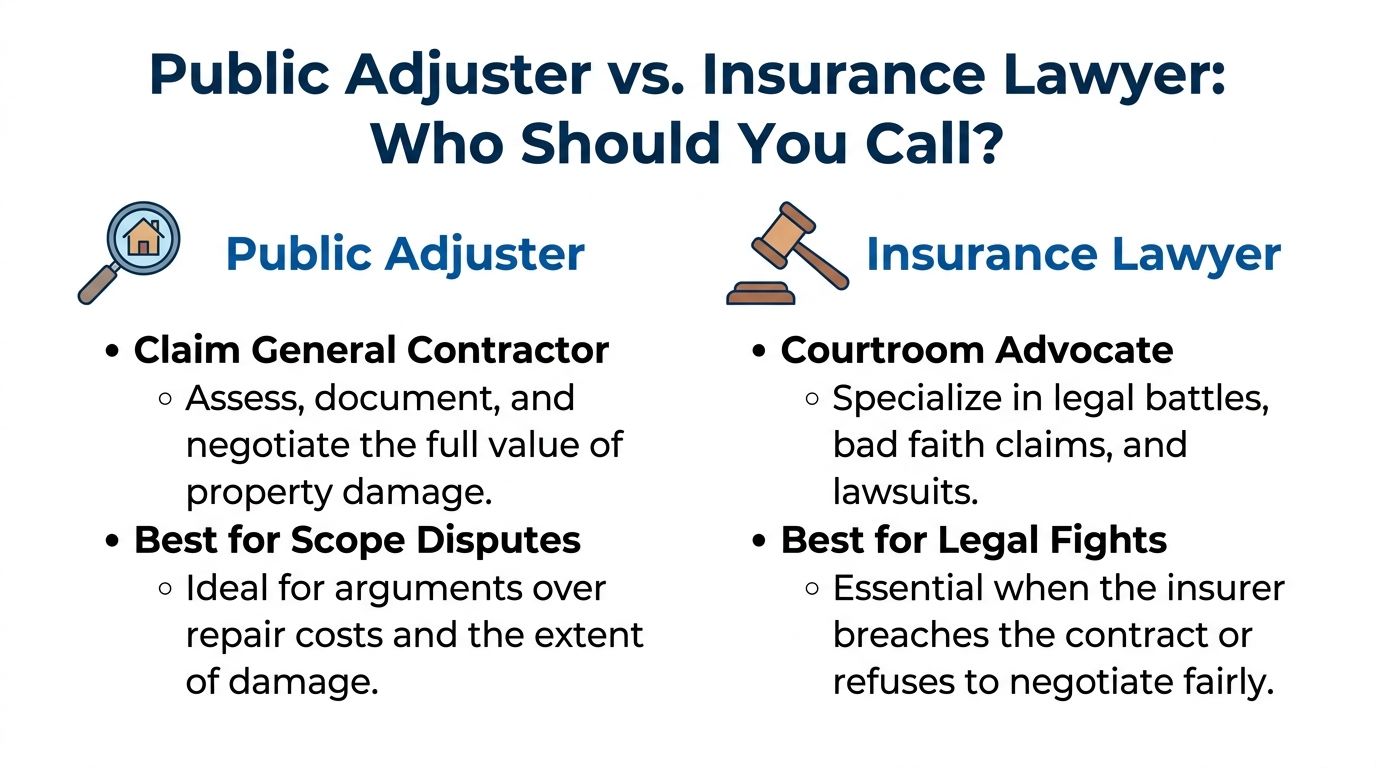
The visual makes it clear: your choice hinges on whether your fight is about the numbers or your legal rights. A public adjuster is your go-to for proving the true cost of your damages, while a lawyer is the expert you need when an insurer's bad behavior requires a legal showdown.
Here are a few real-world scenarios to show you what this looks like:
Scenario 1: The Lowball Offer. Your insurer offers $30,000 for fire damage, but your contractor’s estimate is $75,000. The fight here is about the value of the loss. Start with a public adjuster. They will build a competing line-by-line estimate to prove the higher value and negotiate directly with the carrier.
Scenario 2: The Wrongful Denial. Your claim for major water damage from a burst pipe gets denied. The insurer points to a vague policy exclusion that just doesn't seem to apply. This is a legal interpretation problem. Call an insurance lawyer.
Scenario 3: The One-Two Punch. Very often, these professionals work together. A public adjuster might build the detailed damages estimate, which a lawyer then uses as rock-solid evidence in a bad faith lawsuit. This combined approach can be incredibly effective, ensuring you get paid for both the full property loss and any additional damages caused by the insurer's illegal conduct.
Recognizing Bad Faith Tactics from Your Insurer
When you bought your homeowner’s insurance policy, you bought a promise from your carrier. Legally, it's called the "covenant of good faith and fair dealing," and it means your insurer is required to treat you fairly and honestly.
When they break that promise, it's called insurance bad faith. And it's illegal.
This isn't just a simple disagreement over a repair estimate. It’s about an insurance company intentionally failing to uphold its end of the bargain. Recognizing these bad faith tactics is the first step toward fighting back, and it’s often a clear signal that you need a lawyer for your home insurance claim.
Common Red Flags of Bad Faith
So how do you know if your adjuster is just being difficult or if the company is actually crossing a legal line? You need to look for patterns—a series of actions that feel designed to wear you down and protect their bottom line at your expense.
Watch out for these classic warning signs. These aren't just annoyances; they are strategies that have landed major carriers like State Farm and Allstate in court.
- Unreasonable Delays: Your claim is collecting dust for months with no decision, no clear next steps, and no valid reason for the holdup. They're hoping you'll just give up.
- Grossly Lowball Offers: You get an estimate that's just a fraction of what your contractor quoted, and the adjuster offers no reasonable explanation for the massive gap.
- Misrepresenting Your Coverage: The adjuster tells you something isn't covered, but a careful read of your policy shows that it clearly is. They are counting on you not checking the documents.
- Using Intimidation Tactics: You're threatened with a premium hike, non-renewal, or even baseless accusations of fraud, all designed to scare you into accepting a low offer.
- Refusing to Provide Documents: The insurer stonewalls your requests for a copy of the adjuster’s full report, the engineer's findings, or other key documents you are entitled to see.
For instance, courts have held insurers accountable for bad faith. In one notable case, a jury found that an insurer acted unreasonably by refusing to pay a claim based on a biased "expert" report, ultimately awarding the homeowner significant damages beyond the original claim amount.
These actions are far more than just poor customer service; they represent a breach of the insurer's legal duty to you.
Proving it, however, is another battle. It often takes an attorney who knows how to dissect policy language, depose company employees, and build a case that can stand up in court. As you can see from these examples of unfair claims settlement practices, the tactics can be subtle but damaging.
A successful bad faith lawsuit can result in the court ordering the insurer to pay not only what they owed you in the first place but also additional damages as a penalty for their illegal conduct.
How Rising Repair Costs Magnify Lowball Offers
That lowball offer from your insurance company is a bigger problem today than it’s ever been. With the cost of building materials and skilled labor going through the roof, the gap between their first offer and the real-world price to fix your home is getting wider.
This is where an underpaid claim stops being an annoyance and starts becoming a financial crisis.
This problem gets even worse on bigger claims. Think about fire and lightning damage—the average claim for that kind of disaster ran a staggering $77,340 between 2016 and 2020. Insurers know that even a small percentage cut on a claim that size saves them a fortune, so they get aggressive. They work off old pricing lists that don't come close to what materials and labor actually cost right now. You can see just how badly these costs for homeowners insurance claims have outpaced inflation to understand the full scope of the problem.
The Real-World Impact of Outdated Pricing
When your carrier offers you a settlement based on what it cost to rebuild two years ago, you're the one stuck paying the difference. This isn't just a number on paper; it's a real problem that leaves families with half-finished repairs and growing debt.
It’s critical to know the true cost of repairs before you even think about accepting their offer. For example, if you need a full roof replacement, understanding what local contractors are charging is your best defense. The average roof replacement cost in Columbus is a perfect example of how much regional prices can vary from the national "averages" an insurer wants to use.
This growing gap between what insurers offer and what repairs actually cost is exactly why you need an advocate. A lowball number isn’t just an inconvenience—it’s a direct threat to your ability to make your home whole again.
This is the exact moment where a public adjuster or an insurance lawyer proves their value.
- A Public Adjuster gets to work building a detailed, line-by-line estimate that reflects today's real-world costs for every single nail, wire, and hour of labor needed.
- An Insurance Lawyer can then take that powerful evidence to the carrier—and to court if necessary—to fight for a settlement that covers the full expense of rebuilding.
Without that expert support, you're left arguing with a multi-billion dollar company using their own bad data. It's a fight you're set up to lose from the start.
Your Next Steps to Fight a Claim Denial
You’ve decided you’re not taking the insurance company’s “no” or their low-ball offer as the final word. Good. Now it’s time to build a real plan to fight back.
The first step isn’t arguing—it’s getting the facts straight. This is where a public adjuster’s detailed, independent damage assessment becomes your most powerful tool. It replaces the carrier’s low number with the real-world cost to fix your home.

But what if the insurance company still won't budge? If they refuse to negotiate or you suspect they’re dragging their feet on purpose, it's time to call a lawyer. This is where you can learn how to appeal an insurance claim denial and escalate the fight.
Your Legal Action Checklist
Walking into a lawyer's office prepared can make all the difference. Before you pick up the phone, get your paperwork in order. This isn't just a pile of documents; it's the evidence for your case.
- Your Complete Insurance Policy: Pull the full document, especially the declarations page and any extra riders or endorsements.
- All Communications with Your Insurer: Every single email, official letter, and even your own notes from phone calls with dates and times.
- The Denial or Lowball Offer Letter: This is the document that started the fight. It's critical.
- Your Proof of Loss: The forms and documentation you originally sent to the insurer to prove your claim.
- All Repair Estimates: Get every quote you have, both from contractors you trust and from the ones the insurance company sent.
- Photos and Videos: You can’t have too many. Show the damage from every angle, ideally right after it happened.
Our clients consistently praise our team's expertise in navigating these disputes. One homeowner noted, "For The Public Adjusters, Inc. was the first team that actually listened and gave us a real plan. Their assessment was the key to unlocking our settlement."
This checklist is your foundation. For more specific tactics, especially after a fire loss, check out 360 Hazardous Cleanup's fire claim tips. Whether you start with a public adjuster or go straight to a lawyer, getting organized is the first real step toward getting the payout you deserve.
Answering Your Questions About Hiring Claim Help
When you’re fighting with your insurance company, deciding who to call for backup—a lawyer, a public adjuster, or anyone at all—can feel like one more impossible choice. It’s not.
Getting straight answers is the first step to taking back control. Here are the common questions we hear from homeowners just like you.
How Much Does It Cost to Get This Kind of Help?
This is the number one question, and the answer is simple: there are no upfront costs.
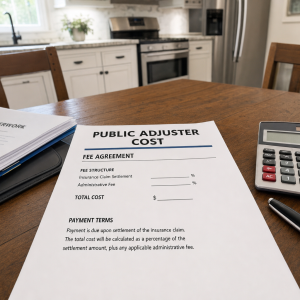
Nearly all public adjusters and insurance claim lawyers work on a contingency fee. They get paid a percentage of the money they recover for you, and only if they win. If you don’t get paid, neither do they. This structure lets any homeowner access expert help without having to pay out-of-pocket during a financial crisis.
When Should I Call a Lawyer vs. a Public Adjuster?
Think of it as a question of value versus legal rights. The two often work together, but here's where to start:
- Call a public adjuster for value disputes. The insurance company’s offer is a joke, but they haven't denied the claim outright. A public adjuster’s job is to prove the real scope and cost of your damage to force a fair settlement.
- Call a lawyer for legal disputes. Your claim was flat-out denied. The insurer is accusing you of something, refusing to negotiate, or dragging their feet in bad faith. You need a lawyer to enforce your rights under the policy and the law.
Many times, a public adjuster documents the full value of the loss, and then a lawyer uses that powerful evidence in a lawsuit to get it paid. One success story involved a client who was low-balled by Liberty Mutual on a major water damage claim. Our public adjuster created an exhaustive damage report that quantified the loss at nearly triple the insurer's offer. When Liberty Mutual refused to budge, this report became the cornerstone of the successful legal case that followed, securing the full amount for the homeowner.
Can I Still Hire Help if I Already Cashed the Insurance Check?
Yes, absolutely. Cashing that first check is not the end of your claim.
Unless you signed a specific document called a "final release of all claims," you have not waived your right to pursue the full amount you are owed. That initial payment is often just the undisputed portion of your loss. You can—and should—still fight for the rest.
Why Is My Insurance Company Making This So Hard?
It’s not just you. The entire insurance industry has become a much tougher battleground for homeowners.
Driven by severe weather and skyrocketing repair costs, homeowners filed 18% more claims in 2023 than in 2019. In fact, property damage now accounts for 97.3% of all homeowner claims. This explosion in claim volume has led many carriers to dig in their heels, deny more, and pay less. You can see the homeowner claim statistics for yourself and understand the scale of the problem. In this environment, professional help is often the only way to get a fair outcome.
At For The Public Adjusters, Inc., we believe you deserve to be treated fairly and paid what you're owed. Our licensed public adjusters are experts at fighting for homeowners in North Carolina and Virginia. Have your water damage claim questions answered at NO COST. Call 919-400-6440 to speak with a licensed Public Insurance Adjuster or Contact Us here with questions. WE Work For YOU… NOT Your Insurance Company