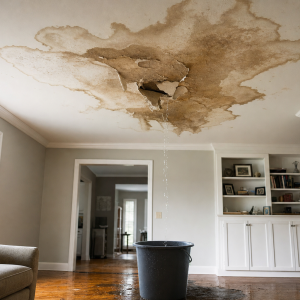

Your adjuster says they're “sending the sample to ITEL” like that should calm you down. Usually it does the opposite. You already have storm, water, hail, or fire damage staring at you. Then the insurance company adds a lab report, technical language, and a settlement number that somehow feels too small to restore your property the right way.
That's a critical issue with ITEL Laboratories Inc. in a claim dispute. The report often becomes the insurance company's shield. They point to it as if it ends the conversation. It doesn't. If the report leads to a patch job that won't match, a price that won't buy the material, or a denial dressed up as “science,” you need to push back hard and in writing.
Table of Contents
- Your Insurer Mentioned an ITEL Report Now What
- Who Is ITEL Laboratories Inc The Insurers Expert
- How ITEL Reports Fuel Low-Ball Claim Offers
- Red Flags Your ITEL Report Is a Problem
- Your Playbook to Fight an Unfair ITEL Assessment
- Case Study How a Public Adjuster Beat an ITEL Low-Ball
- Get Expert Claim Help for Your ITEL Dispute
Your Insurer Mentioned an ITEL Report Now What
You get the call. The adjuster says they need a piece of your siding, roofing, or flooring tested. Then a report comes back saying your material can be “matched” or replaced with something “comparable.” A week later, the offer lands, and it won't cover what your contractor says is needed to make the property whole.
That's when homeowners realize the ITEL report isn't just paperwork. It's an advantage.
A common version looks like this. A roof has visible storm damage across several slopes, but the carrier focuses on a few damaged shingles. The sample goes out. The report comes back with a supposed available replacement. Suddenly the carrier wants to pay for a repair instead of a full slope or full roof replacement. The argument sounds technical, but the result is simple. You get less money and more risk.
Why this changes the claim immediately
Once ITEL Laboratories Inc. enters the file, the insurer has a document it can use to control the narrative. The adjuster can stop talking about the actual repair problem and start talking about “lab findings.” That shift matters because homeowners often assume the report is neutral. It isn't neutral in the way a frustrated policyholder thinks of neutral. It's a vendor report being used inside an insurance claim.
Practical rule: The moment an insurer mentions ITEL, ask for the full report, all sample details, and every estimate that relied on it.
If your dispute involves roofing, it also helps to compare what your carrier is saying against practical repair guidance from contractors who deal with matching and replacement issues in the field. This breakdown on how to handle roof insurance claims is useful because it frames the repair problem from the property owner's side, not just the carrier's spreadsheet.
What to do before you say yes
Don't agree that the report settles anything. Don't let the adjuster reduce a restoration problem to a one-line “match found” summary.
Do these first:
- Ask for the complete report and not just the adjuster's summary.
- Compare the report to your actual damage across the full elevation, slope, room, or continuous run.
- Get a contractor's written response if the proposed match won't blend, won't install correctly, or won't restore pre-loss condition.
- Keep every email and letter because claims that start with “just a sample test” often turn into low-ball disputes fast.
Who Is ITEL Laboratories Inc The Insurers Expert
Your adjuster says the claim is going to ITEL. That usually means the file is shifting from common-sense restoration to a vendor opinion the carrier can point to later. Homeowners hear “lab” and assume neutral science. In a real claim, that is the wrong assumption.
ITEL Laboratories, Inc. is an ISO-accredited materials testing company founded in 1993 that works on property-claim issues involving flooring, roofing, siding, and cabinets, according to Bloomberg's company profile.

What the company does
ITEL tests samples and issues opinions about material identification, possible matches, and pricing support. In plain English, it helps answer questions like: What is this product, what can replace it, and what should that replacement cost?
Those questions sound narrow. They are not narrow inside a claim. They shape whether the carrier pays for a repair, a partial replacement, or a much larger scope that restores the property.
That is why policyholders need to treat an ITEL report as claim evidence, not as the last word.
Why insurers rely on ITEL
Insurers use outside vendors because vendor reports give the file technical cover. An adjuster can point to the lab and say the decision was based on an expert opinion, even when the actual dispute is broader than lab testing. Matching, uniform appearance, installation limitations, discontinued materials, and code requirements do not disappear because a report found a “closest available” product.
The valuation problem matters too. A carrier may use an ITEL-supported number to defend a lower settlement position, especially if the dispute starts sliding into depreciation and replacement-cost arguments. If you need to sort out how the carrier is valuing the loss, read this guide on actual cash value in insurance claims.
The conflict homeowners miss
The issue is not that ITEL exists. The issue is who brings the report into the claim and how it gets used.
A homeowner does not control the sampling, the way the question is framed, or the estimate built around the result. The insurer usually does. That makes the “independent expert” label less comforting than it sounds.
Here is how the inside game works:
- The carrier chooses when to involve ITEL. That timing often comes after a scope dispute starts costing real money.
- The report can narrow the argument. Instead of discussing full restoration, the file gets pushed toward product ID, a claimed match, or a lower price point.
- The adjuster may present the conclusion as settled. Many policyholders never see the assumptions, limitations, or missing context until the offer is already too low.
A lab can identify a material sample. It cannot decide whether the insurer's proposed fix returns your home to pre-loss condition.
Treat ITEL for what it is in practice. It is a vendor opinion used inside the insurer's claim process. If that opinion supports a smaller scope, a cheaper product, or a repair that leaves visible mismatch, challenge it early and in writing.
How ITEL Reports Fuel Low-Ball Claim Offers

Your carrier sends out a sample, gets an ITEL report back, and suddenly the estimate drops. Full replacement becomes a spot repair. A discontinued material becomes a "comparable" product. The number on your claim starts looking less like the cost to restore your home and more like the cost to close the file.
That is how low-ball offers are built.
The report gives the insurer a technical-looking basis to limit scope, defend mismatch, or justify pricing that does not hold up in the market. Once that document lands in the file, many adjusters treat it like permission to pay less. Homeowners then get pushed into arguing against a lab result instead of forcing the carrier to prove that its repair plan returns the property to pre-loss condition.
How the report gets turned into a cheaper estimate
Start with siding. An ITEL report may identify a current product the carrier calls an acceptable match. On paper, that sounds reasonable. In the field, it often falls apart. Color fade, sheen, profile, texture, exposure, and weathering decide whether a repair blends. If the new material stands out from the existing elevation, the carrier is not paying for a proper restoration. It is paying for a visible patch.
Roofing and flooring claims get hit the same way. The insurer uses "closest available match" language to shrink the repair area and avoid replacing a continuous slope, room, or section. That saves the carrier money. It leaves you with a result that looks repaired, not restored.
Pricing is the second pressure point. If the estimate relies on a material price or replacement option your contractor cannot buy, the offer is still too low even if the report sounds technical. This is also where policyholders get trapped by valuation rules. If you need a clearer read on how insurers use depreciation and first payments to keep offers down, review this explanation of actual cash value in insurance claims.
Why this conflict matters
The problem is not just product identification. It is that the insurer gets a vendor report, then uses that report to support its own payment position.
That setup rewards outcomes that reduce claim cost.
A lab report can answer a narrow question about material type or possible substitutes. It does not decide whether a partial repair complies with your policy, local matching rules, manufacturer requirements, or basic common sense. Yet carriers routinely stretch the report far beyond its lane. They turn "similar product available" into "full replacement not owed." They turn "possible repair" into "claim resolved."
Public reporting on ITEL's sale to Nearmap only adds to the concern. As discussed in the PR Newswire announcement, ITEL now sits within a larger property intelligence business that serves insurers. You do not need to prove some hidden scheme to see the problem. The vendor helping inform claim value is part of the same insurer-facing ecosystem that benefits from cost control and faster claim decisions.
Treat the report like a defense document, not a neutral answer key.
If the proposed match will not blend, reject it in writing. If the pricing does not reflect what local contractors can source and install, document the gap. If the carrier keeps pointing back to the ITEL report, force the conversation back to the ultimate question. Will this repair return the property to its pre-loss condition, yes or no?
Red Flags Your ITEL Report Is a Problem
The fastest way to lose this fight is to skim the report and focus only on the conclusion. You need to read it like the insurance company's defense exhibit, because that's how it will be used against you.
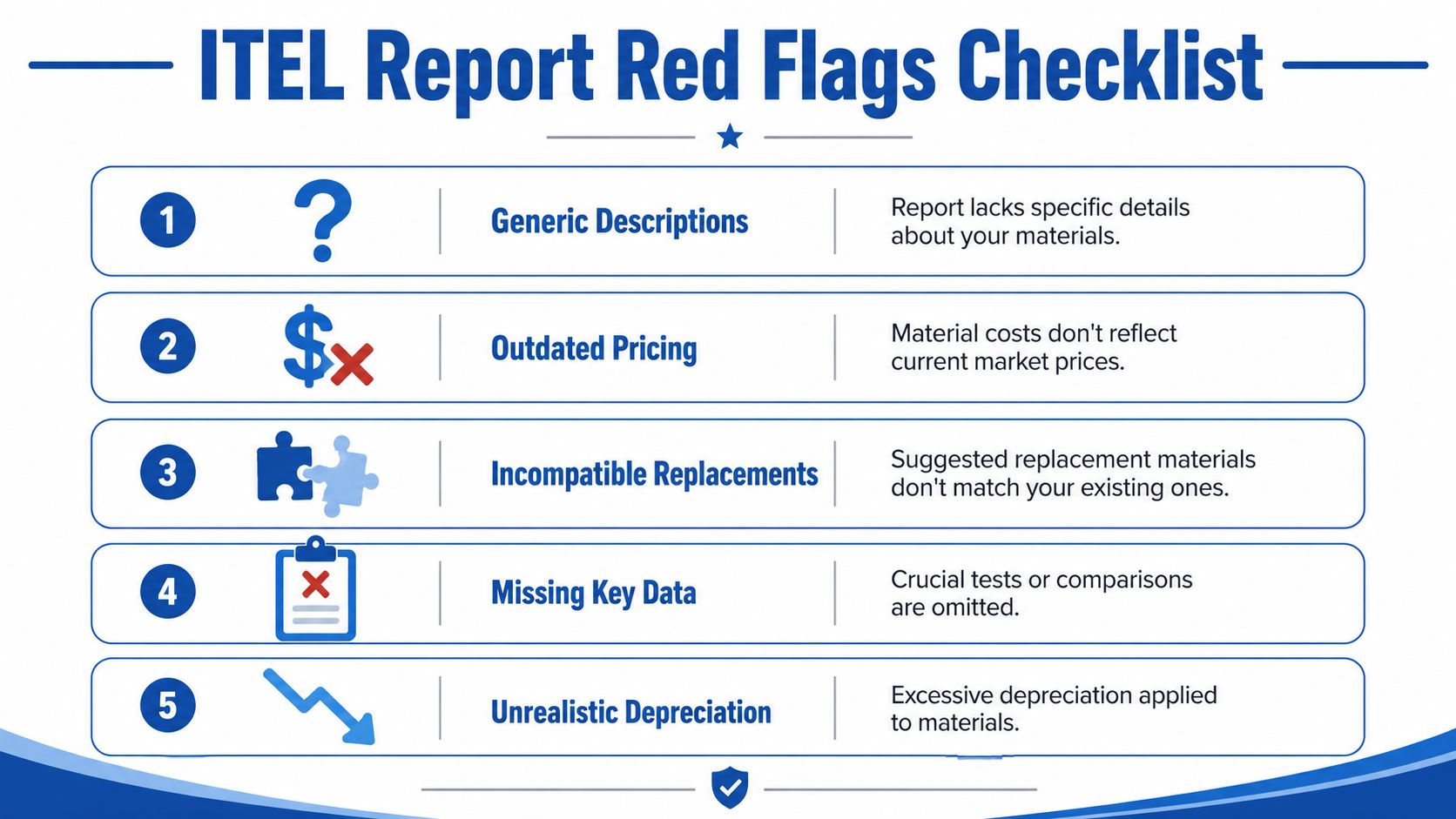
The checklist homeowners should use
Look for these warning signs right away:
- A vague product description. If the report describes the material in generic terms and doesn't pin down what was tested, that's a problem.
- A “match” that only works on paper. Similar dimensions don't mean similar appearance. Roofing, siding, and flooring disputes often turn on visible mismatch.
- Pricing that your contractor laughs at. If local suppliers and installers can't perform the work at the stated figure, the report may be driving an unrealistic estimate.
- No attention to continuous replacement. A carrier may want to replace a few shingles, boards, planks, or panels when a proper repair requires a larger integrated area.
- Context missing from the analysis. Weathering, fading, age, installation pattern, and surrounding material condition can make a spot repair unreasonable.
Don't ask whether the report sounds technical. Ask whether the proposed repair would actually restore your property.
Quick review table
| Issue in the report | Why it matters in the claim |
|---|---|
| “Closest available match” language | The insurer may use it to avoid full replacement |
| Low material pricing | The estimate may be impossible to perform in the real market |
| Limited repair scope | The carrier may ignore continuity and appearance |
| Missing testing details | You can't evaluate whether the conclusion is reliable |
| Old or excluded damage language | The carrier may be setting up a partial denial |
Another red flag is when the adjuster won't give you the full report or keeps summarizing it instead of producing it. If they're relying on it, you're entitled to inspect what they're relying on.
What a clean report shouldn't need
A fair report shouldn't need the adjuster to “interpret” it in a way that always reduces scope. If the file needs constant spin from the carrier to justify the estimate, that tells you plenty.
Your Playbook to Fight an Unfair ITEL Assessment
Your carrier drops an ITEL report into the file and acts like the debate is over. It isn't. A vendor hired to identify material or suggest a match does not get the last word on what your insurer owes. If that report is being used to shrink scope, cut price, or steer you into a patch job that won't restore the property, treat it like disputed evidence and go on offense fast.

Put the insurer on the record
Stop debating by phone. Make the carrier commit in writing.
Ask for the full ITEL report, the exact sample submission information, all photos, all estimates built from the report, and every claim note that relies on it. If the insurer says part of the damage is old, excluded, cosmetic, or outside the loss, demand a written coverage explanation by certified mail. Carriers get bolder when their position stays vague. They get more careful when they have to put it in black and white.
Then build your own file with evidence the adjuster cannot shrug off:
- Get a contractor or specialist statement that addresses matching, availability, installation method, code requirements, and whether the proposed repair will restore the property.
- Challenge the carrier's pricing with real bids or supplier input if the estimate will not buy the work in your market.
- Document the full affected area so the file shows continuity, visibility, and the practical limits of spot repair.
- Preserve everything in writing. Emails, letters, photos, and estimates carry weight. Casual calls usually disappear into the claim log.
Separate the real dispute
A lot of homeowners get trapped arguing the wrong issue. If coverage is accepted and the fight is over price or scope, say that clearly. Do not let the insurer blur a valuation dispute into a fake coverage dispute just because an ITEL report sounds technical.
That distinction matters because it changes your options. If the carrier agrees the loss is covered but hides behind a low number, you may have the right to force the value dispute into appraisal under the policy. If the carrier is denying parts of the loss outright, press for a written basis and prepare your rebuttal with documents, not opinions.
Use pressure points the carrier respects
Adjusters ignore frustration. They respond to deadlines, policy language, documented contradictions, and the risk that their file will look bad later.
A practical sequence looks like this:
- Confirm the insurer's position. Is it accepting coverage and underpaying, or denying part of the damage?
- Review the policy for appraisal language, proof of loss requirements, and any deadlines that matter.
- Send a formal dispute letter that identifies the exact points you contest in the ITEL-based estimate.
- Attach supporting documents from contractors, suppliers, consultants, or code sources that undercut the carrier's repair plan.
- Escalate when the carrier stalls. If you need a broader strategy, review this guide on how to dispute a property insurance claim.
Do not wait for the insurer to “reconsider” out of fairness. That is not how these files move. They move when you create a paper trail, expose weak assumptions, and force a decision-maker to defend the low number.
For homeowners and business owners who do not want to handle that fight alone, For The Public Adjusters, Inc. represents policyholders in documenting damage, reviewing scope, and negotiating with carriers.
Case Study How a Public Adjuster Beat an ITEL Low-Ball
A storm hits, the roof is damaged, and the insurer shows up with a familiar play. It leans on an ITEL-related material finding to say only a small section needs repair, not a full restoration. Then it starts floating the usual excuses about wear, age, or pre-existing condition to shave the claim down even more.
That is how a lot of underpayments are built.
In this claim, the homeowner did not accept the report as the final word. The public adjuster forced the fight back onto the core issue. What does it take to restore the property correctly under the policy? That shift matters because ITEL may identify a material, but the carrier often tries to stretch that finding into a valuation tool that favors its bottom line.
The first move was simple and aggressive. The public adjuster had the homeowner demand a written explanation for every position the carrier was taking on old damage, exclusions, and limited repair scope. No phone call summary. No vague adjuster comments. A written explanation creates accountability, and insurers get a lot less comfortable when they have to spell out weak reasoning in the file.
What changed the outcome
The carrier's low number started to crack when the public adjuster built a stronger factual record around the report:
- a contractor's written opinion that the proposed spot repair would not produce a proper match
- documentation showing the insurer's repair plan would leave obvious visual inconsistency
- a fuller presentation of the roof damage pattern, including affected surrounding areas instead of the small sample the carrier focused on
That changed the pressure on the file. The insurer could still point to ITEL, but it could not justifiably claim ITEL answered the full scope and restoration question. Once the record showed the carrier was using a vendor report to support a cut-rate outcome, the low-ball position became much harder to defend.
This is why policyholders bring in a public adjuster for insurance claim disputes. The job is not to make bad evidence disappear. The job is to expose where the insurer is overreaching, document the actual cost to fix the loss correctly, and force the carrier to negotiate on facts instead of hiding behind a report.
Get Expert Claim Help for Your ITEL Dispute
If your insurer dropped an ITEL report into the file and used it to cut scope, reduce pricing, or support a denial, don't treat that as the end of the claim. Treat it as the start of a real dispute.
ITEL Laboratories, Inc. has become a major force in property claims. Public reporting states that the company, now part of a $1.3 billion acquisition, has processed millions of samples for the insurance industry, making it a key and often contentious player in claim payouts for property damage across the country, according to Preqin's company profile information. That scale is exactly why homeowners need to be alert. A report from a company this embedded in the system can carry enormous weight inside the claim file.
What homeowners should do next
You need a disciplined response.
- Get the full report and every estimate tied to it.
- Compare it to real contractor input and the actual condition of your home or building.
- Demand written explanations for any denial, limitation, or “old damage” language.
- Use formal dispute tools when the carrier accepts coverage but underpays value.
- Get help early if the insurer keeps leaning on technical reports to avoid paying for proper restoration.
You also have the right to understand who represents whom in this process. Your carrier's adjuster works for the carrier. Vendors in the carrier's process help the carrier handle claims. If you want someone on your side, learn what a public adjuster does for a policyholder.
Ultimately, this fight usually comes down to stamina, documentation, and a strong position. The insurance company is counting on frustration. Don't give it that win. Have your water damage claim questions answered at NO COST. Call 919-400-6440 to speak with a licensed Public Insurance Adjuster or Contact Us here with questions. WE Work For YOU… NOT Your Insurance Company!
If you're dealing with a denied, delayed, or low-ball dwelling or business property claim, For The Public Adjusters, Inc. can help you review the insurance company's position, examine reports being used against you, and build a documented dispute strategy focused on the full amount owed under your policy.