
When you’re dealing with the aftermath of a major storm, the first settlement offer for your insurance claim storm damage is almost guaranteed to feel like a slap in the face. It’s going to be low. Shockingly low.
This isn’t an accident or a simple oversight. It’s a calculated business move from giant corporations like State Farm or Allstate, a test to see if you’ll just take the money and go away quietly. The insurance company is throwing out an anchor number, hoping you don’t know enough to challenge it, so they can protect their bottom line.
Why Your First Settlement Offer Is a Lowball
Let’s be brutally honest. That first offer isn’t just low; it’s a strategic opening bid in a negotiation you probably didn’t even know you were in.
Big insurance carriers are massive, for-profit corporations with a primary responsibility to their shareholders, not their policyholders. Their entire business model is built on a simple formula: collect as much as possible in premiums and pay out as little as possible in claims. Your devastation is just another number on their balance sheet.
The offer you’re holding is based on a report written by their company adjuster—an employee whose job is to protect the company’s financial interests, not yours. Their goal is to close your file fast and cheap.
The Adjuster’s Biased Assessment
The insurance adjuster sent to your property is not on your side. Period. They are a company employee, paid and trained by the insurer to find ways to limit the payout.
They often rely on pricing software, like Xactimate, which can be easily manipulated to spit out lower repair costs. This software is notorious for ignoring the on-the-ground reality after a disaster, conveniently leaving out critical details like:
- The massive surge in labor costs when every contractor in a hundred-mile radius is booked solid.
- Skyrocketing material prices caused by sudden, widespread demand and broken supply chains.
- Local building code upgrades required by your city or county that can add thousands to the real cost of rebuilding.
By pretending these factors don’t exist, they can justify an offer that leaves you footing a huge chunk of the bill yourself.
Common Tactics to Undervalue Your Claim
Insurers have a whole playbook of tactics designed to chip away at the true value of your claim. They’ll try to argue that some of the damage was “pre-existing” or just normal “wear and tear,” even when a hurricane just ripped through your neighborhood. This is a common delay and deny tactic.
We see it all the time. An adjuster will look at a hail-battered metal roof and call the damage “cosmetic,” refusing to pay for a replacement even though the protective coating has been compromised, dooming it to rust and leaks. This isn’t an honest assessment; it’s a strategy to protect profits.
Insurer Tactics vs. Your Counter-Strategies
The insurance company’s game plan is predictable, but that means you can prepare for it. You have to be ready to counter their moves from day one.
| Common Insurer Tactic | Your Proactive Counter-Strategy |
|---|---|
| The Quick, Lowball Offer | Reject it immediately. State in writing that the offer is insufficient and you are gathering your own evidence and estimates. |
| “Pre-Existing Damage” | Provide “before” photos of your property. Have maintenance records, inspection reports, or receipts for recent repairs ready. |
| Misinterpreting Your Policy | Demand they cite the exact policy language (page, section, line) they are using to deny or limit coverage. |
| Delaying Tactics | Communicate everything in writing. Set firm deadlines for responses. Follow up relentlessly. |
| Using Their “Preferred” Contractor | Insist on getting multiple independent estimates from reputable, local contractors you trust. |
Don’t let them control the narrative. By documenting everything and knowing their playbook, you force them to justify every decision they make.
A lowball settlement offer is not the end of the road. It’s an invitation to prove them wrong. Your insurance policy is a contract, and you have every right to fight for what you’re owed to be made whole again.
This is especially true after a catastrophic event like a hurricane. Insurers know you’re exhausted, stressed, and desperate for a sense of normalcy. They count on you being too overwhelmed to put up a fight. For a deeper dive into this, our guide on navigating a hurricane insurance claim is essential reading.
Taking that first, pitiful offer is exactly what they want you to do. It’s the worst mistake you can make.
Building an Evidence-Based Case They Cannot Ignore
If you want to successfully dispute your insurance claim for storm damage, you need to understand one hard truth: blurry cell phone pictures won’t cut it. You have to build an ironclad case so detailed and undeniable that their lowball offer looks exactly like what it is—a cheap attempt to underpay you.
That adjuster is not your friend. He’s there to protect his company’s bottom line. Your job is to hit back with overwhelming, irrefutable proof that shreds his self-serving report.
This goes way beyond a simple list of what broke. You need to become the lead investigator on your own claim, documenting every single crack, stain, and damaged item with methodical precision. Your goal is to deliver a professional rebuttal that proves, line by line, the real cost of making you whole again.
Document Everything Like a Pro
Your smartphone is your single most powerful weapon in this fight. Use it to build a visual timeline of the damage that leaves zero room for the insurance company to argue about “pre-existing conditions.”
- Get the immediate aftermath. Start with wide shots of your whole property from every angle. This establishes the big picture. Then, get in close for detailed shots of the specific damage—the siding that got dented, the shingles that lifted, the windows that shattered.
- Timestamp everything. Go into your phone’s camera settings and turn on the timestamp feature. This is non-negotiable. It proves your photos and videos were taken right after the storm, killing any argument that the damage was old or that you waited too long.
- Record a video walkthrough. This is huge. Do a slow, narrated video tour of your property, inside and out. As you record, talk about what you’re seeing. Saying, “This is the new water stain on the living room ceiling that showed up right after the hurricane,” creates a powerful record that’s hard to ignore.
Make no mistake: the burden of proof is on you. The more detailed your evidence, the less wiggle room the insurance company has. They are literally banking on you being too overwhelmed and disorganized to fight back properly.
Create an Exhaustive Inventory of Your Losses
When it comes to interior damage, a simple list of “broken stuff” is worthless. You need a comprehensive, room-by-room inventory of every single item that was damaged or destroyed.
For every item on that list, you need to include:
- A specific description (e.g., “Samsung 55-inch 4K Smart TV,” not just “TV”)
- The brand, model number, and serial number if you can find them
- The original purchase date and how much you paid
- Clear photos or video showing the damage to the item
- A link to a comparable replacement item online to prove today’s cost
I know this sounds tedious. It is. But it’s also the difference between a vague complaint and a specific, evidence-backed demand for the money you are rightfully owed.
The infographic below shows the brutal reality most policyholders face. You go from the shock of the storm to the insult of a lowball offer, and then you’re forced into a fight you never asked for against your own insurer.
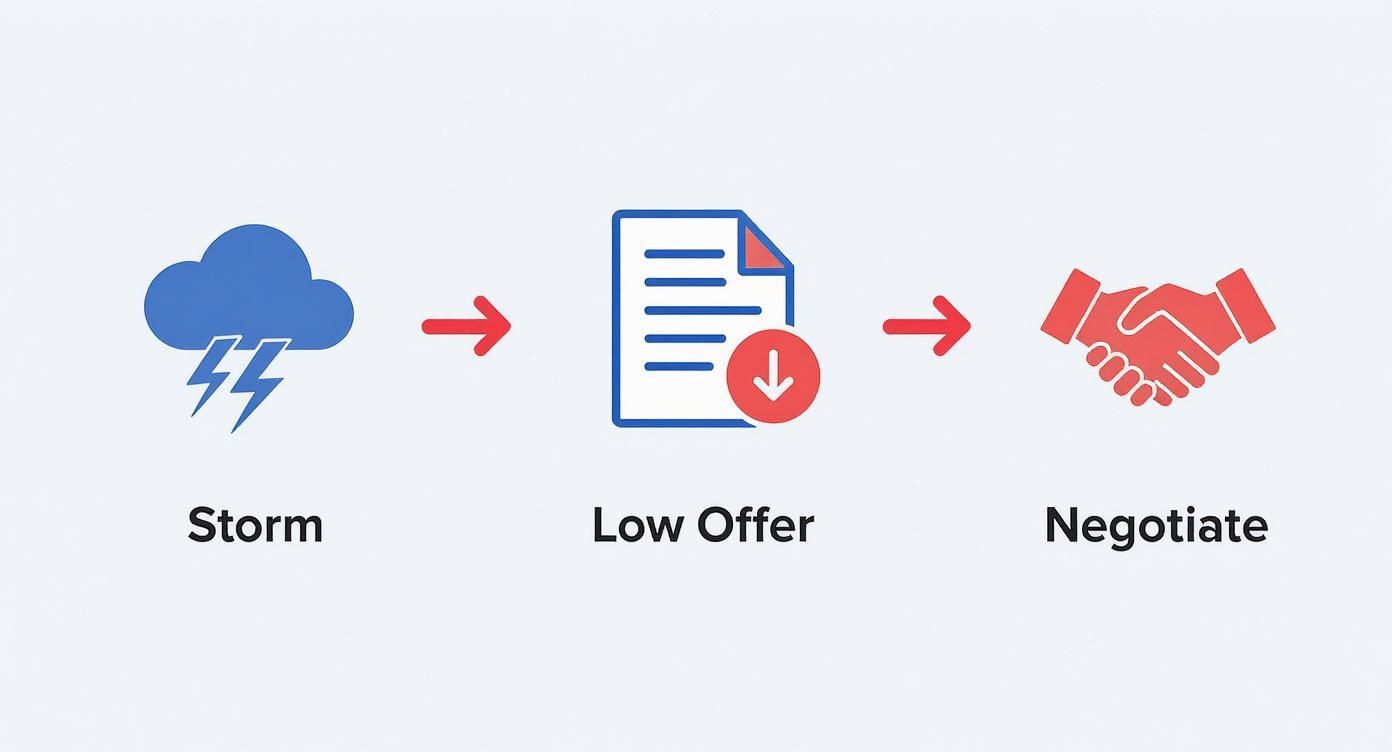
This process proves one thing: the insurance company’s first offer is almost never their best one. You have to be ready to fight back.
Get Your Own Contractor Estimates
Never, ever trust the contractor your insurance company “recommends.” These so-called “preferred vendors” have a cozy relationship with the insurer, and their main job is to keep repair costs down. It’s a rigged game.
You have the absolute right to get your own estimates.
Go find at least two or three respected, local, and independent contractors and ask them for a detailed, line-item estimate. A real estimate breaks down every single cost: materials, labor, permits, cleanup, everything. This independent proof of what repairs actually cost is one of the most powerful tools you have to demolish the insurer’s fantasy numbers.
This kind of detailed prep work is more critical than ever. We’ve seen a massive spike in severe convective storm (SCS) claims, with damages hitting $46 billion through September—the third straight year it’s been over $40 billion. That trend just gives insurers even more incentive to find ways to slash every single payout.
How to Dissect and Demolish Their Adjuster’s Report
That flimsy report handed to you by the insurance company’s adjuster is their entire justification for the lowball offer you just received. Let’s be clear: it’s not an objective assessment. It’s a carefully crafted document designed from the ground up to minimize their payout.
Learning to read between the lines is the first step to tearing their weak arguments apart when disputing an insurance claim for storm damage.
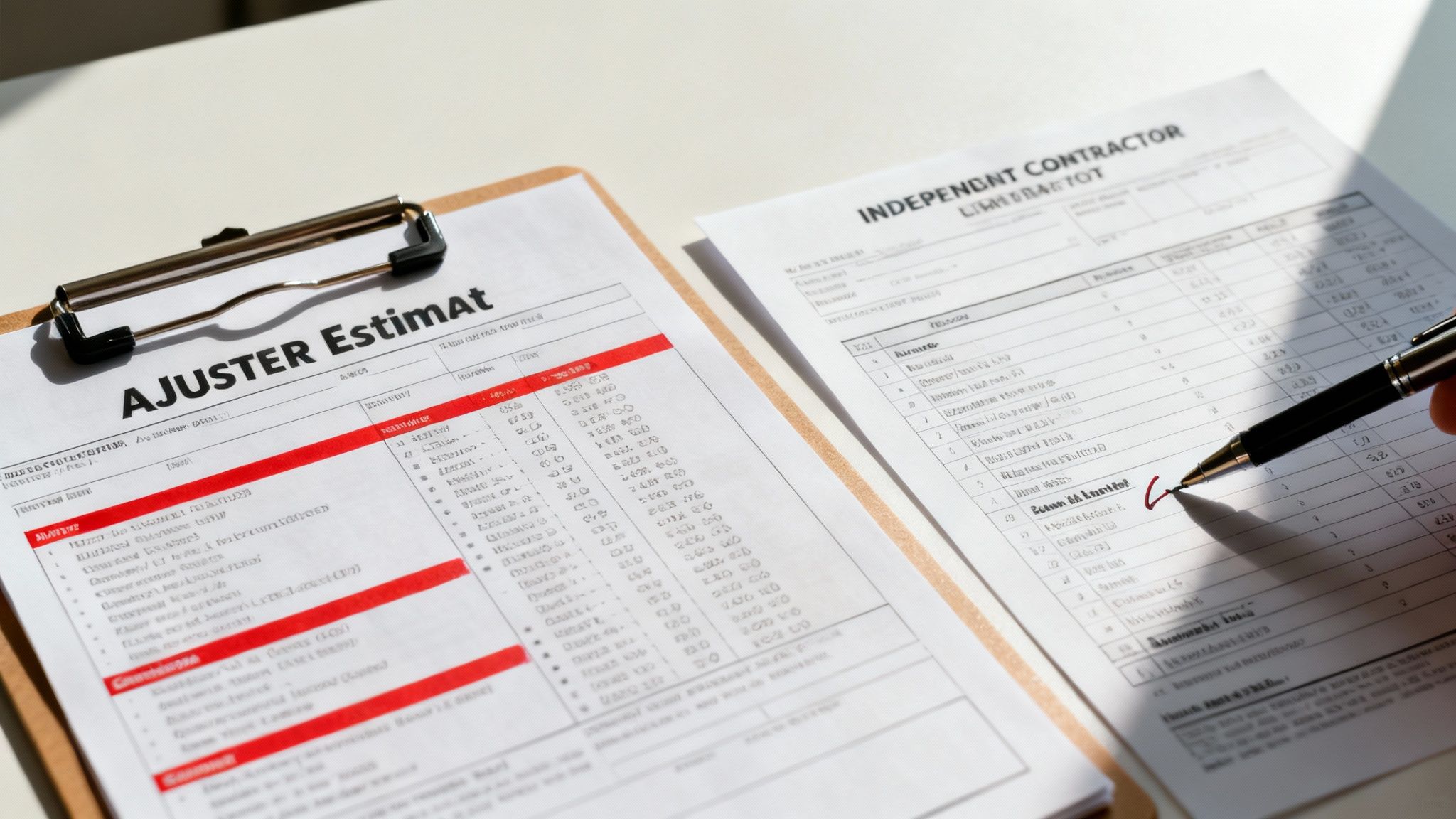
This report is your battlefield. Treat it like one. Get out a red pen and prepare to challenge every single item, because you can be sure they’ve omitted damages, undervalued materials, and ignored critical repair components to save their company money. Your job is to expose every single flaw.
Uncovering Omissions and Vague Language
The first thing you’ll notice is what isn’t in the report. Their adjuster likely did a quick, superficial inspection, conveniently “missing” major issues. They fill their reports with vague terms like “repair patch” or “spot treat” specifically to avoid paying for full, proper replacements.
Here are the classic tricks to watch for:
- Missing Components: Did they include roof underlayment, drip edge, flashing, or ventilation? These are essential parts of a roofing system. Leaving them out is a classic way to shrink an estimate.
- Interior Damage: Was a small ceiling stain noted, but the report fails to account for soaked insulation, compromised drywall behind the paint, or potential mold growth? This is intentional.
- Matching Issues: They might offer to replace a few damaged siding panels but conveniently ignore the fact that the new panels won’t match the old, sun-faded ones. This often entitles you to a full replacement of that entire section under your policy.
Don’t let their jargon intimidate you. If you see a line item you don’t understand, demand a written explanation. Ambiguity is a weapon they use to confuse policyholders and underpay claims.
Spotting Undervalued Materials and Labor
Next, you have to attack their pricing. Insurers like Allstate and State Farm often use standardized pricing software that spits out bulk, national-average costs—not the real-world prices you’ll actually face after a local disaster.
They might price your architectural shingles at the cost of cheap 3-tab shingles. They’ll lowball labor rates, completely ignoring the fact that skilled, reputable contractors are in high demand after a storm. This isn’t an accident; it’s a deliberate tactic to justify a lower payout.
Compare their estimate line-by-line with the detailed scope of work from your own independent contractor. Your contractor’s estimate reflects local market reality—the true cost of materials and labor in your area, right now. This direct comparison is one of your most powerful pieces of evidence.
The Building Code Trap
This is a huge one. Insurers love to cut corners here. Local building codes may have been updated since your home was originally built. If your roof is destroyed, the new one must be built to the current code, which can add thousands to the final cost.
For example, a new code might require hurricane straps or a different type of roof decking. The company adjuster’s report will almost never include these “code upgrade” costs unless you force the issue. It’s on you to know what your local codes require and demand the settlement covers it. If you don’t, you’ll be paying for these mandatory upgrades straight out of your own pocket.
Case Study: Exposing a Flawed Report in Action
A business owner in Raleigh, NC, received a settlement offer of just $22,000 for serious wind and hail damage to their commercial building. The insurance adjuster’s report dismissed the damage as “minor” and limited it to just a few roof sections.
Feeling the offer was absurdly low, the owner hired a public adjuster. Our public adjuster conducted a thorough, top-to-bottom inspection and immediately found massive flaws in the insurer’s report. The company adjuster had completely missed widespread hail damage to the HVAC units on the roof and failed to account for a local ordinance requiring a full roof system upgrade when more than 25% of a roof is damaged.
Armed with a detailed counter-estimate and undeniable photographic evidence, the public adjuster completely demolished the initial report. The final settlement was negotiated to $115,000—more than five times the original offer—covering a full roof replacement, all HVAC repairs, and code upgrades. This is a perfect example of how an expert can expose the weaknesses in an adjuster’s report to secure a fair settlement.
Hiring a Public Adjuster to Maximize Your Claim
After a major storm, you realize the nightmare isn’t over. It’s just beginning. Fighting your insurance company can feel like a second disaster—you’re exhausted, your home is a wreck, and the very company you paid to protect you is suddenly treating you like an enemy.
This is the moment you realize you can’t win this battle alone.
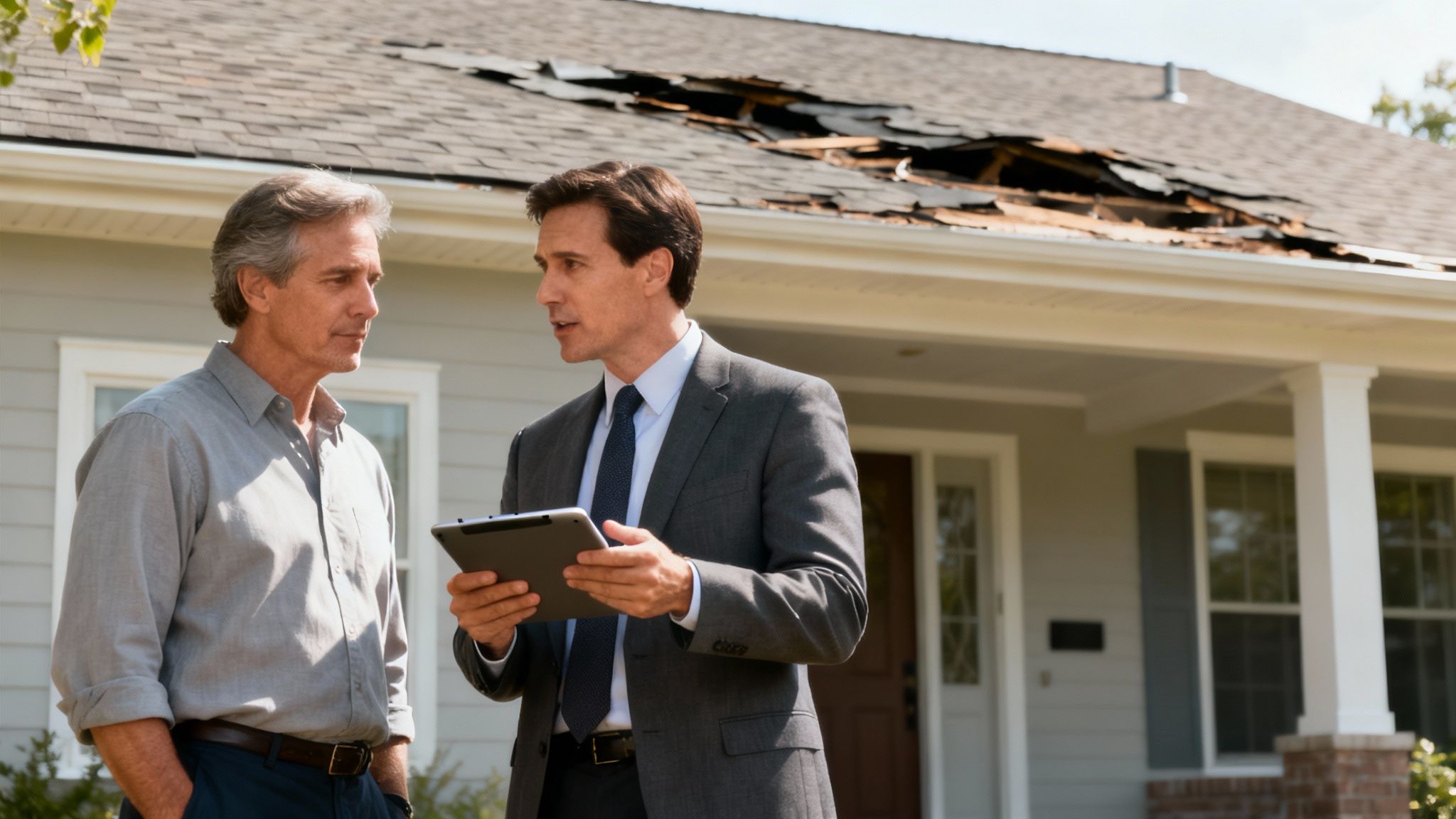
A public adjuster is a state-licensed insurance professional who works for one person and one person only: you, the policyholder. Unlike the company adjuster who shows up representing the carrier, a public adjuster’s loyalty is never divided. Their entire job is to level the playing field, making sure your insurance claim storm damage is documented, filed, and negotiated for every single penny you’re owed.
Clear Signs You Need an Advocate
So, how do you know it’s time to call for backup? The signs are usually obvious and incredibly frustrating. If you’re nodding along to any of these, it’s time to stop fighting a losing battle and get an expert on your side.
- Your claim was flat-out denied. The insurance company is betting you’ll just walk away defeated. A public adjuster will reopen that claim with a mountain of evidence they can’t ignore.
- The settlement offer is a slap in the face. If their offer doesn’t even cover half of what your contractor quoted, you need a professional negotiator to prove the real cost to make you whole.
- They’re blaming “pre-existing conditions.” This is a classic trick. An experienced public adjuster will use historical weather data and forensic proof to shut down that argument and prove the storm was the cause.
- The process is dragging on forever. Constant delays aren’t accidental; they’re a strategy designed to wear you down. An expert knows how to apply pressure and enforce the deadlines your policy guarantees.
What Does a Public Adjuster Actually Do?
Think of a public adjuster as the quarterback of your claim. They take over the entire grueling process, managing the endless paperwork, phone calls, and negotiations so you can focus on your family.
First, they’ll dig deep into your insurance policy, line by line. They understand the dense, confusing language and will find pockets of coverage you never even knew you had. We break down their roles and responsibilities in our guide on what is a public adjuster.
Next comes the real work. They perform their own independent, incredibly thorough inspection of your property. They find the hidden damage the company adjuster “missed”—the compromised roof underlayment, the moisture trapped behind walls, the cracked foundation.
From there, they build an exhaustive, line-item estimate using the same software as the insurance carriers. The difference? They use it to reflect real-world local labor and material costs, not some national average designed to save the insurer money.
A public adjuster speaks the same language as the insurance company. They counter the insurer’s flawed report with an evidence-based claim package that is too professional and detailed to be easily dismissed.
This has never been more critical. Insurers are under immense pressure as global insured losses from natural catastrophes have exploded. In just the first nine months of the year, damages hit a staggering $105 billion. As noted by Risk & Insurance, this is the sixth year in a row that losses have blown past the $100 billion mark. That gives carriers a massive incentive to tighten their belts and underpay claims wherever they can get away with it.
Case Study: A Denied Hail Claim Becomes a Six-Figure Win
A family in Virginia had their insurance claim storm damage for a hail-battered roof flat-out denied. Their insurer, one of the biggest names in the business, sent an adjuster who spent less than 20 minutes on the property before deciding it was all just “normal wear and tear.”
Frustrated and staring down a $45,000 bill for a new roof, the homeowners called us. Our public adjuster immediately scheduled a new, top-to-bottom inspection. He didn’t just document the hundreds of obvious hail impact marks on the shingles; he found significant damage to the gutters, siding, and window screens the company adjuster conveniently ignored.
He built a brand new claim package from the ground up, including:
- High-resolution photos with clear measurements of the impacts.
- A certified report from a meteorologist confirming the date, time, and size of the hail that hit their specific address.
- A detailed, line-by-line estimate for a full roof replacement and repairs for all the collateral damage.
Armed with this undeniable proof, the public adjuster reopened the claim. After some intense negotiation, the insurance company completely reversed its denial.
The final settlement was $112,000. That was enough to give the family a brand-new roof, repair all the other storm damage, and even cover the interior water damage that had started to seep in. That’s the power of having a professional advocate in your corner.
Escalating Your Fight with Bad Faith Lawsuits
When your insurance company drags its feet, denies your valid claim, or tries to lowball you, they might be crossing a line from bad customer service into illegal “bad faith.”
This isn’t just business as usual. It’s a fundamental breach of the contract you’ve been paying them for. When the endless phone calls and emails go nowhere, it’s time to escalate the fight.
Your policy is their promise to pay when disaster strikes. If they break that promise, you have powerful tools to hold them accountable.
File a Formal Complaint with the Department of Insurance
Your first move should be filing a formal complaint with your state’s Department of Insurance (DOI). It’s a free service, and it immediately puts your insurer on notice with a government regulator.
Let’s be clear: the DOI usually can’t force your insurer to write a check. But a formal complaint is a strategic power play.
- It Creates an Official Record: This documents the dispute and the carrier’s behavior, which is critical evidence if you end up in court.
- It Forces a Response: The insurance company is legally required to answer the DOI. They can’t just ignore you anymore.
- It Flags Bad Actors: Regulators track these complaints. A pattern of abuse against one company can trigger major investigations and massive fines.
Filing a complaint costs you nothing, but it applies serious pressure and shows the carrier you mean business.
Invoke the Appraisal Clause
Buried deep in your policy is a powerful—and often overlooked—tool called the appraisal clause. This isn’t about if the damage is covered; it’s a formal process to settle disputes over the cost of the damages.
Here’s how it works: You hire your own independent appraiser. The insurance company hires theirs. Those two then agree on a neutral third party, called an “umpire.” If your appraiser and the insurance company’s appraiser can’t agree on the value of the loss, the umpire makes the final call. And that decision is typically binding.
Appraisal is how you take the power away from a biased company adjuster. It forces a resolution based on the facts of the damage, not the insurer’s bottom line.
When It’s Time for a Bad Faith Lawsuit
If your insurer’s behavior is genuinely outrageous—like they’re making up excuses, deliberately twisting your policy language, or flat-out refusing to pay an undisputed part of your claim—you have to consider legal action.
A bad faith lawsuit isn’t just about getting the money for your repairs. It’s about punishing the company for their malicious tactics.
Courts have hammered insurance giants for this stuff. In the landmark case State Farm Mut. Auto. Ins. Co. v. Campbell, the U.S. Supreme Court addressed the issue of excessive punitive damages but still affirmed that insurance companies can be punished severely for bad faith practices, highlighting a nationwide pattern of capping payouts to meet corporate profit goals.
Look at the real-world case of a Colorado family whose home was hit by lightning. Their insurer, USAA, tried to get away with a lowball offer of just $70,000. After fighting for a year, the family sued for bad faith and ultimately walked away with a settlement closer to $297,000.
The lesson is brutal but true: sometimes, the only way to get a fair payout is to prove you’re willing to drag them into a courtroom. It shows the insurer you will not be bullied.
Common Questions About Disputing Your Storm Damage Claim
When your insurance claim for storm damage gets denied or lowballed, it feels like a gut punch. You’re left trying to figure out how to fight a massive corporation, and the questions pile up fast. Here are the hard truths and real answers you need.
What Should I Do Immediately After My Storm Damage Claim Is Denied?
First thing’s first: do not accept their “no” as the final answer. The insurance company is banking on you feeling overwhelmed and just giving up. That’s a win for them.
Your very next move should be to demand, in writing, a full explanation for the denial. They are required to provide one. This letter must point to the exact language in your policy they’re using to justify their decision. Forget emotional phone calls; you need a paper trail. This letter becomes a critical piece of evidence. While you wait for their response, start gathering every single piece of documentation you have and seriously think about calling a public adjuster. An expert can tell you in minutes if their denial is legitimate and show you the clearest path to getting it overturned.
Can I Hire My Own Contractor Instead of the Insurer’s Choice?
Yes. And you absolutely should. Insurers love to push their “preferred vendors” on you, but you need to understand why. These vendors have pre-negotiated deals with the insurance company to do the work cheap, which serves the insurer’s bottom line, not the quality of your repair.
Think about it: who is that contractor really working for? The company that sends them a constant stream of business, or you? It’s a massive conflict of interest. When you hire your own licensed, reputable local contractor, you get someone whose only loyalty is to you. They will build a scope of work that’s focused on truly restoring your property, giving you a powerful, independent estimate to throw right back at the insurance company’s lowball offer.
Be extremely wary of any contractor recommended by the insurance company adjuster. Their primary goal is often to perform the cheapest possible repair that satisfies the insurer, not the best possible repair for your home.
What if an Insurance Check Says ‘Final Payment’ but Is Not Enough?
This is a classic trap, and if you fall for it, you could lose thousands. Cashing a check marked “final payment” or “full and final settlement” can be legally seen as you agreeing that their lowball offer is fair and final. It can kill your ability to pursue another dime.
If the check isn’t enough to cover your repairs, do not cash it. Instead, immediately send a certified letter to your insurer. State clearly that you are accepting this check only as a partial payment and that you are not, under any circumstances, waiving your right to claim the full amount you are owed under your policy. Better yet, talk to a public adjuster before you do anything with that check.
What if My Insurer Blames the Damage on ‘Wear and Tear’?
This is one of the oldest, most dishonest excuses in the book. Carriers like State Farm and Allstate have mastered the art of claiming your roof or siding was already old and the storm just gave it the final push. It’s a deliberate strategy they use to weasel out of paying a legitimate insurance claim for storm damage.
You fight this tactic with cold, hard evidence.
- Dig up “before” photos of your property to prove its condition before the storm.
- Provide any records you have of recent maintenance, inspections, or repairs.
- Get an independent contractor or public adjuster to write an expert opinion stating that the storm was the direct and sudden cause of the damage.
A good public adjuster will also pull meteorological data, proving the exact wind speeds and hail size that hit your specific address. That makes it a whole lot harder for the insurer to pretend the damage was just old age. Don’t let them rewrite history to protect their profits.
Q2: How can I tell if the roof damage on my home was caused by hail versus normal wear and tear?
A: Hail damage is characterized by randomly scattered dents or strikes that chip the shingle granules or leave soft spots. Normal wear is typically uniform across the entire roof slope. An independent inspection by a Public Adjuster or licensed contractor will provide definitive proof.
Q3: How much time do I have to file an insurance claim after a major wind or hurricane event?
A: While most policies require you to report the claim promptly, the deadline for filing the final claim documentation (like the Proof of Loss) can vary by state, often ranging from 1 to 3 years after the storm date. Consult your policy or a Public Adjuster for the specific timeline.
Q4: What is "matching" coverage, and how can I fight my insurer if they refuse to replace all my siding?
A: Matching coverage requires the insurer to replace undamaged sections of materials (like siding or shingles) if the damaged sections cannot be perfectly matched, often due to color fading or discontinuation. You fight this by citing the "Reasonable Repair" section of your policy.
Q5: How does a Public Adjuster prove the full scope of wind damage when the insurer only wants to pay for minor repairs?
A: A Public Adjuster brings in independent structural engineers and roofing consultants to conduct invasive inspections and use drone technology to document all damage, submitting a full scope of loss that the insurer's low estimate cannot logically dispute.
Q6: My insurance company is only offering Actual Cash Value (ACV). How do I get the full Replacement Cost Value (RCV)?
A: Your policy likely pays ACV upfront. To get the remaining RCV (depreciation amount), you must complete the repairs and submit receipts showing the actual cost to rebuild or replace the property. A Public Adjuster helps manage this RCV recovery process.
Q7: What should I do if my hurricane damage claim is denied because the insurer claims it was flood damage?
A: This is a complex "Wind vs. Water" dispute. You need a Public Adjuster and a forensic engineer to prove the damage (e.g., roof tear-off) occurred due to wind before the floodwaters arrived, ensuring your standard homeowner's policy pays the wind portion.
Q8: Can the insurance company deny my entire roof claim if they find evidence of previous, unrepaired damage?
A: They can try to limit payment, but a Public Adjuster counters this by arguing the current storm caused new, separate damage, or that the new damage was compounded by the old, forcing the insurer to pay the costs associated with the most recent covered event.
Q9: How does a Public Adjuster stop the insurer from delaying my storm damage claim for months?
A: A Public Adjuster immediately takes control of all communications, establishes an aggressive timeline, and leverages state regulations (like the Fair Claims Settlement Practices Act) to hold the insurer accountable to processing deadlines.
Q10: Can I get money for living expenses (ALE) if my home is uninhabitable after a major storm?
A: Yes, if the storm damage is from a covered peril and forces you out, your policy's Additional Living Expense (ALE) coverage will pay for reasonable and necessary extra costs like temporary housing and increased food expenses while your home is under repair.
If you’re facing a denied, delayed, or underpaid claim, you don’t have to fight the insurance company alone. At For The Public Adjusters, Inc., we advocate exclusively for policyholders to secure the full and fair settlement you are owed. Contact us today for a free, no-obligation review of your claim at https://forthepublicadjusters.com.

Great article that really highlights the adversarial nature of the insurance claims process after a major storm. It’s a sobering reminder that policyholders need to be prepared to fight for a fair settlement.
This makes me wonder about another critical aspect of financial protection, especially for those of us who travel. Your section on being prepared with documentation and understanding your policy’s fine print is spot on. It reminds me of a similar, brutal financial shock that can happen abroad: the staggering cost of a medical evacuation after an accident or illness in a foreign country. I recently read a detailed breakdown of this on another site, and the parallels to the insurance lowballing you describe are striking.
Sorry to drop a link here, but it really helps illustrate what I’m talking about and adds another layer to the “be prepared” message of your post. I’m curious, from your expertise in claims and policy language, have you ever encountered clients who faced financial ruin from an overseas medical emergency that their travel or health insurance didn’t properly cover? It seems like being underprepared for a storm claim and being underprepared for a medical evacuation abroad are two sides of the same coin.
Here’s the article I mentioned for reference: https://pillintrip.com/ru/article/when-your-vacation-turns-into-a-100000-nightmare-the-brutal-truth-about-medical-evacuation
Thanks for sharing such valuable and empowering information.