
Filing an insurance claim for fire damage feels like it should be the first step toward recovery. In reality, with insurers like State Farm or Allstate, it’s often the start of a grueling fight you never saw coming.
You expect your insurance company to be a lifeline after a disaster. But the hard truth is, their main goal is almost always to protect their own profits by paying you as little as possible. That means their first offer will probably be a low-ball fraction of what you actually need to rebuild your life. You have to be ready to fight them from day one.
Why Your Fire Damage Claim Is A Fight From The Start
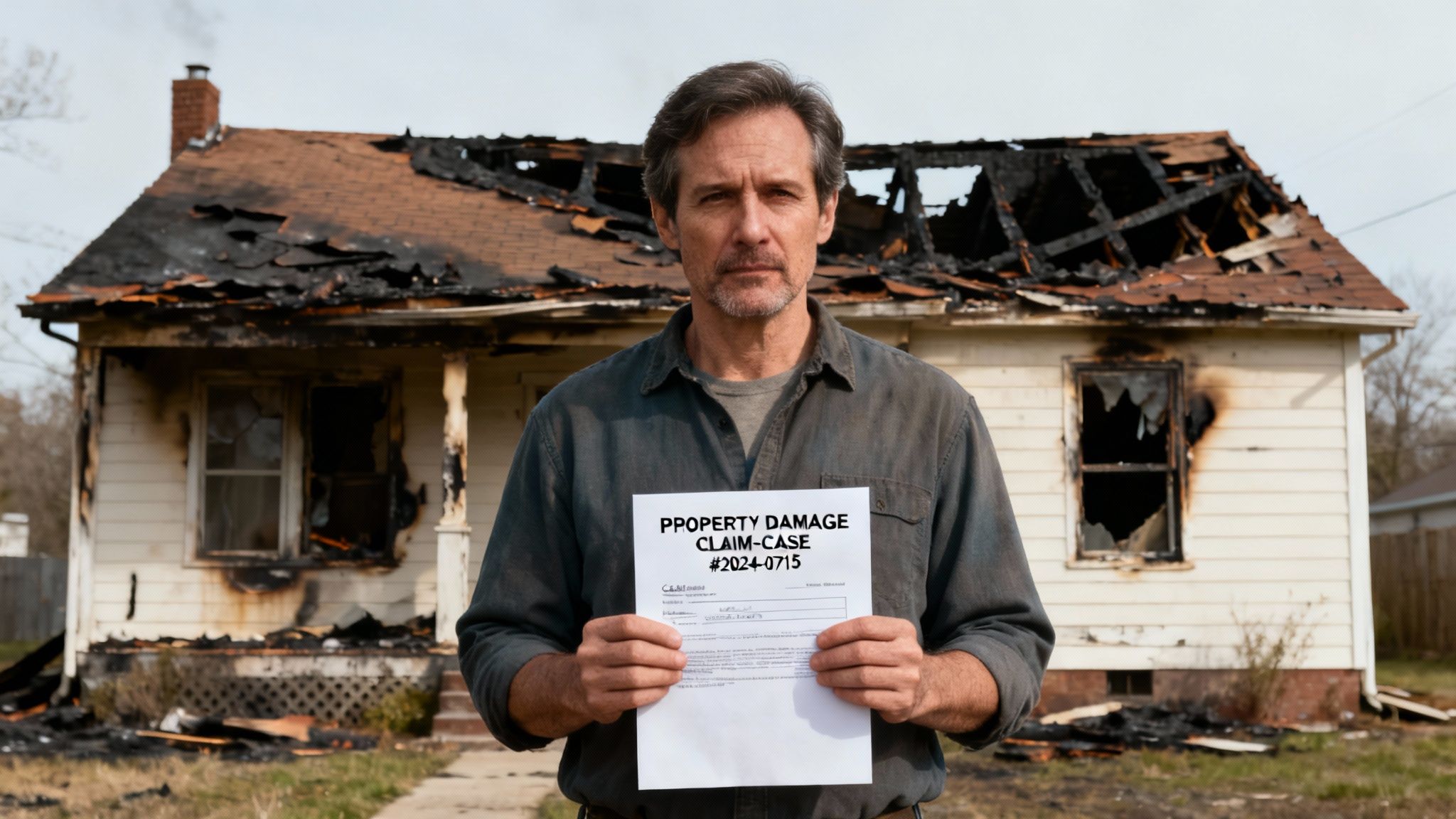
After the shock of a fire, your first instinct is to call your insurance agent, hoping for the relief you’ve been paying for all these years. Unfortunately, this is where the real battle begins.
Big insurance carriers are massive, for-profit corporations. Their adjusters are trained professionals, but their loyalty is to the company’s bottom line, not to you. This creates an immediate and unavoidable conflict of interest. The very person responsible for assessing your losses is employed by the company that has to write the check.
You’ll see this conflict of interest play out in that first settlement offer. It’s almost guaranteed to be a lowball number, calculated to cover only the most obvious, surface-level damage. These initial offers are designed to undervalue the true cost of getting back on your feet, conveniently leaving out thousands in hidden expenses you might not even recognize yet.
Common Tactics Insurers Use To Underpay You
Insurance companies have a playbook of strategies to pressure policyholders into accepting a quick, cheap settlement. One of their favorite tactics is delay. They drag their feet, hoping your financial desperation grows until you’re forced to accept whatever they’re willing to give you.
They’ll also use your own policy against you, hiding behind confusing jargon and obscure clauses to justify their low numbers. You’ll find them arguing about the scope of repairs or completely ignoring less obvious forms of damage, such as:
- Widespread smoke and soot damage that has seeped into every porous surface.
- Hidden structural damage to joists, studs, and trusses behind the walls.
- Mandatory building code upgrades required for any major reconstruction.
- The actual replacement cost of your personal belongings, not just their depreciated value.
Understanding the common reasons insurance companies deny fire claims is your first step in preparing for this fight. Don’t be caught off guard.
Key Takeaway: Their first offer is a negotiation tactic, not a final decision. You shouldn’t just consider disputing it—you absolutely must.
You Are Not on a Level Playing Field
Let’s be clear: this isn’t a fair fight. The company adjuster walks in with years of experience, powerful estimating software, and an entire team of experts dedicated to one thing: minimizing your claim’s value.
Meanwhile, you’re likely going through this for the first time, all while dealing with the incredible stress of losing your home or business. While preventative measures like implementing effective workplace fire prevention tips can reduce the risk of a fire, once it happens, the claims process itself becomes adversarial.
Accepting that lowball offer means you’ll be paying for a huge chunk of your own recovery out-of-pocket, which defeats the entire purpose of having insurance in the first place.
Insurer’s Adjuster vs Public Adjuster Who Works For You
It’s critical to understand who is actually working for you. The adjuster your insurance company sends has a different agenda than an adjuster you hire to represent your interests.
| Attribute | Insurance Company Adjuster | Your Public Adjuster |
|---|---|---|
| Loyalty | Works for the insurance company. | Works directly for you, the policyholder. |
| Primary Goal | Minimize the insurer’s financial payout. | Maximize your financial settlement. |
| Who Pays Them | Paid a salary by the insurance company. | Paid a small percentage of the claim settlement. |
| Motivation | Protect the company’s bottom line. | Protect your best interests and ensure full recovery. |
| Outcome | Often leads to a lower initial settlement offer. | Typically results in a significantly higher payout. |
The difference is night and day. One is trying to save their employer money; the other is fighting to get you every dollar you are rightfully owed under your policy.
Decoding Your Policy: What Insurers Hope You Miss
After a fire, that thick insurance policy document is supposed to be your financial lifeline. But here’s a hard truth: carriers like State Farm and Allstate don’t write these things to be clear and helpful. They’re packed with dense, confusing language for one simple reason—it gives them the upper hand.
They count on you being overwhelmed. They want you focused only on the blackened walls and burnt roof, hoping you’ll completely miss the valuable coverages that could pump thousands more into your insurance claim for fire damage. This isn’t just bad luck; it’s their business model.
Looking Beyond the Charred Walls
Your policy is so much more than a promise to rebuild the structure. Tucked away in the fine print are crucial provisions designed to cover the full, devastating impact of a fire. But you can bet your insurance company’s adjuster won’t be volunteering this information.
Here are a few key areas they bank on you overlooking:
- Additional Living Expenses (ALE): This is the money that covers your hotel bills, temporary rent, and even the extra cost of eating out while you’re displaced. Insurers are notorious for pressuring you into the cheapest, quickest option or trying to cut off these benefits long before your home is actually livable again.
- Mandatory Code Upgrades: Building codes change. If bringing your home back to its pre-fire condition requires updating the electrical, plumbing, or structure to meet current laws, your policy should pay for it. Adjusters love to “forget” these expensive but non-negotiable upgrades in their initial low-ball offers.
- Pervasive Smoke and Soot Damage: Smoke is a silent destroyer. It doesn’t just stain what you can see; it seeps into insulation, contaminates your HVAC system, and leaves toxic, corrosive particles on everything you own. Getting rid of it properly requires specialized, expensive cleaning—a cost insurers will fight tooth and nail to downplay.
For business owners, the stakes are even higher. A fire doesn’t just destroy a building; it kills your income stream. That’s what Business Interruption coverage is for. It’s supposed to replace lost profits and cover ongoing costs like payroll while you’re shut down. It’s also one of the most complex parts of a commercial claim, and the company adjuster’s main goal is to limit this payout as much as possible.
Your policy is a contract. The insurance company is legally obligated to honor every last word of it. A public adjuster’s entire job is to force them to do just that, making sure every single applicable coverage is paid out to its absolute maximum.
How Insurers Twist Policy Language to Pay You Less
It’s a classic move. The insurance adjuster will show up, point to some damage, and confidently tell you it’s not covered, citing some obscure exclusion in your policy. They’ll argue that the thick layer of soot in an unburned room is just a “cleaning issue,” not real physical damage. Or they’ll misclassify your high-end appliances to pay you their garage-sale value instead of what it costs to actually replace them.
This game gets even more complicated for property owners in places like North Carolina and Virginia, who often deal with multiple disasters at once—like a fire that follows hurricane wind damage. The United States has been hit by hundreds of billion-dollar weather and climate disasters, and insurers are experts at using that chaos to their advantage. You can see the staggering costs for yourself over at NOAA’s National Centers for Environmental Information.
Driven by their own bottom line, company adjusters are notorious for undervaluing these complex claims. In fact, it’s common for their initial offers to be 30-40% below fair value for up to 70% of policyholders. This is exactly where a state-licensed public adjuster in NC or VA becomes your most powerful weapon—they dissect every line of your policy and every detail of your loss to build a rock-solid case for the full amount you’re owed.
Building An Undeniable Case Against A Lowball Offer
Trying to fight your insurance company after a fire feels like a battle you shouldn’t have to wage. But when their adjuster slides an insultingly low settlement offer across the table, your frustration alone won’t get you a dime more. Your only move is to build a counter-claim so solid and so thoroughly documented that they have no choice but to take you seriously.
It all starts with a meticulous inventory of everything you lost. And I don’t mean a quick list you jot down from memory. I’m talking about a detailed catalog of every single item, from the big-ticket electronics and furniture right down to the spatulas in your kitchen drawer. For every item, you need to find its actual replacement cost—what it would cost to buy that item brand new today, not its depreciated garage-sale value.
Sourcing Independent Proof of Your True Costs
Let’s be clear: the insurance company’s estimate is based on their software, their numbers, and their adjuster’s goal, which is to close your claim for as little as possible. To tear that lowball number apart, you have to bring in your own team of experts who work for you.
- Get Independent Contractor Estimates: Never, ever accept their adjuster’s repair quote as the final word. Call at least two or three reputable local contractors and have them provide their own detailed, line-item estimates to rebuild. Their numbers will reflect the real cost of labor and materials in your area, not some national average from the insurer’s database.
- Demand a Professional Damage Assessment: Hire your own industrial hygienist or a certified damage restoration professional. These experts have the specialized equipment and training to find the damage the company adjuster is paid to overlook—things like toxic smoke particles that have penetrated your drywall or structural beams weakened by the intense heat.
You have to dig deep into your policy’s full value by looking at the structure, your personal property (contents), and all the extra expenses you’re now facing.
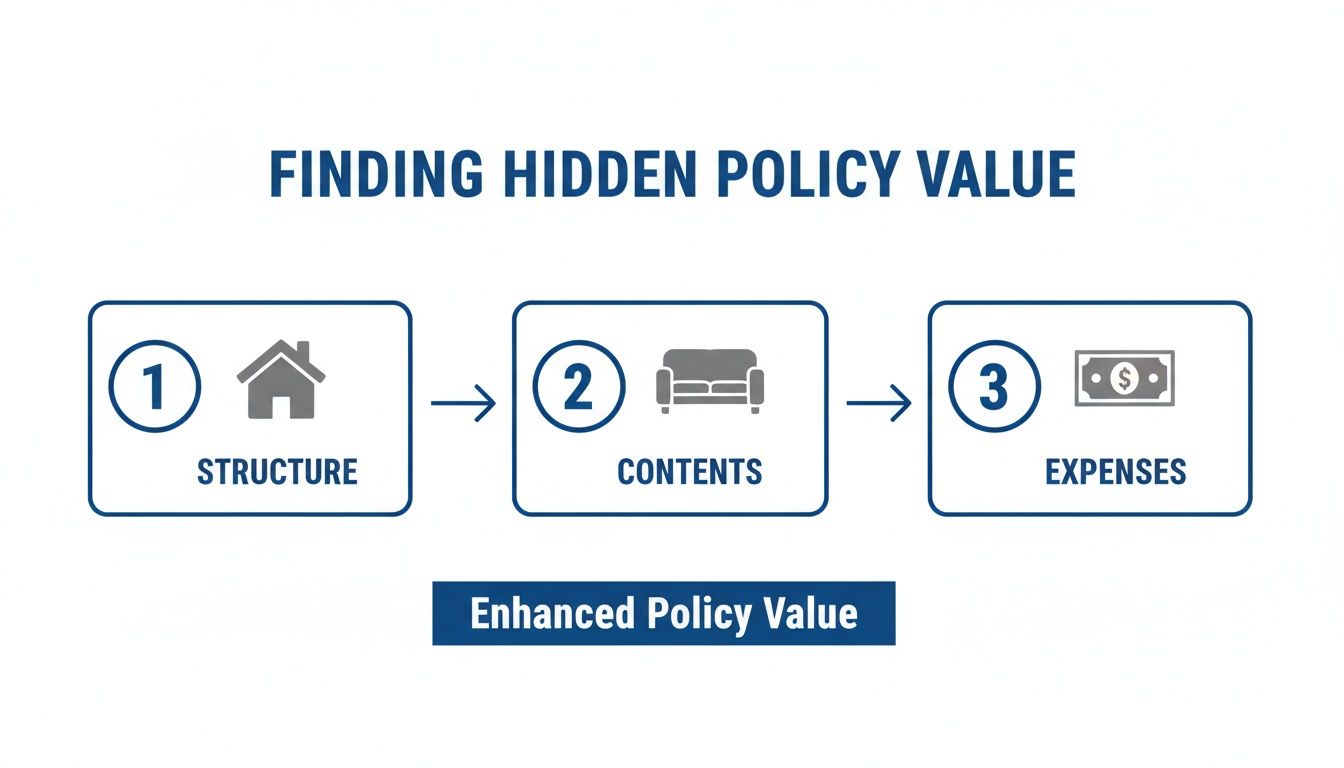
This is how you start to uncover the true value of your claim—by proving the full extent of the damage across every category, not just the obvious charring and debris.
Documenting The Invisible Damage
The biggest fights in a fire damage claim are almost always about the damage you can’t easily see. Smoke is the perfect example. A room might look untouched by the flames, but corrosive soot and microscopic toxic particles can get everywhere. They work their way into your HVAC system, behind your walls, and into every porous surface, creating a long-term health hazard.
Insurance giants like Allstate and State Farm love to downplay widespread smoke contamination, calling it a simple “cleaning issue.” Don’t fall for it. Proper smoke remediation is a highly technical and expensive process needed to make your home safe again. They are banking on you not knowing the difference.
You also have to think about every single part of your property’s structure. The extreme heat from a fire can absolutely destroy the integrity of your roof, even if it doesn’t look burned. Understanding common roofing problems and their fixes can help you spot damage that the adjuster might otherwise “miss,” saving you from massive leaks and structural failures down the road.
Every piece of evidence you gather—every photo, contractor’s quote, expert report, and receipt—is ammunition. You are systematically turning your claim from a simple request into a fact-based demand that cannot be brushed aside. This collection of proof is what you’ll use to complete a critical document called a Proof of Loss.
How A Public Adjuster Wins Your Claim Dispute
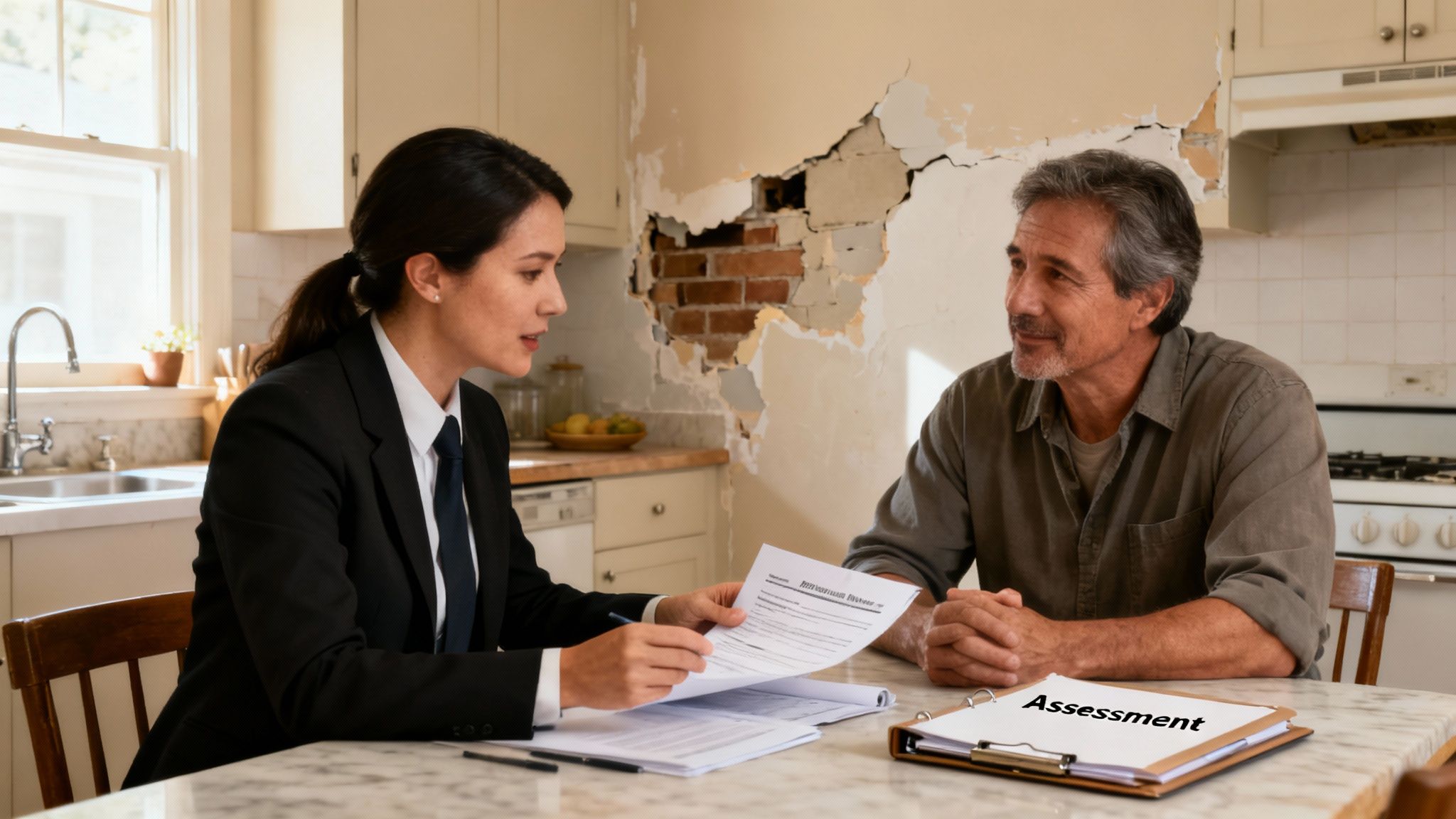
When your insurance claim for fire damage gets denied or lowballed, it can feel like you’re being pushed into a corner. And you are. Your insurer has an army of adjusters and lawyers whose entire job is to protect the company’s bottom line.
A public adjuster is the expert you bring to the fight. We’re your advocate, dedicated to protecting your interests and forcing the insurance company to actually honor the policy you paid for.
Our process is built on a foundation of meticulous inspection, exhaustive documentation, and aggressive negotiation. We don’t just glance at the obvious charring; we become forensic investigators of your loss. This isn’t guesswork. It means deploying specialized knowledge and certifications, like those from the IICRC (Institute of Inspection, Cleaning and Restoration Certification), to uncover every single layer of damage.
Exposing What The Company Adjuster “Missed”
Let’s be blunt: insurance company adjusters are trained to minimize the scope of your loss. They are experts at overlooking or downplaying less obvious—but incredibly costly—issues. Our job is to find what they conveniently missed and prove its value.
- Structural Integrity Analysis: We go way beyond the surface. We assess how extreme heat may have silently weakened load-bearing walls, trusses, and foundations, even if they don’t look completely torched.
- Smoke and Soot Infiltration: We document exactly how corrosive soot has seeped deep into drywall, insulation, and HVAC systems. This requires specialized remediation, not just a cheap coat of “odor-blocking” paint.
- Code Compliance Costs: We calculate the full, non-negotiable cost of bringing your property up to current building codes during reconstruction—a massive detail insurers frequently try to omit from their estimates.
- Contents Valuation: Forget their depreciated, garage-sale figures. We create a detailed, room-by-room inventory of your personal or business property, valuing every item at its true replacement cost.
By building a comprehensive, evidence-backed claim file, we completely change the dynamic. Your dispute is no longer your word against theirs. It becomes a matter of undeniable fact. The entire conversation shifts when the insurer realizes they are no longer dealing with an overwhelmed homeowner but a seasoned professional who knows every tactic in their playbook.
A Proven Record of Turning Denials into Dollars
Our commitment isn’t just a promise; it’s proven by the results we get for clients who felt completely abandoned by their insurance carriers.
This review from one of our clients says it all:
This client’s experience drives home a crucial point. Hiring a public adjuster isn’t just about getting a better settlement. It’s about having a dedicated expert manage the stress and complexity of the entire process so you can focus on putting your life back together.
The value of this advocacy is immense. Insurers in fire-prone states often deploy adjusters who systematically undervalue claims. By hiring an advocate, you level the playing field, ensuring every scorched beam and soot-damaged fixture is fully accounted for.
To get a better handle on the specific roles we play and the advantages of this partnership, you might be interested in our detailed guide on what a public adjuster does. We get in the trenches and negotiate directly with the carrier to recover the full, fair value you are owed under your policy.
When Insurers Get Caught Playing Dirty In Court
It’s an awful feeling. Your home is damaged, your life is upside down, and the insurance company you’ve paid for years is giving you the runaround. A lot of people feel completely powerless and just assume the insurer holds all the cards.
But here’s the thing: insurance companies are not above the law. Far from it. And courts have a long history of holding them accountable when they act in bad faith.
When an insurer flat-out refuses to honor its end of the deal—by dragging its feet, refusing to investigate properly, or coming up with a nonsense reason to deny your payment—you might have a solid case for a bad faith lawsuit. Think of it as your ultimate weapon against their unfair tactics.
What It Takes to Prove They Cheated
Now, courts don’t just hand out bad faith rulings without serious proof. You have to show that the insurance company acted unreasonably and didn’t have a legitimate reason for its actions.
In fire claims, this often comes down to showing how the company deliberately ignored the obvious.
A classic example is when an insurer tries to claim widespread smoke and soot damage isn’t a “direct physical loss.” It sounds ridiculous, and it is. The funny part is, their own internal industry manuals and publications often admit that smoke residue leaves behind toxic, hazardous chemicals that demand professional cleaning. That kind of hypocrisy is pure gold in a courtroom.
The turning point in a bad faith case is often when you can prove the insurer’s entire investigation was a sham. Did they toss your contractor’s detailed estimate in the trash? Did they refuse to run tests for hidden soot contamination? Did they use ancient, low-ball pricing to calculate your repair costs? That’s not just a mistake—that’s a pattern of behavior designed to cheat you.
When the Tables Turn: The High Cost of Bad Faith
Winning a bad faith lawsuit means you get more than just the money you were originally owed for your claim. Far more.
Courts can award consequential damages to cover all the extra financial hits you took because of the delay. And in really nasty cases, they can slam the insurer with punitive damages.
Punitive damages are exactly what they sound like: a punishment. They’re designed to make an example out of the insurance company and send a clear message to the rest of the industry to not even think about trying the same thing.
In one famous case, Hangarter v. Provident Life & Accident Ins. Co., a jury awarded a staggering $5 million in punitive damages. Why? Because they found the insurer had an actual company-wide system for unfairly denying claims just to pad its own profits.
Another landmark case, State Farm Mut. Auto. Ins. Co. v. Campbell, went all the way to the U.S. Supreme Court. While it started as a car insurance dispute, the ruling set a powerful precedent for everyone. The court made it crystal clear that insurers have a strict duty to act in good faith, and if they breach that duty, the financial penalties can be severe.
These cases aren’t just legal history—they’re proof that you can fight back. And you can win.
Common Questions About Disputing Fire Damage Claims
When your insurance carrier starts digging in its heels, a flood of questions can feel completely overwhelming. You just want straight answers so you can figure out your next move. Here are some of the most common—and critical—questions we hear from homeowners and business owners fighting a tough fire damage claim.
Can I Dispute My Claim If I Cashed The First Check?
Yes, absolutely. Cashing that first check from the insurance company does not mean you agree it’s the final and full payment. Think of it as a down payment on what you’re owed.
That initial payment is almost always considered the undisputed portion of your claim. You have every right to use those funds to get started on immediate repairs and then continue to negotiate for the full amount you’re actually owed. Don’t let an adjuster tell you otherwise; it’s a common intimidation tactic designed to make you back down.
What If My Insurer Says Smoke Damage Is Not Covered?
This is a classic move, especially for rooms that weren’t directly hit by flames. An adjuster from a big carrier like State Farm or Allstate might try to argue that smoke residue is just a “cleaning issue” and not “direct physical damage.”
That’s just plain wrong. Their own industry’s research confirms that smoke and soot are hazardous, corrosive chemical contaminants. They don’t just “wipe off.” It takes professional, specialized remediation to make a property safe and habitable again. If you hear this from your adjuster, it’s a massive red flag. They’re banking on you not knowing the science behind the damage.
How Long Does The Insurance Company Have To Settle?
While the exact timelines can vary by state, every insurance company is legally required to act in “good faith.” This isn’t just a suggestion—it’s the law. It means they can’t create unreasonable delays just to wear you down and hope you’ll give up.
Is your adjuster constantly pushing back deadlines, ignoring your calls, or asking for the same paperwork over and over again? They might be acting in bad faith.
Pro Tip: Document everything. Every phone call, every email, every missed deadline. This pattern of behavior becomes powerful evidence if you need to escalate the dispute and hold them accountable for their stall tactics.
Can A Public Adjuster Reopen A Closed Claim?
In many cases, yes. Let’s say you settled your claim, but months later, you discover significant hidden damage—like warped structural beams, widespread soot in the attic, or mold blooming behind the walls from the firefighting efforts. A public adjuster can often get that claim reopened.
There are time limits for this, known as statutes of limitation, so you can’t wait around. We can review your original settlement and the new evidence to see if filing a supplemental claim makes sense. We’ve seen it happen time and time again, with policyholders successfully recovering thousands more long after their claim was supposedly “closed.”
When you’re facing an uphill battle against a giant insurance carrier, you don’t have to fight alone. The team at For The Public Adjusters, Inc. is here to level the playing field, manage your entire claim, and secure the full and fair settlement you deserve.
Contact us today for a free, no-obligation review of your insurance claim for fire damage.



Need a quote for fire damage
Hello Salma, I’m so sorry to hear about your fire. They can really turn your life upside down. What city and state are you in?