When the floodwaters finally pull back, a whole new battle begins: the fight over your insurance claim for flood damage. You’ve paid your premiums faithfully, expecting that policy to be a lifeline. But as countless homeowners and business owners discover, filing a claim under the National Flood Insurance Program (NFIP) is an uphill fight from the very start.
Why Your NFIP Flood Claim Is a Fight From Day One
Let's be blunt: the system isn't built to make you whole. It's designed to protect the insurer's bottom line.
Whether your policy is directly with FEMA or managed by a "Write Your Own" (WYO) company like State Farm or Allstate, the game is often the same: pay out as little as possible. These companies have a reputation for lowballing, delaying, and denying perfectly valid claims, leaving you stranded in a nightmare of paperwork and suffocating deadlines.

This isn't just a string of bad luck; it’s baked into the process. The adjuster your insurance company sends out has a massive conflict of interest. Their job security is tied to protecting the insurer's finances, not making sure you get every penny you're owed. This adversarial relationship kicks off the second they set foot on your property.
An Overwhelmed and Strained System
With natural disasters growing more frequent and severe, the entire insurance industry is under immense pressure. In the first half of 2025 alone, global insured losses from natural catastrophes, including brutal floods, topped a staggering $100 billion.
This isn't just a number. It represents a tidal wave of claims that is overwhelming the system, making it that much harder for individual policyholders like you to get the attention—and the settlement—you deserve. You can dig deeper into the complexities of flood damage and see how these trends impact homeowners.
When the system is strained, insurers fall back on predictable, defensive tactics:
- Crushing Deadlines: The NFIP gives you a strict 60-day deadline to file a "Proof of Loss" form. This is a highly technical document, and one small mistake can put your entire claim in jeopardy.
- Deliberately Confusing Paperwork: You'll be buried in forms and document requests. They are often intentionally confusing, designed to make you slip up or just give up entirely.
- Shameless Lowball Estimates: The company adjuster will come in with estimates using outdated pricing, conveniently "miss" hidden water damage, and twist policy language to shrink the scope of your loss.
Your struggle with a flood claim isn't a personal failure. It’s a common experience for people caught in a system that is intentionally stacked against them from the start.
This is exactly why bringing in a public adjuster is so critical. They work only for you, the policyholder. A good public adjuster levels the playing field by taking over the entire process, meticulously documenting every last detail of your loss, and fighting back against the insurer’s delay-and-deny tactics. They know the game, they know the tricks, and they make sure you don't leave a dime on the table.
Recognizing Insurer Tactics Used to Deny Flood Claims
After a flood, the adjuster sent by your WYO company—whether it's Allstate, State Farm, or another carrier—might seem helpful at first. But you have to understand their real job. They are not on your side.
Their primary mission is to protect the insurance company's bottom line, and that means paying out as little as possible on your insurance claim for flood damage.
This creates a massive conflict of interest right from the start. While you're trying to figure out how to put your life back together, their job is to find reasons to delay, underpay, or flat-out deny your claim. Knowing their playbook is the first step in fighting back.
Common Lowball and Denial Strategies
Insurers and their adjusters lean on a few predictable tactics to slash your settlement amount. One of the most common is blaming new flood damage on so-called "pre-existing conditions." It's a classic move. An adjuster will point to a faint, old water stain on a subfloor and claim the severe structural rot you're dealing with now isn't from the flood. Just like that, they try to gut your claim's value.
Another go-to strategy is creating a laughably low repair estimate. They'll use outdated prices for materials and labor, completely ignoring the post-disaster reality where construction costs have spiked. The result? An offer that doesn't come close to covering what it will actually cost to rebuild.
They also love to wrongly apply policy exclusions. The National Flood Insurance Program (NFIP) has very specific—and often confusing—rules, especially for basements. An adjuster might issue a blanket denial for everything in your basement, conveniently "forgetting" that crucial equipment like your furnace, electrical panels, and water heater are usually covered.
Key Takeaway: An adjuster’s initial assessment is not the final word; it is an opening offer in a negotiation. Their estimate is crafted to benefit the insurer, not to accurately reflect your true loss.
The Conflict of Interest at a Glance
It’s crucial to understand that the goals of the insurance company’s adjuster and a public adjuster you hire are polar opposites. One works to limit how much you get paid; the other works exclusively to maximize it.
This table really breaks down the stark contrast in their roles and motivations.
Insurer's Adjuster vs Your Public Adjuster: A Head-to-Head Comparison
| Claim Aspect | Insurer's Adjuster (Working for the NFIP/WYO) | Public Adjuster (Working for You) |
|---|---|---|
| Allegiance | Works for and is paid by the insurance company. | Works exclusively for you, the policyholder. |
| Primary Goal | Minimize the claim payout to protect the insurer's profits. | Maximize your settlement to ensure a full recovery. |
| Damage Assessment | Often overlooks hidden damage and uses low-cost estimates. | Conducts a detailed, forensic inspection to find all damage. |
| Policy Interpretation | Interprets policy language in the insurer's favor to limit coverage. | Uses expert knowledge to apply the policy for your maximum benefit. |
| Outcome | A settlement that often falls short of what is needed to rebuild. | A fair and comprehensive settlement that covers the true cost of loss. |
Once you recognize these strategies and the conflict of interest baked into the system, you can start to see their low offers and questionable denials for what they are: negotiating tactics. They are designed to save the insurance company money, period. And it’s always at your expense.
How to Build an Unbeatable Case for Your Flood Damage
A fight over your insurance claim for flood damage is won or lost based on one thing: evidence. The adjuster from your WYO company—think State Farm or Allstate—will show up with a clipboard and a camera, but their goal is to document just enough to justify a lowball settlement.
Your job is to build an undeniable case that proves the true, full value of your loss. This isn't about playing defense; it's about going on the offensive with irrefutable proof that goes far beyond what their adjuster is willing to see.
Go Beyond Surface-Level Documentation
The insurance company's adjuster will take pictures of the obvious damage. That's easy. But floodwater is insidious. It seeps into wall cavities, under flooring, and soaks into insulation, creating a hidden breeding ground for mold and rot that won't show up for months. You have to document this hidden destruction.
Here’s how you build a powerful evidence file they can't ignore:
- Independent Moisture Readings: Don't ever rely on the adjuster's basic moisture meter. A public adjuster uses professional-grade equipment to map moisture saturation throughout your walls, floors, and structural components. This proves exactly what needs to be ripped out and replaced.
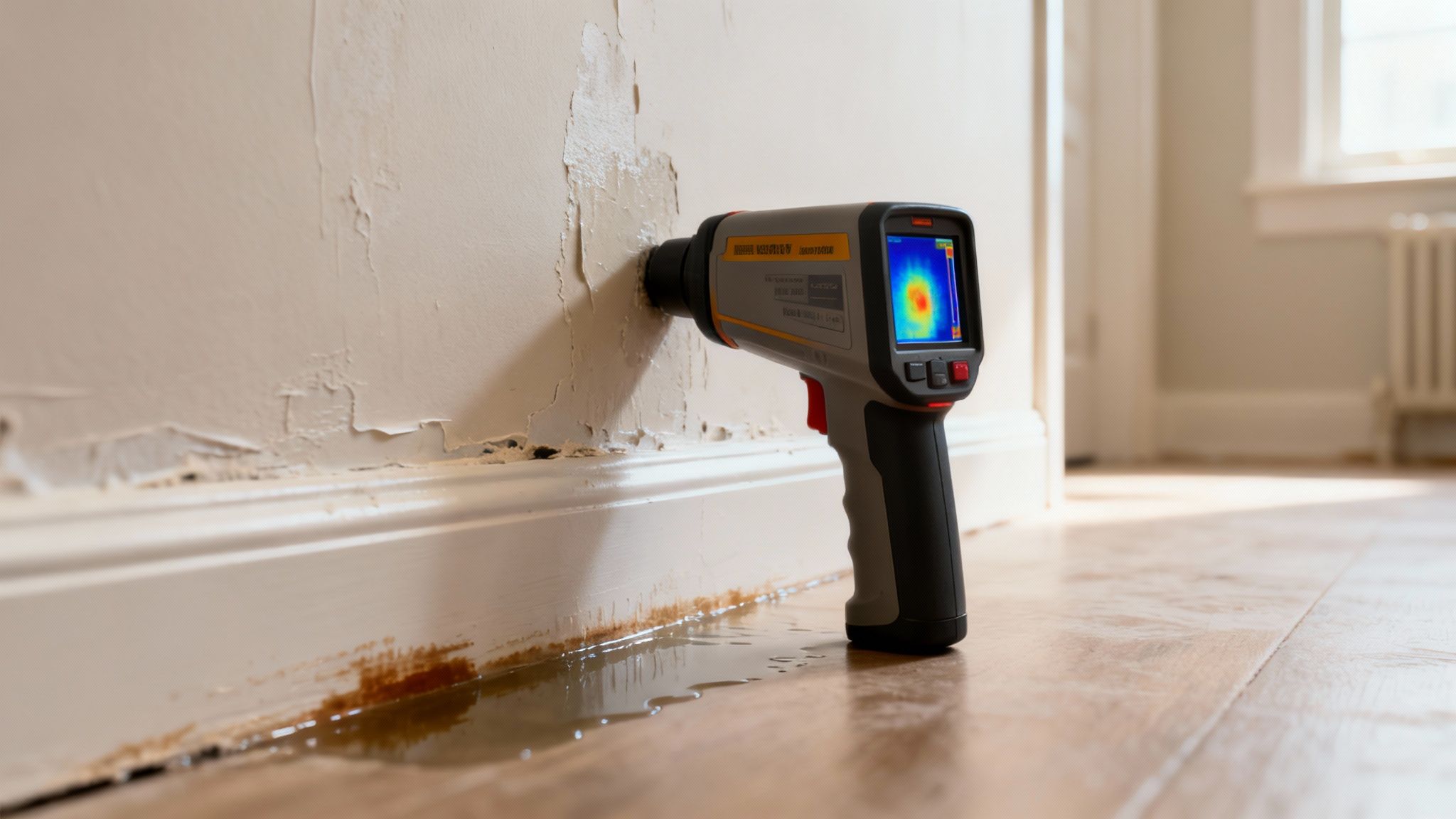
- Thermal Imaging: An infrared camera is your best friend. It reveals temperature differences behind surfaces, creating a clear visual map of where water has traveled. This is devastating evidence against an adjuster who tries to claim a wall is "mostly dry."
- Detailed Inventory of Damaged Property: You need an exhaustive list of every single item the water touched. For each one, document the brand, model, age, and—this is crucial—the replacement cost, not what you paid for it years ago.
This level of detail is non-negotiable. An adjuster will write down "damaged sofa." Your inventory needs to say, "Ashley Furniture 'Larissa' 3-Seater Sofa, purchased 2022, current replacement cost $1,299." See the difference? It leaves zero room for them to undervalue your belongings.
Master the Proof of Loss Form
The single most important—and dangerous—document in any NFIP claim is the Proof of Loss. This is your sworn statement detailing the exact amount of money you are demanding. It must be submitted to your insurer within 60 days of the flood, and trust me, they will not send you a friendly reminder.
The Proof of Loss is a trap for the unwary. Any mistake, omission, or understated value on this form can be used by the insurer to legally limit or even deny your entire claim.
Filing this form correctly is everything. It must be backed by all the detailed evidence you’ve gathered—the moisture maps, thermal images, contractor estimates, and your hyper-detailed contents inventory. Miscalculating your loss or, worse, missing the deadline gives the insurance company a gift-wrapped excuse to pay you pennies on the dollar.
After a flood, you’ll also be thinking about rebuilding smarter. When looking at lower levels of your home, exploring options like the best waterproof flooring for basements is a practical step toward future mitigation. Building a strong case also involves knowing your rights, and you can learn more about how to claim insurance for flood damage in our complete guide. A public adjuster’s primary job is to ensure this critical form is filled out perfectly and submitted on time, turning it from a potential landmine into the foundation of your unbeatable claim.
Real Stories of Public Adjusters Winning Against Insurers
The gap between what your insurance company offers and what they actually owe you can be staggering—often tens of thousands of dollars. Having a professional advocate in your corner doesn't just level the playing field; it changes the entire outcome.
These real-world examples show exactly how a public adjuster can turn a frustrating denial or a lowball offer into a successful insurance claim for flood damage.
The Case of the Hidden Structural Rot
A homeowner in coastal North Carolina watched in horror as a hurricane forced several feet of water through his house. The adjuster from his WYO (Write Your Own) insurance company did a quick, surface-level walkthrough, scribbled down an estimate, and came back with an offer for $15,000. The homeowner’s gut told him something was wrong, but the company adjuster just brushed off his concerns about damage hiding behind the walls.
That’s when he hired a public adjuster.
This wasn't just another walkthrough. The public adjuster, who held an IICRC certification in water damage restoration, brought in serious gear: advanced moisture mapping equipment and a thermal imaging camera. The results were shocking. The camera lit up with massive cold spots behind the drywall—a clear sign of widespread water saturation the first adjuster had completely ignored.
Once they opened the walls, the true scope of the disaster was revealed: severe structural rot in the studs and subfloor. The public adjuster built a brand-new, bulletproof claim package with this undeniable proof, documenting an additional $75,000 in damages. Faced with an expert-level report they couldn't argue with, the insurance company had no choice but to pay what they truly owed.
Overturning a Business Owner's Denial
Down in Virginia, a business owner assumed his commercial flood policy was there to protect the specialized, expensive equipment in his workshop. He was wrong. After a flood destroyed it, the insurer’s adjuster slapped him with an immediate denial, hiding behind a confusing policy exclusion for "property in the open." The business owner was staring at financial ruin.
Enter the public adjuster.
Instead of just looking at the wrecked equipment, this PA did a deep dive into the dense language of the NFIP policy. What they found was a game-changer. The specific location of the equipment, while not inside the main building, was actually covered under a provision for structures "appurtenant" (or attached/related) to the primary insured property.
The public adjuster didn't just call the insurer; he drafted a detailed rebuttal letter, citing the exact policy sections and legal precedents that tore the flimsy denial apart. The result? The claim was overturned, and the business owner received a check for over $120,000—enough to replace his essential equipment and get back to work.
These stories prove a critical point: Big insurers often rely on rushed inspections and aggressive interpretations of your policy to protect their bottom line. A public adjuster forces them to deal with the documented reality of your loss.
This fight is only getting more common. With the U.S. shouldering 83% of the $107 billion in global insured natural catastrophe losses in 2025, the financial squeeze on policyholders is immense.
A full analysis from Swiss Re shows this trend is making claims far more complex and expert help more essential than ever.
Navigating the NFIP Appeals Process After a Denial
Getting a denial letter for your insurance claim for flood damage can feel like getting kicked when you’re already down. But I’m here to tell you, this isn't the end of the road. It’s just the beginning of the real fight.
The National Flood Insurance Program (NFIP) has a formal appeals process, but don't be fooled—it's not a walk in the park. This isn't about just sending back the same paperwork and hoping for a different result. It's a strategic battle with tight deadlines and rules almost designed to make you give up.
FEMA Appeal vs. Litigation: The Critical Choice
When your Write-Your-Own (WYO) company—think giants like State Farm or Allstate—denies your flood claim, you have two main options on the table. It's crucial to understand both.
First, you can file a formal appeal directly with FEMA. This is essentially an administrative review. You’re making the case that your insurance company either misinterpreted your policy or completely botched the math on your damages. The good news is that your appeal is reviewed by an NFIP official who had nothing to do with the original denial.
Your second option is to take them to court. You can file a lawsuit directly against your WYO insurance company in a U.S. District Court. This is a much more aggressive move, but it brings the fight into a legal arena where you can truly hold the insurer accountable for their bad-faith tactics.
Crucial Timing: You must file an appeal with FEMA within 60 days of the date printed on your denial letter. For a lawsuit, you have exactly one year from that denial date. If you miss these deadlines, your right to challenge their decision is gone. Forever.
Building a Bulletproof Case for Your Appeal or Lawsuit
A successful challenge, whether it's an appeal or a lawsuit, is always built on a mountain of evidence. Your appeal letter can't be an emotional rant; it needs to be a precise, factual document that systematically tears down every single reason the insurer gave for the denial.
You need to throw everything you have at them:
- Independent estimates from trusted contractors.
- Moisture mapping reports that show the full extent of water intrusion.
- Thermal imaging photos that reveal hidden damage.
- A meticulous, itemized inventory of all your lost and damaged property.
There's real legal precedent for this. Landmark cases like Spence v. Omaha Indemnity Insurance Company have established that WYO companies can be held liable for misleading policyholders. In that case, the court found the insurer made "material misrepresentations" about flood coverage. This case drives home a critical point: insurers have a duty to act in good faith, and the courts can and will penalize them when they don't.
This is exactly where a public adjuster becomes your most valuable player. We live and breathe this stuff. We manage the entire appeals process, making sure every deadline is hit and that your argument is structured for maximum impact. We know the subtle details that win appeals and can give you an honest, experienced opinion on whether to stick with a FEMA appeal or escalate to a lawsuit.
For a deeper look into the nuts and bolts, check out our guide on how to appeal an insurance claim denial.
This flowchart breaks down the decision-making process into its simplest form when you’re staring down a lowball offer.
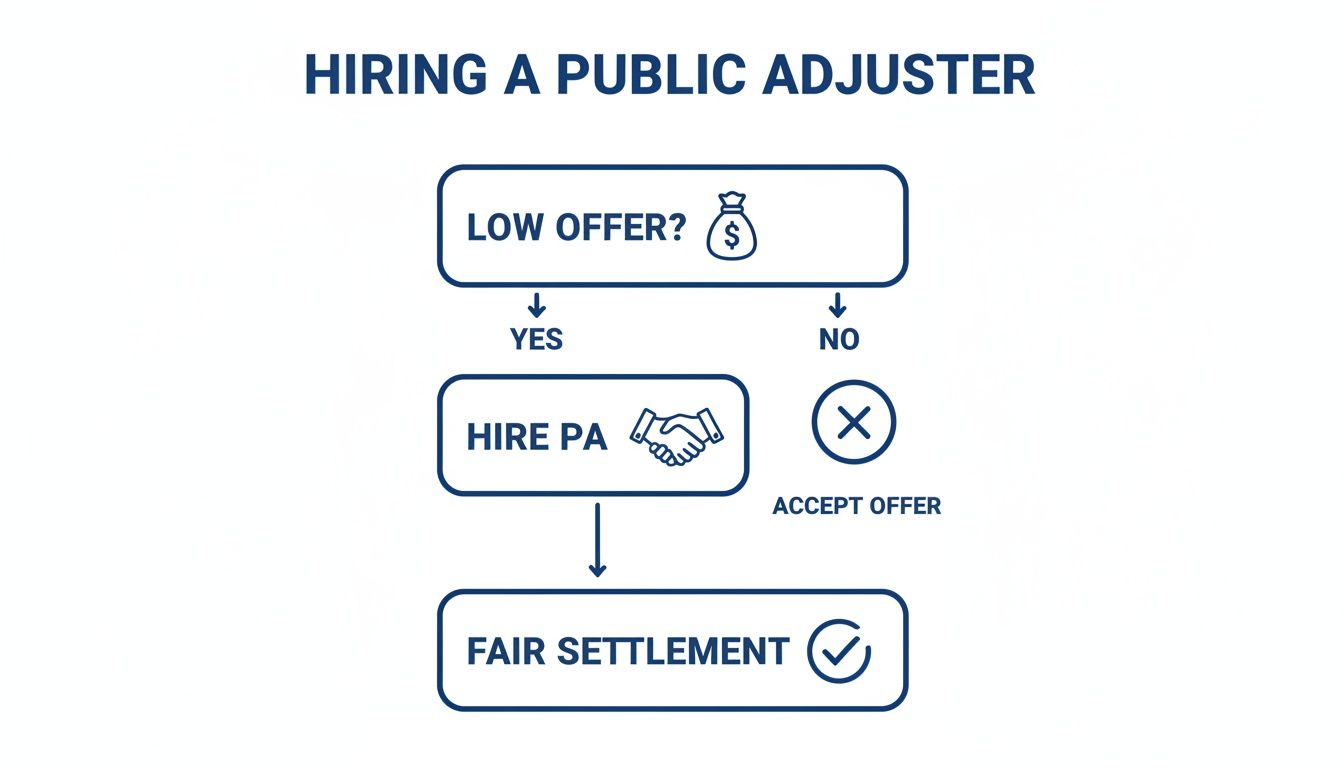
As you can see, the most direct path from an unfair offer to a fair settlement runs straight through hiring a public adjuster. Trying to navigate the appeals process alone is a huge gamble, but with an expert on your side, you can challenge an unjust denial with confidence and fight for every penny you deserve.
Common Questions We Hear About Disputed Flood Claims
When you're fighting an insurance claim for flood damage, it’s easy to feel like you're on an island. The adjusters from WYO companies like State Farm and Allstate have a playbook, and their answers often feel vague or misleading—almost like they're designed to make you just give up.
Here are some straight answers to the questions we hear from homeowners every single day.
The Adjuster Said My Basement Damage Isn't Covered. Can I Fight This?
Yes, and you absolutely should. It's true that standard NFIP policies have limitations on basement coverage, but this is a rule that insurance company adjusters love to misapply. They often issue a blanket denial for everything down there, and that’s just wrong.
Crucial equipment—like your furnace, water heater, circuit breaker box, and sump pumps—is typically covered. The company adjuster might try to sweep the entire basement under one denial without separating these covered items. A good public adjuster will go through with a fine-toothed comb, documenting every single covered component the insurer wrongfully excluded. This alone can recover thousands of dollars for items you were told were a total loss.
My Insurance Company Is Stalling on My Flood Claim. What Can I Do?
Delay tactics are a classic, frustrating strategy. Insurers use them to wear you down, hoping you'll get so exhausted that you accept a lowball settlement just to be done with it.
Your single most powerful move here is to hire a public adjuster. The moment you do, they take over all communication. They apply professional pressure, citing the specific federal regulations that WYO companies are required to follow. This one action changes the entire dynamic and dramatically speeds things up. Why? Because the insurer is suddenly forced to respond to a licensed expert who won't be intimidated, ignored, or put off with excuses. It takes your frustration out of the equation and stops them from using it against you.
Is It Worth Hiring a Public Adjuster for a Smaller Flood Claim?
Absolutely. The key is not to judge the claim by the insurer’s initial lowball offer, but by the actual, documented damage to your property. Their $20,000 assessment might be based on using the cheapest possible materials while completely ignoring the hidden water damage that’s now creeping up behind your walls.
A public adjuster's investigation often uncovers evidence that proves the true repair cost is closer to $50,000 or more. Since they work on a contingency fee paid from the additional money they recover, you have no upfront costs.
The much larger settlement they secure for you almost always far outweighs their fee. In the end, you walk away with significantly more than you ever would have gotten trying to fight that battle alone.
And for those thinking about long-term prevention to stop water from getting into your basement in the first place, it's smart to understand what a real solution involves. Learning about drainage tile installation costs can be an invaluable first step in protecting your property from future claims.
When your insurance company is delaying, denying, or underpaying your flood damage claim, you need an expert in your corner. The team at For The Public Adjusters, Inc. fights exclusively for policyholders to secure the maximum settlement you are owed. Contact us for a no-cost claim review today. https://forthepublicadjusters.com