
When you need help with an insurance claim, the first thing to understand is a harsh reality: your insurance company isn’t always on your side. After a disaster strikes your home or business, you expect the support and help insurance claim because you’ve paid through the years of premiums. What you often get is a fight.
Major insurance carriers like State Farm and Allstate are massive, for-profit corporations. Their primary duty is to their shareholders, which means protecting their bottom line—not paying you the full and fair value of your dwelling or business owner claim. They achieve this by strategically delaying claims, making lowball offers, and creating a process designed to make you give up.
Why You Need Help With Your Insurance Claim
The moment you file a claim for significant property damage, you’re at a serious disadvantage. You’re trying to pick up the pieces of your life, stressed and overwhelmed, while your insurance company assigns their “expert” adjuster—a professional trained to minimize their payout.
It’s an immediate conflict of interest. Big insurers have built entire systems designed to deny, delay, and underpay claims from their own policyholders. They are not looking out for your best interests.

They do this with tactics that are subtle but incredibly effective. Their adjuster might use outdated pricing for labor and materials, twist ambiguous policy language to their advantage, or blame new, legitimate damage on bogus “pre-existing conditions” or “wear and tear.”
The First Offer Is Just a Test
One of the most common plays in their book is the lowball settlement offer. That first number they give you is almost never their best—it’s a calculated test to see if you’ll take a fraction of what you’re owed and just go away.
For unsuspecting homeowners and business owners, this offer looks official. It feels final. It’s designed to make you feel like you have no other choice.
Accepting an insurer’s first offer without a professional review is one of the most expensive mistakes you can make. It can leave you with thousands in uncovered repair costs, forcing you to pay out of your own pocket to get your property back to its original condition.
Imagine a bad hailstorm shreds your roof. The company’s adjuster comes out, glances around, and approves a patch job for a few shingles, estimating the repair at $1,500. But you know the damage is worse, so you get an independent roofer to inspect it. They find widespread damage that requires a full replacement costing $15,000.
By accepting that first offer, you would have been short $13,500. That’s not a small discrepancy; it’s the difference between a real recovery and financial disaster.
Insurer Tactics vs Your Strategic Response
It helps to know their playbook. Here’s a quick look at common tactics used to underpay your homeowner or business claim and the proactive strategies you can use to counter them.
| Insurer’s Tactic | Your Proactive Strategy |
|---|---|
| Lowball Initial Offer | Never accept the first offer. Treat it as a starting point for negotiation, not the final word. |
| Outdated Pricing | Obtain your own detailed estimates from trusted, local contractors using current material and labor costs. |
| Blaming “Wear and Tear” | Provide maintenance records, pre-loss photos, and expert reports to prove the damage is new and covered. |
| Strategic Delays | Document every communication, set firm deadlines for responses, and don’t be afraid to escalate the issue. |
| Misinterpreting Policy | Have an expert review your policy to pinpoint the exact language that supports your claim for full coverage. |
Knowing these moves in advance puts you back in control. It’s about turning their strategy against them by being prepared, documented, and relentless.
Navigating Delays and Denials
Insurers also know that time is on their side. Dragging out the process isn’t just about bad customer service; it’s a deliberate strategy. They know the longer your claim languishes, the more financial pressure you’re under and the more likely you are to give up and accept a terrible settlement out of sheer exhaustion.
These timelines are regulated, but carriers often push the limits. To understand your rights, you can explore our guide on how long an insurance company has to settle a claim.
Getting professional help with your insurance claim turns this defensive battle into a strategic negotiation. An expert on your side levels the playing field, builds an undeniable case backed by hard evidence, and forces the insurer to honor the contract you paid for.
Decoding Your Insurer’s Denial Letter
That denial letter from your insurance company? It feels like a final verdict, a door slammed shut. But you need to understand that it’s almost never the final word. It’s an opening move in their fight against your homeowner or business owner claim.
These letters are carefully crafted legal documents designed to make you give up. They’re packed with complicated policy jargon and vague excuses, all intended to make you feel like you have no other choice. Seeing through their strategy is the first real step you take when you need help with an insurance claim dispute.
Insurers have a whole playbook of reasons to deny a claim. They love to hide behind specific policy exclusions and definitions that sound official but are often twisted to fit their narrative. For example, they’ll look at a roof clearly battered by a recent hailstorm and blame it on “pre-existing wear and tear.” Or they’ll argue that the water flooding your basement isn’t from a covered “peril.”
These aren’t honest mistakes. They’re calculated tactics designed to protect their bottom line.
Common Denial Excuses and What They Really Mean
You have to be able to translate their corporate-speak into plain English. Big carriers like Allstate and State Farm employ armies of experts whose entire job is to find loopholes to deny claims, and their letters are masterpieces of deflection.
Here are a few of the greatest hits you’re likely to see:
- “Wear and Tear”: This is the go-to excuse for denying claims on roofs, siding, and fences. They’ll try to argue your roof was old and failing anyway, conveniently ignoring the fact that a violent storm just ripped through and caused brand new, catastrophic damage that demands a full replacement.
- “Damage Not Caused by a Covered Peril”: Your policy lists specific events it covers—things like fire, wind, and hail. The insurer might claim the water damage in your home came from a slow, seeping leak (which they often exclude) instead of a sudden pipe burst (which is usually covered), even if their adjuster barely looked at the evidence.
- “Insufficient Documentation”: This is a classic move to shift the blame onto you. The insurance company claims you didn’t provide enough proof of your loss, often after their own adjuster did a rushed, five-minute “inspection” and missed everything important.
A denial letter is not a statement of fact. It is your insurer’s self-serving interpretation of a contract, written specifically to protect their own financial interests. Your job is to smash that interpretation with better evidence and an undeniable counter-argument.
Spotting the Red Flags of Bad Faith
Sometimes, a denial crosses the line from a simple disagreement into outright bad faith. This is a serious legal term for when an insurance company fails to live up to its end of the bargain—the duty it has to treat you fairly.
Knowing the warning signs is absolutely critical for protecting your rights.
Keep a close eye out for these red flags:
- Failure to Investigate Properly: The adjuster shows up, walks around for ten minutes, takes a few pictures, and leaves. They ignore the evidence you try to show them or refuse to hire an expert to assess complex damage.
- Intentional Delays: Your insurer goes silent. They take weeks or even months to respond to your calls and emails, hoping you’ll get frustrated and just drop it.
- Misrepresenting Your Policy: This is a big one. The adjuster flat-out tells you something isn’t covered, but when you actually read your policy, the language clearly shows that it is.
If you see these things happening, document every single interaction. Write down dates, times, names, and what was said. Understanding these dirty tricks is how you start building a powerful case to fight back and win.
Building an Undeniable Case for Your Claim
When you need help with an insurance claim, the single most powerful tool you have against your insurer is overwhelming, undeniable proof. Think of their adjuster’s estimate for what it is: one opinion. And it’s an opinion that’s almost always designed to save them money, not make you whole.
Your job is to build a case so strong, backed by such thorough evidence, that it leaves them no room to argue. This proof becomes the foundation of your entire negotiation, moving beyond their adjuster’s quick walkthrough to create a detailed record of your actual loss.
Document Damage Like a Forensic Investigator
First things first: you need to document everything. And I mean everything. Before a single thing is cleaned up or repaired, you need to capture the damage from every possible angle.
- Photos and Videos Are Your Best Friend: Start with wide shots of entire rooms or the outside of your property. Then, get in close. Take detailed photos of specific damage points. Video is even better—do a slow walk-through and narrate what you’re seeing, explaining how the storm, fire, or flood damaged each area.
- No Detail is Too Small: Get photos of the hail dents on your A/C unit, the water stains creeping up the drywall behind the sofa, the fine layer of smoke residue inside your kitchen cabinets. If you can, make sure your photos are time-stamped to create a clear timeline of events.
- Don’t Throw Anything Away: It’s tempting to start clearing out the mess, but don’t you dare throw away that ruined couch or those soot-covered electronics. Keep them as physical proof until your claim is officially closed and paid.
This level of meticulous documentation is a direct counter-attack to the adjuster’s inevitable attempt to downplay how bad things really are.
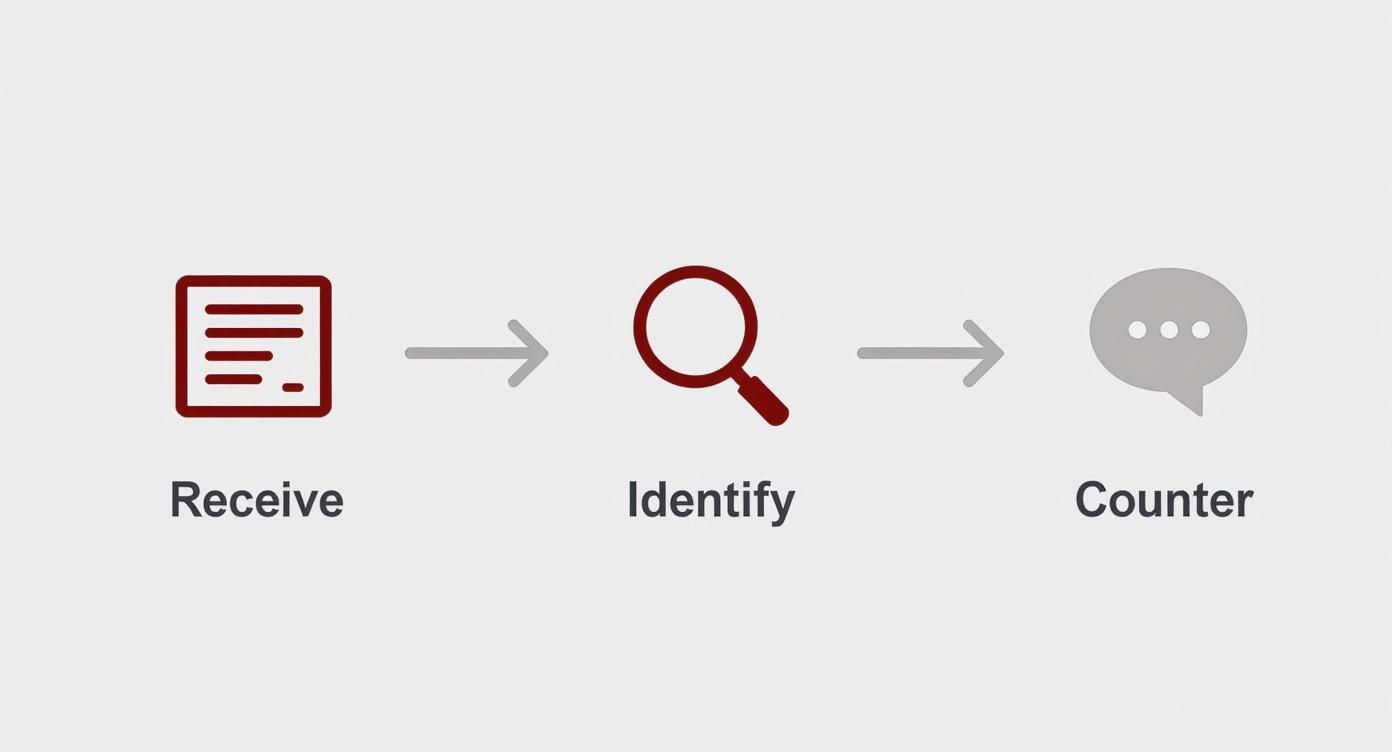
It’s a frustrating but common cycle: you get a denial, you pinpoint the bad reasoning, and you fire back with solid proof. This is how the game is played.
Create an Itemized Inventory of Your Losses
For all the personal or business property that was damaged, you need a painfully detailed inventory list. Open up a spreadsheet and start listing every single item that was damaged or completely destroyed.
For every single item, you need to include:
- A clear description (e.g., “Samsung 55-inch 4K Smart TV, 2023 model”)
- The model and serial number if you can find it
- When and where you bought it, and for how much
- A copy of the receipt or credit card statement if you have it
- A link to a comparable new item for sale online today to prove its current replacement cost
An adjuster’s report might just lump all your “damaged electronics” into one insultingly low number. Your detailed inventory forces them to look at the real-world cost of replacing each and every item, one by one.
Secure Independent Repair Estimates
Never, ever rely on the estimate provided by the insurance company’s adjuster or one of their “preferred” contractors. Let’s be clear: those estimates are written to serve the insurance company’s interests, not yours.
You need to go out and get at least two or three of your own detailed, line-item estimates from trusted, local, and independent contractors. These are pros who work for you. They will give you a realistic assessment of what it will actually cost to do the repairs correctly, using quality materials at today’s prices. This can become a powerful negotiating weapon. Your best and MOST powerful weapon would be to secure a Public Adjuster who gathers this information for you.
Remember, insurers are buried under a mountain of claims and are under immense pressure to close them out as quickly and cheaply as possible. Just look at the numbers. The first quarter of 2025 saw over 160,000 insurance claims filed in Texas alone. This scale highlights just how complex the claims environment has become. That kind of volume pushes adjusters to rush inspections and write lowball estimates. You can dig deeper into these insights on recent claim trends to see what you’re up against.
How to Counter a Lowball Settlement Offer
That shockingly low settlement offer for your property damage claim isn’t a mistake. It’s a tactic. It’s a move straight from the big insurance playbook, designed to make you feel frustrated, cornered, and ready to give up.
But it’s almost never their final word. Think of it as their opening shot in a negotiation you didn’t ask for—a shot you can absolutely counter with the right strategy.

Your first instinct might be to pick up the phone and let them have it. Don’t. Your counter-attack needs to be formal, professional, and built on the mountain of evidence you’ve already gathered. This is where you get help with your insurance claim by letting your documentation do all the talking.
Draft a Formal Dispute Letter
Your response must be in writing. Period. A formal dispute letter, sometimes called a demand letter, creates a paper trail and signals to the insurer that you’re not just complaining—you’re building a case.
This letter isn’t about venting your frustration. It’s a methodical, point-by-point takedown of their lowball offer.
Here’s how you structure it to break down their assessment and make your case undeniable:
- State Your Claim Clearly: Open with the basics—your claim number, the date of the loss, and the settlement amount they offered.
- Pinpoint Every Error: This is the core of your letter. Go through their adjuster’s estimate line by line. Use your own quotes from independent contractors to highlight every single discrepancy in material costs, labor rates, and the overall scope of work. For instance, you might write, “Your estimate only accounts for patching the roof, while two licensed roofers have confirmed a full replacement is required due to widespread wind lift.”
- Attach All Your Evidence: This is your proof. Include copies of everything: your photos, videos, independent estimates, and your detailed inventory of lost personal property. Make sure you reference these documents directly in your letter to justify every dollar you are claiming.
This approach completely changes the game. It’s no longer your word against theirs; it’s their opinion against a wall of hard, factual evidence.
Master the Art of Communication
From this point forward, every single interaction you have with the insurance company needs to be handled with precision. Keep your tone firm and professional. Never get emotional or accusatory. This shows them you’re in control and focused squarely on the facts of your homeowner or business claim.
Never agree to a single thing over the phone. If an adjuster makes a new offer or a promise during a call, politely ask them to send it to you in writing via email. This creates an official record and stops them from denying what was said later.
Remember, insurance adjusters are trained negotiators. They are masters of pressure tactics. They might try to rush you into a decision, imply your claim is weak, or create a false sense of urgency. You sidestep these traps by sticking to written communication and giving yourself the time you need to review every document with a clear head.
Insurance is a massive global industry. The Property and Casualty (P&C) segment—the part that handles your homeowner or business claim—grew by a staggering 7.7% in 2024. That growth is fueled by collecting premiums, and insurance companies protect their profits by minimizing what they pay out. You can read more about the growth of the global insurance market to understand the sheer size of the financial machine you’re up against.
This isn’t a personal dispute. It’s a business transaction, and you have to treat it that way.
When to Hire Professional Reinforcements
Fighting a lowball offer or an outright denial from a major insurer feels like a full-time job. It’s exhausting.
You’ve sent them all your evidence, you’ve made your case, and they still won’t pay what you’re owed. This is a classic stall tactic. They are waiting for you to get tired and just give up. This is the exact moment you need to recognize it might be time for professional help with your insurance claim.
Knowing when to call in the cavalry is a critical decision. You’ve reached a point where your well-documented case isn’t enough to move the needle against a company like Allstate or State Farm—companies that have perfected the art of delay and denial.
Bringing in a professional sends a powerful message: you’re serious, you know your rights, and you will not be pushed around.
Public Adjuster vs. Attorney
Okay, so you need help. But who do you call? This is your next strategic move.
For most complex homeowner or business property damage disputes, a public adjuster is your best first call. These are state-licensed professionals who work exclusively for you, the policyholder. Their entire job is to document, negotiate, and settle your claim for the maximum amount possible. They speak the insurer’s language fluently and can often cut through the red tape and resolve disputes without ever needing to see the inside of a courtroom.
A public adjuster will also setup your claim file to be ready to hand over to an attorney at the right time.
An attorney, on the other hand, becomes essential when your insurer has crossed a legal line into bad faith. This isn’t just about a low offer; it’s about their conduct. Bad faith includes things like intentionally misrepresenting your policy, refusing to investigate your claim properly, or just flat-out ignoring all your attempts to communicate.
If a lawsuit is your only remaining option, an attorney is the only professional who can take that step.
A public adjuster is your claims expert who fights for every dollar you’re owed under your policy. An attorney is your legal weapon for when the insurance company breaks the law.
It also helps to understand the financial pressure these companies are under. Global insurance premium growth is projected to slow to just 2% in 2025, a steep drop from previous years. This squeeze on their bottom line often makes them even more aggressive in minimizing payouts to protect their profits. You can read more about the economic headwinds facing the insurance industry to see the bigger picture.
Ultimately, deciding to hire help is about leveling a very uneven playing field. For a deeper dive into their role, check out our guide on if you should hire a public adjuster for your claim.
Answering Your Toughest Questions About Disputing a Claim
Going toe-to-toe with your insurance company can feel like you’re walking through a minefield, blindfolded. You’re overwhelmed, frustrated, and you’ve got a million questions running through your head. This is exactly where the insurance company wants you to be when you need help with an insurance claim.
Let’s cut through the noise. Here are the real answers to the most critical questions we hear from homeowners and business owners when their insurer is refusing to pay what’s fair.
How Long Do I Have to Fight a Settlement Offer?
This is probably the most urgent question on your mind, and for good reason. The clock is ticking, and the insurance companies are counting on you to let it run out. The exact deadline you have to fight a lowball offer or a flat-out denial comes down to two things: the fine print in your policy and your state’s laws.
Most insurance policies have a sneaky clause buried inside that says you must file a lawsuit within a specific window after the damage occurred—often just one or two years. This isn’t the same as the deadline for filing your initial claim. On top of that, every state has its own statute of limitations for this kind of legal action, which can sometimes override what your policy says.
Don’t wait. If you miss these deadlines, you could lose your right to collect the money you’re owed forever, no matter how strong your case is. If you’re anywhere near the one-year anniversary of your loss, it’s time to get serious.
Can My Insurer Drop Me for Disputing a Claim?
This is a huge fear for so many policyholders. You worry that if you push back, your insurer will just cancel your policy and leave you high and dry. The truth is, while an insurer can choose not to renew your policy for a lot of reasons, they generally can’t just drop you in the middle of your policy term for fighting for a legitimate dwelling or business claim.
Consumer protection laws in most states prevent this kind of retaliation. But let’s be clear: insurance companies are masters at finding official-sounding reasons for a non-renewal. They might claim you’ve become an “increased risk” after a major claim. It’s a gray area, but fighting for every penny you’re owed on your current claim has to be your number one priority. A bad settlement will hurt you a lot more today than the headache of shopping for a new policy will tomorrow.
What if My Contractor’s Estimate Is Way Higher Than Theirs?
If this hasn’t happened, I’d be surprised. It’s not just common; it’s practically part of the insurance company’s playbook. The adjuster from a big carrier like State Farm or Allstate is almost always using standardized pricing software that spits out low-cost, cookie-cutter numbers. It rarely accounts for real-world local labor rates or the actual skill needed to do the job right.
Your local contractor, on the other hand, lives in the real world. Their estimate is based on what it actually costs to get the right materials and skilled labor to restore your property correctly.
When you see that huge gap, don’t get discouraged. Your contractor’s detailed, line-item estimate is now your most powerful negotiation tool. Your formal dispute letter should slam their lowball numbers right next to your contractor’s realistic ones, line by line.
- For example: Their adjuster probably quoted cheap, 3-tab shingles, while your roofer knows you need higher-grade architectural shingles to match what was destroyed.
- Or maybe: The insurer conveniently “forgot” to include the costs for pulling permits, hauling away debris, or updating the repaired section to meet current building codes—all things a pro contractor’s estimate will include.
That price difference isn’t your problem to eat. It’s hard proof that their settlement offer is based on a fantasy.
Is Hiring a Public Adjuster Really Worth the Money?
When you’re already staring at thousands of dollars in damages that the insurance company won’t cover, the idea of paying another professional is a tough pill to swallow. I get it. But you have to change how you’re looking at it. A good public adjuster doesn’t cost you money—they find the money the insurance company is trying to hide from you.
Most reputable public adjusters work on a contingency fee. That means they get paid a small percentage of the money they recover for you, and only after you get paid. There are no upfront costs. This setup means their goal is the same as yours: get the absolute maximum settlement possible.
They take over the entire nightmare—documenting every last detail, handling all the calls and paperwork, and negotiating directly with the insurer. For most property owners, the extra money a public adjuster gets for them covers their fee many times over.
What is the main difference between a Public Adjuster and the adjuster assigned by my insurance company?
The main difference is who they legally represent. The Insurance Company Adjuster (or staff/independent adjuster) is employed and paid by the insurer, and their fiduciary duty is to their employer—the company—often resulting in lowball offers. The Public Adjuster is hired and paid by you, the policyholder, and their sole duty is to protect your best financial interests.
When is the absolute best time to hire a Public Adjuster?
The best time is immediately after the loss occurs, even before notifying your insurance company, to ensure the claim is documented and filed correctly from the start. However, people do not usually know to do this. It's ok if you have already filed a claim. Most people learn about public adjusters after they are getting pushback form their adjuster. Call anytime you need assistance or questions answered (919-400-6440).
Will my insurance company penalize me if I decide to hire a Public Adjuster?
No, it is illegal for an insurance company to penalize or discriminate against a policyholder for exercising their right to professional representation.
What types of insurance claims can a Public Adjuster help me with?
Public adjusters handle first-party property claims for homeowners and businesses, including fire, water, flood, storm, hurricane, mold, and complex commercial losses.
Is hiring a Public Adjuster always worth the cost for a property claim?
Yes, studies often show that policyholders who hire a public adjuster receive significantly higher settlements than those who handle their claims unrepresented.
My property insurance claim was just outright DENIED. Can a Public Adjuster re-open it?
Yes. A public adjuster can review the denial letter, investigate the cause of loss independently, and submit a detailed, documented appeal package to challenge the insurer's decision.
What should I do if the insurance company gives me a LOWBALL settlement offer?
Immediately consult a public adjuster to review the offer, consider the coverage, and perform an independent estimate to challenge the undervalued payment.
How does a Public Adjuster successfully challenge the insurance company’s scope of damage?
They use their own licensed adjusters, engineers, and building cost estimators to create a detailed, legally defensible scope and estimate that accurately reflects the full cost of repair.
Can a Public Adjuster help if my claim is stuck in a cycle of DELAY or unresponsiveness?
Yes. A public adjuster assumes all communication, holds the insurer to state-mandated claims processing timelines, and quickly moves the process toward resolution.
My insurer says the damage is EXCLUDED under my policy. Can that be disputed?
Yes. Public adjusters are experts at policy interpretation and often find ambiguity or relevant case law to argue for coverage where the insurer initially claimed an exclusion.
Can a Public Adjuster re-open an already closed or settled insurance claim?
In many states, you have a statutory period (typically 1-5 years) to file a supplemental claim if you discover additional damage or if the initial settlement was inadequate. For NC the statue of limitations to challenge a claim is 3 years from the date of loss. A public adjuster can initiate this process.
What are the signs that my insurance company might be acting in BAD FAITH?
Signs include unreasonable claim delays, refusal to provide a written explanation for denial, or misrepresenting policy language to avoid paying a valid claim.
How much does a Public Adjuster charge for their services, and what is the fee structure?
Public Adjusters typically charge a contingency fee, which is a small percentage (usually 10% to 30% depending on type and size of the claim, and other factors) of the final claim settlement amount recovered for you.
Do I have to pay a Public Adjuster UPFRONT or out-of-pocket?
No. Under the contingency fee model, the public adjuster only gets paid once your claim is successfully settled and you receive payment from your insurance company.
How long does the entire public adjusting claims process usually take?
While every claim is unique, having a public adjuster involved will not often speed up the overall process. However, it can by presenting a complete, documented claim. Either way, with an insurance company protecting their bottom line, there will usually be a lengthy back-and-forth dispute process.
Can a Public Adjuster help with the challenging process of valuing personal property loss after a FIRE?
Yes. Public adjusters are experts at preparing detailed personal property inventory lists (Contents Claim) and accurately applying depreciation and replacement cost coverage.
Can a Public Adjuster help with an NFIP FEMA flood claim?
Yes, absolutely. A Public Adjuster provides critical assistance on NFIP FEMA flood claims by acting as the policyholder's expert advocate. They are crucial for interpreting the complex federal policy rules, accurately documenting the loss according to NFIP standards, and challenging low or unfairly denied payments.
Do I need a Public Adjuster for a Business Interruption or Commercial Property Claim?
Yes. Commercial claims are complex, and a public adjuster can meticulously calculate loss of income, extra expense coverage, and manage the policy's coinsurance clause to prevent a penalty.
Should I hire a Public Adjuster immediately after a HURRICANE or major storm event?
Absolutely. Following a catastrophe, insurers are overwhelmed; a public adjuster provides immediate, dedicated attention to your file, protecting you from low initial disaster offers.
When your insurance company puts its profits before your recovery, you need an expert who is 100% in your corner. The team at For The Public Adjusters, Inc. fights only for policyholders—turning denials and lowball offers into the fair settlements you deserve. Get a no-cost review of your claim today and see how we can fight for you. Learn more at https://forthepublicadjusters.com.