
Let’s get one thing straight right away. Yes, your standard homeowners policy (like an HO-3) should cover the damage caused by an ice dam. But insurance companies like Allstate and State Farm will absolutely not pay to remove the ice dam itself, and they will fight you tooth and nail on the cost of the actual damage.
Think of it this way: your insurance covers the water damage after a pipe bursts, but it won’t pay the plumber to fix the pipe. It’s a frustrating but critical distinction they use to their advantage.
Will Your Homeowners Insurance Cover Ice Dam Damage
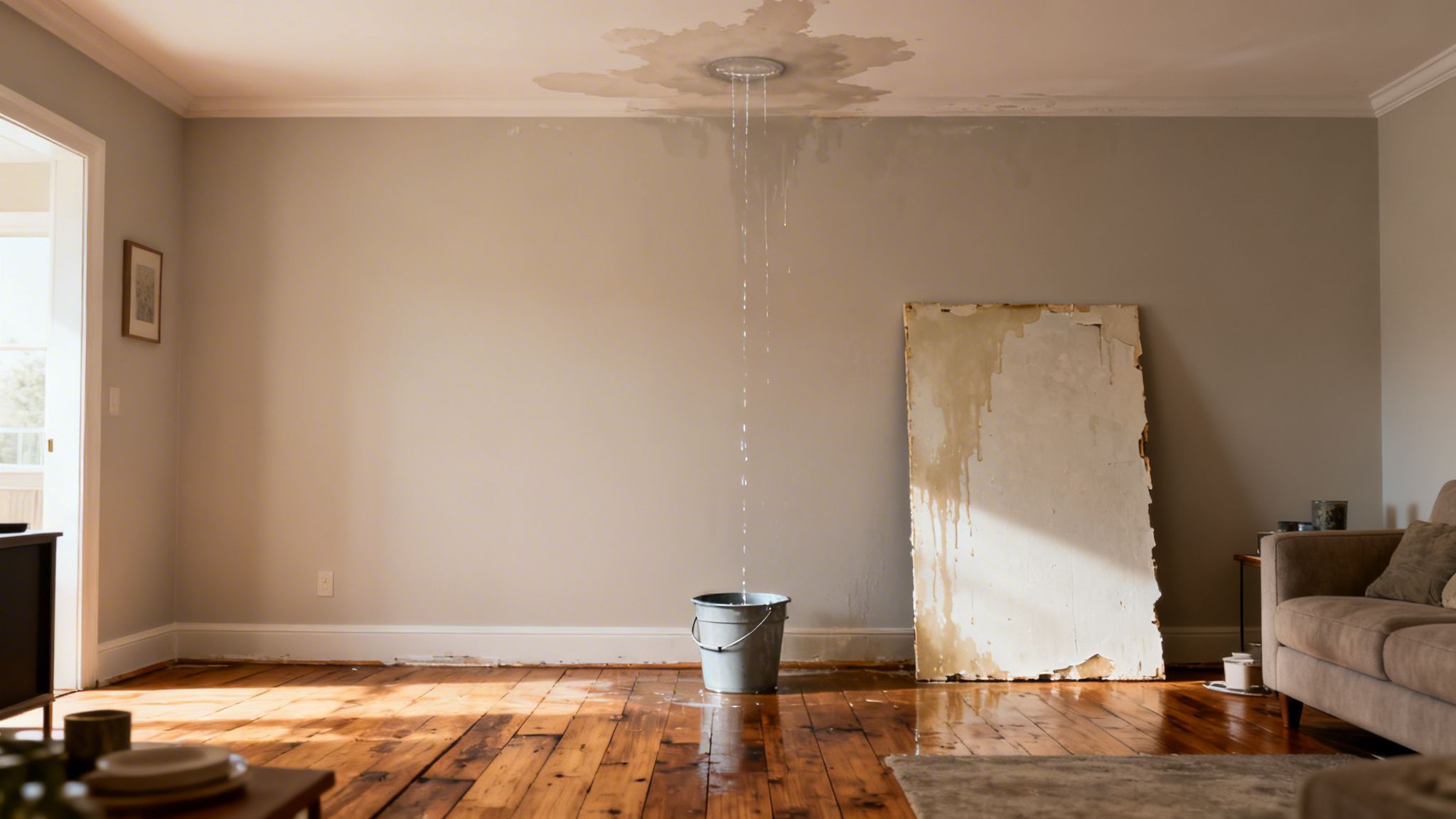
When an ice dam builds up on your roof, it acts like a barricade, forcing melting snow to pool up and seep back under your shingles. That water then drips into your attic and walls, kicking off a chain reaction of destruction.
The good news? Most policies cover this "sudden and accidental" interior water damage under a peril called "weight of ice and snow."
This coverage is your lifeline because the damage is rarely just a simple stain. It’s often hidden and extensive, leading to:
- Water-soaked ceilings and bubbling, peeling paint
- Saturated drywall that’s ruined beyond repair
- Hardwood floors that cup and warp
- Soaked insulation, which quickly becomes a breeding ground for toxic mold
- Destroyed personal belongings, from furniture to electronics
But this is exactly where the fight with your insurance company begins. Big carriers like State Farm or Allstate are masters at minimizing what they have to pay out. You’ll probably get a quick, low-ball check meant to cover a cosmetic fix—like patching and painting the ceiling stain.
This initial offer is almost always a tactic. The insurer's adjuster has one primary goal: to close your claim as cheaply as possible. They are not incentivized to search for the hidden, long-term problems that will cost you thousands down the road. They are trained to protect the company's profits, not your best interests.
The Real Cost of Ice Dam Damage
That adjuster will conveniently ignore the soggy insulation in your attic, the potential for rot spreading in your roof decking, or the mold that’s already starting to grow behind your walls. They are betting you’ll take the check and go away, leaving you to discover the real damage months later.
This is why you have to be ready to fight their first, inadequate assessment.
Spotting the critical signs of water damage in your ceiling is your first step. But the real key is knowing how to dispute their findings. Understanding the full scope of your coverage is your best defense against these classic insurer tactics.
They are counting on you not knowing the true value of your claim. We’re here to give you the claim help you need to fight back and demand the full, fair settlement you’re owed.
Ice Dam Damage: What Insurance Typically Covers vs. What You Pay For
It's easy to get confused about what's covered and what isn't. Insurance companies often use this confusion to their advantage to deny parts of your claim. Here’s a simple breakdown of what your policy is designed to pay for versus the costs you'll likely have to handle yourself.
| Damage or Service Type | Typically Covered by Insurance? | Why It's Covered (or Not) |
|---|---|---|
| Interior Water Damage | Yes | This is considered "sudden and accidental" damage resulting from a covered peril (weight of ice). It includes drywall, insulation, and flooring. |
| Damaged Personal Property | Yes | Your policy's contents coverage (Coverage C) pays to repair or replace belongings like furniture, electronics, and clothing ruined by the water. |
| Roof & Gutter Repair | Maybe | If the weight of the ice itself caused physical damage (e.g., collapsed a gutter), it's often covered. Damage from the water leak is not. Insurers often use this to low-ball the repair. |
| Ice Dam Removal | No | This is considered routine maintenance. Insurers view preventing ice dams as the homeowner's responsibility, not a sudden loss. They will use this as an excuse. |
| Mold Remediation | It's Complicated | Most policies have a low limit (or "cap") for mold, often just $5,000 – $10,000, which is rarely enough for a serious problem. They will fight you on paying a penny more. |
| Code Upgrades | Sometimes | If your policy includes "Ordinance or Law" coverage, it can help pay to bring repaired areas up to current building codes. Insurers often "forget" to include this. |
This table shows the battle lines. Your insurer will focus on the "No" and "It's Complicated" columns to limit their payout, while a good public adjuster will maximize every "Yes" and fight for coverage where it's ambiguous.
How Insurers Use Ice Dam Causes Against You
To win this fight, you have to know the other side’s playbook. When an adjuster from a big carrier like Allstate or State Farm shows up, they aren’t there to sympathize about your water-stained ceiling. They’re there to find a reason—any reason—to pay you as little as possible.
And their strategy almost always starts by picking apart how the ice dam formed in the first place.
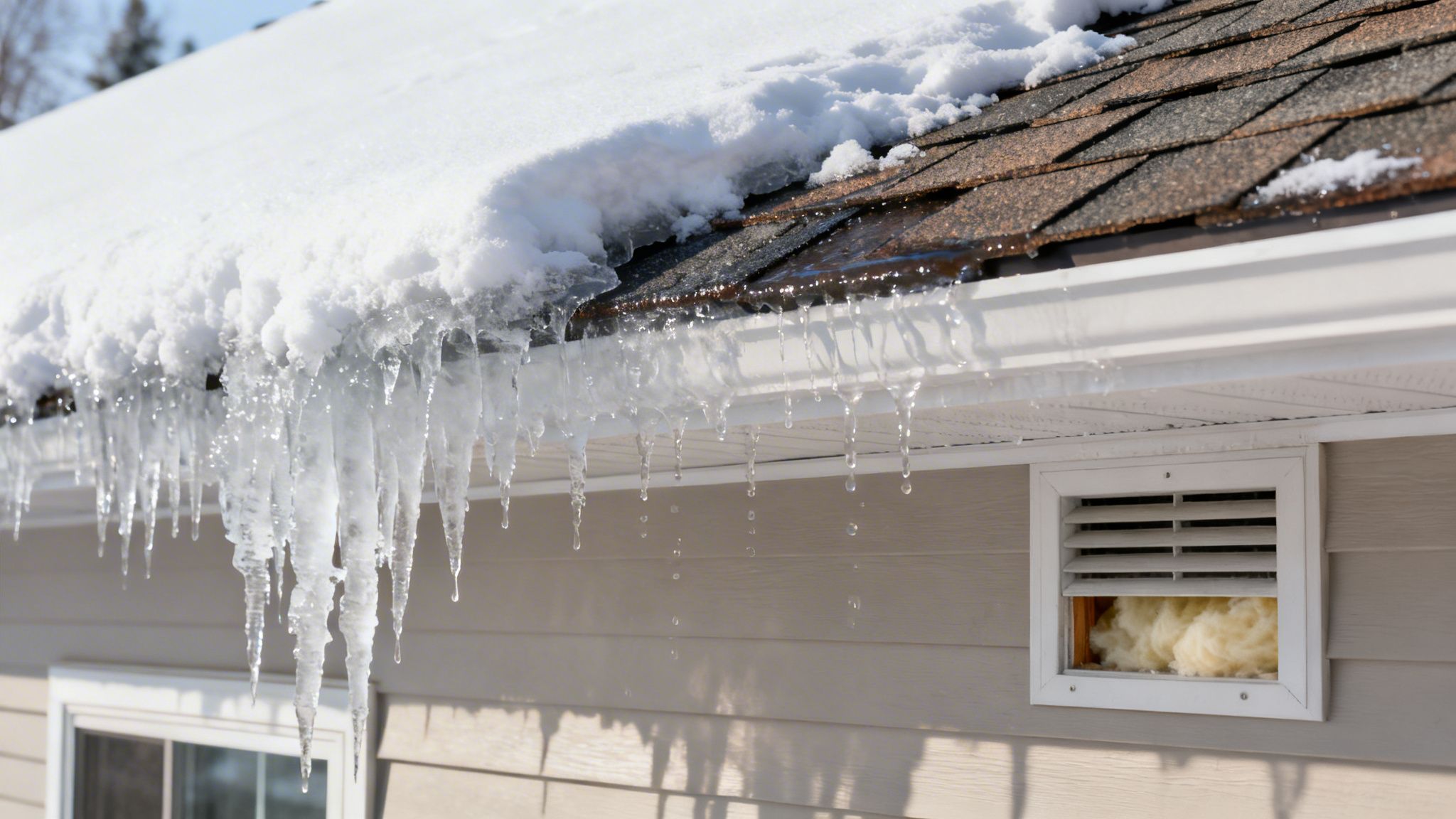
Ice dams are born from a simple but destructive cycle. Heat escapes your house, gets trapped in the attic, and warms the roof deck from below. That warmth melts the snow on your roof, and the meltwater runs down to the colder eaves and gutters where it refreezes into a solid ridge of ice—the dam.
With nowhere else to go, more melting snow backs up behind that dam, seeping under your shingles and pouring into your home. The two classic culprits behind this mess are almost always poor attic insulation and inadequate ventilation.
The Maintenance Negligence Trap
This is where the insurance adjuster becomes an expert forensic investigator for their employer. They will crawl through your attic and scrutinize every inch of your roofline, looking for the smoking gun: a pre-existing maintenance issue they can use against you.
They’ll find insufficient insulation or clogged soffit vents and immediately reframe the entire claim. Suddenly, it’s not about a sudden accident; it’s the predictable result of your own failure to maintain the property.
Their argument is a classic move, and it sounds something like this:
"Your policy covers sudden and accidental damage, but this ice dam was the direct result of long-term maintenance problems you never addressed. Because you failed to maintain your property, we are denying your claim."
This is how they justify a lowball offer or deny the claim outright. They’ll concede that your policy covers water damage, but then weaponize the cause of that damage to shift the blame right back onto you.
Why The Statistics Are On Their Side
Insurers know these "preventable" issues are incredibly common. In fact, a staggering 1 in 4 homes in colder climates deals with ice dams each winter, and an estimated 80% of cases are tied directly to bad insulation and ventilation.
That statistic is a huge problem for homeowners in areas like northern NC and VA, where a heavy snow can quickly turn into a disaster seeping through the roof. You can see more on how this impacts homeowners in this insightful report.
Because these root causes are so widespread, insurers have a built-in excuse to challenge nearly every ice dam claim right out of the gate. They are betting you won't know how to push back or prove the damage was, in fact, sudden and accidental. This puts you on the defensive from day one, forced to justify your claim against their accusations of neglect.
Strategies to Fight a Low-Ball or Denied Ice Dam Claim
This is where the real fight begins. After you report the damage from an ice dam, your insurance company will send out their adjuster. It won’t be long before you get a check for a few thousand dollars—just enough to slap some new paint over that ugly water stain on your ceiling.
Don't fall for it. This is a classic low-ball move.
Insurers like State Farm and Allstate are banking on you accepting this first, fast, and insultingly low offer. They want you to take the money and sign away your rights, closing the claim before anyone discovers the true extent of the damage.
That low-ball check isn't about making you whole. It's a business decision designed to protect their profits. It conveniently ignores the expensive, hidden problems an ice dam really causes:
- Saturated Insulation: Once insulation gets wet, it’s useless. It loses its R-value and quickly becomes a perfect breeding ground for toxic mold.
- Rotted Roof Decking: The plywood sheathing under your shingles can slowly decay from the moisture, destroying your roof's structural integrity from the inside out.
- Damaged Structural Supports: Water doesn't just stain drywall. It seeps into rafters and wall studs, causing slow, silent rot that will cost a fortune to repair down the road.
Rejecting the First Offer and Demanding Accountability
Your first move is simple, but absolutely critical: do not cash that check. Cashing it can be legally interpreted as accepting their settlement, which makes it nearly impossible to fight for the money you're actually owed.
Instead, you have to formally dispute their offer in writing. This starts a paper trail and puts the insurer on notice that you won't be pushed around.
An inherent conflict of interest exists in every claim. The company adjuster is paid by the insurance company, and their primary job is to minimize claim payouts. They are not on your side and are not there to find all your damage.
Your letter needs to be firm and clear. Demand a detailed, line-by-line breakdown of their estimate. Make them justify every single item—what was included, what was left out, and why. Force them to put their weak reasoning on paper.
Citing Your Policy and Building Your Case
Your insurance policy is a contract. It's the most powerful weapon you have in this fight. Get a complete copy of your policy and find the sections on "Perils Insured Against" and "Duties After a Loss."
You have to hold them accountable by quoting the specific language in their own contract that promises to cover this exact type of damage. Politely but firmly point out their obligation to pay for the "direct physical loss" caused by the water—and that includes everything the water touched, not just the surface stain.
To properly challenge their numbers, you need your own. Getting independent free estimates for repairs is a crucial step. Contact at least two or three reputable local contractors who specialize in water damage. They will provide detailed estimates that expose the true cost of repairs, including all the things the company adjuster conveniently "missed." This is powerful evidence. For a deeper dive, our guide on homeowners claim disputes offers more key strategies.
When the Insurer Won't Budge
Even with rock-solid evidence, your insurer might just dig in their heels and refuse to pay, hoping you’ll just give up. They'll start delaying, demanding redundant paperwork, and using confusing jargon to frustrate you. This is a deliberate tactic.
They know the longer they drag this out, the more likely you are to take a bad deal out of sheer exhaustion. They are banking on you not having the energy or expertise to keep fighting.
This is the point where you have to escalate. You can file a complaint with your state's Department of Insurance, which can sometimes light a fire under them. But for a serious claim dispute, you need a professional in your corner who knows all their games. It’s time to bring in an expert who works only for you.
Your Essential Ice Dam Claim Dispute Checklist
When your insurance company slides a low-ball offer across the table for your ice dam damage, they're making a bet. They're betting you don't have the proof—or the sheer energy—to fight back. Documentation is the single most powerful weapon you have to tear their flimsy arguments apart and prove what your claim is really worth.
This checklist is your battle plan. It breaks down exactly how to build a case so strong they can't ignore it.
Phase 1: Immediate Mitigation Actions
Deep in your policy, there's a clause that says you must take "reasonable steps" to prevent more damage. Insurers like State Farm love to use this against you, claiming you didn't act fast enough to justify a denial. Let's flip that on its head and use it to your advantage.
- Photos First, Always: Before you move a single thing, go crazy with your phone. Take hundreds of photos and videos. Get the ice dam itself, the water seeping in, the sagging, stained ceilings, and the soaked walls. Get every angle.
- Temporary Fixes: If you can do it safely, get buckets under the drips or throw a tarp over the area. Keep every single receipt for anything you buy. This stuff is often reimbursable.
- Notify Them in Writing: Fire off an email to your insurance company and the adjuster they assign you. Tell them about the loss and what you're doing to stop it from getting worse. This creates a time-stamped paper trail proving you were responsible.
Phase 2: Comprehensive Damage Documentation
This is where you build the foundation of your fight. The company adjuster’s estimate isn't gospel; it’s just their opinion—an opinion designed to save their boss money. Your job is to smother that opinion with cold, hard facts.
- Get Your Own Quotes: Call at least two reputable, independent contractors who know water damage restoration inside and out. Don't just get a number; demand a detailed, line-by-line estimate covering everything: demolition, drying, new materials, labor, and mold prevention. These quotes are your ammunition against a pathetic offer.
- Inventory Every Damaged Item: Make a spreadsheet of every single personal item that got wet. List what it was, how old it was, what it cost you, and what it costs to replace it today. Take photos of the damaged items before you toss them.
- Document the Hidden Damage: A good contractor will use moisture meters and thermal imaging cameras to find the water hiding in your walls, ceilings, and insulation. The insurer’s adjuster will conveniently "miss" this. Make sure your photos and the contractor's report highlight this invisible damage.
Water damage from ice dams is one of the most common—and expensive—homeowners claims out there. Data from Verisk shows the average payout hovers around $8,000 per incident. That number is a joke. It barely covers the obvious stuff like peeling paint and stained drywall, completely ignoring the thousands more needed to fix the hidden, structural mess. You can read more about why prevention is often discussed in home insurance circles.
Phase 3: Strategic Communication and Negotiation
How you talk to your insurer is just as critical as the evidence you gather. Every conversation is a chance for them to twist your words or corner you into a bad deal. You need to control the narrative from start to finish.
This is the basic playbook for fighting a bad offer.
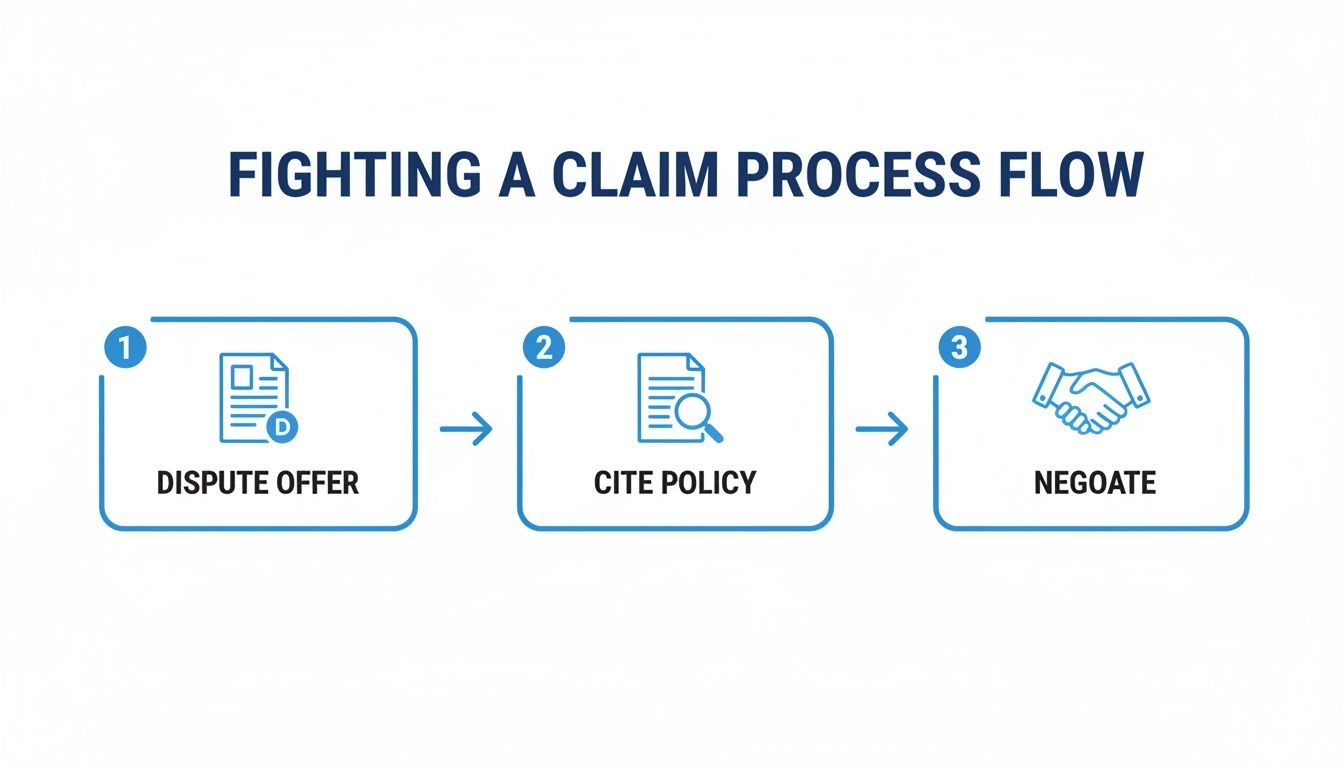
The process is simple: move from a documented dispute to a negotiation based on facts, not feelings. It takes emotion out of it and focuses on the contract they wrote.
Crucial Tip: Communicate only in writing. Use email. This gets rid of the "he said, she said" nonsense and gives you a perfect record of every request, every delay, and every offer. If an adjuster calls you, immediately follow up with a summary email: "Hi [Adjuster's Name], just to confirm what we discussed on our call today…"
And whatever you do, never, ever sign a "final release" form or cash a check marked "full and final settlement" until you are 100% certain that money covers every last penny of the repair cost, including anything discovered later. They rush you to sign those forms to wash their hands of you. Once you sign, your fight is over.
Why a Public Adjuster Is Your Best Ally in an Insurance Fight
When you’re staring down a billion-dollar insurance company over your ice dam claim, you’re walking into a fight you can’t win alone. Let's be clear: the adjuster they send out works for them, not you. They are trained by the insurance company and graded on how well they protect the company’s bottom line. Their job isn’t to find all your damage—it’s to close your claim for the absolute lowest amount possible.
You need an expert in your corner who only works for you. This is where a public adjuster becomes your most powerful weapon. Unlike the company adjuster, a public adjuster is a state-licensed professional who advocates exclusively for you, the policyholder. They’re here to level a playing field that’s tilted steeply in the insurer’s favor.
Leveling the Playing Field with Expertise
Insurance giants like Allstate and State Farm have armies of adjusters, lawyers, and engineers who know every trick in the book to shrink your claim. A public adjuster brings that same firepower to your side of the table.
They have a deep, practical understanding of:
- Complex Policy Language: They know how to cut through the dense, confusing jargon in your policy to find every last dollar of coverage you are owed.
- Damage Valuation: They are experts at identifying and valuing all the damage—especially the hidden structural issues and potential for mold that company adjusters conveniently "miss."
- Negotiation Strategy: They are master negotiators who know precisely how to dismantle an insurer's low-ball arguments and build an ironclad case for a full and fair settlement.
A public adjuster takes the entire soul-crushing burden of the claim off your shoulders. They handle the inspections, the overwhelming documentation, the detailed estimates, and every single frustrating phone call and email with the insurance company. Their only goal is to maximize your financial recovery so you have the money you actually need to rebuild your home correctly.
A Success Story in Fighting Back
Take a recent ice dam claim we handled. A homeowner had ugly water stains spreading across their living room ceiling. The insurance company's adjuster showed up, snapped a few pictures, and quickly offered $4,500 to patch and paint the ceiling. The homeowner knew it wasn't right and called us.
Our public adjuster got to work, conducting a real investigation. Using moisture meters and thermal imaging cameras, we discovered the water had completely saturated the attic insulation, run down inside the wall cavity, and was already causing rot in the roof decking. This was a much bigger problem. We documented everything and built a detailed estimate for all the actual damage, not just the cosmetic stain.
After presenting our evidence and going toe-to-toe in negotiations, we forced the insurance company to accept the true scope of the disaster. The final settlement was over $28,000—more than six times their initial insulting offer. This is the difference an expert advocate makes.
This homeowner's review says it all.
This experience proves a critical truth: insurance companies will almost always try to get away with paying the bare minimum. A public adjuster is your only real defense against that strategy. For a deeper look into their role, you can learn more about what a public adjuster does in our detailed guide. They take the fight to the insurer, armed with the evidence and expertise needed to win.
The Hidden Costs of an Ice Dam Claim You Didn't See Coming
Winning your ice dam claim dispute is one thing. But what happens after you cash the check is a whole other battle that insurance companies like State Farm and Allstate don't advertise.
The moment you file a claim—even a perfectly legitimate one for ice dam damage—you get flagged in their system. This isn't just a note in your file. It's a "high-risk" label that can stick with you and comes with some serious financial consequences.
Many homeowners are stunned when their renewal notice arrives with a premium hike of 20% to 50%. In the worst-case scenarios, the insurer decides you're not worth the risk anymore and sends you a non-renewal notice, kicking you to the curb.
Why the "Average" Settlement is a Trap
You might hear that the average settlement for an ice dam claim is around $8,000. On the surface, that sounds like a decent amount of money. But that number is a carefully calculated trap designed to work in the insurer's favor.
That $8,000 might just be enough to cover the obvious, cosmetic stuff—like patching up a water-stained ceiling or replacing a section of buckled hardwood floors. It's a quick fix that makes it look like the problem is solved.
What it conveniently ignores are the much bigger, more expensive problems lurking out of sight. That settlement leaves you holding the bag for:
- Replacing gutters that were ripped off by the weight of the ice.
- Repairing shingles that were torn and lifted.
- Fixing the waterlogged and rotting roof deck underneath.
- Paying for mold remediation in the attic where moisture went undetected.
This leaves you with a terrible choice: either fork over thousands more out of your own pocket to properly fix your home or just cross your fingers and hope it doesn't leak again next winter.
The Insurer's Multi-Million Dollar Problem
To understand why your insurance company fights so hard to nickel-and-dime your claim, you have to see the bigger picture. They aren't just dealing with your house; they're managing massive, catastrophic risk.
A single winter storm in 2023 caused an unbelievable $93.3 million in insured damages from ice and snow across multiple states. You can learn more about how these events shape insurance underwriting to see what they're up against.
When your insurer looks at your $15,000 ice dam claim, they don’t see a family struggling with a damaged home. They see a tiny piece of a multi-million dollar exposure they have to contain at all costs. Their first move is almost always to lowball, delay, and hope you’ll just give up.
This is the unvarnished truth of the insurance game. Before you even pick up the phone to file, you have to weigh your deductible against the real repair costs and the very real risk of getting slammed with higher premiums or a non-renewal. For smaller claims, sometimes the long-term financial pain just isn't worth the fight.
Fighting an Ice Dam Claim? Here’s What the Insurance Company Won’t Tell You
When you’re trying to get a fair payout for ice dam damage, the insurance company can feel like a brick wall. It's a frustrating fight. Here are the real answers to the questions homeowners are forced to ask when their insurer starts playing games.
If I File a Claim, Will My Rates Go Up?
Almost certainly, yes. Insurers don't see a legitimate claim; they see risk. Even for damage that was completely out of your control, you can expect your premium to shoot up by 20% to 50% when it’s time to renew.
Worse, they might just drop you entirely. A non-renewal forces you back into the market to find new coverage, often at a much higher price. This is exactly why you have to think hard about your deductible and the true cost of the damage before you even pick up the phone.
Can the Insurance Company Make Me Use Their Contractor?
Absolutely not, but they will try. This is one of their favorite pressure tactics. They'll hand you a list of "preferred" contractors who have cozy relationships with them.
These contractors are known for one thing: doing cheap, fast work that benefits the insurance company's bottom line, not you. You have every right to choose your own independent contractor—someone who works for you and will fight to get the job done right.
What if I Find More Damage After They "Closed" My Claim?
This happens all the time. An insurer pushes you to accept a quick, low-ball check, and you think the nightmare is over. Then, months later, you find rot, or worse, mold growing behind a wall.
If you haven't signed a "final release" document, you can petition to reopen the claim, but get ready for a serious fight. The insurance company will dig in its heels. This is precisely why you should never, ever accept that first offer without getting a thorough, independent inspection first.
Does Insurance Cover the Cost of a Public Adjuster?
No, your policy won't cover the public adjuster's fee. But here's what the insurance company hopes you don't figure out: that fee is just a small percentage of the final settlement.
A good public adjuster can increase a settlement by 2x, 5x, or even more than the insurer's initial insulting offer. Their services more than pay for themselves. You pay them out of the money you never would have seen otherwise, and you finally get the funds you need to actually fix your property.
When you're facing a denied or underpaid ice dam claim, you don't have to fight a billion-dollar insurance company on your own. The team at For The Public Adjusters, Inc. works only for policyholders like you to document the real damage and secure the full settlement you're owed. Get the expert claim help you need by visiting https://forthepublicadjusters.com for a no-cost claim review.

Trackbacks/Pingbacks