When a Car Hits Home Claim Turns Into a Months-Long Insurance Battle
A car hits home claim can quickly become one of the most frustrating insurance disputes a homeowner faces — because what looks like surface damage at first glance often conceals serious structural harm that insurers are slow to acknowledge. Hidden load-bearing damage is far more common than adjusters let on, and bringing in a public adjuster who can commission an independent engineering inspection is frequently what forces a full, honest re-evaluation of the claim.
Key takeaways
- A car hits home claim often involves hidden structural damage that insurers may initially classify as cosmetic, undervaluing the true scope of repairs needed.
- Load-bearing wall framing can be compromised even when exterior damage appears minor, making an independent engineering inspection critical after any vehicle impact.
- Public adjusters in North Carolina can request a re-inspection and force carriers to reissue estimates when documented structural evidence contradicts the original assessment.
- Delaying a car hits home claim while disputing scope can expose homeowners to secondary damage, mold, and code-compliance costs not covered in a lowball estimate.
- North Carolina homeowners have the right to invoke the appraisal clause in their policy if there is a disagreement over the value or scope of a covered loss.
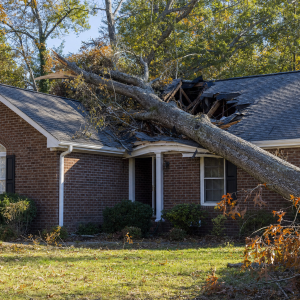
Picture a homeowner in North Carolina waking up to the sound of impact. A vehicle has left the road and driven directly into the side of their house. There is visible damage — a crumpled garage wall, cracked siding, a broken door frame. The insurance company sends out an adjuster within a few days, and the initial estimate arrives shortly after. The number feels low. The repairs described seem superficial. And yet the homeowner, shaken and trusting the process, almost signs off on it.
This scenario plays out regularly across North Carolina and Virginia. The reason it drags into a months-long battle almost always comes down to one thing: the insurer’s adjuster scoped the claim as cosmetic damage when the real problem ran much deeper.
Why Insurance Companies Minimize Vehicle-Impact Claims From the Start
- Adjusters are not structural engineers. The person your insurer sends to document the loss is trained to estimate repair costs — not to assess whether a load-bearing wall has been compromised or whether a foundation has shifted.
- Cosmetic repairs cost far less than structural remediation. Replacing siding and patching drywall is a fraction of the cost of shoring up a damaged rim joist, replacing a compromised header, or addressing foundation cracking caused by the impact force.
- The initial scope sets the anchor. Once an insurer writes an estimate, they are motivated to defend it. Reopening a claim requires pressure — documentation, expert opinions, and in many cases, a formal dispute process.
- Vehicle-impact claims are categorized differently in some systems. Because the at-fault driver’s auto liability coverage may be involved alongside your homeowner’s policy, the coordination of coverage can create delays and gaps that work against you.
The Hidden Damage Problem Nobody Warns You About
When a vehicle strikes a home, the energy of that impact travels. Walls transfer force to adjacent framing. A hit to a garage can transmit stress into the foundation sill plate. Brick veneer may look intact while the wall ties behind it have snapped. Roof trusses connected to the impacted wall can rack out of alignment. None of this shows up in a walk-around visual estimate — it shows up in an engineering inspection.
Homeowners who push back on low settlements and bring in a licensed public adjuster often discover that the real scope of damage is significantly broader than what the insurer documented. If you are in the Wake County area and feel your claim has been minimized, working with a public adjuster serving Cary, NC who understands structural claims can be the difference between a partial patch job and a settlement that actually restores your home.
The bottom line: do not accept the first number. A car hits home claim that gets properly investigated almost always reveals more than the insurer’s initial scope captures — and you have every right to demand that full picture.
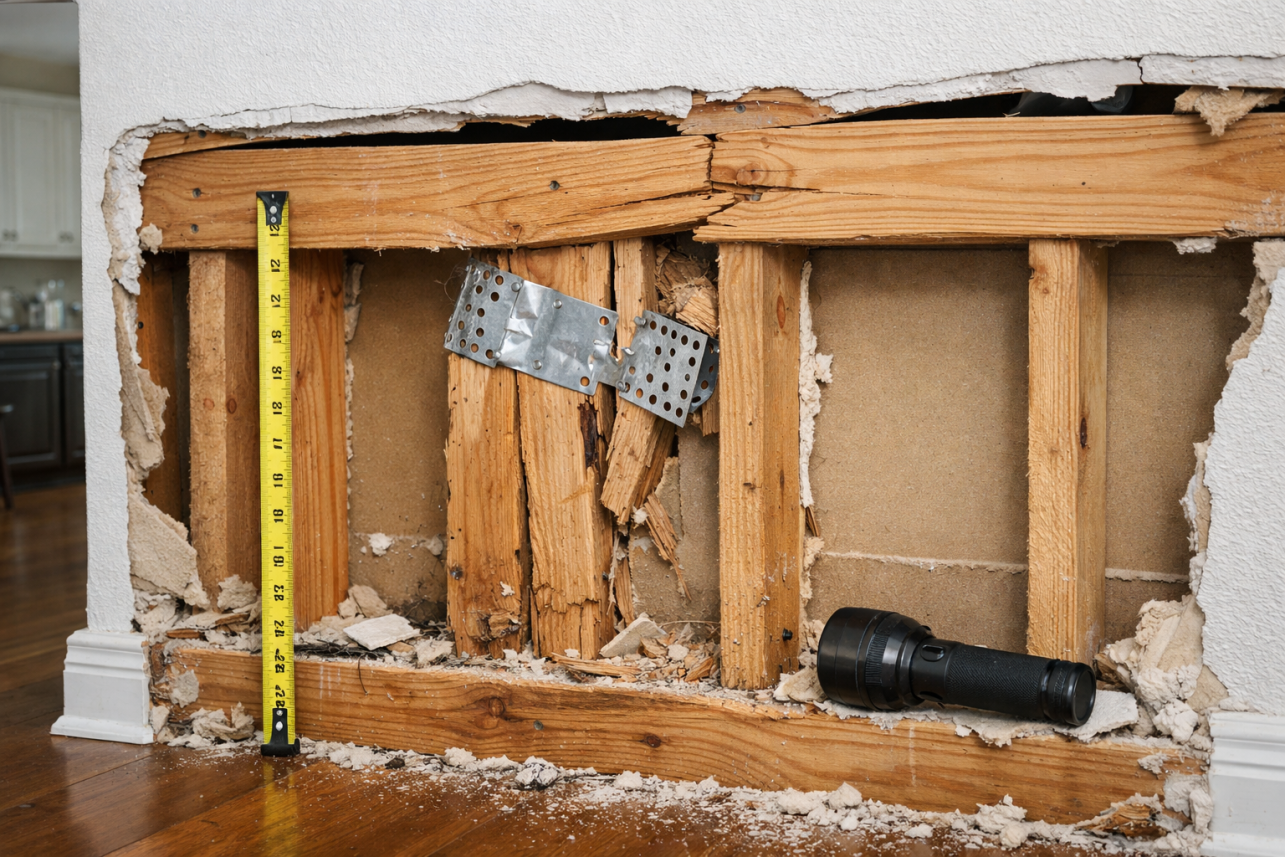
Why Do Insurers Label Structural Damage as Cosmetic Repairs in a Car Hits Home Claim?
Insurers classify vehicle-impact damage as cosmetic rather than structural because it dramatically reduces what they must pay. An adjuster who documents only surface-level damage — cracked siding, scuffed trim, a dented door frame — can close a claim for a few thousand dollars. Acknowledging compromised framing, shifted load-bearing walls, or displaced foundation anchors can push a settlement into the tens of thousands or higher.
The Financial Incentive Behind the Label
Insurance companies are for-profit businesses, and claim payouts directly affect their loss ratios. When a vehicle strikes a home, the visible damage is easy to photograph and price. The damage behind the wall — bent studs, cracked sheathing, loosened anchor bolts, shifted headers — requires more invasive investigation to document. If an adjuster can write a scope of loss that stops at the exterior surface, the file closes faster and cheaper. That outcome benefits the insurer’s bottom line, not yours.
This dynamic is not unique to vehicle-impact claims. Homeowners dealing with other sudden-event losses often encounter the same pattern, which is why understanding how adjusters build their estimates matters regardless of what caused the damage.
Who Is Actually Assessing Your Framing?
Most insurance adjusters — staff adjusters and independent adjusters alike — are not licensed structural engineers, architects, or contractors with framing expertise. They are trained to document and price damage using estimating software, most commonly Xactimate. That software is a powerful tool, but it only prices what the adjuster enters. If the adjuster does not probe behind the exterior cladding, does not order a structural inspection, and does not pull back insulation to examine rim joists or wall plates, those items simply do not appear in the estimate.
Common structural elements adjusters miss after a vehicle strike include:
- Cracked or bowed wall studs behind intact siding
- Displaced double top plates that affect roof load transfer
- Damaged sole plates or bottom plates near the foundation
- Shifted or cracked sheathing panels that reduce racking resistance
- Compromised anchor bolts or sill plate connections
- Hidden damage to electrical conduit, plumbing runs, or HVAC chases inside impacted walls
What ‘Like-Kind and Quality’ Replacement Is Supposed to Mean for You
Most homeowners insurance policies contain language obligating the insurer to restore your home to its pre-loss condition using materials and construction of like kind and quality. In plain terms, that means if a car destroyed a load-bearing wall, your policy should pay to rebuild a load-bearing wall — not just re-side the exterior over damaged framing. The gap between what that language promises and what an adjuster’s initial estimate delivers is often where homeowners lose money.
Understanding your policy’s replacement cost provisions is critical here. If you are unsure how replacement cost language applies to structural versus cosmetic repairs, the overview at Replacement Cost Coverage breaks down what that standard actually obligates your insurer to pay — and where insurers commonly fall short of that obligation.
When the estimate you receive covers only paint and siding while a structural engineer would flag framing damage, you are not receiving the like-kind and quality restoration your policy guarantees. Recognizing that gap is the first step toward challenging it.
What Did the Engineering Inspection Reveal in a Car Hits Home Claim?
A licensed structural engineer hired during the public adjuster’s inspection found far more than surface-level damage. The findings included compromised load-bearing wall studs, shifted top plates, and violations that triggered mandatory code-compliant remediation — documentation that ultimately forced the insurance carrier to abandon its cosmetic-only estimate and issue a full replacement scope of work.
Why a Structural Engineer Was Brought In
After the insurance carrier issued a repair estimate limited to siding replacement and minor patching, the homeowner’s public adjuster pushed back. The impact point was a corner section of the home — one of the most structurally sensitive areas because corner assemblies carry load in multiple directions simultaneously. That red flag was enough to justify bringing in a licensed structural engineer before any repairs began.
What the Engineer’s Report Documented
The structural inspection went well beyond what a visual walk-through or standard adjuster assessment would catch. Key findings included:
- Compromised load-bearing wall studs: Several studs in the wall assembly that the vehicle struck had visible lateral displacement and micro-fractures along the wood grain. These studs were no longer performing their intended load-transfer function, even though they hadn’t fully snapped.
- Shifted top plates: The top plates — horizontal framing members that connect wall studs to the roof structure above — had moved out of alignment. This kind of shift can quietly transfer stress to rafters and ceiling joists over time, leading to progressive structural problems that appear months or years after the initial impact.
- Racking of the wall assembly: The overall wall frame had racked slightly out of square, meaning windows and doors in the affected section were at risk of binding, sealing improperly, or failing altogether as the structure settled into its new misaligned position.
- Code-required remediation triggers: Because the damage crossed specific thresholds under the North Carolina State Building Code, repairs couldn’t legally be limited to cosmetic fixes. Any permitted repair work required bringing the affected section up to current code standards — including updated framing connections and potentially upgraded sheathing.
How the Documentation Changed the Claim Outcome
The engineer’s written report, paired with annotated photographs and references to applicable building code sections, gave the public adjuster the evidence needed to formally dispute the carrier’s position. Faced with a licensed professional’s findings and the legal exposure of approving repairs that would violate state code, the insurer revised its position. The final approved scope included full framing replacement in the damaged section, proper sheathing, and exterior finishes — a dramatically different outcome than the original cosmetic estimate.
The lesson for NC homeowners is straightforward: an insurance adjuster is not a structural engineer, and a car hits home claim that looks minor from the outside can hide frame-level damage that only a qualified inspection will find.
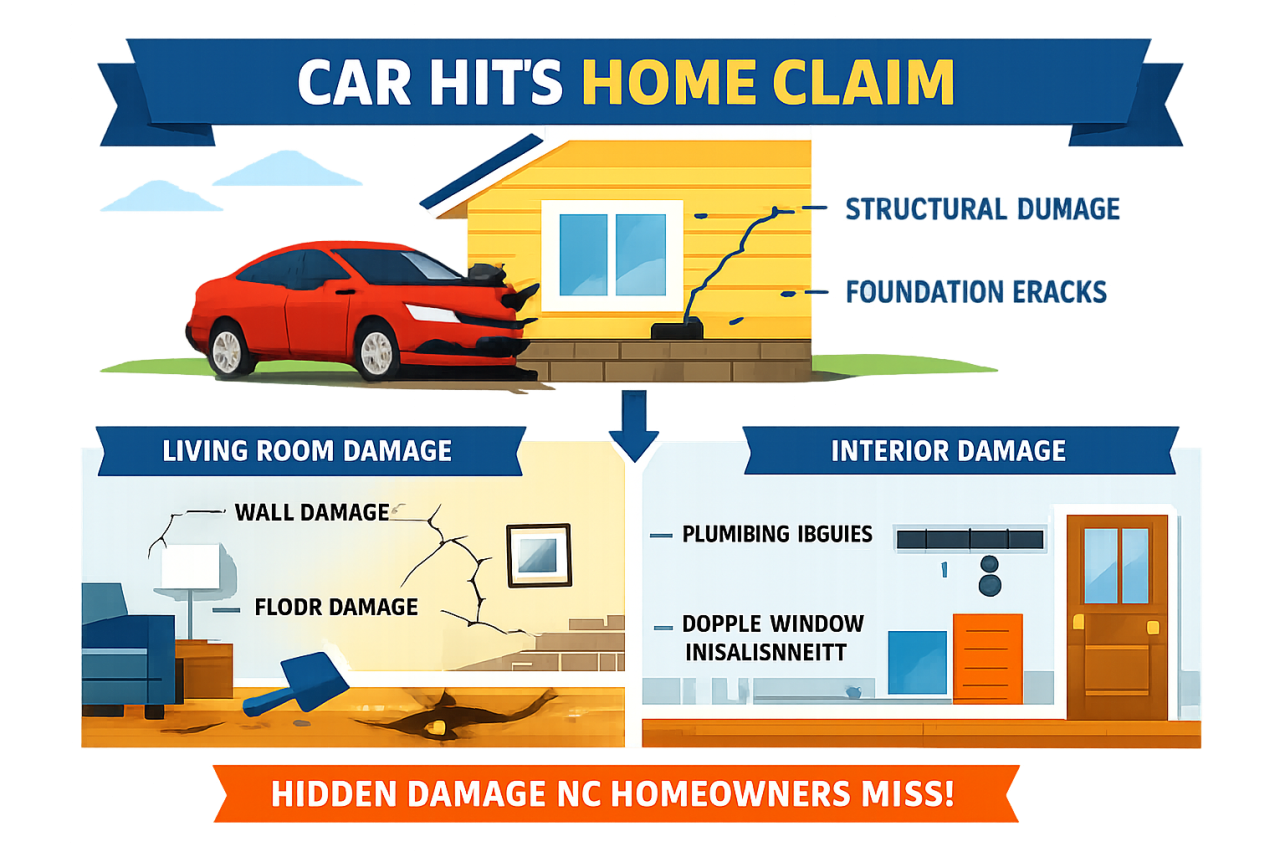
How Can a Car Hits Home Claim Uncover Damage Your Insurer Missed?
A thorough car hits home claim investigation uses layered inspection methods — moisture intrusion checks, stud-by-stud framing assessments, building-code analysis, and independent contractor cost verification — to surface structural damage that a standard adjuster walk-through routinely overlooks. Each method targets a different failure point that impact force can create behind finished walls and beneath floors.
Moisture Intrusion Checks
When a vehicle breaches a wall, it almost always compromises the weather barrier, even if the exterior siding appears intact after patching. Inspectors use thermal imaging cameras and handheld moisture meters to detect water that has already begun migrating into wall cavities, insulation, and floor systems. Left undetected, that moisture becomes mold and rot — damage an insurer can later argue was pre-existing rather than impact-related.
- Thermal imaging identifies cold spots where insulation was displaced or the vapor barrier was torn
- Moisture meters confirm actual water content inside wall assemblies, not just surface readings
- Inspectors document baseline readings in unaffected areas to establish a clear comparison
Stud-by-Stud Framing Assessment
Impact energy travels along the path of least resistance through a wood or steel frame. An adjuster who simply looks at the point of contact misses shear damage, cracked load-bearing members, and shifted connection points that can be several feet away from the visible hole. A proper framing assessment means opening wall sections and physically probing each stud and connection in the impact zone.
- Inspectors check for lateral displacement — studs pushed even a fraction of an inch out of plumb can affect load transfer
- Nail and screw connections are examined for pull-through or shear failure
- Rim joists, headers, and corner assemblies near the strike point are evaluated for compression damage
Building-Code Analysis
North Carolina’s residential building code sets minimum standards for structural repair — not cosmetic patching. A code-based analysis compares what the insurer’s repair estimate actually requires workers to do against what the code mandates. Frequently, a code-compliant repair costs significantly more than the insurer’s initial scope because it requires permits, inspections, and full replacement of compromised structural elements rather than surface-level fixes.
Independent Contractor Cost Verification
Insurance adjusters use estimating software with regional pricing databases, but those figures don’t always reflect real-world contractor bids in your specific market. Getting two or three independent contractor estimates — from licensed NC builders familiar with structural repair — gives you documented proof when the insurer’s number falls short. These estimates should itemize labor, materials, permit fees, and any required engineering sign-off separately so every line item can be directly compared to the insurer’s scope of work.
Have Courts Sided With Homeowners in Structural Damage Disputes After a Car Hits Home Claim?
Yes, courts have repeatedly sided with homeowners when insurers undervalue or misclassify structural damage following sudden-loss events like vehicle impacts. Judges and juries consistently give significant weight to independent engineering evidence, and policyholders who document damage thoroughly have demonstrated meaningful legal leverage against carriers who attempt to minimize legitimate claims.
Why the Courts Tend to Favor Documented Structural Evidence
Insurance disputes that reach litigation often hinge on a single question: whose expert is more credible? When a homeowner arrives with a licensed structural engineer’s report and the insurer presents only an adjuster’s field notes, courts have generally found the engineering analysis more persuasive. This pattern holds across property damage cases involving vehicle impacts, windstorm, and other sudden structural losses.
Several legal principles work in a homeowner’s favor in these disputes:
- Policy interpretation against the drafter: Known in insurance law as contra proferentem, this doctrine holds that ambiguous policy language is construed against the insurer who wrote it — not the policyholder. If your policy is unclear about whether compromised load-bearing framing constitutes a covered structural loss, that ambiguity can benefit you.
- Bad faith statutes in NC and VA: Both North Carolina and Virginia have statutory frameworks that allow homeowners to pursue claims against insurers who handle losses improperly or delay payment without reasonable justification. A pattern of ignoring engineering evidence can support a bad faith argument.
- The appraisal process as a legal mechanism: Many courts have upheld a homeowner’s right to invoke the appraisal clause in their policy when a dispute arises over the scope or value of damage. Independent appraisers and umpires regularly arrive at higher figures than the insurer’s initial offer — and those awards are typically binding.
What This Means Practically for Your Claim
You do not need to accept the first number an adjuster puts in front of you. Courts have consistently signaled that documented engineering inspections, professional repair estimates, and thorough photographic evidence shift the balance of power back toward the homeowner. Carriers who label hidden structural compromise as cosmetic damage — and then face a detailed engineering report in litigation or appraisal — frequently revise their positions before a case ever reaches a verdict.
The lesson for any NC or VA homeowner navigating a car hits home claim is straightforward: independent documentation is not just helpful, it is the foundation of any successful dispute. Legal precedent has shown, again and again, that the homeowner who builds a paper trail wins more often than the one who relies solely on the insurer’s assessment.
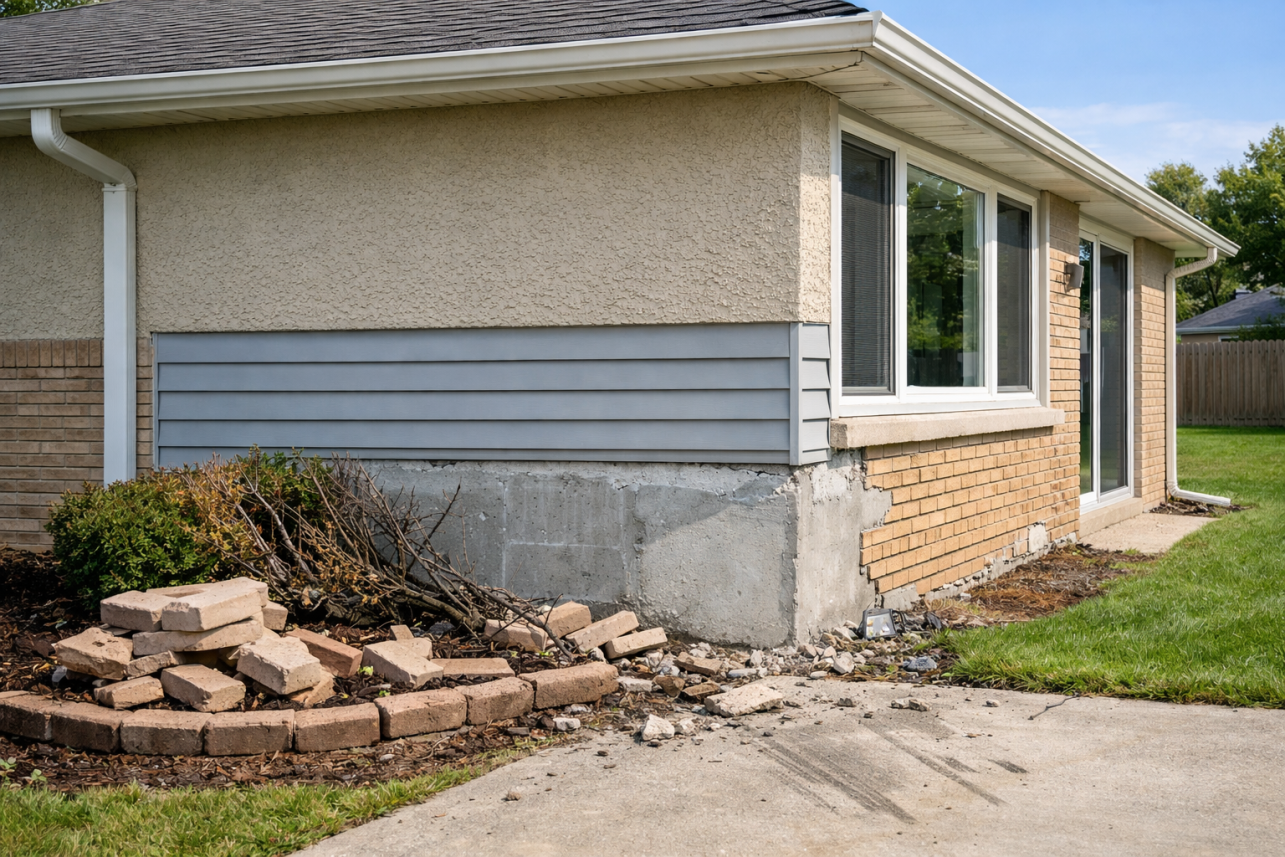
What Should NC and VA Homeowners Do After a Car Hits Home Claim?
After a vehicle strikes your house, act quickly and methodically: secure the scene, document everything before any cleanup begins, avoid signing any release or accepting a check marked “full and final settlement,” request a complete written scope of damage from your insurer, and consult a licensed public adjuster before your claim is closed. These steps protect your right to a full and fair settlement.
Step 1: Secure the Scene and Protect Your Property
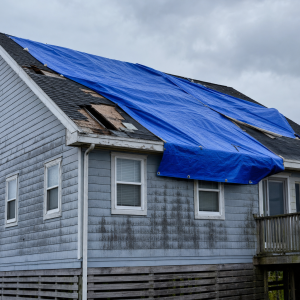
Your first priority is safety. Keep family members away from the damaged area until a structural professional confirms the space is safe to occupy. Contact your local building or inspections department — many NC and VA municipalities require a permit and inspection before structural repairs begin. Temporary measures like tarping, boarding, or shoring are appropriate, but do not allow permanent repairs to start before the full damage is documented.
Step 2: Preserve Every Piece of Evidence
- Photograph and video the damage from multiple angles before anything is moved or cleaned up.
- Save any debris, broken framing, or displaced materials — these can support a structural damage finding later.
- Get a copy of the police report and the at-fault driver’s insurance information.
- Keep receipts for all temporary repairs and emergency expenses.
- Write down the names and contact information of any witnesses.
Step 3: Watch What You Sign
Do not accept a check or sign any document described as a “full and final settlement,” “release of all claims,” or similar language until you are certain every item of damage — including hidden structural issues — has been identified and valued. Signing prematurely can forfeit your right to reopen the claim if additional damage surfaces during repairs.
Step 4: Request a Written Scope of Damage
Ask your insurance adjuster to provide a complete written scope of loss — a line-by-line breakdown of every repair item they intend to pay for. Review it carefully. If structural components such as load-bearing walls, foundation connections, or roof framing are not listed, ask in writing why they were excluded. A written record of those conversations matters if the claim escalates.
Step 5: Consult a Licensed Public Adjuster Before the Claim Closes
A licensed public adjuster works on your behalf — not the insurance company’s — and can conduct an independent inspection, review the insurer’s scope, and identify damage that was missed or undervalued. The North Carolina Department of Insurance Consumer Services and the National Association of Public Insurance Adjusters (NAPIA) are good starting points to verify licensing and understand your rights as a policyholder. Engaging a public adjuster does not guarantee a specific outcome, but it does ensure your car hits home claim receives a thorough, professional review before it is closed.
Car Hits Home Claim: Insurer-Only Process vs. Public Adjuster-Assisted Process
| Factor | Insurer’s Adjuster Only | With Public Adjuster + Engineer |
|---|---|---|
| Damage Assessment Scope | Typically limited to visible exterior damage | Includes structural, framing, and hidden system inspection |
| Load-Bearing Wall Review | Rarely included in initial estimate | Specifically evaluated by licensed structural engineer |
| Estimate Outcome | Often categorized as cosmetic repair | More likely to reflect full replacement cost |
| Claim Resolution Time | Can stall for months if scope is disputed | Dispute resolved faster with documented engineering evidence |
| Homeowner Out-of-Pocket Risk | Higher — gaps in coverage more likely | Lower — scope is independently validated and documented |
Illustrative Example: The Impact Behind the Siding
Illustrative example
In a composite scenario representative of cases seen across North Carolina, a homeowner filed a car hits home claim after a vehicle left the roadway and struck the front corner of their house. The insurer’s adjuster inspected the property and issued an estimate covering only exterior siding replacement and minor trim repair, concluding that the impact was cosmetic.
Unsatisfied with the assessment, the homeowner retained a public adjuster, who commissioned a licensed structural engineer to evaluate the affected wall section. The engineer’s report documented that the rim joist, corner post, and adjacent stud framing had sustained significant lateral loading, compromising the structural integrity of that wall assembly in ways invisible from the exterior.
Faced with the engineering report, the carrier withdrew its original estimate and issued a revised scope covering full framing repair, exterior replacement, and code-required upgrades — substantially increasing the settlement and allowing the homeowner to restore the property correctly.
Should I File With the Driver’s Auto Insurance or My Homeowners Policy First?
In most cases, file with your own homeowners insurer first and let it pursue the at-fault driver’s auto carrier afterward. Your own policy obligates your insurer to respond promptly, while a third-party liability claim moves at the other carrier’s pace — they can investigate fault, dispute the extent of damage, or wait on a police report before paying anything. Going through your homeowners policy means paying your deductible up front, but if the driver was at fault, your insurer will typically pursue subrogation against the driver’s carrier and may recover your deductible for you once that process concludes. Ask your adjuster in writing whether deductible recovery is included in their subrogation effort. If you’d rather deal directly with the driver’s insurer, understand you are a third-party claimant with no contract with that company — they owe duties to their own insured, not to you. Whichever route you choose, notify both carriers promptly so no deadline lapses, keep the claims separate in your records, and don’t let one insurer stall by pointing at the other. You can pursue your own policy even while fault is still being sorted out.
What If the Driver Was Uninsured or Fled the Scene?
A hit-and-run or an uninsured driver doesn’t leave you without options — it just changes the order of operations. Vehicle impact is a covered peril under most standard homeowners policies, and that coverage applies whether or not the driver is ever identified or carries insurance. File the claim with your own homeowners insurer, and the process described elsewhere on this page — documentation, scope review, structural inspection — proceeds exactly the same way. You will be responsible for your deductible, and without a solvent at-fault party there may be no subrogation recovery to reimburse it. Still report the incident to police immediately: an official report supports your claim, and if the driver is later identified, it preserves your ability to recover. If an uninsured driver is known, you can pursue them personally for the deductible and any uncovered losses, though collectability is often the practical obstacle. One caution: some homeowners assume that without a driver to blame, the insurer will treat the claim more generously. The opposite is often true — with no auto carrier to shift costs to, your insurer bears the full payout, which can increase the pressure to scope the damage narrowly. Document accordingly.
What If I (or a Family Member) Drove Into Our Own House?
Backing into the garage, hitting a porch post, or a teen driver misjudging the driveway is one of the most common versions of this loss — and the coverage picture is different from a stranger crashing into your home. Your auto liability coverage will not pay, because liability insurance covers damage you cause to other people’s property, not your own. The claim instead falls to your homeowners policy, and here the details matter: some policies cover vehicle damage regardless of who was driving, while others limit or exclude damage caused by a vehicle owned or operated by a resident of the household. Read the vehicle-impact language in your policy’s covered perils section carefully before assuming either way, and ask your agent to point to the exact provision in writing. Damage to the vehicle itself is a separate matter handled under your auto policy’s collision coverage, with its own deductible. If you carry both claims, you may pay two deductibles for one incident. Because these self-inflicted claims can involve exclusion language open to interpretation, they are exactly the situation where having someone review the policy wording before the insurer issues a position can change the outcome.
Will Insurance Pay for a Hotel If My Home Is Unsafe to Live In?
If the impact leaves part of your home unsafe or unusable — a breached wall, an unstable corner, a garage that can’t be secured — most homeowners policies include loss-of-use or additional living expenses coverage that pays the reasonable extra costs of living elsewhere while repairs are made. That can include hotel stays, short-term rentals, and increased food costs above what you’d normally spend. Two things determine whether this coverage activates: the damage must stem from a covered loss, and the home (or the affected portion) must genuinely be uninhabitable or unsafe. This is another place where the cosmetic-versus-structural fight has real consequences. If the insurer’s scope treats the damage as surface-level, they may also take the position that the home is perfectly livable — cutting off displacement benefits at the same time they cut the repair estimate. If a building official, engineer, or contractor tells you an area is unsafe to occupy, get that in writing and submit it with your claim. Keep every receipt from day one, including the first night, because these expenses are reimbursed against documentation. Ask your adjuster for your policy’s loss-of-use limit early so you can budget the displacement realistically.
Frequently asked questions
What should I do immediately after a car hits home claim event in NC?
Document everything before any cleanup or repairs begin. Take dated photos and videos of all visible damage from multiple angles, including the vehicle’s point of impact, surrounding wall sections, and any interior areas near the impact zone. Report the claim to your homeowner’s insurer promptly, and avoid signing any repair authorization or accepting a settlement until a thorough structural inspection has been completed. Contact the at-fault driver’s auto liability carrier as well, since both policies may be relevant depending on fault and coverage limits.
Why do insurers sometimes classify structural vehicle impact damage as only cosmetic?
Initial insurance inspections are often performed by general adjusters who rely on visible surface damage to estimate scope. When exterior cladding, siding, or brick appears to be the primary damage, carriers may write estimates limited to replacing those materials. However, the force of a vehicle impact can transfer energy deep into wall assemblies, displacing or cracking load-bearing framing, sheathing, and connectors that are hidden behind finished surfaces. Without opening walls or commissioning a structural engineering assessment, this hidden damage is easy to overlook or undervalue.
What does a public adjuster’s structural inspection typically uncover that a standard insurance inspection might miss?
A public adjuster experienced in vehicle impact claims will often bring in or recommend a licensed structural engineer to open wall cavities and evaluate framing members directly. This process can reveal compromised studs, cracked top or bottom plates, sheathing separation, and damage to load-bearing connections that would not appear in surface-level photos. These findings are documented in a formal engineering report, which provides objective evidence that carriers must address when reconsidering their damage estimate.
Can a NC homeowner dispute an insurer’s low estimate after a vehicle impact claim?
Yes. North Carolina homeowners have several options to challenge an inadequate settlement offer. You can request a re-inspection with additional evidence such as a structural engineering report, hire a licensed public adjuster to negotiate on your behalf, or invoke the appraisal clause if it exists in your policy, which allows each party to appoint an independent appraiser to resolve the dispute. If bad faith handling is suspected, you may also file a complaint with the NC Department of Insurance. Acting promptly matters because policy deadlines and statutes of limitations apply.
Related local pages
- Public Adjuster Cary NC: Navigating Insurance Claims When Insurance Companies Leave You Holding The Bill
- Public Adjuster Garner NC — Fight for the Full Settlement You Deserve
- Public Adjuster Holly Springs NC — Fight For The Full Settlement You Deserve
Think your car hits home claim was underpaid? Contact our licensed NC/VA public adjusters for a free policy review — no obligation, no guarantees, just answers. Get in touch.
Last updated: August 12, 2026