You received the denial letter after weeks of waiting. The insurer says the roof damage is excluded, the water loss is “long-term maintenance,” or the storm damage doesn't justify the amount you requested. Meanwhile, the house still needs repairs, your business may be losing income, and the adjuster has stopped returning calls.
So, can you sue an insurance company for denying a claim? Yes, sometimes. But “yes” isn't the useful answer. The key questions are whether the policy covers the loss, whether the insurer handled the claim unreasonably, whether you can prove the amount of damage, and whether you still have time to act.
For homeowners and small business owners in North Carolina and Virginia, the best strategy usually starts before a lawsuit. A strong written dispute, complete documentation, a public adjuster's claim analysis, or an attorney's demand can resolve a claim without trial. When those efforts fail, the evidence you built becomes the foundation of the case.
Table of Contents
- When You Can Actually Sue Over a Denied Claim
- How the Right to Sue Insurers Became Mainstream
- Legal Grounds You Can Bring Against an Insurer
- North Carolina and Virginia Compared
- NFIP Flood Claims and Federal Court Deadlines
- Evidence and Documentation to Build Before Filing
- When to Hire a Public Adjuster or Attorney
- Practical Next Steps After a Denial
When You Can Actually Sue Over a Denied Claim
A denial alone doesn't win a lawsuit. Courts generally want a policyholder to connect the denial to a recognizable legal theory, prove the loss, and show that the claim was presented properly. You also need to check the deadline immediately. A strong claim filed too late can be worth nothing.
The real decision starts with coverage
Start with the policy, not the adjuster's conclusion. Identify the insuring agreement, exclusions, conditions, endorsements, deductibles, and any appraisal or dispute-resolution language. A homeowner with wind-created openings in a roof has a different argument from a homeowner whose insurer says the damage came entirely from wear and tear. A commercial owner facing fire, smoke, or water damage must perform the same policy-versus-facts analysis.
Before filing suit, assemble these pieces:
- A covered loss: The facts must fit an available coverage provision, subject to exclusions and conditions.
- Proper claim presentation: Keep proof that you reported the loss and supplied requested information.
- A written denial or underpayment: The insurer's stated reason defines the dispute.
- Required procedures: Review any appraisal, contractual dispute, or appeal provision before suing.
- An unexpired deadline: Check policy language and applicable state law as soon as the denial arrives.
A typical homeowner dispute moves from denial to a written appeal or demand. The policyholder identifies the incorrect coverage position, supplies photographs, estimates, expert opinions, and policy language, then asks the insurer to reverse or revise its decision. If the carrier refuses, an attorney may investigate the claim file, preserve evidence, send a formal demand, and file a civil action for contract damages and any legally available additional remedies.
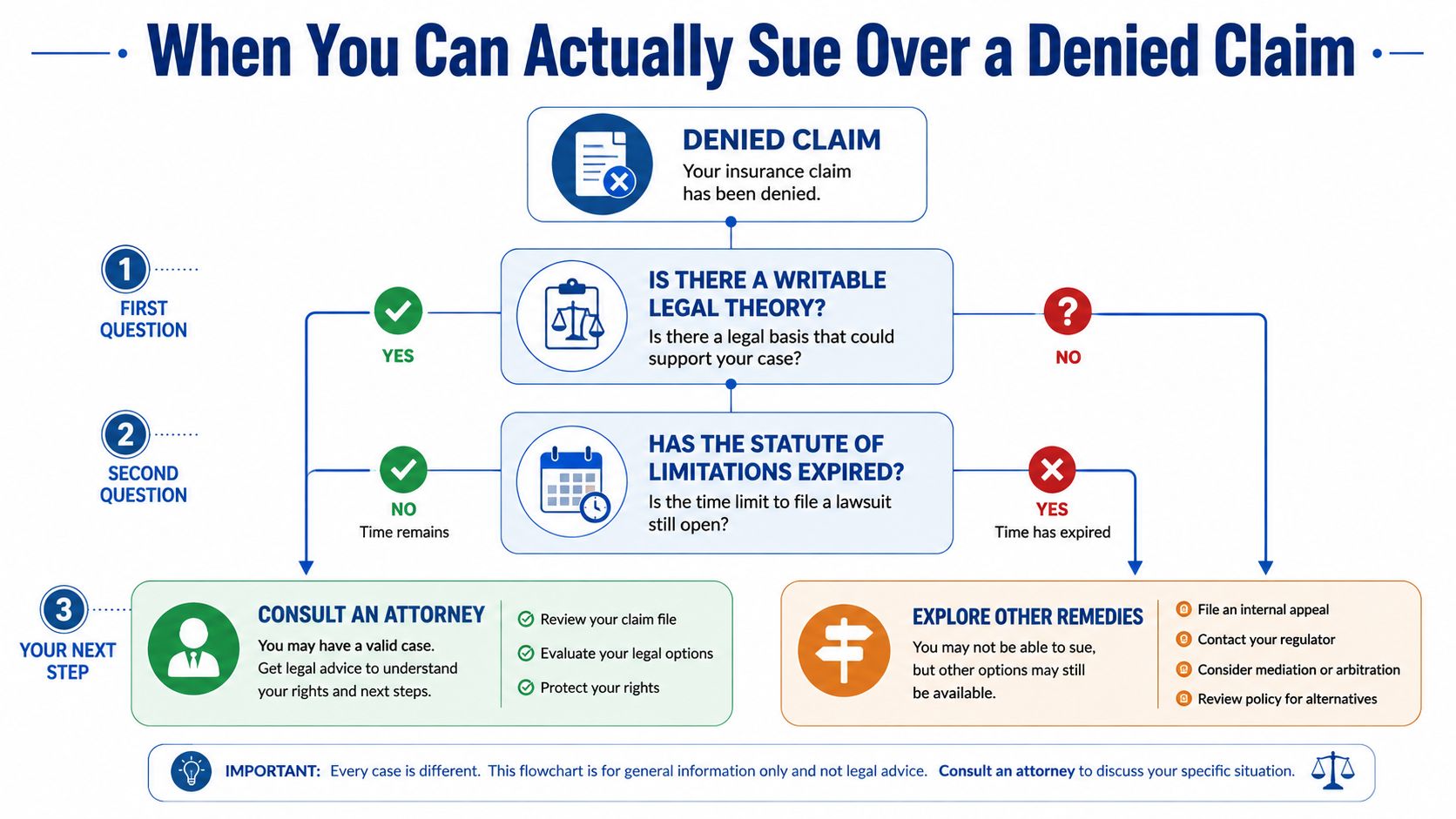
Practical rule: Don't let an internal appeal create false confidence. An appeal can improve the record, but it doesn't automatically extend every lawsuit deadline.
Consider a homeowner whose insurer pays for emergency drying but denies the remaining water-damage repairs as excluded leakage. The homeowner should obtain the full policy, identify the exact exclusion, compare it with the source and timing of the loss, gather the adjuster's estimate and photographs, and obtain an independent scope. If the evidence shows a sudden covered event and the insurer ignored it, the dispute may justify escalation. If the policy clearly excludes the loss, litigation may only increase cost.
The question isn't merely “Can you sue?” It's “What can you prove, what remedy fits, and what deadline controls?”
How the Right to Sue Insurers Became Mainstream
Insurance disputes weren't always treated as a broad fight over claim conduct. Historically, policyholders often approached a denial as a straightforward contract problem. The question was whether the policy required payment. If the insurer breached, the usual remedy centered on the benefits owed under the contract.
That changed as courts recognized that insurers occupy a special position when they evaluate claims from their own policyholders. The California Supreme Court recognized insurer bad-faith liability in 1958, in Comunale v. Traders & General Ins. Co. The court later expanded the doctrine to first-party fire insurance in 1973, in Gruenberg v. Aetna Ins. Co. These cases helped establish the principle that an insurer's obligations involve more than reading policy language narrowly. Claims must also be handled consistently with the duty of good faith and fair dealing. The historical development is summarized in the overview of insurance bad faith doctrine.
Why the shift matters to property owners
By the early 1980s, the theory had spread widely. A legal survey noted that when South Carolina addressed first-party bad-faith claims in Nichols v. State Farm in 1983, more than 25 states had already adopted the theory, as described in the same insurance bad-faith legal history. That milestone matters because it shows that suing over an unreasonable denial became a mainstream legal cause of action, not an exotic remedy reserved for unusual cases.
For a homeowner or business owner, the distinction is practical. A contract claim asks whether the policy required payment. A bad-faith claim asks whether the insurer had a reasonable basis, investigated fairly, considered the evidence, and acted in evaluating the loss. Depending on state law and the facts, that second theory can support remedies beyond the unpaid policy benefits.
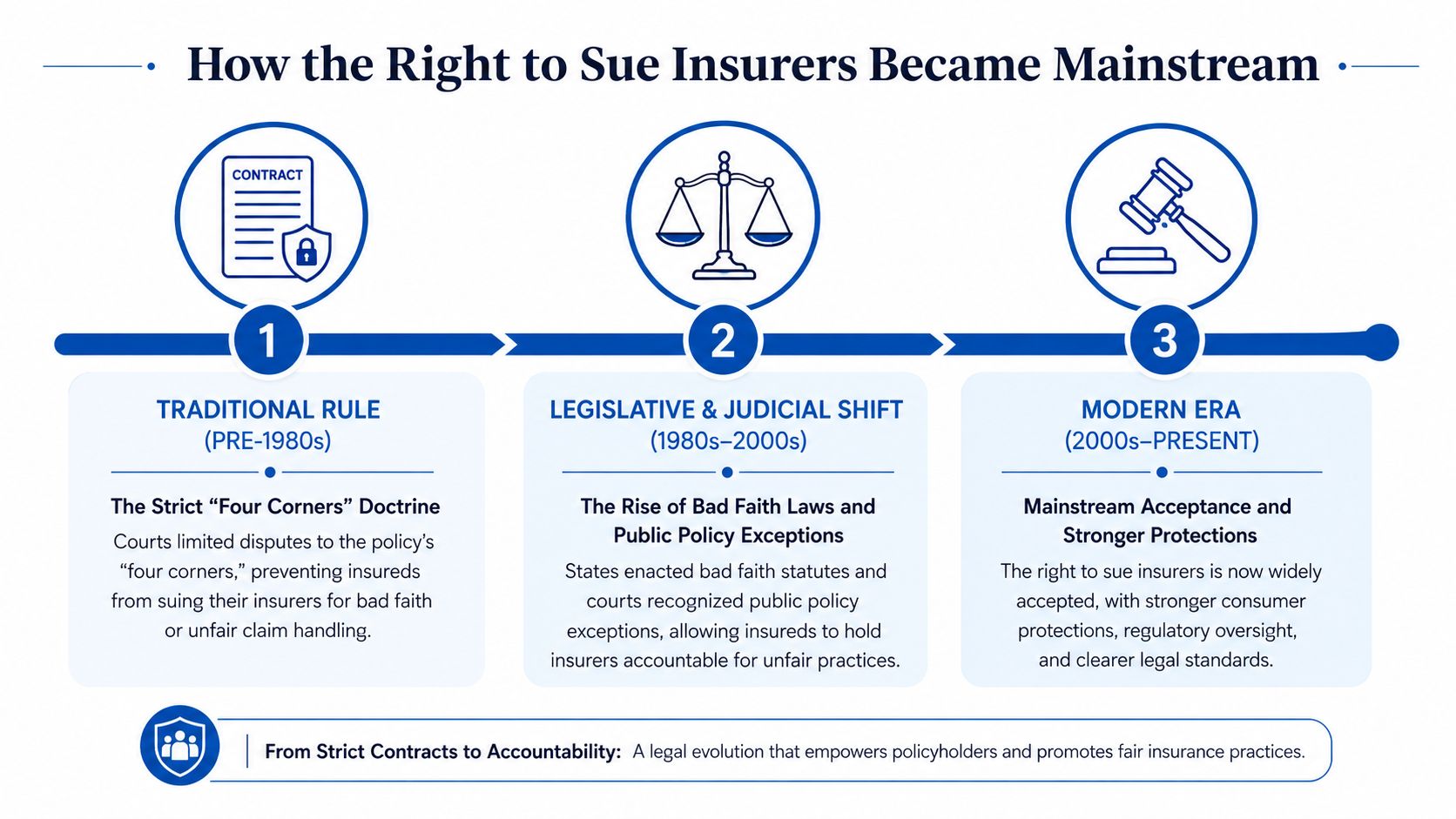
The history doesn't guarantee that a particular denial is actionable. Courts still examine the policy, the evidence, the insurer's reasoning, and the governing state law. But the legal framework gives policyholders a clear path to challenge more than a simple failure to pay when claim handling crosses into unreasonable or abusive conduct.
Legal Grounds You Can Bring Against an Insurer
A denied property claim may support several legal theories. Choose the theory based on what the policy requires, how the insurer handled the investigation, and what the governing state law allows. Treating every denial as bad faith weakens negotiations and can lead to unnecessary litigation costs.
Breach of contract
A breach-of-contract claim is usually the starting point. The policyholder generally must show a valid policy, a covered loss, compliance with relevant policy conditions, and the insurer's failure to pay the benefits the policy requires. The insurer may argue that an exclusion applies, the damage falls below the deductible, a policy condition was not met, or the claimed amount lacks support.
This route often fits a coverage or valuation mistake without proof of improper conduct. The dispute centers on what the policy covers and how much the insurer should have paid. Gather the policy, denial letter, estimates, photographs, invoices, and communications before demanding payment.
Bad faith
Bad faith requires proof beyond an incorrect coverage decision. The policyholder generally must show that the denial lacked a reasonable basis and that the insurer knew, or should have known, its position lacked support. Useful evidence can include ignored photographs, a one-sided investigation, unexplained changes in the denial reason, selective reliance on an engineer, or failure to address favorable policy language.
In North Carolina, a policyholder generally cannot win a standalone bad-faith claim just because the insurer denied the claim. The loss must first qualify as a valid, recognized covered loss. The policyholder must also prove bad faith and aggravating conduct, such as fraud, malice, or willful or wanton behavior, as explained in this North Carolina bad-faith claim analysis.
That distinction should control your strategy. A disputed scope estimate may call for a focused coverage demand or public-adjuster review. A carrier that ignores favorable evidence, changes its explanation, or refuses payment despite clear policy language may justify an attorney's assessment of bad-faith remedies. This guide to insurance bad faith in North Carolina provides further context on the state standard.
Statutory and procedural remedies
Some states recognize statutory remedies for unfair claims practices or consumer-protection violations. Depending on the claim and governing law, those remedies may include regulatory complaints, enhanced damages, attorney fees, or other statutory relief. A declaratory judgment action can also ask a court to interpret coverage before the parties calculate the full loss.
| Theory | What You Must Prove | Typical Damages | Best Used When |
|---|---|---|---|
| Breach of contract | Coverage, a valid loss, compliance with policy conditions, and nonpayment | Covered policy benefits and other contract remedies allowed by law | The insurer's coverage or valuation position is wrong |
| Bad faith | A covered loss, unreasonable handling, lack of reasonable basis, and any additional state-required misconduct | Contract benefits plus remedies permitted by applicable law | The investigation or denial shows a deliberate or reckless pattern |
| Statutory remedy | A qualifying violation under the governing statute and required underlying facts | Enhanced damages, fees, or other statutory relief where available | The insurer's conduct fits a specific statutory prohibition |
The practical rule is direct: a wrong denial supports a contract dispute; an unreasonable and aggravated denial may support something more. Before filing, match the evidence to the legal theory and compare the likely recovery with the cost of hiring counsel.
North Carolina and Virginia Compared
The same roof, fire, or water denial can produce different litigation risks in Raleigh and Richmond. State law controls the available theory, proof requirements, damages, and timing. Don't assume a result from another state applies to your property.
North Carolina
North Carolina sets a demanding standard for bad-faith litigation. A policyholder generally must establish a valid covered loss first, then prove bad faith and aggravating conduct such as fraud, malice, or willful or wanton behavior. A basic disagreement over whether a loss is covered may support contract damages without supporting a separate bad-faith recovery.
That distinction affects settlement strategy. If the insurer's estimate is plainly too low but its investigation was not outrageous, the practical fight may center on scope and value. If the carrier ignored evidence, shifted explanations, or refused payment despite knowing the policy covered the loss, the facts may justify a more aggressive legal demand.
Virginia
Virginia provides a more specific statutory remedy for certain motor-vehicle property damage, medical-expense, and income-loss claims. When a court finds the denial wasn't made in good faith, the insurer can owe double the judgment, interest beginning 30 days after written submission of the claim, and reasonable attorney fees and expenses, under Virginia Code § 8.01-66.1. Certain bad-faith uninsured or underinsured motorist exposures can reach double the underlying judgment, capped at $500,000, under the statute.
That specific statute isn't a general answer for every homeowner or commercial property dispute. Property owners need counsel to identify the correct Virginia theory and remedy rather than importing a motor-vehicle rule into a dwelling or business claim.
| Element | North Carolina | Virginia |
|---|---|---|
| Core starting point | Establish a valid covered loss | Establish the covered obligation and applicable statutory or common-law remedy |
| Bad-faith burden | Bad faith plus aggravating conduct is generally required | The available remedy depends heavily on claim type and statute |
| Extra-contractual recovery | May be available when the required misconduct is proven | Specific statutory enhancements may apply to qualifying claims |
| Practical focus | Policy language, ignored evidence, and aggravated conduct | Written submission, denial conduct, timing, and the governing remedy |
| Best first move | Build the coverage record before alleging bad faith | Identify the exact statutory or contractual path before demanding enhanced damages |
Treat broad internet summaries cautiously. Venue, procedural rules, mediation practice, and the jury's view of the insurer's conduct can affect the case, but no general prediction replaces a policy-specific review.
NFIP Flood Claims and Federal Court Deadlines
NFIP flood claims are different from ordinary homeowners claims. The Standard Flood Insurance Policy operates under federal rules, and a Write Your Own company or FEMA-related process can involve requirements that state-law property claims don't share.
The Proof of Loss comes first
For an NFIP claim, the policyholder generally must submit a signed Proof of Loss within 60 days of the loss, unless FEMA waives that requirement, according to the NFIP claims manual. The insured, not the adjuster, carries responsibility for submitting a complete and accurate document. A late, incomplete, or unsupported Proof of Loss can create a serious obstacle before a lawyer ever evaluates the merits.
Build the claim package while the evidence is available. Preserve the adjuster's report, photographs, measurements, elevation materials, contractor estimates, repair invoices, and records showing what floodwater damaged. Don't assume the flood adjuster's estimate is the final word.
Appeal and federal litigation are separate tracks
A written appeal to FEMA must be submitted within 60 days of the flood insurer's denial letter. FEMA's rules count the period starting the day after the letter date, include weekends and legal holidays, and move the deadline to the next business day when day 60 falls on a weekend or legal holiday, as explained in FEMA's flood-claim appeal form%20Static%20Fillable.pdf).
An appeal doesn't replace the lawsuit deadline. Under NFIP rules, the policyholder may sue in federal district court where the flood damage occurred within one year after the date the insurer first denied all or part of the claim in writing, according to this NFIP policyholder guidance.
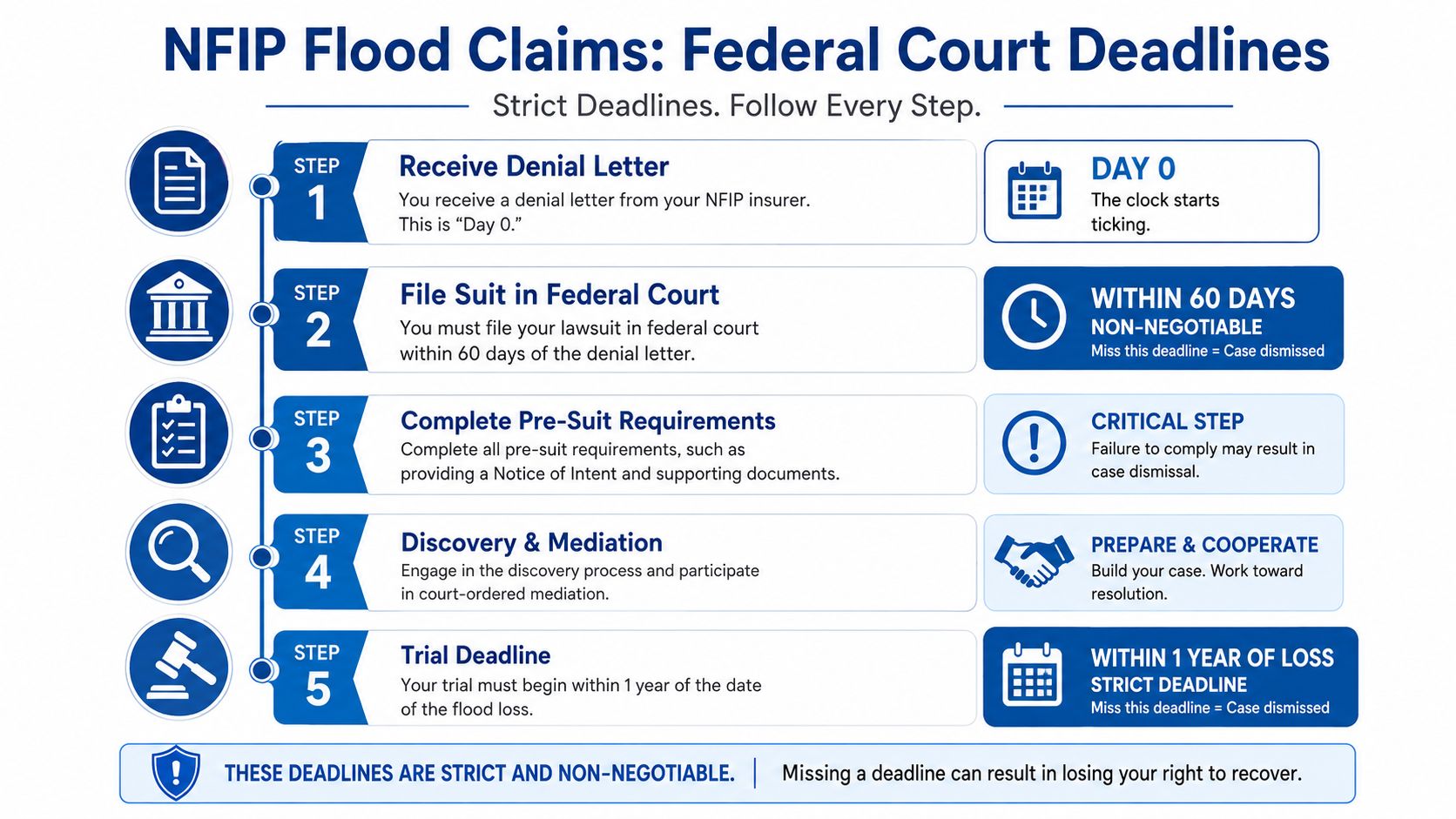
Flood claims punish delay. Calendar the Proof of Loss, appeal, and federal lawsuit deadlines separately.
Read the NFIP Proof of Loss deadline guidance before signing anything. Federal courts apply strict compliance standards, so an argument that might receive flexibility in an ordinary state-court property dispute may not rescue an NFIP claim.
Evidence and Documentation to Build Before Filing
A lawyer or public adjuster can't properly evaluate a denial from a few photographs and a frustrated phone call. The initial case review depends on a complete file that shows what the policy promised, what happened to the property, what the insurer did, and how the parties reached the disputed number.
Build the file in this order
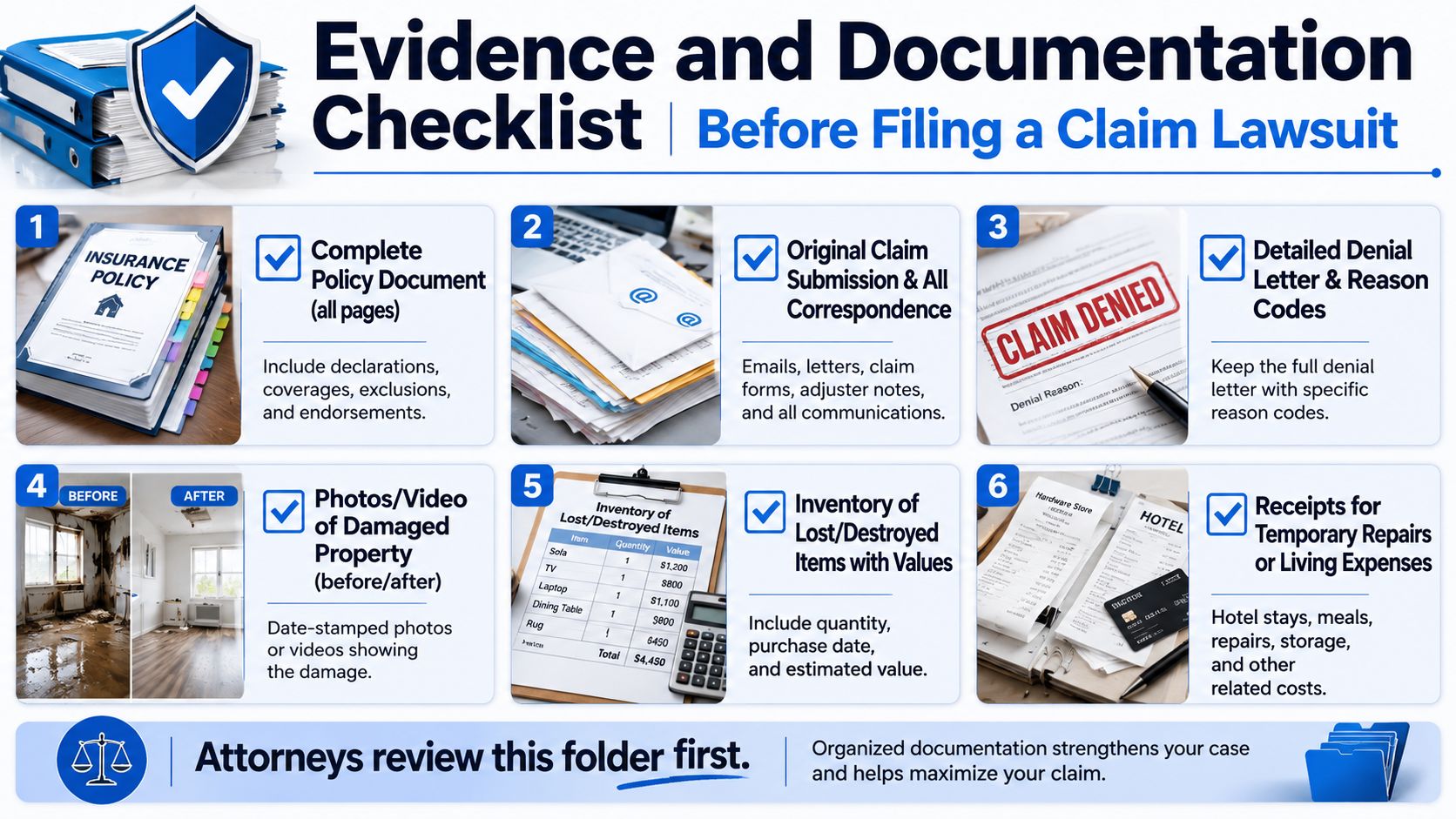
Collect the complete policy, including declarations, endorsements, exclusions, conditions, and amendments. Then preserve every denial, reservation-of-rights letter, estimate, inspection report, and communication with the carrier.
Your working file should include:
- Policy documents: Save every page, not only the declarations page.
- Claim correspondence: Keep letters, emails, texts, and portal messages in date order.
- Adjuster materials: Request the field estimate, photographs, diagrams, measurements, and reports provided to you.
- Independent evidence: Obtain contractor estimates, restoration scopes, engineer opinions, and other reports that address the cause and extent of damage.
- Damage inventory: List damaged contents, building components, and business property with descriptions and supporting values.
- Loss records: Preserve temporary repair receipts, additional living expense records, business interruption documents, and invoices.
Photographs and video should show the whole room or elevation as well as close views of damage. A contractor's estimate is more useful when it explains quantities, materials, code-related work, labor, access, and necessary demolition instead of presenting one unexplained total.
Preserve the communications trail
Create a log with the date, person contacted, method, subject, and promised follow-up. Save voicemails and confirmation emails. Ask in writing for the claim file and identify missing documents. If litigation appears likely, an attorney can advise on preservation requests and whether a litigation hold is appropriate.
Independent engineering or contractor evidence that directly contradicts the carrier's cause or scope usually creates more settlement strength than a larger pile of undifferentiated paperwork. Gaps in the file are a common reason counsel declines a case that might otherwise have had merit.
When to Hire a Public Adjuster or Attorney
Use the right professional for the dispute you have. A public adjuster is generally useful when the insurer accepts some responsibility but undervalues the scope, misapplies policy language, or fails to account for covered damage. The adjuster can inspect the property, prepare a detailed estimate, organize supporting documents, and negotiate with the carrier.
An attorney becomes more important when the insurer denies coverage outright, alleges fraud, threatens a coverage lawsuit, refuses to reconsider, or creates deadline pressure. Lawyers handle litigation, discovery, depositions, motions, and bad-faith theories. Most public adjusters don't take a claim through trial.
A contingency fee may be sensible for a substantial claim, but the percentage and expenses must be explained in writing. Hourly representation can make sense for targeted policy analysis, a demand, or a limited consultation. Don't choose based on the title alone. Choose based on the work needed.
| Factor | Public Adjuster | Insurance Attorney |
|---|---|---|
| Main role | Investigates, documents, estimates, and negotiates property damage | Advises on legal rights and prosecutes or defends litigation |
| Best dispute | Scope, valuation, damage documentation, and underpayment | Coverage denial, deadline risk, bad faith, and court action |
| Day-to-day work | Inspections, estimates, inventories, carrier communications | Legal research, demands, pleadings, discovery, negotiation, and trial preparation |
| Payment structure | Often contingency-based, subject to written agreement | Contingency, hourly, or another agreed structure |
| Litigation authority | Usually cannot represent you in court as your lawyer | Can file and litigate the civil action |
A public adjuster can be the better first call when the carrier's number is the problem. A lawyer is the better call when the insurer says it owes nothing or when extra-contractual damages may matter. For a fuller breakdown of that decision, see this guide on when to hire a lawyer for a home insurance claim.
Practical Next Steps After a Denial
Read the denial letter line by line. Circle every policy clause, exclusion, factual conclusion, and request for information. Those statements define the issues you must answer, and the insurer may later rely on the letter to defend its position.
Send a written appeal or demand with the missing evidence. Ask for the complete claim file, including the adjuster's notes, estimates, photographs, and expert reports. Keep the communication factual, organized, and dated.
Use this short action list:
- Calendar deadlines: Record the denial date, policy deadline, appeal deadline, and any applicable lawsuit deadline.
- Preserve evidence: Photograph unrepaired damage where safe, save communications, and retain invoices.
- Get an independent scope: Ask a qualified contractor or public adjuster to explain what the carrier omitted.
- Match facts to policy language: Respond to each denial reason separately.
- Escalate intelligently: Consider a public adjuster for valuation disputes and an attorney for coverage, bad-faith, or deadline issues.
For roof-damage documentation and contractor-related claim guidance, homeowners may also find this resource on roofing claim guidance in Concord useful. Don't make repairs that destroy important evidence without recording the condition first, unless emergency work is necessary to protect people or property.
Your paper trail may become the most important exhibit in the case. Start it now, not after the insurer files an answer.
For The Public Adjusters, Inc. reviews denied, delayed, and underpaid homeowner and commercial property claims, then helps document damage, interpret coverage, prepare dispute packages, and negotiate with the insurance company. Visit For The Public Adjusters, Inc. for claim assistance across North Carolina and Virginia. Have your water damage claim questions answered at NO COST. Call 919-400-6440 to speak with a licensed Public Insurance Adjuster or Contact Us here with questions. WE Work For YOU… NOT Your Insurance Company!