
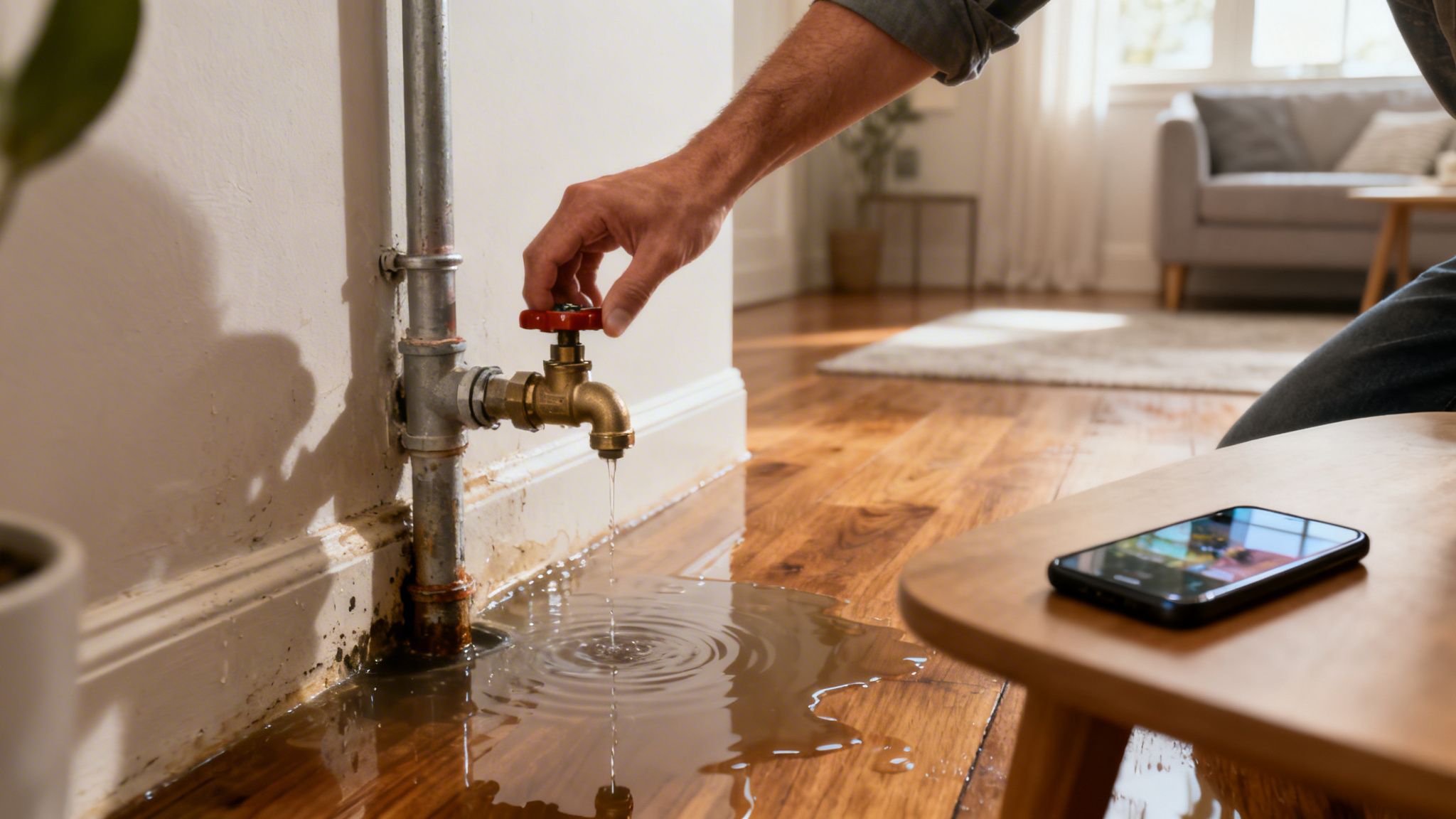
Nothing prepares you for the shock of a burst pipe water damage disaster. One minute everything is fine, the next you have a waterfall in your living room. Your first moves are everything. You have to take control and start building your case before you even think about dialing your insurance company's 800 number.
What you do in that first hour will determine whether you get a fair settlement or a low-ball offer that leaves you paying out of pocket.
What to Do When a Burst Pipe Floods Your Home
Panic is a normal reaction when water is pouring into your home. But insurance carriers like Allstate and State Farm are counting on that chaos. They want you disoriented so they can steer you toward their "preferred vendors"—contractors who work for them and have a vested interest in minimizing the scope (and cost) of your repairs.
Don't fall for it. Your job is to stop the damage and protect your claim. First things first: get the water off. Now. Find your main water shut-off valve and turn it. Every second you hesitate is another square foot of soaked drywall and ruined flooring.
Your First Moves vs Your Insurer's Playbook
There's a massive difference between the steps you should take to protect your home and your claim, and what your insurance company wants you to do. They have a playbook designed to control the situation and minimize their payout from the very first call.
Here’s a look at how their script differs from your best-interest action plan.
| Your Proactive First Steps | What Your Insurer Wants You to Do (and Why) |
|---|---|
| Shut off the main water supply. This is your #1 priority to stop more damage. | Call them first. They want to control the narrative and send their "approved" plumber, who may downplay the cause or severity. |
| Call an independent, trusted plumber. You need an unbiased expert who works for YOU to find and document the pipe failure. | Use their "Preferred Vendor." This contractor's loyalty is to the insurer, not you. Their job is often to find the cheapest, not the best, fix. |
| Document EVERYTHING. Take tons of videos and photos of the leak, the standing water, and all damaged items. This is your proof. | Wait for their adjuster. They want to be the first ones to document the scene, allowing them to frame the loss in a way that benefits them. |
| Begin immediate water removal. Start getting standing water out with buckets, a shop vac, or mops to prevent further saturation. | "Just wait and we'll take care of it." Delaying cleanup allows more damage to set in, which they might later argue is your fault for "failing to mitigate." |
This table isn't just a guide; it's your defense strategy. By taking these proactive steps, you seize control from the insurance company and start building a powerful, undeniable claim from day one.

A Problem More Common Than You Think
A pipe bursting isn't some freak accident. It happens to about 14,000 people every single day across the U.S. These are one of the most common—and expensive—headaches a homeowner can face.
The Insurance Information Institute crunched the numbers and found the average claim for water damage or freezing between 2017 and 2021 was a staggering $12,514. It’s the third-most frequent reason people file property insurance claims.
Of course, prevention is always the best policy. Knowing how to spot a hidden water leak can save you from a catastrophe down the road. And since frozen pipes are a huge culprit, especially here in NC and VA, check out our guide on what to do when you have a frozen pipe and need a plumber.
Why Your Insurer Will Low-Ball Your Water Damage Claim
When you’re standing in a soaked home after a pipe bursts, you have to face a hard truth: your insurance company is not your friend. It’s a for-profit business, and its first duty is to its shareholders, not you.
This isn't just business; it's a direct conflict of interest. Every single dollar they pay you to fix your home is a dollar that comes straight out of their profits. This reality has built a culture of minimizing payouts, and they have a playbook to do it.
The Adjuster Works for Them, Not You
Your insurer will send out an adjuster—either a "staff" employee or a supposedly "independent" contractor—and act like they're a neutral expert. Don't believe it for a second. That adjuster is paid by the insurance company, trained by them, and their career often depends on how much money they save the company on claims just like yours.
Their loyalty is crystal clear. They aren't there to meticulously find every bit of damage. They’re there to find every reason to pay you as little as possible.
Common Tactics to Deny or Underpay Your Claim
Big insurance carriers like State Farm and Allstate are masters at twisting your policy language against you. The moment you report a burst pipe, they start searching for an escape hatch—any loophole that justifies a denial or a ridiculously low offer.
Here are some of the most common excuses we see every day:
- “Gradual Leakage”: This is a classic. They'll insist the pipe was leaking for weeks or months, even when the final failure was sudden and catastrophic. Most policies exclude long-term, slow leaks, and they know it.
- “Wear and Tear” or “Corrosion”: They’ll point to a bit of rust and argue the pipe failed simply because it was old. This is a maintenance issue, they’ll say, making it your problem. But a sudden burst from a corroded pipe is exactly the kind of event that should be covered.
- “Pre-Existing Damage”: The adjuster might find an old water stain in a closet and try to claim your current, widespread damage was already there before the pipe even broke.
These aren't just hypotheticals. In one Arkansas case, Sims v. State Farm Fire & Cas. Co., State Farm successfully used a laundry list of exclusions to deny a claim—arguing everything from gradual leaks and corrosion to water from a pipe under a slab touching soil. It’s a brutal example of the gap between their "good neighbor" ads and their courtroom strategies.
These arguments are designed to make you feel overwhelmed and hopeless, pressuring you to just take whatever scraps they offer first. They are betting you don't know the fine print of your own policy.
The Deliberately Low Estimate
Even when they do approve the claim, the adjuster’s initial estimate will almost certainly be a fraction of what it actually costs to make you whole again. They do this by systematically undervaluing and omitting huge chunks of the restoration work.
This is happening in a massive industry. Water damage restoration services are on track to become an $11.14 billion global market by 2025, and burst pipes are a major part of that. Knowing this, insurers routinely deny 20-30% of these claims right out of the gate, often with those flimsy "wear and tear" excuses.
Here’s how their adjusters cook the books on your estimate:
- They ignore hidden moisture festering behind your walls and under your floors.
- They price out cheap, builder-grade materials instead of matching the quality of your home.
- They conveniently forget the cost of mold remediation, a serious health risk after any water disaster.
- They calculate a low-ball "actual cash value" for your ruined property instead of what it truly costs to replace it. You can see exactly how they manipulate this figure by reading our guide on actual cash value in our detailed article.
This entire playbook is designed to save them a fortune at your expense. Without an expert on your side who knows these games, you’re walking into a fight you're not equipped to win.
Building an Undeniable Claim Your Insurer Cannot Ignore
If you want to fight your insurer’s low-ball offer for burst pipe damage, you have to change your mindset. Stop being a victim and start thinking like a prosecutor building a case. Your insurance company has a stable of experts whose entire job is to pay you as little as possible. To win, you need to build a case so airtight it leaves them no wiggle room to defend their pitiful numbers.
This means you have to document every single detail of your loss with obsessive precision. Their adjuster will do a quick, superficial walkthrough. Your job is to go deeper, creating your own exhaustive "scope of loss" that is so thorough it's simply undeniable. This document is your single most powerful weapon.
Create a Detailed Inventory of Damaged Property
The company adjuster will probably glance at your ruined belongings and plug in some generic, depreciated value. This is a classic low-ball tactic. You have to shut this down by creating a detailed inventory of everything that was damaged or destroyed.
Don't just write down "couch" or "TV." That's what they want you to do. Get specific.
- For electronics: Note the brand, model number, serial number, and the year you bought it.
- For furniture: Document the manufacturer, the material (is it solid oak or cheap particle board?), and where you purchased it.
- For personal items: List clothing brands, books, and anything else of value. Don't leave anything out.
For every single item, find the current replacement cost. Don't guess. Go online, find the exact item or a direct comparable, and save a screenshot of the price. If you have the original receipts or credit card statements, even better—include copies. This is the hard work that stops them from pretending your high-end leather sofa has the same value as a college kid's futon.
Document the Hidden Structural Damage
Here’s one of the company adjuster’s favorite tricks: ignore what they can’t immediately see. They write estimates based only on the obvious water stains, conveniently "forgetting" that water travels, soaks, and hides. After a major pipe burst, the worst damage is almost always lurking behind your walls, under the floors, and in the ceiling.
You have to document this hidden damage to force your insurer to pay for a complete and safe repair. Your own investigation needs to include:
- Saturated Insulation: Once insulation gets wet, it’s useless and becomes a perfect breeding ground for mold. It must be torn out and replaced, not just "dried."
- Warped Subflooring: Plywood or OSB subfloors will swell, warp, and lose their structural integrity when they get soaked. You can't just throw new carpet on top; the subfloor has to be replaced.
- Compromised Electrical Systems: Water inside walls can short out wiring and outlets, creating a major fire hazard. You need an electrician to inspect the system.
- Swollen Drywall and Framing: Waterlogged drywall and wooden studs get soft, weak, and must be cut out well beyond the visible water line to remove all moisture.
Get a moisture meter and take pictures of the readings in these hidden areas. This is the kind of hard evidence that proves the damage is far more extensive than the insurance company wants to admit.
Takeaway: Your insurer only pays for what you can prove. By creating a detailed inventory and documenting all the hidden damage with photos, videos, and professional assessments, you build a "Proof of Loss" document that backs up the real value of your claim. It changes the game from their opinion versus yours to your hard evidence versus their flimsy excuses. To learn more about this critical document, you can read our guide on mastering the Proof of Loss form.
Get Your Own Independent Repair Estimates
Never, ever rely on the insurer's "preferred vendor" or accept their repair estimate at face value. The contractor they send you works for them, not you. It's no coincidence that their estimate will magically align with the low-ball number the adjuster wants to pay.
You need to hire your own trusted, independent contractors to write estimates. And you must insist that their estimates are incredibly detailed and itemized. A vague proposal that just says "Repair bathroom – $15,000" is worthless. A powerful estimate breaks down the cost line by line, including:
- The cost of all materials, specifying quality and brand.
- Labor hours and the rates for each trade (plumber, electrician, drywaller, painter).
- All costs for necessary permits and debris removal.
- A line item for contingency to cover unforeseen issues.
When you present two or three of these detailed estimates from your own experts, you expose just how inadequate the insurer's offer is. This is how you build a strong foundation for negotiating the true cost to make you whole. This is how you turn the tables and force them to pay what you're rightfully owed.
How a Public Adjuster Fought a Denied Burst Pipe Claim

It’s one thing to talk about insurance companies trying to low-ball or deny claims. It's another thing to see a successful fight in action. When your home is on the line, results are the only thing that matters.
This case study from right here in North Carolina shows you exactly how a completely denied burst pipe water damage claim was turned around with an expert on the policyholder's side.
A family came home from vacation to an absolute nightmare. While they were away, a pipe in an upstairs bathroom had burst, flooding the home. Water poured through the ceiling, ran down the inside of their walls, and pooled all over their main floor.
They filed their claim, and their national insurance carrier sent out their adjuster. After a quick walk-through, he delivered the worst possible news: the claim was denied. Flat out.
The insurance company's excuse? They blamed it on a "long-term leakage" exclusion in the policy. It’s a classic move. They claimed the pipe must have been seeping for a while, making it a maintenance issue—the homeowner’s problem, not theirs. Facing a denied claim and tens of thousands in repairs, the family called us.
How We Reversed the Denial
The moment we took the case, we knew the company adjuster's conclusion was based on an assumption, not evidence. Our entire job was to prove it. We had to build a case based on undeniable facts that showed this was a sudden and accidental loss, which is absolutely a covered event.
Here's the playbook we used to systematically tear down their denial:
- Brought in a Real Expert: First things first, we hired a licensed, independent plumber to perform a forensic exam of the broken pipe. His expert report was crystal clear: the pipe had failed in a catastrophic burst, not a slow leak. This directly demolished the insurance company's entire reason for denying the claim.
- Found the Hidden Damage: The company adjuster’s quick visual tour missed the real story. We brought in thermal imaging cameras, which immediately revealed huge pockets of trapped moisture inside the walls and under the floors—damage that was completely invisible. This proved the water intrusion was far more severe than the insurer wanted to admit.
- Wrote the Real Scope of Loss: We tossed the insurer’s faulty assessment and built a new, comprehensive scope of loss from the ground up. We documented everything, with line-item estimates for tearing out all the saturated materials, the proper protocols for mold remediation, and the true cost to replace finishes with materials of like kind and quality.
Forcing the Insurance Company to Pay
Armed with a mountain of fresh evidence—the plumber’s expert report, thermal imaging proof, and a meticulously detailed scope of work—we officially challenged the denial. The proof was so overwhelming they had no choice but to reopen the claim.
But the fight wasn't over. The tide had turned. We went into negotiations not begging for help, but from a position of power, ready to pick apart their adjuster's flawed report piece by piece.
The result was a complete reversal. The final settlement we secured for the family covered 100% of the repairs, including all the hidden water damage. It paid for the full mold remediation and covered the family’s temporary living expenses while their home was being rebuilt. It shows the power of having an advocate who knows the insurer's playbook and exactly how to beat them at their own game.
This experience isn't unique. We see it all the time, and so do our clients.
When this client says we got them "EVERYTHING" and handled the entire process, it shows what a public adjuster really does. We turn a stressful, losing battle into a successful recovery so you can actually rebuild your life.
Your Guide to Disputing an Unfair Settlement Offer

The settlement offer from your insurance company finally arrives. You open it, and your stomach drops. The number is a fraction of what your contractors said it would cost to fix everything—a slap in the face after the chaos your family has been through.
Let me be clear: this isn't a simple mistake. It’s a calculated business strategy. Big carriers like Allstate and State Farm are counting on you being too exhausted, stressed, and overwhelmed to put up a fight.
This is where the real battle for your burst pipe water damage recovery starts. It’s not about shouting at an adjuster over the phone. It's about building a professional, evidence-backed case they can't ignore.
Draft a Formal Dispute Letter
Your first move is to formally reject that low-ball offer in writing. I can't stress this enough: do not cash that check. Cashing it can be seen as a full and final settlement, legally killing your chances to get another dime.
Instead, you need to send a formal dispute letter. This isn't an angry email; it's a professional document sent via certified mail to create a paper trail.
In your letter, you need to state a few things very clearly:
- You are formally rejecting their offer and the amount provided.
- The specific reasons why, pointing out where their estimate falls short—missed repairs, undervalued materials, or ignored hidden damage.
- That you are providing your own detailed evidence, including your independent repair estimates.
- That you expect a revised, fair settlement that actually covers the true cost of making you whole again.
From this point on, keep everything in writing. If an adjuster calls you, be polite but firm: "Please send me that question in an email." This simple step stops them from making verbal promises they can—and will—deny ever making.
Invoke the Appraisal Clause in Your Policy
If the insurance company agrees certain things need to be fixed but you're miles apart on the cost, you have a powerful tool buried in your policy: the appraisal clause. It’s one of the most effective weapons a policyholder has, yet most people have no idea it exists.
Invoking appraisal takes the negotiation out of the company adjuster's hands and moves it to a more neutral, arbitration-style process. Here’s a rundown of how it works:
- You hire your own appraiser. This is an independent expert who will assess the damage and calculate the real-world cost to repair it.
- The insurer hires their own appraiser. They'll get their own "expert" to create a competing valuation.
- The two appraisers negotiate. Their job is to hash it out and try to agree on the total amount of the loss.
- An umpire steps in if needed. If the two appraisers can’t agree, they select a neutral third-party umpire. An agreement between any two of the three—your appraiser and the umpire, for instance—becomes binding.
This process forces the insurer to defend their cheap estimate against a true industry professional, not just an overwhelmed homeowner. It's often much faster and less expensive than a full-blown lawsuit.
CRITICAL: Appraisal is a technical, formal process. To win, you need an appraiser with deep experience in both construction and insurance claims. This is exactly what an expert public adjuster brings to the table.
Why a Public Adjuster Is Your Strongest Ally
When you're facing a dispute, you might think about calling a contractor or an attorney. While both can be helpful, only a public adjuster is an expert in the entire insurance claim process from start to finish.
Let's break down the roles:
- Contractors: They are masters of building and repairs. They can write you a solid estimate, but they can't legally negotiate your claim or interpret policy language for you.
- Attorneys: They are your last resort. You need one if you plan to sue the insurance company for acting in bad faith, but litigation is a long, expensive, and draining process.
- Public Adjusters: We are licensed insurance experts who work only for you, the policyholder. A public adjuster takes over the entire fight—re-documenting the damage, handling all communications, invoking appraisal, and negotiating directly with the carrier.
We take the burden completely off your shoulders. We speak their language, use their software, and know all the tactics they use to underpay. Our job is to force them to honor the policy you've been paying for, making sure you get every dollar needed to put your home back together after a devastating burst pipe.
Common Questions About Burst Pipe Claim Disputes
When you’re trying to fight your insurance company over a burst pipe water damage claim, it’s easy to feel lost. The whole process is confusing on purpose, and it's designed to give the insurer the upper hand. Let's tackle some of the biggest questions homeowners have when they're up against an unfair settlement or outright denial.
My Insurer Blamed 'Wear and Tear' for the Burst Pipe. Can I Fight This?
Yes. And you absolutely should. This is one of the oldest and most dishonest denial tactics in the book.
A sudden and accidental pipe burst is a covered event in nearly every homeowner's policy, and it doesn't matter how old the pipe was. The insurance company has to prove the damage came from a slow, long-term leak—not just a pipe that suddenly gave way.
Think about it. All building materials get older. Blaming a burst pipe on its age is like denying a storm damage claim because your roof shingles weren't brand new. It's a ridiculous argument meant to scare you into walking away.
A public adjuster knows exactly how to shut down this excuse. We bring in an independent, licensed plumber or even a metallurgical engineer to analyze the pipe. Their expert report gives us the hard evidence to prove the failure was sudden, which is the key to getting a "wear and tear" denial overturned.
The Insurance Company's Estimate Is Thousands Lower Than My Contractor's. What Now?
First, do not even think about accepting their number. This isn't a simple math error; it's a deliberate low-ball offer.
The adjuster from your insurance company is working with a manufactured number. They often use old pricing data, spec out cheap materials, and conveniently leave out entire steps required for a proper repair. Their estimate is built to save them money, not to make you whole.
Your job is to formally send your contractor’s detailed, line-item estimate to your insurer in writing. Then, you must demand they provide a point-by-point written explanation for every single difference between their offer and your contractor's price.
This is the fight a public adjuster was made for. We dig into both estimates, find every omission and incorrect price using the same Xactimate software they use, and force them to account for the real cost of putting your home back together. We beat them at their own game.
How Much Does a Public Adjuster Cost for a Burst Pipe Claim?
This is a fair question, and the answer is why hiring a public adjuster is a completely risk-free decision for any homeowner. Legitimate public adjusters, like our firm, work on a contingency fee basis.
What does that mean? You pay us absolutely nothing upfront. No retainers. No hourly bills. No out-of-pocket costs at all. We only get paid a small, agreed-upon percentage of the final settlement money after we win it for you.
- If your claim was denied and we get it paid, our fee is paid from that new settlement money.
- If we take your low-ball offer and get it increased, our fee is paid from the extra money we recover.
- If for some reason we can’t get you a recovery, you owe us absolutely nothing.
This setup guarantees our goals are perfectly aligned with yours. We have one job: get you the largest possible settlement from your insurance company. Your first consultation and claim review are always 100% free, so you have nothing to lose by finding out how we can help.
When you're facing a denied or underpaid claim, you don't have to fight the insurance company alone. At For The Public Adjusters, Inc., we take on the entire burden, from documenting the loss to negotiating the final settlement, so you can focus on rebuilding. If you're struggling with a burst pipe water damage claim in North Carolina or Virginia, contact us today for a free, no-obligation claim review at https://forthepublicadjusters.com.


Trackbacks/Pingbacks