Tree Damage Claim Denied: What Happened and What You Need to Know
A tree damage claim denied by an insurer doesn’t have to be the final word — and one North Carolina homeowner proved exactly that. After a large oak fell during a storm and crushed a significant portion of their roof and attached garage, the insurer refused to pay, alleging the tree was already diseased before the storm ever hit. The homeowner pushed back, hired the right experts, and ultimately received a full claim settlement.
Key takeaways
- A tree damage claim denied on ‘pre-existing disease’ grounds can often be overturned if a certified arborist documents that wind force — not decay — was the primary cause of structural failure.
- Insurers may cite visible fungal growth or dead limbs to deny claims, but these signs do not automatically prove the tree would have fallen without the storm event.
- A certified arborist’s written report is the single most powerful piece of evidence a homeowner can obtain after a tree damage claim denial.
- North Carolina homeowners have the right to formally dispute a claim denial and submit independent expert evidence before accepting the insurer’s final decision.
- Acting quickly after storm damage preserves critical physical evidence — delays allow decomposition and cleanup to erase the proof needed to challenge a denial.
The Setup: A Fallen Oak and a Surprise Denial
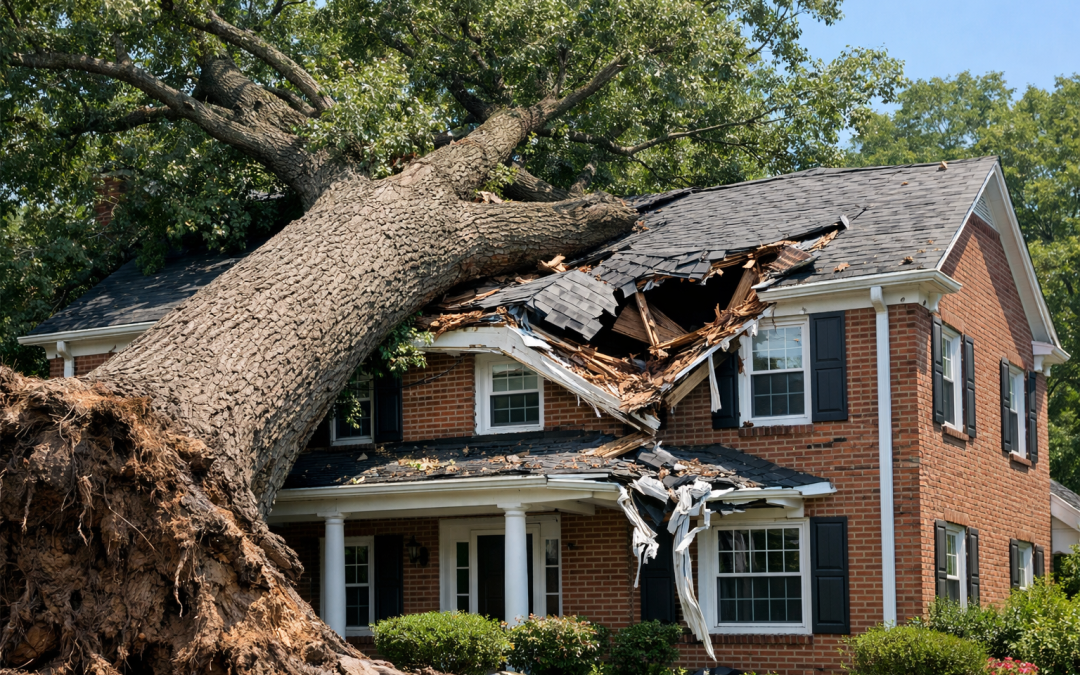
The storm came through overnight. By morning, a mature oak that had stood in the homeowner’s yard for decades had come down hard across the roofline, punching through the sheathing, cracking rafters, and partially collapsing one wall of the garage. The damage was visible, severe, and clearly connected to the storm event.
When the homeowner filed a claim, they expected the process to be straightforward. The tree fell during a named storm. The damage was documented. Their policy covered wind and storm events. What they didn’t expect was a denial letter citing “pre-existing disease” in the tree — language that essentially shifted blame away from the storm and placed it on a condition the insurer claimed existed long before the weather event.
Why the Denial Felt Wrong — and Why It Probably Was
Here’s the core problem with that denial: insurers sometimes use vague language about tree health as a blanket reason to avoid paying storm-related structural claims. But a tree falling during a storm is not automatically evidence that the tree was diseased or that the homeowner was negligent. Wind events can fell healthy trees too.
The homeowner recognized something important early on:
- The insurer’s adjuster spent very little time inspecting the actual tree
- No certified arborist was brought in by the insurer to formally assess tree health
- The denial letter used general, non-specific language about decay without citing any documented evidence
- The policy language on “pre-existing conditions” was being applied in a way that stretched its intended meaning
How the Claim Was Eventually Paid in Full
The homeowner refused to accept the denial and took three critical steps: they hired a certified arborist to conduct an independent inspection of the fallen tree, they brought in a public adjuster to formally challenge the insurer’s findings, and they requested a detailed explanation of exactly which policy language supported the denial. That combination — professional documentation, policy-level scrutiny, and persistent advocacy — is what ultimately reversed the outcome.
If you’ve had a similar experience, you’re not alone, and you likely have more options than you realize. The sections below walk through each part of this case in detail — including what the arborist actually found, how the dispute process worked, and what steps you should take right now if your own tree damage claim was denied.
Why Do Insurers Claim a Tree Was Already Diseased Before a Storm — and How Does It Lead to a Tree Damage Claim Denied?
Insurers use a “pre-existing condition” defense to deny tree damage claims by arguing the tree was already weakened by disease or decay before the storm hit — meaning, in their view, the storm didn’t truly cause the loss. This shifts financial responsibility onto the homeowner by reframing a storm event as the inevitable result of a maintenance problem you supposedly should have addressed.
What Is the Pre-Existing Condition Defense?
Most standard homeowners policies cover sudden and accidental losses — including storm damage from wind, lightning, and fallen trees. However, they typically exclude damage caused by neglect or deterioration. When a large tree falls on your roof during a storm, your insurer may send an adjuster who looks not at the storm, but at the tree itself. If that adjuster spots anything that could be interpreted as disease, rot, or prior decay, the company may claim the tree was already a hazard and that it would have fallen eventually — storm or no storm.
This is a powerful and frequently used argument because it moves the conversation away from the storm event and toward your behavior as a homeowner. The implication is that you knew — or should have known — the tree was dying and failed to remove it. Once that narrative is in place, the insurer has a basis to deny the claim entirely or drastically reduce any payout.
How Do Adjusters Identify — and Misidentify — Tree Disease?
Insurance adjusters are not arborists. Yet after a major storm, they are often the first and sometimes only professionals to assess a fallen tree. Some of the signs they look for include:
- Discoloration or fungal growth on the trunk or root flare
- Hollow sections or soft wood at the base
- Dead branches in the upper canopy
- Bark abnormalities such as deep cracks or missing patches
- Root damage or soil heaving near the base
The problem is that many of these signs are ambiguous. Fungal growth, for example, can appear on a structurally sound tree. Dead branches in the canopy are common in otherwise healthy trees, especially older hardwoods. An adjuster without specialized training can easily mistake normal aging or surface-level cosmetic issues for deep structural decay that would have caused a fall regardless of the storm.
Why This Argument Is So Effective at Shifting the Burden
Once an insurer plants the seed of pre-existing disease, the burden effectively falls on you — the homeowner — to prove otherwise. You are no longer simply filing a storm claim. You are now defending your tree maintenance history, your awareness of the tree’s condition, and your judgment as a property owner. Without expert documentation to counter the adjuster’s assessment, many homeowners accept the denial or a lowball settlement simply because they don’t know how to fight back. Understanding what not to say to a storm claim adjuster during the initial inspection can also be critical — certain offhand remarks about the tree’s appearance before the storm can inadvertently reinforce the insurer’s narrative.
What Did the Certified Arborist’s Report Actually Prove in This Tree Damage Claim Denied Case?
The certified arborist’s report proved that the tree failed because of acute storm-force wind loading, not pre-existing disease. By documenting specific physical evidence — including intact root systems, clean fiber fractures, and failure patterns consistent with sudden mechanical stress — the arborist gave the homeowner concrete, expert testimony that directly contradicted the insurer’s denial rationale.
Why the Insurer’s “Pre-Existing Decay” Argument Fell Apart
When the carrier denied the claim, their adjuster pointed to what they described as signs of decay visible in post-storm photographs. The problem with that conclusion is that surface-level visual inspection by a non-specialist is not the same as a scientific assessment of the tree’s structural condition at the time of the storm. A licensed arborist brings a completely different level of analysis to the table.
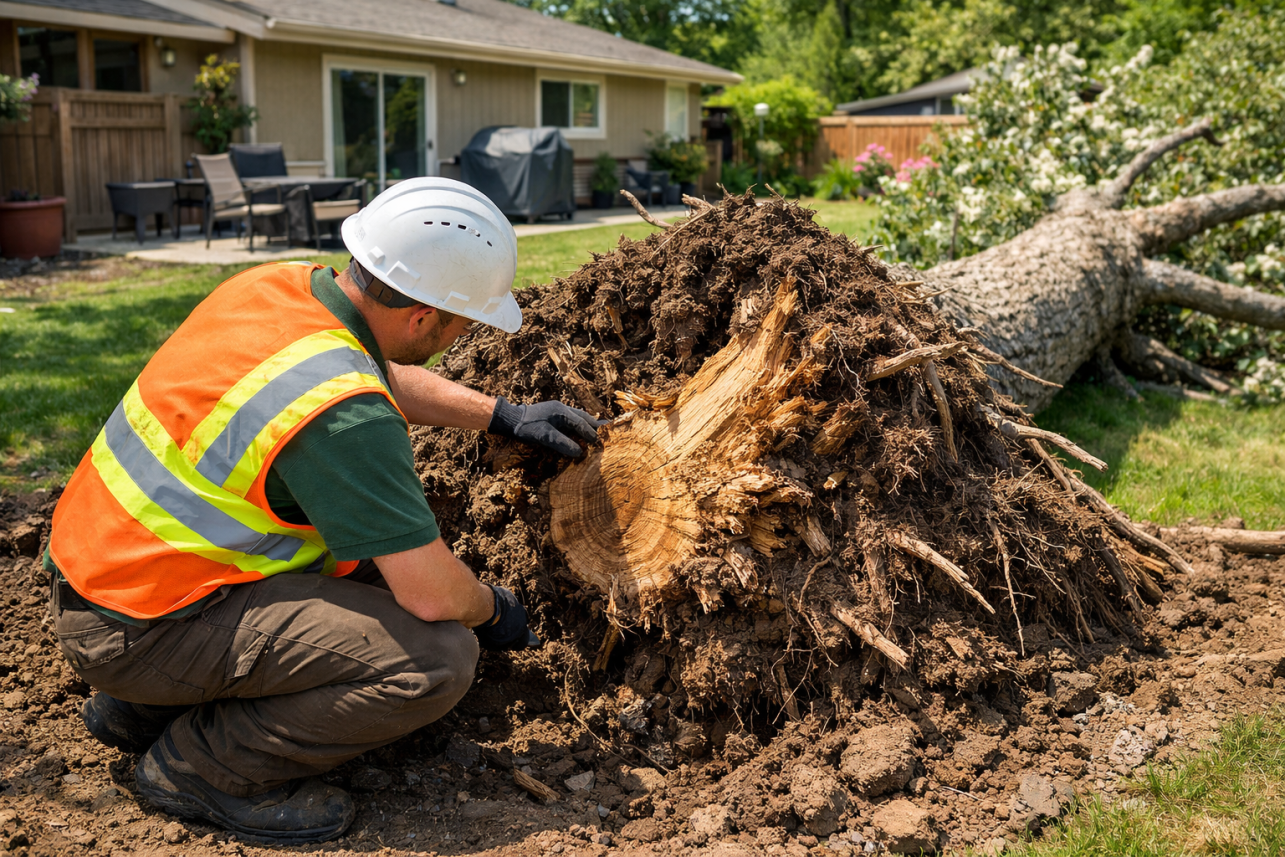
In this case, the arborist conducted an on-site examination of the fallen tree, the root ball, and the surrounding soil before any debris was removed. That timing mattered. Here is what the report actually documented:
- Wind-load failure patterns: The fracture point on the trunk showed a classic wind-throw break — a sudden, lateral shear failure at the base rather than the gradual collapse pattern associated with internal rot or structural decay over time.
- Root system integrity: The root ball, when examined after the tree fell, showed healthy lateral roots that had been mechanically pulled from the soil. Decayed root systems typically disintegrate or show soft, discolored tissue. These roots were firm, white at the core, and structurally sound.
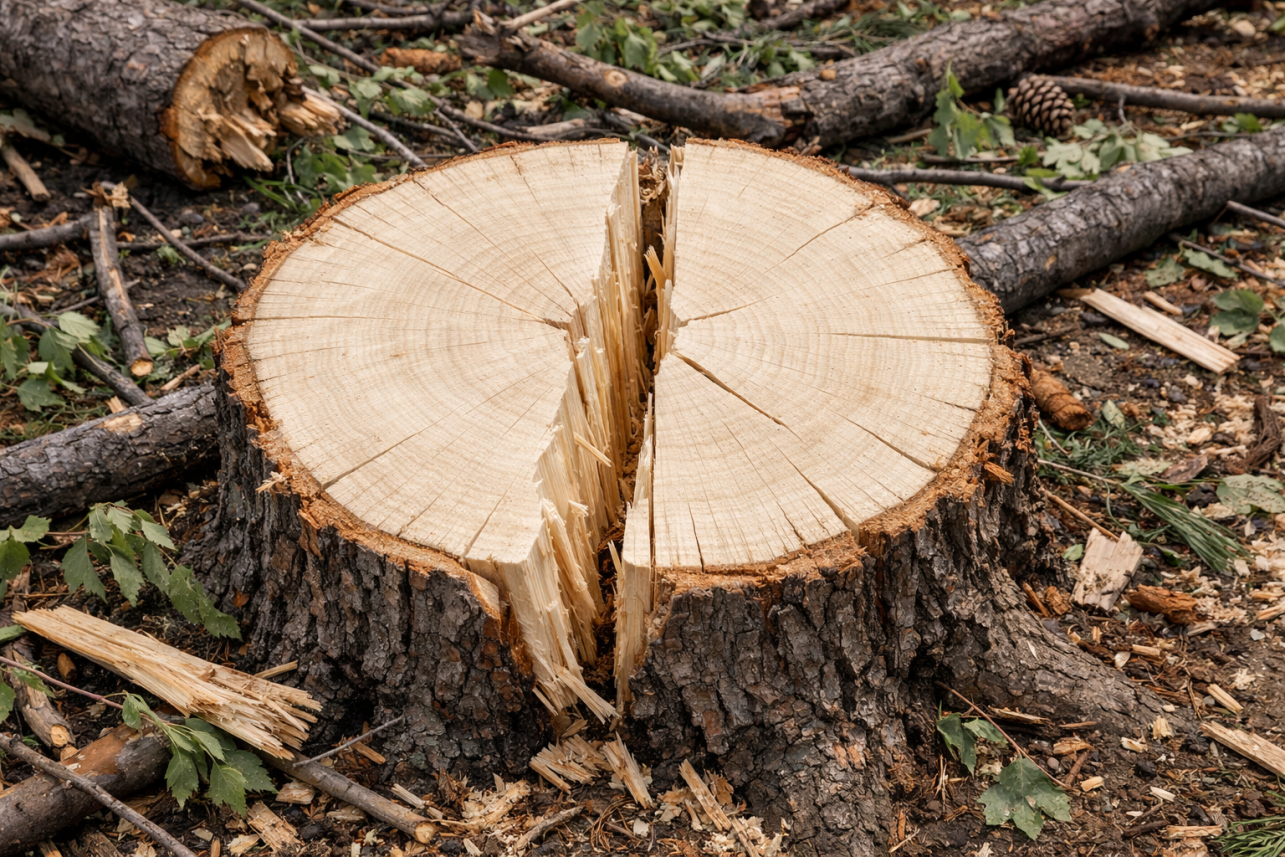
- Fiber damage consistent with acute stress: Inside the trunk at the failure point, the wood fibers were bright and intact — not darkened, punky, or hollowed out. The arborist noted that internal decay severe enough to cause failure without storm force would have left unmistakable evidence in the wood grain and cellular structure.
How This Evidence Dismantled the Carrier’s Position
Insurance carriers often rely on the assumption that homeowners cannot produce expert-level evidence to counter a denial. When an arborist with professional credentials submits a written report that methodically addresses each point the insurer raised — using recognized industry standards for tree risk assessment — it fundamentally changes the dynamic of the dispute.
In this case, the arborist’s findings were consistent with a tree that was alive and structurally sound before the storm and failed solely because wind forces exceeded what any healthy tree of that species and size could reasonably withstand in those conditions. That distinction — between storm causation and pre-existing condition — is exactly what the policy language hinged on, and it is exactly what the report proved.
If your tree damage claim was denied on similar grounds, an independent arborist assessment is often the single most powerful piece of evidence you can obtain.

What Happens When a Tree Damage Claim Denied Goes to Dispute? A Real Court Case
When a tree damage claim denied by an insurer goes to dispute, courts have repeatedly sided with homeowners — provided the evidence shows wind or another covered peril was the proximate cause of the loss. Insurers who rely solely on a tree’s prior condition to deny a claim often face an uphill legal battle, because policy language and case precedent both require more than that.
The Legal Standard: Proximate Cause Matters Most
In insurance disputes involving falling trees, courts across North Carolina and the broader United States have applied the proximate cause doctrine. This means the question is not simply whether a tree was weakened or diseased — it is whether the covered peril (such as wind) was the dominant, direct cause that set the loss in motion. If a storm triggered the fall, the fact that a tree had underlying decay does not automatically eliminate coverage.
North Carolina follows what is known as the efficient proximate cause rule in many property insurance contexts. Under this framework, when a covered cause — like a windstorm — initiates a chain of events that results in damage, the insurer generally cannot escape liability simply by pointing to a contributing non-covered condition such as disease or rot.
How Courts Have Ruled Against Insurers on Similar Arguments
While every case turns on its specific facts and policy language, courts in multiple jurisdictions have rejected insurer arguments that closely mirror the tactics homeowners commonly face. Key patterns in these rulings include:
-
- Disease alone is not a defense. Courts have held that an insurer must demonstrate the diseased condition — not the storm — was the proximate cause of the damage. Showing a tree had decay is not enough on its own.
- Maintenance exclusions must be clearly written. When policy exclusions for “neglect” or “lack of maintenance” are ambiguous, courts typically construe them in favor of the policyholder, not the insurer.
- The burden of proof shifts. Once a homeowner demonstrates a covered peril occurred, the burden often shifts to the insurer to prove an exclusion clearly and specifically applies.
- Expert testimony carries weight. Courts have given significant weight to certified arborist reports that document a tree’s pre-storm structural integrity, directly undermining insurer claims of obvious prior decline.
Why This Matters for Your Denied Claim
Understanding this legal landscape means a denial is not necessarily the final word. If your insurer is arguing that your tree was already compromised before the storm, that argument has been tested in court — and it has failed when homeowners presented solid evidence. A tree damage claim denied on those grounds may be ripe for appeal, appraisal, or litigation, especially when supported by qualified expert opinion.
How Can a Public Adjuster Help If Your Tree Damage Claim Denied?
A public adjuster helps reverse a tree damage claim denied by doing the work most homeowners cannot do alone: gathering physical evidence, coordinating independent experts, dissecting policy language, and negotiating directly with the carrier from a position of documented strength. In this North Carolina homeowner’s case, that combination turned a flat denial into a full payout.
Step One: Independent Evidence Gathering Before Anything Gets Cleaned Up
The moment a public adjuster gets involved, the priority is preserving evidence. Insurance companies send their own adjusters quickly — often before a homeowner fully understands what they are agreeing to. A public adjuster works on the homeowner’s behalf to document everything first, including:
- Detailed photographs and measurements of the impact zone, root system, and structural damage
- Weather data and storm reports tied to the exact date and location of the incident
- Samples or observations of the tree’s internal wood condition at the point of failure
- Contractor assessments of the structural damage that the carrier’s adjuster may have undervalued
Step Two: Coordinating Expert Witnesses the Carrier Has to Reckon With
When an insurer claims a tree was pre-diseased, they are usually relying on their own internal review or a cursory visual inspection. A public adjuster knows which experts carry weight in a dispute. In this case, that meant bringing in a certified arborist who could produce a written report addressing the specific criteria insurers use to argue pre-existing decay — things like the presence of fungal conks, cavity formation, or root plate failure patterns. That report gave the claim a factual foundation the carrier could not dismiss without contradicting qualified expert testimony.
Step Three: Policy Language Analysis That Most Homeowners Miss
Homeowners insurance policies are written in dense, layered language. Public adjusters read these documents the way attorneys read contracts — looking for coverage triggers, exclusion carve-outs, and definitions that shift the burden of proof. Many denials lean on vague exclusionary language that does not actually apply once the specific facts of the loss are lined up against the exact policy wording. Identifying that gap is often where a tree damage claim denied begins to unravel for the insurer.
Step Four: Carrier Negotiation With a Complete Claim Package
Rather than calling the insurance company to argue, a public adjuster submits a structured, documented demand that includes the expert report, photographic evidence, repair estimates, and a written policy interpretation. This is not a conversation — it is a counter-position the carrier must formally respond to. In this homeowner’s case, that package covered both tree removal costs and full structural repair to the damaged roof and wall framing, categories the original denial had rejected entirely.
What Should You Do Right Now If Your Tree Damage Claim Denied?
If your tree damage claim was denied, act quickly and methodically: preserve all physical evidence, request the written denial letter, halt any cleanup that could erase proof, hire a certified arborist to document the tree’s condition, and contact a licensed public adjuster before your state’s claim dispute deadline passes.
Getting a denial notice in the mail is frustrating, but it is not the end of the road. Virginia and North Carolina homeowners have specific rights to challenge an insurer’s decision — and the steps you take in the first few days after a denial can make or break your case. Here is exactly what to do.
1. Stop All Cleanup and Preserve Your Evidence
Before you hire anyone to haul away debris or repair the damaged area, document everything thoroughly. Courts and mediators rely heavily on physical evidence, and once a tree is removed or a roof is patched, that evidence is gone permanently.
- Take dated photographs and video of the fallen tree, the point of failure, and all structural damage from multiple angles.
- Photograph the root ball, the trunk cross-section, and any visible decay, fungus, or pest damage — this becomes critical if the insurer claims pre-existing disease.
- Save any limbs or trunk sections that show the interior wood until an arborist has inspected them.
- Keep copies of weather reports, radar screenshots, or National Weather Service alerts for the date of the storm, as these establish the triggering event.
2. Request the Full Written Denial Letter
Your insurer is required to provide a written explanation of why your tree damage claim was denied. Read it carefully. Note the specific policy language cited and the exact reason given — whether it is a claim of pre-existing disease, lack of sudden loss, or a policy exclusion. This language tells you and any expert you hire exactly what must be rebutted.
3. Hire a Certified Arborist Immediately
An independent evaluation from an arborist certified by the International Society of Arboriculture (ISA) carries significant weight in disputes. Ask the arborist to issue a written report that addresses the specific cause of failure and whether any disease or structural weakness was visible or detectable before the storm event.
4. Know Your Dispute Rights in Virginia and North Carolina
Both Virginia and North Carolina have state insurance regulations that give policyholders the right to request an internal appeal and, in many cases, an independent appraisal. The National Association of Insurance Commissioners (NAIC) maintains consumer guidance on policyholder rights that applies broadly across states. Check your denial letter for appeal deadlines — missing them can permanently close your options.
5. Contact a Licensed Public Adjuster Before the Deadline
A public adjuster works exclusively for you — not the insurance company — and is licensed by the state to negotiate claims on your behalf. They can review your policy, identify coverage language the insurer may have misapplied, coordinate expert reports, and present a documented rebuttal before your appeal window closes. Reaching out early gives a public adjuster the maximum time to build a strong case on your behalf.
Quick Action Checklist
- ✅ Stop cleanup — preserve the scene as-is
- ✅ Photograph and video all damage from every angle
- ✅ Save weather service records for the storm date
- ✅ Request your written denial letter if not already received
- ✅ Retain a certified ISA arborist for an independent report
- ✅ Note your appeal and statute of limitations deadlines
- ✅ Contact a licensed public adjuster in Virginia or North Carolina as soon as possible
Tree Damage Claim Denied vs. Approved: Key Differences in How Claims Are Handled
| Factor | Claim Denied (Insurer’s Argument) | Claim Approved (Homeowner’s Counter-Evidence) |
|---|---|---|
| Cause of Failure | Pre-existing disease or decay made fall inevitable | Certified arborist confirms wind event as primary cause of structural failure |
| Tree Condition Evidence | Visible fungal growth or dead branches cited | Arborist report distinguishes cosmetic decay from load-bearing structural integrity |
| Documentation Presented | Adjuster’s field notes and photos only | Independent arborist report, storm data, and meteorological records |
| Outcome | Homeowner absorbs removal and repair costs | Carrier pays full removal, repair, or replacement costs per policy terms |
| Timeline | Denial issued after single adjuster visit | Dispute resolved after formal appeal with supporting expert documentation |
Illustrative Example: How One Homeowner Challenged a Denial and Prevailed
Illustrative example
Consider a hypothetical Northern North Carolina homeowner whose large oak tree fell across their roof during a severe thunderstorm, causing significant structural damage. The insurer’s adjuster denied the claim, pointing to visible bracket fungus near the tree’s base as evidence of pre-existing disease that made the fall inevitable regardless of weather. The homeowner hired a certified arborist, who documented through core sampling and biomechanical analysis that the tree’s primary load-bearing structure remained intact prior to the storm, and that the recorded wind speeds that evening were consistent with causing sudden stem failure even in a healthy specimen.
Armed with this written expert report and local meteorological data, the homeowner filed a formal appeal, and the carrier ultimately reversed its denial and covered the full cost of tree removal and roof repair. This type of outcome illustrates why independent expert documentation — obtained quickly before evidence is lost — can be the deciding factor in a contested tree damage claim.
Frequently asked questions
My tree damage claim was denied because the insurer said the tree was diseased — what can I do?
Don’t accept the denial as final. Request the insurer’s written explanation and the specific policy language they’re relying on. Then hire a certified arborist (look for ISA certification) to inspect the tree and document whether the primary cause of failure was the wind event rather than pre-existing decay. An arborist’s written report can distinguish between incidental disease and structural failure caused by storm forces, which is often the evidence needed to challenge a denial and reopen the claim.
Does homeowners insurance typically cover tree removal and property repair after a storm?
Most standard homeowners policies cover damage that a fallen tree causes to a covered structure, such as your home, fence, or garage. Coverage for tree removal alone — when the tree falls but doesn’t hit a structure — is more limited and varies by policy. Always read your declarations page and policy exclusions carefully, and ask your insurer specifically what triggered the denial so you know exactly what you’re disputing.
What does a certified arborist’s report actually include, and why does it matter for a claim dispute?
A certified arborist’s report typically documents the tree’s species, overall health history, root and trunk condition, and the likely sequence of events that led to failure. Crucially, it can distinguish between a tree that fell primarily because of high winds or saturated soil versus one that failed mainly due to advanced internal decay. Insurers often rely on general observations about disease to deny claims, but a detailed professional report with photographs and technical analysis gives you credible, third-party evidence to counter that position during an appeal or appraisal process.
If my claim is denied, what formal options do I have besides just resubmitting documentation?
You have several options. First, file a formal written appeal with your insurer citing the new arborist evidence. If that fails, most policies include an appraisal or arbitration clause that lets both sides bring in neutral evaluators to resolve disputes without going to court. You can also file a complaint with your state’s Department of Insurance if you believe the denial was unreasonable or made in bad faith. Consulting a public adjuster or an attorney who handles insurance disputes is worth considering if the repair and removal costs are significant.
Related local pages
- Public Adjuster Cary NC: Navigating Insurance Claims When Insurance Companies Leave You Holding The Bill
- Public Adjuster Garner NC — Fight for the Full Settlement You Deserve
- Public Adjuster Holly Springs NC — Fight For The Full Settlement You Deserve
Had your tree damage claim denied in North Carolina? Don’t accept the insurer’s decision as final. Contact our team today for a free claim review — we fight to get you every dollar you’re owed. Get in touch.
Last updated: July 12, 2026