You opened the mail, skimmed past the policy jargon, and landed on the sentence that mattered. Denied. After the leak, the tear-out, the soaked drywall, the ruined flooring, and the stress, the carrier is now telling you the damage somehow isn't their problem.
I'm going to be blunt. A denied water claim isn't always the end of the claim. A lot of the time, it's the moment the actual fight starts. Carriers know many homeowners will feel overwhelmed, accept the denial, or say the wrong thing on the next call. That's what you can't afford to do.
If your claim for water damage denied situation involves a homeowners policy, dwelling policy, or business owner property policy, you need a strategy, not more frustration. The right evidence, the right wording, and the right escalation can change the outcome.
Table of Contents
- Your Water Damage Claim Was Denied Now What
- Unmasking the Insurers Playbook Common Denial Reasons
- Build Your Case An Evidence Checklist for a Denied Claim
- The Denial Appeal Workflow How to Fight Back
- When to Call for Backup Public Adjusters vs Attorneys
- Special Rules for NC VA and NFIP Flood Claims
- Stop Being a Victim Take Control of Your Claim
Your Water Damage Claim Was Denied Now What
The denial letter usually lands when you're already stretched thin. Maybe a pipe let go behind a wall. Maybe an appliance line failed and soaked cabinets, baseboards, and flooring. You reported it thinking your policy would respond, then the carrier came back with words like “seepage,” “maintenance,” or “excluded water.”
That punch to the gut is real.

Water losses get intense scrutiny because they're common and expensive. Water damage and freezing made up nearly 24% of all U.S. homeowners insurance claims in 2021, with an average household claim of about $12,514 from 2017 to 2021, according to ConsumerAffairs' summary of Insurance Information Institute data. When even one claim can involve five-figure repairs, carriers look hard for reasons to narrow, reduce, or deny.
What the denial really means
A denial is the carrier's position. It is not the final truth.
In practice, a lot of denied water claims turn on proof. Can you show the source? Can you show timing? Can you show the damage was sudden and accidental instead of gradual? Can you show you acted quickly to protect the property? If the answer becomes yes, the claim can move.
Practical rule: Don't answer a denial with anger. Answer it with evidence, policy language, and a timeline.
I tell homeowners to treat the first denial letter like a roadmap to the carrier's weak spots. Every sentence in that letter tells you what they think you can't prove. That gives us our target.
Don't make the next mistake
The next mistake is usually one of these:
- Talking too much on a recorded call and guessing about cause
- Throwing away damaged materials before they're documented
- Starting repairs without preserving proof
- Missing another deadline while waiting for the insurer to “reconsider informally”
If part of your water loss also involved roof entry, it can help to understand how carriers analyze related building-envelope issues. This expert guide to Colorado roof claims gives useful context on documentation and insurer dispute points that often overlap with interior water-loss fights.
You don't need to beg the insurer to be fair. You need to build a file they can't casually dismiss.
Unmasking the Insurers Playbook Common Denial Reasons
Most denied water claims aren't denied with a dramatic accusation. They're denied with bland, technical phrases that sound objective. That's the playbook. Dress up a disputed judgment as if it were a settled fact.

One point matters more than homeowners realize. Claims are frequently denied for procedural reasons, not just financial ones. The most common triggers include late reporting, failure to prove the damage was sudden, and insufficient documentation of the loss, as explained in this guidance on why water damage claims may be denied.
They say it was gradual, not sudden
This is one of the carrier's favorite positions. If they can frame the loss as long-term seepage, repeated leakage, or neglected deterioration, they shift the damage away from covered accidental discharge and toward maintenance.
That doesn't mean they're right. It means they're choosing the category that helps them.
Look at what they relied on:
- Visible staining or rot: They'll argue age proves duration.
- Corrosion on plumbing parts: They'll imply the event developed over time.
- No obvious puddle when inspected later: They'll use the delay against you.
- General wear nearby: They'll bundle unrelated conditions into one denial.
They blame maintenance
“Lack of maintenance” is broad enough to be useful to them and vague enough to frustrate you. If the carrier says you should have caught the problem earlier, they're trying to turn a covered event into homeowner neglect.
Your answer has to be specific. Show inspection history, service calls, prior repairs, and the condition of the system before the loss. If the issue involved roof penetrations, vent boots, or flashing details, technical construction context matters. This roof penetration flashing guide is a solid reference for understanding how water can enter around roof components and why source identification can get complicated fast.
They use your words against you
This happens every day. A homeowner says, “My house flooded,” meaning there was a lot of water inside. The carrier hears “flood,” tags the file with an excluded peril issue, and the fight gets harder.
Don't give the insurer labels. Give them observations. “Water came through the ceiling below the bathroom.” “The supply line failed under the sink.” “Water entered near the window during the storm.”
They hide behind exclusions and deadlines
A denial letter often stacks arguments. Maybe they say the loss was excluded, but also say you reported late, failed to mitigate, or didn't document enough. That's not accidental. They want multiple fallback positions.
Here's the smarter way to read that letter:
| Insurer argument | What it usually means | Your response |
|---|---|---|
| Gradual seepage | They think source timing is weak | Get plumber or contractor findings on sudden failure |
| Lack of maintenance | They're shifting blame to you | Produce upkeep records and condition evidence |
| Late notice | They want prejudice from delay | Build a date-by-date timeline immediately |
| Exclusion applies | They think cause is misclassified | Match facts to the policy wording carefully |
When your claim for water damage denied letter uses fuzzy language, don't accept the fuzziness. Force the issue into documented facts.
Build Your Case An Evidence Checklist for a Denied Claim
You won't overturn a denial with a heated phone call. You overturn it with a file that is organized, technical, and hard to argue with.
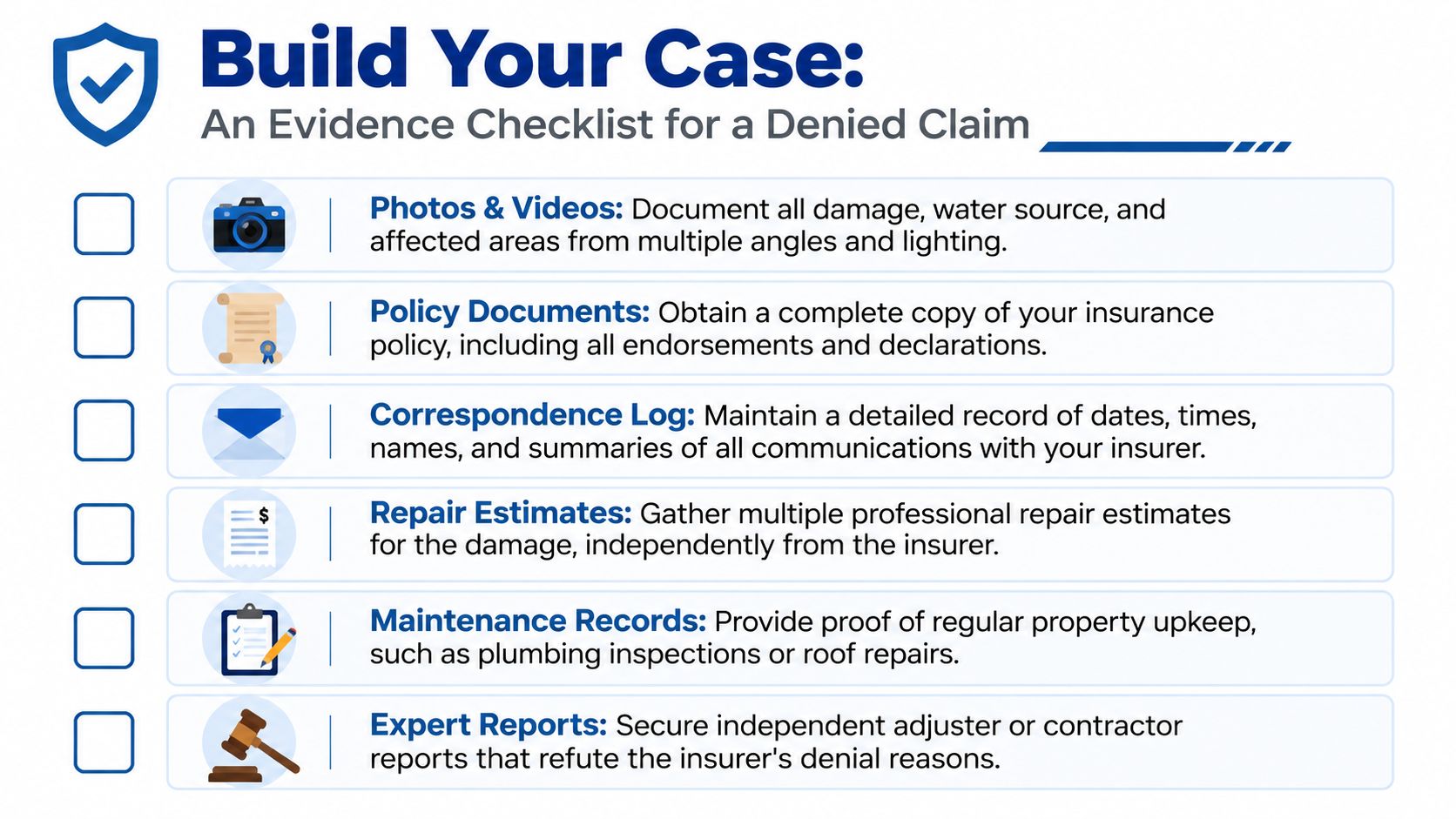
The strongest recovery files don't rely on one kind of proof. They combine images, measurements, reports, policy analysis, and chronology. That matters because one documented case study showed a denied water claim with an initial offer of $11,000 later settled for $37,300, a 239% increase, after detailed moisture diagnostics and documentation aligned with IICRC S500 standards were used, as reported in this water damage claim case study.
What belongs in your evidence file
Start with the basics, but don't stop there.
- Photos and video with timestamps: Capture the source area, damaged finishes, removed materials, and any standing water or staining. Wide shots matter. Close-ups matter more than people think.
- A complete policy set: Get the declarations page, full form, endorsements, and any water-related add-ons. Denials often hinge on endorsement wording.
- A communication log: Track dates, adjuster names, what was requested, what was promised, and what was said about cause.
- Repair and mitigation records: Keep invoices, emergency dry-out paperwork, plumber notes, and receipts for anything you bought to limit damage.
- Maintenance records: Prior plumbing service, roof work, appliance replacement, or inspections can help neutralize neglect arguments.
The evidence most homeowners miss
The carrier may have already built its position around limited observations. That's why independent technical evidence can change the claim.
Consider adding:
- Moisture mapping to show spread and affected materials
- Thermal imaging to identify hidden moisture patterns
- Air-quality or related testing when conditions justify it
- A licensed plumber or contractor report that speaks directly to cause and timeline
- A room-by-room damage inventory tied to the source event
Field advice: If the denial says “insufficient documentation,” treat that as an invitation to overwhelm the file with organized proof.
A lot of homeowners also underestimate finish damage. Flooring, trim, cabinets, and subfloor conditions often tell the story of direction, duration, and severity. If wood floors are involved, this resource on repairing water damage to wood floors can help you understand what professionals look for when evaluating cupping, staining, and material response.
Organize it like you're preparing for cross-examination
Don't dump a pile of PDFs on the carrier. Build sections.
- Section A: Denial letter
- Section B: Policy excerpts tied to the denial points
- Section C: Chronology of events
- Section D: Photos and videos
- Section E: Expert reports
- Section F: Estimates and invoices
- Section G: Maintenance and prior condition records
That structure does two things. It makes your appeal easier to read, and it makes it harder for the adjuster to pretend you didn't address a point.
The Denial Appeal Workflow How to Fight Back
You need a formal process now. Not another casual call. Not another message asking for an update. A real appeal package.

Step one is matching every denial reason to proof
Read the denial line by line. Underline each reason. Then answer each one with a document, photo set, contractor report, or policy provision. If the letter gives three reasons, your appeal should have three direct rebuttal sections.
Use this format:
- Carrier reason stated in the denial
- Why that conclusion is disputed
- Evidence attached
- Policy wording that supports reconsideration
- Your requested action
That keeps emotion out of the center of the file. Good. Emotion doesn't win this part. Precision does.
Use firm language in your appeal letter
You don't need to sound aggressive. You need to sound controlled.
Here's clean language you can adapt:
I am requesting formal reconsideration of the denial of my water damage claim. The denial relies on conclusions regarding cause, timing, and coverage that are not supported by the attached documentation. Enclosed are photographs, expert findings, repair records, mitigation documents, and relevant policy provisions that address each stated reason for denial.
Then get specific.
The denial states the damage resulted from a long-term condition. The attached plumbing findings and moisture documentation support a sudden discharge and resulting damage pattern. Please review the enclosed materials and provide a written coverage position after reconsideration.
Build a timeline and hold them to it
Your appeal package should include a simple timeline:
- date loss discovered
- date source identified
- date emergency action taken
- date reported
- date inspection occurred
- date denial issued
- date appeal submitted
Then ask for a written response. If you need a stronger framework, this guide on how to appeal an insurance claim denial lays out the process in practical terms.
Escalation is part of the workflow
If the carrier ignores evidence, delays, or repeats the same denial language without addressing your submissions, escalate. That can include:
- Supervisor review
- A written request for the basis of denial
- A complaint to your state Department of Insurance
- Bringing in a public adjuster to reframe the entire file
A denial appeal should read like a rebuttal brief, not a plea for sympathy.
The biggest mistake here is sending an appeal that says, “I disagree.” That's weak. Your appeal needs to say, in substance, “Here is why your denial is unsupported, and here is the documentation that requires a new decision.”
When to Call for Backup Public Adjusters vs Attorneys
Some claims can be fixed by the homeowner with a disciplined appeal. Others are too technical, too large, or too tangled in policy language. That's when you stop trying to outlast the carrier on your own.
A public adjuster fixes the claim before it becomes a lawsuit problem
A public adjuster's role is practical. Re-inspect the loss. Analyze coverage. Document the full scope. Build the estimate. Negotiate with the carrier. In water claims, that matters because cause classification is often where the file went sideways.
A major pitfall is mislabeling the event. Using the word “flood” for a burst pipe can trigger an immediate denial, while an expert report can correctly identify the cause as a covered “sudden and accidental discharge,” as explained in this Investopedia guide on home insurance water damage claims.
That's why public adjusters often help most when:
- The denial cites exclusions
- The cause of loss is disputed
- The scope of repairs is incomplete
- The carrier says the damage is old, gradual, or preventable
- You're tired of getting nowhere with desk adjusters
If you want a straightforward explanation of the role, this article on what a public adjuster is is worth reading.
One option in North Carolina and Virginia is For The Public Adjusters, Inc., a licensed public adjusting firm that handles property claims for homeowners and businesses by inspecting damage, reviewing policy language, preparing documentation, and negotiating with carriers.
An attorney comes in when the dispute moves beyond adjustment
Attorneys matter when the issue becomes legal power, bad faith allegations, or litigation. That's usually later, not first.
Use this rule of thumb:
| If your problem is mostly | Start with |
|---|---|
| Damage scope, valuation, cause, documentation | Public adjuster |
| Lawsuit posture, legal deadlines, bad faith claims | Attorney |
Here's the reality. Most denied water claims don't need a courtroom on day one. They need someone who knows how carriers analyze water losses and how to dismantle a bad denial before the fight hardens.
A client once put it plainly: I was getting nowhere with my insurer after a pipe burst. For The Public Adjusters came in, documented everything, and got my denial overturned. I couldn't have done it without them.
That kind of result usually starts with better facts, not louder arguments.
Special Rules for NC VA and NFIP Flood Claims
North Carolina and Virginia policyholders run into a special problem after hurricanes, coastal storms, and major rain events. One loss can involve more than one water source. That's where carriers often press the advantage.
Mixed water losses create the hardest fights
In storm-prone regions, the same event can include covered wind-driven rain and excluded flood damage, which makes documentation decisive, as explained in this discussion of why water damage claims are denied. If your file mixes roof entry, failed seals, plumbing breaks, surface water, and rising water, the carrier may try to blame the entire loss on the excluded piece.
That's why your evidence has to separate source by source.
For example:
- Water staining below a roof opening may support one cause
- Burst interior plumbing may support another
- Mud lines or exterior water entry patterns may point toward flood
- Window or door intrusion during wind-driven rain may support a different path
In a hurricane claim, the fight is often less about whether water caused damage and more about which water caused which damage.
Standard homeowners water damage is not the same as flood
Homeowners often face difficult situations: a standard homeowners policy typically covers certain sudden internal water events, like a burst pipe. It usually does not cover rising surface water flood loss. Flood claims generally involve separate coverage through the National Flood Insurance Program, often handled by NFIP or a Write Your Own carrier under NFIP rules.
If your loss involves flood, don't let anyone handle it like a standard homeowners water claim. It isn't one. The rules, documentation demands, and dispute path are different. If you're dealing with that category, review this page on flood damage claims so you understand the difference before you answer the insurer the wrong way.
NC and VA homeowners need cleaner documentation than generic online advice suggests
A lot of generic claim advice assumes one simple cause and one obvious coverage answer. That's not how coastal and storm-related water files look in real life.
What works better:
- Separate damaged areas by likely source
- Use a precise room-by-room timeline
- Get contractor observations in writing
- Preserve storm-related conditions before cleanup erases proof
- Avoid broad labels that collapse distinct causes into one
NFIP and WYO flood claims can be unforgiving. If the loss involves both homeowners and flood issues, treating it as one blended claim is a mistake. Split the facts cleanly, document each category, and don't let the insurer decide the whole story for you.
Stop Being a Victim Take Control of Your Claim
The denial letter was designed to slow you down. It was written to sound final, technical, and intimidating. Don't give it that power.
You already know the truth now. Carriers deny water claims for weak documentation, bad wording, missed deadlines, cause confusion, and policy interpretations that often go unchallenged because the homeowner is exhausted. That's exactly why you need to answer with a disciplined file, a direct appeal, and outside help when the claim gets too technical.
If your claim for water damage denied situation has put you in a corner, stop reacting and start strengthening your position. Get the policy. Get the timeline. Get the source identified correctly. Get independent documentation. Then force the carrier to deal with facts.
The fastest way to regain control is a no-cost conversation with someone who works for policyholders, not the insurer. Have your water damage claim questions answered at NO COST. Call 919-400-6440 to speak with a licensed Public Insurance Adjuster or Contact Us here with questions. WE Work For YOU… NOT Your Insurance Company!
If your homeowners, dwelling, or business property claim for water damage denied issue is turning into a fight, For The Public Adjusters, Inc. helps policyholders inspect the loss, document the damage, review policy language, and push back against denials, delays, and underpayments. If you need someone on your side, not the carrier's side, that's the conversation to have first.