
A Non-Waiver Agreement Insurance is a document that protects the insurance company from unintentionally giving up (waiving) its rights while it investigates a claim.
What it means in summary – when an insurance company starts looking into your claim, they might not yet know if the policy actually covers the damage, or if there are reasons to deny your claim. By signing a Non-Waiver Agreement, you’re agreeing that the insurer can investigate your claim without it meaning they accept coverage. (Read further for more details.)
Example – Your roof is torn open, your drywall is wet, your business inventory smells like smoke, and the carrier’s adjuster shows up acting calm and helpful. Then they slide a document across the table and call it “routine.”
It is not routine for you. It is strategy for them.
If you are dealing with non waiver agreement insurance language after a fire, storm, water loss, theft, or other property damage claim, stop and pay attention. That paper is often the insurer’s first serious attempt to protect its own position before it protects your home or building. The company wants room to investigate, delay, question, and potentially deny, without losing any legal defenses.
You do not need to panic. You do need to stop signing things just because an insurer says they are standard.
The Insurer’s First Move in Your Claim Dispute
A common scene plays out the same way in North Carolina and Virginia.
A homeowner calls in a storm claim. Shingles are missing, water is inside, insulation is soaked, and the family is already paying out of pocket to stabilize the property. Or a business owner has a fire claim and is trying to keep operations alive while smoke damage spreads through the building and contents.
Then the field adjuster says something like this:
“We just need this signed so we can continue the investigation.”
That line sounds harmless. It is not.

Why the form shows up early
The insurer wants an advantage before the claim facts are fully developed. They want your cooperation, your documents, your statements, your inspection access, and your patience. What they do not want is to accidentally give up a future denial argument.
That is why these agreements are not rare anymore. Their use grew significantly after the 1980s, and insurers in states like North Carolina and Virginia now use them in an estimated 20 to 30% of disputed homeowner claims involving potential exclusions, according to the discussion in this analysis of preventative paperwork. The same source notes that after Hurricane Florence in 2018, the Carolinas saw $22 billion in insured losses and 15% of claims were challenged on coverage grounds.
Those numbers matter because they show the pattern. Big loss event. Heavy volume. More scrutiny. More paperwork designed to box in the policyholder.
What the adjuster is really doing
When an insurer asks for a non-waiver, it is usually signaling one of these problems:
- They see a possible exclusion and want room to use it later.
- They do not trust the loss presentation and want broad freedom to dig.
- They expect a dispute over scope, cause, timing, or policy conditions.
- They want to control the pace while you pay the carrying costs.
A lot of homeowners think refusing to sign means the claim stops. That fear helps the carrier. In real property claims, that fear is often exactly what the insurer is counting on.
What a Non-Waiver Agreement Really Means for You
A non-waiver agreement is a contract between you and the insurer. Not a memo. Not a courtesy form. A contract.
Its purpose is simple. It lets the insurance company investigate your property claim without giving up its right to later deny coverage. It only works if you sign it, because it is bilateral, not unilateral. That point is explained in this description of a non-waiver clause.
The plain-English version
Think of it as a legal permission slip for the insurer.
You are being asked to agree that the company can keep moving through the claim, inspect, request records, ask questions, maybe even take partial steps, while still holding onto every defense it may want to use against you later.
That is why insurers push hard for signatures. If they act in ways that imply coverage without protecting themselves first, courts can sometimes hold them to those actions. In plain terms, the company may lose the ability to deny later if its conduct reasonably led you to believe the claim was covered. The same source explains that this is tied to estoppel.
Waiver and estoppel without legal jargon
You do not need to speak lawyer to understand the danger.
Here is the short version:
- Waiver means the insurer gives up a defense.
- Estoppel means the insurer may be blocked from denying because its conduct misled you.
If a carrier starts behaving like coverage is accepted, then later tries to pull the rug out, that can create a serious problem for them. A non-waiver agreement helps them avoid that problem.
That is why I do not view this document as neutral. It is a shield for the carrier.
If the insurer says, “This protects everyone,” ask them what right of yours gets stronger after you sign. Usually, there is no good answer.
What this means in a property claim
For a homeowner or business owner, signing can affect how the rest of the dispute unfolds:
- The investigation gets wider. The carrier may dig into maintenance history, prior repairs, prior leaks, occupancy, vacancy, business use, mitigation timing, and pre-existing wear.
- The timeline stretches. The company has more breathing room to “evaluate” while you sit with damage and uncertainty.
- The pressure shifts onto you. Every document request starts to feel like one more test you must pass.
You still have duties under your policy. You usually must allow inspection, protect the property from further damage, and provide information relevant to the loss. But that does not mean you are required to sign extra paperwork that helps the insurer preserve denial options.
The key point
A non waiver agreement insurance request is not a favor to you. It is the carrier trying to improve its legal position while your property is still damaged.
Non-Waiver Agreement vs Reservation of Rights Letter
These two get confused all the time. They should not.
A non-waiver agreement is something the insurer wants you to sign. A reservation of rights letter is something the insurer sends without needing your permission.
That difference matters because one asks you to participate in the insurer’s legal protection plan, and the other is the insurer putting you on notice.

Side-by-side comparison
| Feature | Non-Waiver Agreement | Reservation of Rights Letter |
|---|---|---|
| Who creates it | Insurer drafts it | Insurer drafts it |
| Who must act | You must sign for it to become effective | The insurer can send it without your signature |
| What it does | Preserves the insurer’s ability to investigate and later deny | States the insurer is investigating or handling the claim while reserving defenses |
| Your control | You can refuse to sign | You cannot stop them from issuing it |
| Risk to you | You may strengthen the insurer’s position with your signature | You receive notice, but you do not give extra contractual consent |
| Best response | Slow down, review, and usually refuse until you get advice | Read carefully and respond strategically |
Why refusal matters
If you refuse to sign a non-waiver, the insurer still has another tool. It can issue a reservation of rights letter. That means the claim does not automatically end because you said no.
This is the point many policyholders miss. You are not required to make the carrier’s job easier.
A reservation of rights letter can still be serious. It tells you the insurer sees possible coverage issues. It may point to exclusions, conditions, or unanswered factual questions. But it is different from agreeing, in writing, to help the insurer lock in its defenses.
If you need a deeper breakdown of that notice, this guide on a reservation of rights letter is worth reading before you answer the carrier.
Which one should worry you more
The more dangerous document is usually the one they want you to sign.
A reservation of rights letter puts the insurer’s position on record. A non-waiver agreement can put your cooperation with that position on record.
That is not the same thing.
Refusing to sign does not make you uncooperative. It means you are cooperating under the policy, not under extra paperwork drafted to protect the insurer.
A practical rule
Use this rule in every property damage dispute:
- If the document requires your signature, assume it benefits the carrier first.
- If the insurer can issue it without your signature, read it carefully but do not confuse it with consent.
That distinction can save you from walking into a denial fight with one hand tied behind your back.
The Legal Dangers of Signing an Insurer’s Non-Waiver
When a carrier like State Farm, Allstate, or another major property insurer asks for a non-waiver, they are not being generous. They are closing legal gaps before they decide how little they can pay or whether they can deny outright.
That is the practical danger.
What your signature gives them
Once you sign, the insurer can argue that everyone understood the investigation was proceeding without any commitment to coverage. That gives the company room to keep collecting facts while protecting itself from claims that its conduct suggested acceptance.
The legal logic shows up in Arceneaux v. Amstar Corp. The Louisiana Supreme Court explained that an insurer’s actions do not automatically waive defenses, but the case also highlights why carriers care so much about clear notice. An insurer that moves forward despite known coverage issues, without a non-waiver agreement or reservation of rights, risks losing the right to deny. That is discussed in this review of the Arceneaux decision.
Insurers understand that risk. That is why they chase signatures early.
How this plays out in a real property dispute
The trap is not only legal. It is tactical.
You sign. Then the carrier asks for more records, more photos, more prior repair invoices, more recorded statements, more proof of ownership, more access, more time. Meanwhile, your home stays damaged or your business stays disrupted.
Then one of two things often happens:
- A low-ball offer arrives based on a narrow scope, limited causation finding, or selective reading of the policy.
- A denial arrives citing wear and tear, prior damage, seepage, maintenance, vacancy, business use, or some other exclusion the insurer was looking for from the start.
Your signature does not create those defenses. It helps the carrier preserve them while it hunts.
Why paperwork discipline matters
Policyholders often lose ground because they treat insurer forms casually. That is a mistake.
A property claim dispute creates a document trail. Every form, email, statement, and inspection note can become part of the coverage fight. If you want a useful outside resource on keeping contracts and records under control, these contract management best practices give a solid framework for reviewing obligations, tracking versions, and avoiding sloppy approvals.
That kind of discipline matters when a carrier starts layering in extra documents beyond the policy itself.
The non-waiver and the deeper investigation
Once a claim gets adversarial, insurers may escalate beyond ordinary inspection requests. They may press for examinations, sworn statements, broad document production, and highly technical cause-and-origin positions.
If the carrier starts leaning toward a formal statement process, learn what that means before you walk in. This explanation of an examination under oath shows why policyholders should not treat insurer questioning casually.
My blunt recommendation
Do not sign a non-waiver agreement at the kitchen table, in the driveway, or through a quick email on your phone.
Do not let an adjuster rush you with “we can’t proceed unless you sign.” In a property claim dispute, that line is often pressure, not truth.
The insurer already wrote the policy. It does not need extra help from you to protect itself.
If the carrier believes it needs to reserve rights, let it reserve rights. That is their move to make. You do not need to strengthen it for them.
Your Step-by-Step Response to a Non-Waiver Request
This is the part that matters most when the adjuster is standing in front of you or emailing the form over.
You need a script. Not a theory.
Step 1 Do not sign on the spot
Say this:
“I am willing to cooperate with the claim investigation, but I am not signing additional agreements without review.”
That is calm, reasonable, and strong.
Do not argue policy law in the moment. Do not try to outtalk the adjuster. Just stop the signature.
Step 2 Ask what coverage issue they are questioning
Make the insurer put its concern into words.
Ask for a written explanation of what part of the policy they believe may apply against you. It may be wear and tear, repeated seepage, vacancy, maintenance, causation, business use, or some other exclusion. If they refuse to identify the issue, that tells you a lot.
Use a short email:
- State the date of loss
- State the claim number
- Ask what specific coverage issue prompted the request
- Confirm you will continue to cooperate under the policy
This creates a paper trail instead of a hallway conversation the carrier can later spin.
Step 3 Separate cooperation from consent
You can cooperate without giving away an advantage.
That means:
- Allow inspection if required by the policy
- Preserve damaged materials when possible
- Provide relevant records tied to the loss
- Document all communications with dates and names
It does not mean signing every insurer form put in front of you.
Step 4 Push the carrier toward a reservation of rights instead
This is often the smarter lane for the policyholder. If the insurer wants to preserve its position, let it do so unilaterally.
Public adjusters report that when policyholders bring in help before signing, refusing the non-waiver and forcing the insurer to issue a reservation of rights is successful in over 85% of cases in NC and VA, and those claims often settle for 25% more than the insurer’s initial offers. Per the source instructions, that same underlying source URL is cited earlier in this article, so I am stating those figures here without repeating the link.
That does not mean every case becomes easy. It means the power dynamic changes.
Step 5 Get a second set of eyes on the claim file
Outside help can change the temperature of the dispute.
A public adjuster can review the agreement, compare it to the policy, inspect the damage independently, and challenge a carrier that is trying to narrow scope or delay a decision. If you are weighing that option, this article on should I hire a public adjuster is a useful starting point.
For property owners in North Carolina and Virginia, For The Public Adjusters, Inc. is one example of a state-licensed firm that represents homeowners and businesses in fire, water, wind, hail, hurricane, theft, and vandalism claims.
A review that reflects the difference
When people get help early, they stop reacting and start controlling the file.

That kind of feedback matters because claim disputes are not just about policy language. They are about whether someone is willing to challenge a bad scope, a weak causation analysis, or a pressure tactic disguised as routine paperwork.
A practical success pattern
The cleanest wins usually follow this pattern:
- The homeowner refuses to sign.
- The insurer issues its own reservation of rights.
- The loss is independently documented in more detail.
- The claim gets pushed back toward actual building damage and policy language instead of insurer assumptions.
That is how a shaky claim posture can turn into a fairer settlement discussion.
Special Alert for North Carolina and Virginia Policyholders
North Carolina and Virginia policyholders sit in a difficult spot on this issue.
The problem is not that insurers have too little room. The problem is that policyholders often have too little clear guidance.
Why this is different in NC and VA
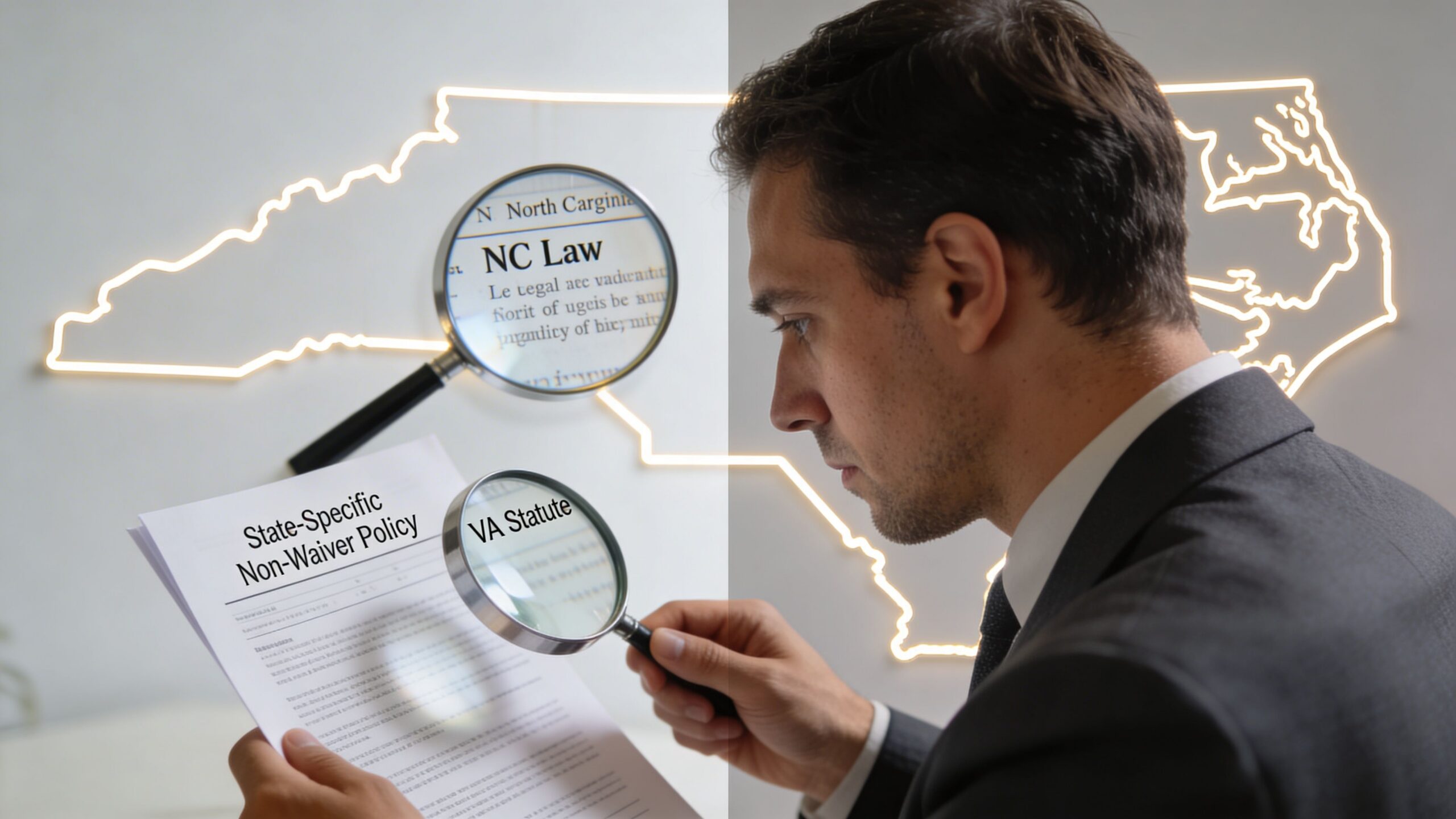
Some states are clearer. Florida, for example, has a statute discussed in this analysis of non-waiver demands in Florida that treats insurer investigation as non-waiver by default and labels demands for a signature as improper. North Carolina does not have that same explicit framework.
That creates uncertainty for homeowners and business owners after storm losses and other property claims. The same source highlights that this gap leaves policyholders unsure whether a demand to sign could violate unfair claims handling standards, especially after hurricane-related claim surges.
What insurers do with that gray area
They use it.
When the law does not give the average policyholder a clean, obvious answer, the carrier can make the request sound mandatory. The adjuster can frame refusal as non-cooperation. The desk examiner can keep repeating that the form is “needed to continue.”
That kind of pressure works on people who are exhausted, displaced, or trying to keep a building open.
What you should do in NC and VA
Use a stricter standard than the insurer wants you to use.
- Ask where the policy requires your signature. Usually, the request is outside the policy’s ordinary post-loss duties.
- Demand written identification of the disputed issue. Vague concern is not good enough.
- Keep your own file. Save every email, voicemail, photo, estimate, and request.
- Do not confuse pressure with obligation. The carrier’s urgency is not your legal duty.
In North Carolina and Virginia, the gray area is exactly why policyholders should be more careful, not less.
Why local claim experience matters
A generic national article will not help much when your insurer is citing storm-created opening, interior water exclusions, repeated seepage, or pre-existing damage after a Carolina wind event.
You need someone who understands local carrier behavior, local weather claim patterns, and how these disputes unfold on homes and commercial buildings in this region.
That is where policy language meets real-world claim handling. And that is where many policyholders finally realize the insurer’s “simple form” was never simple.
Conclusion Taking Control of Your Claim Dispute
A non-waiver agreement is not harmless paperwork. It is an insurer tool.
The company wants flexibility. It wants time. It wants to investigate your claim aggressively without giving up denial arguments. That is why the form appears early, why the pressure feels urgent, and why signing it can shift the dispute in the insurer’s favor.
Your first job is simple. Do not sign on the spot.
Your second job is just as important. Keep cooperating under the policy while refusing extra agreements that strengthen the carrier’s legal position.
If the insurer believes rights need to be reserved, let the insurer reserve them. That is different from helping them do it through your signature.
Property claims are already technical. Add a non-waiver request, and the fight usually gets harder. You are dealing with scope disputes, cause disputes, policy language, deadlines, documentation demands, and an adjuster whose employer saves money by paying less. That is not a level playing field.
If you are trying to estimate losses in other legal settings, tools like this personal injury settlement calculator can show how people think about claim value generally. But for home and building losses, calculators do not replace a serious review of policy language, building damage, contents, and insurer tactics.
If the carrier has put a non-waiver agreement in front of you, the dispute is already taking shape. Act like it.
Frequently Asked Questions About Non-Waiver Agreements
Do I have to sign a non-waiver agreement?
Usually, no. It is a bilateral agreement, which means it depends on your signature. You can refuse and still state that you will cooperate with the insurer’s investigation under the policy.
Will my claim be denied if I refuse?
Not automatically. The insurer may respond with a reservation of rights letter instead. That is often a better position for you than signing the insurer’s contract.
Can my public adjuster sign it for me?
The agreement is aimed at the insurer and the insured. Do not assume someone else’s signature solves the issue for you. Have the document reviewed before anyone agrees to anything.
Is a non-waiver agreement always bad?
It is always serious. In a disputed property claim, you should treat it as a red flag and not a routine form.
What should I say to the adjuster?
Keep it short. Tell them you will cooperate with inspection and claim investigation, but you will not sign extra-contractual agreements without review.
If your insurance company has asked you to sign a non-waiver agreement after fire, water, wind, hail, hurricane, theft, or vandalism damage, get help before you respond. For The Public Adjusters, Inc. represents homeowners and business owners in North Carolina property claim disputes, reviews insurer paperwork, documents damage, and helps challenge low-ball, delayed, and denied claims.