When you file a hurricane insurance claim, you're not just filling out forms. You're entering a battle to get the money you're owed to put your home or business back together. But make no mistake, it’s often a draining fight where your needs are in direct conflict with your insurance company's bottom line.
The Reality of Your Hurricane Insurance Claim
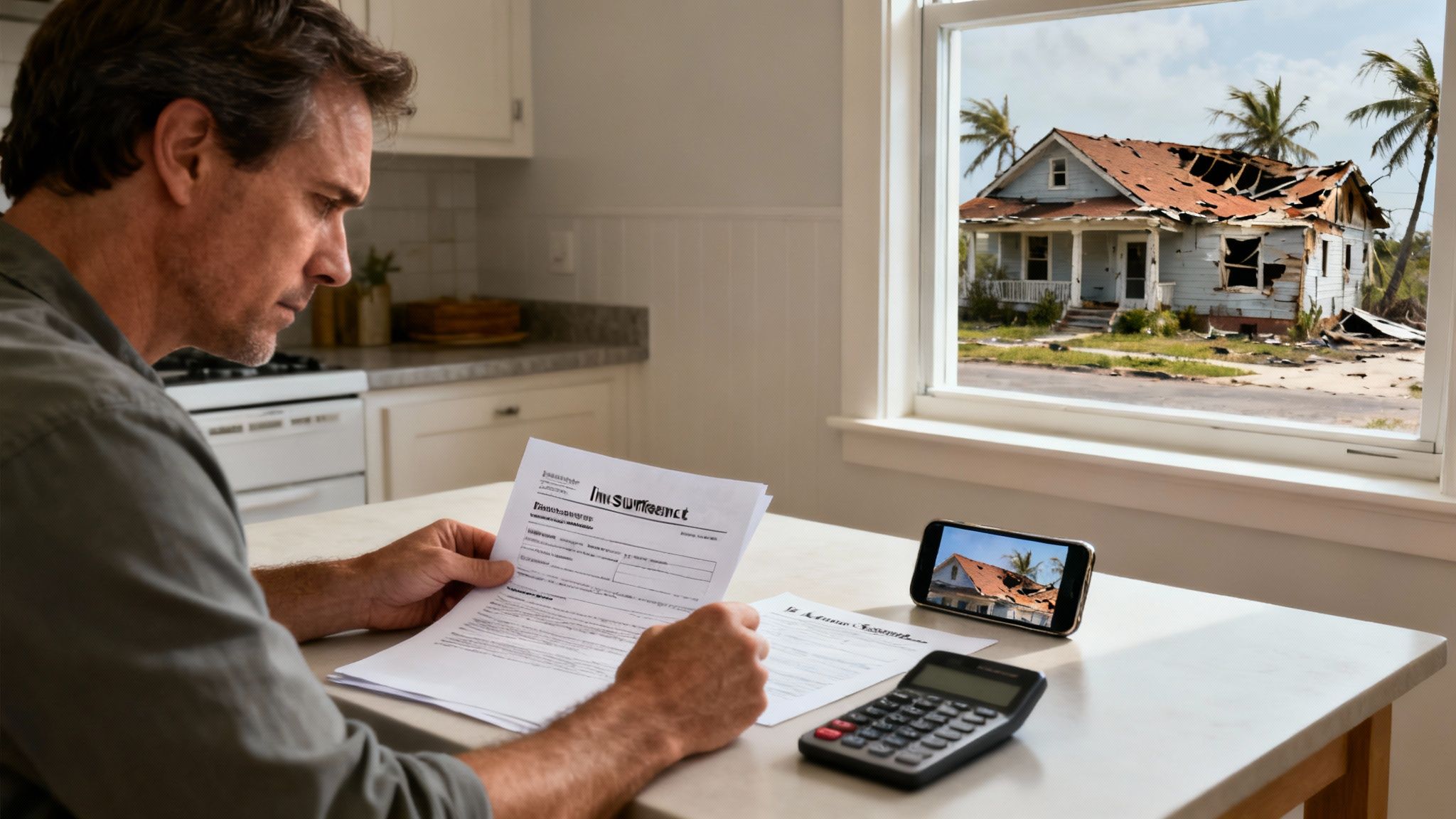
After a hurricane tears your world apart, your first instinct is to call the insurance company you’ve been paying faithfully for years. You expect a partner. You expect help.
The cold, hard truth? You’re starting a business deal with a corporation that is financially motivated to pay you as little as legally possible.
This isn’t just a cynical take; it's the basic business model of the insurance industry. Big carriers like State Farm and Allstate are publicly traded companies. Their primary responsibility is to their shareholders, not to you. Their profits go up when your claim payout goes down.
Understanding the Built-In Conflict of Interest
Think about the adjuster your insurance company sends out. They might seem friendly, but that person works for the insurer. Their loyalty is to the company that signs their checks.
It’s their job to assess the damage from the company’s point of view, and that almost always involves:
- Lowballing repair costs: They often use outdated pricing for labor and materials that completely ignores the reality of post-hurricane price spikes.
- Twisting policy language: They are experts at finding vague clauses and exclusions to deny coverage for parts of your claim.
- Ignoring hidden damage: They’ll gloss over things like wind-driven rain that gets behind your siding, setting the stage for major mold and rot problems they won't have to pay for later.
This is why so many homeowners and business owners end up feeling betrayed and completely exhausted by the process. Your claim isn’t being reviewed by a neutral party. It’s being judged by the very people who have to pay it. For a deeper dive into what you’re up against, check out a complete guide to the homeowner insurance claim process.
The insurance company's adjuster is trained to protect the company's financial interests. They are not there to be your advocate or to find every bit of damage you are entitled to be paid for. Their goal is claim closure at the lowest possible cost.
This is the hostile environment you walk into after a storm. If you feel like you're being stonewalled, delayed, or lowballed, you're not imagining things. It’s the result of a system designed to work against you.
Knowing this from the start is the most critical step you can take. It prepares you for the fight to get the settlement you actually deserve.
Why Your Insurer's First Offer Is Never Their Best
Let’s be brutally honest. That first settlement offer you get from your insurance company after a hurricane isn’t some benevolent gesture to help you get back on your feet. It's a business calculation. It’s their opening shot in a negotiation you probably didn't realize was happening, and it's almost always a lowball designed to save them a ton of money.
Insurers like Allstate and State Farm didn’t become multi-billion-dollar giants by generously paying every claim in full. Their whole business model is built around a simple formula: collect as much as possible in premiums and pay out as little as possible in claims. Your hurricane claim is just another number in that equation, and their initial offer is a test. They're seeing if you're the type of person who will take the low number and just go away.
The Anatomy of a Lowball Offer
Insurance companies have this down to a science. They use a playbook of tactics to systematically undervalue your claim, and while these moves might be technically legal, they feel fundamentally unfair when you're just trying to put your life back together.
The company adjuster they send out will write up an estimate using software that is often riddled with problems:
- Outdated Pricing: The software often uses national average costs for materials and labor. That’s useless when a hurricane has just slammed your local area, causing demand—and prices—for good contractors to skyrocket.
- Ignoring Code Upgrades: Your town’s building codes have likely changed since your home was built. If repairs require bringing your electrical, plumbing, or roofing up to current standards, those significant costs are conveniently left out of the initial estimate.
- Excessive Depreciation: This is a classic. They’ll look at your 10-year-old roof that was in perfect shape before the storm and claim it was "near the end of its life anyway," slashing its value with an unreasonable depreciation percentage.
This is exactly how a legitimate repair bill gets chopped down by tens of thousands of dollars before you ever see a check.
A Real-World Lowball Scenario
Think about a homeowner in North Carolina after a hurricane. The wind tore half the shingles off their roof, and the driving rain soaked everything underneath—the plywood decking, the attic insulation, you name it.
The insurance company's adjuster shows up, measures the square footage of the missing shingles, and comes back with an offer for $45,000. To someone in shock, that might sound like a lot of money.
But here’s what was really going on:
- The adjuster only priced out a patch job. Local building codes, however, required a full roof replacement when that much of it was damaged.
- They used pre-storm labor rates from their database, completely ignoring the 30-40% price spike that always happens when every contractor in a hundred-mile radius is booked solid.
- The estimate said nothing about the soggy plywood decking or the soaked attic insulation, which is a guaranteed recipe for a massive black mold problem down the road.
A public adjuster, hired by the homeowner, got a real quote from a trusted local roofer. The actual cost to do the job right—replace the whole roof, tear out the hidden water damage, and meet building codes—was over $70,000. The insurer’s first offer was $25,000 short.
Your insurer's estimate is not a statement of fact; it is a proposal. It's their opinion of what they owe you, and it's an opinion heavily biased in their favor. Accepting it without a fight is leaving money on the table that you are contractually owed.
Red Flags to Spot in Your First Offer
You don't need to be a contractor to smell a lowball offer. When you get that first estimate from your insurer, grab a highlighter and look for these warning signs:
- Vague Line Items: Are you seeing generic descriptions like "General Repairs" or "Miscellaneous Materials"? That’s a trick to hide undervalued or completely missed items.
- Missing Overhead & Profit: Any repair job that requires a general contractor to manage subcontractors (like roofing, drywall, and painting) must include their overhead and profit. This is a standard 20% (10% for overhead, 10% for profit) that insurers love to "forget."
- No Mention of Hidden Damage: If the wind blew rain sideways for hours, water got behind your walls. If the estimate doesn't account for investigating and repairing hidden water damage, it’s incomplete.
- Lowballing Labor Rates: Look at the hourly rates they're allowing for skilled trades. Do they seem ridiculously low for your area, especially after a disaster? Call a local contractor and ask what they charge.
If you spot even one of these red flags, it’s a giant signal that the offer isn't fair. This is the moment to stop thinking of your insurer as your partner in recovery and start realizing you need an expert on your side—a public adjuster—to fight for what it actually costs to fix your home.
Building an Ironclad Case with Proper Documentation
When you're fighting a hurricane insurance claim, the quality of your evidence is everything. It can literally make or break your case.
Insurance companies—especially the big players like State Farm and Allstate—thrive on vague, undocumented claims. Why? Because it gives their adjusters all the wiggle room they need to justify a lowball settlement. Your job is to take away that wiggle room. You need to build a case so detailed and undeniable that it leaves them nowhere to hide.
This isn't about snapping a few quick photos on your phone. It's about creating a comprehensive, organized record of your loss that tells a clear and compelling story. This evidence becomes your most powerful weapon when the insurer inevitably tries to downplay how bad the damage really is.
Think of it this way: the insurance company wants to create a gap between the true cost to fix your home and the low offer they slide across the table. Your documentation is what closes that gap.
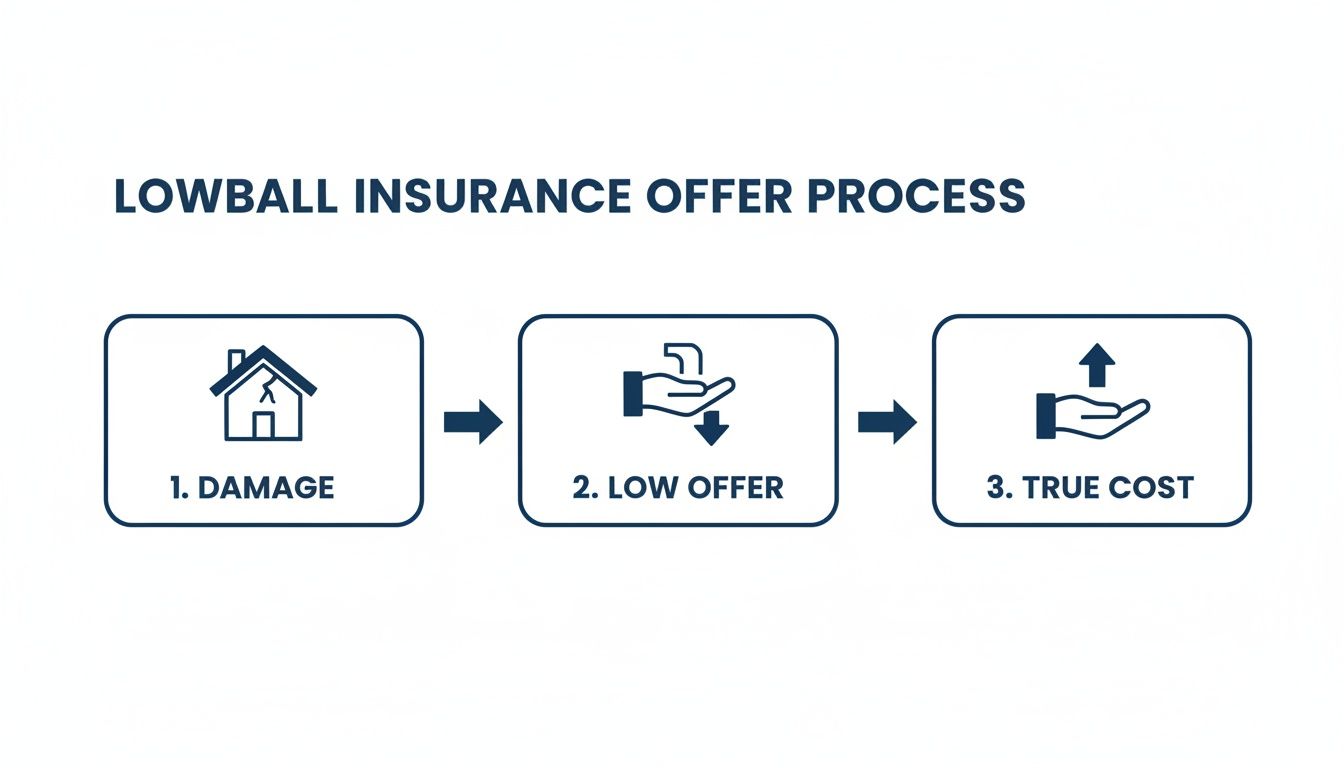
This flowchart shows the game they play. They see the damage, make a low offer, and hope you don't have the proof to fight for the true cost. Let's make sure you do.
Creating an Unshakable Damage Inventory
Your first mission is to document everything. And I mean everything. Don't just take wide shots of a trashed room; you have to get granular.
- Go Room by Room: Create a detailed list of every single item that was damaged or destroyed. For each item, you need to note its make, model, age, and your best guess at its original cost.
- Video Walkthroughs: Before you touch a single thing, do a slow video tour of your property on your phone. Narrate what you're seeing in real-time. "This is the living room. The water line is two feet up the wall, and you can see the drywall is crumbling. The sofa is completely soaked and ruined."
- Photo Evidence: Take hundreds of pictures. No, that’s not an exaggeration. Get close-ups of damaged electronics, warped flooring, and torn roofing. Take photos of brand labels and serial numbers on appliances. The more detail, the better.
This level of detail makes it much harder for an adjuster to claim your high-end television was a budget model or that your custom kitchen cabinets were just cheap particleboard.
Tracking Every Penny and Every Promise
Your documentation doesn't stop with the physical damage. You also have to track every single interaction and every expense from the moment the storm passes. This creates a timeline that can expose an insurer's bad faith delay tactics.
Keep a dedicated notebook or a digital file just for your claim. In it, you need to record:
- A Communication Log: Every time you speak with someone from the insurance company—phone, email, or in person—log the date, time, the person's name and title, and a summary of what was said.
- Receipts for All Expenses: Did you buy tarps to cover your roof? Pay for a hotel because your home was unlivable? Save every single receipt. These are called Additional Living Expenses (ALE) and are often covered by your policy, but only if you can prove you spent the money.
Securing detailed repair estimates from reputable contractors is another critical piece of the puzzle. A professional quote from a firm like Aldridge Construction is powerful evidence to throw back at an insurer's lowball estimate. This documentation is also vital when you prepare formal claim documents. You can learn more about this crucial form in our guide on what you need to know about the Proof of Loss.
Case Study: A North Carolina family's claim was initially denied after a hurricane, with the insurer blaming "pre-existing wear and tear" on their roof. Their public adjuster put together a file that included pre-storm photos showing a well-maintained roof, detailed receipts for the emergency tarping, and a meticulous log of every unreturned phone call from the company adjuster. Faced with this overwhelming and organized evidence of both the damage and their own poor communication, the insurer reversed its decision and paid the $112,000 claim in full.
Navigating the Nightmare of Flood Damage Claims with FEMA and NFIP
When a hurricane forces floodwater into your home, it triggers a bureaucratic nightmare most people never see coming. You quickly learn a hard, painful lesson: your standard homeowner's insurance policy is worthless against flood damage. That coverage comes from a completely separate, federally-backed program—the National Flood Insurance Program (NFIP).
And let me be clear: dealing with an NFIP claim is nothing like a standard homeowner claim. It's a hostile, rigid, and unforgiving process that feels designed to wear you down until you give up.
You might pay your flood premium to a familiar name like State Farm or Allstate—they're known as Write-Your-Own (WYO) companies—but don't be fooled. They aren't making the rules. They’re just the middlemen administering a deeply flawed federal program run by the Federal Emergency Management Agency (FEMA).
The Reality of NFIP and WYO Adjusters
The adjuster who shows up at your flooded property might have a recognizable insurance logo on their shirt, but they’re not operating like a typical company adjuster. They're bound by an incredibly strict and inflexible set of federal guidelines.
These WYO adjusters have almost no room to make judgment calls. Their only job is to follow the FEMA playbook to the letter, a playbook that often works directly against you.
This creates a few major landmines for property owners:
- Cruelly Rigid Rules: NFIP rules are infamous for what they don't cover. They often refuse to pay for damaged items in a basement or cover your Additional Living Expenses (ALE) if you're forced out of your home—protections that are standard in most homeowner policies.
- Unforgiving Deadlines: The NFIP requires a document called a Proof of Loss to be submitted by a specific, non-negotiable deadline. If you're one day late, your entire claim can be thrown out, no matter how legitimate it is.
- Lowballing by Design: WYO adjusters are trained to document only the damage they can see with their own eyes. They almost never account for the full cost of repairs, required code upgrades, or the hidden moisture that will absolutely lead to a massive mold problem down the road.
It's not just a feeling; it's a fact. A FEMA report after Hurricane Harvey found that NFIP policyholders were underpaid by thousands and thousands of dollars on average. The system isn't set up to make you whole. It's built to limit how much money the federal government has to pay out.
This is exactly why so many families end up with a settlement that's just a fraction of what they actually need to rebuild their lives. The federal government, through FEMA and the WYO carriers, has created a process that is exhausting and difficult on purpose.
You Cannot Win an NFIP Fight on Your Own
Trying to handle a complex hurricane insurance claim that involves NFIP flood damage without an expert in your corner is a recipe for financial ruin. The rules are buried in fine print, the adjusters are trained to say "no," and your entire home is on the line.
This is precisely where a public adjuster who specializes in the brutal world of NFIP claims becomes your most critical asset.
An experienced public adjuster speaks the unique language of the NFIP. They know the deadlines, the obscure documentation requirements, and exactly how to build a claim that satisfies FEMA's rigid standards while fighting for every dollar you're owed.
Think about this common scenario: A family's home takes on three feet of floodwater. The WYO adjuster writes an estimate to replace the drywall just up to the waterline. A public adjuster, however, brings in moisture meters and proves the water wicked up the studs inside the walls. They document the need to tear out four feet of drywall, treat for mold, replace the soaked insulation, and bring the electrical up to code.
That's the difference between a cheap patch job and a safe, proper recovery. For a deeper dive into these challenges, you can learn more about navigating flood damage claims in our detailed guide.
From day one, an NFIP claim is an uphill battle. The system is not your ally, and the WYO adjuster is not your friend. They are gatekeepers for a federal program that is designed to pay out as little as possible. Hiring a public adjuster is how you level the playing field and get the flood settlement you paid for and desperately need.
Hiring a Public Adjuster to Maximize Your Settlement
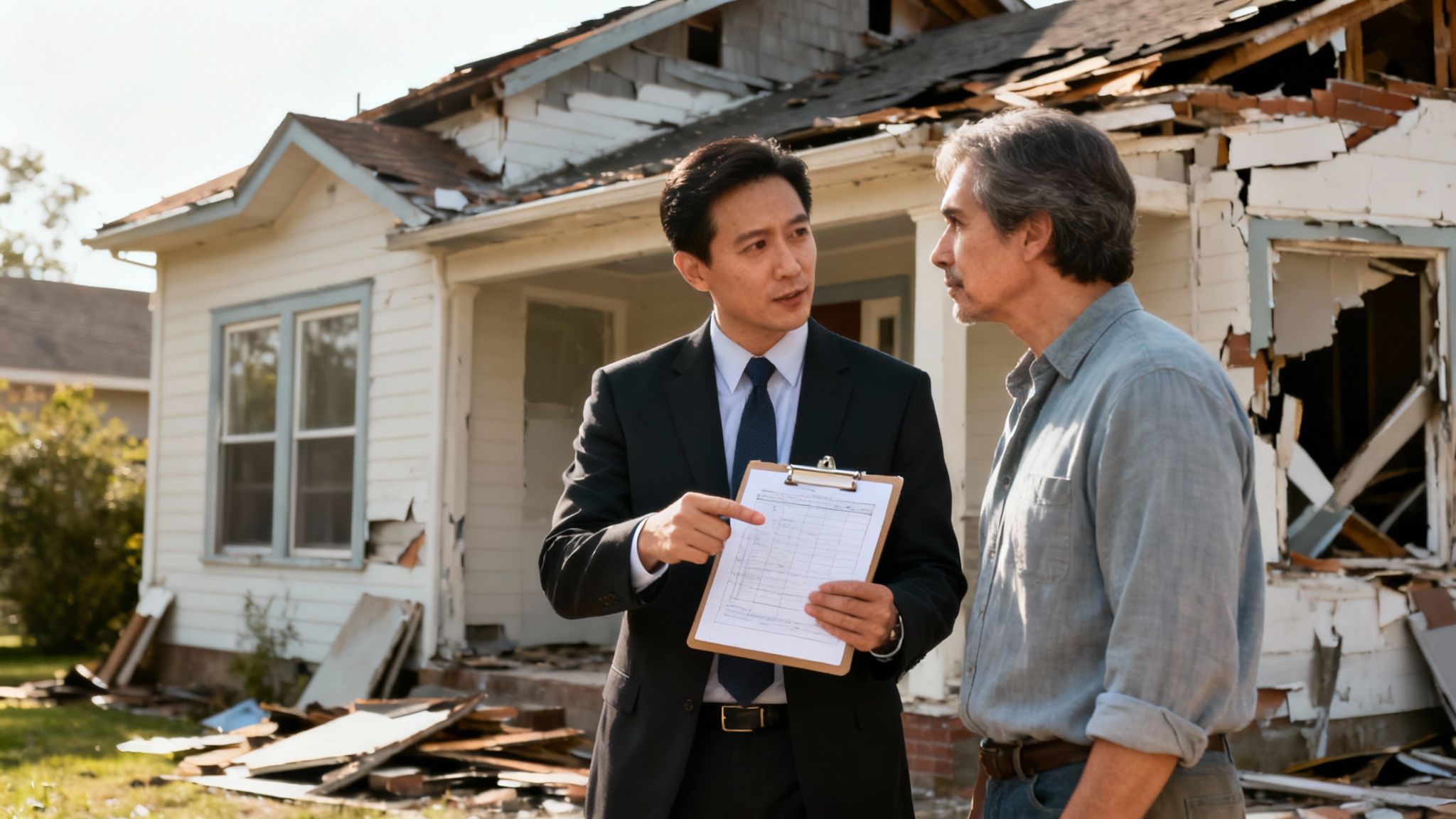
After a hurricane, the single most powerful tool you have isn’t a contractor or even an attorney—it’s a public adjuster. It’s a hard truth, but the adjuster your insurance company sends works for them, not you. Their job is to protect their employer’s bottom line.
A public adjuster, on the other hand, works only for you. Their entire mission is to get you the maximum and fairest settlement you’re entitled to under your policy.
If you’ve gotten a lowball offer, are caught in an endless cycle of delays, or have been slapped with a flat-out denial, those aren’t just minor frustrations. They are giant red flags. They’re a signal that it’s time to stop trying to fight a multi-billion-dollar corporation on your own and bring in a professional advocate.
The Critical Difference in Loyalty
The core conflict of interest in any hurricane insurance claim comes down to one simple question: who does the adjuster work for?
The person your insurer sends is called a company adjuster. They are trained, paid, and promoted by the insurance company. Their career hinges on their ability to close claims quickly and for as little money as possible.
A public adjuster is a state-licensed professional that you hire to represent your interests, and yours alone. They are your expert on policy language, damage valuation, and negotiation. This isn't a minor detail; it’s the entire ballgame. To really get it, you need to understand what a public claims adjuster does and why they are so crucial to your financial recovery.
You would never go to court and let the other side's attorney represent you. So why would you let the insurance company's employee decide how much they owe you for your catastrophic loss?
This one shift in loyalty changes absolutely everything. A public adjuster will dig through your policy, finding coverage the company adjuster conveniently “missed.” They bring in their own team of experts—engineers, roofing consultants, industrial hygienists—to build an ironclad case for the real cost to make you whole.
Let's break down exactly who you're dealing with.
Company Adjuster vs Public Adjuster: Who Are They Really Working For?
This table cuts through the noise and shows you exactly where each adjuster's loyalties lie. It's a critical distinction that can mean the difference between a fair settlement and a financial disaster.
| Attribute | Insurance Company Adjuster | Public Adjuster |
|---|---|---|
| Who They Work For | Your insurance company | You, the policyholder |
| Primary Goal | Minimize the insurance company's payout | Maximize your settlement payout |
| Who Pays Them | The insurance company (their employer) | You (a small, agreed-upon % of the settlement) |
| Motivation | Close claims quickly and cheaply to meet quotas | Get you the best possible outcome to earn their fee |
| Policy Interpretation | Finds language to limit or deny coverage | Finds language to justify and maximize coverage |
| Damage Assessment | Often overlooks or downplays hidden damage | Conducts a forensic, detailed damage inspection |
Seeing it laid out like this makes the conflict of interest undeniable. The company adjuster simply cannot serve your best interests when their paycheck depends on serving their employer's.
A Case Study in Turning the Tables
Think about this real-world example. A commercial property owner had a warehouse shredded by a hurricane. After months of getting the runaround, their insurer—one of the big national names—finally offered $450,000. The offer was a joke. It completely ignored the massive costs of bringing the building up to current codes and pretended the hidden water damage to the steel frame didn't exist.
The business owner was about to lose everything.
On the verge of giving up, he hired a public adjusting firm. Immediately, the public adjuster took over all communications, submitted a brand-new, thoroughly documented claim, and started negotiating aggressively. They proved the insurer had deliberately misinterpreted key policy clauses for code upgrades and business interruption.
The final result? The insurance company paid out $1.4 million. That's more than a 200% increase from their insulting first offer. This wasn't just about getting more money; it was the difference between that business shutting its doors forever and being able to rebuild and reopen. That is the real-world impact of having a true expert in your corner.
Answering Your Toughest Hurricane Claim Questions
Dealing with the chaos after a hurricane is one thing. Fighting the very company you paid to protect you? That’s a whole different level of stress. Let's tackle some of the most common and infuriating questions we hear from property owners whose hurricane insurance claim has gone off the rails.
What Should I Do If My Hurricane Insurance Claim Is Denied?
First things first: never, ever take a denial as the final answer. It’s a standard play for big insurers like State Farm and Allstate to reject valid claims using weak, often bogus, reasoning. Your first move is to push back.
Immediately demand they send you a detailed denial letter in writing. This isn't just a piece of paper; it’s evidence. It must cite the exact policy language they're using to justify their decision. Once you have that letter, it's time to call in an expert. A licensed public adjuster can review your claim for free, dissecting their argument and finding the holes. More often than not, these denials are built on misinterpretations or a lazy investigation—things a public adjuster is trained to dismantle.
How Long Can an Insurer Legally Drag Out My Claim?
This is where it gets maddening. While state laws demand that insurers act in "good faith" and handle claims promptly, the reality is that delays are a brutal but effective tactic. They hope to wear you down, to make you so desperate for any money that you'll accept a garbage settlement.
If your adjuster has gone silent or the process has been stalled for months without a legitimate explanation, that’s a giant red flag.
Document every single unanswered call, ignored email, and broken promise. This pattern of behavior can be considered 'bad faith,' and it’s a clear signal you need a public adjuster to step in and force your insurance company to do its job.
Can I Reopen a Claim If I Already Cashed the Check?
In many cases, the answer is a firm yes. Cashing a check from the insurance company doesn’t automatically sign away your rights, especially when new, hidden storm damage shows up after the first round of repairs.
The critical piece of advice here is to never sign a form labeled "full and final release" if you have any doubt that the settlement is too low. If you've already been paid but now realize the amount won't even come close to covering the actual repair costs, don't panic. A public adjuster can review the insurer's initial lowball assessment and file a supplemental claim to get the rest of the money you're rightfully owed.
When your insurance company puts its bottom line ahead of your recovery, you need an expert in your corner. For The Public Adjusters, Inc. exists to fight for policyholders and secure the settlement you deserve. Contact us for a free, no-obligation claim review today at https://forthepublicadjusters.com.