
A fire damage insurance claim is your formal request to the insurance company to get you the money you need to recover from a fire. It’s a complex process that involves proving your losses, documenting every single detail, and negotiating a settlement that covers everything from rebuilding your home to replacing your belongings and even paying for a place to live in the meantime.
If you have any questions about anything claim related we are here to help. Have your claim questions answered at NO COST. Call 919-400-6440 to speak with a licensed Public Insurance Adjuster.
Your First 48 Hours After a House Fire
The first two days after a house fire are a blur of shock, confusion, and raw emotion. But amid that chaos, the actions you take—or don’t take—will set the entire tone for your insurance claim. These 48 hours are about getting your bearings, securing what’s left, and laying the groundwork for a successful recovery.
Your absolute first priority is safety. Period. Even after the fire department leaves, your home is a dangerous place. Fight the instinct to rush back inside. The structure could be unstable, and toxic soot and smoke particles are everywhere. Wait until a professional gives you the all-clear.
This infographic really captures the calm, methodical mindset you need to adopt as you start this journey.
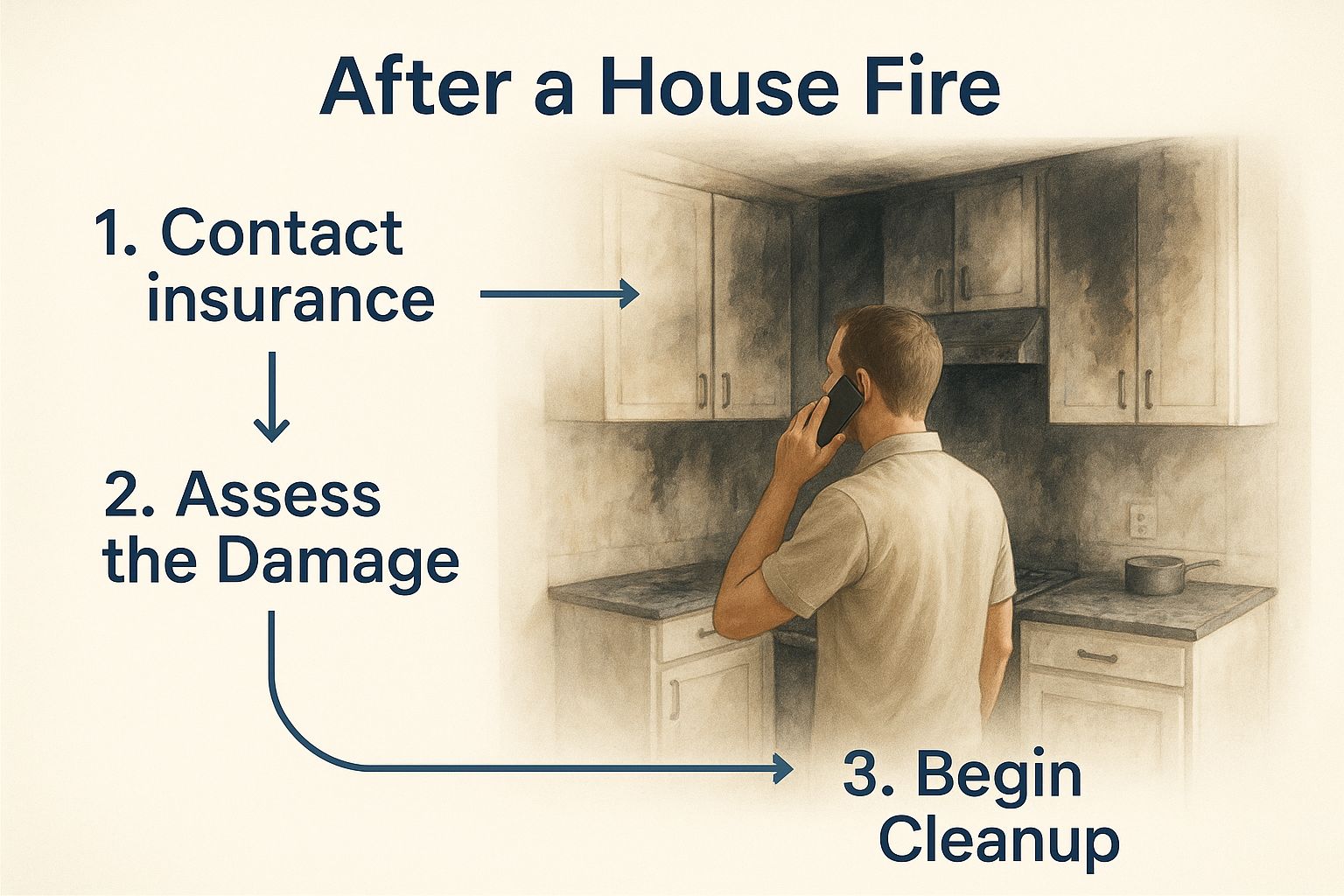
It’s a powerful reminder to stay composed and take the right first steps, even when everything feels like it’s falling apart.
To help you focus during this critical time, here’s a quick-reference checklist of what needs to happen right away.
Immediate Action Checklist After a Fire
This table breaks down the first five things you absolutely must do. Following these steps helps protect both your family and your financial recovery.
| Priority | Action Item | Why It’s Critical |
|---|---|---|
| 1 | Confirm Safety | Wait for official clearance from the fire department before re-entering. The site can have hidden structural dangers and toxic air. |
| 2 | Contact Your Insurer | Call your insurance agent or the 24/7 claims hotline immediately. This officially starts the claim process and gets the clock ticking. |
| 3 | Secure the Property | Board up windows, tarp the roof, or fence off the area. Your policy requires you to prevent further damage (mitigate loss). |
| 4 | Request an Advance | Ask for an advance on your claim for immediate needs like clothes, food, and toiletries. This is part of your policy. |
| 5 | Start a Claim Journal | Get a notebook and log every call and conversation. Note the date, time, who you spoke with, and what was said. |
Each of these steps is a building block for a strong, well-documented claim that can withstand the scrutiny it will inevitably face.
Securing Your Property and Mitigating Further Damage
Once it’s safe to be on the property, your insurance policy actually requires you to take reasonable steps to prevent any more damage from happening. This is called “mitigating your loss.”
In real terms, this means boarding up broken windows, throwing a tarp over a hole in the roof, or putting up a temporary fence to keep people out. If you don’t, and a rainstorm causes water damage through that exposed roof, your insurer could argue that the new damage isn’t their problem.
Be sure to keep every single receipt for plywood, tarps, or any other supplies you buy for these temporary fixes. These are almost always reimbursable expenses under your policy.
Making the Initial Call to Your Insurance Company
As soon as you can, call your insurance agent or the company’s 24/7 claims hotline. Have your policy number ready if you can find it. You don’t need to have all the answers right now—just give them a clear, factual account of what happened: the date, time, and what you know about the cause.
During that first call, they’ll give you a claim number. This number is your new best friend. Write it down, put it in your phone, and keep it somewhere safe. You’ll need it for every single interaction from here on out.
Crucially, you also need to ask about your Additional Living Expenses (ALE) coverage.
Key Insight: ALE is a lifeline. This part of your policy is designed to cover the costs of temporary housing, meals, and other essentials when your home is uninhabitable. Getting this benefit activated right away gives you some breathing room and financial stability, so you can focus on the bigger picture of your claim.
With fires becoming more frequent and severe, insurance companies are tightening their belts. The devastating wildfires across the Los Angeles area in early 2025 caused an estimated $53 billion in total losses, with around $40 billion insured. Those staggering numbers show you exactly what’s at stake and why insurers will scrutinize every detail of your fire damage claim.
What to Expect After Reporting the Claim
After that first call, the insurance company will assign a claims adjuster to your case. They will contact you to schedule a time to inspect the property and see the damage for themselves.
While you’re waiting for them, you can get a head start.
- Don’t throw anything away. I can’t stress this enough. Even if something looks like a charred mess, leave it be. The adjuster needs to see it. If you get rid of evidence, you make it that much harder to get paid for it.
- Request an advance payment. If you’re strapped for cash to buy essentials like clothes, food, and toiletries, ask your insurer for an advance against your final settlement. Most will oblige.
- Start your claim journal. Document every single phone call, email, and conversation. Write down the date, time, the name of the person you spoke with, and a quick summary of the discussion. This log can be a lifesaver if disputes come up down the road.
Taking these deliberate, organized steps can transform an overwhelming catastrophe into a manageable process. For a more detailed breakdown, you can read our guide on the first steps to take after a fire.
Building an Unshakeable Proof of Loss

Once the initial shock begins to fade, your focus has to pivot to the single most critical document in your fire damage insurance claim: the proof of loss. This isn’t just a list. It’s a painstakingly detailed inventory of everything you lost, from the living room sofa down to the last spoon in the kitchen drawer.
Putting this document together feels like an impossible task, but it’s the absolute foundation your entire financial recovery is built on.
Your insurance company isn’t going to write you a blank check based on what you think you lost. They need a comprehensive, itemized list that justifies every single dollar you’re claiming. The more detailed and organized you are, the smoother this whole process will be and the more leverage you’ll have later.
Think of yourself as a detective rebuilding a case file. You’re creating a room-by-room, item-by-item catalog of your life before the fire. Grab a notebook or open a spreadsheet and just tackle one room at a time. It’s the only way to do it without getting completely overwhelmed.
The Art of Recreating Your Inventory
Trying to rebuild your home inventory from memory alone is a recipe for disaster. It’s just not possible. You have to get creative and use every tool at your disposal to jog your memory and prove ownership and value.
Here are a few methods I’ve seen work time and time again:
- Photo and Video Forensics: Start digging through your phone, social media accounts, and any cloud storage you use. Look for pictures from holidays, birthday parties, or just random snapshots inside your house. What’s in the background? A lamp, a piece of art, that specific TV you bought on Black Friday—these are all valuable clues.
- Credit Card and Bank Statements: Your financial records are an absolute goldmine. Pull up months, or even years, of statements to find purchases from furniture stores, electronics retailers, and department stores. This gives you a hard record of what you bought, where, and when.
- Online Shopping Histories: This one is huge. Log in to your accounts on Amazon, Wayfair, Best Buy, and anywhere else you shop. Your entire purchase history is usually saved, giving you the exact item description, price, and date of purchase.
These digital breadcrumbs are often the most powerful evidence you have. They turn a fuzzy memory into a documented fact the insurer can’t ignore.
Pro Tip: Don’t forget the small stuff. It’s so easy to focus on the big-ticket items like appliances and furniture. But the cost of replacing every single thing in your closets, kitchen cabinets, and bathroom drawers adds up faster than you can imagine. These “small” items can easily add up to tens of thousands of dollars in a typical claim.
Understanding Value: Replacement Cost vs. Actual Cash Value
As you’re building out this inventory, you’ll run into two terms that will have a massive impact on your final payout: Replacement Cost Value (RCV) and Actual Cash Value (ACV). You absolutely have to understand the difference if you want to maximize your fire damage insurance claim.
| Policy Type | What It Covers | Example |
|---|---|---|
| Replacement Cost Value (RCV) | The cost to replace a damaged item with a new, similar item at today’s prices, without any deduction for depreciation. | Your five-year-old laptop is destroyed. RCV coverage gives you enough money to buy a brand-new, comparable model today. |
| Actual Cash Value (ACV) | The cost to replace the item with a new one, minus depreciation for its age, wear, and tear. | For that same five-year-old laptop, ACV would pay you what that used laptop was worth the moment before the fire. |
Most modern homeowner policies provide RCV coverage, but here’s the catch they don’t always explain clearly: The insurer will almost always pay you the ACV amount first. You only get the rest of the money (the depreciation) after you’ve actually bought the replacement item and sent them the receipt. This is a critical detail to keep in mind for managing your cash flow while you’re trying to get back on your feet.
Documenting Non-Visible Damage Like Smoke and Soot
Fire damage is so much more than what you can see has been burned. Smoke, soot, and ash are sneaky. They get into everything—inside your walls, your HVAC system, the attic. These contaminants aren’t just a bad smell; they can be corrosive and seriously toxic.
This isn’t just a homeowner’s opinion; insurance companies know it’s a covered peril. For instance, major carriers like Chubb have published guides on the serious health risks from post-fire contaminants, acknowledging that these particles travel far beyond the charred areas.
Your proof of loss has to account for the cost of fixing this hidden damage.
- Demand Professional Testing: Don’t let an adjuster’s quick visual scan be the final word. Insist on professional air quality and surface sampling to find out how bad the contamination from combustion byproducts really is.
- Document Everything: Get your phone back out. Take pictures of soot stains inside cabinets, on walls, and up in the attic spaces.
- Itemize Cleaning Costs: Your claim needs to include line items for professional cleaning of your HVAC system, upholstery, clothing, and the structure itself.
Ignoring smoke and soot damage is one of the most frequent and expensive mistakes I see homeowners make. Documenting it properly is the only way to ensure you get the funds for a safe, complete restoration—not just a cheap cosmetic fix. This is a non-negotiable part of a successful fire damage insurance claim.
Managing the Insurance Adjuster Visit

The site visit from the insurance adjuster is a make-or-break moment for your fire damage insurance claim. This isn’t just some casual walkthrough; it’s a detailed inspection where the adjuster starts putting a dollar value on everything you’ve lost. How you prepare for this meeting directly shapes the first settlement offer you’ll see.
It’s crucial to understand who you’re dealing with. The adjuster is an employee of the insurance company. Their job is to evaluate the damage based on what your policy covers. While most are professionals, their loyalty is to their employer—not to you. Your job is to make your case so clear, organized, and undeniable that they have no choice but to see the full scope of your loss.
Preparing the Scene Before They Arrive
A little prep work before the adjuster shows up can make a world of difference. You’re not trying to “stage” the damage, but you do want to make it incredibly easy for them to see everything that’s been destroyed, without any distractions.
Your goal is to be the one guiding the tour, not just following them around. Have your detailed home inventory, contractor estimates, and all your photos ready to go in a binder or a neat digital folder. This immediately shows them you’re an organized policyholder who means business.
- Don’t Clean Up: It’s a natural instinct, but fight the urge to clean or throw away damaged belongings. The adjuster needs to see the property exactly as the fire left it to properly assess the damage.
- Provide Clear Access: Make sure there’s a safe path for them to walk through the damaged areas. Get rid of any clutter that isn’t related to the claim so they have an unobstructed view.
- Have Your Documentation Ready: Get your proof of loss inventory, photos, videos, and any receipts for emergency repairs together. Presenting this right away proves you’ve done your homework.
This level of preparation sends a powerful message: you’re on top of this, and you expect a fair and thorough evaluation.
Navigating the Conversation with Confidence
During the walkthrough, what you say is just as important as what you show them. The adjuster will ask a ton of questions and might even record your conversation. You need to be cooperative, but also very careful and precise with your answers.
Stick to the facts you’ve already documented. Don’t guess about what might have caused the fire. And when it comes to repair costs, don’t throw out a number—just refer them to the professional estimates you’ve gathered.
Crucial Advice: Never, ever sign any documents or agree to a final settlement offer on the spot during this first meeting. Politely tell them you need time to review any reports or offers with your own team. Rushing this decision can cost you thousands.
Keep the conversation professional and courteous, but be firm. You’re fighting for your family and your home. Remember, the adjuster is just one piece of this puzzle. For a deeper dive, you can learn how a fire claim adjuster can provide essential help and advocate for you every step of the way.
What to Say and What to Avoid
Your words can either build your case or tear it down. Keep your answers short, sweet, and factual.
What you SHOULD do:
- Point out all damage: Walk with the adjuster and show them everything, especially the less obvious stuff like soot in the attic or smoke damage inside the walls.
- Provide documentation: Give them copies of your inventory and contractor bids. Never hand over your only originals.
- Ask for their timeline: Find out what the next steps are and when you can expect to see their report and the initial offer.
What you should NOT do:
- Don’t speculate: Avoid guessing about repair costs or the fire’s cause. Stick to what you know.
- Don’t minimize the damage: Never say things like “it’s not that bad” or “I think that can just be cleaned.” Let the experts decide.
- Don’t give a recorded statement unprepared: If they ask for one, tell them you’d be happy to schedule it for a later time once you’ve had a chance to prepare.
Your role here is to be a helpful, evidence-backed guide to your own loss. When you manage the adjuster’s visit with this mindset, you protect your own interests and pave the way for a much fairer negotiation.
How to Decode Your Settlement Offer
Getting that settlement offer from your insurance company feels like a huge relief. You see a number and think, “Finally, this is almost over.” But hold on. That document isn’t the finish line; it’s the starting gun for the negotiation. The first offer is almost always just that—a starting point in your fire damage insurance claim.
These settlement sheets can be a nightmare to read. They’re packed with confusing jargon, weird depreciation math, and line-item estimates that don’t make a lick of sense at first glance. Your job is to pick it apart, piece by piece, and stack it up against the detailed records you’ve been keeping. Don’t get overwhelmed by the complexity—understanding what you’re looking at is how you fight for what you’re owed.
Breaking Down the Offer Sheet
The first thing you’ll see is a long, intimidating list of items. Most of the time, this is generated by software like Xactimate, the gold standard for contractors and insurers. The offer is typically carved into a few main sections:
- Structural Repairs (Dwelling): This is the breakdown of what they think it will cost to fix or rebuild your house. It should cover everything from lumber and drywall to labor and permits.
- Personal Property (Contents): Here’s where they put a price tag on all your lost stuff. This valuation is based on the inventory you sent them, so you can see why that detailed list was so important.
- Depreciation: This is a big one. It’s the amount they deduct for age and normal wear and tear. You’ll see an “Actual Cash Value” (ACV) payment, which is what they give you upfront, and a “Recoverable Depreciation” amount you can claim after you replace the items.
- Additional Living Expenses (ALE): This bucket of money is meant to cover your rent, hotel bills, and other costs you’ve had while you’ve been out of your home.
You need to go over this with a fine-toothed comb. Did they estimate cheap laminate flooring when you had custom hardwood? Did they forget to include the cost of a specialized company to clean smoke out of your ductwork? That’s where they get you—the little details can add up to thousands of dollars.
Spotting Red Flags and Undervalued Items
Let’s be honest: insurance companies are businesses, and they’re managing massive financial risks. With global insured losses projected to hit nearly $145 billion in 2025—driven by disasters like wildfires—insurers are tightening their belts. You can read more about these rising insurance risks to get the bigger picture.
That financial pressure trickles down directly to your settlement offer.
Key Takeaway: The first settlement offer is just that—an offer. It’s the insurance company’s opening move. Think of it as the start of a business conversation, not a final, non-negotiable decree. Your documentation is your leverage.
Keep an eye out for these common lowball tactics:
- Unfair Depreciation: They say your five-year-old roof has depreciated by 50%? That’s probably way too high. Question any depreciation that doesn’t reflect the real-world condition of your property before the fire.
- Missed Scope: Does the estimate include the cost of bringing your home up to current building codes? If the fire destroyed old wiring, your policy should cover the cost to install new wiring that meets today’s safety standards. This is often overlooked.
- Lowball Labor Rates: Check the labor costs. Do they reflect what contractors are actually charging in your area right now? After a widespread disaster, labor costs can spike, and a generic estimate won’t cut it.
Comparing the Offer to Your Own Estimates
This is the moment where all your hard work pays off—your detailed inventory, your photos, and especially those bids from your own contractors.
The best way to do this is to set up a simple spreadsheet. Make three columns: “Insurer’s Offer,” “Your Contractor’s Estimate,” and “Difference.” Go through their estimate line by line and plug in the numbers. This gives you a crystal-clear, visual roadmap of every single discrepancy.
When their offer to rebuild your kitchen is $25,000, but your contractor’s detailed bid comes in at $40,000, you’ve got a concrete point to negotiate. You can hand them the bid and ask them to explain, step-by-step, why their number is so much lower. This moves the conversation out of the realm of feeling and into the world of facts. And at the end of the day, a fire damage insurance claim is a business transaction.
Contesting a Low Offer or Claim Denial
Getting a lowball settlement offer—or even worse, an outright denial—feels like a punch to the gut. After everything you’ve been through with the fire, it’s a frustrating and disheartening moment. But it is absolutely not the end of the road.
Your insurer’s first decision is rarely their final one. Think of this as the start of a formal disagreement, one that requires a calm, professional, and strategic response. Your emotions are completely valid, but moving forward successfully is all about facts, evidence, and a clear game plan. This is where you shift from simply documenting your loss to actively defending its true value.
Initiating the Formal Appeals Process
Your first move is to formally notify your insurance company that you dispute their decision, and you need to do it in writing. A phone call won’t cut it here; you need a paper trail. Draft a clear, professional letter that gets straight to the point about why their assessment is wrong.
This isn’t the time to vent your anger or share long, emotional stories. Keep it strictly business. Reference the specific line items you’re contesting and attach any competing estimates from your contractor or the parts of your home inventory they undervalued. The goal is to hit them with compelling new evidence that forces them to take a second look.
- Get Specific: Don’t just say the offer is “too low.” Instead, state, “Your estimate for kitchen repairs is $15,000 less than my licensed contractor’s bid, which is attached for your review.”
- Use Your Policy: Point directly to the language in your policy that backs up your position, especially for things like code upgrades or matching materials.
- Set a Deadline: Politely request a written response within a reasonable timeframe, like 30 days.
This formal letter officially puts the ball back in their court and creates a record showing you’re proactively trying to resolve the dispute.
Knowing When to Call for Professional Help
If your letter doesn’t get you a fair adjustment, it’s time to bring in the pros. Too many homeowners feel they have to fight this battle alone, but there are experts whose entire job is to level the playing field for you.
The two main professionals to consider are public adjusters and attorneys. A public adjuster is an insurance professional licensed by the state who works only for you, the policyholder. They take over the entire claim, from re-evaluating the damage to negotiating directly with the insurance company, usually for a percentage of the final settlement.
An attorney becomes necessary if your insurer is acting in bad faith—things like unreasonable delays, misrepresenting your policy, or flat-out refusing to pay a valid claim. While a public adjuster focuses on the value of the claim, an attorney deals with the legal violations.
Expert Insight: A good rule of thumb is to hire a public adjuster when the disputed amount is significant (over $10,000), the damage is complex, or you just don’t have the time and energy for the fight. Their expertise often uncovers damage the company adjuster missed, which can more than cover their fee.
Understanding how to challenge an insurer’s numbers is a critical skill. For a deeper dive, check out our guide on how to defend your fire insurance claim calculation.
Alternative Dispute Resolution Options
Before anyone starts talking about court, your policy likely has built-in options for resolving disagreements. The two most common are appraisal and mediation.
The appraisal process is a powerful tool when the fight is purely about the cost of the damage, not whether it’s covered. It works like this: you hire an appraiser, and the insurance company hires one. Those two appraisers then agree on a neutral third-party “umpire.” A decision agreed upon by any two of those three becomes binding.
Mediation, on the other hand, is a more informal process. A neutral mediator steps in to help you and the insurer negotiate a settlement that you can both agree on. The mediator doesn’t make a ruling but helps guide the conversation toward common ground.
It’s important to understand the bigger picture. The increasing frequency and scale of fires have put enormous pressure on the insurance industry. When plans like the California FAIR plan face staggering losses, such as the $4.8 billion from the Los Angeles fires, it creates a systemic risk. This pressure forces private insurers to tighten their belts and get more aggressive in managing what they pay out. This industry context is exactly why you have to be ready to stand your ground with a well-documented and professionally supported case.
Common Questions About Fire Damage Claims
Walking through the aftermath of a fire is tough enough without the blizzard of questions that comes with an insurance claim. The whole process can feel just as stressful as the event itself. Let’s cut through the noise and get you some clear, straightforward answers to the questions we hear most often.
How Long Will My Fire Damage Claim Take?
This is the big one, and the honest-to-goodness answer is: it really depends.
A relatively simple claim, where the damage is clear and your documentation is spot-on, might wrap up in a few months. But if you’re dealing with major structural damage, fighting over the value of your lost possessions, or just have an insurer dragging their feet, it can easily stretch out for a year or even longer.
Your timeline is going to hinge on a few key things: how organized you are, how responsive your insurance company is, and the sheer scale of the damage. For instance, if a wildfire has torn through the region, insurers get absolutely slammed. Delays are almost a given. The best thing you can do is stay on top of it—meet every deadline, document every single conversation, and prevent any hold-ups that are within your control.
ACV vs. RCV: What Is the Real Difference?
Getting these two terms straight is absolutely essential. They are the foundation of how you’ll get paid, and misunderstanding them can cost you thousands.
| Term | What It Means | Real-World Example |
|---|---|---|
| Actual Cash Value (ACV) | This is what your stuff was worth the second before the fire. Think of it as today’s replacement price minus depreciation for age, wear, and tear. | Your 7-year-old couch might cost $2,000 to replace today, but its ACV could be just $600. This is the amount of the first check you’ll likely receive. |
| Replacement Cost Value (RCV) | This is the full cost to buy a brand-new, comparable item at today’s prices, with no deduction for depreciation. | First, you get the $600 (ACV). Once you actually go out, buy a new couch, and send the insurer the receipt, they pay you the remaining $1,400. |
Key Insight: Most policies won’t pay you the “recoverable depreciation” (that extra $1,400 in our example) until after you’ve already spent the money. This can create a real cash-flow crunch, since you’re trying to rebuild your life with only the initial ACV funds.
When Should I Hire a Public Adjuster?
Bringing in a public adjuster isn’t just for worst-case scenarios; it’s a strategic move. You should really think about it if you find yourself in these situations:
- The Damage is Severe: When you have a large-scale loss, the work involved in documenting everything is a full-time job. A public adjuster handles that mountain of work for you.
- You’ve Received a Lowball Offer: If the insurance company’s first offer seems insultingly low and they aren’t budging.
- The Claim is Complex: Things get complicated fast with issues like hidden smoke and soot damage, building code upgrades, or business interruption. An expert knows how to navigate these.
- You Just Don’t Have the Time or Energy: The claims process is a marathon, not a sprint. If you’re overwhelmed and can’t dedicate dozens of hours to the fight, a professional can lift that weight.
What if My Contractor’s Estimate is Higher?
First off, don’t panic. This happens all the time in a fire damage insurance claim. When your trusted contractor gives you a detailed estimate that’s way higher than the insurance adjuster’s, it’s not a dead end—it’s a starting point for negotiation.
The first thing to do is send your contractor’s bid to the adjuster in writing. Ask them for a line-by-line comparison to explain the price difference. More often than not, the insurer’s estimate is missing key things. They might have overlooked local labor rates, forgotten about the cost of hauling away debris, or based their numbers on cheaper, lower-quality materials.
Your contractor’s detailed bid is your single best piece of leverage. It’s the proof you need to negotiate for what you’re truly owed.
Fire Damage Insurance Claim FAQs
What does a fire damage insurance claim cover?
A standard homeowner’s policy typically covers structural repairs, personal property losses, and additional living expenses if you must relocate during repairs. However, coverage can vary depending on your policy’s terms, exclusions, and limits.
How long does a fire damage insurance claim take to settle?
Minor claims may settle in a few weeks, but large or complex fire losses can take several months. Working with an experienced public adjuster helps speed up documentation, negotiation, and approval by ensuring all damage is properly reported and valued.
Can I file a fire damage claim myself?
Yes, you can file the claim yourself, but insurance companies often have teams of adjusters protecting their interests. Hiring a public adjuster means you have an advocate who works exclusively for you, ensuring fair documentation and compensation.
What if my insurance company’s offer is too low?
If you receive a lowball settlement, you do not have to accept it. You can dispute the offer, request a re-inspection, or bring in a public adjuster or claims expert to re-evaluate the loss and negotiate a higher, fair settlement.
Do I need receipts for everything lost in the fire?
Receipts help strengthen your claim but are not mandatory. You can use photos, credit card records, or witness statements to prove ownership and value of lost items. A public adjuster can help reconstruct your inventory list professionally.
What are common reasons fire damage claims get denied?
Denials often occur due to incomplete documentation, suspected negligence, or policy exclusions (like intentional acts or lack of maintenance). Having a claims professional handle the process from day one can reduce your risk of denial.
Can smoke or soot damage be claimed even without visible fire?
Yes. Smoke, soot, and heat damage are typically covered if caused by a fire. They can severely affect air quality, walls, electronics, and furniture — even without visible flames. Proper testing and documentation are key to getting coverage approved.
How can a public adjuster help with a fire damage insurance claim?
A public adjuster manages every step — from damage inspection to filing paperwork and negotiating settlements — ensuring you get the maximum payout allowed under your policy while minimizing stress and delays.
How do I choose the right public adjuster for my claim?
Look for licensed adjusters with a strong reputation, local experience, and verified client reviews. Ask about their fire claim expertise, fees, and how they communicate throughout the process.
Trying to navigate all this on your own can be completely overwhelming. The team at For The Public Adjusters, Inc. brings the expertise and advocacy needed to make sure you get a fair and complete settlement. If you’re dealing with a tough fire damage claim in North Carolina or Virginia, reach out to us for a no-cost claim review.



Solid article. No fluff, just value.