
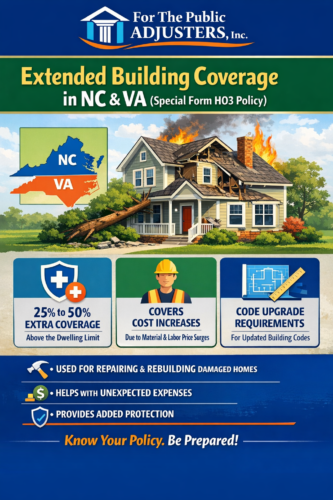
What is Extended Dwelling Coverage? It is a policy endorsement that provides an additional buffer (typically 10%, 25%, or 50%) above your standard Dwelling Limit (Coverage A). In NC and VA, where construction labor shortages and “Demand Surge” after hurricanes or storms are common, this coverage prevents you from being underinsured if the actual cost to rebuild your home exceeds your policy limit.
When rebuilding costs outpace your policy limit, extended dwelling coverage can prevent a costly shortfall. Also called extended replacement cost, it is an optional homeowners endorsement that raises your Coverage A dwelling limit by a fixed percentage to cover higher-than-expected rebuilding expenses. Common percentage bands run from 10 percent to 50 percent; a $300,000 dwelling limit with a 25 percent endorsement becomes $375,000, and the endorsement protects replacement cost for rebuilding rather than your home’s market value.
Key takeaways
Here are the most important points to remember about extended dwelling coverage and how it can affect a claim. Check your declarations page first, then use the guidance below to decide whether you need additional endorsements or a professional review.
- Raises Coverage A by a fixed percentage to cover higher-than-expected rebuild costs; protects replacement cost, not market value.
- Activates when replacement costs exceed your dwelling limit; the insurer will pay up to the extended cap subject to policy terms, documentation and replacement-cost requirements.
- Extended dwelling coverage and extended replacement cost add a percentage cap above the policy limit; guaranteed replacement cost may cover the full rebuild without a cap—read your policy language.
- Choose a percentage based on a reliable replacement-cost estimate (commonly between 10 percent and 50 percent) and consider pairing an inflation guard to keep limits current between renewals.
1. What extended dwelling coverage is and why it matters
When contractors and material costs rise quickly after a loss, your base dwelling limit can leave you with a large out-of-pocket bill. Extended dwelling coverage increases your dwelling limit so you are less likely to face that shortfall when rebuilding costs exceed your policy limit. Typically the endorsement adds between 10 percent and 50 percent to the base limit to cover cost overruns caused by inflation, labor shortages or post-disaster demand.
The endorsement generally applies to the main dwelling and any attached structures covered under Coverage A. Detached garages, fences, sheds and landscaping are usually covered under Coverage B and may require separate endorsements or higher Coverage B limits to avoid gaps. Homeowners often assume all structures are treated the same; check the declarations page to confirm which structures the extended limit covers.
The endorsement only matters when the insurer’s replacement-cost calculation exceeds your stated dwelling limit, and then the carrier applies the extended percentage as the maximum payout. Payment remains subject to policy conditions such as documentation requirements, repair timing and exclusions.
 2. How extended dwelling coverage affects rebuild timelines and payouts
Major disasters can slow every part of a rebuild, and those delays often coincide with higher material and labor costs. Supply-chain disruptions increase lead times for materials, contractor backlogs push start dates out, and overloaded permitting offices can add weeks or months to a project. These factors combine to raise replacement costs while homeowners and insurers both deal with extended schedules.
Insurers typically divide payments into stages to verify work and limit overpayment. Common stages include emergency repairs, an initial actual cash value payment to cover immediate needs, contractor progress draws as work is completed, and a final replacement-cost release after you provide proof of repair or a final invoice. Those stages help carriers manage risk but they can create cash-flow gaps for homeowners who must cover out-of-pocket costs while repairs are underway.
Extended dwelling coverage raises the amount the insurer will ultimately pay, but it does not speed up the carrier’s draw schedule or change documentation requirements. Longer timelines commonly strain additional living expense coverage because temporary housing and storage costs add up while insurance funds arrive in stages. A licensed public adjuster can document scope changes, prepare supplements and negotiate draw schedules to reduce out-of-pocket exposure.
3. Extended dwelling coverage vs. extended replacement cost vs. guaranteed replacement cost
Policy wording decides whether you get a capped uplift or an uncapped rebuild promise, so reading definitions matters. Extended dwelling coverage and extended replacement cost typically raise the payout by a stated percentage above the policy limit, while guaranteed replacement cost covers the full actual rebuild cost without a cap. Guaranteed replacement cost is rare and often limited to specific policy types or homes the carrier has evaluated closely. For a plain-language overview of extended replacement cost, see what extended replacement cost means.
Common percentage bands include lower-cost options around 10 to 15 percent, a 25 percent standard option that balances premium and protection, and 50 percent or higher for high-risk markets. Which bands a carrier offers depends on state rules and underwriting practices (see the Colorado Division of Insurance bulletin for an example of state guidance), and guaranteed replacement cost will be limited or unavailable in many places. Choose based on your home’s risk profile and how comfortable you are with paying a higher premium for broader protection.
Single-family tract homes often fare well with 25 percent protection, while coastal, wildfire-prone or post-disaster rebuild zones typically call for 50 percent or more. Custom, historic or one-of-a-kind homes may require guaranteed replacement cost if you can find a carrier that will underwrite it. Match the option to your local market, your home’s construction type and any unique features that increase rebuild complexity.
4. How insurers set dwelling coverage limits and common endorsements
Insurers set your dwelling limit based on an estimate of the cost to rebuild, using local construction costs, material and labor prices and current building codes. That estimate becomes Coverage A and determines whether a claim pays on a replacement-cost or an actual-cash-value basis. Replacement cost pays to repair or rebuild without deducting depreciation, while actual cash value subtracts depreciation and can leave homeowners covering the difference.
A few common endorsements change how limits respond after a loss. An inflation guard automatically adjusts dwelling limits between renewals to track construction-cost indices. Using both an inflation guard and an extended limit can reduce the risk of underinsurance in volatile markets because the inflation guard keeps limits current and the extended limit provides extra cushion at claim time.
Ordinance and law coverage pays to bring older parts of your home up to current code after a loss, and higher limits for detached structures protect garages and guest houses. These endorsements can stack with dwelling limits but often carry separate caps, so shortfalls can appear even when you have generous Coverage A. Review how endorsements combine on your policy so you know where separate caps might leave gaps during a rebuild. For a deeper primer on overall policy components, see Understanding Homeowners Insurance Coverage Explained.
5. How to calculate the percentage you should buy (step-by-step)
- Gather reliable replacement-cost estimates. Hire a contractor or a licensed appraiser, request an Xactimate-based scope when possible, and collect two or three local contractor bids to confirm the number. Keep written estimates and update them after renovations so your coverage reflects current materials and labor.
- Calculate the needed uplift using this formula on a calculator: needed percentage = (estimated rebuild cost ÷ current dwelling limit, 1) × 100. For example, if your rebuild estimate is $375,000 and your dwelling limit is $300,000, then ($375,000 ÷ $300,000, 1) × 100 = 25 percent, so you would need at least a 25 percent uplift.
- Add a safety margin and choose the nearest endorsement option. Include permit fees, scope misses and post-disaster demand in your buffer. Many homeowners use a modest buffer of about 10 percent; higher-risk areas may require more. Round up to the nearest endorsement your carrier offers and re-check replacement-cost numbers annually and after remodels.
- Suburban, low-risk homes: plan for about 25 percent total uplift to feel comfortable. That accounts for permit-driven fees and small scope misses.
- Coastal, wildfire or post-disaster rebuild zones: plan for around 50 percent uplift. These areas see larger demand spikes and material shortages that drive costs up quickly.
- Unique or high-end custom homes: assume higher than 50 percent unless you have a detailed builder’s estimate. Custom finishes and code upgrades often add unforeseen costs.
6. What adding extended dwelling coverage typically costs
Adding extended dwelling coverage is often a modest premium increase for the extra protection. For a typical dwelling, endorsements commonly add roughly $25 to $50 per year and may amount to less than 10 percent of a homeowners premium, though dollar amounts vary by carrier and base premium. A $300,000 dwelling with a 25 percent extension might raise annual premium by about $30, while a higher-value home could see a larger dollar increase depending on insurer pricing.
Those numbers vary by location and risk. Coastal and wildfire-prone areas typically carry larger add-on costs because insurers price for local rebuild demand and materials scarcity. Underwriting factors such as claims history, construction type and local code requirements also affect the premium impact.
You can manage cost by shopping multiple carriers at renewal and asking about bundled discounts if you carry other policies with the same insurer. Consider a higher deductible if your emergency fund allows, or pair a modest inflation guard with a smaller percentage extension to cover short-term spikes at lower cost. Ask insurers for a written explanation of how the endorsement changes your replacement-cost exposure so you can compare options accurately.
Final thoughts on extended dwelling coverage
Extended dwelling coverage gives your policy breathing room when rebuilds take longer and cost more after a major loss. By raising Coverage A, the endorsement reduces the chance you will face an out-of-pocket gap caused by rising labor and material prices. Confirm whether your policy includes extended dwelling coverage and how it interacts with an inflation guard, ordinance and law coverage, and Coverage B limits so you understand where gaps could appear.
Start by locating your declarations page and noting any dwelling endorsements and limits, and document delays, receipts and contractor schedules if you expect a long rebuild. Compare policy terms carefully because extended dwelling coverage, extended replacement cost and guaranteed replacement cost work differently and affect how a carrier calculates payment.

Schedule a free claim review with For The Public Adjusters, Inc.; our state-licensed adjusters serve homeowners and businesses in North Carolina and Virginia, work on a contingency-fee basis and provide a no-cost assessment of whether extended dwelling coverage should change your claim strategy. For background on how endorsements typically operate, you can read Progressive’s guide to extended replacement cost, and if you want a quick checklist about engaging a public adjuster, see our Top 5 Things To Know About What Is A Public Adjuster.
Extended Dwelling Coverage: The “Quick-Start” Summary
What is Extended Dwelling Coverage? It is a policy endorsement that provides an additional buffer (typically 10%, 25%, or 50%) above your standard Dwelling Limit (Coverage A). In NC and VA, where construction labor shortages and “Demand Surge” after hurricanes or storms are common, this coverage prevents you from being underinsured if the actual cost to rebuild your home exceeds your policy limit.
This guide provides a high-level analysis of Extended Dwelling Coverage (also known as Extended Replacement Cost), specifically tailored for property owners in North Carolina and Virginia.
2. Why is Extended Dwelling Coverage critical for North Carolina coastal properties?
Coastal NC is subject to "Demand Surge." After a major hurricane (like Florence or Helene), the cost of local labor and shingles can double due to scarcity.
A standard estimate created in January may be useless by October after a storm. Extended Dwelling Coverage is specifically designed to absorb this "localized inflation" that standard Consumer Price Index (CPI) adjustments in your policy don't account for.
3. Does Extended Dwelling Coverage pay for "Building Code Upgrades" in Virginia?
Generally, no. These are two different endorsements. Extended Dwelling covers the cost of materials and labor to replace what you had. You need Ordinance or Law Coverage to pay for the extra cost of bringing an older home up to current VA state building codes.
Public Adjuster Insight: If you have an older home in Old Town Alexandria or Norfolk, you must have both. If a fire occurs, the Extended coverage handles the increased labor costs, while Ordinance or Law handles the mandatory new electrical or plumbing codes.
4. How does NC’s "Matching Law" affect my Extended Dwelling limit?
In North Carolina (NC Admin Code 11 NCAC 08.0910), if a material (like siding or shingles) is no longer available, the insurer may have to replace the entire area to ensure a "reasonably uniform appearance."
This "matching" requirement can quickly push a claim over the primary Coverage A limit. Extended Dwelling Coverage provides the necessary funds to replace an entire roof or all the siding when the insurance company would otherwise claim they only owe for a "patch."
5. Is my "Market Value" the same as my "Dwelling Limit" in NC and VA?
No. Market value includes the land and the location’s desirability. Dwelling limits (and the extension) are based solely on Replacement Cost Value (RCV)—what it costs to buy the wood, nails, and labor today.
Many homeowners in booming areas like The Triangle (NC) or Northern Virginia are underinsured because their policy is based on what they paid for the house, not what it costs a contractor to rebuild it. Extended Dwelling is your safety net against this "Valuation Gap."
6. Can I invoke Extended Dwelling Coverage for a partial loss, like a kitchen fire?
Yes, but it only "kicks in" once the primary Coverage A limit is exhausted.
This is rare in partial losses unless the home is severely underinsured. However, if the fire causes hidden structural damage that wasn't in the initial estimate, the extension ensures there is a "bucket of money" left to finish the job once the main limit is spent.
7. What happens if I don't have Extended Dwelling Coverage and my rebuild goes over budget?
In NC and VA, the insurance company's liability is strictly limited to the number on your Declarations Page.
The Problem: Without the extension, any cost above that number—whether due to inflation, labor shortages, or simple under-estimation—becomes a personal debt or a reason to settle for a smaller, inferior home.
8. How does "Inflation Guard" interact with Extended Dwelling Coverage?
Inflation Guard is an automatic annual increase (usually 4-8%) to your base limit. Extended Dwelling is a percentage on top of that new, increased base limit.
Think of Inflation Guard as the "Floor" and Extended Dwelling as the "Ceiling." In the current 2024-2026 economic climate, standard 4% inflation guards are failing to keep up with the 15-20% rise in specialty construction labor.
9. Does Extended Dwelling Coverage cover my personal belongings (Contents)?
Extended Dwelling applies strictly to the structure (Coverage A).
If you need more money for your furniture or clothing, you must check your Coverage C (Personal Property) limits. Don't assume that a dwelling extension helps with your contents; they are separate silos of money.
10. How do I prove to my insurer in VA or NC that the rebuild cost exceeds the limit?
You must provide a detailed, line-item estimate from a licensed contractor or a Public Adjuster that uses current local market pricing (often using software like Xactimate).
Insurers use "national averages." If you are in a high-cost area like Fairfax, VA, those averages are wrong. A Public Adjuster helps you prove the "local reality" of construction costs to trigger the use of your Extended Dwelling funds.
Our firm handles complex claims across North Carolina and Virginia. We have seen hundreds of policyholders saved from financial ruin by a simple 25% Extended Dwelling endorsement. Because we are licensed Public Adjusters, we don’t just read the policy—we enforce it. We understand the specific administrative codes in Raleigh and the litigation environment in Richmond that dictate how these funds are actually paid out.
Next Steps for Policyholders:
-
Check your Dec Page: Look for “Extended Replacement Cost” and the percentage.
-
Request an RCV Update: Ask your agent for a new “Replacement Cost Valuation” every two years.
-
Consult a Pro: If you’ve suffered a loss and the carrier says you’re “over the limit,” contact us immediately to audit the estimate.
Frequently asked questions
What does dwelling extension coverage mean?
Dwelling extension coverage adds an extra layer of protection above your policy's stated dwelling limit. If a covered loss destroys your home and rebuilding costs exceed your base limit, the extension pays the overage up to a set percentage of that limit. On some policies, the term also refers to coverage for detached structures like garages, fences, and sheds, so check your declarations page to see how your insurer defines it.
What is building structure reimbursement with extended limits?
Building structure reimbursement with extended limits is an endorsement some insurers offer that pays above your dwelling coverage limit when rebuilding costs run higher than expected. It typically extends your limit by a stated percentage, protecting you when construction prices spike after widespread disasters or when your home's replacement cost was underestimated. You still need to insure your home to its full estimated replacement value for the endorsement to apply.
What is the increased dwelling option on a homeowners policy?
The increased dwelling option is an endorsement that raises your dwelling coverage limit by an additional percentage if rebuilding costs exceed your policy limit after a covered loss. Insurers use different names for it, but the function is the same: it acts as a cushion against underinsurance. Most versions require you to insure your home at its full estimated replacement cost and report renovations that increase the home's value.
Do I need increased dwelling protection?
You likely benefit from it if construction costs in your area are rising, your home has custom features, or you live where disasters can drive up labor and material prices for everyone at once. Replacement cost estimates are educated guesses, and rebuilding often costs more than expected. The endorsement is usually inexpensive relative to the protection it provides, making it a sensible safeguard for most homeowners against being underinsured at the worst moment.
How is extended dwelling coverage different from guaranteed replacement cost?
Extended dwelling coverage pays above your policy limit up to a capped percentage, while guaranteed replacement cost pays whatever it takes to rebuild your home with no cap. Guaranteed replacement cost offers stronger protection but is harder to find and often carries stricter underwriting requirements. Extended coverage is the more widely available middle ground between a fixed limit and unlimited rebuild protection, so compare what your insurer actually offers before deciding.
Does extended dwelling coverage pay for building code upgrades?
Usually not on its own. Extended dwelling coverage addresses higher rebuilding costs, while bringing a damaged home up to current building codes typically falls under a separate ordinance or law endorsement. If your home is older, you may need both: the extension to cover construction cost overruns, and ordinance or law coverage to pay for required code upgrades like updated wiring, plumbing, or structural changes mandated during reconstruction.
What happens if rebuilding costs exceed even my extended dwelling limit?
You would pay the difference out of pocket. That is why it matters to keep your base dwelling limit accurate rather than relying on the extension as a substitute. Review your replacement cost estimate at each renewal, report renovations and additions promptly, and ask your insurer to rerun the calculation after major market shifts in construction costs. The extension works best as a buffer on top of a realistic limit, not a correction for a low one.
Last updated: September 19, 2026