

Does homeowners insurance cover mold? Let’s cut right to the chase: almost never. And that’s by design. Your policy is a legal labyrinth written by insurance company lawyers with one goal: to protect their profits by denying your claim.
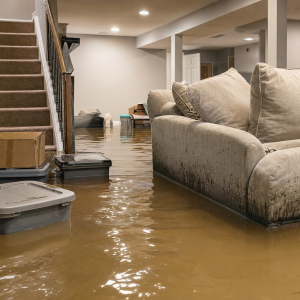
The only time you have a fighting chance at coverage is when the mold is the direct result of a sudden and accidental disaster that’s already covered—think a pipe suddenly bursting and flooding your basement. Even then, your insurer will look for any excuse to lowball or deny you.
The Hard Truth About Your Mold Coverage
Most homeowners are stunned when their insurance company, like State Farm or Allstate, denies their mold claim. These big insurers have spent decades carefully crafting policy language to protect their bottom line, not your home.
They draw a very clear, firm line between two kinds of water damage. This one distinction is the battleground where the vast majority of mold claims are fought and lost, often against an adjuster determined to find a reason to say no.
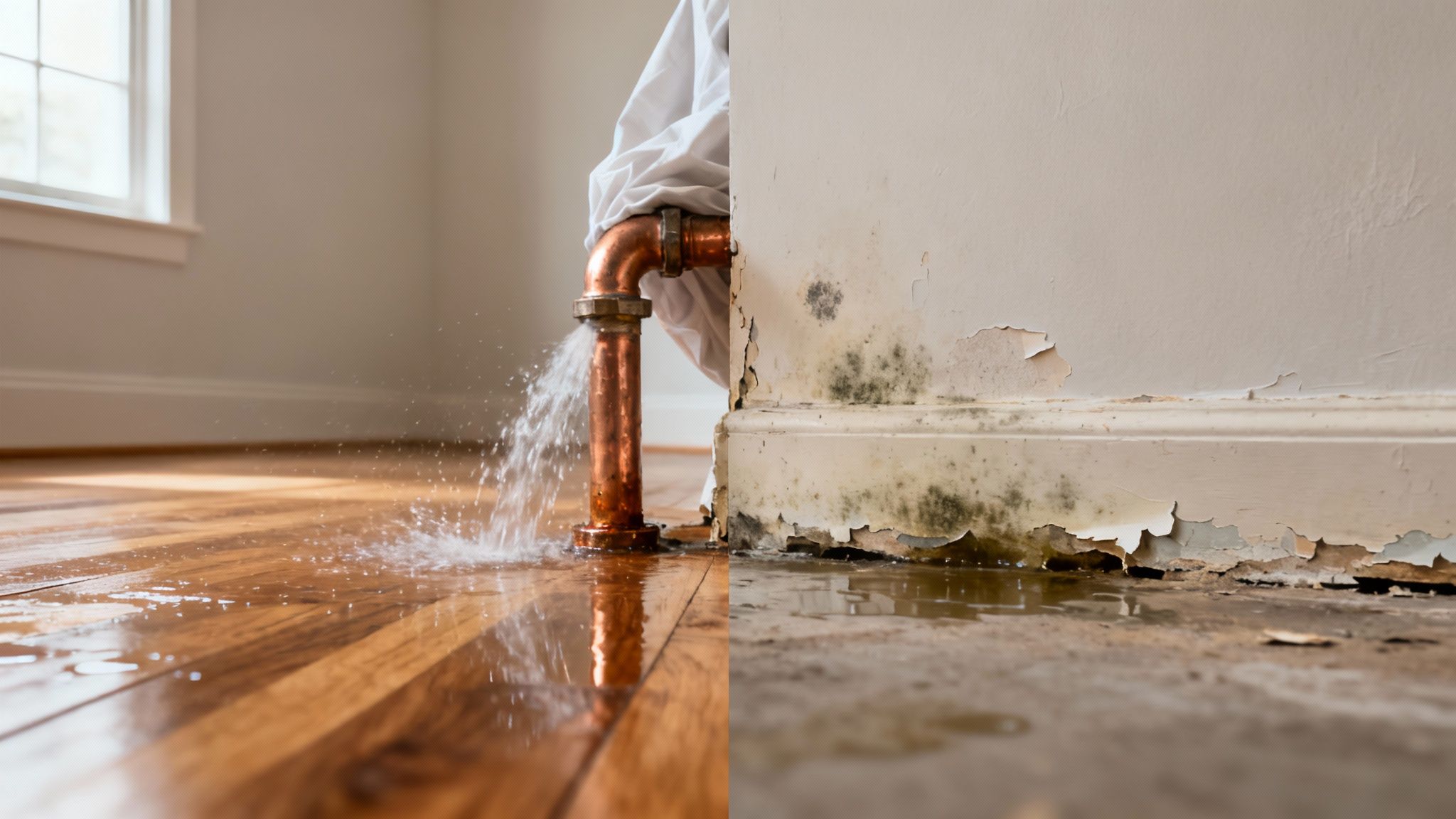
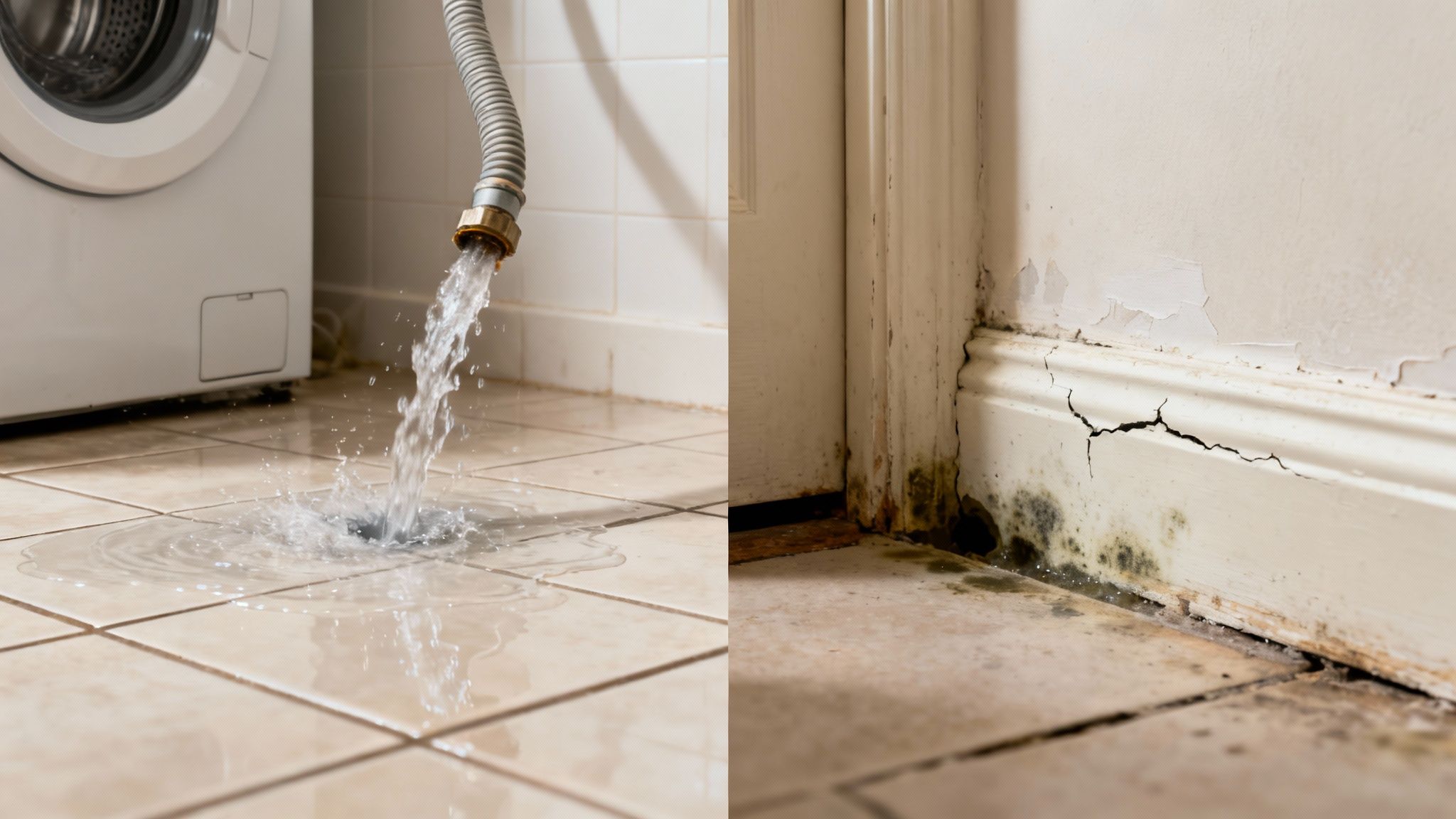
The whole game boils down to whether the water came from a "covered peril" or from gradual damage. A covered peril is something unexpected and catastrophic, like a washing machine hose snapping and dumping gallons of water across your laundry room floor.
Gradual damage, on the other hand, is the slow stuff. A tiny, seeping leak behind a wall, high humidity in a stuffy attic, or condensation from a window. Insurers like Allstate and Nationwide love these situations. They call them "maintenance issues," which is their coded language for, "This is your problem, not ours. Claim denied."
Sudden Accident vs. Gradual Neglect
The insurance company’s playbook is simple and ruthless. If the mold grew because of a sudden, accidental event they already cover (like that burst pipe), you have a fighting chance. But if it’s from neglect, poor maintenance, or general flooding, the door is slammed shut.
This is the tripwire for countless homeowners. That slow drip under the sink you meant to fix? The window that’s been foggy for years? Your insurer sees that as neglect. Their policies are crystal clear: they don't pay for problems that fester over time due to wear and tear or a lack of upkeep.
This flowchart is a perfect visual of how an insurance adjuster is trained to think when they see a mold claim. Their job is to find the path to denial.
As you can see, the path to a denied claim is paved with slow leaks and long-term water issues. Insurers have a name for that: homeowner neglect. And they will use it against you.
When Is Your Claim Destined for Denial?
Before you even think about filing a claim, your first job is identifying the unmistakable signs of mold in your home. Once you know you have a problem, the entire case will hinge on where the moisture came from.
Your insurance company's adjuster is trained to be a detective. Their one and only goal is to find any shred of evidence pointing to a long-term issue. They want to reclassify the cause from a "sudden event" to "gradual damage" because that gives them all the justification they need to deny your claim flat out.
To give you a clearer picture, let's break down a few common scenarios. This table gives you a realistic look at how an insurer will likely see your claim, especially if you're a homeowner in North Carolina or Virginia.
Mold Coverage Scenarios At a Glance
| Scenario | Likely Covered? | Why an Insurer Will Fight You |
|---|---|---|
| Burst pipe floods a room | Yes, with limits | The damage was sudden, accidental, and from a covered peril. |
| Slow leak from a toilet base | No | Considered a maintenance issue that developed over time (gradual damage). |
| Roof leak after a hailstorm | Yes, with limits | The storm is a covered peril; the resulting water damage is direct. |
| Mold from bathroom humidity | No | Caused by poor ventilation, which they'll call a homeowner maintenance responsibility. |
| Washing machine hose breaks | Yes, with limits | A classic example of a sudden and accidental failure of an appliance. |
| Leaky window seals | No | This is wear and tear and falls under the gradual damage exclusion. |
| Sump pump failure during a storm | Maybe | Coverage often depends on a specific endorsement they hope you don't have. |
| Foundation cracks letting water in | No | Almost always considered a maintenance issue or a pre-existing problem. |
Think of this table as a quick gut check. If your situation looks more like the items on the right side of the chart, you have a serious fight on your hands.
Why Your Insurer Is Terrified of Mold Claims
To really understand why your insurance company fights you tooth and nail on mold, you have to look back at the one event that sent the whole industry running for the hills. Before the early 2000s, mold damage was often covered. But insurance giants got greedy and scared, and they rewrote the rules to protect themselves.
That all changed with a single, seismic court case.
This case wasn't just a loss for one insurer; it was a blaring alarm that threatened their entire business model. The verdict kicked off an industry-wide panic, leading directly to the confusing and restrictive policy language homeowners in North Carolina and Virginia are stuck with today.
Make no mistake: this isn't about fair coverage. It’s about an industry that systematically rewrote the rules to protect its own profits, leaving you to pay the price.
The Verdict That Changed Everything
The whole story starts with the now-infamous 2001 Ballard verdict out of Texas. A jury awarded a homeowner a staggering $32 million for a toxic mold claim against Farmers Insurance.
Insurers freaked out. They coined the term "mold stampede" to describe the wave of claims they were sure would bankrupt them. They immediately launched a massive lobbying effort, and it worked. By 2003, around 40 state insurance departments had approved sweeping mold exclusions or strict limitations on policies. As the consumer advocacy group United Policyholders details on UPhelp.org, insurers have long considered mold far too risky to cover properly.
This historical panic is the reason for the insulting coverage limits you see today. A major carrier might offer a measly $5,000 for mold cleanup after a covered water loss, when the real remediation bill can easily blow past $20,000. They designed a system where even when you "win," you still lose.
Engineering the Denial
The Ballard case taught insurers a very expensive lesson: ambiguity in a policy costs them money. To make sure they never got hit with another multi-million-dollar payout, they went to work systematically engineering denials right into their policy language.
Here’s how they did it:
- Adding specific mold exclusions: They added explicit language stating that mold, fungus, and rot are flat-out not covered—unless they are the direct result of a very narrowly defined "covered peril."
- Imposing strict sub-limits: They slapped low dollar caps on any mold remediation, guaranteeing that even if they were forced to pay, their financial bleeding would be minimal.
- Shifting the burden of proof: The new policy language puts the entire burden on you, the homeowner. You now have to prove the mold came from a sudden, accidental event, giving the adjuster all the ammunition they need to argue it was "gradual" damage or a maintenance issue.
This wasn’t just some minor policy update. It was a strategic overhaul designed from the ground up to make mold claims nearly impossible to win without a bare-knuckle fight. Insurers like State Farm and Allstate didn't just limit your coverage; they built a fortress of legal jargon to protect themselves.
So today, when you ask, "does homeowners insurance cover mold?" the answer is a complicated mess because the industry made it that way on purpose. Their adjusters aren't looking for ways to help you. They are trained to hunt for reasons to deny you, all because of a decades-old fear of another massive verdict. They rewrote the rulebook to make sure they’d never be on the hook again.
Sudden Damage Versus Gradual Neglect Explained
When you file a mold claim, your insurance company doesn’t see a homeowner in crisis. They see a simple, two-path flowchart. One path leads to a potential payout. The other, far more traveled route, leads to a swift denial.
The entire fate of your claim hangs on one critical distinction: sudden and accidental damage versus gradual neglect.
Think of it like this. A burst washing machine hose that floods your laundry room is a sudden, chaotic event. It's a house fire, but with water. It happened at a specific moment in time, which forces your insurer to at least acknowledge it, making it much harder to deny outright.
Gradual damage is the complete opposite. It’s the slow, silent enemy—that tiny drip behind the drywall, a poorly sealed window, or the relentless humidity of a North Carolina or Virginia summer. Insurance companies love this scenario. Why? Because it lets them shift the blame entirely onto you.
The Adjuster's Hunt for Homeowner Neglect
Let’s be brutally honest: from the moment an insurance company's adjuster steps onto your property, they are not there to help you. Their job is to find any evidence, no matter how small, that points to a long-term problem. They are trained to hunt for signs of homeowner neglect to justify killing your claim.
They'll be looking for things like:
- Old water stains: That faint ring on the ceiling from months ago? To them, that's "proof" you ignored a known leak.
- Caulking and seals: Cracked caulking around a tub or window is immediately re-framed as your failure to maintain the property.
- Lack of ventilation: They’ll argue that humidity-related mold in a bathroom or attic is your fault for not running a fan or opening a window.
It’s a tough pill to swallow, but while some water damage is sudden, issues that require you to fix leaking windows that then lead to rotten wood and mold are almost always considered gradual neglect. The insurer will build a narrative that you, through inaction or poor upkeep, allowed the problem to fester. This narrative is their primary weapon.
The Burden of Proof Is on You
Here’s the most unfair part of this whole game: the burden is 100% on you to prove the water damage was sudden and accidental. The insurance company holds all the cards. They have their own adjusters, engineers, and a team of lawyers ready to argue that your mold problem is a pre-existing condition born from neglect.
Your policy is a complex legal contract, and insurers like Allstate and State Farm wrote it that way on purpose. They deliberately use vague terms like "long-term seepage" and "repeated leakage" to give their adjusters maximum leeway to interpret the damage in their favor.
This is the battleground where most homeowners lose. You might know for a fact the pipe just burst last Tuesday, but if the adjuster finds a hint of rust or a pre-existing moisture stain, they will use it to build a case against you.
To have any chance of countering their arguments, you have to understand the fine print. Learning how to read your insurance policy is your first line of defense. Without an expert on your side who understands their tactics and can present compelling evidence to the contrary, you're fighting an uphill battle you are almost certain to lose.
The Hidden Costs and Penalties of Filing a Mold Claim
So, let's say you fight the good fight and your mold claim actually gets approved. You might feel a wave of relief, but the financial nightmare is often just getting started. Insurance companies have turned punishing policyholders into an art form, and they have a whole playbook of hidden costs, insultingly low limits, and harsh penalties that can leave you worse off than before.
This isn't just about getting a check in the mail. It's about surviving the fallout from daring to use the policy you pay for every month. The game is rigged. Insurers have built a system where even a "win" feels like a crushing loss, making it painfully clear why you need a public adjuster in your corner.
The Illusion of Coverage: Mold Sub-Limits
Buried deep in your policy's fine print, you’ll likely find a nasty little surprise called a mold remediation sub-limit. This is a classic insurance company tactic to cap their payout at a ridiculously low amount. It's not uncommon to see limits of just $5,000 or $10,000.
That might sound like a decent chunk of change until you get a real quote from a remediation company. A serious mold problem, especially one that has crept into your walls or HVAC system, can easily cost $20,000 to $30,000—or more—to fix properly. Your insurer knows this. They set the limit just high enough to look like they're helping, but low enough to guarantee you're left holding the bag for the majority of the cost.
This isn't an accident; it's a deliberate strategy. The insurer pays out a tiny fraction of the real cost, closes your claim, and pats themselves on the back for their "great service," while you’re left draining your savings or taking out loans just to make your home safe again.
Deductibles That Devour Your Payout
On top of those suffocating sub-limits, you still have to fork over your deductible. In the last few years, insurance companies have been aggressively pushing for higher deductibles to discourage you from filing claims in the first place. Today, a $2,000 or even $5,000 deductible is pretty standard.
Let's do the simple math they hope you won't. Say you have that $10,000 mold sub-limit and a $2,500 deductible. The absolute most you can ever get from your insurance company is $7,500. When the actual remediation bill comes in at $22,000, you’re still on the hook for a soul-crushing $14,500. That's how a "covered" claim becomes a financial disaster.
Consumer advocates like United Policyholders have highlighted this massive coverage gap for decades, yet insurers have done nothing to close it. This is exactly why a public adjuster’s no-cost claim review is so critical—it's your first line of defense against an insurer determined to underpay.
The Ultimate Penalty: Policy Non-Renewal
Here it is—the most cynical move in the insurance company's playbook. After you’ve gone through the whole agonizing ordeal of fighting for your claim, they can just kick you to the curb and non-renew your policy. The moment you file a significant water or mold claim, a big red flag goes up, and you're branded as "high risk."
Insurers share your claims history through a database called the Comprehensive Loss Underwriting Exchange (CLUE). A water damage claim on your CLUE report can make it incredibly difficult—and wildly expensive—to find new coverage. Many carriers will flat-out refuse to insure a property with a history of water claims, leaving you with few, if any, options.
Think about that. You're punished for having a problem, and then you're punished again for asking the company you paid for protection to help you fix it. This is the reality of dealing with giant insurance corporations.
How a Public Adjuster Can Win Your Mold Claim
Let's be blunt. Filing a mold claim on your own is like walking into a legal battle unarmed. Your insurance company has a team of adjusters, engineers, and lawyers whose entire job is to protect their bottom line by lowballing and delaying your claim—not helping you. To even the odds, you need an expert in your corner who works only for you.
That expert is a public adjuster. Think of them as your licensed advocate, your strategist, and your frontline soldier in the fight. Unlike the company adjuster who gets a paycheck from your insurer, a public adjuster’s loyalty is exclusively to you, the policyholder. Their mission is simple: to dismantle the insurance company's weak arguments and get you the full and fair settlement you're owed.
Dismantling the "Gradual Damage" Excuse
The most common denial tactic you'll face is the "gradual damage" or "poor maintenance" excuse. It's the insurance company's go-to move. A public adjuster attacks this argument head-on with science and hard evidence. They don't just accept the insurance company's opinion; they bring in their own team of certified pros to prove exactly where the mold came from.
This isn't guesswork. It's a forensic investigation:
- Independent Moisture Mapping: A public adjuster uses high-tech tools like thermal imaging cameras and non-invasive moisture meters to trace the water back to its source. This creates a scientific map that pinpoints where and when the water got in.
- Forensic Documentation: They connect the dots between the mold and a covered event. For example, after a storm with heavy winds, they can prove how wind-driven rain got behind your siding or under your roof shingles, directly causing the mold. This blows up the insurer's lazy claim of a "pre-existing leak."
- Expert Policy Analysis: Public adjusters live and breathe insurance policies. They know every loophole, exclusion, and endorsement. They use this deep knowledge to shred the insurance company’s self-serving interpretations and hold them to the contract you paid for.
A public adjuster is your best weapon to fight back when your insurer is acting in bad faith.
Case Study: Turning Denial Into Dollars
Consider a family in Apex, NC. After a nasty thunderstorm, they found a massive mold bloom in their upstairs bonus room. Their insurance company—a huge national carrier—sent out their adjuster who snapped a few photos, pointed at some minor staining on a window seal, and denied the claim. The reason? "Long-term seepage" and "lack of maintenance." The family was left holding a denial letter and a gut-wrenching estimate for over $25,000 in repairs.
Feeling completely powerless, they called us. Our team immediately launched a full-scale counter-investigation.
- We brought in an IICRC-certified water damage expert who used thermal imaging to map the hidden moisture in the walls and ceiling.
- The camera didn't lie. It showed a clear path of water coming from the roof flashing, which had been lifted by the storm's high winds—a textbook covered peril.
- We documented everything in a detailed report, complete with meteorological data from the day of the storm, proving the damage was sudden and accidental.
Armed with this undeniable proof, we reopened the claim and went back to the insurance company. Their flimsy "gradual damage" excuse crumbled under the weight of our evidence.
The result? A complete 180-degree turn. The claim went from a $0 denial to a full settlement of over $28,000. This covered the mold remediation, the roof repair, new drywall, insulation, and painting.
This case says it all. Without an expert fighting for them, this North Carolina family would have been stuck paying for everything out of pocket, all because their insurer tried to protect its profits instead of honoring its promise.
Special Mold Risks for NC and VA Homeowners
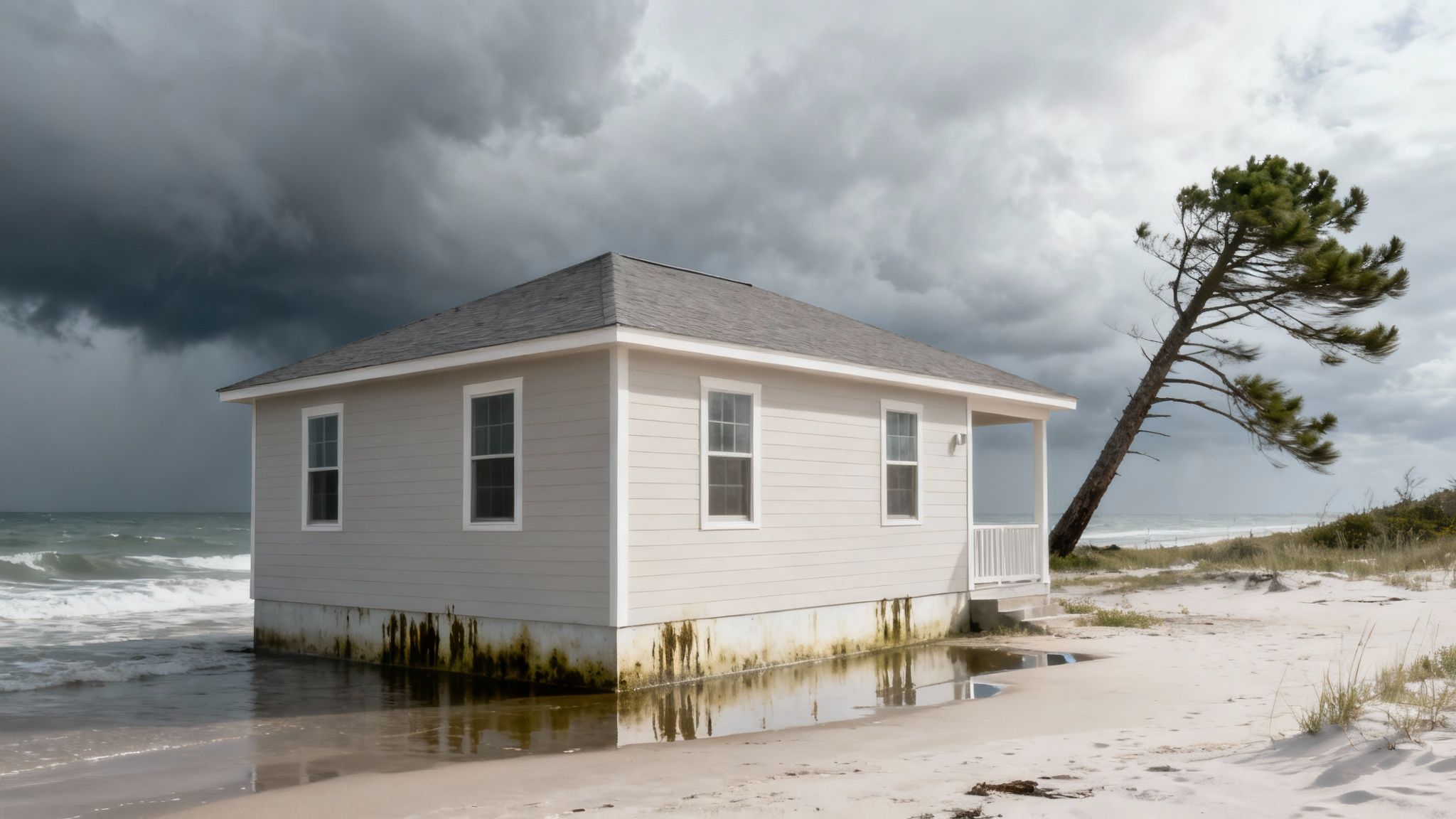
If you’re a homeowner in North Carolina or Virginia, you’re on the front lines. You know the brutal combination of relentless humidity, destructive hurricanes, and the constant threat of flooding. This creates a perfect storm for mold to take over your home, but your standard homeowners policy offers almost zero real protection against these specific threats.
Let’s be blunt: mold caused by flooding is never covered by a standard homeowners insurance policy. Period. For that, you must have a separate flood policy, usually through the notoriously difficult National Flood Insurance Program (NFIP). NFIP claims are a nightmare of red tape and lowball offers from adjusters who are not on your side. Fighting them requires a public adjuster who specializes in the complex and frustrating NFIP process.
The Wind-Driven Rain Deception
After a hurricane, insurers have another dirty trick ready to go: the "wind-driven rain" exclusion. Adjusters from companies like State Farm and Allstate will march into your damaged home and argue that the water didn't come from a hole the wind punched in your roof (a covered event).
Instead, they’ll claim the water was simply pushed through existing gaps around your windows or under your doors. By calling it a maintenance issue or a form of flooding, they have their excuse to deny your claim flat out. A good public adjuster knows exactly how to dismantle this bogus argument. They bring in their own engineers and building consultants to prove the hurricane winds created an opening, which makes the resulting water damage and mold a covered loss.
Insurance companies exploit the chaos after a storm. They bank on you being too overwhelmed to fight back against their confusing terminology and bad-faith denials. They will use any excuse they can find to avoid paying for expensive, widespread damage.
Even if your claim is legitimate, filing it can feel like a trap. As reported by consumer groups, many claims end with the insurance company dropping the homeowner entirely, leaving them uninsured right when they need protection the most. You can read more about how insurers have long viewed mold as too risky to cover on UPhelp.org. This is exactly why having local, expert representation isn't just a good idea—it's non-negotiable.
Frequently Asked Questions About Mold Insurance Claims
When your mold claim gets denied or the offer is a joke, a million questions start racing through your mind. Let's cut through the insurance company's double-talk and get you some straight answers. The most important thing to remember is this: your insurer is not your friend, and you're going to need a professional in your corner.
My Insurer Denied My Claim Citing Poor Maintenance What Do I Do Now
This is the oldest trick in the insurance company’s playbook. They love to use "poor maintenance" as a blanket excuse to point the finger at you and slam the door on your claim. Do not take this initial denial as the final answer. It’s just their opening move to get you to give up.
They’ll claim anything from a worn-out window seal to a tiny bit of rust on a pipe is "proof" that you neglected your property. Your very first move should be to contact a public adjuster. We bring in our own network of engineers and building experts to give a real, unbiased assessment that blows their flimsy excuse out of the water and proves the mold was caused by a covered disaster.
Should I Clean Up The Mold Before The Insurance Adjuster Arrives
Absolutely not. It's one of the biggest mistakes you can make. While you absolutely have a duty to stop the source of the water—like shutting off the main valve if a pipe bursts—tearing out or cleaning the mold yourself is a gift to the insurance company.
Why? Because they will immediately argue that you destroyed the evidence. It gives them the perfect out to deny your claim or slash their offer, saying they can't verify the extent of the damage. A public adjuster makes sure everything is meticulously documented with photos, moisture readings, and professional testing before a single thing is touched. This creates an ironclad record of your loss.
Never, ever remove damaged materials before they have been professionally inspected. The insurance company's adjuster will use it against you, arguing the damage wasn't that bad or even that you're acting in bad faith.
Is A Special Mold Rider Or Endorsement Worth The Cost
It might help a little, but it's no silver bullet. These endorsements typically just raise your coverage limit from a laughably low amount, like $5,000, to a slightly less insulting one, like $15,000. But they don't change the fundamental rules of the game.
The mold still has to come from a covered event. If the insurance company denies your claim because the cause was "gradual leakage" or a flood, that fancy endorsement is completely worthless. It's a band-aid the industry invented to create a false sense of security. A good public adjuster can tear apart your policy and show you whether that rider offers any real protection or if it's just another empty promise.
When your insurance company starts playing games with your mold claim, you need an expert on your side of the table. The team at For The Public Adjusters, Inc. fights for homeowners across North Carolina and Virginia to get the settlement you are owed. Contact us for a no-cost claim review today at https://forthepublicadjusters.com.


Trackbacks/Pingbacks