When you file an insurance water damage claim, you expect the company you’ve paid for years to have your back. But the hard truth is, the moment your claim is filed, you shift from a valued customer to a line item on their expense report. Insurers like State Farm, Allstate, and their peers are multi-billion dollar corporations, and they didn’t get that way by paying claims fairly.
Their goal is singular: to pay you as little as legally possible. They send their own adjusters, hide behind complex and confusing policy language, and turn what should be a straightforward recovery process into a brutal fight for every dollar you are rightfully owed. This isn’t a partnership; it’s a battle, and they are counting on you being too overwhelmed to fight back.
Why Your Water Damage Claim Was Instantly Undervalued
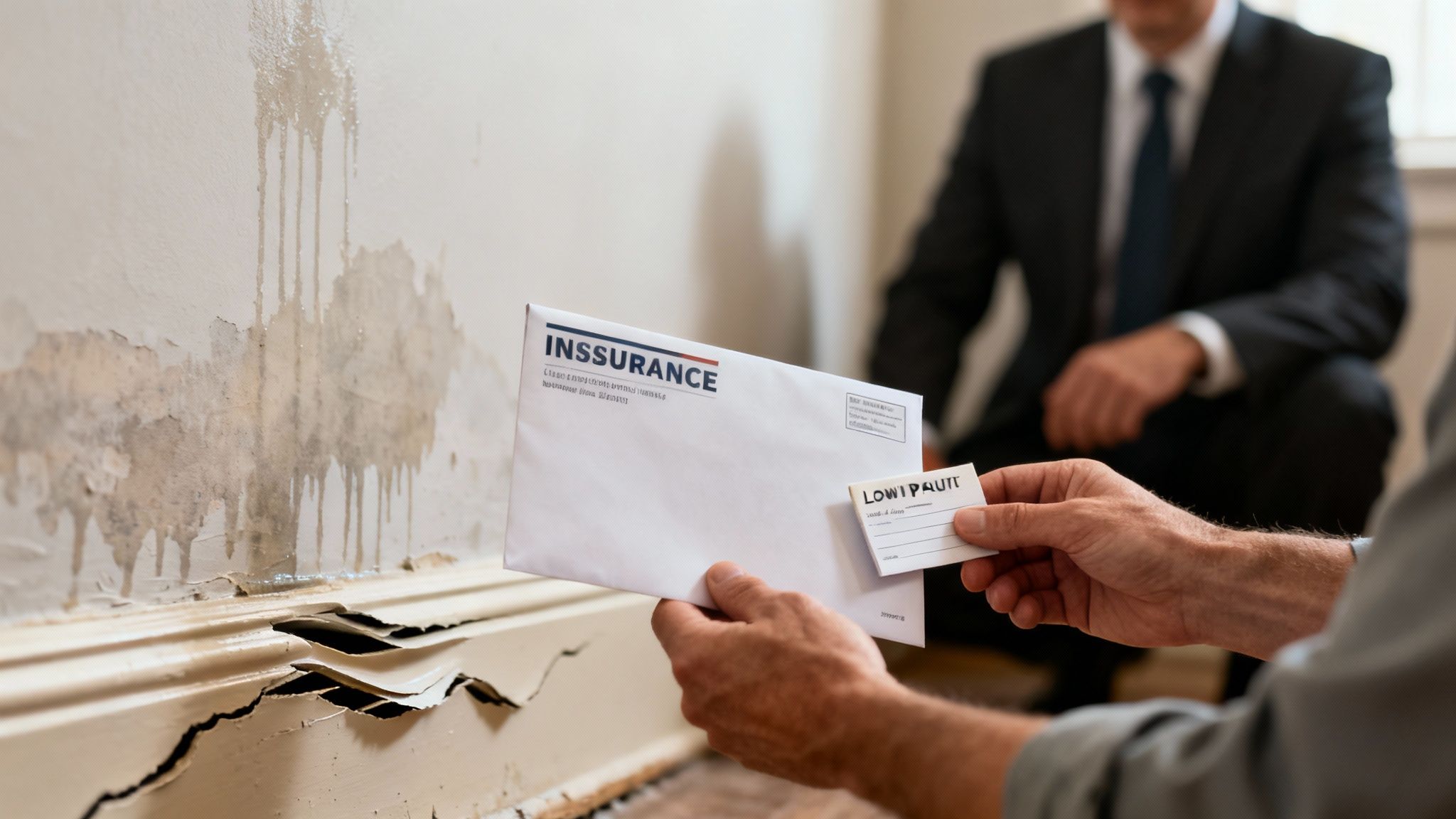
From the second you report the loss, the insurance company’s machine kicks into gear. Its one and only purpose? To protect its bottom line at your expense.
This isn’t a good-faith effort to get your home or business back to normal; it’s a financial negotiation where you start at a massive disadvantage. Big insurers run the same playbook every time, and it starts with them controlling the narrative and the numbers from day one.
Their first move is sending their staff adjuster or a so-called “independent” adjuster. Don’t let the title fool you. This person works for and is paid by the insurance company, and their job is to find ways to limit the payout and close your claim as cheaply as possible. This almost always results in a rushed, superficial inspection where they conveniently ignore hidden moisture, downplay the potential for mold, and overlook unseen structural problems.
That Lowball Offer Is a Strategy, Not a Mistake
That first settlement offer you get? It’s almost never the real value of your claim. It’s a calculated opening bid in a negotiation they hope you don’t realize you’re in. They are betting on your stress, your desperation, and your lack of expertise to get you to take a quick, low check without asking questions.
Insurers have a few go-to tactics to justify these insulting low offers:
- Arguing the Cause: They will dig deep to determine if the damage was “sudden and accidental” (covered) or “gradual” (not covered). A slow, hidden leak is one of the most common reasons they’ll deny a claim, even if you had no way of knowing it was there.
- “Preferred” Vendors: They’ll often push you to use their network of contractors. These vendors have pre-negotiated rates that save the insurance company money, but that doesn’t mean they’ll do the best quality work for you. Their loyalty is to the insurer who sends them a steady stream of business, not to you.
- Bad Math: They rely on estimating software that aggressively depreciates the value of your damaged property. They also use national cost databases that rarely reflect the actual cost of materials and skilled labor in your specific area.
The Gradual Damage Trap
The “gradual damage” exclusion is the insurance company’s favorite escape hatch. They’ll argue that the damage came from a long-term leak that you should have fixed as part of routine maintenance, essentially blaming you for the problem.
When a leak has been festering behind a wall for weeks or months, even without your knowledge, they’ll use it as grounds to deny or drastically underpay your insurance water damage claim. Finding the true source and timeline of a leak is critical, which is why professional water leak detection services can be so important in proving your case.
The entire system is designed to put the burden of proof on you. You have to prove every single dollar of your loss, while the insurer’s team actively works to disprove it.
You’re set up to lose unless you take back control. This is where a public adjuster becomes your most powerful weapon. We work only for you, not the insurance company. We level the playing field by conducting our own forensic inspection, documenting everything, and fighting to get you the settlement you’re actually owed under your policy.
Decoding the Policy Language They Hope You Ignore
Let’s be clear: your homeowners or business owners policy isn’t a helpful guide. It’s a dense legal contract, meticulously crafted by insurance company lawyers with one primary mission—to limit what they have to pay out.
Insurers like Allstate and State Farm are banking on the fact that you’ll be too overwhelmed by the disaster to scrutinize the fine print. This allows them to weaponize obscure clauses to deny or drastically underpay your legitimate insurance water damage claim.
Understanding this language isn’t just a good idea; it’s your first and most powerful line of defense. When an adjuster casually tells you something isn’t covered, you need to know whether they’re stating a fact or just hoping you’ll take their word for it. This knowledge lets you fight back from a position of strength, not desperation.
Sudden and Accidental vs. Gradual Damage
This is where the gloves come off in most water damage disputes. Insurers absolutely love the “gradual damage” exclusion. It’s their favorite catch-all excuse to deny claims for those slow, hidden leaks behind walls, under floors, or in ceilings.
- Covered Scenario: Imagine a pipe under your kitchen sink suddenly bursts, sending water gushing across the room. This is a classic “sudden and accidental” event. The resulting nightmare—ruined cabinets, warped floors, and soggy drywall—should be covered.
- Denied Scenario: Now, picture that same pipe having a slow, barely perceptible drip for months. It goes completely unnoticed, causing wood rot, subfloor decay, and a nasty mold problem. The insurer will almost certainly deny this claim, arguing it’s “gradual” damage caused by poor maintenance.
They’ll put the burden of proof squarely on your shoulders, arguing you should have known about a leak you couldn’t even see. It’s a classic tactic to shift blame and avoid payment.
The Myth of Flood Coverage in a Standard Policy
Let’s get this straight, because it’s a brutal lesson for thousands of property owners every year: your standard homeowners or dwelling policy does not cover flood damage. Period.
Insurers have a very specific definition of a “flood”: it’s rising surface water entering your home from the outside. Think storm surge, overflowing rivers, or torrential rains that saturate the ground and seep into your foundation. For that kind of catastrophe, you need a separate policy, usually from the National Flood Insurance Program (NFIP). Without it, you’re on your own.
“When we first filed the claim our selves, the insurance company offered a little over $20,000 for our loss. When it was all said and done, we received just shy of $60,000. Public adjusters are worth their weight in gold.” – Adam W., Google Review
This distinction is a weapon for them. After a hurricane, an adjuster might try to classify rainwater pouring through your storm-damaged roof as “flooding” to get out of paying the claim under your standard policy. Don’t fall for it.
Common Insurer Excuses vs. Your Reality
When your claim is on the line, the adjuster isn’t your friend; they’re an employee trained to protect the company’s bottom line. They have a playbook of excuses designed to make you give up. Here’s a look at what they say, what it really means, and how you can push back.
| Insurer’s Tactic or Excuse | What It Really Means for You | Your Proactive Counter-Strategy |
|---|---|---|
| “This is gradual damage from a long-term leak, so it’s a maintenance issue.” | “We’re blaming you for a problem you likely couldn’t see, so we don’t have to pay.” | Document everything. Show evidence that the source of the leak was hidden. Get a plumber’s report confirming the sudden nature of the failure. |
| “The water damage is from ‘flooding,’ which your policy doesn’t cover.” | “We’re trying to use a technicality to avoid paying for storm or rain damage that should be covered.” | Firmly establish the source of the water. If it came from a failed roof or wind-driven rain, it’s not a “flood” by policy definition. |
| “We’ll only pay to dry the wet spot, not to replace the entire damaged floor.” | “We’re trying to patch the problem instead of restoring your property to its pre-loss condition.” | Argue for “matching.” Most policies require the insurer to restore the property’s appearance, which means replacing the entire floor if a patch won’t match. |
| “Mold isn’t covered” or “Mold coverage is capped at a very low limit.” | “We’re using the mold exclusion to avoid paying for a proper tear-out and remediation of water-soaked materials.” | Frame the issue as a “water damage” problem. The mold is a symptom of the covered water loss. Argue that proper water damage repair prevents mold. |
Don’t let these tactics intimidate you. An informed policyholder is an insurer’s worst nightmare. By understanding their game, you can prepare your counter-moves and fight for the settlement you deserve.
Understanding “Ensuing Loss”
Here’s another legal rabbit hole they love to lead you down: “ensuing loss.” It’s a tricky concept. In some cases, a policy will exclude the initial cause of the damage (like that slow, gradual leak) but will cover the separate damage that results from it.
For instance, your policy won’t pay to fix the old, corroded pipe itself. But if that slow leak causes an electrical short that starts a fire, the “ensuing” fire damage may actually be covered.
These provisions are a minefield. Company adjusters often misinterpret them—intentionally or not—to minimize your payout. Winning a claim based on an ensuing loss clause requires a rock-solid understanding of policy language. It’s one of the key areas where you can learn more about how to read an insurance policy in our detailed guide to arm yourself.
Knowing these terms flips the power dynamic. You go from being a passive victim of circumstance to an informed advocate who can challenge flimsy excuses and demand the full coverage you’ve been paying for.
Building an Ironclad Case to Maximize Your Settlement
Let’s be blunt: a poorly documented water damage claim is a gift to your insurance company. It’s the green light they’re looking for to delay, dispute, and ultimately underpay what you’re rightfully owed.
If you want to fight back against the inevitable lowball offer, you need to build a case so detailed and undeniable that it leaves them no room to argue. This isn’t about just snapping a few photos with your phone. You’re walking into a negotiation, and every single piece of evidence is a bargaining chip. The mission is to prove the full extent of your loss so thoroughly that their adjuster has nowhere to hide and no corners to cut.
Go Beyond Photos and Videos
Photos and videos are absolutely critical, but they’re just the opening act. To really build an ironclad case, your documentation has to be almost forensic in its detail. You need to think like a public adjuster and collect every scrap of proof you can get your hands on.
Your visual record has to be exhaustive. I’m talking about:
- Wide-angle shots of every single affected room to show the big picture.
- Close-up shots of every damaged item. Get detailed photos of furniture, warped flooring, soaked drywall, and fried electronics.
- Walk-through videos where you narrate what you’re seeing. Move slowly. Open up cabinets, pull back carpets, and zoom in on moisture readings on the wall.
This level of detail shuts down the common tactic where the company adjuster tries to claim that some of the damage wasn’t part of the original water event.
Create a Meticulous Inventory of Damaged Property
The adjuster’s initial estimate will likely be a vague, jumbled mess that groups items together and uses generic, low-cost pricing. Your job is to counter that with a painfully detailed, itemized list of everything—and I mean everything—that was damaged or destroyed.
For every single item, you need to document:
- A specific description (e.g., “Samsung 65-inch 4K Smart TV,” not just “TV”)
- The make and model number if you can find it
- Its approximate age and what you originally paid for it
- A link to a comparable replacement item for sale online right now to establish its current market value
This detailed inventory isn’t just for your records; it’s a foundational part of the formal Proof of Loss form your insurer will require. Getting this right is non-negotiable.
Demand the Data and Get Your Own Estimates
Don’t be fooled. The insurance company’s “preferred vendors” are not your friends. They have a cozy relationship with the insurer that often hinges on keeping repair costs down. You have to seize control of the estimates.
“From start to finish our experience with this company was great. They were very thorough in their inspections, communicated and responded quickly, answered any questions that we had, and were very professional and helpful throughout the entire process.” – Brooke T., Google Review
Instead of just accepting their numbers, go out and get at least two of your own independent estimates from contractors you trust. Make sure these estimates are incredibly detailed, breaking down every cost for labor, materials, and any necessary permits. This creates a powerful counter-argument to the lowball figure their adjuster will almost certainly present.
On top of that, if a water mitigation company was involved, you must demand a full copy of all their reports. This includes their moisture meter readings, any thermal imaging reports, and the daily drying logs. This data is the hard evidence that proves the true extent of the water saturation. It’s what justifies tearing out and replacing materials, not just a superficial and ineffective attempt to dry them out. This is especially crucial when a burst pipe has sent water spreading far beyond the initial break.
The chart below shows how different types of water damage—from a sudden burst pipe to a slow, hidden leak—can play out in the claims process.
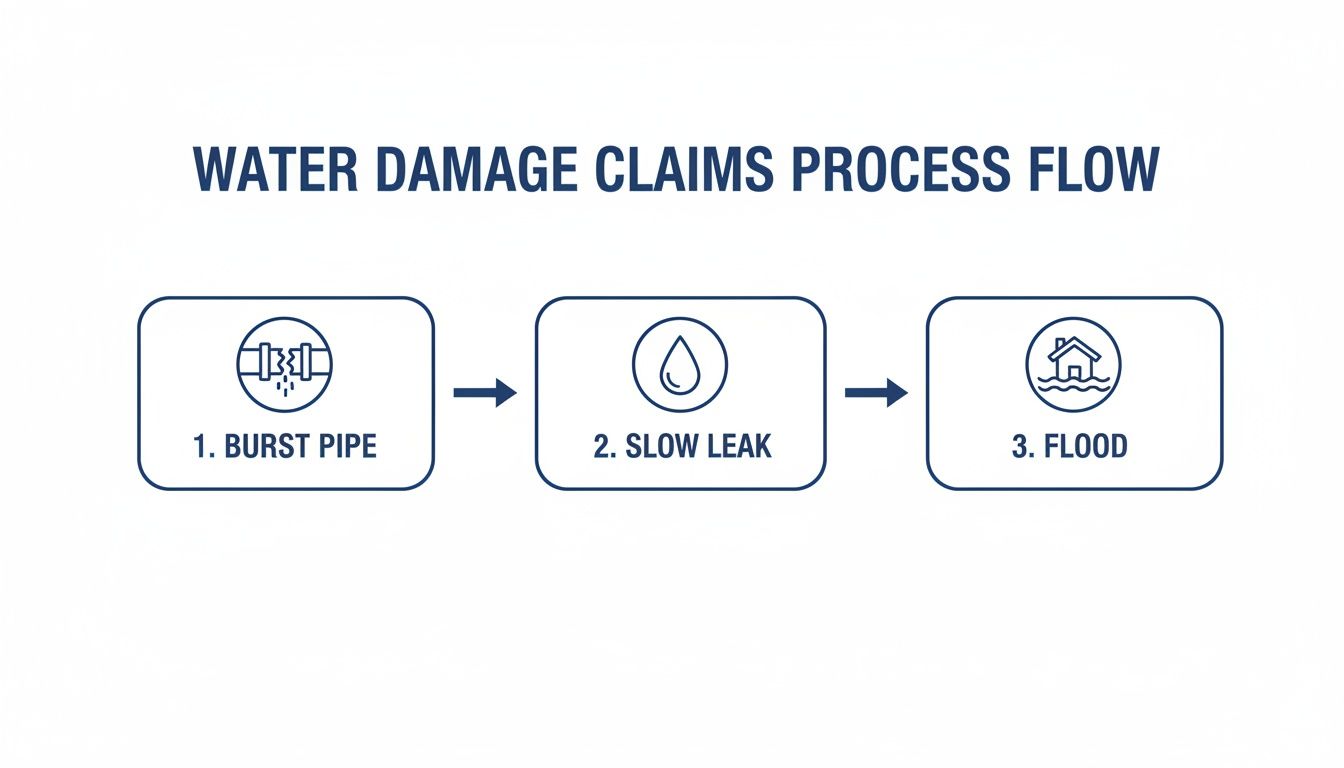
As you can see, no matter the source, the need for rigorous documentation is constant if you want to get a fair settlement.
Understanding the principles of thorough documentation is key. Many of these same evidence-gathering tactics apply to other claim types, which is why it’s also helpful to know the best way to file a roof insurance claim, especially since roof leaks are a common source of water damage. This mountain of evidence—your photos, videos, detailed inventory, independent estimates, and mitigation reports—is the leverage you need to fight back and secure the settlement you actually deserve.
How to Fight a Denied Claim and Turn the Tables
That denial letter from your insurance company? It’s meant to feel like a final blow—a punch to the gut designed to make you give up. It’s frustrating, infuriating, and exactly what the insurer is counting on.
They’re betting you’re too exhausted from the water damage, the mess, and the stress to fight back. They hope you’ll just accept their decision and walk away, saving them a massive payout.
Don’t give them the satisfaction. A denial isn’t the end of the road. It’s a signal that the time for being cooperative is over. It’s time to start demanding what you’re owed.
First, Demand Everything in Writing
Never, ever accept a claim denial over the phone. A verbal “no” from a company adjuster is completely meaningless and gives you nothing to fight against. Your first move is to formally demand they put their denial in writing.
This isn’t just about getting a letter. It’s about forcing them to go on record. In your request, you must demand two critical things:
- The exact policy language they are using to justify their decision. Make them point to the specific section, subsection, and sentence in your policy contract.
- All reports, photos, and expert opinions that led to the denial. This includes their adjuster’s moisture readings, any vendor reports, and all internal communications about your claim.
When you force them to put their reasoning on paper, you strip away their ability to hide behind vague excuses. That letter becomes the foundation of your entire dispute, giving you a specific target to dismantle.
Go Up the Chain of Command
Once you have that written denial in hand, stop wasting your breath on the adjuster who already said no. It’s time to escalate. Go straight up the chain of command and formally request to speak with a claims manager or supervisor.
When you get them on the phone, stay professional but firm. State that you are officially disputing the denial of your claim (give them the claim number) and start laying out why their decision is wrong, referencing the evidence you’ve collected. A manager has more authority to reverse a bad decision, especially when they realize you’re organized, informed, and not going away.
This is also the perfect time to light another fire under them by filing a formal complaint with your state’s Department of Insurance. It creates an official record of the dispute and puts regulatory pressure on the company to justify its actions.
Unleash the Power of a Public Adjuster
This is where the game completely changes. While escalating your claim and filing complaints are necessary steps, nothing turns the tables on an insurer like hiring a professional who works only for you. A public adjuster’s sole job is to fight for policyholders. They reopen, renegotiate, and win claims that insurance companies have wrongfully denied or shamelessly underpaid.
A prime example is the case of State Farm Lloyds v. Johnson, where a Texas jury found that State Farm had engaged in unfair and deceptive practices by wrongfully denying a water damage claim. The court upheld the verdict, sending a clear message that insurers can be held accountable for their bad-faith tactics. These victories prove that fighting back is not only possible but necessary.
A good public adjuster dismantles the insurance company’s denial piece by piece. They conduct their own forensic investigation, bring in their network of trusted experts, and build an airtight case that proves your claim is valid. They speak the insurance company’s language and know every sneaky tactic and loophole they use to avoid paying.
Bringing in a public adjuster sends a clear message: you will not be bullied. The fight is no longer an overwhelmed homeowner against a multi-billion-dollar corporation. It’s now a battle of experts.
And that shift in power is often all it takes to turn a hard “no” into a fair settlement check. Water damage claims are incredibly costly for insurers—severe storms alone caused billions in insured losses last year. These staggering costs give them a powerful incentive to deny claims whenever they think they can get away with it, making an expert advocate more critical than ever. Read the full research about these rising costs.
Navigating the NFIP Flood Claim Nightmare
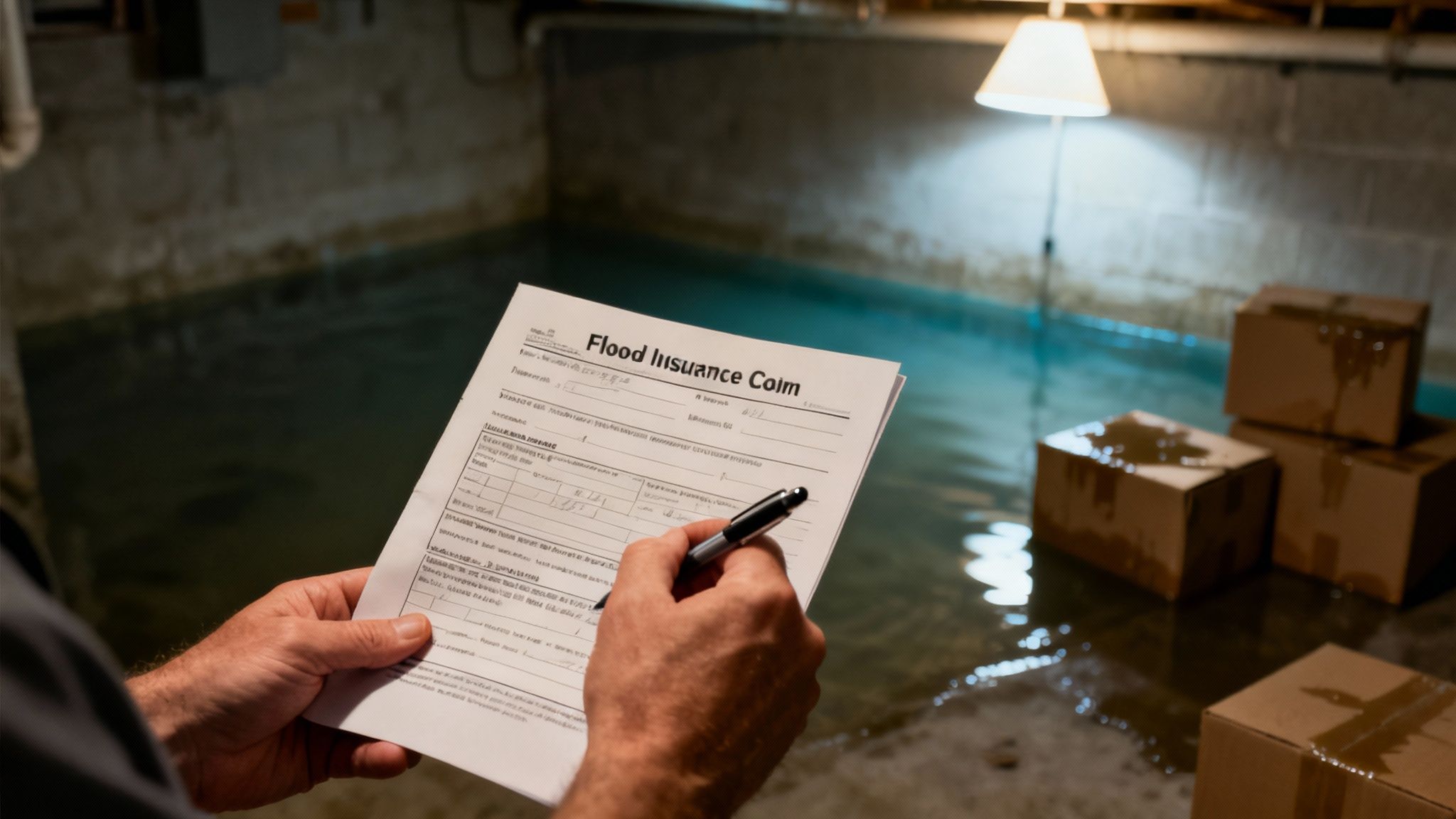
If the water damage in your home came from rising surface water—think storm surge, overflowing rivers, or flash floods—you’ve just stepped into an entirely different, and frankly, hostile world. You are now dealing with the National Flood Insurance Program (NFIP), and it is a bureaucratic nightmare.
This isn’t your local insurance agent. The NFIP is a federal program run by FEMA, and it plays by its own set of unforgiving rules. Even if you pay your premiums to a private company like Allstate or State Farm (known as a Write Your Own or WYO carrier), they are just contractors for the government. The adjusters sent by the NFIP or WYO are notorious for being incredibly strict, inflexible, and quick to deny anything that doesn’t fit perfectly within the NFIP’s rigid guidelines. They are difficult to deal with and are not on your side.
The System Is Built to Wear You Down
Let’s be blunt. An NFIP claim feels less like a request for help and more like a federal audit where you’re presumed guilty until proven innocent. The entire process is a minefield of brutal deadlines and unique paperwork that seems designed to trip you up.
The most critical weapon they use against you is the Proof of Loss (POL). This isn’t just a simple list of your damaged stuff. It’s a formal, sworn statement that must be perfectly filled out, signed, and in the insurer’s hands, usually within 60 days of the flood.
One mistake, one missed deadline, one tiny omission on this form is all they need to issue an immediate and often irreversible denial. There’s no room for error, and the adjuster sent by FEMA or the WYO carrier isn’t there to help you get it right. They often count on you getting it wrong.
Get Ready for Shocking Gaps in Coverage
Even if you manage to navigate the bureaucratic maze perfectly, you’re in for another nasty surprise: the NFIP policy is riddled with exclusions that leave homeowners with massive, unexpected bills.
Here are a few of the most brutal coverage gaps we see all the time:
- Basement Black Hole: Got a finished basement? Too bad. The NFIP offers virtually no coverage for anything below ground level. Finished walls, flooring, furniture, and most personal belongings stored down there are flat-out excluded.
- Nowhere to Live: If the flood makes your home uninhabitable, the NFIP will not pay a single dime for you to live somewhere else while it’s being repaired. This is called Additional Living Expenses (ALE), and it’s a standard part of most homeowner policies, but it’s completely absent here. You’re on your own for hotel bills or rent.
- Outside Stays Outside: Forget about damage to your deck, fences, swimming pool, landscaping, or septic system. That’s almost always excluded from coverage.
These gaps are financially devastating. They reveal the cold reality of the NFIP: it’s not designed to make you whole; it’s designed to limit the government’s financial exposure.
You Can’t Fight This Alone
Going up against an NFIP claim on your own is a recipe for financial disaster. The adjusters on the other side are federal specialists who will use every technicality against you.
To level the playing field, you need a public adjuster who specializes in the brutal, complex world of NFIP claims. A seasoned pro knows the deadlines, understands the intricate Proof of Loss requirements, and has the experience to counter the WYO adjuster’s lowball tactics. They take over the entire process for you, from documenting the loss down to the last nail to negotiating with the federal program on your behalf.
“Our home sustained flood damage from Hurricane Matthew. We could not get the insurance company to pay what we were entitled to and ended up hiring Scott from ‘For The Public Adjusters’. He was very professional and persistent and was able to get our claim resolved with us being fairly compensated. I would highly recommend their services!” – Lynn C., CustomerLobby Review
Don’t ever mistake a flood claim for a typical insurance water damage claim. They are two completely different beasts. You can check out our guide on navigating flood damage to learn more about this unique challenge. In this fight, hiring a public adjuster isn’t a luxury—it’s an absolute necessity.
Answering Your Questions About Water Damage Claim Disputes
If you’re staring down a dispute over your water damage insurance claim, it’s easy to feel like you’re on an island. You’re not. Homeowners and business owners get railroaded by their insurance companies every single day with the same playbook of tactics.
Here are some straight answers to the questions we hear most often from people who are tired of fighting and ready for a fair settlement.
Can I Dispute the Insurance Adjuster’s Estimate?
Yes. Not only can you, you absolutely should. That estimate from the company adjuster isn’t the final word—it’s just their opening bid in a negotiation.
Their number is almost always spit out by software that defaults to the cheapest materials and labor rates imaginable. It conveniently ignores hidden damage, the need to bring things up to current building codes, or the real-world cost of matching the new repairs to your existing finishes.
You have every right to get your own detailed, independent estimates from contractors you choose and trust. When you slap those line-item bids on the adjuster’s desk, it puts the burden back on them to justify their ridiculously low number. It’s powerful leverage.
What if My Insurance Claim Is Taking Forever?
Let’s be blunt: unreasonable delays are a classic bad-faith game played by the big insurers. It’s a calculated strategy. They intentionally drag their feet, hoping you’ll get so frustrated and cash-strapped that you’ll eventually cave and accept whatever crumbs they offer.
Don’t fall for it.
Your first move is to create a paper trail. Document every single delay. Send polite, but firm, emails to the adjuster demanding a specific update and a clear timeline for when you can expect a decision. If they keep stalling, it’s time to escalate. File a formal complaint with your state’s Department of Insurance and give serious thought to bringing in a public adjuster. It’s amazing how fast an insurance company starts moving when an expert is watching their every move.
Is It Really Worth It to Hire a Public Adjuster?
For any claim that’s complex, high-value, denied outright, or seriously underpaid, hiring a public adjuster isn’t just worth it—it’s one of the smartest financial decisions you can make. They work for you, not the insurance company. That single fact completely levels the playing field.
Most public adjusters work on a contingency fee, which means they only get paid when you get paid. Their fee is just a small percentage of the settlement they recover for you.
Time and again, official studies and our own case files prove it: policyholders who team up with a public adjuster typically walk away with substantially larger settlements than those who go it alone—even after the fee. They take over every headache, from documenting the loss to negotiating the final check, so you can focus on putting your life or business back together.
“Dealing with our insurance carrier was an absolute nightmare! Constant denials and run around. It wasn’t until we contacted For The Public Adjusters did we get any movement. Scott was very patient with us and helped us to understand the whole process. He was persistent and kept on them until we got what we needed. We truly appreciate all his hard work and would HIGHLY recommend their services!” – Stephanie H., Google Review
When your insurance company is playing games—delaying, denying, or lowballing your water damage claim—you need a fighter in your corner. The team at For The Public Adjusters, Inc. works exclusively for you, the policyholder, to force your insurer to pay what you’re actually owed under your policy.
Don’t let them keep a penny that belongs to you. Contact us today for a free, no-strings-attached claim review.