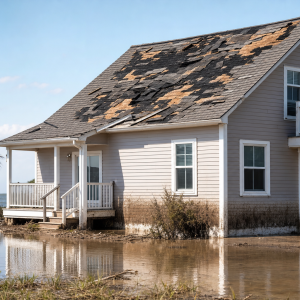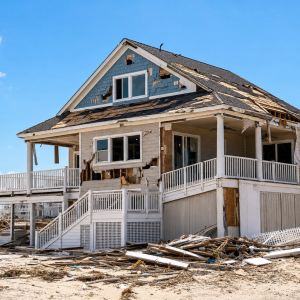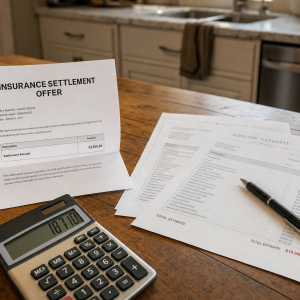

What you do in the first few hours after discovering property damage can make or break your entire insurance claim. I'm not exaggerating. Before an adjuster even steps foot on your property, you have a critical window to take control of the situation.
This is all about building an undeniable case from the ground up. Your goal is to gather so much clear, indisputable proof that it shuts down the typical lowball tactics insurance companies use to protect their bottom line.
Your First Moves After Discovering Property Damage
Walking into a disaster scene at your own home is chaotic and deeply unsettling. Frankly, big insurance carriers like State Farm and Allstate count on that confusion. They hope you're so overwhelmed that you'll accept their first, fast, and almost always low settlement offer just to make it all go away.
Don't let them. By taking a few strategic steps right away, you protect your rights and prepare for the fight ahead. This isn't just about mopping up water; it's about building your case, piece by piece.
The two most powerful things you can do immediately are to stop the damage from getting worse and document everything. Taking steps to mitigate the damage shows the insurer you're a responsible homeowner. Documenting it creates a factual record they simply can't argue with.
Preventing Further Damage
Your insurance policy isn't just a safety net; it's a contract. And that contract requires you to take reasonable steps to prevent the damage from spiraling out of control. Insurers watch this part very closely. If you let a bad situation get worse, they'll jump at the chance to argue the new damage is your fault and refuse to pay for it.
Here’s what that looks like in the real world:
- Tarping a Damaged Roof: A storm tears shingles off your roof. You need to get a tarp over that hole immediately to stop rain from pouring into your attic and ceilings.
- Boarding Up Windows: If high winds shatter a window or a tree branch smashes through a door, get it boarded up. This protects your home from the elements and keeps it secure from theft.
- Shutting Off Water: The moment you discover a burst pipe, your first move is to find the main water shut-off valve and crank it closed. Every second the water flows, the damage multiplies.
Of course, preventing a problem is always better than dealing with the aftermath. For instance, knowing a few essential tips for homeowners to prevent pipe freezing can save you from a catastrophic water loss down the road.
Make sure you keep every single receipt for tarps, plywood, or anything else you buy for these temporary fixes. Those costs are almost always reimbursable as part of your claim.
Documenting the Scene Like a Pro
Before you move a single piece of furniture or throw away a single soaked rug, grab your phone. Your camera is the single most powerful tool you have right now.
Yes, the insurance company's adjuster will show up and take their own photos. But remember their job: to minimize the loss and, by extension, the payout. Your photos and videos need to tell the full, unvarnished story from your perspective.
Don’t just document the damage; document the context. An insurer might try to claim a water stain on the ceiling looks old. But a video of water actively dripping from a light fixture onto that exact spot? That's indisputable proof of a recent and active loss.
This simple flowchart breaks down the critical first steps that set the stage for a successful claim.
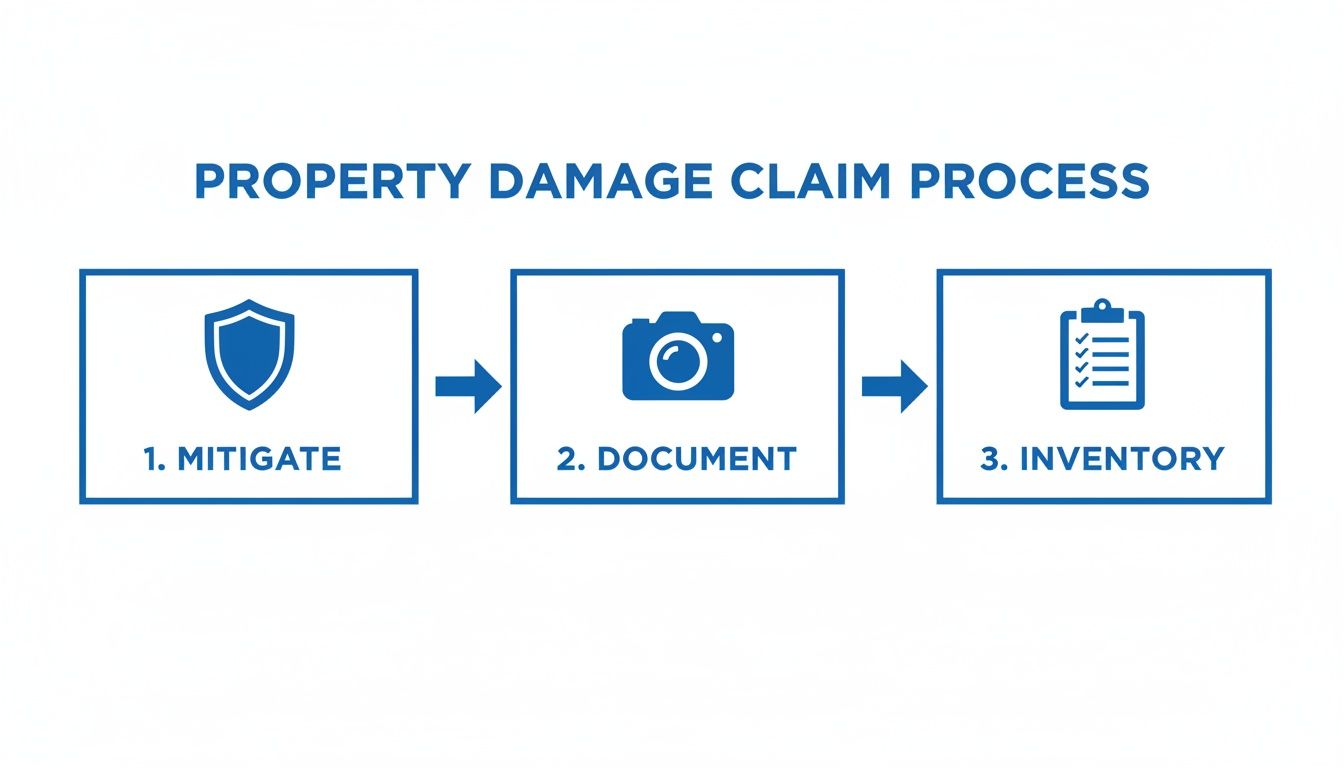
Following this flow—mitigate, document, inventory—is how you start building a powerful claim from the very first hour.
While you're documenting, start a quick, rough list of everything that's been damaged. This isn't the final, detailed inventory, but it gives you a crucial head start. This initial list will eventually grow into the formal Proof of Loss—a sworn statement that becomes the backbone of your entire claim.
Uncover the Policy Loopholes Your Insurer Hopes You'll Miss
Let’s be honest: your insurance policy is a legal contract written by their lawyers to protect their interests. They know you probably haven’t read it. They’re banking on it.
But that dense document is also your rulebook for the fight ahead. Buried in the fine print are the definitions and clauses that can turn a lowball offer into a fair settlement. Knowing how to find and use their own language against them is how you level the playing field.
Know the Difference Between RCV and ACV
The single biggest fight you’ll have with an adjuster often comes down to three little letters: RCV vs. ACV. They will almost always try to pay you based on ACV because it saves them a fortune.
- Replacement Cost Value (RCV): This is the money it takes to rebuild or repair your property today, with brand new materials of similar kind and quality. No funny business, no deductions. This is what it actually costs to make you whole again.
- Actual Cash Value (ACV): This is the replacement cost minus depreciation. The adjuster will say your 15-year-old roof isn't worth as much as a new one, so they'll only pay you a fraction of the cost, leaving you to cover the massive gap.
This isn’t a small detail—it can mean the difference between getting your home fixed and being left thousands of dollars short. Understanding exactly how your policy defines these terms is your first move in demanding the RCV settlement you’re actually owed.
Insurers love a little trick called "recoverable depreciation." They'll pay you the ACV upfront and hold back the rest of the money until you've completed the repairs and sent them every single receipt. They make you jump through these hoops hoping you’ll run out of money or just give up before you can claim the full amount you are legally owed.
Here’s a simple breakdown of how these two valuation methods stack up against each other.
Replacement Cost Value (RCV) vs. Actual Cash Value (ACV)
The valuation method used by your insurance company is the single most important factor determining the size of your settlement check. Here’s why the distinction between RCV and ACV is so critical.
| Feature | Replacement Cost Value (RCV) | Actual Cash Value (ACV) |
|---|---|---|
| Payout Basis | Cost to replace with new, similar materials | Cost to replace minus depreciation (age, wear & tear) |
| Goal | To make you whole again | To pay for the used value of your property |
| Depreciation | Not deducted from your final payout | Deducted from your payout, reducing your funds |
| Policyholder Cost | Typically covers the full cost of repairs | Often leaves you with a large out-of-pocket gap |
| Typical Use | The standard for most modern homeowners policies | Common in older policies or for certain items (e.g., roofs) |
Ultimately, an RCV policy is designed to put you back in the position you were in before the loss, while an ACV policy ensures you’ll be paying a significant portion of the recovery costs yourself.
Find the Hidden Coverage They "Forget" to Mention
Beyond the main payout, your policy likely has extra coverages that can add thousands to your claim. Adjusters rarely volunteer this information; you have to find it and demand it. A more thorough guide on understanding homeowners insurance coverage can give you a deeper dive, but here are two huge ones to look for.
- Ordinance or Law Coverage: After a fire, you might discover that today’s building codes require major electrical or plumbing upgrades. Your standard policy won’t pay for this, but Ordinance or Law coverage will. It’s essential for older homes.
- Matching Clauses: A hailstorm ruins the siding on one side of your house, but that siding isn't made anymore. Without a matching clause, the insurer will only pay to create a mismatched patchwork on your home. With it, they may have to pay to re-side the entire house to ensure it matches.
Watch Out for Sneaky Exclusions
Knowing what your policy doesn't cover is just as important. Insurers use exclusions to deny claims right out of the gate. Flood damage is a classic example—it's almost never covered by a standard policy and requires a separate NFIP plan.
Another favorite is the "wear and tear" or "gradual deterioration" exclusion. An adjuster will try to claim your leaking roof is just old, not storm-damaged. This is a pure delay-and-deny tactic. With your own documentation and expert reports, you can prove the damage was from a specific, covered event—not just old age. Knowing their playbook helps you build a case they can't easily dismiss.
The Adjuster is Not on Your Side
The moment an insurance adjuster shows up at your door, you need to understand one thing: they are not there to help you.
They might be friendly. They might seem incredibly empathetic. But they are a company employee, often rewarded for how much money they save their employer. The money they save comes directly out of your claim for property damage. From the second they arrive, the relationship is adversarial.
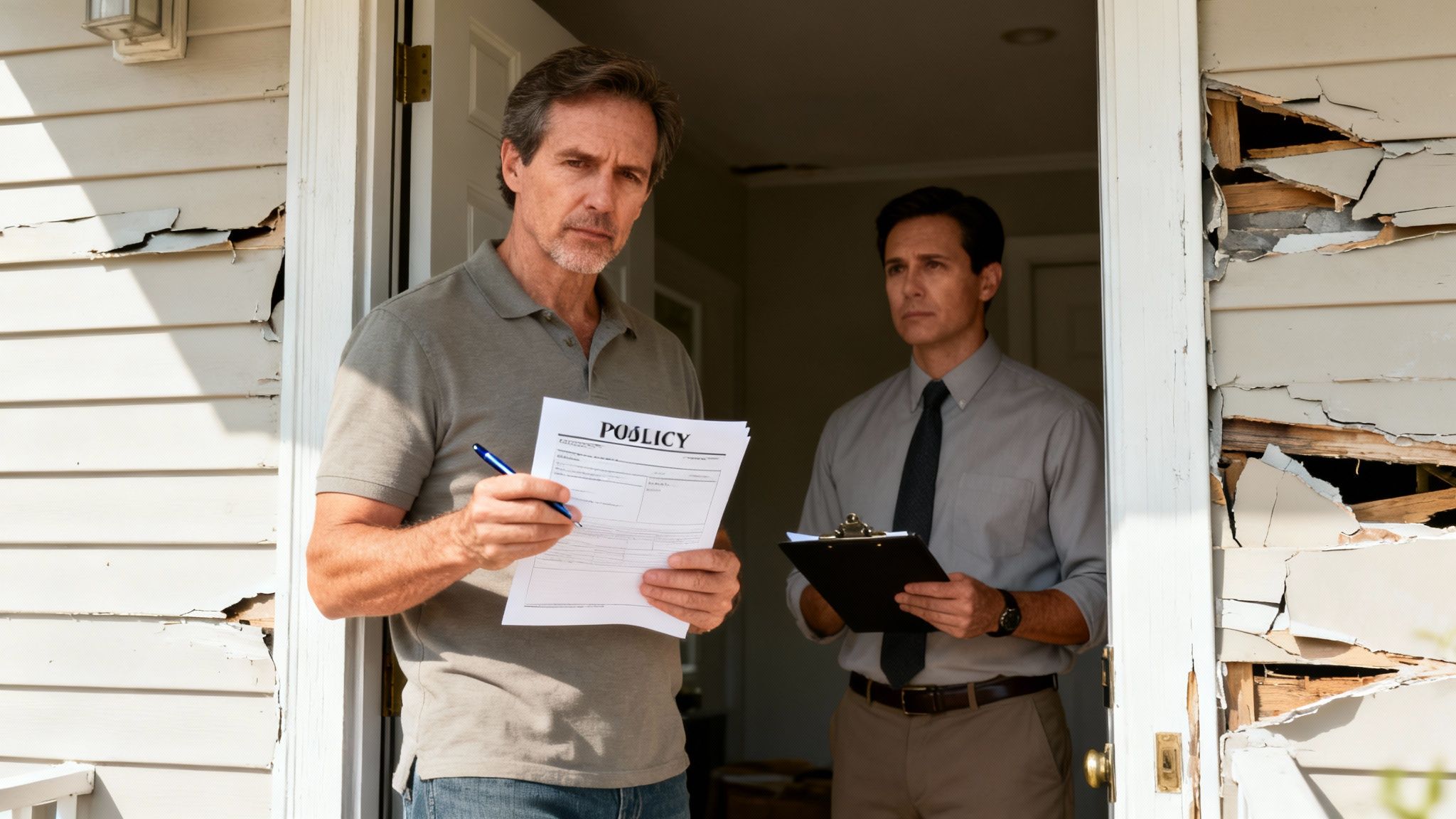
This is a game of strategy. They build rapport to lower your guard. They ask calculated questions to find any piece of information they can use to chip away at your claim—to delay, underpay, or deny it altogether.
What to Say and What You Must Never Say
Every word you speak to the company adjuster can and will be used against you. Your best defense is caution and precision. It’s less about what you say and more about what you don’t.
Here are the ground rules for every conversation:
- Just the Facts: Answer only the specific question asked. Don't ramble, don't guess about what caused the damage, and never volunteer extra information.
- Admit Nothing: Never say anything that hints you might be at fault. Simple phrases like, "I probably should have fixed that sooner…" or "I noticed a small drip a while back…" are pure gold for an insurer looking for an excuse not to pay.
- Embrace "I Don't Know": If you aren't 100% certain about an answer, the correct response is, "I don't know." Guessing gives them ammo they can use to discredit you later if you're wrong.
Sooner or later, they will ask for a recorded statement. Politely and firmly decline. These recordings are not for your benefit. They are a trap, designed to lock you into a story before you even know the full extent of your loss.
You have zero obligation to give a recorded statement. Your policy requires you to cooperate—which means letting them inspect the damage and providing documents. A recorded statement is a strategic weapon used against you, not a part of cooperation.
The Problem with Their "Preferred" Contractors
Adjusters will often try to "help" by suggesting you use one of their "preferred" contractors. It sounds convenient, but it's a huge red flag. These contractors get a steady flow of work from the insurance company, and their loyalty is to the hand that feeds them, not to you.
They often agree to work for less, use cheaper materials, and cut corners to keep the insurer happy. The only way to get a fair and accurate estimate for quality repairs is to hire your own independent, vetted contractor.
How They Use Building Codes to Lowball You
One of the dirtiest tricks in the book involves ignoring local building codes. I've seen adjusters from major carriers like Allstate and State Farm write an estimate to repair a damaged roof using methods that are completely illegal today.
They know full well the current code requires a full replacement, but they write the estimate for a patch job anyway. They are banking on your ignorance.
This isn't a mistake; it's a calculated strategy to produce a rock-bottom initial offer. They know it will cost tens of thousands more to do the job legally and safely, but they're leaving it up to you to fight for the money you're actually owed.
Case Study: An Ignored Code Becomes a $25,000 Swing
We saw this play out with a homeowner in Apex, NC, after a nasty hailstorm chewed up their roof. The insurance company's adjuster came out, spent about 20 minutes on-site, and offered $7,000 for some basic repairs.
The homeowner knew something was wrong. They brought in a public adjuster who immediately saw the glaring problem: the local building code in Apex requires that if more than 25% of a roof is damaged, the entire roof must be replaced. The company adjuster had conveniently "forgotten" this expensive little detail.
The public adjuster wrote a new, detailed estimate for a full, code-compliant roof replacement, cited the specific municipal ordinance, and formally challenged the insurer. Backed into a corner with undeniable proof, the carrier had no choice but to pay.
The final settlement was $32,000—more than four times the original offer. That's the difference between an insurance company's first offer and what it actually takes to make a homeowner whole.
How to Build an Ironclad Property Damage Claim
Let’s get one thing straight: an insurer’s first settlement offer on your claim for property damage is not a good-faith starting point for a conversation. It's a test. They're probing to see how much you know, how prepared you are, and frankly, how much of a fight you have in you.
The way you win isn't by arguing—it's by burying them in a mountain of undeniable, organized proof. You have to build a claim so meticulous and well-documented that it leaves them no room to wiggle. It forces them to respond to your facts, not their own self-serving, lowball numbers.
This is exactly how you do it.
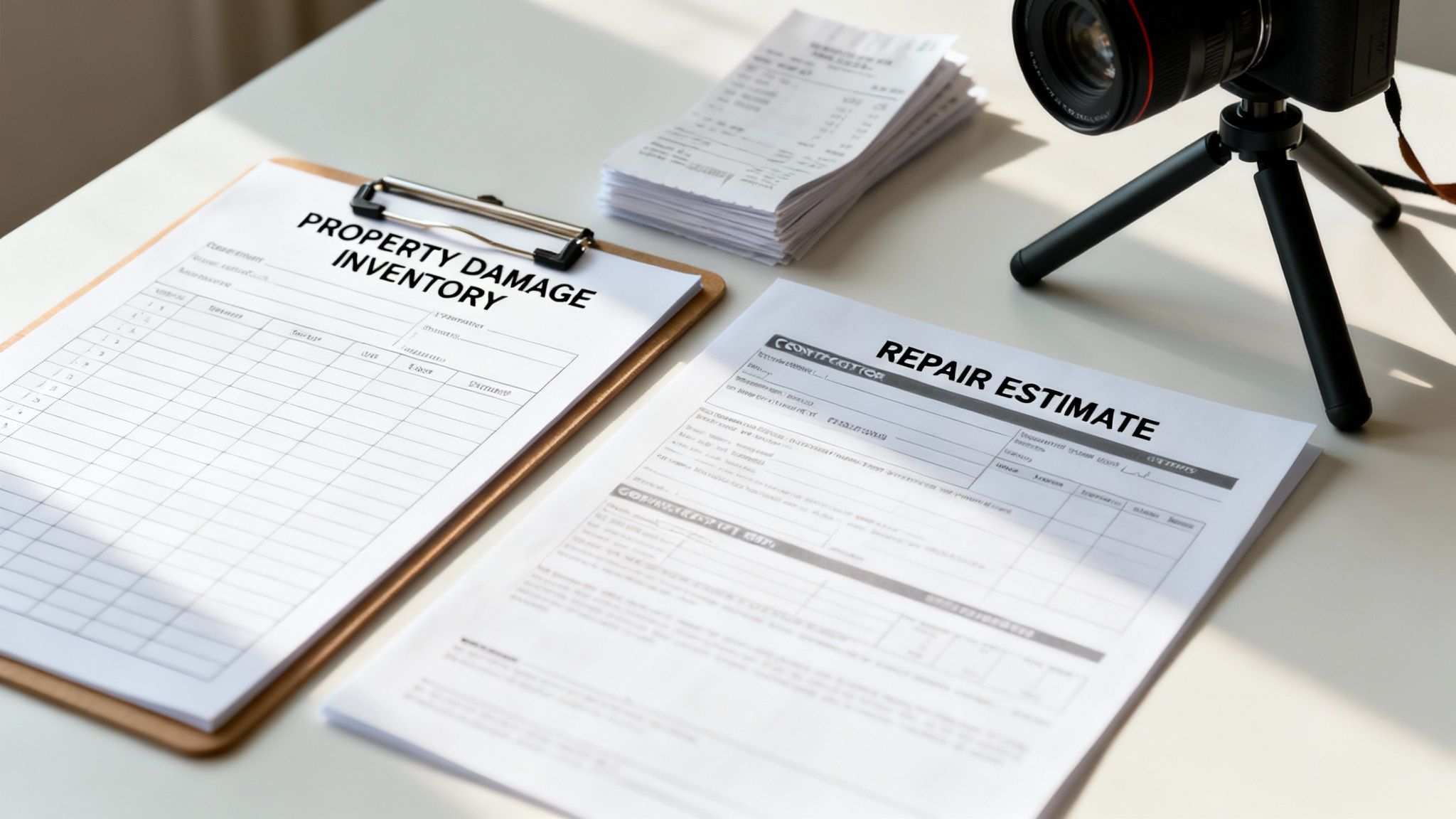
Create a Room-by-Room Inventory of Loss
The company adjuster will perform a quick walkthrough and generate a basic list of damages. Your job is to make their list look like scribbled notes on a napkin. You need to create a granular, hyper-detailed inventory of every single thing that was damaged or lost.
Go through your home room by room, closet by closet, and drawer by drawer.
Don’t just write "couch." Instead, document: "Ashley Furniture, 3-seat microfiber sofa, model #1234, gray, purchased in 2019." For every item, you need to capture:
- Description: Brand name, model, material, and any identifying features.
- Age: How old was it?
- Original Cost: Dig up receipts, bank statements, or even old photos to prove value.
- Replacement Cost: Go online and find what it costs to buy a new, comparable item today.
- Photos/Videos: Link each item back to the visual proof you've already collected.
I won't lie, this is an exhausting and emotionally draining process. But every single item you forget is money you're willingly giving back to the insurance company.
Secure Independent Repair Estimates
Never, and I mean never, accept the estimate provided by the insurance company's adjuster or their "preferred contractor" as the final word. This is the number one way carriers lowball claims. Their estimate is engineered from the ground up to be the cheapest possible number, often by cutting corners, using subpar materials, or completely ignoring local building codes.
You need to get your own quotes. Get at least two, but preferably three, detailed estimates from independent, reputable, local contractors you trust. Insist that their bids are "apples to apples," meaning they outline the exact same scope of work and quality of materials. A professional roof inspection from an independent source, for instance, is absolutely essential for documenting the full extent of storm damage.
An independent contractor's estimate isn't just a number—it's expert testimony. When a licensed professional puts their name and reputation on an estimate that details the true cost of bringing your home back to its pre-loss condition, it becomes a powerful weapon that directly challenges the insurer’s lowball figure.
This is more critical now than ever. Post-pandemic inflation sent construction costs soaring, making the price lists adjusters use completely obsolete. We’ve seen replacement costs jump an estimated 35.64% between early 2020 and mid-2025. That’s a massive detail a company adjuster might just "forget" to include in their calculations.
Document All Additional Living Expenses
If the damage is bad enough to force you out of your home, your policy should cover Additional Living Expenses (ALE). This is another area where insurers love to squeeze policyholders, often pressuring them into a cheap motel or nickel-and-diming every expense.
Don't let them. Your policy states it will cover the costs needed to maintain your normal standard of living. That means you need to keep every single receipt for:
- Temporary Housing: Hotel stays or a short-term rental agreement.
- Food Costs: If your rental doesn't have a kitchen, ALE covers the difference between your normal grocery spending and the higher cost of eating out.
- Mileage: Track the extra miles you drive if your temporary place is farther from work or your kids' school.
- Laundry: Costs for a laundromat if you don’t have access to a washer and dryer.
- Pet Boarding: If your temporary rental won't allow your pets.
When you present your claim, you hit them with everything at once: the structural damage estimates, the detailed personal property inventory, and the meticulously documented ALE claim. This comprehensive demand package signals that you are organized, serious, and know precisely what you are owed. That level of preparation is what flips the power dynamic back where it belongs—with you.
Fighting Back Against Insurer Delay and Deny Tactics
When your property damage claim is met with a wall of silence, endless requests for the same documents, or an outright denial based on flimsy reasoning, don't mistake it for a simple error. It's a strategy.
Insurance giants like Allstate and State Farm often weaponize these delays and denials. It’s a calculated business practice designed to wear you down. They know that the longer they drag out the process, the more financial pressure you’re under, and the more likely you are to accept an unfair, lowball settlement out of sheer exhaustion.
Recognizing these tactics for what they are is the first step toward fighting back. This isn't just a disagreement over numbers; it's a battle for your financial recovery, and you need to come prepared.
Writing a Powerful Demand Letter
When phone calls go nowhere and the company adjuster refuses to budge from a ridiculous offer, it's time to get serious. Your next move is to draft a powerful, formal demand letter. This isn’t just firing off an angry email—it’s a structured, professional document that lays out the facts, your damages, and the exact amount you are demanding to settle the claim.
Make sure your letter is sharp, professional, and fact-based. It absolutely must include:
- Claim Details: Your full name, policy number, claim number, and the date of the loss.
- A Clear Rejection: State firmly that you reject their settlement offer and spell out exactly why it is insufficient to make you whole.
- Your Evidence: Reference the evidence you’ve gathered—your independent contractor estimates, your detailed property inventory, photos, and expert reports. Attach copies of everything.
- The Demand: Clearly state the specific dollar amount you require to settle the claim and give them a reasonable deadline to respond.
This letter does two critical things: it creates an official paper trail and signals to the insurer that you are not backing down. You're putting them on notice that their valuation is wrong, and you have the proof to back it up.
When to Invoke the Appraisal Clause
What if the demand letter doesn't move the needle? If your dispute is purely about the cost of repairs—not whether the damage is actually covered—your policy contains an incredibly powerful tool: the appraisal clause.
Invoking appraisal takes the decision completely out of the company adjuster’s hands. Here’s how it works: you hire an independent appraiser, and the insurance company hires one. Those two appraisers then select a neutral third party, called an "umpire."
If your appraiser and the insurance company's appraiser can't agree on the value of the loss, the umpire steps in to make the final, binding decision. It’s an incredibly effective way to break a stalemate and force a fair resolution based on facts, not insurance company tactics.
Insurance Bad Faith: Proving Insurers Can Be Beaten
Sometimes, an insurer's actions go far beyond a simple disagreement. When their conduct becomes egregious—unreasonable delays, denying a claim without a proper investigation, or knowingly lowballing a settlement—it can cross the line into "bad faith."
This is a legal term for when an insurance company completely fails to uphold its contractual duty to treat you fairly. And courts take it very seriously.
In the landmark case State Farm Mut. Auto. Ins. Co. v. Campbell, the U.S. Supreme Court upheld a massive verdict against State Farm, sending a powerful message that insurers can face huge punitive damages for this kind of behavior. While that was an auto insurance case, the principle applies across the board. These cases prove that homeowners and business owners have legal recourse and can win these fights.
Success Story: A Virginia Business Saved from Ruin
A fire broke out in a Richmond, VA, commercial kitchen, causing what the insurance company called "superficial" smoke and soot damage. They denied the claim. Facing financial ruin, the business owner hired a public adjuster. We brought in industrial hygienists who proved toxic smoke particulates had contaminated the entire building, including the HVAC system, making it unsafe for employees and customers. We documented every penny of the loss, including the crippling business interruption costs. Faced with this undeniable expert evidence, the insurer reversed its denial and paid a six-figure settlement that covered full remediation, repairs, and lost income, saving the business from collapse.
These situations happen every day. Knowing what to do when your insurance claim is denied is crucial for any policyholder.
The pressure on insurance companies to deny and underpay is only getting worse. In a recent year, the number of global catastrophic events causing over $1 billion in economic losses jumped to 54 from 44 the year before. These disasters caused a staggering $368 billion in weather-related damages, but insurance only covered 40% of that. This leaves a massive financial burden on property owners like you. Insurers are fighting harder than ever to limit payouts, making it essential to understand your rights and how to fight back.
Frequently Asked Questions About Property Damage Claims
Going head-to-head with an insurance company on a claim for property damage is going to stir up a lot of questions. The whole process can make you feel completely alone and confused, especially when it feels like your insurer is doing everything they can to underpay, delay, or just plain deny what you're owed.
Here are some straight answers to the questions we hear every single day from homeowners and business owners just like you.
What Should I Do If My Insurance Company's Offer Is Too Low?
Whatever you do, don't cash that first check if it feels wrong. That initial offer is almost always a lowball. It's a calculated move to see how little they can get away with paying you.
The first thing you should do is demand, in writing, a detailed, line-by-line breakdown of their estimate. You need to see exactly how they came up with that number. Then, you fight back with your own mountain of evidence. Hand over the detailed quotes from your own trusted contractors and your complete room-by-room inventory. Put it all in a formal dispute letter that spells out precisely why their offer is unacceptable and what a fair settlement actually looks like. If they still won't budge, that's your cue to escalate by either invoking the appraisal clause in your policy or hiring a public adjuster.
Can I Hire My Own Contractor or Do I Have to Use Theirs?
You absolutely have the right to hire your own contractor. In fact, you should.
Insurers like State Farm or Allstate love to push their "preferred" vendors on you. But these contractors often have cozy relationships with the insurance company, built on an understanding that they will keep repair costs low. Their primary loyalty isn't to you or the quality of your home's restoration; it's to the company that keeps sending them work.
Get at least two or three bids from independent, reputable, local contractors you've vetted yourself. This is the only way to establish the real-world cost of putting your property back together the right way, with quality materials and up to current building codes.
What Is a Public Adjuster and When Should I Hire One?
A public adjuster is a state-licensed insurance expert who works only for you—the policyholder. The adjuster the insurance company sends works for them and is paid to protect their bottom line. A public adjuster's job is to protect your best interests. We take over the entire stressful claims process, from documenting every detail of the loss and digging into your policy to negotiating the final payout.
You should think seriously about hiring a public adjuster the second you feel overwhelmed. If your claim is large, complicated, or if you're getting nothing but delays, lowball offers, or an outright denial, you need a professional in your corner. Our expertise completely levels the playing field against a multi-billion dollar insurance company and can make a massive difference in your final settlement.
How Long Does the Insurance Company Have to Settle My Claim?
While the exact timelines differ from state to state, every insurance company has a legal duty to handle claims in "good faith" and settle them in a reasonable amount of time. If you're dealing with endless delays, constant requests for the same documents you've already sent, or just dead silence, those aren't just signs of bad service—they are classic bad faith insurance tactics.
If your claim is going nowhere, document everything. Keep a log of every call and save every email. Then, send a formal letter via certified mail demanding a status update and a clear timeline for when you can expect a resolution. Unreasonable delays are a huge red flag that your insurer isn't playing fair and that it's time to get professional help to force their hand. While the global insurance market is always in flux, with pressures from catastrophe losses easing and tightening over the years (you can read more about these global insurance market trends on marsh.com), those big-picture issues don't change the ground-level fight you're in.
When you're facing a difficult claim for property damage, you don't have to fight the insurance company alone. At For The Public Adjusters, Inc., we are your advocates, working exclusively for you to secure the full and fair settlement you are entitled to. Contact us today for a no-cost claim review and learn how we can help you rebuild with confidence: https://forthepublicadjusters.com