Most homeowners policies don't pay to test, remove, or abate stable asbestos as a precaution or part of a remodel. But when a covered event damages asbestos-containing material and safe repairs require its removal, that cost may be owed, even though insurers often deny or underpay it.
That's why the popular advice that “insurance never covers asbestos” is too blunt. The dispute is whether a covered loss made professional removal necessary to repair the dwelling, and whether the carrier is using pollutant wording to avoid paying for that work.

An old, intact floor tile containing asbestos is like an old roof that hasn't failed. The condition exists, but it hasn't become a covered loss just because you discover it, want it tested, or plan to renovate. The analysis changes when fire, wind, a fallen tree, or sudden water physically damages the material and the home can't be safely repaired without disturbing it.
Even then, the carrier may accept the building repair while disputing licensed abatement, containment, air clearance, or disposal. If water damage is part of the dispute, the AMPM Restoration mold coverage guide offers useful context on why coverage often turns on the cause of the damage, not the cost of cleanup.
Commercial property forms often use similar pollutant language, though their limits and endorsements can differ. This article concerns buildings and contents, not bodily-injury claims. Before accepting a denial, pull your declarations, the HO-3 or HO-5 policy (or the commercial property form), the ordinance-or-law provision, and any asbestos or pollutant endorsement.
Table of Contents
- The Short Answer on Asbestos and a Dwelling Policy
- What Carriers Pay Deny or Low-Ball on Asbestos
- Policy Words That Shrink an Asbestos Repair
- Code Upgrades Matching and Extra Living Costs
- How to Fight a Denial or a Low-Ball Abatement Number
- Get Claim Help Before You Accept the Offer
The Short Answer on Asbestos and a Dwelling Policy
Elective asbestos testing, removal, and abatement are typically excluded when the material is stable and no covered event damaged it. A buyer's inspection, a kitchen remodel, or curiosity about old floor tile doesn't create an insured loss. If you choose to remove intact material for an upgrade or sale, expect to pay for that work yourself.
A covered loss can change the answer. If a fire chars asbestos-backed material, or a tree opens the roof and damages insulation, the policy may cover the resulting repair. When licensed removal is necessary to complete that repair safely, it's reasonable to dispute a scope that pays only for a patch while leaving damaged material in place.
The strongest coverage argument ties each disputed abatement cost to the physical damage and the work needed to restore the dwelling, not to a general wish to remove asbestos.
The carrier may point to pollution, contamination, wear, or maintenance language. Don't assume the label settles the issue. Ask which exact policy wording applies and how it relates to the covered event and the specific repair.
Commercial property coverage raises a similar question: did a covered event damage the building, and is removal necessary to restore it? The form may apply different limits, but the basic distinction between elective work and loss-related repair remains useful.
What Carriers Pay Deny or Low-Ball on Asbestos
| Situation | Typical carrier position | What may still be owed | Dispute focus |
|---|---|---|---|
| Elective remodel removal | Denied as maintenance | No payment for voluntary abatement | Don't treat removal as a claim |
| Pre-sale or curiosity testing | Denied | Test cost only if tied to a covered repair | Keep test invoices separate |
| Undisturbed asbestos, no peril | Denied | Nothing until a covered loss damages it | Document that no loss occurred |
| Fire or smoke damages asbestos material | Repair often accepted, abatement disputed | Repair plus removal required to restore | Separate the fire from a pollutant denial |
| Wind, hail, or a fallen tree opens asbestos material | Partial patch offered | Full safe close-up of the opening | Challenge a scope that leaves asbestos exposed |
| Sudden water damages asbestos flooring or insulation | Mixed, contamination wording cited | Drying and repair of the water path | Don't let pollutant language erase the water loss |
| Building code forces removal during a covered repair | Paid only with ordinance-or-law coverage | Upgrade cost up to that limit | Invoke the endorsement in writing |
The dividing line is whether a covered peril caused damage that makes asbestos removal part of repairing the building. A remodel or sale doesn't satisfy that test. A fire, storm, falling tree, or sudden water loss may, but the carrier may separate the accepted repair from the abatement work.
Consider a Cary homeowner who uncovers vinyl tile and mastic during a kitchen remodel. Testing confirms asbestos, but no covered event damaged the floor. The carrier has a strong basis to deny the testing and removal because the work arose from a planned renovation, not an insured loss.
Now suppose a thunderstorm drops a limb through the roof and damages asbestos insulation. If the opening can't be safely closed without removing the damaged material, a scope that pays only for a patch may be inadequate. Photograph the damaged assembly and nearby intact material before containment or disposal, and ask the licensed abatement contractor to explain why removal is needed to complete the repair.
A kitchen fire presents a similar dispute. If flames char asbestos-backed material and smoke enters wall cavities, the covered fire damage doesn't disappear because the carrier calls the material a pollutant. Keep the fire damage, the necessary removal, and any optional work in separate parts of the estimate. Removal from rooms the fire never reached remains a separate project.
In commercial buildings, the same distinction can affect costly disposal work. Don't let a patch estimate stand in for a complete repair scope merely because the affected material contains asbestos.
Policy Words That Shrink an Asbestos Repair
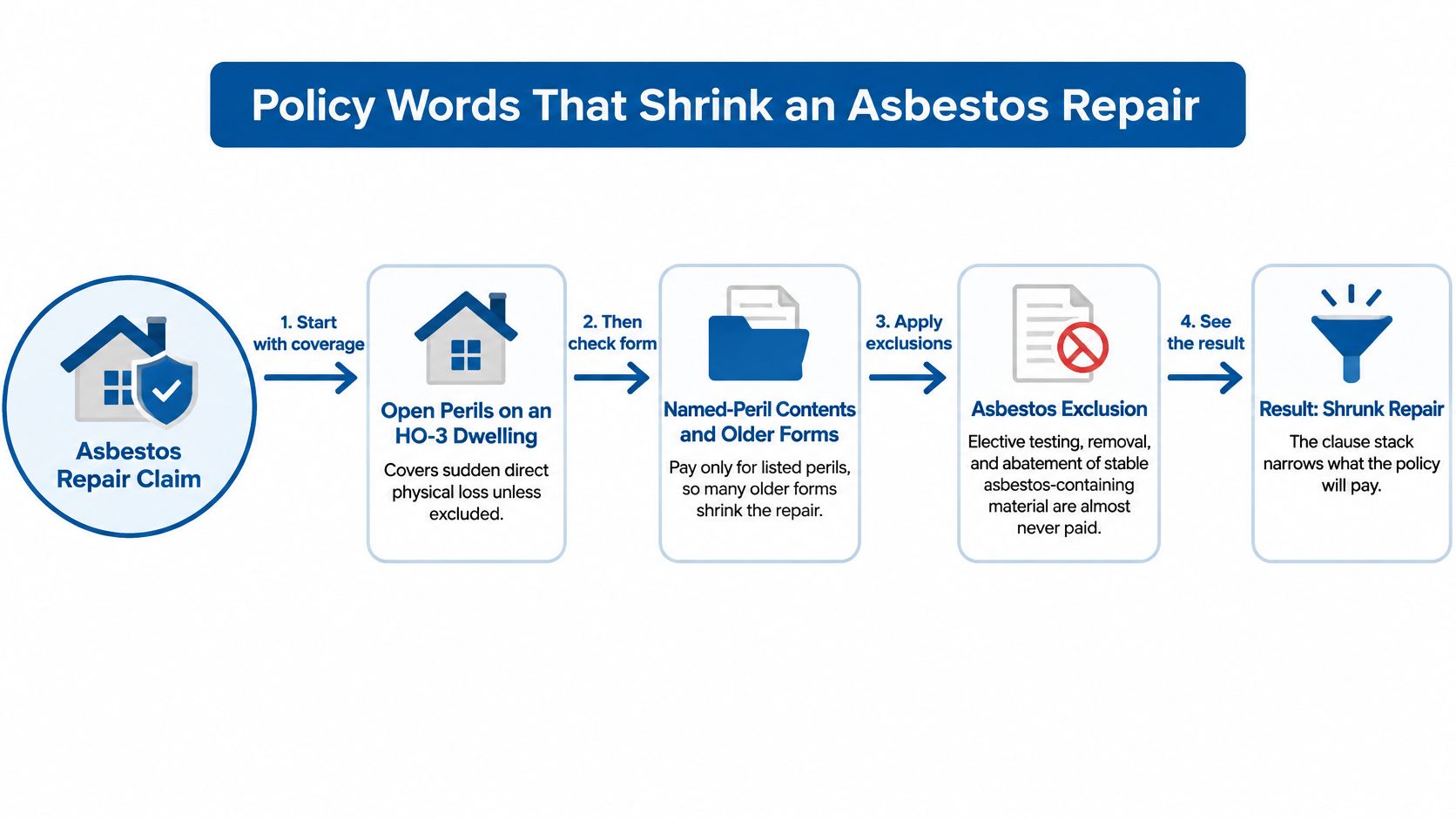
A carrier usually starts with the policy's coverage grant, then applies exclusions and limitations. On an HO-3, open-perils dwelling coverage generally applies to sudden direct physical loss unless the policy excludes it. Contents coverage, many older policies, and some other forms may cover only listed causes of loss, which can narrow the claim from the outset.
Next comes the pollution or contamination exclusion. Insurers may use broad wording that includes asbestos fibers, lead, and other irritants. The adjuster may quote that clause and treat it as the end of the discussion, even when a covered fire or fallen tree first damaged the material inside the home.
Wear, deterioration, and maintenance language can be the next cut. If the carrier says the tile or insulation was old before the storm, separate the material's age from the cause of the damage. An old component can still be damaged by a new covered event.
Faulty-workmanship wording may come into play if a contractor disturbed asbestos during a remodel that wasn't itself a covered loss. That's different from removal required after a covered peril damages the dwelling. The cause, timing, and repair sequence matter.
Ask for the exact exclusion paragraph the carrier relies on, not just a letter saying “pollution exclusion applies.”
Ordinance or law coverage may pay for required code upgrades when the damaged area can't legally be repaired in kind. Check the declarations and endorsement for the actual limit; don't assume the policy pays every code-driven cost. Additional living expense is a separate coverage bucket, not part of the abatement invoice.
A pollutant exclusion aimed at environmental contamination may be a poor fit when a covered event has already broken open asbestos-containing material inside a dwelling. The question isn't whether asbestos can be described as a pollutant. It's whether the policy's wording excludes the specific cost of removing material damaged by a covered peril so the home can be repaired.
For broader context on planning a kitchen project, Jennifer Gilmer Kitchen & Bath's guide to cosmetic updates versus structural kitchen work helps distinguish changes made by choice from work that may involve permits or code requirements.
Code Upgrades Matching and Extra Living Costs
The abatement invoice isn't always the only missed cost. A covered repair can trigger code requirements, affect continuous finishes, or make parts of the home unusable while contractors contain the work. Treat those as separate coverage questions, not as details buried in the removal estimate.
Cary's current building codes often require upgrades during repairs, and carriers routinely omit that cost unless the policyholder specifically invokes the coverage. If the local code won't allow a damaged assembly to be restored as it was, identify the required work and the applicable ordinance-or-law provision. That coverage usually has its own limit, so compare the documented upgrade cost with the policy's cap.
Matching can matter when asbestos tile sits within a continuous floor. If a covered loss damages one part of that floor, the policy's matching language may support replacing flooring across connected areas rather than leaving a conspicuous patch. The same issue can arise with continuous siding. For The Public Adjusters, Inc. identifies applicable coverage, including code upgrades and additional living expenses that homeowners often overlook.
Containment can also make a kitchen, bathroom, or bedroom unusable during repairs. Additional living expense may help with covered increases in living costs while the home can't be used normally. Keep those expenses separate from abatement and repair invoices, and document which rooms were inaccessible and why.
In one Apex case, For The Public Adjusters, Inc. recovered additional living expenses for the days a family couldn't use its kitchen and master bath. That illustrates why the loss-of-use portion of a claim deserves its own review rather than being folded into the contractor's removal bill.
Don't assume code-driven removal is unlimited. Identify the endorsement, its cap, and any amount the estimate leaves unpaid.
How to Fight a Denial or a Low-Ball Abatement Number
If the carrier has already denied the claim or priced only a patch, keep the dispute focused on the covered damage and the repair that remains unfinished.
Get the decision in writing. Mark the exact exclusion in the denial or the line items missing from the estimate, such as licensed removal, containment, air clearance, and disposal. A short explanation from the adjuster isn't a substitute for the policy wording.
Tie each disputed cost to the covered peril. Use photos of the damaged assembly, the contractor's proposed work sequence, and a clear explanation of why removal is required to finish the repair. Distinguish necessary abatement from a remodel or an upgrade you chose.
Address pollutant language directly. Separate undisturbed asbestos, which you aren't claiming, from the material damaged by fire, wind, a fallen tree, or sudden water. Ask the insurer to explain why the quoted exclusion applies to that specific repair.
Replace a lump sum with a room-by-room scope. Have a licensed abatement contractor identify the affected rooms and itemize removal, containment, air clearance, and disposal. If the carrier proposes a patch that can't legally or safely be installed, ask the contractor to explain the problem in writing.
Invoke ordinance or law coverage when code requires a different repair. Identify the code requirement and show how it changes the scope. A general statement that “code requires it” is weaker than a documented requirement tied to the damaged assembly.
Use appraisal for an amount-of-loss dispute. North Carolina policyholders have the right to invoke the appraisal clause in most homeowner policies to resolve disagreements over the amount of loss without going to court. Appraisal addresses the amount of loss; it doesn't automatically decide whether a disputed item is covered.
Send a concise written rebuttal and keep proof of delivery. Quote the carrier's paragraph, attach your competing scope, and state which items remain unpaid. It's illegal for an insurer to penalize or discriminate against a policyholder for hiring professional representation such as a public adjuster.

Don't reopen a claim just to pay for elective removal, pre-sale testing, or asbestos that remains undamaged. Keep the licensed contractor's invoice, testing report, and disposal records separate from later repair costs. If a covered event damages the home afterward, those records help show which work came from the earlier project and which work the new loss required.
Get Claim Help Before You Accept the Offer
If a remodel merely uncovered asbestos, stop treating the abatement bill as a homeowners claim. If fire, wind, a fallen tree, or sudden water damaged the building and the carrier's offer leaves out removal needed to complete the repair, don't accept a patch price without reviewing the scope and policy language.
For The Public Adjusters, Inc. represents homeowners and businesses in North Carolina on building and contents claims, not on claims unrelated to property damage. The firm handles property losses involving fire, smoke, water, wind, hail, hurricanes, and related damage. A customer said the firm got them more than the insurance company wanted to settle for after a house fire.
In one Apex case, a family's claim after a July thunderstorm dropped a limb through their roof settled at $67,800. A storm opening like that can expose hidden building materials and complicate the repair scope. The firm answers policyholders' claim questions at no cost, so an independent review makes sense when a covered peril is already in dispute, not when the only issue is elective removal.
Have your water damage claim questions answered at NO COST. Call 919-400-6440 to speak with a licensed Public Insurance Adjuster or Contact Us here with questions. WE Work For YOU… NOT Your Insurance Company!
For The Public Adjusters, Inc. helps policyholders document and dispute property claims when an insurer's estimate leaves out necessary asbestos-related repair work. If a covered loss is at issue, visit For The Public Adjusters, Inc. for claim guidance and an independent review.