If you need a public adjuster Smithfield NC policyholders can call after a fire, burst pipe, or hurricane loss, For The Public Adjusters, Inc. represents you — not the insurance company. We document the full scope of your damage, prepare the estimate, and negotiate directly with the carrier’s adjuster on your behalf. We are licensed and bonded, and we work on residential and commercial property claims throughout Johnston County.
What This Service Is
A public adjuster is an insurance professional who works exclusively for the policyholder. The adjuster your insurance company sends works for the insurer; we are the counterweight — reading your policy, measuring and photographing the damage, pricing the repairs, and pushing back when the carrier’s numbers fall short.
In North Carolina, this work is regulated. The NCDOI Public Adjusters Guide explains that public adjusters must be licensed by the state, and it spells out what a legitimate adjuster can and cannot do — a useful read before you sign anything with anyone.
For The Public Adjusters, Inc. handles fire damage claims, water damage claims, smoke damage, tree damage, vandalism, flood insurance claims, and commercial business losses. We serve Smithfield and the surrounding towns, including nearby communities where we already work regularly — see our public adjuster services in Four Oaks NC for an example of the same representation just down US-301. We do not handle claims involving cell phones, motor vehicles, health, or life insurance.
Common Problems
What Does A Public Adjuster Smithfield NC Homeowners Hire Actually Cost?
We work on a contingency fee — a percentage of what the insurance company pays on your claim. There is no hourly bill and no upfront retainer, so our interests are aligned with yours from day one.
The real question is value. Carrier estimates often miss things: smoke residue inside wall cavities, moisture that migrated under flooring, code-upgrade costs on older homes, and damaged contents nobody inventoried. Finding and documenting those items is precisely what we do. We never guarantee a specific outcome — no honest adjuster can — but we make sure nothing covered gets left off the claim.
The Insurance Company Is Delaying, Lowballing, Or Denying My Claim. Now What?
Delays and underpayment are the most common complaints we hear after a serious loss. The fix starts with documentation the carrier cannot wave away: a line-item estimate, moisture readings, photographs, and a contents inventory tied to your policy language.
Courts have long held insurers accountable when they mishandle property claims. In Bi-Economy Market, Inc. v. Harleysville Insurance Co. of New York, a family-owned market destroyed by fire prevailed at the state’s highest court, which allowed the insured to pursue consequential damages after the insurer delayed and underpaid the building and business-interruption claim. Most disputes never need a courtroom, but when they do, we coordinate with insurance dispute lawyers so your file is already litigation-ready. We take the same approach on complex losses like a water damage claim in Wake Forest, where hidden moisture is often the entire fight.
Can’t I Just Handle The Claim Myself?
You can, and for a small, straightforward loss it may make sense. The trouble starts when the loss is large, layered, or contested — a kitchen fire with smoke throughout the house, a hurricane claim with both wind and water damage, or a carrier that keeps asking for one more document.
Judge any Smithfield public adjuster the same way: verify the state license, confirm they are bonded, ask who will actually inspect your property, and ask for the fee in writing before you sign. A good adjuster explains your policy in plain English and never pressures you. That is how we operate here and in neighboring towns — our public adjuster work in Benson NC follows the exact same standard.
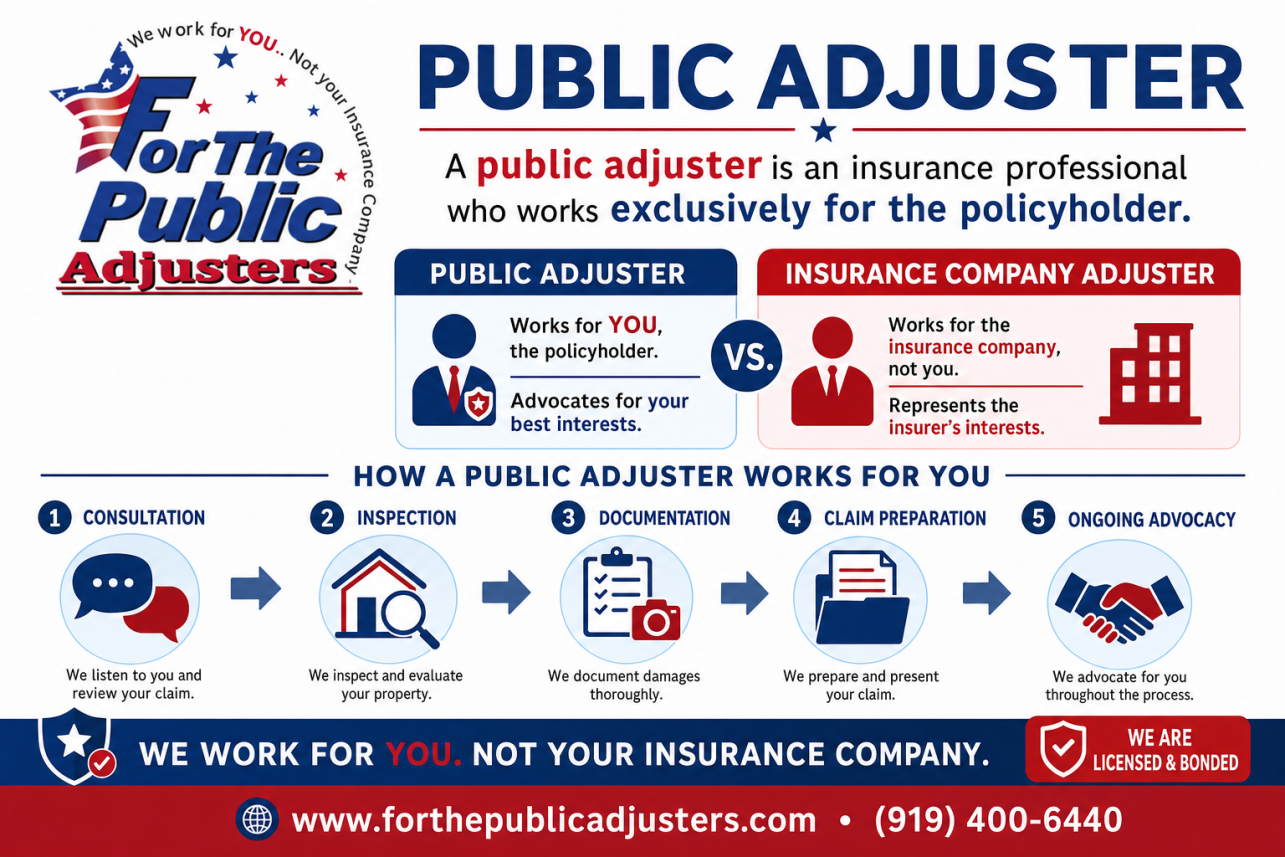
Our Process
Free Claim And Policy Review
We start by reading your actual policy — coverages, endorsements, deductibles, and exclusions — and comparing it against what happened to your property. You’ll know quickly whether your claim is worth pursuing and where the likely friction points are. There is no charge and no obligation for this review.
Full Documentation Of The Loss
We inspect and photograph the property, take moisture readings where water is involved, inventory damaged contents, and build a detailed repair estimate. On fire and smoke losses we look beyond the burn area, because soot and odor travel far past what a quick walkthrough catches. This file becomes the backbone of your claim.
Negotiation And Settlement
We present the claim to your carrier, meet their adjuster on site, and negotiate every disputed line item. You approve any settlement before it is accepted — the decision is always yours. If the carrier refuses to deal fairly, we help you weigh next steps, including appraisal or referral to counsel.
| What Happens | Filing on Your Own | With For The Public Adjusters, Inc. |
|---|---|---|
| Damage documentation | You rely on the carrier’s adjuster, who works for the insurance company | Independent inspection with photos, moisture readings, test squares, and lab testing when needed |
| Estimate accuracy | Carrier estimates often miss hidden damage, code upgrades, and matching requirements | Line-item estimates built to include everything your policy owes |
| Negotiation | You negotiate against trained claims professionals alone | A licensed advocate negotiates directly with the carrier on your behalf |
| Business income losses | Frequently undervalued or left off the claim entirely | Calculated from your actual financial records and documented in the proof of loss |
| Cost | Free upfront, but underpayments often cost thousands in unrecovered damage | Contingency fee — we’re paid a percentage only from what we recover for you |
| Typical result | Settlements often reflect only visible surface damage | Settlements that account for hidden, structural, and consequential damage |
Commonly Overlooked In The Public Adjusting Industry
- Matching requirements for discontinued shingles and siding — Carrier adjusters often write for a patch repair without checking whether the material is still manufactured, which can entitle you to full replacement.
- Code upgrade coverage (ordinance or law) — Many Johnston County homes were built under older codes, and repairs triggering current requirements are frequently paid only if someone specifically claims them.
- Business interruption based on strongest revenue months — Carriers tend to average income over slow periods, which quietly cuts what a seasonal Smithfield business is actually owed.
- Attic insulation saturation after roof leaks — Wet insulation loses its R-value permanently but looks fine from below, so it gets skipped unless someone takes moisture readings in the attic.
- Smoke residue in HVAC ductwork — Ducts hide contamination that recirculates odor for years, and estimates routinely include duct cleaning when the residue type actually demands replacement.
- Contents depreciation and recoverable depreciation deadlines — Policyholders often never learn they can claim back withheld depreciation after repairs, and the deadline to do so passes silently.
- Additional living expenses during displacement — Hotel stays, extra mileage, and meal costs are reimbursable under most policies, but only if they’re tracked and submitted with receipts.
- Hail strikes on soft metals, not just shingles — Gutters, window wraps, and AC fins prove storm severity and date, yet carrier inspections frequently examine the roof alone.
Case Studies
Case Study #1
Situation: A family on Buffalo Road in Smithfield came home after a spring hailstorm to find water staining spreading across two bedroom ceilings. Their carrier sent an adjuster within a week, and the initial inspection took less than twenty minutes.
Problem: The insurance company’s estimate came back at $4,200 — enough to patch a section of shingles and repaint the ceilings, but nothing more. The homeowners suspected the damage went deeper, and the roofer they called confirmed hail bruising across the entire south-facing slope.
Investigation: Our team performed a full roof inspection with test squares on every slope, documented hail strikes on the gutters, window wraps, and HVAC condenser fins, and pulled moisture readings inside the attic. We also photographed granule loss patterns consistent with the storm date confirmed by local weather data for Johnston County.
Findings: The hail impact was widespread, not isolated. Matching shingles for the discontinued product line were no longer manufactured, which under North Carolina matching considerations supported full slope replacement rather than spot repair. Attic moisture readings also revealed saturated insulation the carrier’s adjuster never checked.
Solution: We prepared a line-item estimate covering full roof replacement, gutter and downspout replacement, insulation removal and replacement, interior drywall and paint, and code-required drip edge. We then scheduled a joint reinspection with the carrier’s adjuster and walked the roof together, strike by strike.
Outcome: The claim settled at $38,700 — more than nine times the original offer. The family replaced the entire roof, corrected the attic insulation, and had the interior restored without paying beyond their deductible.
Lesson: A twenty-minute inspection rarely tells the whole story of hail damage. Test squares, attic readings, and matching documentation are what turn a patch job into the full recovery a policy actually owes.
Case Study #2
Situation: A small restaurant owner near downtown Smithfield suffered a kitchen fire that was extinguished quickly, but smoke traveled through the ductwork into the dining room. The carrier acknowledged the claim but pushed for cleaning rather than replacement of finishes and equipment.
Problem: The insurer’s offer covered surface cleaning of the dining area and a modest allowance for the kitchen — about $27,000 total. It ignored smoke-contaminated ceiling tiles, the odor absorbed into upholstered booths, and the business income the owner lost while closed.
Investigation: We brought in independent testing that confirmed protein-based smoke residue throughout the HVAC system and dining room, the kind of contamination that cleaning alone cannot remove. We inventoried every affected item, from booth cushions to the walk-in cooler gaskets, and built a business interruption calculation from the restaurant’s actual sales records.
Findings: The protein smoke residue meant duct replacement, not duct cleaning, and full replacement of porous materials including tiles, upholstery, and menus. The business income loss had been undervalued by more than half because the carrier’s calculation ignored the restaurant’s strongest revenue months.
Solution: We submitted a detailed proof of loss combining the structural estimate, a room-by-room contents inventory, and a documented business interruption claim tied to twelve months of sales data. When the carrier disputed the smoke findings, we presented the lab results and requested reinspection with their field adjuster present.
Outcome: The final settlement reached $96,400 across structure, contents, and lost income. The restaurant reopened fully renovated in under four months, with the odor problem solved permanently rather than masked.
Lesson: Smoke damage is chemistry, not just appearance. Independent testing and a properly documented income loss are frequently the difference between a partial cleanup and a real recovery for a business owner.
| Your Situation | Should You Call? | Why It Matters |
|---|---|---|
| Claim denied or partially denied | Yes — immediately | Denials can often be reversed with policy analysis and better documentation, but appeal windows are limited |
| Settlement offer feels too low | Yes — before you cash the check | Accepting payment without reviewing scope can make it harder to reopen underpaid items |
| Large loss (fire, major water, storm over ~$10,000) | Yes — the same week | Bigger claims have more hidden damage and more room for the carrier’s estimate to fall short |
| Damage looks minor and offer covers it fully | Probably not needed | If repairs are simple and the payout matches contractor quotes, a professional review may not add value |
| Business interruption or lost rental income involved | Yes — early | Income calculations require financial documentation carriers rarely help you assemble correctly |
| Carrier is delaying or not responding | Yes | North Carolina claims-handling standards give you leverage, but someone has to enforce them |
| Claim already closed months ago | Worth a review | Underpaid claims can sometimes be supplemented or reopened, depending on policy terms and timelines |
Reviews
Our insurance company offered us $6,000 after a tree came through our roof during a storm. For The Public Adjusters found water damage in the walls the first adjuster completely missed and got our settlement up to over $41,000. They handled every call with the carrier so I never had to argue with anyone. Worth every penny.
Darlene M., Smithfield
I run a rental property off Brogden Road and had a burst pipe claim denied for ‘gradual damage.’ These folks reviewed my policy, documented that the pipe failure was sudden, and got the denial reversed. The claim paid out $28,500. I honestly thought the denial was final until they got involved.
R. Talton, Johnston County
After kitchen fire smoke got into our whole house, the insurance estimate barely covered repainting. Their team brought in smoke testing, itemized everything room by room, and tripled the settlement. The process took a couple months, which they were upfront about, but the result was night and day. Only wish I’d called them the day of the fire instead of six weeks later.
Kevin B., Smithfield
Frequently Asked Questions
How Much Does It Cost To Hire A Public Adjuster Smithfield NC Homeowners Can Trust?
For The Public Adjusters, Inc. works on a contingency fee basis, which means you pay nothing out of pocket. Our fee is a percentage of the settlement we recover for you, and if we don’t recover anything, you owe us nothing. In North Carolina, public adjuster fees are regulated by the Department of Insurance, so the percentage is agreed to in writing before any work begins.
For most Johnston County homeowners, the math works strongly in their favor. Industry studies have consistently shown that policyholders who use licensed adjusters recover significantly more than those who handle claims alone — often several times the initial insurance company offer. Even after our fee, the vast majority of clients walk away with substantially more money than they would have received on their own.
We also provide a free, no-obligation claim review before you sign anything. We’ll look at your policy, inspect the damage to your Smithfield property, and tell you honestly whether hiring us makes financial sense. If your claim is small or the insurer’s offer is already fair, we’ll say so.
There are no upfront costs, no hourly billing, and no hidden charges for inspections, estimates, or documentation. Everything we do — from the initial damage assessment to final settlement negotiations — is covered by the single contingency fee spelled out in your contract. That structure keeps our interests aligned with yours: the more we recover for you, the better we both do.
When Should I Hire A Public Adjuster After Storm Or Water Damage In Smithfield?
You can bring in a public adjuster Smithfield NC at almost any stage of a claim, but earlier is almost always better. Ideally, call us before you file, or immediately after the damage occurs. That lets us document everything properly from day one, review your policy language before the insurance company frames the claim, and avoid the missteps that lead to underpayment.
That said, it is rarely too late. Many of our Johnston County clients come to us after receiving a lowball offer, after weeks of delays, or after an outright denial. We regularly reopen and supplement claims that homeowners thought were closed. In North Carolina, you generally have up to three years from the date of loss to pursue a property claim, though your specific policy may set shorter deadlines for certain steps, so it pays to act quickly.
Common situations where Smithfield homeowners call us include hurricane and wind damage from storms tracking through Johnston County, hail damage to roofs, water and pipe-burst losses, fire and smoke damage, and tree impacts. If a check has already been issued, we can often still negotiate a supplemental payment when the original estimate missed hidden damage — which happens frequently with roof decking, insulation, and interior moisture.
The one thing we’d caution against is signing a final release or accepting a settlement labeled as full and final before having it reviewed. Once you sign certain documents, your options narrow. A free review takes less than an hour and can protect thousands of dollars in recovery.
What’s The Difference Between The Insurance Company’s Adjuster And A Public Adjuster?
The adjuster your insurance company sends works for the insurance company. They may be polite and professional, but their job is to settle your claim within the insurer’s guidelines — and those guidelines are built to protect the company’s bottom line. A public adjuster, by contrast, is licensed by the North Carolina Department of Insurance to represent only you, the policyholder.
That difference shows up in the details. Company adjusters in this area often spend twenty or thirty minutes on a property and rely on standardized pricing software with settings that favor the carrier. Our team spends hours documenting a Smithfield loss: moisture readings behind walls, matching requirements for roofing and siding, code-upgrade coverage under your policy’s ordinance-and-law provisions, and additional living expenses many homeowners never realize they’re owed.
We also read your policy the way it’s actually written, not the way the carrier summarizes it. Coverage for things like debris removal, tree removal, food spoilage after outages, and detached structures gets overlooked constantly in Johnston County claims — especially after major wind events when carriers are processing thousands of files at once.
Finally, there’s negotiation. The insurer’s adjuster reports to a desk examiner whose job is cost control. We build a fully documented, line-item claim that’s hard to dispute, then negotiate directly with the carrier on your behalf. You stay informed at every step, but you don’t have to argue with the insurance company yourself. That advocacy is the core of what For The Public Adjusters, Inc. does.
Do You Handle Claims Outside Smithfield, Like Selma, Clayton, And The Rest Of Johnston County?
Yes. While Smithfield is home base for much of our work, we represent policyholders throughout Johnston County and the surrounding region — including Selma, Clayton, Four Oaks, Benson, Princeton, Pine Level, Wilson’s Mills, Kenly, and Micro. If a storm system moves up the I-95 or US-70 corridor, it rarely damages just one town, and we’re set up to respond wherever the loss occurred.
Local knowledge matters more than most homeowners realize. We know how hurricanes and tropical remnants coming off the coast typically damage roofs and siding in this part of the Coastal Plain, how the Neuse River and local drainage patterns contribute to water intrusion claims, and which building materials are common in Johnston County homes — from older farmhouses outside Four Oaks to newer construction in Clayton subdivisions. That familiarity helps us document losses accurately and push back when carriers apply generic assumptions.
We also understand local repair costs. Carrier estimates frequently use regional pricing that doesn’t reflect what licensed contractors in this county actually charge, especially after a widespread storm when demand spikes. We build estimates based on real local market conditions so your settlement actually covers the repairs.
Handling residential and commercial losses alike, we take on wind, hail, fire, smoke, water, and storm claims across the county. If you’re unsure whether your property falls within our service area, call For The Public Adjusters, Inc. and we’ll tell you right away — and if you’re nearby, we can usually schedule an on-site inspection within days.
What Types Of Insurance Claims Does A Public Adjuster Smithfield NC Property Owners Rely On Actually Handle?
For The Public Adjusters, Inc. handles the full range of property damage claims that hit homes and businesses across Johnston County. That includes wind and hail damage from the severe thunderstorms that roll through every spring, hurricane and tropical storm damage, roof leaks, fire and smoke losses, lightning strikes, and water damage from burst pipes or failed water heaters.
We also work on claims that homeowners often assume are hopeless, like tree strikes on older Smithfield homes near the Neuse River, mold that developed after a slow leak, and business interruption losses for shops and restaurants along Market Street and Brightleaf Boulevard.
Commercial claims are a big part of our work too. Warehouses, churches, rental properties, and farm buildings throughout the county all carry policies with fine print that insurers use to limit payouts. We read that fine print for a living.
If you’re not sure whether your situation qualifies, the easiest step is a free claim review. We’ll look at your policy, inspect the damage, and tell you honestly whether hiring a Smithfield public adjuster makes financial sense for your claim. Sometimes it doesn’t, and we’ll say so. But when your loss is significant, having a licensed professional document, price, and negotiate the claim almost always changes the outcome in your favor.
My Claim Was Already Denied Or Underpaid. Can You Still Help?
Yes, and this is one of the most common reasons Smithfield homeowners call us. A denial or a lowball check is not the end of your claim. In North Carolina, you generally have three years from the date of loss to pursue a property claim, though your specific policy may set shorter deadlines for certain steps, so acting quickly still matters.
When we take on a denied or underpaid claim, we start by pulling apart the insurer’s position. Often the carrier’s estimate missed hidden damage, used below-market pricing for Johnston County contractors, or applied an exclusion incorrectly. We re-inspect the property, document everything the first adjuster missed, and build a detailed, line-item estimate using the same software insurers use.
From there, we file a supplemental claim or a formal dispute and negotiate directly with the carrier. If the insurer still won’t move, North Carolina policies typically include an appraisal clause, which is a structured dispute process we can invoke on your behalf.
We’ve reopened claims where homeowners were told hail damage was “wear and tear,” or where water damage payouts didn’t come close to covering actual repair costs in the local market. Bring us the denial letter, the carrier’s estimate, and your policy, and we’ll give you a straight answer about whether the claim is worth reopening.
How Does The Claims Process Work When I Hire A Public Adjuster In Smithfield?
It starts with a free consultation, usually at your property. We inspect the damage, review your policy, and explain what your coverage actually says, not what the insurance company’s phone rep told you.
If we agree to work together, you sign a contract that spells out our fee, which is a percentage of what we recover for you. North Carolina law regulates these agreements, and you pay nothing out of pocket. From that point, we become your official representative, and the insurance company communicates through us.
Next comes documentation. We photograph and measure everything, bring in specialists when needed, and build a detailed estimate that reflects real repair costs in Smithfield and the surrounding area, including current material and labor pricing that carriers’ automated estimates often lowball.
Then we file or refile the claim, meet the insurance company’s adjuster on site, and negotiate every line item. You’ll get updates at each stage, but the paperwork, phone calls, and back-and-forth are our job, not yours.
Most claims resolve within 30 to 90 days depending on complexity and how responsive the carrier is. Larger losses, like a house fire or major hurricane damage, can take longer, but you’ll always know where things stand. Once the settlement is paid, you choose your own contractor and control your own repairs. We don’t do construction, so there’s never a conflict of interest in the amount we fight for.

Is A Public Adjuster Smithfield NC Residents Hire Required To Be Licensed In North Carolina?
Yes. Every public adjuster Smithfield NC property owners work with must hold an active license issued by the North Carolina Department of Insurance. That license requires passing a state examination, maintaining a surety bond, and completing continuing education, and it can be verified for free on the NCDOI website. We encourage every client to look us up before signing anything.
This matters because after big storms, out-of-state “claim helpers” and unlicensed contractors flood into Johnston County offering to negotiate with your insurance company. In North Carolina, it’s illegal for anyone without a public adjuster license to negotiate a claim on your behalf for a fee, and contractors are specifically prohibited from doing it. Signing with someone unlicensed can jeopardize your claim and leave you with no recourse if things go wrong.
A legitimate license also comes with real consumer protections. State law caps how our contracts are structured, gives you a right to cancel within a set window after signing, and holds us accountable to the Department of Insurance for how we handle your claim.
For The Public Adjusters, Inc. is fully licensed and bonded in North Carolina, and we’ve represented policyholders through Johnston County’s hurricanes, hailstorms, and everything in between. Before you hire anyone, ask for their NC license number, confirm it’s active, and ask how many claims they’ve settled in this part of the state. If they hesitate on any of those questions, keep looking.
How Long Will My Claim Take Once A Public Adjuster Smithfield NC Property Owners Work With Gets Involved?
Every claim is different, but most residential claims we handle in Smithfield resolve within 60 to 120 days from the date we take over. Straightforward wind or hail claims on the Johnston County side often settle faster, sometimes in four to six weeks, while large fire losses or disputed water claims can run longer.
North Carolina law gives insurers deadlines they must follow. Once you file, the carrier has to acknowledge the claim promptly and respond to proof-of-loss documentation within set timeframes. Part of our job is holding them to those deadlines instead of letting your file sit in a queue.
A few things speed the process up: getting us involved early, documenting damage before repairs begin, and responding quickly when we ask for records like mortgage statements or receipts. Things that slow it down include carrier reinspections, engineering reports the insurer orders, and disputes over the scope of repairs.
Here’s the honest trade-off. Working with a Smithfield public adjuster sometimes adds a few weeks compared to accepting the carrier’s first offer, because we’re negotiating for the full scope of damage rather than a quick, low number. In our experience, that additional time is where most of the recovered money comes from. We’ll give you a realistic timeline at your free initial inspection based on your specific policy, the type of loss, and which carrier you’re dealing with, and we’ll keep you updated at every stage so you’re never guessing where things stand.
Will Hiring A Claims Advocate Cause My Insurance Company To Cancel My Policy Or Raise My Rates?
No. Hiring a public adjuster Smithfield NC homeowners are legally entitled to retain cannot be used as grounds to cancel your policy, and it is not a rating factor by itself. North Carolina licenses public adjusters through the Department of Insurance specifically so policyholders have professional representation, and carriers know this is a normal part of the claims process.
What can affect your premiums is the claim itself, and that happens whether you handle it alone or with representation. A hail claim in Smithfield goes on your claims history the moment you file it, not the moment you hire help. So you’re not adding risk by bringing in an advocate; you’re simply making sure the claim you’ve already filed pays what the policy actually owes.
Some homeowners worry that pushing back on a lowball offer will make them a ‘problem customer.’ In practice, we see the opposite. When a carrier knows the file is being professionally documented, adjusters tend to handle it more carefully and by the book.
One genuinely useful tip: if you’re on the fence about whether damage is worth filing at all, call us before you call your insurer. We inspect first at no charge. If the damage falls under your deductible or the claim isn’t worth pursuing, we’ll tell you, and nothing goes on your record. That pre-filing conversation has saved plenty of Johnston County homeowners from filing small claims that hurt them more than they helped.
Can You Handle Commercial Property Claims In Smithfield, Or Only Residential Losses?
We handle both. Commercial claims are actually where professional representation makes the biggest financial difference, because business policies are more complicated and the dollar amounts are higher.
Around downtown Smithfield, the Outlet Center corridor, and the industrial areas off I-95 and Highway 70, we’ve worked claims involving retail spaces, restaurants, warehouses, churches, and rental properties. Common losses include roof damage from hail and wind, fire and smoke, burst pipes, and flooding from the Neuse River corridor when policies include the right coverage.
Commercial policies add layers that residential claims don’t have: business interruption coverage, extra expense provisions, coinsurance penalties, ordinance and law coverage for code upgrades, and tenant-versus-landlord responsibility questions. Miss any one of these and you can leave tens of thousands of dollars unclaimed. Business interruption alone is frequently underpaid because it requires financial documentation most carriers won’t help you assemble correctly.
For landlords, we also handle loss-of-rents claims on rental houses and multi-family properties throughout Johnston County, which matters in a market where Smithfield and Clayton rentals stay in high demand.
Our process for commercial losses starts the same way as residential: a free inspection and policy review. From there we build the full scope of the loss, including the parts of the policy you may not know you’re paying for, and negotiate directly with the carrier so you can focus on keeping your business running instead of fighting an insurance company.
What Should I Do To Protect My Claim Before Your First Inspection?
The first 48 hours after a loss matter more than most Smithfield homeowners realize. What you document and preserve early often determines how much the carrier ultimately pays.
First, photograph and video everything before you touch it. Wide shots of each room, close-ups of specific damage, and exterior shots showing the roof, siding, and gutters. If a storm caused the loss, note the date and time; we can match it to weather data for your exact address in Johnston County.
Second, make only the emergency repairs needed to prevent further damage, like tarping a roof or shutting off water, and keep every receipt. Your policy requires you to mitigate damage, and those costs are typically reimbursable. Do not start permanent repairs or throw away damaged items yet. Damaged materials are evidence, so bag wet carpet samples and keep destroyed contents until they’ve been documented.
Third, start a simple log: every call with your insurer, who you spoke to, and what was said. Save every email and letter. If the carrier’s adjuster has already inspected, keep their estimate but don’t sign anything accepting it as final.
Finally, gather your full policy, including the declarations page and all endorsements, plus any receipts, photos, or appraisals showing your property’s pre-loss condition. When our team arrives, we’ll build on what you’ve preserved, document the complete scope of damage, and take over communication with the carrier from there. The better the early record, the stronger your position at the negotiating table.
Can A Public Adjuster Smithfield NC Homeowners Hire Take Over A Claim I Already Started On My Own?
Yes, and it happens more often than you might think. Many of our Smithfield clients filed their claim, exchanged a few emails with the insurance company, and then realized the process was stacked against them. You can bring us in at almost any stage before the claim is fully closed and released.
When we take over mid-claim, we start by requesting a certified copy of your full policy and everything already in the claim file, including the carrier’s adjuster reports and estimates. That tells us exactly where things stand and where the numbers fall short.
From there, we conduct our own detailed inspection, document damage the first adjuster may have skipped, and prepare a line-item estimate using the same software carriers use. All future communication runs through our team, so you’re no longer fielding calls or trying to interpret policy language on your own.
One important note: if you’ve already cashed a check marked as final settlement or signed a release, your options narrow considerably, so call us before you sign anything. In North Carolina, accepting a partial or undisputed payment usually does not close the claim, and supplements are often still possible. We regularly reopen and supplement claims for Johnston County property owners who accepted an early payment and later discovered the damage was far more extensive than the initial estimate reflected.
Is There A Deadline To File Or Dispute A Property Claim In North Carolina?
Yes, and the deadlines matter more than most Smithfield property owners realize. North Carolina generally allows three years from the date of loss to bring a legal action on a property insurance claim, but your policy almost certainly imposes shorter internal deadlines that arrive much faster.
Most homeowner and commercial policies require prompt notice of loss, often described as “as soon as practicable.” Waiting months to report hail damage from a spring storm or water damage from a burst pipe gives the carrier an opening to argue the delay prejudiced their investigation.
Policies also typically set time limits for submitting a sworn proof of loss, sometimes as short as 60 days after the carrier requests it. Miss that window and you can jeopardize an otherwise valid claim. Replacement cost holdback provisions add another layer, usually requiring repairs to be completed within a set period, often 180 days to two years, before the depreciation is released.
After major storms move through Johnston County, we see a lot of roof damage that owners don’t discover until a leak appears a year later. That’s not necessarily fatal to the claim, but the clock and the burden of proof both work against you the longer you wait.
Our advice is simple: report the loss promptly, then call a licensed claims professional before deadlines start stacking up. We track every date in your policy so nothing lapses while your claim is being documented and negotiated.
What Damage Do Insurance Company Estimates Most Often Miss On Smithfield-Area Properties?
In our experience as a public adjuster Smithfield NC property owners call after a disappointing first estimate, the gaps tend to fall into predictable categories. Carrier adjusters work fast, often spending under an hour on site, and speed leads to omissions.
On roofs, we frequently find missed hail bruising on architectural shingles, damaged ridge caps and pipe boots, and dented soft metals like gutters, flashing, and window wraps that prove a storm’s severity. Many Johnston County homes have older shingles that can’t be patched to match, which can trigger full-slope or full-roof replacement under matching considerations.
With water and pipe losses, initial estimates often stop at the visible stain. They miss saturated insulation, moisture trapped behind baseboards and inside wall cavities, damaged subflooring under vinyl or hardwood, and the proper drying protocol needed to prevent mold in our humid climate.
Fire and smoke claims are routinely underscoped on cleaning, sealing, and odor remediation, and contents inventories are almost always incomplete when the homeowner is left to build them alone.
We also see code-upgrade costs left out entirely. Older homes around downtown Smithfield and throughout the county often need electrical, plumbing, or structural updates to meet current code during repairs, and ordinance-or-law coverage exists precisely to pay for that. Our inspections use moisture meters, detailed photo documentation, and line-item estimating to capture the full scope, which is usually where the biggest settlement differences come from.

Will You Help With Additional Living Expenses And My Contents List, Or Just The Building Damage?
We handle the entire claim, not just the structure. For most families, additional living expenses and personal property are where the insurance company’s shortcuts cost you the most, because those coverages depend heavily on documentation the carrier expects you to produce yourself.
If your home is uninhabitable after a fire, major water loss, or storm damage, your policy’s loss-of-use coverage should pay for comparable temporary housing, plus the increase in costs like meals, mileage, laundry, and even pet boarding. We calculate what “comparable” actually means for your household and push back when a carrier tries to place a family of five in a single hotel room or cuts off housing before repairs are genuinely complete.
On contents, we walk the property with you room by room and build a detailed inventory with quantities, descriptions, ages, and replacement pricing. Carriers routinely apply aggressive depreciation to personal property, and we challenge those figures item by item. We also track the recoverable depreciation so you actually receive the replacement-cost portion after items are replaced.
For Smithfield business owners, this same work extends to business personal property, inventory, and business interruption losses, which require their own financial documentation.
Most people underestimate what they own until they have to list it from memory after a loss. Having our team manage that process typically adds a meaningful amount to the settlement while removing one of the most exhausting parts of recovery from your plate.
Local Relevance
Smithfield sits on the Neuse River, and anyone who lived here through Hurricane Matthew in 2016 or Florence in 2018 knows what that river can do when a storm stalls over eastern North Carolina. Hurricane-driven wind damage, wind-blown rain, and river flooding produce some of the most complicated claims we see, because wind and flood are covered under different policies. Flood losses fall under a separate flood policy backed by the Federal Emergency Management Agency (FEMA), and sorting out which policy owes what is exactly where a policyholder needs their own representative.
Beyond hurricane season, Johnston County’s humid summers and hard summer thunderstorms bring lightning fires, tree strikes, and the occasional tornado. Smithfield’s housing stock ranges from historic homes near downtown to newer construction along the I-95 corridor, and older homes in particular often trigger code-upgrade costs that carriers overlook in their first estimate.
We cover all of Johnston County, including public adjuster services in Princeton NC and Pine Level NC public adjuster claims, so we know how local carriers’ field adjusters price repairs in this market.
Because Smithfield sits in the Neuse River basin, hurricane remnants here often cause simultaneous wind and flood damage — and since flood is a separate policy, carriers sometimes attribute covered wind or rain intrusion to excluded flooding. Documenting the water’s path early, before repairs begin, is often the difference between a paid claim and a denied one.
Talk To A Smithfield Adjuster Who Works For You
If your fire, water, smoke, or storm claim in Smithfield or anywhere in Johnston County feels stalled or undervalued, get a second opinion before you accept the carrier’s number. For The Public Adjusters, Inc. is licensed and bonded, and the initial claim review costs you nothing.
Call us: (919) 400-6440
Helpful Resources
- NCDOI Public Adjusters Guide
- Federal Emergency Management Agency (FEMA)
- North Carolina Department of Insurance — State regulator that licenses public adjusters in NC
- FloodSmart, the official National Flood Insurance Program site — Federal flood insurance information for policyholders
Our services in this city
Service pages for this city are coming soon.
Last updated: August 28, 2026